THE PHILIPPINES will apply for a $44-million loan from Beijing-based Asian Infrastructure Investment Bank (AIIB), with the proceeds going towards improving the sustainability of investment in transport infrastructure.
“The project will support the formulation of transport infrastructure master plans, covering passengers and goods, the development of manuals, guidelines, and tools to plan and define low-carbon, climate resilience, safe, and technology-enabled transport infrastructure, and the procurement and implementation activities,” the bank said in a post on its website detailing the loan application.
The AIIB also said the project is aligned with the Philippines’ sustainable development goals.
“There will be no direct financing for infrastructure investment projects or any type of civil works, thus the project is categorized as C as there will be no adverse environmental and social (E&S) impacts,” it added.
Under the project, a Strategic Environmental and Social Assessment (SESA) will be conducted as part of national, regional, and urban master plans.
“The SESA will include a high-level analysis of potential E&S impacts and opportunities to be considered in the decision-making of the investment programming,” it said.
“Findings and recommendations of the SESA will be integrated into the master plans to address potential E&S impacts and opportunities associated with the master plans execution. An overview of SESA in local language will be timely disclosed in an appropriate manner,” it added. — Luisa Maria Jacinta C. Jocson
BUSINESS groups are urging Congress to ensure that 2024 is used to pass measures boosting the ease of doing business in the country and continuing infrastructure projects vital to the faster delivery of agricultural produce.
Congress should also be resolute on approving laws that would grant more fiscal incentives that, in turn, result in a surge in investments, according to a think tank.
“I hope that the government can expand the easement of doing business and also infrastructure,” Philippine Chamber of Commerce and Industry President George T. Barcelon told BusinessWorld in a telephone interview.
He stressed that projects being implemented, like roads, should not only adhere to what is within budget, but must bear a “satisfactory level agreement.”
“Any physical structure must guarantee a certain number of years of service,” said Mr. Barcelon.
In terms of continuity of infrastructure development, he said lawmakers must pursue measures that ensure continuity in infrastructure projects in order to lessen costs for repair and maintenance.
As a natural consequence, better infrastructure would lower the prices of agricultural commodities, he said.
“The whole cycle from farm gate, from farm to market roads, and all the logistics involved must be lower so that the end price to consumer is something that will not be too heavy burden on the consumer,” he added.
He also called for measures incentivizing companies to train their employees and make them competitive in the export market.
Bienvenido S. Oplas, Jr., founder of the think tank Minimal Government Thinkers, called for the removal of excise on diesel and gasoline.
“Oil products are public goods, not public bads. Expensive diesel means expensive cost of farming (tractors, harvesters, threshers, irrigation pumps), expensive cost of transporting agri products (trucks, tricycles, ships), higher food inflation,” Mr. Oplas also said via Viber.
He also pushed for the passage of laws granting more fiscal incentives to boost investments and state spending next year.
“All laws on fiscal incentives should apply to all players in each sector. A level playing field will significantly improve the investment environment,” he said, adding that new measures must have a sunset provision that would end obsolete programs.
Last month, the Japanese Chamber of Commerce and Industry of the Philippines, Inc. urged Congress to restore the original value-added tax waiver for Philippine Economic Zone Authority locators, which was in force before the Corporate Recovery and Tax Incentives for Enterprises (CREATE) law.
Shigeru Shimoda, president of the JCCIPI, told senators that legislators should reconsider the imposition of a sunset period for the 5% tax on gross income earned granted to the projects and activities registered prior to the enactment of the CREATE law.
The Finance and Trade and Industry departments recently approved an amendment of the CREATE law’s implementing rules and regulations, which allows transitory domestic market enterprises availing of 5% gross income tax scheme to register as VAT taxpayers.
The House Ways and Means Committee had approved the CREATE MORE (CREATE to Maximize Opportunities for Reinvigorating the Economy) bill, which aims to introduce a streamlined refund system.
The measure would also authorize the President to grant incentive packages without the recommendation of the Fiscal Incentives Review Board.
Meanwhile, American Chamber of Commerce of the Philippines executive director Ebb Hinchliffe called for the speedy passage of the proposed Open Access in Data Transmission Act and the Real Property Valuation Reform bill.
He also urged Congress to approve secrecy of Bank Deposits Act amendments, the Philippine Ports Authority Charter Act amendments, Intellectual Property Act amendments and Apprenticeship Program Reform.
“The speed with which these bills may be tackled may be affected by the upcoming mid-term elections,” Mr. Hinchliffe said in a Viber chat.
For his part, China Banking Corp. chief economist Domini S. Velasquez said fast-tracking tax reforms such as those on sweetened beverages and single-use plastic could improve government funding of development programs
“To fund these spending (infrastructure, agriculture, education development programs), the executive branch and lawmakers should fast-track tax reforms that will help close the fiscal gap,” she said in a Viber message.
President Ferdinand R. Marcos Jr., in his second State of the Nation Address, sought the support of Congress for the passage new tax measures, including the single-use plastics tax measure.
In November, the House approved the proposed Single-Use Plastic Bags Tax Act, which seeks to impose an excise tax on P100 per kilogram on single-use plastic basis.
Congress will resume its regular sessions on Jan. 22, 2024. — with a report fromJohn Victor D. Ordoñez
AN ENVIRONMENTAL advocacy group has rejected the government’s plan to replace traditional jeepneys with reportedly more eco-friendly vehicles, claiming that even the modern units set to take over the streets fail to comply with United Nations (UN) recommendations.
The Philippine Movement for Climate Justice (PMCJ) said that the Public Utility Vehicle Modernization Program (PUVMP), which claims to pave the way for the phaseout of jeepneys, allegedly does not follow the recommendations set in the 28th meeting of the Conference of the Parties (COP28) to the UN Framework Convention on Climate Change which concluded on Dec. 12.
The UN convention recommended the swift transition from a fossil fuel-based transport industry to sustainable and energy-efficient public transportation, said PMCJ’s senior energy program officer, Larry Pascua, in an interview.
“The PUVMP does not address the reduction of carbon emissions, a response needed for the climate crisis,” he said.
He explained that the modern jeepney units, although “newer and more fuel-efficient,” still rely on petroleum, the same fossil fuel that the traditional jeepneys use. “Transitioning to these modern units would still contribute to the steady rise of our global temperature,” Mr. Pascua pointed out.
The Land Transportation Franchising and Regulatory Board (LTFRB) claimed in a statement, however, that the PUVMP provides “a safer, more efficient, reliable, convenient, affordable, climate-friendly, and environmentally sustainable transportation system.”
Mr. Pascua emphasized the need for the modernization program to shift directly to eco-friendly units powered by renewable energy to achieve the government’s goal of environmental sustainability in transportation.
He added that this could have saved drivers and operators from potential future burdens associated with additional transitions.
He cited that the modern fuel-based units currently cost around P2 million to P3 million each, highlighting that these expenses may not be the only transition costs drivers could encounter.
“Other than the need for these units to be subsidized, there is also the question of making the transition more efficient by going directly for eco-friendly units so that drivers won’t pay for another transition down the line,” said Mr. Pascua.
The PMCJ program officer also asserted that the Euro 4 engines intended for use in modern units constitute outdated technology from the United States and Europe. This could consequently lead to the utilization of their disposed machines, he added.
The PUVMP mandates drivers and operators to merge their separate franchises into a cooperative or corporation by yearend to obtain franchises for modern public utility vehicle units. Transport groups argued that this would initiate the phaseout of jeepneys, benefiting only financially capable large corporations able to meet consolidation requirements.
Concurring with transport groups, PMCJ, in Filipino, said the transport modernization plan “is an expansion of the role of private corporations in public transportation, which could lead to the abandonment of services for citizens and pave the way for higher fares.”
PRESIDENT FERDINAND R. MARCOS, JR. — PRESIDENTIAL COMMUNICATIONS OFFICE
By John Victor D. Ordoñez, Reporter
THIS YEAR’S foreign trips of President Ferdinand R. Marcos, Jr. has cornered a total of P4.019 trillion or $72.189 billion in investments and pledges for various Philippine development projects, according to an updated report by the Department of Trade and Industry (DTI).
In a statement on Tuesday, the DTI said the amount covers 148 projects, including 20 that have been approved and registered with the Board of Investments and the Philippine Economic Zone Authority (PEZA).
“These investments, realized and in the pipeline, are in mostly in the sectors of manufacturing, information technology, renewable energy, data centers and telecommunications,” the agency said.
The DTI’s data was based on its monitoring of investment pledges bagged during the President’s trips this year ending Dec. 21.
Mr. Marcos’ business talks in Japan earlier this month resulted in about nine investment commitments from Japanese firms that amounted to P14.5 billion or $263.08 million. The deals were related to cooperation in semiconductor, healthcare, infrastructure, development, security and agriculture.
The commitments secured by Manila are expected to generate about 200,000 jobs, the Presidential Communications Office earlier said.
The President’s trip to San Francisco last month for the Asia-Pacific Economic Cooperation (APEC) Meeting yielded $672.3 million in investments in telecommunications, artificial intelligence, manufacturing and health sciences, the DTI said.
The agency said the investments were related to investment promotion agency deals (IPA), and other memorandums of understanding tackling planned investments.
The President has visited China, Switzerland, Japan, the US, the UK, Indonesia, Malaysia and Singapore this year.
Earlier this month, Mr. Marcos signed an executive order creating an office that would provide him with strategic advice on economic concerns and investment opportunities.
PEZA Director-General Tereso O. Panga had said his agency observed a significant increase in investments from China and Australia, both members of the Regional Comprehensive Economic Partnership (RCEP), that was ratified by the Senate in February. PEZA said it is preparing for global supply chain disruptions and other external headwinds that may affect new investments.
Investments approved by PEZA this year would likely reach over P170 billion, Mr. Panga said.
Foreign Investment pledges approved by IPAs more than doubled in the third quarter from the same period a year ago, the Philippine Statistics Authority said on Nov. 14.
BRP SIERRA MADRE, a marooned transport ship which Philippine Marines live in as a military outpost, sits on the disputed Second Thomas Shoal, part of the Spratly Islands in the South China Sea. — REUTERS
By Kyle Aristophere T. Atienza and John Victor D. Ordoñez, Reporters
IT HAD been, for a time, a mission aborted for a coalition of civic groups that sought to deliver food and other supplies to Filipino fishermen and other civilians in Philippine-occupied features in the South China Sea.
Its 40-boat convoy was forced to change course on the night of Dec. 10 after leaders said they had been shadowed by Chinese vessels on their way to Lawak Island, which China calls Nanshan, in the disputed Spratly Islands.
But to the surprise of many on board as well as journalists awaiting updates in Manila, a smaller boat had veered away from the direction of the lead supply ship, which was bound to return to the province of Palawan with the rest of the small boats, and managed to slip past the gigantic vessels of China which, in recent months, has been blocking the resupply missions of the Philippine government.
The Dec. 10 incident involving Filipino civilians and Chinese state forces, which followed two separate water cannon attacks of the Chinese coast guard against Philippine government vessels, is just a microcosm of both the challenges and opportunities facing Manila’s bid to modernize its infrastructure and build new ones within its 200-nautical mile exclusive economic zone (EEZ) in the South China Sea, according to experts.
THE INFRASTRUCTURE RACE “There is a brewing race among claimants to build infrastructure in their occupied features to consolidate control and beef up their claim for effective jurisdiction,” Lucio B. Pitlo III, a research fellow at the Asia-Pacific Pathways to Progress Foundation, told BusinessWorld in a Messenger chat.
Mr. Pitlo said the Philippines should consider building more wharves and ports to house ferries and coast guard vessels in the Kalayaan Island Group to improve logistics and response times during emergencies.
“Manila should not be left out in this infrastructure build-up in the flashpoint,” he said, pointing out that not only China is moving into the many maritime features in the South China Sea.
For the Philippines, the main barrier to pursuing massive infrastructure development in the West Philippine Sea is China’s interference as demonstrated by its ongoing illegal blockade of Second Thomas Shoal, said Raymond M. Powell, a fellow at Stanford University’s Gordian Knot Center for National Security Innovation.
He noted that China restricts the delivery of anything but food and replacement troops to BRP Sierra Madre, a World War II-era vessel that the Philippines intentionally grounded in the shoal in 1999 to serve as an outpost for Filipino troops
This action was aimed at asserting the Philippines’ sovereignty after China seized Mischief Reef.
“Right now Beijing is especially focused on Ayungin Shoal (Second Thomas Shoal), where its long-time strategy has been to blockade the BRP Sierra Madre until it disintegrates,” said Mr. Powell. “So, any efforts to build there will certainly draw a reaction.”
BRP SIERRA MADRE, a marooned transport ship which Philippine Marines live in as a military outpost, sits on the disputed Second Thomas Shoal, part of the Spratly Islands in the South China Sea. — REUTERS
“Should China decide to widen the blockade to include other Philippine-held features, that would be an escalation of its aggression, though it’s not clear that would happen,” he said in an e-mail. “After all, Vietnam is currently building out many of its own outposts without direct interference by Beijing.”
Vietnam has been expanding its reclaimed area in the Spratly Islands through dredging and landfill work, which started in 2021 and measures about 750 acres as of November this year, according to the Asia Maritime Transparency Initiative.
From 2013 to 2016, China has created about 3,200 acres of land in the South China Sea.
The Philippine Department of Foreign Affairs (DFA) has urged China to stop what it called the “militarization of the South China Sea.”
In August, Armed Forces of the Philippines (AFP) Chief General Romeo S. Brawner, Jr. vowed to boost the country’s military presence in the South China Sea, given China’s aggression and the Philippines’ having only a few small structures occupied by state military and naval forces in the waterway.
Mr. Pitlo said the government should also consider building more naval vessels to patrol the marine features in the waterway. “The state should also work with the private sector and international shipbuilding firms to boost the country’s shipbuilding capabilities,” he said.
The geopolitics expert said the state should harness the Agila Subic Shipyard in Zambales to build more capable marine vessels to sail the disputed waterway.
POWER OF THE PURSE Victor Andres C. Manhit, president of think tank Stratbase ADR Institute, said the restoration of the BRP Sierra Madre should be among the top priorities of the government because once it becomes uninhabitable for troops stationed there, “the Philippines will lose its presence in the shoal.”
The restoration of BRP Sierra Madre was among the highlights of the proposed P5.768-trillion 2024 national budget ratified by Congress on Dec. 11, months after the House of Representatives stripped several non-security departments of their confidential and intelligence funds to bolster the Philippines’ presence in the South China Sea.
The House move resulted in a total amount of P1.23 billion saved, with the Department of Transportation (DoTr) receiving an additional P381.8 for the development and expansion of an airport in Thitu Island, which the Philippines calls Pag-asa.
Speaker Ferdinand G. Martin G. Romualdez said Congress would allot P3 billion to develop islands in the South China Sea, which includes a 500-meters extension of the Pag-Asa Island runway to accommodate larger aircraft. This would also widen the opposite area to serve as shelter for fishing vessels during bad weather, said the Speaker.
Similarly, Senator Francis “Chiz” G. Escudero earlier proposed to build a pier and lodging structure for Filipino soldiers and fishermen at Second Thomas Shoal, which the Philippines calls Ayungin Shoal.
Lawmakers also allocated an additional P300 million for the National Intelligence Coordinating Agency and an additional P100 million for the National Intelligence Coordinating Agency, while the Philippine Coast Guard (PCG) got an additional P200 million for its intelligence activities and ammunition.
After the bicameral conference, Senate President Juan Miguel F. Zubiri said he had pushed the addition of P10.47 billion to upgrade the Philippines’ defense capabilities and enhance presence in the South China Sea. Of the total amount, P6.17 billion was added to the budget of the Defense department for the Philippine Navy, P2.8 billion for the Philippine Coast Guard, P1 billion for NICA, and P500 million for the Department of Environment and Natural Resources for the proposed establishment of a Marine Research Center in one of the Philippine islands in the waterway.
On Dec. 20, Philippine President Ferdinand R. Marcos, Jr. signed the General Appropriations Act (GAA) of 2024 into law.
Also recently, the Senate passed a bill seeking to boost the country’s defense program through investments in local defense equipment manufacturing amid rising tensions with China. The program will get P1 billion in seed funding.
Lawmakers have also proposed legislation establishing Philippine maritime zones and territories extending to disputed areas in the South China Sea.
Senator Francis N. Tolentino had said that the Senate Special Committee on Maritime and Admiralty Zones would craft a Philippine map to assert the country’s claim in the disputed waterway.
“Clearly the government needs to increase the capacity and capability of its maritime forces in order to present a credible deterrent to People’s Republic of China’s aggression,” Mr. Powell said. “In that sense, commitments from the legislature to increase budgets and from international partners to assist are welcome developments.”
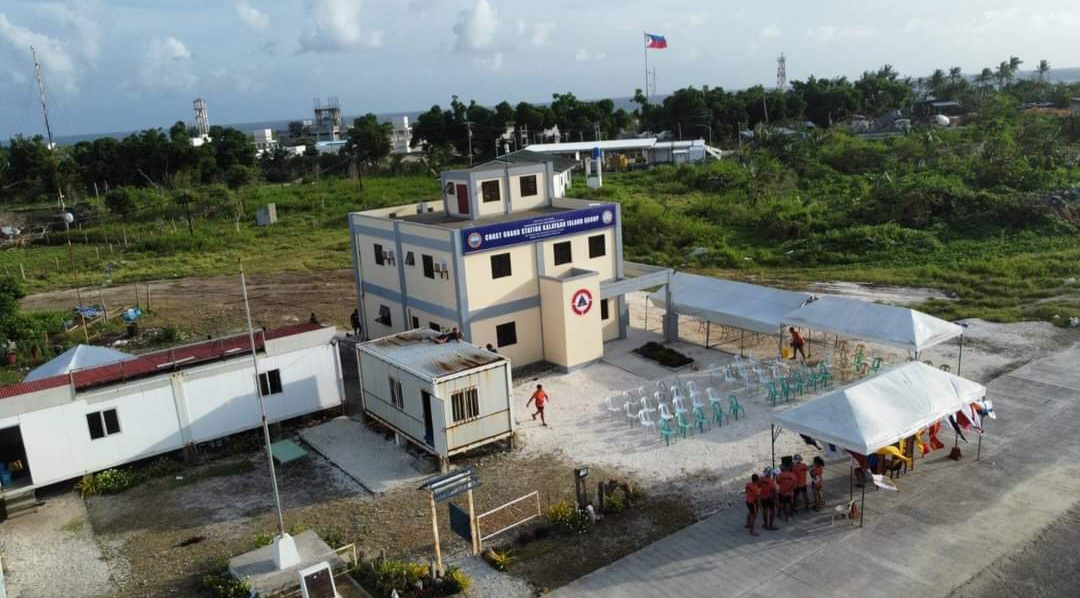
BEACON OF STRATEGIC IMPORTANCE Mr. Powell said the PCG station on Pag-Asa Island that was inaugurated in early December is an “excellent example” of the kind of infrastructure that will help the Philippines fully establish its presence in the South China Sea.
The Philippine Coast Guard inaugurates its three-story Kalayaan station on Pag-Asa Island on Dec. 1, 2023. — PHILIPPINE COAST GUARD FACEBOOK PAGE
“The Philippines should make its surveillance and monitoring of China’s ships there public on a continuous basis,” he said, adding that if China wants to keep stationing its coast guard and militia ships so close to Thitu Island, “let them be subject to international scrutiny.”
Among all Philippine-occupied features in the Spratly islands, or the Kalayaan Island Group, Pag-Asa is the only one inhabited by Filipino civilians and has the most number of facilities and structures. The Philippine government formally established the municipality of Kalayaan on the 37.2-hectare island in 1978, through a presidential decree of Mr. Marcos’ late father.
China has been claiming ownership over Pag-Asa, calling out the Philippines for “illegally occupying” it.
“In the vast expanse of the West Philippine Sea, Pagasa Island stands as a beacon of strategic importance and potential prosperity,” said Joshua Bernard B. Espeña, a fellow at the International Development and Security Cooperation. He noted that the island is key to fostering “inter-island trade and tourism” within the Philippine EEZ.
At present, the island has a landing ramp, a dual use military and civilian airstrip, a lighthouse, a lying-in clinic, a communication tower powered by Smart, and a small school for basic education.
It is also home to the only marine research center of the Philippines in the South China Sea, which the government wants to upgrade with a mini-museum.
The government should also develop a multifunctional Western Command outpost on Pagasa Island, which would serve as both a military stronghold and an evacuation facility during national calamities, Mr. Espeña said.
“It should boast state-of-the-art command-and-control facilities, a protected cyber network, and coastal defense systems,” he added. “Operational security is a paramount concern, considering potential cyber-electronic warfare attacks or espionage.”
The vision for Pag-Asa Island as a logistic hub for the military and the coast guard and as a thriving fishing community should also be applied to other Philippine-occupied islands in the Spratlys, such as Likas Island, Parola Island, Lawak Island, Kota Island, Panata Island, and Patag Island, said Mr. Espeña.
These islands should have command-and-control facilities equipped with radar and jammers, coastal air defense and anti-ship missile batteries, as well as berthing and docking areas for ship replenishment, crew rest, and maintenance.
They should also cater to the replenishment needs of Filipino fishermen, Mr. Espeña said, citing previous plans to establish an express fisher’s hub on each island.
CIVILIAN LIFE Above all, Mr. Manhit said Philippine features in the South China Sea should contribute to the national economy and cater to the needs of Filipino civilians, including fishermen.
“We see this in the efforts of the local government in organizing tourist activities such as The Great Kalayaan Expedition, the marine science research activities, and the regular ferry service for Kalayaan residents,” he said.
A modernized West Philippine Sea should make life on Pag-Asa Island “more comfortable for the residents,” he said, noting that a robust internet connection is also needed by the residents. “There should be enough teachers, and hospital workers as well as facilities for basic welfare services,” said Mr. Manhit. “A modernized West Philippine Sea should also include robust economic activities, which include fishing and other livelihood activities.”
Aside from Pag-Asa Island, other features held by the Philippines should also be sites for regular tourism activities and marine science research activities, he said.
The Pag-Asa research station of the University of the Philippines Marine Science Institute. — UP-MSI WEBSITE
“Eco-tourism represents yet another innovative way to raise the international profile of this issue outside of the security realm and make it harder for Beijing to hide its aggression,” Mr. Powell said.
A sooty tern protecting its egg on Lawak Island in Kalayaan Municipality. — PALAWAN COUNCIL SUSTAINABLE DEVELOPMENT
On the economic front, there are pending bills in Congress seeking to designate some Philippine features in the South China Sea, including the Pag-asa Island, as an ecotourism destination and protected area. Earlier this year, Speaker Martin G. Romualdez said the Kalayaan town could be a key tourist destination comparable to the Maldives.
The municipal government of Kalayaan has been offering week-long tours, including the Pag-Asa Summer Tour (in May 2024 and May 2025), which allows travelers to stay in the main island and participate in its festival, and The Great Kalayaan Expedition, where tourists take part in various activities such as diving, bird watching, and fishing, among others, with tours slated for March, April, and May of 2024 and 2025.
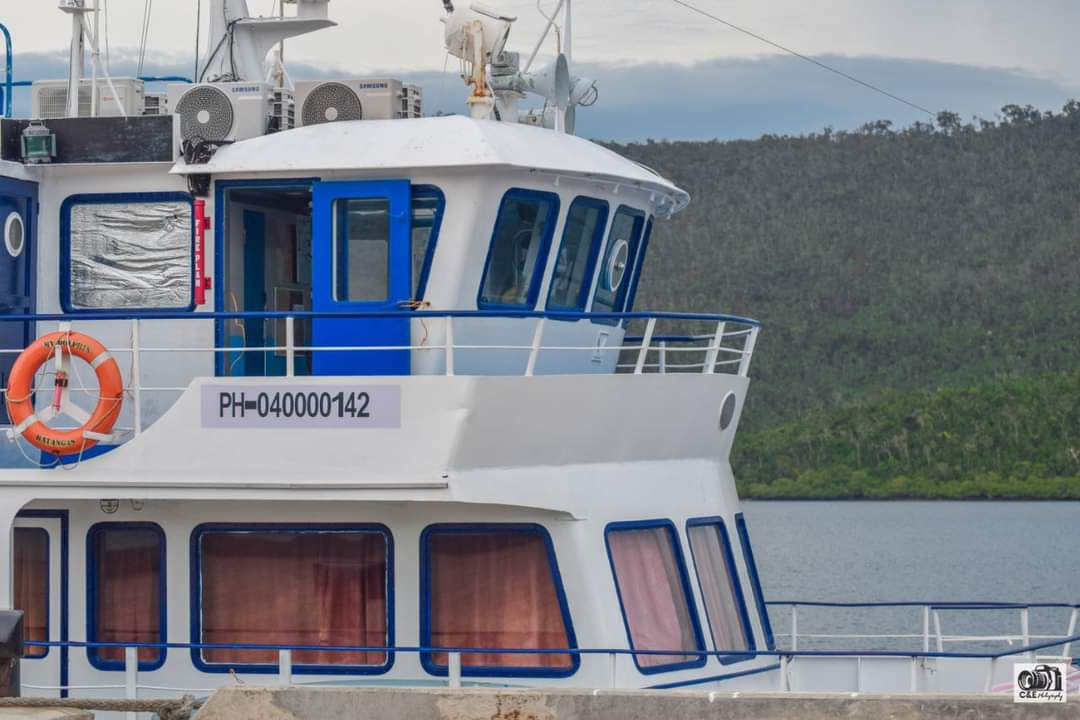
Twenty tourists boarded a yacht at Ulungan Bay, Palawan for a seven-day trip to the islands of Lawak, Likas, and Pag-Asa in June, 2023. — PHOTO C&E PHOTOGRAPHY AS SHARED BY THE MUNICIPAL GOVERNMENT OF KALAYAAN ON FACEBOOK
PUBLIC-PRIVATE COOPERATION There are also calls for the government to allow gas and oil exploration activities in the waterway, as the Philippines faces an energy crisis that could heavily impact the national economy.
Experts said pushing for a modernization agenda within the Philippine EEZ requires cooperation between the national government and the private sector at the national level.
“Encouraging private sector investment in strategic areas identified by the government is essential. This involves not only providing materials for development, traded goods, and essential services but also addressing critical military logistics to ensure effective sea control,” Mr. Espeña said.
As the maritime security domain expands to include cyber warfare, the private sector may offer its expertise on emerging technologies to detect, mitigate, and respond to cyber threats, Mr. Manhit said. “Tapping the private sector’s expertise and resources will enable the Philippines to boost its technological capacity to address the myriad of security threats in the West Philippine Sea,” he told BusinessWorld in an email.
Don McLain Gill, who teaches international relations at De La Salle University, said China’s “expansionist behavior” in the disputed waters may make it difficult to convince potential investors to pursue infrastructure projects.
“China may create both physical and economic obstacles for companies to effectively carry out their projects in the West Philippine Sea largely due to logistical challenges,” he said in a Facebook Messenger chat.
“Therefore, motivating the private sector to play an active role in shaping our interests in the West Philippine Sea is crucial, and it will be equally important to create the basic conditions for maximizing such projects,” Mr. Gill added.
Gregory B. Poling, director of the Asia Maritime Transparency Initiative at the US-based Center for Strategic and International Studies, said legal hurdles may prevent foreign companies from actively participating in the Philippines’ modernization agenda for the South China Sea.
“The private sector could also play a key role here, though it will likely be Filipino rather than foreign companies that do most investments due to both legal hurdles and potential business risks,” he said.
“No foreign governments take a position on sovereignty over disputed islands like Pag-asa, though they do recognize Philippine rights to its own waters, including at Second Thomas Shoal,” Mr. Poling said in an e-mail.
Meanwhile, Mr. Powell believes Manila should recognize that many of its foreign partners will be hesitant to openly side with the Philippines regarding specific island claims.
“China is not the only country with overlapping South China Sea claims,” he said, citing Vietnam and Taiwan, which both lay claim to many Philippine-held features.
But even so, a joint Philippines-U.S. military civic action mission to Thitu Island is necessary “to demonstrate US commitment to its ally,” said Mr. Powell.
Mr. Espeña said the Philippine government needs to clearly communicate its defense needs to foreign partners. “These may include specifics such as munitions for air defense, coastal anti-ship missile systems, the development of hangars, sophisticated command-and-control infrastructure, and patrol rafts, among others,” he said.
China is expected to consistently exert influence and pose a significant challenge to any efforts by the Philippines to modernize its assets and assert its claims, said Mr. Espeña.
“Specifically, China is anticipated to escalate its divide-and-conquer disinformation tactics in the Philippines,” he said. “This will likely be accompanied by economic promises to create confusion and disrupt momentum.”
Chinese ships would likely intensify their operations against Philippine vessels, “intending to wear down Filipinos both materially and psychologically,” he added.
But Mr. Manhit upheld that the Philippines is on the right side of history, citing a 2016 arbitral ruling that invalidated China’s expansive claims.
“We have the support of the international community as well as a legal basis for our presence and actions,” he said.
A BILL seeking to exempt motorists from paying the toll on connecting highways during regular holidays has been filed before the House of Representatives, citing how it would help “ensure smooth travel.”
“This bill proposes to exempt all vehicles on regular holidays from the payment of toll fees under such procedures and circumstances,” Quezon City Rep. Marvin C. Rillo said in the explanatory note of House Bill No. 9661.
Regular holidays have a fixed date like Christmas Day, New Year’s Day, and Independence Day, including holidays like Holy Thursday, Good Friday, Eid’l Fitr, Eidul Adha, and National Heroes Day.
Mr. Rillo said the measure would help avoid traffic congestion and financial losses, especially when traveling.
Citing a Boston Consulting Group study conducted in 2017, Mr. Rillo said motorists and commuters spend an average of 66 minutes in daily traffic in Metro Manila, leading to a projected daily loss of P3.5 billion due to congestion.
Metro Manila was ranked the ninth worst congested city out of 389 cities in the TomTom Traffic Index 2022.
It took an average of 27 minutes for Filipinos to travel 10 kilometers in the capital region last year, according to TomTom.
On Dec. 7, NLEX Corp., a unit of Metro Pacific Tollways Corp. (MPTC), sought an increase in the toll after the completion of the Magsaysay Interchange.
NLEX Corp. maintains the current discounted rate of P86 for the NLEX Connector, but once approved, the fee will increase to P120.
The Toll Regulatory Board (TRB) in July approved to increase the toll at the Subic-Clark-Tarlac Expressway (SCTEX).
The toll for class 1 vehicles or cars and jeepneys is at P4.62 per kilometer, P9.32 per kilometer for class 2 vehicles or trucks and buses, and class 3 vehicles would have to pay P13.85 per kilometer for class 3 vehicles or trucks with three or more axles. — Beatriz Marie D. Cruz
THE BUREAU of Customs (BoC) has seized P56 million worth of “shabu” and arrested the claimant in Cavite.
The agency said that it seized 8,126 grams of the illegal and addictive substance in a joint operation with the Philippine Drug Enforcement Agency (PDEA).
“Physical examination resulted in the discovery of eight brown heat-sealed plastics containing the illegal substance declared as ‘dry food’ which arrived on Dec. 17, from California, USA,” it said.
Laboratory analysis showed that the substance was methamphetamine hydrochloride or “shabu.”
The BoC and PDEA also arrested the consignee in Cavite on Dec. 19. — Luisa Maria Jacinta C. Jocson
THE DAVAO City waste-to-energy (WTE) project is gaining momentum with the formation of a crucial Technical Working Group (TWG), a city council member revealed over the weekend.
Councilor Temujin “Tek” Ocampo, who heads the City Council’s Committee on Environment and Natural Resources, said the TWG is led by the Department of Environment and Natural Resources (DENR), in collaboration with the Davao city government and the City Environment and Natural Resources Office (CENRO).
Based on its design, the WTE plant has a capacity of 600 metric tons and the ability to generate up to 12 megawatts of energy.
Mr. Ocampo cited the potential benefits of the proposed project, which draws inspiration from the success of the TWE plant in Kitakyushu City in Japan.
It integrated stringent pollution control, waste segregation, proper disposal, and early-age education in its operation and is now a benchmark for environmentalists.
Mr. Ocampo expressed hope that more than just waste reduction, the proposed WTE could contribute to Davao City’s energy needs.
Davao City, with a population of 1.6 million, generates a daily average of 600 to 650 tons of garbage, as per data from the CENRO. The existing challenge lies in the accumulation of waste at the city’s sanitary landfill in Barangay New Carmen, Tugbok District.
Since 2016, the landfill has surpassed its full capacity, accumulating 900,000 tons against the intended 700,000 to 800,000 tons.
As Davao City grapples with the mounting waste crisis, the TWG’s formation signifies a crucial step toward the implementation of a sustainable solution.
With Kitakyushu as a guiding example, Mr. Ocampo envisions Davao City adopting effective waste management practices, fostering a cleaner environment and contributing to the city’s energy sustainability through the WTE project.
“Although, based on the data and all of the best practices that are being done in Kitakyushu, Japan there are no negative effects on human health. Japan strictly monitors the emission of toxins such as dioxin,” he said. — Maya M. Padillo
BAGUIO CITY — Despite the government’s renewed effort to negotiate peace with Maoist rebels, the Communist Party of the Philippines (CPP), commemorating its 55th anniversary, reaffirmed on Tuesday its commitment to armed revolution.
In the 18-page statement it released, the CPP’s Central Committee outlined its worldview, member tasks, and directives for its armed wing, the New People’s Army (NPA).
It said that part of its agenda for 2024 is focusing on exposing and opposing the Philippine government’s economic policies promoted by what it referred to as United States imperialism.
The statement also mentioned directives to the NPA to strengthen, recover from losses, and rebuild its mass base. In addition, it was directed to “acquire weapons for Red fighters by seizing these from the enemy through tactical offensives or by other means.”
Politically, the CPP Central Committee urged its cadres to “take advantage of the splits within the ruling Marcos and Duterte cliques, by pushing the demand for accounting and punishment of Duterte and his cohorts for the crimes they perpetrated during their time in power.”
However, the CPP advocates for the National Democratic Front of the Philippines’ representation in peace negotiations, opposing schemes of capitulation.
Still, the CPP pledged to strengthen fraternal communist relations and wage active ideological struggles against revisionist currents, such as Trotskyism and Gonzaloism. — Artemio A. Dumlao
TNT is pinning its PBA Commissioner’s Cup playoffs aspirations on another RHJ — Rahlir Hollis-Jefferson.
Rahlir is tasked to finish what his brother Rondae started and bring the TNT Tropang Giga (4-5) to the quarterfinals of the season-opening conference.
Rondae sustained a neck injury in TNT’s 80-69 win over Taipei Fubon Braves in the East Asia Super League (EASL) on Nov. 20, forcing him to miss the Tropang Giga’s Christmas Day duel with Ginebra, which they lost, 78-86.
The 6-foot-6 Rahlir, who originally came in as Rondae’s partner in the EASL, is set to plunge into PBA action when the Tropang Giga resume their drive against Rain or Shine (ROS) on Jan. 5 and Phoenix nine days later.
“Si Rahlir na iyun sa Jan. 5,” TNT team manager and interim coach Jojo Lastimosa said.
Currently sharing seventh and eighth with the Elasto Painters, the Tropang Giga need to beat ROS and Phoenix to gain a trouble-free passage into the Last-8.
Rahlir’s activation, meanwhile, will effectively render Rondae ineligible for the rest of the Commissioner’s Cup even if he obtains medical clearance along the way. Per PBA rules, an original import may be reactivated only once from the injured list.
Rondae was on the injured roster (gastroenteritis) when TNT played its first game and returned to active duty for the second assignment, playing seven matches before getting sidelined anew.
Mr. Lastimosa stressed Rondae’s health is paramount.
“You don’t take those kinds of injuries lightly. Even if feeling niya wala nang pain if he turns (his neck), it’s a physical game; if it gets jarred again, he could re-injure that. So we’re going to be conservative and protect Rondae’s career,” he said. — Olmin Leyba
INJURED Adamson star Jerom Lastimosa emerged from knee surgery after his second-round injury ended his stellar University Athletic Association of the Philippines (UAAP) career.
In his social media his first public post since Adamson’s exit in the UAAP Season 86, Lastimosa thanked supporters following the end of his five-year run with the Falcons.
“Maraming salamat sa limang taon, Adamson. Coaches, bosses, klasmeyts, at sa buong UAAP community, walang Jerom Lastimosa kung wala kayo,” he said.
Mr. Lastimosa suffered a torn ACL late in the second round of the eliminations in November but delayed his surgery to be with the team until their last game. He played in the dying seconds of Adamson’s 70-48 loss to Ateneo in a knockout playoff, missing the Final Four.
The Dumaguete native was sen in by head coach Nash Racela in the final moments, thus capping his career with a three at the buzzer, much to the delight of both the Falcon and Blue Eagle fans. He only went under the knife this month, signaling the start of his long recovery before turns pro.
“JL7 signing off,” he said in his post.
Mr. Lastimosa’s Falcon highlights included a heroic performance in Season 85 after an 80-76 win over La Salle in a knockout duel.
His exploits in the UAAP also paved the way for his Gilas Pilipinas debut in the Southeast Asian Games in Cambodia, where he played a pivotal part as the Nationals completed redemption for the gold medal. — John Bryan Ulanday
LAMAR Jackson threw for 252 yards and two third-quarter touchdowns while the Baltimore Ravens intercepted San Francisco 49ers quarterback Brock Purdy four times in a 33-19 win Monday night in Santa Clara, California.
Baltimore (12-3) entered as a 6 1/2-point underdog in a matchup of the top teams in their conferences, and the visitors overcame a slow start.
Mr. Jackson decisively outplayed Purdy in a matchup of the quarterbacks considered by many to be the top candidates for Most Valuable Player.
Mr. Jackson, who completed 23 of 35 passes, turned a four-point game at the half into a rout with scoring strikes of 6 and 9 yards to Nelson Agholor and Zay Flowers, respectively, in an 18-second span early in the third.
His touchdown pass to Mr. Flowers came on the first play after Patrick Queen logged the Ravens’ fourth pick of Purdy and returned it 21 yards to the San Francisco 9-yard line.
Ravens kicker Justin Tucker added a 24-yard field goal, his fourth of the game, later in the period.
The result means Baltimore can clinch the AFC North and the top seed in the conference Sunday with a home win over the AFC East-leading Miami Dolphins.
Mr. Purdy hit on 18 of 32 attempts for 255 yards before leaving during a fourth-quarter touchdown drive with a stinger in his neck.
Sam Darnold replaced him and finished the drive with a 12-yard strike to Ronnie Bell but later tossed the team’s fifth interception of the night.
Christian McCaffrey rushed for 103 yards and a touchdown on 14 carries, but it wasn’t enough to prevent San Francisco from falling to 11-4.
But the 49ers can still claim the No. 1 seed for the NFC playoffs by beating the Washington Commanders and the Los Angeles Rams in their last two games.
San Francisco took a 5-0 first-quarter lead when Mr. Jackson was flagged for intentional grounding in the end zone and Jake Moody subsequently kicked a 45-yard field goal.
The Ravens responded with three field goals by Mr. Tucker and a 1-yard touchdown run by Gus Edwards, enabling them to take a 16-12 advantage into halftime. — Field Level Media