Home Blog Page 3735

ICC arrest warrants may take time — human rights lawyers

PHILSTAR FILE PHOTO

IT WOULD probably take time for the International Criminal Court (ICC) to issue arrest warrants against Philippine state officials connected to President Rodrigo R. Duterte’s deadly drug war, according to human rights lawyers.

“We expect warrants to be issued, but we will not pressure the ICC within timelines,” Maria Kristina C. Conti, National Union of Peoples’ Lawyers (NUPL) National Capital Region secretary general who lawyers for several victims of the drug war, said in an e-mail.

“We are well aware of the quantum of evidence necessary to proceed with the formal trial and we prefer investigators to focus on the quality of information,” she added.

On Jan. 23, Philippine President Ferdinand R. Marcos, Jr. said ICC investigators would be allowed to come to the Philippines as “ordinary people,” but his government would not help in the probe.

“The Philippine government will not lift a finger to help any investigation that the ICC conducts,” he told reporters.

The Department of Justice said last week said the international tribunal had yet to inform them of its investigators’ visit, adding that the government is not legally bound to cooperate with the investigation.

In an X message to BusinessWorld on Jan. 24, iDefend human rights group said it has been submitting evidence to the ICC since it reopened its probe in January.

“iDefend hopes to participate in any way at the trial stage through the victims’ participation processes with our potential legal counsel,” it said.

The group reiterated that cooperating with the ICC would not violate Philippine sovereignty, adding that it would affirm the country’s commitment to prevent human rights abuses.

In January last year, the ICC pre-trial chamber resumed its investigation into killings and so-called crimes against humanity under former Mr. Duterte’s drug war, saying it was not satisfied with Philippine efforts to probe the deaths.

Philippine Solicitor General Menardo I. Guevarra in July said Philippine officials who could face arrest would likely hire their own defense lawyers. The solicitor general would only represent the state at the ICC hearings, he added.

In November, Mr. Marcos said the government was considering rejoining the ICC. He had ruled out cooperation, saying the probe violates Philippine sovereignty given the country’s fully functioning justice system.

Mr. Duterte canceled Philippine membership in the ICC in 2018 amid criticisms that his government had systematically murdered drug suspects in police raids. It took effect a year later.

The tribunal, which tries people charged with crimes against humanity, genocide, war crimes and aggression, was also set to probe vigilante-style killings in Davao City when he was still its vice mayor and mayor.

“President Marcos should rethink his position and listen to the clamor for investigation from the victims and the public,” NUPL Secretary-General Josalee S. Deinla said in a Viber message. “Under the Rome Statute, states that were once parties to ICC continue to have an obligation to cooperate with investigations initiated prior to their withdrawal.”

The United Nations Human Rights Committee has said the Philippines should comply with international human rights mechanisms and cooperate with the ICC’s drug war probe.

The Philippine government estimates that at least 6,117 drug dealers were killed in police operations. Human rights groups say as many as 30,000 drug suspects died. — John Victor D. Ordoñez


10 agroforestry projects in Iloilo to push dev’t, help environment

FIRST Secretary and Agriculture Attaché Tachikawa Jumpei of the Japanese Embassy in Manila attends the official turnover of the completed agroforestry support facilities under the Forestland Management Project in Calinog, Iloilo. —EMBASSY OF JAPAN IN THE PHILIPPINES

By Adrian H. Halili Reporter

THE DEPARTMENT of Environment and Natural Resources (DENR), in partnership with the Japan International Cooperation Agency (JICA), has completed and turned over 10 agroforestry infrastructure projects seen to boost development and help protect the environment in Iloilo province.

“These facilities include irrigation pipeline systems, access roads, pathways, and bridges which aim to connect communities to markets, boost their access to social services and help sustain community-based forestry initiatives,” the Embassy of Japan in Manila said in a statement on Monday.

It added that a coffee processing facility was also constructed in the municipality of Janiuay to further develop the local coffee industry and boost the livelihoods of farmers in the area.

First Secretary and Agriculture Attaché Jumpei Tachikawa of the Embassy of Japan said that the projects would help efforts to “improve livelihoods and sustained flow of development in the municipalities, creating a positive ripple effect in neighboring communities.”

Funded through the P1.8-billion cooperation project targeted at building or rehabilitating agroforestry support facilities under the management of the Forestland Management Project (FMP), the projects are also seen to contribute environment protection and mitigate climate change.

“The FMP seeks to protect 71,300 hectares of forests in the country’s watershed areas Upper Magat and Cagayan River Basins, Pampanga River Basin, and the Jalaur River Basin, covering the provinces of Ifugao, Nueva Vizcaya, Quirino, Nueva Ecija, and Iloilo,” said the embassy.

“Launched 10 years ago, the FMP highlighted environmental protection including forestland management as one of the major pillars of collaboration between the Philippines and Japan,” it added.

No reef ‘arrangement’ with China

THE PHILIPPINES denied on Monday that China had a “temporary special arrangement” with Manila to allow the delivery of supplies to Philippine troops occupying a disputed South China Sea reef, calling it “a figment of imagination.”

The Chinese Coast Guard said on Saturday it had temporarily allowed the Philippines to provide food and water to soldiers stationed at the BRP Sierra Madre, a vessel grounded in 1999 at the Second Thomas Shoal, 190 km off Palawan, to assert Manila’s territorial claims.

“This is a figment of the imagination of the Chinese Coast Guard. There is no truth to this,” National Security Council spokesperson Jonathan Malaya told state-run broadcaster PTV-4.

The Chinese Coast Guard said the Philippines air-dropped supplies to the navy vessel on Jan. 21. Mr. Malaya did not confirm nor deny the airdrop but said supplying troops was his country’s right.

“We do not need to get the permission of anyone, including the Chinese coastguard, when we bring supplies through whatever means, whether by ship or air,” Mr. Malaya said.

The Philippines’ occupation of the shoal has irked Beijing and has been a flashpoint in recent disputes between them, which have intensified under President Ferdinand R. Marcos Jr., who has sought stronger ties with the US military.

China claims almost the entire South China Sea, a conduit for more than $3 trillion (about P1.69 trillion) in annual ship commerce. Its territorial claims overlap with the exclusive economic zones of the Philippines, Vietnam, Indonesia, Malaysia and Brunei, some of which have competing claims to various islands and reefs.

In 2016, the Permanent Court of Arbitration in the Hague said China’s claims had no legal basis, a decision Beijing has rejected.

Last weekend, top officials of the Northern Luzon Command (NOLCOM) inspected its two farthest naval detachments — the ones on Basco and Mavulis islands in the Batanes Group of Islands — to ensure their readiness to respond to any territorial defense situation in the northernmost tip of the country.

Lt. Gen. Fernyl G. Buca led the inspection, along with other Nolcom officials and Baliktatan 39-2024 planners with the aim of reviewing operational procedures to strengthen the defense posture in the Nolcom’s Joint Operational Area.

The two naval detachments are responsible for securing and controlling the Luzon Strait, which includes the Balintang and Bashi Channels. Major Al Pueblas, commander of Nolcom’s Civil Relations Group (CRG), stressed the Batanes area’s strategic importance as a chokepoint for naval and air traffic, influencing forces for strategic advantage.

In October last year, officials inaugurated the Naval Detachment in Mavulis Island which bolsters the Philippines’ defense and strategic security capabilities in Northern Luzon. It plays a pivotal role in safeguarding Philippine territory, sovereignty, and sovereign rights to protect maritime borders and interests.

Mr. Buca cited the dedication of the 14-man team from the Philippine Navy (Marines) and Civilian Active Auxiliary deployed at the detachment. In turn, Marine Sergeant Harley Calicaran expressed gratitude for their commanders’ visit which has boosted their morale.

The weekend visit also demonstrates the Nolcom’s commitment to national defense and security, part of the transitional phase toward territorial defense operations and a site inspection for the upcoming Balikatan Exercises 39–24, the largest bilateral military exercise with the United States military. — Reuters with a report from Artemio A. Dumlao

Changes to education bill OK’d

A HOUSE committee ironed out some provisions of a bill proposing optional senior high school education in the country to include a requirement for students to undergo an assessment exam that would determine their fitness for higher learning, a lawmaker said on Monday.

Pasig Rep. Roman T. Romulo, chair of the House Committee on Basic Education, said the proposed measure would require a diagnostic exam to be given to Grades 3, 6, 10, and 12 learners to assess “age-appropriate” reading comprehension and mathematics knowledge.

Under House Bill No. 7893, the Department of Education (DepEd) would oblige a student to take “special classes” if their assessment exam performance points to a “deficiency.”

The bill seeks to amend Republic Act No. 10533 (Enhanced Basic Education Act of 2013), which implemented the Kindergarten to Grade 12 or K-to-12 program.

Lawmakers and stakeholders have deemed it ineffective in producing job-ready and college-ready graduates. “All surveys show that neither was fulfilled. Most surveys of even industry players have said that still they prefer an individual who has gone to college rather than one who has finished K-to-12,” said Mr. Romulo.

The measure also mandates that Grade 10 learners must take up Grades 11 and 12 if they seek to enroll in a university course. Otherwise, they may choose a technical-vocational (techvoc) education track for a more skills-based training.

“The curriculum will be industry-driven,” Mr. Romulo said, referring to the techvoc track to be handled by the Technical Education and Skills Development Authority (TESDA). “It will really be mostly skills training outside with the industry concerned.” — Beatriz Marie D. Cruz

Metro water allocation stable

THE NATIONAL Water Resources Board (NWRB) has approved maintaining Metro Manila’s water allocation at 50 cubic meters per second (cms) for February, ensuring sufficient water supply.

Patrick James B. Dizon of the Metropolitan Waterworks and Sewerage System (MWSS) Angat/Ipo Operations Management Division said the decision was reached during the NWRB meeting last Jan. 26 after the MWSS was granted its request for a reservoir elevation of 240 meters by yearend, based on the Angat Technical Working Group’s projection.

“So, we have a sufficient amount of water or additional buffer for the summer,” Mr. Dizon said.

“The water releases shall be subjected to daily monitoring and assessment to determine if there is a need to modify, reduce or terminate the releases.”

He added that based on their projection, the water elevation will not drop to 180 meters by May.

Angat Dam is the primary water source for Metro Manila, providing approximately 90% of the capital’s potable water.

In a separate development on Monday, Manila Water Co., Inc. expressed openness to continue its partnership with the Pangasinan provincial government after the termination of a 25-year bulk water supply deal.

In an emailed statement, the east-zone concessionaire said that Manila Water Philippine Ventures (MWPV) has reached out to the province to explore the revival of their terminated concession agreement.

“This presents an opportunity to revisit the conditions precedent of the old contract and renew partnership for the benefit of Pangasinenses,” it said.

The terminated agreement, with a capital expenditure of about P8 billion, aimed to supply Pangasinan with an additional 200 million liters per day. — Sheldeen Joy Talavera

P53M released for medical needs

OFFICIALS of the Bangsamoro social services ministry inspect the emergency bags filled with basic life-saving supplies for distribution to poor families in Maguindanao del Norte. —THE PHILIPPINE STAR/JOHN FELIX M. UNSON

COTABATO CITY — The Bangsamoro region’s social welfare ministry has disbursed a total of P53.2 million in separate allocations for humanitarian projects benefitting the poor, of which P40 million was released last December to a local branch of Mercury Drug.

Social Services and Development Minister Raisa H. Jajurie said the advance payment is intended for medicines prescribed by physicians in both private and government medical facilities catering to the needs of marginalized residents.

The Ministry of Social Services and Development in the Bangsamoro Autonomous Region in Muslim Mindanao also allocated P10 million to the Cotabato Regional Medical Center to cover the medical bills of poor patients.

In addition, an orphanage operated by the Turkish non-government organization Insani Yardim Vakfi received P1.9 million for the provision of food and necessities for orphans in its care. The Matanog Orphanage Center and the Ribat Islamic Center Orphanage also obtained grants of P480,000 and P468,000, respectively.

Finally, the MSSD-BARMM earmarked P300,000 for the Glang Eye Care Clinic, which focuses on treating elderly eye patients and supplying reading glasses to residents in Bangsamoro towns. — John Felix M. Unson

Philmech disburses farm equipment, coconut facility funding

THE Philippine Center for Postharvest Development and Mechanization (PhilMech) has allocated a total of P82.97 million to fund the disbursement of farming equipment and the construction of a processing facility.

In a statement, PhilMech said that it had granted P36.27 million worth of farming machineries to farmers from Zambales. It had also funded a P46.7-million coconut processing facility in Misamis Oriental.

The agency said that 20 units of hand tractors, six units of four-wheel tractors, six units of rice combine harvesters, four units of riding type transplanter, two units of precision seeder, and one unit of single pass rice mill were handed to 26 farmers cooperatives and local government units in Zambales.

To date, Zambales has received 303 units of various agricultural machinery and postharvest facilities already, amounting to P232.14 million.

Additionally, PhilMech said that an integrated white copra and coconut oil processing facility in Misamis Oriental. This was funded by the Coconut Farmers and Industry Development Program (CFIDP).

The facility is aimed at benefiting over 200 coconut farmer-beneficiaries in the area. —  Adrian H. Halili

Thai economy in recession, needs a boost — official

A view of traffic during sunrise in Bangkok, Thailand, Jan. 5, 2024. _ REUTERS

BANGKOK — Thailand’s economy is in a state of recession owing to a high level of household debt, a deputy finance minister said on Monday, raising pressure on the central bank to cut interest rates.

Deputy Finance Minister Julapun Amornvivat also said the government was committed to delivering on its signature 500 billion baht ($14 billion) handout plan of transferring 10,000 baht ($281) each to 50 million Thais, and hoped a delay in its rollout would not be long.

He said the country’s policy interest rate, which is at a decade-high of 2.50%, should be cut at the central bank’s next policy review on Feb. 7 to help lower high borrowing costs.

“The rate should be lowered as high rates now are people’s burden. People can’t survive,” he told reporters.

Prime Minister Srettha Thavisin has also urged the central bank to cut the key rate to help Southeast Asia’s second-largest economy he says is in crisis.

Bank of Thailand Governor Sethaput Suthiwartnarueput, who has come under fire from the premier for not cutting rates despite negative inflation, told Reuters last week growth had been slower than expected but the economy was not in crisis.

Mr. Sethaput said the current policy rate was “broadly neutral.”

The central bank left its policy rate unchanged at 2.50% at its last rate meeting in November, having raised it by 200 basis points since August 2022 to curb inflation.

The government last week slashed its 2024 growth projections for Southeast Asia’s second-largest economy to 2.8% from an earlier forecast of 3.2% on weaker exports and lower foreign tourist numbers.

It also lowered the 2023 growth estimate to 1.8% from 2.7%, below 2022’s 2.6% growth. Official 2023 gross domestic product (GDP) is due to be released by the planning agency on Feb. 19.

“If you ask, now it’s at the dangerous level. It’s a kind of economic recession,” Mr. Julapun said, adding the situation was driven by the high debt burden of households and the private sector.

“It’s difficult to drive the economy forward. That’s why we’ve seen economic growth that has always been sluggish.”

Mr. Julapun also said Thailand is planning to issue bonds overseas in the next one or two years in dollar, yuan and yen to create benchmarks for businesses to raise funds.

He said there would be a sale of government savings bonds worth about 100 billion baht ($2.8 billion) in the 2024 fiscal year, with the first batch of 40 billion baht in March. —  Reuters

Global watchdog proposes new ethics code to help combat greenwashing

REUTERS

LONDON — Firms that check environmental, social and governance claims made by companies will be asked to follow a proposed new ethics code to help combat greenwashing, the chief of a global standards body told Reuters.

Trillions of dollars have flowed into investment funds touting green credentials, but these can be misleading, a practice known as greenwashing. As a result, companies are increasingly being asked to disclose more about their actions on climate change and other issues such as board diversity.

Companies in the European Union (EU) and globally from this year will have to use new, mandatory disclosures on ESG and climate-related factors in their annual reports for 2024 and onwards.

These disclosures will need checking by external auditors as a safeguard against greenwashing.

Gabriela Figueiredo Dias, chair of the International Ethics Standards Board for Accountants (IESBA), said it was proposing revisions and additions to its ethics standards for auditing sustainability information from companies.

The IESBA is an independent global body that sets ethics standards for business and other organizations.

The standards spell out best practice for verifying a company’s sustainability claims by offering detailed instructions in areas such as accounting for the impact of corporate actions on emissions, relying on outside experts, and identifying and tackling conflicts of interest.

“There is nothing more central to sustainable finance than the information that is provided to those who decide to invest or fund projects and businesses.”

Ms. Dias said the proposed standards, which will be open for public consultation until May, would complement the development of new technical assurance standards from the International Auditing and Assurance Standards Board.

“Ethics is the baseline for the whole infrastructure. If you think about… greenwashing and misinformation, (it) always has behavioral issues at its root and not technical reporting reasons.”

“It’s not because preparers and providers don’t know what they have to report and assure, it’s because there are ethical or independence issues such as conflicts of interest,” she said, for example, financial interests, pressure from client companies or their management, inducements or a lack of competence.

Global securities watchdog IOSCO has encouraged the moves by IESBA to update its standards as climate related disclosures under mandatory rules, rather than private sector guidance, are rolled out, making enforcement against greenwashing easier.

IOSCO board Chair Jean-Paul Servais said he welcomed IESBA’s action to call on issuers, investors and assurance providers to participate in the consultation.

“Trust in such disclosures will be enhanced when they receive external assurance based upon globally accepted standards regarding ethical behavior and independence.”

IESBA said the proposed new standards could also be used by firms other than professional accountants for auditing sustainability disclosures, such as consultants, engineers or lawyers, responsible for more than half of sustainability reports.

EU rules allow non-accounting firms to audit sustainability disclosures — which will be checked to a lower standard than financial statements — to provide competition for KPMG, EY, Deloitte and PwC, dubbed the Big Four who dominate corporate auditing. —  Reuters

Racial profiling allegations spark lawsuit against Japan police

A RICKSHAW DRIVER takes a souvenir photo for his clients at Asakusa district in Tokyo, Japan. — REUTERS

THREE MEN are suing the Japanese government, citing a pattern of racially motivated police harassment and asking for improved practices and about ¥3 million ($20,330) each in compensation.

The suit is unusual in Japan, a historically homogeneous place with little precedent for punishing racial discrimination. The plaintiffs — two permanent residents and one a foreign-born Japanese citizen — are seeking to show that disparate treatment based on race violates the constitution and international human rights agreements.

Plaintiffs say they have been repeatedly stopped for questioning by police for no apparent reason, and had their belongings searched, according to a summary of the case provided by lawyers. One, an African American who has lived in Japan for more than a decade and has a Japanese family, said he’d been stopped more than 15 times before he decided to join the suit. Another, a Pacific Islander, said he’d been questioned about 100 times.

“If police officers are allowed to discriminate, then it creates this image from the top to the citizens that discrimination is OK,” said Moe Miyashita, one of the lawyers for the plaintiffs. “On the other hand, if the police, the national government and other public organizations tell people that they can’t do this, it sends a strong message to the general public that discrimination is wrong.”

The suit names the Japanese government and the Tokyo Metropolitan and Aichi prefecture governments. All three declined to comment on the case. The National Police Agency did not immediately respond to questions about the suit.

The lawsuit adds to simmering questions about how Japan will manage the growing diversity of its population. To make up for its shrinking workforce, the country is increasingly reliant on immigrants. Foreign workers now number a record-high 2 million, according to the most recent government data.

Awareness of racism and racial profiling has been rising since a 2021 viral video showed a police officer admitting he’d searched a mixed-race man because “many people with dreadlocks carry drugs.” The US Embassy in Tokyo warned US citizens about racial profiling by Japanese police on their X account.

Japan’s constitution explicitly bans race-based discrimination, and the country is a signatory to the International Convention on the Elimination of All Forms of Racial Discrimination.

Nevertheless, a study by the Tokyo Bar Association showed that among 2,000 respondents of foreign background, over 60% said they had been questioned by police and about 77% of those questioned said there was no apparent reason other than the fact they appeared foreign.

“More people are starting to recognize that these issues are happening,” Miyashita said. “I think this is just the beginning.” — Bloomberg

First deadly strike against US forces since Gaza war started

PEOPLE take part in a protest on the day of the release of a video showing police officers beating Tyre Nichols, the young Black man who died three days after he was pulled over while driving during a traffic stop by Memphis police officers, in New York, US, Jan. 27, 2023. — REUTERS

THREE US service members were killed and at least 34 wounded in a drone attack by Iran-backed militants on US troops in Jordan, said US President Joseph R. Biden, the first deadly strike against US forces since the Israel-Hamas war erupted.

The attack, which Iran said it was not involved in, marks a major escalation in tensions that have engulfed the Middle East, amid concerns Israel’s war against Hamas militants could spread into a wider conflict involving Iran’s proxies in Lebanon, Yemen and Iraq.

“While we are still gathering the facts of this attack, we know it was carried out by radical Iran-backed militant groups operating in Syria and Iraq,” Mr. Biden said in a statement.

“Have no doubt — we will hold all those responsible to account at a time and in a manner of our choosing,” he said.

At least 34 personnel were injured in the Sunday attack in northeastern Jordan near the Syrian border, according to a statement from US Central Command.

Iran’s mission to the United Nations said in a statement on Monday that Tehran was not involved in the attack.

“Iran had no connection and had nothing to do with the attack on the US base,” the mission said in a statement published by the state news agency IRNA.

It added: “There is a conflict between US forces and resistance groups in the region, which reciprocate retaliatory attacks.”

The US military said the attack occurred at a base near the Syrian border. It did not name the base, but a person familiar with the matter identified it as Tower 22 in Jordan.

Tower 22 holds a strategically important location in Jordan, at the most northeastern point where the country’s borders meet Syria and Iraq. Little is publicly known about the base. But it includes logistics support and there are 350 US Army and Air Force troops at the base.

The conflict in Gaza began on Oct. 7 when Hamas fighters stormed border defenses to attack Israeli bases and towns, killing more than 1,200 people and seizing more than 200 hostages. More than 100 hostages remain captive.

Israel’s intense bombardment of Gaza since Oct. 7 has killed nearly 25,000 Palestinians, says health authorities in the Hamas-run enclave, and left millions homeless.

Missile attacks in Syria, Lebanon, Iraq and Yemen this month by Iran-backed militants has highlighted the increasing risk of a wider regional conflict pitting Iran and its allies against Israel and the US

While the United States has maintained an official line that Washington is not at war in the region, it has been retaliating against the Iran-backed groups in Iraq and Syria and carrying out strikes against Yemen’s Houthi military capabilities.

Yemen’s Iran-aligned Houthis have continued to attack shipping in the region, and on Monday said they had launched a rocket at US warship Lewis B. Puller as it sailed through the Gulf of Aden a day earlier.

GAPS IN HOSTAGE TALKS
Talks held on Sunday initiated by Qatar, the United States and Egypt to broker a hostage deal between Israel and Hamas were “constructive” but meaningful gaps remain, the Israeli prime minister’s office said.

“There are still significant gaps in which the parties will continue to discuss this week in additional mutual meetings,” Prime Minister Benjamin Netanyahu’s office said in a statement.

It said the talks took place in Europe, without giving a specific venue.

The World Court ordered Israel on Friday to prevent acts of genocide against the Palestinians and do more to help civilians, although it stopped short of ordering a ceasefire as requested by the plaintiff South Africa.

While the ruling denied Palestinian hopes of a binding order to halt the war in Gaza, it also represented a legal setback for Israel, which had hoped to throw out a case brought under the genocide convention established in the ashes of the Holocaust.

On the ground in Gaza, the heaviest fighting in weeks is now taking place in crowded areas jammed with hundreds of thousands of people who fled from earlier fighting elsewhere.

Israel kept up its bombardment of the main southern city of Khan Younis, reporting “intensive battles” and strikes on dozens of Hamas fighters and infrastructure from the air and ground.

Residents said Israeli forces blew up buildings and houses in the western part of the city as gun battles raged.

Palestinians say Israel has hampered efforts to rescue the dead and wounded as well as blockading hospitals, which Israel denies, blaming Hamas fighters for operating near them.

In a new setback for stricken Palestinians, the United States said it was pausing funding to the UN aid agency for Palestinian refugees (UNRWA) after Israel alleged that 12 UNRWA employees were involved in the Oct. 7 Hamas attack on Israel.

UNRWA said it was urgently investigating and “any UNRWA employee who was involved in acts of terror” would be held accountable. — Reuters

Pope says Africans are ‘special case’ when it comes to LGBT blessings

REUTERS

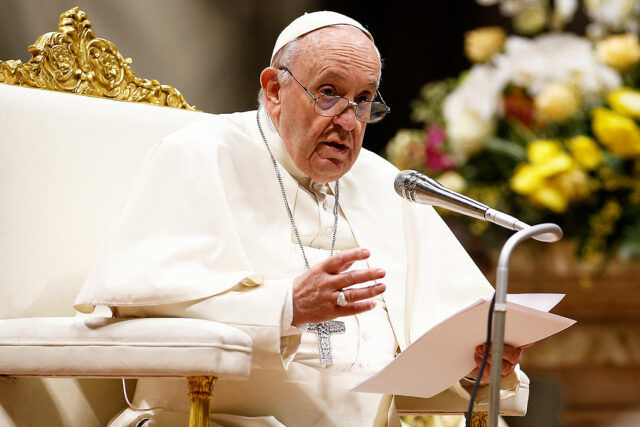
VATICAN CITY — Pope Francis said in an interview published on Monday he is confident critics of his decision to allow blessings for same-sex couples will eventually understand it, except for Africans who are “a special case.”

Blessings were allowed last month in a document called Fiducia Supplicans (Supplicating Trust), which has caused widespread debate in the Catholic Church, with particularly strong resistance coming from African bishops.

“Those who protest vehemently belong to small ideological groups,” Pope Francis told Italian newspaper La Stampa, adding: “A special case are Africans: for them homosexuality is something ‘bad’ from a cultural point of view, they don’t tolerate it.”

“But in general, I trust that gradually everyone will be reassured by the spirit of the ‘Fiducia Supplicans’ declaration by the Dicastery for the Doctrine of the Faith: it aims to include, not divide,” the pope continued.

Already last week, Pope Francis appeared to acknowledge the pushback the document unleashed, especially in Africa, where bishops have effectively rejected it and where in some countries same-sex activity can lead to prison or even the death penalty.

He said that when the blessings are given, priests should “naturally take into account the context, the sensitivities, the places where one lives and the most appropriate ways to do it”.

In the interview with La Stampa, Francis confirmed he is scheduled to welcome at the Vatican the president of his native Argentina, Javier Milei, on Feb. 11, and that finally visiting the country is a possibility.

He said his agenda for 2024 currently includes trips to Belgium, East Timor, Papua New Guinea and Indonesia.

Speaking about his health, which has taken some knocks in recent years with hospitalizations, mobility problems and cancelled trips or events, the 87-year-old said, “there are some aches and pains but it’s better now, I’m fine.” — Reuters