Home Blog Page 3701

Republican bid to impeach Biden border official fails in US House

https://pressgallery.house.gov/

WASHINGTON — The US House of Representatives delivered a blow to Republican Speaker Mike Johnson when it voted on Tuesday against impeaching Democratic President Joe Biden’s top border official.

In a 214-216 vote, the Republican-controlled House blocked a committee’s impeachment charges against Homeland Security Secretary Alejandro Mayorkas.

Four Republicans bucked their leadership, joining Democrats in opposing the charges against Mr. Mayorkas, a Cabinet member.

Partisan fighting over immigration has escalated ahead of the presidential election in November. After the failed impeachment vote, Republicans said they would try again.

“House Republicans fully intend to bring Articles of Impeachment against Secretary Mayorkas back to the floor when we have the votes for passage,” Raj Shah, Mr. Johnson’s spokesman, said in a tweet on X.

Department of Homeland Security spokesperson Mia Ehrenberg said in a statement that House Republicans should “abandon these political games” and instead “get DHS the (border) enforcement resources we need.”

Nevertheless, far-right House Republican rhetoric remained fiery. “Everyone who voted against impeaching Mayorkas owns everything that happens as a result of our wide open border – every rape, every murder, every drug overdose, everything,” said Representative Lauren Boebert in a social media post.

Republican Representative Mike Simpson predicted that his leaders would arrange a second vote on Mr. Mayorkas once House Majority Leader Steve Scalise, who has been receiving treatment for cancer, returns from sick leave.

Mr. Scalise’s office did not say when he plans to return to work.

Several Republicans, including Mr. Simpson, said the failed vote would have no bearing on their party’s investigations of Democratic President Joe Biden.

The senior Democrat on the House Homeland Security, Representative Bennie Thompson, said in an interview that the vote was indicative of Republicans “not understanding the gravity of what impeachment is all about.”

The House already was investigating whether any of Mr. Biden’s past behavior before moving into the White House might have constituted a high crime or misdemeanor. But even some Republicans have said they do not see such evidence yet.

Democrats view the effort as retribution for having twice led impeachments against Republican former President Donald Trump.

Earlier, Senate Republicans appeared to have killed a bipartisan border security deal.

The measure was an effort to solve the very border security problems that they wanted Secretary Mayorkas to stop, including record numbers of people entering the country illegally at the southern border with Mexico.

Mr. Biden, speaking at the White House, laid the blame on Mr. Trump, who is expected to face the president in a rematch in the November presidential election. “All indications are this bill won’t even move forward to the Senate floor. Why? The simple reason: Donald Trump. Because Donald Trump thinks it’s bad for him politically,” Mr. Biden said.

Republican senators have lined up against the $118 billion measure, which includes new military aid for Ukraine and Israel, prompting Senate Republican Leader Mitch McConnell to conclude that the effort would fail.

Some Republicans said the bill failed to effectively deal with the heavy flow of migrants at the border, with criticism beginning almost immediately after the complex bill was unveiled.

“It looks to me, and to most of our members, as if we have no real chance here to make a law,” Mr. McConnell said at a news conference.

Democratic Senate Majority Leader Chuck Schumer vowed to push ahead with plans for a Wednesday procedural vote on the bill, knowing it was unlikely to succeed.

Polls show that immigration has become a top concern for voters as Mr. Trump prepares for a likely November rematch with Mr. Biden.

Mr. Johnson has said that if the Senate passes it, the bill would be “dead on arrival” in the House.

IMPEACHMENT VOTE

The House Homeland Security Committee last week approved two articles of impeachment against Mr. Mayorkas, a near-unprecedented step to take against a member of a president’s cabinet over a policy dispute.

That had happened only once before in US history, in 1876 when a war secretary was impeached on charges of criminal misconduct.

Republican Representative Tom McClintock said the investigation into Secretary Mayorkas had failed to “identify an impeachable crime,” and fellow Republican Representative Ken Buck made a similar statement on Monday.

While Mr. McClintock during debate said, “Secretary Mayorkas is guilty of maladministration of our immigration laws on a cosmic scale,” he added that the Constitution does not intend impeachment to be used as a weapon in “political disputes.”

House Republicans allege that Mr. Mayorkas was intentionally lax in securing the long border with Mexico and violated the public trust by making false statements to Congress.

Around 2 million migrants were arrested by the US Border Patrol at the US-Mexico border in fiscal 2023.

Mr. Mayorkas has denied any wrongdoing and has defended his tenure.

Democratic Representative Richard Neal said it was a mistake for Johnson to bring the Mayorkas impeachment to the floor without first nailing down enough votes, especially given all of the Republican party’s troubles with revolts over the past year.

“When there’s a stop sign, they don’t stop,” Neal said.

Democrats and some legal experts have said the impeachment charges fell well short of evidence of “high crimes and misdemeanors” under the Constitution’s impeachment requirement. — Reuters

Inflation sharply drops to 3-year low

Inflation slowed to 2.8% in January, the statistics agency reported. -- PHILIPPINE STAR/MIGUEL DE GUZMAN

By Keisha B. Ta-asan, Reporter

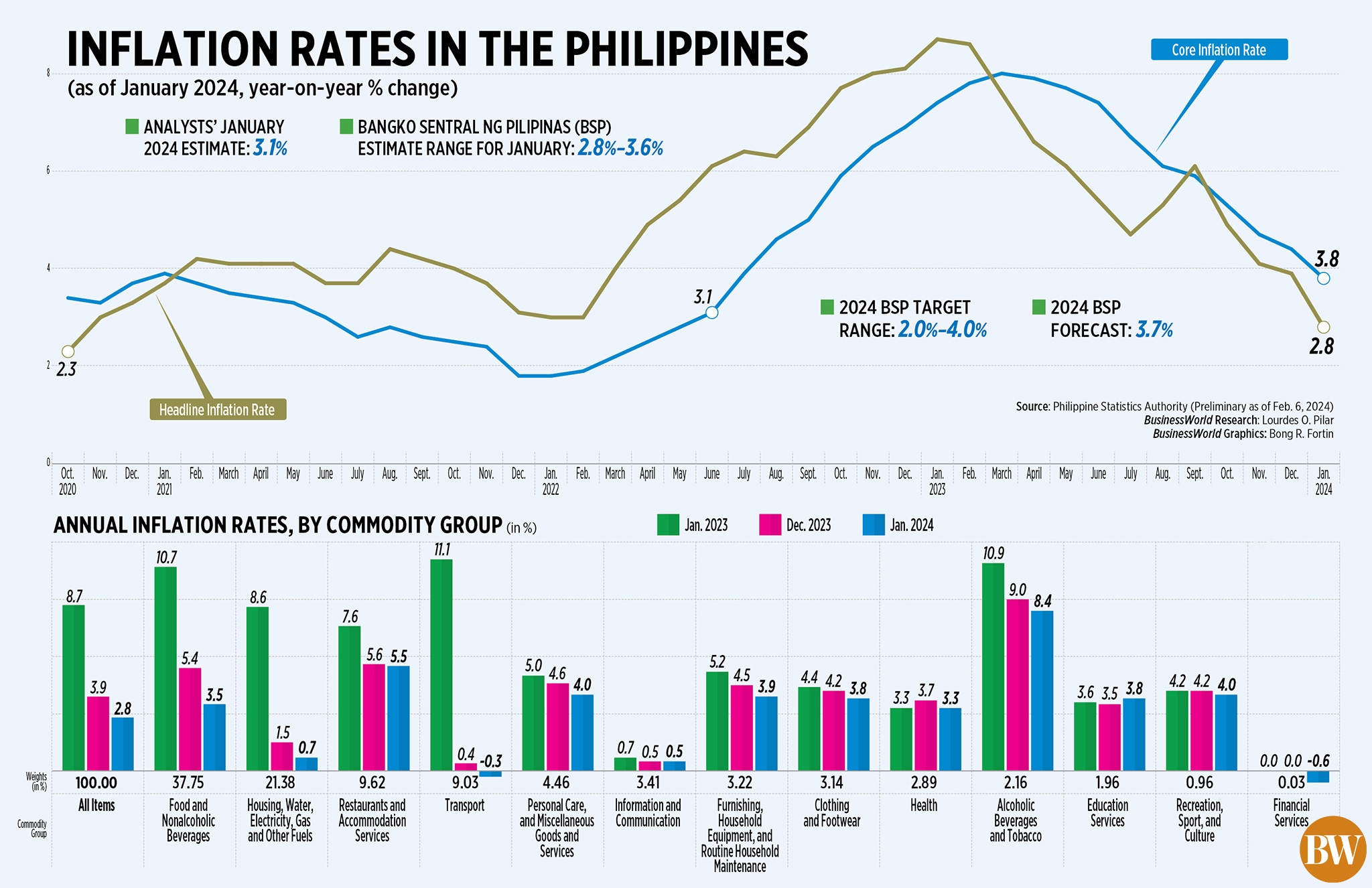
HEADLINE INFLATION sharply decelerated to an over three-year low of 2.8% in January, marking the second straight month it fell within the Bangko Sentral ng Pilipinas’ (BSP) 2-4% target range.

Preliminary data from the Philippine Statistics Authority (PSA) showed the overall year-on-year increase in prices of widely used goods and services cooled to 2.8% in January from 3.9% in December and 8.7% in the same month in 2023.

This marked the slowest inflation print since the 2.3% seen in October 2020 amid the coronavirus pandemic.

Inflation rates in the Philippines

The latest consumer price index (CPI) is below the 3.1% median estimate in a BusinessWorld poll last week and matched the low end of the BSP’s 2.8-3.6% forecast.

Month on month, inflation quickened by 0.6%. Stripping out seasonality factors, month-on-month inflation declined by 0.1% in January.

“This inflation outturn is consistent with the BSP expectations that inflation will likely moderate in the first quarter of 2024 due largely to negative base effects and some easing of supply constraints affecting key commodities,” the central bank said.

Core inflation, which excludes volatile prices of food and fuel, continued to ease to 3.8% in January from 4.4% in December. This is the first time that core inflation settled within the 2-4% target after 17 months and was the slowest print since 3.1% in June 2022.

At a press briefing, National Statistician Claire Dennis S. Mapa attributed the slowdown in January inflation to the 3.5% annual increase in food and nonalcoholic beverages, slower than 5.4% in December.

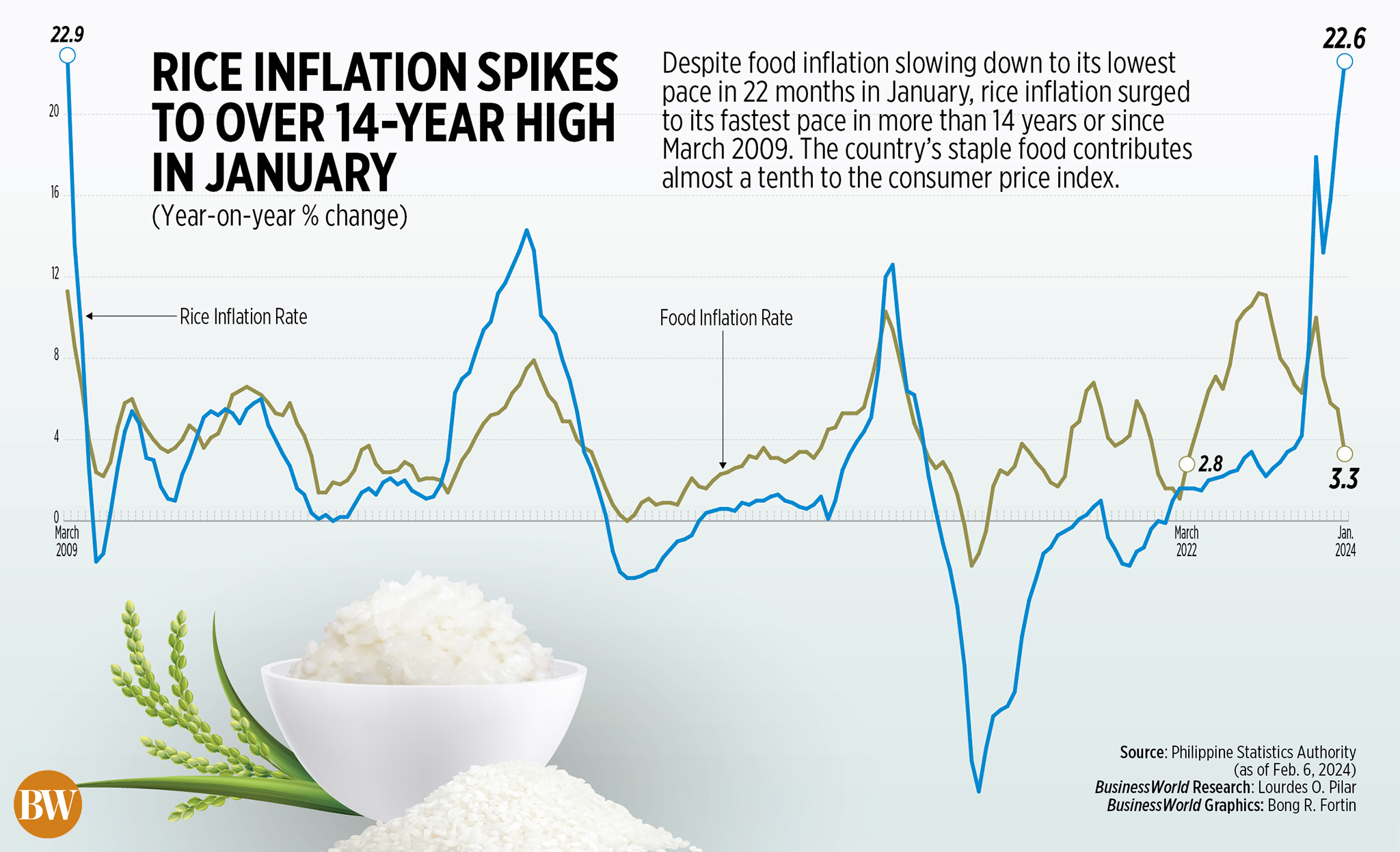
Food inflation alone eased to 3.3% in January from 5.5% in the previous month and 11.2% a year ago. It marked the slowest food inflation figure since the 2.8% in March 2022.

The deceleration of food inflation last month was due to the faster decline of vegetables, tubers, plantains, cooking bananas and pulses, which was at -20.8% from -9.2% in December.

Fish and other seafood also contributed to slower food inflation, as its inflation rate eased to 1.2% in January from 4.8% seen in December.

Inflation for meat and others dropped to -0.7% from 0.2% in December.

Rice inflation spikes to over 14-year high in January

RICE PRICES GO UP
However, rice inflation continued to accelerate. In January, rice inflation quickened to 22.6% in January from 19.6% in December. This is the highest rice inflation in nearly 15 years or since 22.9% in March 2009.

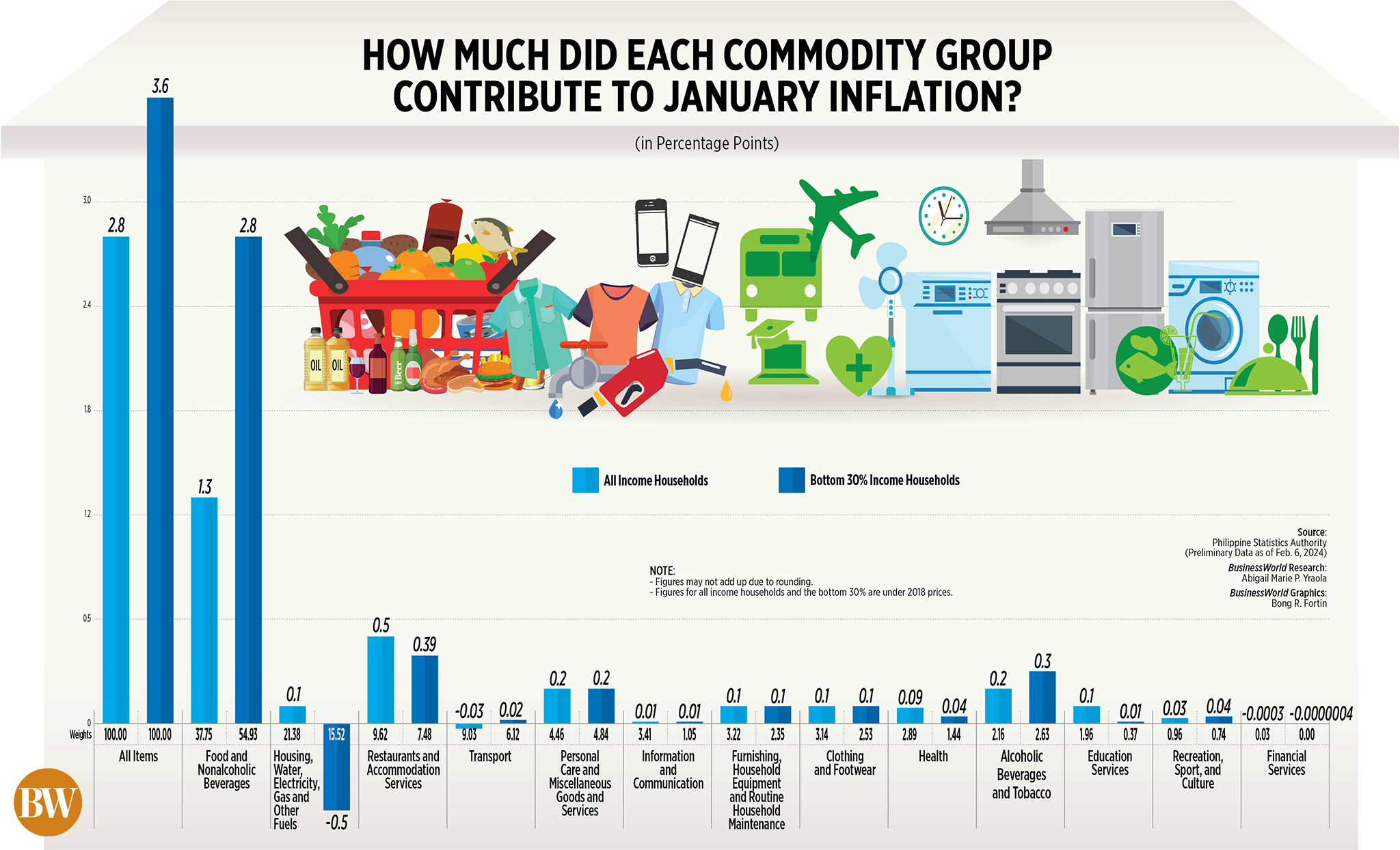
Rice was also the most significant contributor to December inflation, adding 1.3 percentage points to the 2.8% headline print. The commodity has the biggest weight in the overall CPI basket at 8.87%.

Mr. Mapa said the average price of regular milled rice jumped by 2.4% to P49.65 per kilo in January from P48.48 per kilo in December. It also rose by 25.4% from the P39.60 a kilo in January 2023.

The average price of well-milled rice also increased by 2% to P54.91 per kilo in January from an average of P53.82 per kilo a month earlier. Year on year, prices went up by 25% from P43.92 a kilo.

“If we look at rice imports, the prices of rice in the world market are very high,” Mr. Mapa said in mixed English and Filipino.

He also noted that the Philippines had low inflation rates for rice in the first half of 2023 before it started to spike in August and September.

“Rice prices came from a low base last year. Our calculation shows that rice inflation may continue to rise in terms of inflation rates simply because the base is relatively low in 2023,” he said.

“If rice prices continue to remain elevated because of base effects, our expectation is that we will have a rice inflation within the vicinity of 20% or higher until July this year,” he added.

National Economic and Development Authority Secretary Arsenio M. Balisacan said the Inter-Agency Committee on Inflation and Market Outlook is closely monitoring prices of rice and other commodities to provide appropriate policy recommendations.

“We introduce stop-gap measures, as necessary, such as allowing further imports on key commodities until our supply stabilizes at prices affordable to consumers while ensuring remunerative prices for local producers,” he said.

How much did each commodity group contribute to January inflation?

Mr. Balisacan also noted that the Department of Agriculture will continue to monitor on-the-ground developments in addressing food production concerns.

“Rice inflation has a substantial effect (to the headline), but the headline would still depend on the movement of other components of the inflation basket,” PSA’s Mr. Mapa said.

Mr. Mapa said inflation was also driven by slower increases in housing, water, electricity, gas and other fuels, which stood at 0.7% in January, down from 1.5% in December.

He said housing rentals went down in January, in contrast to what happened last year when landlords adjusted rates higher as the economy reopened.

Meanwhile, transport inflation contracted by 0.3% in January, a turnaround from the 0.4% growth in December. Inflation for financial services also declined by 0.6% from zero percent a month prior.

Inflation in the National Capital Region (NCR) decelerated to 2.8% in January from the 3.5% print in December and 8.6% a year ago.

Outside of NCR, consumer prices slowed to 2.8% from 4% a month ago and 8.7% in January 2023.

Inflation for the bottom 30% income households eased to 3.6% in January from 5% in December and 9.7% in the same month in 2023.

“While the general trend we’re seeing is that inflation is going down, we still have threats such as rice prices. And if there are movements in the other commodity items, it could be a source of threat as well to our low inflation rate,” Mr. Mapa said.

“But right now, what we’re seeing is that the overall direction is going down,” he said.

EL NIÑO
According to the BSP, inflation could still accelerate to above the 2-4% target range in the second quarter due to the impact of the El Niño weather condition and positive base effects.

“Key upside risks are associated with potential pressures emanating from higher transport charges, increased electricity rates, higher oil prices, and higher food prices due to strong El Niño conditions,” the BSP said.

A weaker global growth and government measures to mitigate the effects of El Niño could ease some price pressures, the central bank said.

“Looking ahead, the Monetary Board deems it necessary to keep monetary policy settings sufficiently tight until a sustained downtrend in inflation becomes evident,” the BSP said.

It added that the Monetary Board will consider the latest inflation and gross domestic product (GDP) outturn at its first policy review meeting on Feb. 15.

The BSP has kept its benchmark interest rate unchanged at a 16-year high of 6.5% for two straight meetings. This was after it hiked by 450 basis points (bps) from May 2022 to October 2023 to tame inflation.

ING Bank N.V. Manila Senior Economist Nicholas Antonio T. Mapa in a note said the BSP will likely keep its hawkish tone despite the continued slowdown in headline inflation.

“BSP Governor Eli M. Remolona, Jr. indicated that he was expecting inflation to slide in the first quarter before accelerating sharply in the second quarter, justifying his outlook for rates to stay higher for longer,” he said.

Mr. Remolona had also said the Monetary Board may consider a rate cut in the second half this year, but inflation should be firmly within the 2-4% target.

“If we continue to see inflation moderate well into the second quarter, we do expect BSP to begin to change their tune to signal a pivot, possibly by June,” ING’s Mr. Mapa said.

HSBC economist for ASEAN (Association of Southeast Asian Nations) Aris D. Dacanay in a note said the BSP’s tight monetary stance is working its way through the economy, as reflected with easing core inflation.

“But a bit of caution is warranted. Favorable base effects must fade or turn unfavorable at some point,” he said. “Upside risks to inflation also linger. There are still pending petitions to hike minimum wages and transport fares, not to mention global rice prices that have yet to peak.”

The BSP is expected to keep borrowing costs steady at its meeting next week, Mr. Dacanay said.

“With growth pleasantly surprising to the upside in the fourth quarter of 2023, the BSP has the convenience of time to wait for inflation to really settle within its target band before beginning its easing cycle,” he said.

In the fourth quarter, GDP expanded by 5.6%, slower than the revised 6% GDP growth in the third quarter and the 7.1% expansion in the fourth quarter of 2022. This brought full-year GDP to 5.6% in 2023.

“We also do not think the BSP can cut ahead of the Fed. Maintaining its current rate differential with the Fed will help mitigate any volatility in the USD-PHP and prevent FX (foreign exchange) changes in re-stoking inflation,” Mr. Dacanay added.

The US Federal Reserve kept borrowing costs unchanged at 5.25-5.5% since September last year, following the 525-bp rate hikes it did from March 2022 to July 2023.

DBCC reviewing revenue, expenditure targets

BUDGET SECRETARY Amenah F. Pangandaman attends the meeting of the Development Budget Coordination Committee, Feb. 5, 2024. -- DEPARTMENT OF BUDGET AND MANAGEMENT

By Luisa Maria Jacinta C. Jocson, Reporter

THE Development Budget Coordination Committee (DBCC) is reviewing current data to see if there is a need to revise revenue and disbursement assumptions, according to the Budget chief.

“The principals requested the Technical Working Group/Executive Technical Board to study the numbers (actual and emerging) so we can decide if there will be revisions moving forward,” Department of Budget and Management (DBM) Secretary Amenah F. Pangandaman said in a Viber message.

She said this still needs to be “firmed up” as there are still data yet to be released, such as the quarterly disbursement program and revenue estimates from the Finance department.

The DBCC held a special meeting on Monday to discuss medium-term fiscal framework targets, investment and financing strategies and the overall growth outlook of the country.

It was also the first DBCC meeting attended by Finance Secretary Ralph G. Recto and Special Assistant to the President for Investment and Economic Affairs Frederick D. Go. The DBCC is set to have its next meeting in March.

Ms. Pangandaman also said the economic team is working on its fiscal consolidation strategy.

“There will be a consolidation strategy — specifics to follow — but we will ensure that our spending-to-gross domestic product (GDP) ratio will remain above 20% until 2028. We will also ensure that infrastructure spending is between 5% and 6% of GDP over the medium term since this has a higher multiplier effect on GDP growth,” she said.

Based on the latest DBCC data, the government expects deficit-to-GDP ratio to settle at 5.1% this year. Revenues are expected to reach P4.2 trillion or 15.5% of GDP, while disbursements are seen to hit P5.6 trillion or 20.6% of GDP.

In a separate statement, the National Economic and Development Authority (NEDA) said it is “committed to achieving the government’s growth targets this year by incorporating the lessons learned in 2023 in the ways forward this 2024.”

The DBCC is targeting GDP to grow by 6.5-7.5% this year and 6.5-8% from 2025 to 2028.

The economy grew by 5.6% in 2023, missing the government’s 6-7% growth goal. It was also much slower than the 7.6% expansion in 2022.

To achieve its growth targets, the NEDA said that it will be crucial to build a strong fiscal foundation, expand the economic pie, ensure food security, improve access to education, build sustainable settlements and communities and ensure a more responsive and accessible government.

FISCAL CONSOLIDATION
Meanwhile, GlobalSource Partners country analyst Diwa C. Guinigundo said that the government should ensure its fiscal consolidation plan does not come at the cost of growth.

“It is not good for the government to justify the failure of public spending to measure up to the demands of a growing economy by way of providing higher levels of infrastructure, quality education and public health,” he said in a report dated Feb. 5.

“It’s about time good governance produces fiscal and debt sustainability without sacrificing economic prosperity.”

In the fourth quarter, government spending contracted by 1.8%. This was a reversal of the 6.7% growth in the previous quarter and 3.3% a year ago.

Full-year government spending posted flat growth of 0.4%.

Mr. Guinigundo noted that last year was not the first time state spending slowed down.

“Growth of public spending in 2018 and 2019, before the pandemic, was high at 13.4% and 9.1%, respectively. The pandemic year of 2020 even saw public spending climb by 10.5%. In the next three years, it further weakened to 7.2%, 4.9% and last year, to a measly 0.4%,” he said.

NEDA Secretary Arsenio M. Balisacan earlier said this decline in spending was due to the government’s fiscal consolidation strategy.

Mr. Guinigundo said that the government must ensure the budget is used judiciously and is channeled towards “growth-raising public spending.”

He also called for the immediate passage of pending tax measures to boost revenues. If there will be a need to resort to borrowing, he said that the government should “ensure the best terms” and minimize foreign currency risks.

“An even greater challenge is how to deliver on higher, albeit more ambitious targets of 6.5-7.5% for this year and 6.5-8% until the end of the Marcos administration now that global risks seem to have mushroomed and domestic downside risks continue to be dominant,” Mr. Guinigundo said.

Treasury eyes at least P30B from retail bonds

REUTERS

THE GOVERNMENT is looking to raise at least P30 billion from its first retail Treasury bond (RTB) offering for 2024.

In a notice on its website, the Bureau of the Treasury (BTr) said it is planning to sell at a minimum P30 billion worth of five-year RTBs due 2029 and allow existing holders to exchange the debt due this year for the new bonds.

The rate-setting auction is scheduled for Feb. 13.

The public offer period will run from Feb. 13 to Feb. 23, with the issue and settlement date on Feb. 28, the BTr said.

“The interest rate shall be based on current market levels of comparable securities rounded down to the nearest one-eighth (1/8) of one percent (1%),” the BTr said.

The final interest rate will be determined through a Dutch auction with the government securities eligible dealers. In a Dutch auction, the rate for the bond is determined by starting with the highest rate and incrementally lowering it until it is accepted by the auction participants.

This will be the government’s first RTB offering this year and the 30th issuance overall.

Due to the RTB offer, the BTr will cancel the auction for seven-year Treasury bonds on Tuesday.

The RTBs will be sold in minimum denominations of P5,000 and in multiples of P5,000 thereafter, with a maximum investment amount of P500,000.

The BTr is also offering a bond exchange option for holders of RTB 03-11, maturing on March 9, 2024, and RTB 05-12, maturing on March 12, 2024. The exchange offer also runs from Feb. 13 to 23.

“The exchange offer is likewise intended to manage refinancing risk in the debt portfolio of the Republic and is an integral part of its overall liability management program,” the BTr said.

Each exchange offer will have a minimum amount of P5,000 in multiples of P0.01.

Rizal Commercial Banking Corp. Chief Economist Michael L. Ricafort said in a Viber message that demand for the RTBs could be high as yields at the secondary market remain elevated.

It could also be a “sweet spot” for investors as easing inflation recently could lead to rate cuts by the Bangko Sentral ng Pilipinas (BSP) this year, he added.

Yields of the five-year bonds at the secondary market stood at 6.1053%, based on data from the PHP Bloomberg Valuation Service Reference Rates posted on the Philippine Dealing System’s website on Monday.

On the other hand, Bank of the Philippine Islands Lead Economist Emilio S. Neri, Jr. said the rate for the RTB will likely be lower than secondary market rates “as demand from retail and institutional clients continue to be robust for these types of offerings.”

“Timing will probably be pretty soon considering that the US Federal Reserve is signaling that it may not be able to cut in their March meeting given strong labor and growth prints,” he added.

The government borrows from local and foreign sources to help fund its budget deficit, which is capped at 5.1% of gross domestic product this year or P1.39 trillion. — AMCS

Customs surpasses January collection target by 2%

Agents from the Bureau of Customs - Customs Intelligence and Investigation Service inspected a sugar warehouse in Quezon City, Aug. 23, 2022. — COURTESY OF BUREAU OF CUSTOMS

THE BUREAU of Customs (BoC) said it collected P73.329 billion in duties in January, surpassing its target for the month and its collection a year ago.

Based on preliminary data, the agency said its January collection rose by 3.88% from P70.591 billion in the same month in 2023. It was also 2.16% higher than its P71.779-billion target for the month.

In a statement, the BoC attributed the higher collection to its “improved system of determining the customs value of imported goods, strengthened border protection, and concrete trade facilitation efforts.”

Customs Commissioner Bienvenido Y. Rubio said that the agency will be intensifying its collection efforts for this year.

“We are committed to working twice as hard to ensure that we not only meet but exceed our year-end revenue target,” he said.

This year, the agency is aiming to collect P959 billion.

Mr. Rubio in an earlier statement said that the agency is targeting to increase collections by 15-20% this year through “vigilant monitoring and continuous improvement of modernization projects.”

He cited key initiatives such as implementing an information and communications technology-enabled clearance system for express shipments. The BoC is also working on drafting administrative and memorandum orders for e-commerce to curb revenue leakages.

The agency is also aiming to strengthen border control, implement the National Customs Intelligence System to assist in anti-smuggling activities, and streamline processes to better facilitate trade.

Finance Secretary Ralph G. Recto has also ordered the BoC along with the Bureau of Internal Revenue to optimize their performance through “creativity, transparency, and efficiency in tax and customs administration.”

Earlier data from the Finance department showed that Customs collected P883.624 billion as of Dec. 31. This is 1.08% higher than its P874.166-billion target for 2023. This was also 2.46% higher than its P862.419-billion collection in 2022. — Luisa Maria Jacinta C. Jocson

PCC clears Lopez’s acquisition of Casecnan Power Plant

THE Philippine Competition Commision (PCC) has cleared the acquisition of Lopez-led First Gen. Corp.’s subsidiary of the Casecnan Hydroelectric Power Plant (CHEPP), saying it will not affect market competition.

“The Commission en banc on Jan. 25, cleared Fresh River… to take over the Casecnan plant seeing that the transaction would not result in substantial lessening of competition in the relevant markets,” the PCC said in a statement on Tuesday.

First Gen through its wholly owned subsidiary Fresh River Lakes Corp. was set to acquire the hydro plant from Power Sector Assets Liabilities Management Corporation (PSALM) and National Irrigation Administration.

In May 2023, Fresh River was declared the winning bidder for the sale of the plant with a price of $526 million. This was higher than the minimum bid price of $227.27 million.

The hydro plant was turned over to the government in 2021 following the expiration of the build-operate-transfer contract with the previous operator Casecnan Water and Energy Co., Inc.

On Dec. 15, PCC Mergers and Acquisitions Office opened the first phase review of the Casecnan deal, during which it found out that the volume generated by the plant “is unlikely to impact the relevant markets.”

It added that there are enough safeguards under the Electric Power Industry Reform Act of 2001 (EPIRA) to ensure the competitiveness of the market.

“The Casecnan plant’s sale aligns with PSALM’s mandate under the EPIRA to privatize all assets and liquidate all financial obligations of state-owned National Power Corporation,” the PCC said.

Located in Nueva Ecija, the run-of-river hydroelectric power plant generates energy by diverting water from the Casecnan and Taan Rivers through a 26-kilometer-long tunnel.

Last month, Ramon A. Carandang, vice-president for corporate communications of First Gen, said that the operations of the Casecnan plant would complement the company’s 132-megawatt Pantabangan-Masiway hydroelectric power plant (PMHEP).

“CHEPP adds to our renewable energy portfolio and allows us to realize synergies with PMHEP that will be unique to us as owners and operators of both facilities,” Mr. Carandang said in a Viber message.

In its latest quarterly report, First Gen said that it expects the closing and turnover date of the plant in early 2024.

The PCC, under the Philippine Competition Act, is mandated to review mergers and acquisitions to ensure that relevant markets will remain competitive and that the deals will not harm consumer welfare. — Justine Irish D. Tabile

Panasonic Manufacturing resumes production in Sta. Rosa

LISTED appliance manufacturer Panasonic Manufacturing Philippines Corp. said it resumed production at its plant in Sta. Rosa, Laguna, following a fire in December.

In a regulatory filing, Panasonic said that it commenced electric fan production on Tuesday, with its washing machine production scheduled to begin in March.

Sales of electric fan will resume in March while sales of washing machines will begin in April.

“Despite the setback, we are committed to delivering high-quality products to the market the soonest,” Panasonic said.

“We understand the impact this may have on your expectation and sincerely appreciate your understanding. Our team is working diligently to ensure a swift and smooth recovery,” the company added.

Panasonic Manufacturing Philippines is a manufacturer, importer and distributor of various appliances. The company is currently producing refrigerators, air conditioners, washing machines, and electric fans.

Shares of Panasonic Manufacturing Philippines climbed by 19 centavos or 3.66% to P5.38 apiece on Tuesday. — Revin Mikhael D. Ochave

Apex Mining taps First Gen to power mining operations

APEX Mining Co., Inc. on Tuesday said that it had partnered with Lopez-led First Gen Corp. to increase its use of renewable energy in the company’s mining operations in Davao de Oro.

“This will allow the company to have uninterrupted, reliable energy for its daily mining operations with a much lower carbon footprint and a higher degree of corporate and ethical responsibility,” the company said in a statement.

Apex Mining said that it would source energy from First Gen’s Mt. Apo Geothermal Power Plant in Kidapawan, Cotabato.

“This is going beyond mere compliance in our energy management practices… Tapping into renewable energy resources is an effective way to manage our environmental impact,” Apex Mining President and Chief Executive Officer Luis R. Sarmiento said.

The company conducts its mining operations through its Maco gold mine site in Davao de Oro.

It added that prior to its agreement, the company had already been sourcing 59% of its energy usage from renewable sources.

“Apex Mining’s move coincides with the emerging worldwide trend of evaluating mining companies based on their sustainability and energy sourcing practices,” it said.

Meanwhile, for the first three quarters of 2023, the company had allocated P89 million for its environmental protection and enhancement program (EPEP).

The EPEP is a comprehensive plan required by the Department of Environment and Natural Resources (DENR) to ensure the responsible management of all land, water, and air resources that are covered by the operations of a mining company.

Shares for rose by 1.05% or three centavos to close at P2.89 apiece on Tuesday. — Adrian H. Halili

SEC clears Century Properties Group’s offering

LISTED CENTURY Properties Group, Inc. (CPG) has secured the green light from the Securities and Exchange Commission (SEC) for the company’s follow-on public offering of up to 40 million Series B preferred shares.

The company received the certificate of permit to offer securities for sale on Feb. 5, CPG said in a regulatory filing on Tuesday.

The offering includes a base offer of 20 million Series B preferred shares, with an option to oversubscribe for up to 20 million more at P100 each.

The offering has an initial dividend rate of 7.5432% per annum.

The company aims to raise as much as P4 billion from the issuance if the oversubscription option were to be fully exercised.

The offer period started on Feb. 6 and will end on Feb. 13. The issue date is on Feb. 22.

CPG said it would use the proceeds for the partial repayment of the company’s fixed-rate three-year bonds issued in March 2021.

The proceeds would also be used for strategic land banking, capital expenditures and other general corporate obligations, it noted.

The company tapped China Bank Capital Corp. as the sole issue manager, lead underwriter, and bookrunner for the transaction.

Recently, CPG announced plans to launch two projects in the first half. These projects include the Hotel Residences at Acqua development in Mandaluyong City, set to launch in the first quarter, as well as the first mid-rise 12-storey residential project at Azure North in San Fernando, Pampanga, scheduled for launch in the first half.

Shares of CPG dropped by P0.005 or 1.85% to P0.265 apiece on Tuesday. — Revin Mikhael D. Ochave

Ballet Manila stages beloved classics and Filipino stories for 26th season

LE CORSAIRE will star Ballet Manila principal dancers Abigail Oliveiro as Medora, Mark Sumaylo as Conrad, and Joshua Enciso as Ali. — BRONTË H. LACSAMANA

THINGS have been difficult these past few years for Ballet Manila. It has had to deal with rebuilding its theater after it burned down, the pandemic lockdowns, and, most recently, the loss of a dear collaborator and friend. Yet the urge to move forward past the difficulties is strong. Thus, to showcase “technical and virtuosic feats,” the company will be staging a mix of renowned classics and innovative Filipino productions for the opening salvo of its 26th performance season, billed as “Ballet Masterpieces.”

“The company has grown by leaps and bounds since we reopened after the pandemic. I honestly didn’t expect things to move this fast, this soon, and this strongly,” Ballet Manila chief executive officer and artistic director Lisa Macuja-Elizalde said during a press conference on Jan. 31 at the rebuilt Aliw Theater.

After the theater fire in 2019 and the pandemic which forced a pause in activities in 2020 and cast its shadow over the next two years, 2023 saw the theater’s triumphant return to a full season.

Ms. Macuja-Elizalde also said a few words for co-artistic director, master choreographer, and beloved mentor Osias Barroso who passed away in December.

While losing him was a huge blow, she said that he would surely be “looking on right now and cheering us all forward.”

LE CORSAIRE
Ballet Manila steps into its 26th season with a production of Le Corsaire (The Pirate) as re-choreographed by Ms. Macuja-Elizalde.

The classic ballet, loosely based on Lord Byron’s 1814 poem “The Corsair,” is a romantic adventure revolving around the heroic pirate Conrad and his crew who set out to rescue his beautiful love, Medora, from the slave trader Lankendem.

“I have always wanted to re-work Le Corsaire. When I was dancing the role of Medora, I found her character to be a damsel in distress waiting for Conrad to save her,” Ms. Macuja-Elizalde said of the changes she made in her version.

“I also wanted to change the order of the scenes because I always felt that there should be a build-up to the main dances,” she added.

Le Corsaire will have performances on Feb. 24 at 8 p.m. and Feb. 25 at 5 p.m., at the Aliw Theater at the Cultural Center of the Philippines Complex in Pasay City.

TATLONG KWENTO NI LOLA BASYANG
The season will continue with beloved old Filipino tales brought to life in Tatlong Kwento ni Lola Basyang.

“The idea to create a ballet from Anvil Publishing’s books of Mga Kuwento Ni Lola Basyang came about during my children’s book fair,” Ms. Macuja-Elizalde said. “I saw the collection displayed in their school library, and I bought all 12. Then I called a meeting with my artistic team. I put the books on the table and told them to choose one to make into a ballet.”

Anvil Publishing is a special partner for this production, as they are eager to “keep the legacy of renowned Filipino writer Severino Reyes alive.”

The three stories selected for the production have themes of romance, adventure, and comedy. Adding more buzz to the show is celebrated singer, actress, and comedienne Mitch Valdez, who will be taking on the narrator role of Lola Basyang with her signature wit and humor.

“We’re familiar with all the international classics, but this one is a rare chance to see one of our beloved folklores come to life in classical ballet. It will be beautiful because the story is one of our own,” said Ms. Valdez.

Tatlong Kwento ni Lola Basyang goes onstage on May 11 at 8 p.m. and May 12 and 18 at 5 p.m., at the Aliw Theater.

GISELLE
The performance season will close with Giselle, an ethereal, romantic ballet that tackles love, tragedy, and loss.

Though it is a full-length classical ballet, it isn’t a big production, according to Ms. Macuja-Elizalde.

“We decided on the lineup based on the company’s capability, because we can’t really do big dances like Swan Lake just yet. We still haven’t built up the strength of the company to be able to do that,” she explained.

For Ballet Manila principal dancer Abigail Oliveiro, who will play the titular Giselle (as well as Medora in Le Corsaire), the challenges and the pressure of putting on the best show possible are part of the job.

“When we come to the studio every day, we look forward to practicing and honing our craft. We love what we do. That’s what’s important,” she said.

Giselle goes on stage on Aug. 31 at 8 p.m. and Sept. 1 at 5 p.m. At the Aliw Theater.

OTHER PERFORMANCES
Outside of its regular season, Ballet Manila will present the world premiere of a new ballet, collaborate with a museum, and celebrate Christmas.

First up is the world premiere of a ballet based on another Filipino tale, Balagtas’ epic poem “Florante at Laura.” This collaboration between choreographers Gerardo Francisco and Martin Lawrence will be performed on Oct. 12 at 8 p.m. and Oct. 13 and 19 at 5 p.m. at the Aliw Theater.

Then, in partnership with Aréte Ateneo, Ballet Manila audiences will get a chance to revisit Gerardo Francisco’s ballet on yet another Filipino classic story, Ang Ibong Adarna, which was staged last year. This time it will be performed at Ateneo de Manila’s Areté Theater in November.

Lastly, the ballet company will continue its Holiday Cheer Series, which presented Cinderella last year. For 2024, Ms. Macuja-Elizalde is staging her take on Snow White from Dec. 25 to 30.

“We hope that by the end of our 26th performance season, the Filipino audience will rediscover and have a newfound appreciation for classical ballet as well as our vibrant Filipino culture,” she said.

For tickets, visit www.ticketworld.com.ph or call 8891-9999. To know more about Ballet Manila and its shows, visit www.balletmanila.com.ph. — Brontë H. Lacsamana

Monet’s paintings as an immersive adventure

THE CROWD interacts with the changing data paintings on the walls of the exhibit ‘Monet and Friends Alive.’ — BRONTË H. LACSAMANA

IN the spacious Bonifacio Global City (BGC) Arts Center, the sights and sounds of 19th-century Europe light up the walls of the exhibition space, now a large-scale canvas for the works of impressionists like Claude Monet, Camille Pissarro, Pierre-Auguste Renoir, Paul Cézanne, and Edgar Degas.

Grande Experiences is responsible for this multi-sensory experience in BGC, the second of its kind afterVan Gogh Alive” which was presented in the Philippines last year.

“Monet and Friends Alive: An Immersive Adventure into French Impressionism” recreates through data paintings and digital projections the vibrant world of Monet and his contemporaries.

“Once again, the Bonifacio Art Foundation, Inc. has partnered with Grande Experiences to make iconic artworks accessible to local Filipino audiences,” Bonifacio Art Foundation managing director Maria Isabel Garcia said at the exhibition’s launch on Jan. 31.

The experience begins with a room detailing the historical timeline of impressionism and the basic profiles of its renowned painters. The highlight of the exhibition, however, is the immersive gallery where guests can view multiple stories spanning Monet and his friends’ best works and quotes in motion, projected on the walls.

In the gallery, viewers can take as many pictures as they want as they are enveloped by vibrant colors from the various impressionist works. A nice touch is the classical music score featuring music by the likes of Claude Debussy and Nikolai Tchaikovsky, perfectly synchronized with the visual display.

Visitors end their journey in a serene French garden, filled with flowers like those of Monet’s own garden. Lined with mirrors and adorned with leaves and blossoms, selfies and group photos can be taken here. The parting piece is a quaint recreation of the Japanese footbridge that Monet had built in his water-lily garden.

Ms. Garcia noted that Filipinos can more easily embrace art through immersive experiences such as this and the earlier one featuring Van Gogh.

“We hope that this offering will give us a sense of the broader tradition in the arts that have influenced generations of artists the world over, as we ourselves evolve our own beautiful art traditions,” she said.

Premium “flex” tickets, which allow for entry and exit at any time, are priced at P2,500. General admission tickets, which are good for only two hours, cost P1,200 for regular visitors and P800 for children, students, senior citizens, and persons with disabilities.

“Monet & Friends Alive” runs until March at the BGC Arts Center on 26th St. corner 9th Ave. in BGC, Taguig. Visit bgcartscenter.org/mfa for more details. — Brontë H. Lacsamana

PSALM receives P5.18B for properties needed for rail projects

STATE-LED Power Sector Assets and Liabilities Management Corp. (PSALM) said on Tuesday that it had received the initial payment of P5.18 billion from the Department of Transportation (DoTr) for its properties in Sucat, Muntinlupa City.

The amount is part of the total purchase price of P5.19 billion, PSALM said in a statement.

The Sucat properties cover a total land area of 110,129 square meters or 11 hectares.

The second tranche of the sale covers various land improvements and structures.

PSALM said that the sale represents “the culmination of almost three years of coordination beginning January 2021 when the DoTr formally confirmed its interest to acquire the Sucat properties.”

The DoTr aims to use the properties for the North-South Commuter Railway (NSCR) project and the Philippine National Railways (PNR) South Long-Haul (SLH) project.

The NSCR project is a 147-kilometer (km) mass transportation railway system that will connect Malolos, Bulacan with Clark International Airport, and Tutuban, Manila with Calamba, Laguna.

The Transportation department is hoping to begin the project’s partial operations by 2027.

Meanwhile, the PNR SLH project is a 639-km railway line that will connect Metro Manila to Southern Luzon.

PSALM said it will turn over the physical Sucat properties to the DoTr on the closing date, along with the corresponding original owner’s duplicate copies of the transfer certificate titles and tax declarations.

PSALM will use the proceeds from the sale of the Sucat Properties to pay for the remaining stranded contract costs and stranded debts under the EPIRA (Electric Power Industry Reform Act),” it said. — Sheldeen Joy Talavera