Home Blog Page 3633

CIAC pursuing deals at Singapore Airshow

REUTERS

CLARK International Airport Corp. (CIAC) said it hoping to enter into tie-ups at the Singapore Airshow.

Arrey A. Perez, president of the CIAC, said the company’s participation at the airshow, which runs until Feb. 25, is an opportunity to showcase Clark International Airport (CRK).

“It is also an opportunity to forge strategic partnerships with Clark and explore investment opportunities with aviation and logistics companies,” Mr. Perez said in a statement on Wednesday.

“We’re honored to represent the Clark Civil Aviation Complex, host to the world-renowned Clark airport, and with both the Department of Transportation and the Bases Conversion and Development Authority, determined as well to promote our flagship projects in Clark under the Marcos administration,” he added.

The CIAC team is scheduled to meet with the Changi airport operations team, Singapore aviation caterer and logistics company SATS Ltd., urban planning firm Surbana Jurong, and tech solutions company ST Engineering, among others.

Mr. Perez said CIAC has seven flagship projects aimed at attracting more investment to Clark.

These projects include the $152-million National Food Hub, the $376-million Clark Entertainment and Events Center, the $31-million Urban Renewal and Heritage Conservation Program, and the $21-million CRK Direct Access Link.

“These are infrastructure development projects that we hope will attract more aviation- and non-aviation-related investments as we continue to work double-time to transform Clark as the premier global civil aviation and logistics hub of the Philippines,” Mr. Perez said. — Justine Irish D. Tabile

How FAR will RMC 5-2024 take us?

One of the hot topics in tax circles is Revenue Memorandum Circular (RMC) No. 5-2024, which was issued by the Bureau of Internal Revenue (BIR) to clarify the tax treatment of cross-border services, applying the Supreme Court (SC) decision in Aces Philippines Cellular Satellite Corp. v. Commissioner of Internal Revenue. The RMC imposes Philippine withholding tax on payments for services rendered by non-resident foreign corporations (NRFCs), even if rendered entirely outside the Philippines, as long as the utilization or consumption happens within the Philippines. Because of the widespread impact and apparent shift in the tax treatment, the new issuance has raised uncertainty on the proper taxation of service fees paid to NRFCs by service recipients in the Philippines.

It should be noted that the parties involved in the SC case are associated enterprises located in various jurisdictions. Since associated enterprises or related parties are bound by international and local transfer pricing rules, I wonder whether the Court took into account the transfer pricing considerations present in the case.

Transfer pricing comes into play in determining whether the profits earned by related parties are appropriate considering the proper allocation of the income earned across various jurisdictions and among enterprises based on their functions, assets, and risks (FAR). Given the facts of the case, with various phases of the service being performed by different entities in multiple jurisdictions, personally, I find it reasonable (and even necessary) to consider the application of transfer pricing principles.

In the SC case, the court acknowledges the fact that the NRFC’s provision of satellite communication services relies on its entire system, consisting of a communications satellite located in outer space that is interconnected with a network control center in Indonesia, and terminals and gateways located in Indonesia, Thailand, and the Philippines. The case also emphasized that some activities and assets such as: (i) the communication satellite which receives, switches, amplifies, and/or transmits signals to and from the terminals and gateways; (ii) the satellite control facility that monitors and controls the satellite; and (iii) the network control center which consists of the hardware, software, and facilities required in the management and control of the telecommunications system, are performed, located, owned and maintained by NRFCs outside the Philippines. Specific terminals and gateways located in various jurisdictions receive, route, and process the call to a local subscriber until termination. Accordingly, if the network control center beams the signal to the Philippine gateway, any subsequent activities to be performed by the local entity will take place in the Philippines.

Consistent and aligned with economic theory, transfer pricing principles dictate that the more functions being performed, the more assets used, and the more risks assumed, the higher would be the expected profitability or returns. Having said this, it is appropriate to determine each party’s proportionate share of the overall revenues based on their FAR profiles specific to the transaction, and subject to tax only the allocated share of the entity. Aligning with the SC’s decision in Commissioner of Internal Revenue v. British Overseas Airways Corp., it is the property, activity or service that produces the income. Accordingly, only the NRFC’s income, which is attributable to any functions it performs, any of its own assets that is used, and any risks it assumes in the Philippines, should be considered Philippine-sourced income. The remaining portion of the income derived by the NRFC from FAR outside the Philippines should be subject to tax in the jurisdictions where the foreign parties are residing for tax purposes, and hence should be beyond Philippine taxation.

As far as the allocated portion which ties in with the FAR that the NRFC has/employs in the Philippines, any Philippine income taxation should also consider any relief available under an existing tax treaty. Based on Philippine tax treaties, an NRFC’s income can only be taxed if the company has a taxable presence in the Philippines, whether through a fixed place, employees or personnel present and providing services in the Philippines, or through definite actions of a dependent agent. While the SC ruled that the OECD Commentaries on Article 5 of the Model Tax Convention on Income and on Capital is irrelevant to the Aces case simply because the NRFC is a Bermudan resident, which is a non-treaty country, the RMC did not expressly disregard the OECD nor the availability of applicable treaty benefits. Given this, I think it is safe to assume that NRFCs residing in treaty countries would still be able to avail of the treaty relief if requirements under the treaty are met.

Contrary to the circumstances present in the SC case where service providers are in multiple jurisdictions, some of the specific cross-border services enumerated in the RMC can likely be performed completely offshore by a single NRFC. In other words, the income from satellite airtime fees, which require the completion of segmented processes before the communication services can be delivered, is not comparable with the income that may be derived from other cross-border services listed in the RMC. However, assuming a similar case where a cross-border service involves multiple related parties from various jurisdictions, I believe a FAR and an economic analysis should be conducted to properly allocate the income, and consequently, determine the tax base.

We are all pondering how far the RMC will take us, especially now that taxpayers, through a number of business and professional organizations, have submitted their unanimous stand on the RMC. Now, the ball is in the BIR’s court. Perhaps the BIR can likewise consider transfer pricing when it revisits the RMC and address the taxpayers’ uncertainty.

The views or opinions expressed in this article are solely those of the author and do not necessarily represent those of Isla Lipana & Co. The content is for general information purposes only, and should not be used as a substitute for specific advice.


Crystabelle Cruz-Lucas  is a senior manager at the Tax Services department of Isla Lipana & Co., the Philippine member firm of the PwC network.

crystabelle.d.cruz@pwc.com

Peso climbs further ahead of Fed minutes

BW FILE PHOTO

THE PESO appreciated further against the dollar on Wednesday ahead of the release of minutes of the US Federal Reserve’s January policy meeting.

The local unit closed at P55.94 per dollar on Wednesday, strengthening by 9.5 centavos from its P56.035 finish on Tuesday, Bankers Association of the Philippines data showed.

The peso opened Wednesday’s session stronger at P55.99 against the dollar. Its weakest showing was at P56.10, while its intraday best was at P55.90 versus the greenback.

Dollars exchanged went up to $1.29 billion on Wednesday from $1.14 billion on Tuesday.

The peso gained against the dollar on Wednesday ahead of the release of minutes of the Fed’s Jan. 30-31 meeting overnight, Rizal Commercial Banking Corp. Chief Economist Michael L. Ricafort said in a Viber message.

The US central bank held its target rate steady at the 5.25-5.5% range for a fourth straight time during its meeting last month. It raised borrowing costs by a cumulative 525 basis points from March 2022 to July 2023.

The dollar fell broadly on Wednesday as it tracked a global decline in bond yields, while traders awaited minutes of the Fed’s latest policy meeting due later in the day for further clues on the central bank’s rate outlook, Reuters reported.

The greenback slipped below 150 yen in Asia trade and last bought 149.97 yen, giving the Japanese currency some breathing space having been pinned near a three-month low in previous sessions.

In the past, traders have viewed 150 as a line in the sand that could trigger currency intervention from Japanese authorities, such as was the case in late 2022.

The move lower in the dollar has come on the back of a dip in US Treasury yields in line with its global peers.

The US dollar index fell 0.05% to 103.99.

Traders are currently pricing in just above 90 basis points worth of easing by the Fed this year.

For Thursday, Mr. Ricafort sees the peso ranging from P55.85 to P56.05 per dollar. — AMCS with Reuters

Stocks rise further on strong corporate results

BW FILE PHOTO

PHILIPPINE STOCKS climbed further on Wednesday on positive investor sentiment amid strong corporate results and foreign buying.

The benchmark Philippine Stock Exchange index (PSEi) went up by 0.62% or 42.70 points to finish at 6,897.36 on Wednesday, while the broader all shares index rose by 0.51% or 18.4 points to close at 3,600.10.

“The market moved sideways for most of the trading session before having a notable run at the close of trading. The positive bias was due to positive sentiments buoyed by some 2023 earnings results,” AB Capital Securities, Inc. Vice-President Jovis L. Vistan said in a Viber message.

“Companies that unveiled their financial reports generally performed in line with or exceeded market expectations, contributing to the overall optimism,” he added.

First Metro Investment Corp. Head of Research Cristina S. Ulang said in a Viber message that the market improved on Wednesday amid strong foreign buying.

Net foreign buying went down to P506.85 million on Wednesday from P666.48 million on Tuesday.

“Foreign investors have been consistently participating in the market … This positive trend has persisted since the beginning of February, establishing foreigners as net buyers,” Philstocks Financial, Inc. Research Analyst Claire T. Alviar said in a Viber message.

“The local bourse extended its gains, up by 42.70 points (0.62%) to 6,897.36, lifted by property stocks, notably with SM Prime Holdings, Inc. … which experienced the most significant gain of 2.74% among the index members. The possible interest rate cut by the BSP (Bangko Sentral ng Pilipinas), coupled with their strong 2023 earnings result so far, are boosting investors’ sentiment in property stocks,” she added.

SM Prime logged a 33% increase in its net income to P40 billion in 2023, led by higher revenues across its business units, it reported earlier this week.

The company’s net income for 2023 marks an improvement from the P30.1 billion recorded the year prior, it said in a stock exchange disclosure on Monday.

SM Prime said its consolidated revenue increased by 21% to P128.1 billion from P105.8 billion in 2022, while operating income rose by 24% to P61.3 billion.

Majority of sectoral indices closed higher on Wednesday. Property climbed by 1.89% or 54.82 points to 2,952.32; financials went up by 1.12% or 22.57 points to 2,021.96; industrials increased by 0.6% or 54.86 points to 9,176.45; and holding firms rose by 0.53% or 34.12 points to 6,425.45.

Meanwhile, services dropped by 1.69% or 29.89 points to 1,736.96, and mining and oil went down by 0.77% or 68.46 points to 8,735.12.

Value turnover inched down to P4.88 billion on Wednesday with 1.63 billion issues switching hands from the P4.94 billion with 520.65 million shares traded the previous day.

Decliners edged out advancers, 93 against 91, while 50 names ended unchanged. — R.M.D. Ochave

Philippines hits China, says joint air patrol with US to ensure free passage

Two fighter jets of the Philippine Air Force fly with a bomber plane of the US Pacific Air Force over the West Philippine Sea during the third iteration of the two countries' Maritime Cooperative Activity on Feb. 19, 2024. — PHILIPPINE AIR FORCE

THE PHILIPPINES on Wednesday hit China for criticizing its recent joint air patrol with the US, saying it was in line with its national interest and would ensure free navigation.

Three Philippine fighter jets and a US bomber aircraft on Monday flew over parts of the South China Sea within Manila’s exclusive economic zone, days after their navies held drills at sea.

“The joint air patrol or exercise conducted by the Philippine Air Force and the United States Pacific Air Force is a lawful and routine exercise aimed at enhancing interoperability between allied forces and promoting regional peace and security in the Indo-Pacific region,” the National Security Council (NSC) said in a statement.

China’s military has accused the Philippines of stirring up trouble in the South China Sea by conducting a joint air patrol with “extraterritorial countries” and then openly hyping it up.

China’s Southern Theater Command said it had organized front-line naval and air forces to monitor the Philippines’ joint air patrol. Troops “maintained a high degree of vigilance to resolutely defend national sovereignty,” it added.

NSC said its joint patrols with the US are held within Philippine territories, serving “the purpose of enhancing maritime security, promoting regional stability and upholding international law.” “These patrols help deter illegal activities, ensure freedom of navigation, and contribute to the protection of shared interests in the region.”

Monday’s air patrol covered areas 90 nautical miles (167 kilometers) west of Candon, Ilocos Sur and 50 nautical miles northwest of Lubang, Occidental Mindoro.

It was the air component of the third iteration of the Philippine military’s Maritime Cooperative Activity with the US Indo-Pacific Command.

“We urge China to respect the sovereign rights of the Philippines conducted within its territory, consistent with its national interests and international law,” NSC said.

The Philippines and China should adhere to established legal frameworks to keep their relations peaceful and stable, it added.

“Adherence to international norms is essential to the peaceful coexistence of neighboring states,” it said. “Respecting and following international law is essential for maintaining peace, resolving disputes and advancing our shared interests in the region.”

On Feb 9, the Philippine Navy’s BRP Gregorio del Pilar and the US Navy’s USS Gabrielle Giffords participated in the third iteration of the Maritime Cooperative Activity. Exercises included passing, communication and division tactics to enhance coordination between the two forces in maritime scenarios.

The Philippines under President Ferdinand R. Marcos, Jr. has sought closer ties with the US amid escalating tensions with China, which claims vast portions of the South China Sea.

“The joint air patrol with the US is part of our longstanding defense cooperation,” NSC said.

Philippine activists critical of China have also opposed the Southeast Asian nation’s growing security ties with the US, saying it makes the Philippines vulnerable to a potential war between the two rich nations.

Opposition to the Philippines’ security alliance with the US is nothing new, with senators rejecting the renewal of a military base agreement between the two countries in 1991.

The decision led to the dismantling of an American air base in Clark, Pampanga and a US naval base in Subic, Olongapo. The two sites, which are now economic hubs, are located north of Manila.

“We will continue to work closely with our friends, allies and partners to ensure a secure and prosperous future for all nations in the Indo-Pacific region,” NSC said.

Also on Wednesday, the Philippines Senate approved on second reading a bill that seeks to set up maritime zones and territories in the South China Sea.

Under Senate Bill 2492, or the proposed Philippine Maritime Zones Act, maritime zones will also be set up in the Benham Rise in the West Pacific.

Philippine authorities may impose a fine of as much as $1 million (P56 million) on foreign actors that build artificial islands, conduct marine research and destroy Philippine marine environments within the maritime zones.

Senator Francis N. Tolentino earlier said the Senate would craft a Philippine map to assert the country’s claim in the South China Sea in response to China’s so-called 10-dash line map.

The Philippines, Vietnam, India and Taiwan have criticized the map for covering regions beyond China’s borders and claiming most of the South China Sea. — Kyle Aristophere T. Atienza and John Victor D. Ordoñez

Marcos backs push to relax rules on ride-hailing service

PHILSTAR FILE PHOTO

PHILIPPINE President Ferdinand R. Marcos, Jr. on Wednesday said his government is working with Singapore-based Grab Holdings Ltd. as it seeks to legalize motorcycle taxis and relax regulations on ride-hailing services.

He issued the statement after a meeting with officials of Grab, which the presidential palace said was seeking his support to increase its Philippine ridership to 500,000 from 300,000 daily.

“We are working with Grab to legalize motorcycle taxis and relax regulations on transportation network vehicle services,” Mr. Marcos said in a Facebook post. “More transport options will benefit commuters, drivers and micro, small and medium-sized enterprises.”

Grab has generated more than 100,000 jobs locally, Mr. Marcos said during his meeting with company officials, the palace said in a statement.

Grab, led by co-founder and chief executive officer Anthony Tan told the President its rides have risen to 300,000 daily from 8,000 a day after it acquired Move It, another ride-hailing brand, in 2022.

The company has been calling for the removal of the cap on ride-hailing units and the legalization of motorcycle taxis.

The palace noted that with the President’s support, the company can achieve its target of 500,000 rides daily in six months.

Last year, the Land Transportation Franchising and Regulatory Board opened 10,200 slots in Metro Manila for ride-hailing services. More than 300 slots were also opened in Central Luzon.

The Department of Transportation earlier said the removal of the supply cap needs further evaluation.

GrabCar operates in 25 cities, while GrabFood provides services to more than 100 cities nationwide, according to the palace. — Kyle  Aristophere T. Atienza

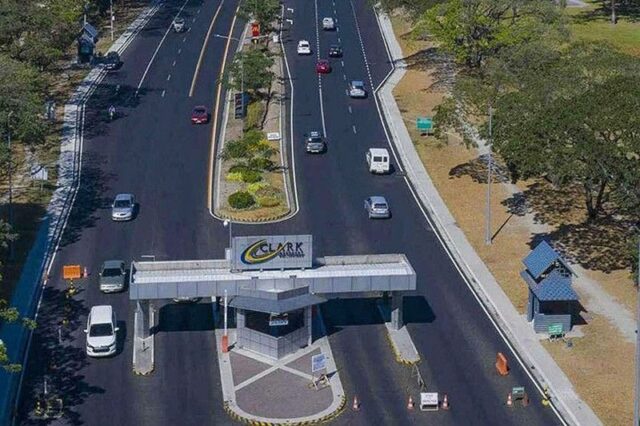
Marcos government sees New Clark City as alternate center of growth

BW FILE PHOTO

PHILIPPINE President Ferdinand R. Marcos, Jr. on Wednesday said he wants to develop a former US military air base south of the capital into an “alternate area” for growth.

The President inspected an P8.42-billion road project that will connect Clark International Airport to New Clark City, which is being groomed to become the country’s first smart city.

The 20-kilometer road is part of the government’s plan “to propel Clark as an alternate growth area,” he said in a speech after the inspection.

“It aims to enlarge Clark’s profile in the global investment map.”

The project, which includes a 900-meter bridge over the Sacobia River in the town of Bamban in Tarlac province, also seeks to enhance connectivity and trade between the central and northern parts of Luzon.

Mr. Marcos touted the modernization program for Clark International Airport and the construction of a rail linking it to Metro Manila.

“We are also building a Clark physical capital,” he said. “We are upskilling the required human capital that will run businesses and will drive prosperity.”

“Clark can now host a wide range of economic activities including innovation labs, creative workshops, manufacturing concerns, leisure complexes and a cyber-corridor,” Mr. Marcos said, adding that the government expects “higher visitor traffic” in return.

The 9,450-hectare New Clark City project is under the Bases Conversion and Development Authority (BCDA). It was proposed by the Aquino administration and was pursued by the Duterte government.

The smart city project, whose construction began in 2018, has been hounded by concerns about the displacement of about 65,000 people from a dozen villages, including about 18,000 members of the Aeta tribe.

Clark was transformed into a freeport and special economic zone in 1992 after the Senate rejected the renewal of the lease of the land for US military bases.

“Military lands converted into economic centers are the concrete proof of the prosperity BCDA has unleashed,” Mr. Marcos said in his speech. “There is no better proof of this than Clark.” — Kyle Aristophere T. Atienza

Inflation-indexed cash grants to boost consumption — IBON

PHILIPPINE STAR/ WALTER BOLLOZOS

A PHILIPPINE government plan to raise cash grants to the poor by indexing these to inflation amid spiraling prices is expected to boost the economy through increased consumption, a think tank said on Wednesday.

“The measure will boost household spending among recipient groups and contribute to gross domestic product growth,” Jose Enrique “Sonny” A. Africa, executive director of think tank IBON Foundation, said in a Facebook Messenger chat.

“Household spending has been conspicuously slowing since last year partly because of higher inflation and falling family incomes especially among the poorest,” he said.

The Philippine economy grew by 5.6% last year, falling short of the government’s 6-7% target as high interest rates tempered private consumption, which accounts for about three-fourths of the economy.

Household spending growth slowed to 5.6% from 8.3% a year earlier.

Social Welfare Secretary Rexlon T. Gatchalian on Tuesday said the state should consider the effects of inflation, which averaged 6% last year, breaching the central bank’s 2%-4% target.

He said President Ferdinand R. Marcos, Jr. has ordered the agency to ensure that social grants, especially the government’s flagship cash transfer program Pantawid Pamilyang Pilipino (4Ps), keep up with inflation.

An index-based mechanism should be completed immediately, he said. “We know that inflation hits the bottom 30% of our population more.”

Inflation slowed to an over three-year low of 2.8% in January, the second straight month it fell within the Bangko Sentral ng Pilipinas’ (BSP) 2-4% target.

“The suggestion to make social grants like 4Ps automatically indexed to inflation is very much welcome, especially in light of persistent inflation which is the top concern of Filipinos,” Enrico P. Villanueva, who teaches money and banking at the University of the Philippines Los Baños, said via Messenger chat.

“If welfare grants can be properly indexed to inflation, then the application and implementation of the concept may also be considered in other realms like wages,” he added.

The Philippine Senate on Monday approved on third and final reading a bill pushing for a P100 ($1.78) across-the-board minimum wage increase for workers in the private sector.

Under the 4Ps program, which provides conditional cash transfer to poor households for as long as seven years, a qualified child enrolled in daycare and elementary school gets at least P300 a month.

Beneficiaries in junior high school get at least P500 monthly, while those in senior high school get at least P700. It also gives qualified households a health and nutrition grant of at least P750 a month.

The program, which is patterned after cash grants in Latin America and African countries, started under former ex-President Gloria Macapagal Arroyo in 2006 and was institutionalized by her successor, the late Benigno S.C. Aquino III. It became a law in 2019.

Once the index is approved by economic managers, it will be introduced to the Legislative Executive Development Advisory Council, Mr. Gatchalian said.

“Most parties seem to acknowledge the positive impact of the suggestion on the poor, but operational concerns have to be resolved,” Mr. Villanueva said.

The Philippine Institute for Development Studies is mandated to recommend to the National Advisory Council whether cash grants should be adjusted.

The council must ensure that the aid is sufficient to “make a positive impact on health, nutrition and education,” according to the law.

“The formula for adjustments should also be considered in the budgeting process,” Mr. Villanueva said, citing the need to develop clear rules for 4Ps adjustments.

CASH OVER RICE
Also on Wednesday, congressmen urged the Social Welfare department to continue its distribution of cash aid instead of rice.

Distributing rice instead of cash raises procurement issues and could delay the aid, Marikina City Rep. Stella Luz Q. Quimbo told a news briefing.

“Cash is easier to distribute,” the lawmaker, who is also a senior vice chairperson of the House of Representatives committee on appropriations, said in Filipino. “The problem with rice is an agency would still have to procure it, and we know that we are not good in procurement.”

Agriculture Undersecretary Roger Navarro earlier suggested the distribution of rice aid to 4Ps beneficiaries.

“If you give cash to a poor family… it will still be allotted to your most basic need, which is rice,” Ms. Quimbo said.

Mr. Gatchalian earlier said it would be “logistically hard” to distribute rice. “We’re not saying no. Studies are ongoing, but taking into account the logistics needed so that our countrymen won’t suffer.”

Party-list Rep. JC Abalos said the government has systems in place for beneficiaries to receive cash grants.

Local regular milled rice costs P50.35 a kilo, while local well milled rice costs P52.21 a kilo, according to the Agriculture department’s latest price watch. Prices of imported regular milled and well milled rice are P50 and P54.26, respectively.

Mr. Abalos said a House measure seeking to adjust 4Ps cash grants for inflation has been fine-tuned by a technical working group for consideration by the plenary. — Kyle Aristophere T. Atienza and Beatriz Marie D. Cruz


Quiboloy claims US plans to kill him

PCOO

By John Victor D. Ordoñez, Reporter

A FILIPINO celebrity evangelist wanted by the United States government for sex trafficking claimed on Wednesday that instead of seeking his extradition, the US has supposedly hatched a plan to assassinate him in the Philippines.

“We have learned at this moment from reliable sources that… they allegedly no longer want an extradition,” Apollo C. Quiboloy, leader of the Kingdom of Jesus Christ religious group, said in an audio recording posted on Facebook.

“What they plan to do, according to the Central Intelligence Agency, the Federal Bureau of Investigation (FBI), the US Embassy, and the State Department… is ‘rendition,’ meaning they can enter my compound at any time and kidnap me.”

He added that US forces are likely to assassinate him once they enter his compound, noting that his 11 compounds in the country are under constant surveillance by drones.

Sought for comment, the US Embassy did not directly address his claims, but expressed confidence that “Quiboloy will face justice for his heinous crimes.”

“For more than a decade, Apollo Quiboloy engaged in serious human rights abuses, including a pattern of systemic and pervasive rape of girls as young as 11 years old, and he is currently on the FBI’s Most Wanted List,” US Embassy in Manila spokesperson Kanishka Gangopadhyay told reporters in Viber message.

Under US law, “rendition” is the surrender of a state of a fugitive in another state that has charged the person with a crime.

“They (Americans) will do whatever they want to do to me in my own country,” Mr. Quiboloy said.

Facing two subpoenas from both the Senate and the House of Representatives, he also said he would face allegations in court, not before Congress.

Congress is in the middle of investigating alleged cases of abuse against members of the religious group.

Mr. Quiboloy, who was former president Rodrigo R. Duterte’s spiritual adviser, had been indicted in a California district court on Nov. 10, 2021, and a federal warrant had been issued for his arrest.

In a statement on Wednesday, Senator Ana Theresia N. Hontiveros-Baraquel, who had issued a subpoena against the religious leader for not attending Senate hearings, said she would cite him in contempt and have him arrested if he continues to snub the Senate probe.

She had urged the Department of Justice (DoJ) to issue an immigration lookout bulletin order against Mr. Quiboloy to stop him from leaving the country amid the probe.

Gov’t Accountancy Office bill filed

SENATOR CHRISTOPHER LAWRENCE T. GO — PHILSTAR FILE PHOTO

A SENATOR has filed a bill seeking to establish the Government Accountancy Office, which would supervise all accounting functions of state agencies and streamline fiscal management in the Philippines.

“The Government Accountancy Office’s primary role will be to ensure that every peso allocated by the government is spent wisely, monitored closely, and accounted for accurately,” Senator Christopher Lawrence T. Go, who filed Senate Bill No. 2536, said in a statement on Wednesday.

He said the office, which would be under the supervision of the Department of Budget and Management, aims to use the latest forms of technology and methods to keep an eye on government spending and corruption.

Under the measure, the office seeks to make the oversight of financial operations more cohesive and efficient as Mr. Go cited an “over-reliance” on the Commission on Audit (CoA) to audit public spending.

It also aims to speed up government financial reporting and reduce redundant processes within the government.

“This move will not only safeguard public funds but also ensure that these funds are directed towards programs and projects that genuinely make a difference in the lives of our people,” Mr. Go said. — John Victor D. Ordoñez

Group urges building of climate-resilient classrooms

PHILSTAR

A BUSINESS group on Wednesday said the Philippines should prioritize building climate-resilient classrooms and exploring remote learning practices, following a Department of Education (DepEd) decision to bring back the pandemic-disrupted June-to-March academic calendar.

The decision, which was announced on Tuesday, should not be seen as a “stopgap measure to address the underlying issues that make the existing school calendar unbearable,” the Philippine Business for Education (PBED) said in a statement.

“To safeguard our children, we need to make sure that classrooms can withstand extreme weather conditions and have transportation support available.”

PBED said DepED needs to be firm with its decision this time so as to avoid learning disruptions.

“Our students need a fixed schedule.”

A DepEd order dated Feb. 19 scheduled the start of classes under school year 2024 to 2025 for July 29, cutting the end for the current school year by two weeks to May 31 from June 21 as it gradually reverts to the old academic calendar.

Classes for the same school year should end on May 16, 2025, according to the order.

DepEd said the return to the old calendar will be “gradual” to avoid major disruptions to the vacations of students and education workers.

PBED said the DepEd should also explore alternatives to face-to-face classes in the event of class suspensions.

“Now is the time for DepEd to institutionalize good practices from remote learning experience, whether through assigned modules, or online or broadcast classes.”

It should also find ways to offset the days lost due to national holidays and class suspensions, the business group said.

The DepEd decision “was a result of the clamor of teachers, students, parents and education support personnel,” House Deputy Minority leader and ACT Teachers party-list Rep. France Castro said in a statement.

The lawmaker noted that the El Niño weather pattern is now in its mature phase and the heat in classrooms is increasing.

“We hope that mitigating measures to reduce the inconvenience of teachers and students are now in place so that classrooms are still conducive to learning.”

“We urge the DepEd to ensure the continuous gradual return to the old school calendar in the next school years and that the proportional vacation pay of teachers would not be reduced,” she added.

In her second basic education report conducted last month, DepEd Secretary Sara Duterte-Carpio said her department will prioritize funding for schools that have makeshift or temporary classrooms and those in calamity-stricken areas with many unfunded and damaged buildings.

The agency will also focus on the construction of medium-rise school buildings in priority areas “with high classroom shortage but with limited buildable space,” she added.

The agency received P17 billion under the 2024 national budget for the construction of new school buildings, up from P15.6 billion last year.

ACT has been urging DepEd to allocate at least P100 billion every year for classroom construction to bring class sizes down to a manageable level. — Kyle Aristophere T. Atienza

Bill on LGU’s take from gaming OK’d

BW FILE PHOTO

CONGRESSMEN on Wednesday approved on second reading a bill that seeks to allocate 2% of the franchise tax collected from gaming operators licensed or operated by the Philippine Amusement and Gaming Corp. (PAGCOR) to its host local government unit (LGU).

Through voice voting at the plenary, lawmakers approved House Bill No. 9874, an amendment to Presidential Decree No. 1869, for the allocation of 2% of the 5% franchise tax collected from a PAGCOR-licensed gaming operator to the LGU where its operations are located. The remaining 3% would be given to the National Government.

“There is a necessity for a measure to be passed by the Congress to fix the host city shares to bolster PAGCOR’s commitment to nation building,” Parañaque City Rep. Edwin L. Olivarez said in his sponsorship speech.

Under the present setup, PAGCOR’s board of directors determines the amount of shares given to LGUs hosting licensed or operated gaming operations.

“The share in PAGCOR’s earnings is likewise limited to cities where PAGCOR conducts its gaming operations through Casino Filipino. Cities where casinos are being operated by franchisees, nonetheless, were not given host shares,” Mr. Olivarez said in an earlier version of the bill.

PAGCOR expects P336.38 billion worth of gross gaming revenues this year, chairman and chief executive officer Alejandro H. Tengco said in January. — Beatriz Marie D. Cruz


ADVERTISEMENT
ADVERTISEMENT