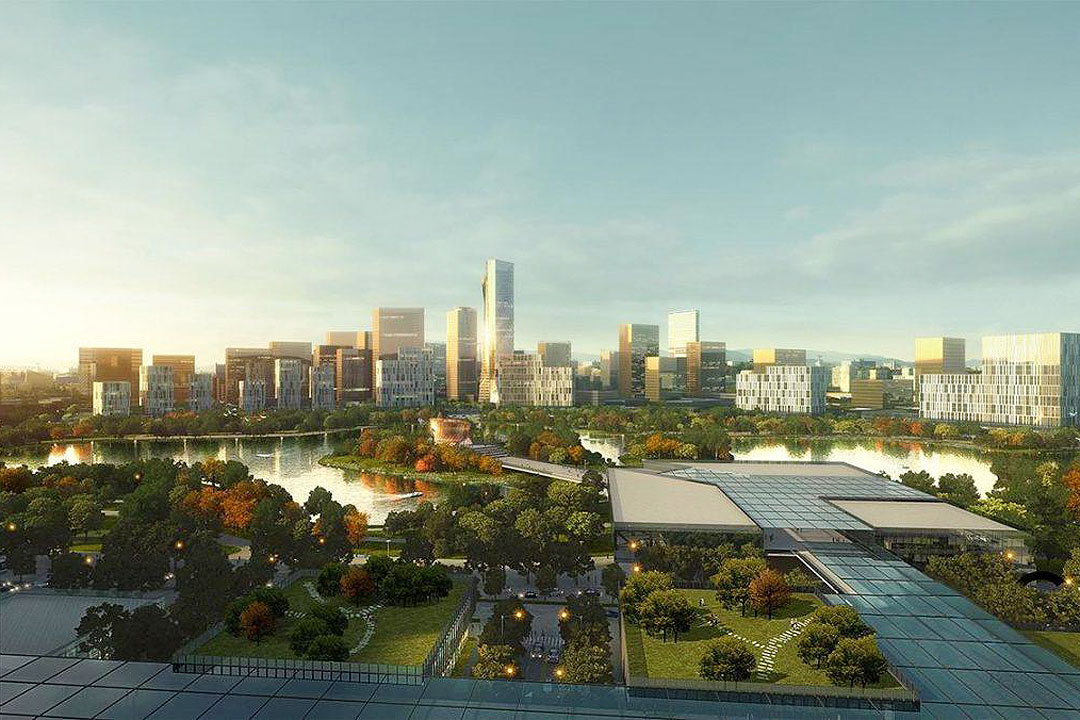
A HUB for artificial intelligence (AI)-native manufacturing will rise within New Clark City in Tarlac to support the transition to high-value industries, the Bases Conversion and Development Authority (BCDA) said.
In a statement on Monday, the BCDA said it has allotted 4,000 acres (about 1,618 hectares) in New Clark City for the hub, which will serve as a Pax Silica Coordination Office where technology firms, research institutions, and government agencies can converge to build a robust AI ecosystem, the BCDA said.
The Coordination Office is also the first of its kind under the Pax Silica partnership, which the Philippines formally joined over the weekend.
The Philippines is the 13th country to join the Pax Silica, a Washington-led initiative that seeks to link the global supply chain across critical minerals, semiconductors, advanced manufacturing, transportation logistics, and AI infrastructure.
The industrial hub will be located within the Luzon economic corridor, a zone that encompasses the ports of Subic, Manila, and Batangas and handles 80% of Philippine port traffic.
“It is being designated as a ‘Golden Node,’ a new model for AI-native investment acceleration hubs,” the BCDA said.
In a separate statement, Trade Secretary Ma. Cristina A. Roque said the AI industrial hub supports the objectives of the Philippine Semiconductor and Electronics Industry Roadmap.
“The AI-native industrial acceleration hub reinforces our semiconductor and electronics industry roadmap by linking our critical minerals advantage with our established strengths and by opening pathways toward higher-value and advanced manufacturing,” she said.
The roadmap sets targets for semiconductor exports of $70 billion by 2030, with the goal for electronics $40 billion.
The global AI chip supply chain is deemed at risk due to shortages of critical materials like hardware and helium.
BCDA President and Chief Executive Officer Joshua M. Bingcang said the hub boosts the Philippines’ role in the global AI supply chain, while supporting job creation.
It stems from the signing of the Philippine-US Memorandum of Understanding on Cooperation in Critical Minerals Development.
“The Philippines is ensuring that our mineral resources and strategic location are not simply supporting global industries from the margins but are actively harnessed to build the industries of the future,” Finance Secretary Frederick D. Go said.
At the end of February, exports of electronic products grew 20% to $8.24 billion, while semiconductor exports climbed 24.7% to $6.28 billion, according to the Philippine Statistics Authority. — Beatriz Marie D. Cruz