Home Blog Page 3630

DHI’s net profit surges to P277.3M

DOMINION Holdings, Inc. (DHI) saw its net income surge in 2023 as the company rebalanced its investment portfolio.

DHI’s net earnings stood at P277.3 million last year, up by 301.4% from P69.3 million in 2022, it said in a disclosure to the stock exchange on Thursday.

Its financial statement was unavailable as of press time.

DHI, formerly known as BDO Leasing and Finance, Inc., saw its gross income rise by 171.06% to P343.7 million in 2023 from P126.8 million the previous year “due to the rebalancing of its investment portfolio towards higher-yielding placements and debt securities,” it said.

Meanwhile, total resources stood at P6.38 billion. Its resources were made up mostly of investment securities, it said.

Stockholders’ equity increased to P6.37 billion, DHI added.

DHI’s parent BDO Unibank, Inc. booked a net profit of P18.7 billion in the third quarter of 2023, up by 16.5% year on year, amid higher interest income and lower provisions. — AMCS

Araneta Properties names Luis Araneta as new president

LISTED property developer Araneta Properties, Inc. has elected Luis M. Araneta as its new president.

Mr. Araneta is the company’s new president effective Thursday, replacing Crisanto Roy B. Alcid, according to a regulatory filing by Araneta Properties.

Mr. Alcid has been elected as the company’s treasurer, which was previously held by Mr. Araneta.

“We wish to inform you that due to the vast amount of work associated with Gregorio Araneta, Inc. and the Gregorio Araneta III Group of Companies, Mr. Alcid has tendered his resignation as the president of Araneta Properties, which the board of directors has accepted,” the listed property developer said.

In the first nine months of 2023, Araneta Properties posted a P19.68-million net loss, a turnaround from the P2.9 million net income in 2022.

The company’s nine-month revenue dropped by 42% to P27.45 million from P51.22 million in 2022.

On Thursday, shares of Araneta Properties fell 0.97% or one centavo to P1.02 apiece. — Revin Mikhael D. Ochave

TikTok, China and cyber-warfare

FLATART-FREEPIK

The Philippine military did the right thing in recently banning TikTok for its service personnel: “In AFP, the use of TikTok has been banned already. So we are not allowed to use TikTok. For one, because it’s an application made by China but is not used by China. So that in itself, we say go figure,” so says Armed Forces of the Philippines (AFP) spokesperson Col. Francel Padilla.

She later went on to clarify that this does not cover service personnel’s off-duty hours and yet “troops must also not post content on TikTok that would compromise their camps’ security,” while at the same time pointing out that the “AFP does not authorize TikTok on devices connected to the military network as personnel are prohibited from compromising the communication and physical security of their installations. ‘What we prohibit specifically are devices connected to the military network’” (a report from the Manila Standard, February 2024).

The AFP ban should really be replicated nationwide. Or at least for all government personnel and not only those of the security services (a recommendation proffered last year by National Security Council Assistant Director General Jonathan Malaya). As was pointed out here (“TikTok is not only annoying. It’s much worse than that,” February 2023), quoting a story from Science Times, April 2022: “‘TikTok brain is a real thing.’ Merely viewing a ‘90-second video clip from the mobile app causes problems in the collective attention span of a person. Now, experts are looking into its effects on kids’ brains using TikTok.’”

Ultimately, TikTok is a drug dealer and the drug is dopamine. And right now, 44.4 million Filipinos (with a staggering 67.9% of Filipinos aged between 16-64) are potential addicts. “The app features short videos of lip-synched songs, acting, dances and memes of various sorts. At first glance, TikTok seems like a harmless platform for sharing content and meeting new people. However, this application is a dopamine factory,” says a story on The Gauntlet (“TikTok is a dopamine factory,” February 2021).

“TikTok takes advantage of this pattern of behavior. Users receive a constant stream of new videos — a dopamine stimulation — every 15 seconds to one minute. In a Forbes article, Dr. Julie Albright, a sociologist specializing in digital culture and communication, mentioned that TikTok users find themselves ‘in this pleasurable dopamine state, carried away. It’s almost hypnotic, you’ll keep watching and watching’,” it continues.

The foregoing must be read in conjunction with the fact that the region’s obnoxious bully — China — has blatantly conducted anti-Filipino propaganda openly online. Mr. Malaya himself noted this in a 2023 interview with the Philippine Center for Investigative Journalism (PCIJ). “We’ve presumed there was a Chinese information operation [in the Philippines]. They operate everywhere in the world. But we started really being alarmed when we saw that there were Filipinos who were parroting the Chinese narrative,” he said. However, it was only last year that the National Security Council (NSC) “publicly recognized the existence of China’s ‘operators’ or ‘proxies’ undermining the country’s claims in the West Philippine Sea. (“Philippines confronts unlikely adversary in SCS row: Filipinos echoing ‘pro-Beijing’ narratives,” PCIJ, October 2023).

And make no mistake, at least in the theater of cyber-warfare, the country right now is locked in an overt and intense struggle against China: “Notably, the country is a prime target for cyber espionage activities conducted by nations like China, North Korea, and Russia. The looming potential conflict over Taiwan adds an element of unpredictability to the regional security landscape, with cyber-warfare being a significant concern.

Recent trends indicate a surge in ransomware attacks within the Philippines, with sectors like finance, government, healthcare, education, and retail being primary targets, with — more disturbingly — “a major data breach expos[ing] the personal information of millions of Filipinos, including records from crucial institutions like the Philippine National Police (PNP), National Bureau of Investigation (NBI), Bureau of Internal Revenue (BIR), and Special Action Force (SAF). Furthermore, the Russian market has witnessed the illicit sale of stolen data logs from compromised Philippine government subdomains.” (“Philippine threat overview,” Cyfirma, October 2023).

The Department of Information and Communications Technology came out with its 2022 National Cybersecurity Plan (NCSP), with its primary goals to include: “1.) assuring the continuous operation of the Philippines’ critical infostructure (CII), and public and military networks; 2.) implementing cyber resiliency measures to enhance ability to respond to threats before, during, and after attacks; 3.) effective coordination with law enforcement agencies; and, 4.) a cybersecurity-educated society.” The NCSP is “intended to shape the policy of the government on cybersecurity and the crafting of guidelines that will be adapted down to the smallest unit of the government.”

Indeed, while cyber-warfare will not take the place of conventional warfare, still its potential to disrupt our economy, energy structure, and socio-political cohesion — thus reducing our abilities to fight an actual war — is immense. The country must learn to absorb and mitigate the damage potential of cyber-warfare, including necessarily creating a legal infrastructure to address the various scenarios it can foreseeably create.

The views expressed here are his own and not necessarily those of the institutions to which he belongs.


Jemy Gatdula read international law at the University of Cambridge. He is the dean of the Institute of Law of the University of Asia and the Pacific, and is a Philippine Judicial Academy lecturer for constitutional philosophy and jurisprudence.

https://www.facebook.com/jigatdula/

Twitter  @jemygatdula

Who’s in charge of writing job descriptions?

I’m the human resources (HR) manager of a company with 200 plus workers. For the first time, we’re planning to come out with a job description program covering all jobs. The trouble is that some department managers refuse the responsibility when I ask them to write it. Please clarify. — Lone Ranger.

It’s a team effort led by the HR department conducting the orchestra so everyone plays a part in making good music. There must be a division of labor with HR taking the lead in policy formulation and data collection. This is a major task for the organization. But first, let’s agree on the parameters.

What is a job description? It’s a summary of tasks derived from another process called job analysis describing the duties performed, the skills and training needed, experience required, and the specific individual responsibilities. In short, a job description contains a list of tasks, duties, and responsibilities.

They are observable actions. A good job description must contain four specifications, known collectively as KASH, or knowledge, attitude, skills, and habits.

It’s a major program that your organization can’t ignore.

If you want to make it easy for you and other department managers, you can hire an external consultant to do the job. That’s assuming you have a budget of around $100,000 on the lowend for consultants without an extensive track record. This amount should alert you to the enormity of writing job descriptions, even for a company of 200 plus workers.

It takes time to do. That’s why you need the assistance of department managers to help you. They know the job better than other managers and the workers. This alone is an excellent argument why we can’t exclude managers (and workers) from the process.

ELEMENTS
To ensure the best possible job description, note the following components, which apply to all jobs, including new positions and any jobs which may have been consolidated from two or three old positions:

Position Summary. This is an abstract of the job. It includes a brief statement on the job’s rationale and the expected results. It must be concise so readers and workers readily understand management expectations. The statement must be crystal clear so the tasks can be readily differentiated from the responsibilities of their line executives.

Principal Duties. This part describes the expected end results to which an incumbent job holder must have the basic accountability and responsibility. This will be the basis for performance appraisals and evaluations. Every statement must start with an action verb like the following for a recruitment assistant: “Find the most qualified candidates for all job vacancies as may be required.”

Education and Experience. It includes the minimum level of formal education and work experience. If necessary, specify if the job requires a professional government license or similar certifications. HR and the concerned department manager may make exceptions by accepting bachelor’s degree holders with at least 10 years of work experience. This is called equivalency.

Confidential Data. Now that we have a law on Data Privacy, it has become easy for everyone to understand that certain jobs are required to properly manage sensitive data. This includes salary and benefits information, work performance issues, marketing strategies, and trade secrets.

Organization Chart. Every organization must have a clear organizational chart to answer the following questions at a glance: To whom does the job holder report to? What position and management level? What other jobs report to the same line executive? And if warranted, what positions report to this position?

JOB EVALUATION
One caveat. Writing the job description of every worker and manager in your organization is not the end-all of everything. It’s not a stand-alone program. It must be correlated with the job evaluation process and industry standards on pay and benefits, among others. It must be defined in relation to other jobs on the basis of qualifications required that may include educational attainment, work experience and the KASH factors.

The goal is to determine which jobs should get more pay and benefits when compared with other job holders. They must be evaluated based on their job content and weight of their contributions in achieving corporate objectives. To do this, HR may consider the three basic methods of job evaluation that includes ranking, classification and factor comparison.

This is another worthy project for HR and all department managers. We can take this up next time if you want. Therefore, be on your guard. Be proactive. Always keep in mind what’s good for your organization, and don’t lose sight of HR’s leading role in this endeavor.


Bring Rey Elbo’s leadership program called “Superior Subordinate Supervision” to your management team. Chat with him on Facebook, LinkedIn, X (Twitter) or e-mail elbonomics@gmail.com or via https://reyelbo.com

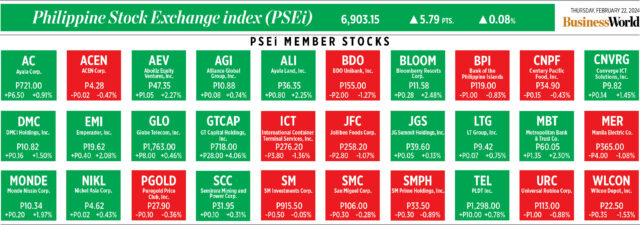
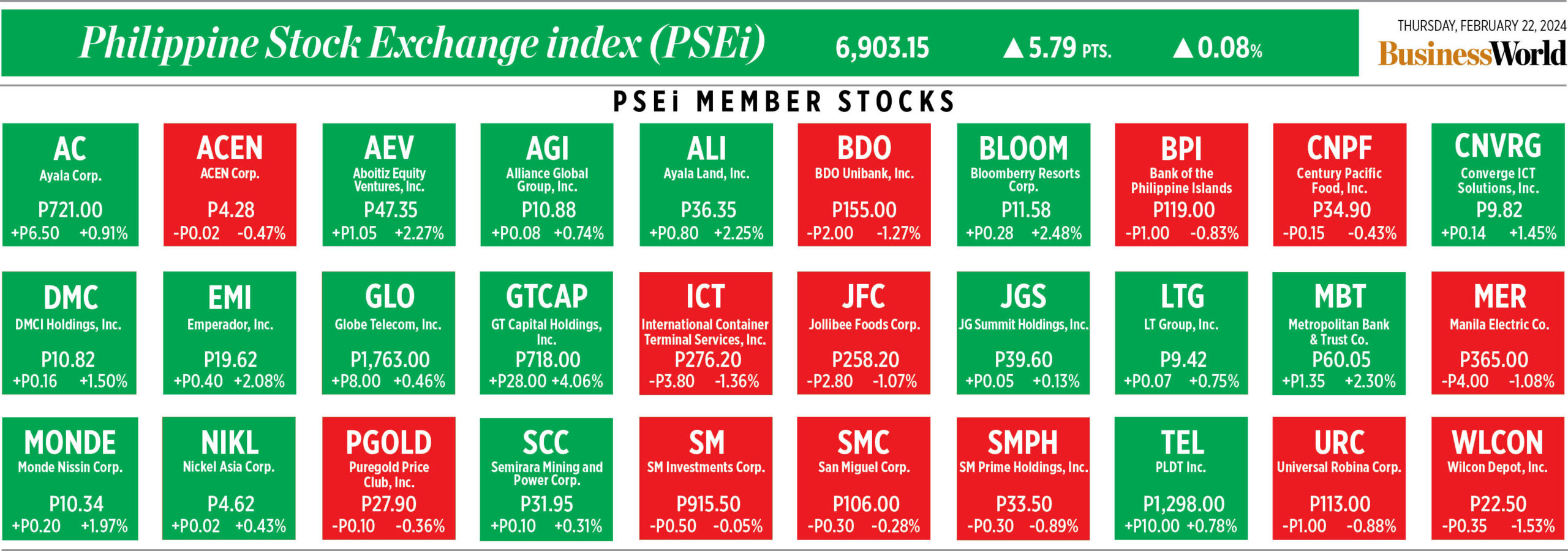
How PSEi member stocks performed — February 22, 2024

Here’s a quick glance at how PSEi stocks fared on Thursday, February 22, 2024.


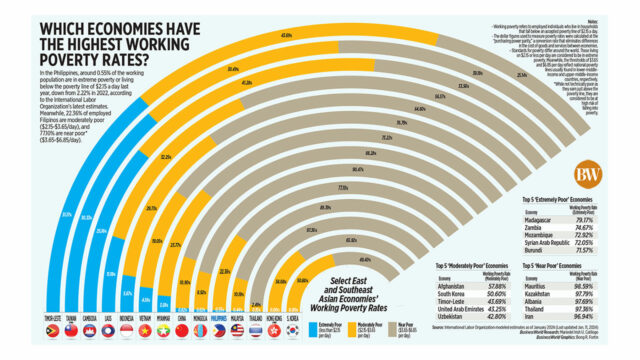
Which economies have the highest working poverty rates?

In the Philippines, around 0.55% of the working population are in extreme poverty or living below the poverty line of $2.15 a day last year, down from 2.22% in 2022, according to the International Labor Organization’s latest estimates. Meanwhile, 22.36% of employed Filipinos are moderately poor ($2.15-$3.65/day), and 77.10% are near poor* ($3.65-$6.85/day).


Which economies have the highest working poverty rates?

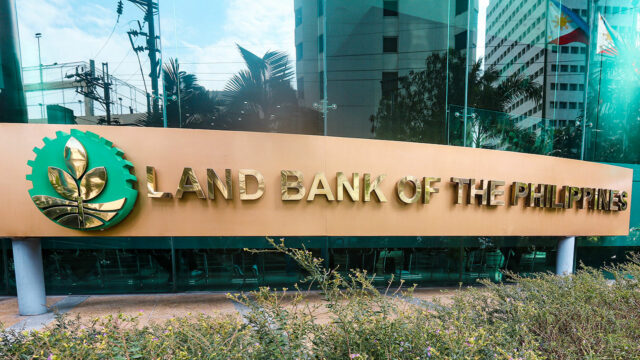
LANDBANK, DBP may be allowed to list shares

BW FILE PHOTO

By Luisa Maria Jacinta C. Jocson, Reporter

THE Department of Finance (DoF) said it is drafting bills to amend the charters of the two major state-owned banks, including provisions that will allow them to list shares.

“We are exploring the amendments to the charters of the Land Bank of the Philippines (LANDBANK) and the Development Bank of the Philippines (DBP), including their possible public listing, to broaden the capital markets,” Finance Secretary Ralph G. Recto was quoted saying in a speech.

Asked to elaborate, Mr. Recto replied in a text message: “We have a draft bill for both. We (will) release soon.”

Mr. Recto’s remarks provide an indication of the strategic direction being mapped out for the state-owned banks, after the government withdrew plans to merge the two institutions.

No further details were provided on the proposed charter amendments.

LANDBANK is the official depository bank of the National Government. It is also tasked to promote countryside development and spur credit activity and financial inclusivity for rural communities.

The DBP performs all the other functions of a thrift bank beyond its primary development mission. It services the medium- and long-term needs of agricultural and industrial enterprises, with a focus on small- and medium-scale industries.

LANDBANK posted asset growth of 4.2% to P3.3 trillion last year. It is the second-largest Philippine bank behind BDO Unibank, Inc.

The central bank reported that the DBP’s assets amounted to P978.5 billion at the end of the third quarter.

Mr. Recto had announced the cancellation of the planned merger, citing the two banks’ differing missions.

“It will be good to continue having two government depository banks,” he added.

The BSP also confirmed not to receive any application for the proposed merger.

In March, President Ferdinand R. Marcos, Jr. ordered the merger of the two lenders, with LANDBANK the surviving entity, becoming the sole authorized government depository bank.

Former Finance Secretary Benjamin E. Diokno had pitched the merger as a consolidation of resources to simplify dealings with counterparty banks and multilateral lenders.

Fitch Ratings, in a commentary, said that contributions of both state banks to the Maharlika Investment Corp. (MIC) “are unlikely to affect the banks’ issuer default ratings, which are driven by sovereign support.”

“However, the banks’ viability ratings, which indicate their standalone credit profiles, might be lowered absent concrete plans to replenish their diminished loss absorption buffers.”

Under the law, the LANDBANK and the DBP are required to contribute P50 billion and P25 billion to Maharlika, respectively.

“The investments would have significantly eroded the banks’ regulatory capital ratios if not for regulatory relief,” Fitch Ratings said.

“Without this relief, we estimate that the capital contributions would have shaved about 4.5 percentage points (ppts) off DBP’s common equity Tier 1 ratio of 13.2% and 3.6 ppts off LANDBANK’S common equity Tier 1 ratio of 14.5% as at September 2023.”

The credit rater said that this underpins its negative outlook on the banks’ capitalization scores, which it may revise down if the banks cannot replenish their capital buffers in the near to medium term.

“Regulatory relief that exempts the banks from deducting capital is insufficient to support the capitalization scores, as it does not improve the banks’ underlying capitalization,” it said.

“However, the planned exemption of dividend payments to the government could help rebuild capital to ameliorate the deficit.”

Fitch Ratings said that the banks’ investment in Maharlika “reinforces the government’s propensity to support the banks, as it further entrenches their policy roles, making them more strategically important to the state.”

Power supply seen as adequate despite El Niño

FREEPIK

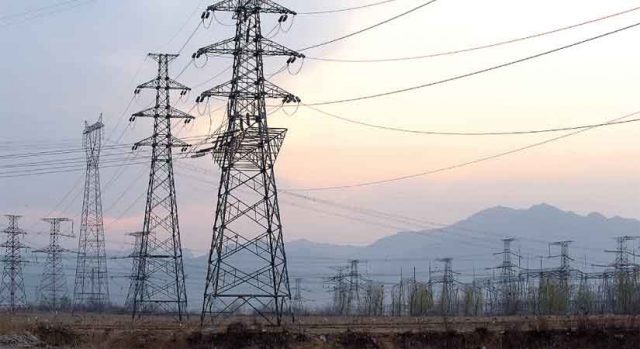
THE Department of Energy (DoE) said on Thursday that the power supply remains adequate even with El Niño putting pressure on hydropower generation.

“There is right now adequate supply but we will continuously monitor… the dams, (which have) good and adequate water supply,” Energy Secretary Raphael P.M. Lotilla told reporters in chance remarks on Thursday.

“But we’ve had to monitor also… because the agriculture sector has an increased need for irrigation… irrigation is also depleting the volumes for power use,” he said.

Mr. Lotilla said the Philippines is well-placed to deal with El Niño because of the relatively high reliance on natural gas-fired power plants vis-a-vis hydropower.

“Let’s continue to work on energy efficiency and conservation. Because that would really help us in addressing the cost. We don’t have to run the diesel-fired and the oil-based power plants, which usually increase rates,” he said.

Energy Undersecretary Rowena Cristina L. Guevara told reporters separately that the DoE is not projecting any yellow or red alerts at the moment.

“Based on the power outlook presented to us, so far wala naman tayong nakikitang yellow alerts or red alerts (we are not expecting red or yellow alerts),” she said.

In 2023, the Philippines raised two red alerts and eight yellow alerts, according to the DoE, well below the initial projection of 12 yellow alerts.

Yellow alerts are declared when the power supply falls below a designated safety margin, while red alerts are enforced when the supply situation deteriorates further, leading to power rationing in the form of rotating brownouts.

As of Friday, the Luzon grid has available generating capacity of 13,076 megawatts (MW), higher than the system peak demand of 11,029 MW, according to the National Grid Corp. of the Philippines.

“For Visayas, ’yun ang medyo manipis (supply is thin) … kasi ang margin natin typical day is anywhere from 8% only (On a typical day, the margin of supply over demand is only 8%),” Ms. Guevara said.

Sa Mindanao, talagang walang problema kasi 25-30% ang kanilang margin (There is no problem with Mindanao because the margin is 25-30%),” she said.

According to the government weather service, known as PAGASA (Philippine Atmospheric, Geophysical and Astronomical Services Administration), the El Niño is “ongoing and is expected to continue through January-February 2024,” likely persisting until May. — Sheldeen Joy Talavera

DENR agrees to simpler ECCs for offshore wind

CARL RAW-UNSPLASH

THE Department of Environment and Natural Resources (DENR) has agreed to simplify the process for issuing environmental clearance certificates (ECCs) to offshore wind projects, the Department of Energy (DoE) said.

The two departments signed a memorandum of agreement regarding the authority to grant access to offshore areas for exploration activities, specifically those covered by offshore wind energy service contracts.

The partnership seeks to assist developers in ensuring that their pre-development exploration activities are compliant within environmental rules and international best practices.

The agreement “actually simplifies the process for the issuance of the pre-development stage ECC,” Energy Secretary Raphael P. M. Lotilla told reporters.

The deal will “facilitate the rollout of the renewable energy projects,” he added.

To date, the DoE has awarded 82 offshore wind project service contracts with a potential combined capacity of 63.36 gigawatts.

“Exploration… may have a significant unintended impact on the environment given that installation, operation, and decommissioning, can potentially, cause some disruption and threaten marine, terrestrial, and socio-economic environments,” Environment Secretary Maria Antonia Yulo-Loyzaga said.

“And this is why it is essential that we work together and support each other in this endeavor,” she added.

Last month, the DENR issued the interim guidelines for issuing ECCs to offshore wind energy projects.

Energy Undersecretary Sharon S. Garin told reporters separately that the interim ECC process will allow developers to conduct studies in the potential resource area. — Sheldeen Joy Talavera

BoI backs CARS-like incentives within CREATE

REUTERS

THE Board of Investments (BoI) is seeking the inclusion of incentives similar to those of CARS (Comprehensive Automotive Resurgence Strategy) to be embedded within the Corporate Recovery and Tax Incentives for Enterprises (CREATE) law, potentially making domestic manufacturing more attractive.

“By incorporating that kind of incentive into the CREATE law, the BoI on its own can directly provide this type of incentive to our investors,” according to Elvin Raymond Garcia, supervising investment specialist of the heavy industry division at BoI, at the Auto Parts and Vehicles Expo 2024 media conference on Thursday.

“The CARS program under Executive Order (EO) 182… provides fixed investments and production volume support through a tax payment certificate scheme,” he added.

He said that because the program was established through an EO, applications for the incentives will have to go through a process which includes approval by the Fiscal Incentives Review Board.

According to Mr. Garcia, the CARS program opened up three slots for participants, of which only two were taken, by Mitsubishi Motors Philippines Corp. and Toyota Motor Philippines Corp.

The participants were given fiscal support through a non-transferable tax payment certificate, which can be used to defray the tax and duty obligations of the participants to the government. These cover excise tax, income tax, import duties, and value-added tax.

In exchange, participants undertake to assemble cars in the Philippines that are suited for large-volume sales.

Some 40% of the fiscal support is allocated for fixed investment support, and 60% constitutes production volume incentives.

“So in that sense, the participants (Toyota and Mitsubishi) opined that the CARS program incentives are more generous than the income tax holiday (ITH) currently offered under the CREATE law,” Mr. Garcia said.

“ITH is not enough to level up the industry, but maybe CARS-like incentives might be a solution,” he added, quoting Rommel R. Gutierrez of the Chamber of Automotive Manufacturers of the Philippines, Inc.

Mr. Garcia said the BoI supports House Bill (HB) 4206, which aims to strengthen the motor vehicle manufacturing industry.

HB 4602 proposes the inclusion of auto projects in the Strategic Investment Priority Plan (SIPP) for the next 12 years, he said.

“For our part, we have included motor vehicles in general, not just electric vehicles, in our listing under the SIPP since 2022,” he added.

BoI-registered investments in the automotive industry remain small, which the BoI plans to increase through more investment outreach.

“Particularly in the automotive industry, our largest investors are still Toyota and Mitsubishi … This is because we do not handle them if they invest or locate through the Philippine Economic Zone Authority or other investment promotion agencies,” he said.

“But we are working on attracting more. Actually, we are doing more investment outreach because the Department of Trade and Industry has this target of making the country the second-largest foreign direct investment destination,” he added. — Justine Irish D. Tabile

Palay farmgate prices up by 41% in January

THE farmgate price of palay, or unmilled rice, rose 41.4% year on year to an average of P25.08 per kilogram in January, according to the Philippine Statistics Authority (PSA).

In a report, the PSA said all regions recorded year-on-year growth in the average farmgate price of palay during the month.

The highest farmgate price gains recorded for January were in the Ilocos Region, where palay prices rose 52.2%. Central Luzon posted a price gain of 46.7%.

The lowest farmgate price gains were posted in Eastern Visayas at 3.3%.

On a month-on-month basis, the PSA said that the average farmgate price rose 9.6% from December, when the average was P22.89 per kilo.

It added that all regions except for Eastern Visayas saw a monthly increase in unmilled rice prices during the month.

The PSA said that Central Luzon reported the highest month-on-month rise at 27.2% from P21.91 per kilo the previous month.

Meanwhile, Eastern Visayas saw an 11.9% month-on-month decline in January compared with the P21.81 per kilo average the previous month. — Adrian H. Halili

Chamber says enforceability of contracts, fair competition key to boosting economy

THE Federation of Filipino Chinese Chambers of Commerce and Industry, Inc. (FFCCCII) said reforms that ensure the sanctity of contracts and fair competition will help strengthen the Philippine economy.

“We are optimistic about economic growth. The economy remains resilient amidst all the global challenges because our people are resilient and the Philippines still has positive macroeconomic fundamentals,” FFCCCII President Cecilio K. Pedro said in a statement on Thursday.

“Moving forward, we believe that we can do better in 2024 if we as a people unite and focus on strengthening our Philippine economy,” he added.

The economy grew by 5.6% in 2023, outpacing the 5.2% posted by China, 5% by Vietnam, and 3.7% by Malaysia.

He called for more reform aimed at attracting more investments centering on “the stability and predictability of contracts and policies to instill confidence in the business environment.”

He cited the need to promote fair competition by upholding “free market conditions and working towards reducing oligopolies, fostering a truly competitive business environment.”

Mr. Pedro also said that the FFCCCII supports the strengthening of export industries via “incentives and comprehensive support to enhance global competitiveness.”  — Justine Irish D. Tabile