
BSP survey: Filipino consumers to spend less in Q2
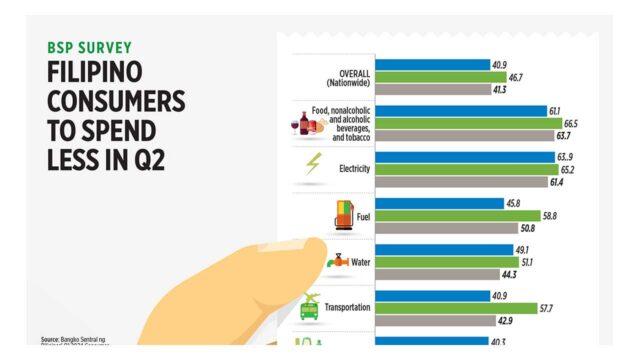
Consumers turned less pessimistic in the first quarter (Q1) amid expectations of improvements in income and employment, a survey by the Bangko Sentral ng Pilipinas (BSP) showed. Read the full story.

Consumers turned less pessimistic in the first quarter (Q1) amid expectations of improvements in income and employment, a survey by the Bangko Sentral ng Pilipinas (BSP) showed. Read the full story.

KPMG R.G. Manabat Foundation, the socio-civic arm of KPMG R.G. Manabat & Co. (KPMG RGM&Co.), had a ceremonial Memorandum of Agreement (MOA) signing for its Elevate AIDA (Artificial Intelligence Data Annotation) Program with Connected Women (CW), a socially responsible data and AI solutions company based in the Philippines, with a vision to power the inclusive workplace of the future by bringing women into tech at scale and a mission to elevate the lives of Filipino women through socially-responsible online work. The MOA was signed by KPMG RGM&Co. Chairman and CEO and Head of People, Performance and Culture (PPC) Sharon G. Dayoan and CW CEO Agnes Gervacio on 26 March 2024 at The KPMG Center in Makati City.
Elevate AIDA is a training program offered by CW which aims to provide data labeling skills, remote work skills, basic professional communication skills and basic computer skills to ten pre-selected women community residents from the host communities of KPMG R.G Manabat Foundation.
Prioritizing those who come from more vulnerable parts of the population, this collaboration’s goal is to improve the economic conditions of unemployed Filipinas by providing online skills development, on-the-job training and assistance with finding employment opportunities for the graduates of the program. Those who have completed the upskilling program can join the workforce pool of CW to deliver artificial intelligence data annotation services.

Several women leaders of KPMG RGM&Co., including Partners and Principals from Audit & Assurance, Tax and Advisory, were in attendance, demonstrating their support for this initiative to empower disadvantaged women.
“The partnership between our KPMG R.G. Manabat Foundation and Connected Women underscores our shared commitment to support women and equip them with the right skills to start and thrive in tech, promoting inclusion and helping uplift the lives of Filipino women,” shared Dayoan.
“We are grateful for the partnership with the KPMG R.G. Manabat Foundation. It is both inspiring and motivating to collaborate with like-minded organizations who share our desire to bring women into tech at scale and elevate the lives of Filipino women through socially-responsible online work,” Gervacio added.
Sharing a vision for empowering women, KPMG RGM&Co., through its KPMG R.G. Manabat Foundation, and CW are dedicated to fostering an inclusive workplace and advancing opportunities for Filipino women.
CW believes that technology can bridge the gender gap and create inclusive economic opportunities for women, training women in market-aligned skills and connecting them with income-generation opportunities. By leveraging the power of AI and digital platforms, they enable women to work from home, support their families, and contribute to the economy. CW has received global recognition in the categories of inclusive innovation, the future of work, e-employment, and women empowerment.
To learn more about partnering with Connected Women, visit www.connectedwomen.com.
Spotlight is BusinessWorld’s sponsored section that allows advertisers to amplify their brand and connect with BusinessWorld’s audience by publishing their stories on the BusinessWorld Web site. For more information, send an email to online@bworldonline.com.
Join us on Viber at https://bit.ly/3hv6bLA to get more updates and subscribe to BusinessWorld’s titles and get exclusive content through www.bworld-x.com.
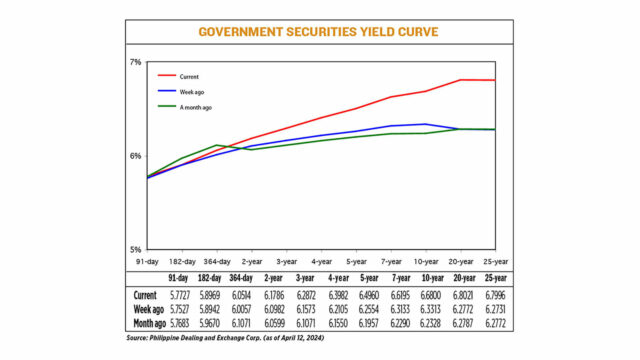
YIELDS on government securities (GS) climbed across all tenors last week following faster US consumer inflation that caused markets to scale back their expectations for Federal Reserve rate cuts.
GS yields, which move opposite to prices, went up by an average of 21.94 basis points (bps) at the secondary market week on week, according to the PHP Bloomberg Valuation Service Reference Rates as of April 12 published on the Philippine Dealing System’s website.
At the short end of the curve, yields on the 91-, 182-, and 364-day Treasury bills (T-bills) went up by 2 bps (to 5.7727%), 0.27 bp (5.8969%), and 4.57 bps (6.0514%), respectively.
At the belly, the rates of the two-, three-, four-, five-, and seven-year Treasury bonds (T-bonds) increased by 8.04 bps (6.1786%), 12.99 bps (6.2872%), 18.77 bps (6.3982%), 24.06 bps (6.4960%), and 30.62 bps (6.6195%), respectively.
At the long end, the 10-, 20-, and 25-year papers climbed by 34.87 bps, 52.49 bps, and 52.65 bps to yield 6.68%, 6.8021%, and 6.7996%, respectively.
Total GS volume reached P14.23 billion on Friday, higher than the P11.32 billion recorded as of Apr. 5.
“Yields are sharply higher because of hotter US consumer price index (CPI) data, which led to higher US Treasury yields. Traders are now forecasting less rate cuts this year,” the bond trader said in a Viber message.
US consumer prices increased more than expected in March as Americans continued to pay more for gasoline and rental housing, leading financial markets to anticipate that the Federal Reserve would delay cutting interest rates until September, Reuters reported.
The consumer price index rose 0.4% last month after advancing by the same margin in February, the Labor department’s Bureau of Labor Statistics said.
In the 12 months through March, the CPI increased 3.5%, the most since September. The CPI was also boosted by last year’s low reading dropping out of the calculation. It rose 3.2% in February. Economists polled by Reuters had forecast the CPI gaining 0.3% on the month and advancing 3.4% year on year.
The Fed last month kept its target rate at the 5.25%-5.5% range for a fifth straight meeting.
“Higher March inflation and upside risks to inflation such as El Niño, disruptions due to geopolitical factors, will tend to keep prices elevated moving forward… The Bangko Sentral ng Pilipinas (BSP) hints cuts could be pushed further in the year or in 2025,” said Jonathan L. Ravelas, senior adviser at professional service firm Reyes Tacandong & Co., added in a Viber message.
“Even in the US, with a faster than expected inflation is pushing rate cuts towards later in the year,” he added.
BSP Governor Eli M. Remolona, Jr. last week said the central bank is leaning towards being “somewhat more hawkish” as upside risks to inflation have worsened due to high food and transport prices.
The Monetary Board kept the target reverse repurchase rate steady at a near 17-year high of 6.5% at its meeting on Monday.
This is the fourth straight meeting that the BSP has kept borrowing costs unchanged since a 25-bp off-cycle rate hike in October that brought cumulative increases since May 2022 to 450 bps.
The BSP raised its baseline and risk-adjusted inflation forecasts to 3.8% and 4%, respectively, from 3.6% and 3.9% previously.
Inflation quickened for a second straight month to 3.7% in March from 3.4% in February.
For this week, the bond trader said GS yields could rise to track US Treasuries. — Lourdes O. Pilar with Reuters

ITALIAN fashion designer Roberto Cavalli, known for his animal-print designs loved by showbusiness stars, has died at the age of 83, his company said.
Mr. Cavalli, who founded his label in the early 1970s, had been ill for some time. He is survived by his six children and his partner Sandra Bergman Nilsson.
“The Roberto Cavalli company shares condolences with Mr. Cavalli’s family, his legacy remains a constant source of inspiration,” Sergio Azzolari, chief executive of Roberto Cavalli, said in a post on Instagram.
The designer died on Friday at his home in Florence, Italian news agency ANSA reported.
Mr. Cavalli, who used bright colors and patchwork effects in his often-revealing creations, was an extroverted art lover who wore tinted glasses and smoked a cigar.
He expanded into real estate and often spent evenings in his popular Just Cavalli Cafe, a nightclub in central Milan.
Giorgio Armani said he always had “enormous respect” for Mr. Cavalli even though his vision of fashion could not have been more different.
“Roberto was a true artist, wild and wonderful in his use of prints, capable of transforming fantasy into seductive clothes,” he posted on social media platform X.
A popular image of US supermodel Cindy Crawford in July 2000 shows her descending Rome’s Spanish steps in a Cavalli-designed long slip dress depicting a tiger face.
“You will be missed and you are loved by so many that your name will continue on, a beacon of inspiration for others, and especially for me,” said Roberto Cavalli’s creative director Fausto Puglisi.
The Florence-based fashion group is owned by Auriel Investment SA, controlled by Dubai’s Hussain Sajwani who rescued it in 2019.
Mr. Cavalli’s funeral will be held in Florence on Monday, Italian media reported. — Reuters
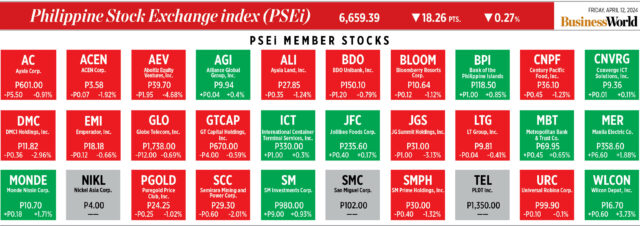
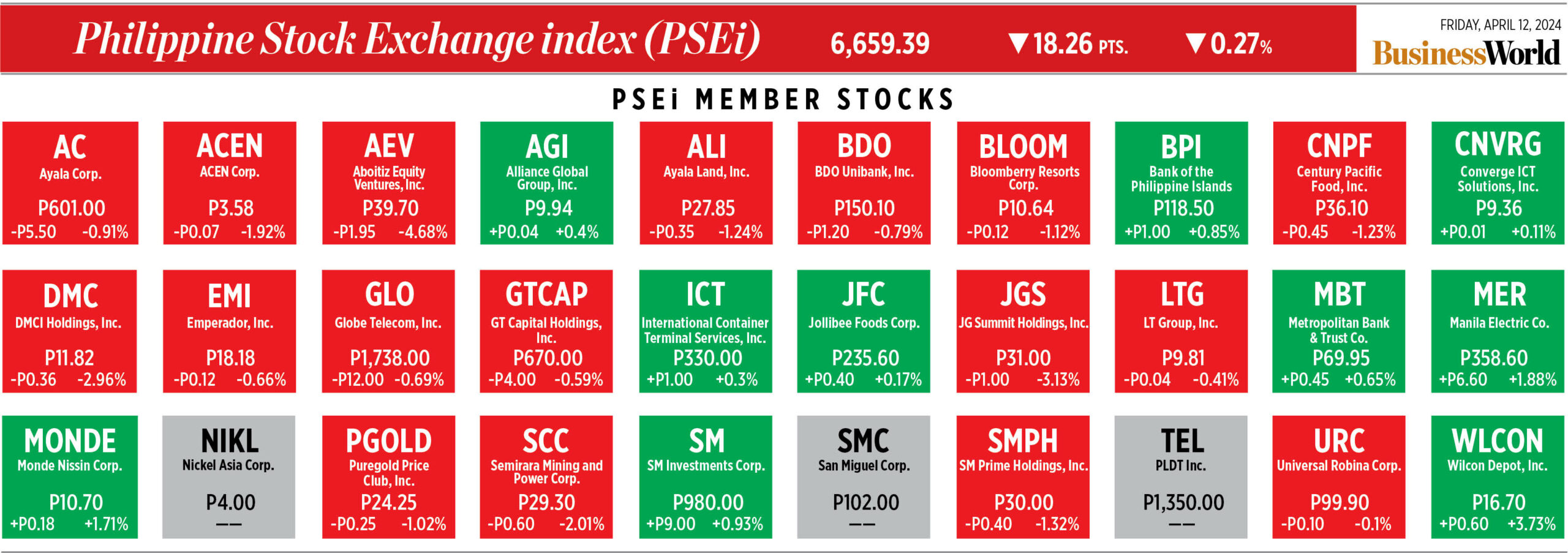
Here’s a quick glance at how PSEi stocks fared on Friday, April 12, 2024.


THE PESO may be broadly steady against the greenback this week ahead of the release of key economic data and expectations of a delayed start to the Bangko Sentral ng Pilipinas’ (BSP) easing cycle.
The local unit closed at P56.53 per dollar on Friday, depreciating by three centavos from its P56.50 finish on Thursday, Bankers Association of the Philippines data showed. Week on week, the peso likewise weakened from its P56.50 close on April 5.
The peso depreciated after hawkish signals from US Federal Reserve officials after higher-than-expected US consumer price index (CPI) data, Rizal Commercial Banking Corp. Chief Economist Michael L. Ricafort said in a Viber message.
The ranks of Federal Reserve officials saying there is no rush to cut interest rates continue to grow, with still-too-hot-for-comfort US inflation a rising concern at home and casting a shadow over expectations for policy easing abroad as well, Reuters reported.
“There’s no clear need to adjust monetary policy in the very near term,” New York Fed President John Williams told reporters on Thursday, a day after disappointingly strong consumer price inflation prompted traders and some analysts to predict a later start to Fed rate cuts, and likely fewer of them.
“Recent data suggest it may take more time than I had previously thought to gain greater confidence in inflation’s downward trajectory, before beginning to ease policy,” Boston Fed President Susan Collins said at a different venue in New York, adding that a strong labor market “also reduces the urgency to ease.”
The two were among several US central bankers voicing caution in recent days about moving too quickly to cut interest rates when inflation appears to be — at best — on what Fed Chair Jerome H. Powell has called a “bumpy” path back to the central bank’s 2% annual target.
Inflation is proving to be a stickier problem than US central bank officials had anticipated it would be just a couple of months ago, while other measures of the economy show little signs of slowing down. That combination has pushed the anticipated start of an easing cycle further down the road.
Richmond Fed President Thomas Barkin, who had already noted his concerns about the breadth of inflation being hard to “reconcile” with a near-term shift to rate cuts, said Thursday the latest numbers “did not increase my confidence” that price pressures were easing on a broader basis throughout the economy.
US consumer price index (CPI) data came in stronger than expected in March, prompting a broad resetting of expectations for when the Fed will be able to cut rates this year. Financial markets are now pricing in a July or September start to Fed rate cuts, versus an earlier view of June.
The CPI rose 0.4% last month after advancing by the same margin in February, the Labor department’s Bureau of Labor Statistics said.
In the 12 months through March, the CPI increased 3.5%, the most since September. The CPI was also boosted by last year’s low reading dropping out of the calculation. It rose 3.2% in February. Economists polled by Reuters had forecast the CPI gaining 0.3% on the month and advancing 3.4% year on year.
For this week, Mr. Ricafort said that the main driver for foreign exchange trading will be the remittances data scheduled for release on Monday (April 15) and the balance of payments report on Friday (April 19).
Markets also expect the BSP to extend its hawkish pause, which would help support and stabilize the exchange rate, Mr. Ricafort added.
The Monetary Board’s next policy meeting is on May 16.
BSP Governor Eli M. Remolona, Jr. last week said that the central bank is leaning towards being “somewhat more hawkish” as upside risks to inflation have worsened.
The BSP could cut rates as late as the first quarter of 2025 if these risks are not contained, Mr. Remolona added.
The Monetary Board kept its benchmark rate steady at a near 17-year high 6.5% for a fourth straight meeting at its policy review last week.
Security Bank Corp. Chief Economist Robert Dan J. Roces and Mr. Ricafort expect the peso to move between P56.30 and P56.70 per dollar this week. — L.M.J.C. Jocson with Reuters
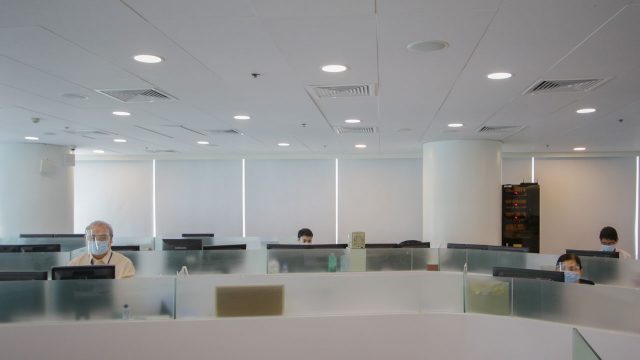
PHILIPPINE SHARES may move sideways this week as investors pick up cheap stocks and amid expectations of elevated interest rates here and abroad due to persistent upside risks to inflation.
On Friday, the 30-member Philippine Stock Exchange index (PSEi) fell by 0.27% or 18.26 points to end at 6,659.39, while the broader all shares index dropped by 0.24% or 8.47 points to close at 3,517.40.
Week on week, the PSEi went down by 1.28% or 86.07 points from its 6,745.46 close on April 5.
“The local bourse continued its slide this shortened trading week as macro headwinds persisted after another red-hot United States inflation print for March,” online brokerage firm 2TradeAsia.com said in a market note.
The US consumer price index (CPI) rose 0.4% in March, steady from the February level, the US Labor department reported last week. In the 12 months through March, the CPI increased 3.5% after rising 3.2% in February.
For this week, Philippine shares could move sideways as market players pick up bargains, Philstocks Financial, Inc. Senior Research Analyst Japhet Louis O. Tantiangco said in a Viber message.
“The local market is currently at a price-to-earnings ratio of 13.3 times, lower compared to its 2019-2023 average of 18.2 times. At its current position, bargain opportunities are seen. Hence, this week, we may see episodes of bargain hunting,” he said.
“However, worries over the Philippines’ inflation and interest outlook are expected to persist, which in turn may continue to weigh on the market. This comes amid the mounting inflationary risks that raise the possibility of a delayed rate cut by the Bangko Sentral ng Pilipinas (BSP). Concerns over the possibility of a delayed rate cut by the Federal Reserve amid the US’ inflation picture may also dampen sentiment,” he added.
BSP Governor Eli M. Remolona, Jr. last week said they could begin their policy easing cycle later than initially expected as they have become “more hawkish than before” due to persistent upside risks to inflation stemming from higher food and transport costs.
The central bank hiked borrowing costs by 450 basis points (bps) from May 2022 to October 2023 to help bring down elevated inflation.
Meanwhile, Fed officials last week said the faster-than-expected US CPI print in March shows inflation in the world’s largest economy remains sticky, reducing the urgency for rate cuts.
The Fed last month kept its target rate at the 5.25%-5.5% range for a fifth straight meeting following cumulative hikes worth 525 bps from March 2022 to July 2023.
“The next local policy rate-setting meeting on May 16 could match the Fed’s rate pause expected on May 1 in order to maintain healthy interest rate differentials to help stabilize the peso exchange rate,” Rizal Commercial Banking Corp. Chief Economist Michael L. Ricafort said in a Viber message.
Mr. Tantiangco placed the PSEi’s support at 6,400 and resistance at 6,700, while 2TradeAsia.com put immediate support at 6,500-6,600 and resistance at 6,800. — R.M.D. Ochave
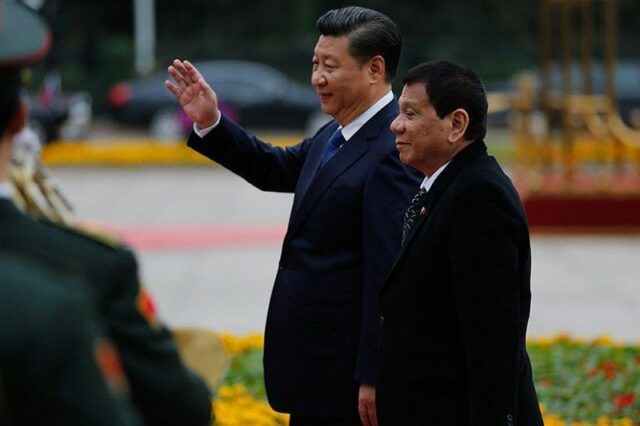
WHATEVER “gentleman’s agreement” former Philippine President Rodrigo R. Duterte had with Chinese President Xi Jinping away from public knowledge — like denying BRP Sierra Madre of building materials to reinforce its position in the South China Sea — is “constitutionally void,” a congressman said on Sunday.
Mr. Duterte allegedly struck an agreement with China to keep the status quo at Second Thomas Shoal, known to Filipinos as Ayungin Shoal, by not including building materials in its resupply missions to the World War II-era battleship grounded intentionally to secure Manila’s claim on the territory.
“The so-called ‘agreement,’ if any, is constitutionally void since it is tantamount to the surrender of our country’s sovereign rights over our exclusive economic zone,” Deputy Majority Leader and Mandaluyong City Rep. Neptali M. Gonzales II said in a statement.
Beijing urged the Philippines to uphold the supposed “gentleman’s agreement” which Mr. Duterte and Mr. Xi allegedly shook on to de-escalate the tensions over the South China Sea.
The Philippine government and Mr. Duterte himself has denied it was a pact.
“As is, where is. You cannot bring in materials to bring in and improve (BRP Sierra Madre), though there was no agreement,” Mr. Duterte said last week in a press briefer about the supposed agreement.
The Philippines intentionally grounded the ship at Second Thomas Shoal in 1999 to maintain Manila’s claim of the territory 200 kilometers west of Palawan Island and 1,000 km off Mainland China’s nearest landmass.
Manila’s effort to resupply a grounded ship has been repeatedly blocked by the Chinese Coast Guard, using water cannons that have resulted in the injury of Filipino troops.
“Like the President, I am truly horrified by the idea that our country’s territory, sovereignty, and sovereign rights may have been compromised by a deal guised as an ‘agreement’ to maintain the peace and status quo in the West Philippine Sea,” Mr. Gonzales said in a statement.
Last week, President Ferdinand R. Marcos, Jr. said he was “horrified by the idea” that the Philippines’ position might have compromised through a secret agreement Mr. Duterte might have made.
But Mr. Gonzales said the agreement is void as it is “equivalent to a new national policy, which must be enshrined in a treaty to be submitted to the Senate for ratification before it can take effect.”
Regardless of the nature of the agreement, it won’t be enforced by the Philippines as there was no executive agreement between Manila and Beijing on the matter.
“Since there is no official record under our records, the alleged ‘agreement’ may not be considered an executive agreement,” he added.
Mr. Gonzales said the issuance of Executive Order (EO) No. 57 signals the country is committed to upholding its sovereignty and territories amid China’s encroachment.
Activated under EO No. 57, the National Maritime Council is a government body tasked to formulate the country’s maritime strategy, a framework that would enhance the Philippines’ territorial and sovereign rights over its seas
CONGRESSIONAL PROBE
Zambales Representative Jefferson F. Khonghun wants a congressional probe into the supposed Duterte-Xi agreement. “It’s crucial to ascertain the truth if indeed the Duterte administration struck such a deal with China,” he said.
The House of Representatives expressed concerns that the alleged agreement shows Beijing’s increasing influence in the country’s domestic affairs, which could steer Manila’s policies in its territorial dispute in South China Sea.
The congressman said the House investigation would involve former government officials and diplomatic representatives to shed light on the reported pact.
“Now that Duterte has finally admitted to entering a secret deal with China, it is imperative that Congress hear House Resolution No. 1216 that we have filed as early as last year,” Party-list Rep. France L. Castro said in a separate statement.
House Resolution No. 1216 was filed last August and has remained pending with the House Committee on the West Philippine Sea since September. — Kenneth Christiane L. Basilio

TRANSPORTATION advocates bewailed the plight of commuters during transport strikes and blamed “faulty and uncoordinated government policy” that has done little to get the nation out of the mobility crisis that has plagued the country since 2019.
That reality kicks in today as jeepney drivers wage a strike against the Public Utility Vehicle Modernization Program (PUVMP), which effectively phases out traditional jeepneys; and the Metropolitan Manila Development Authority (MMDA) imposes its ban on light vehicles like e-bikes from traversing major thoroughfares.
“Unfortunately, ordinary Filipino commuters do not have a choice but to endure the suffering imposed on them by faulty and uncoordinated government policy. Despite all the crippling policies, people still need to travel to work, to school,” transport advocacy group AltMobility PH Director Ira F. Cruz told BusinessWorld in a Viber message.
He said the Philippines has been in a mobility crisis since 2019. “That year, we saw commuters walking on train tracks and people climbing through windows just to get a seat on a bus,” said Mr. Cruz. “The government wasted the unique opportunity during the pandemic to introduce much-needed improvement in transportation.”
Last week, major transport groups MANIBELA and PISTON announced a strike on April 15 to protest President Ferdinand R. Marcos, Jr.’s refusal to suspend or delay the April 30 deadline for franchise consolidation under the PUVMP.
Transportation expert Rene S. Santiago told BusinessWorld in a separate Viber message that “when there is a jeepney strike, restrictions on other vehicles like [light vehicles] and cars should be lifted” to prevent further transport woes for commuters.
British Chamber of Commerce Philippines (BCCP) Executive Director and Trustee Christopher James Nelson told BusinessWorld in a phone interview that businesses are not worried about the transport strike as they have switched to other forms of working, such as hybrid set-ups and adjusted work days.
“It’s not a general withdrawal of transport, but there are impacts. The PUVMP [and its effects] are not significant issue[s] to business groups,” he said.
Commuter-centered group PARA – Advocates for Inclusive Transportation Convenor Nanoy Rafael told BusinessWorld via Viber that the PUVMP, banning of light vehicles, and closure of the Philippine National Railway (PNR) are “not just results of simple state neglect but of the wholesale abandonment of the government in public transport as a service.”
“While there are rail projects, all of these are being funded through loans from foreign multilateral financial institutions like the ADB (Asian Development Bank). Fares will become more expensive, and the Filipino people will bear the burden of onerous loans with unfair structural adjustments attached,” Mr. Rafael said.
Meanwhile, Mr. Cruz said the country’s transport system “unnecessarily adds to household expense on transportation due to delays in the implementation of Automated Fare Collection System (AFCS) — a system that not only offers cashless payment but rationalizes fares.”
He cited a study from the Japan International Cooperation Agency (JICA), which said that traffic congestion in the National Capital Region a day amounts to the loss of at least P3.5 billion or P1.27 trillion annually.
Last week, Philippine President Ferdinand R. Marcos, Jr. addressed the traffic woes of Filipinos through a town hall meeting with various agencies.
He promised the government’s ramped-up efforts to finish railway projects that can help ease the traffic congestion in the capital region, dubbed as the world’s worst by the TomTom Traffic Index in January.
The President said ongoing railway projects, including the proposed Metro Manila Subway, are 41% done. — Chloe Mari A. Hufana

By Kyle Aristophere T. Atienza, Reporter
THE PHILIPPINES should expand its assertive transparency strategy at sea and go as far as encouraging its neighbors to carry out a similar initiative, which has enabled the Southeast Asian nation to secure key security deals in the face of an increasingly aggressive China, a geopolitical expert said.
“I believe the Philippines should actively encourage other countries to engage in their own assertive transparency efforts across other regions and other domains,” said Raymond M. Powell, SeaLight director at the Gordian Knot Center for National Security Innovation at Stanford University, citing the need to cover air and cyber domains and detect illegal activities at sea such as illegal fishing and coral harvesting.
“China’s gray-zone aggression has thrived for years, and for now it can hope to defeat transparency by intimidating the Philippines,” he said in a Facebook Messenger chat.
“But if transparency is widely applied, Beijing will have to reconsider its tactics.”
In the assertive transparency initiative, the Philippines seeks to expose the alleged aggressive and illegal acts of Chinese vessels within Manila’s exclusive economic zone (EEZ) in the South China Sea and expose them to public view.
It was launched last year with an initial focus on Second Thomas Shoal, in which Manila grounded a Navy ship in 1999 following China’s seizure of Mischief Reef, which also falls within the Philippine EEZ.
Chinese Coast Guard vessels backed by maritime militia ships have been conducting dangerous maneuvers and deploying water cannons to block Philippine resupply missions for Filipino troops stationed on the rusting ship.
The assertive transparency campaign of Manila has also prompted more studies on environmental destruction in the South China Sea, as the Philippines raises alarm over coral destruction in some features within its EEZ.
The Center for Strategic and International Studies earlier reported that China had destroyed at least 21,000 acres (about 8,500 hectares) of coral reefs within the Philippine EEZ.
Another think tank, the Asia Maritime Transparency Initiative (AMTI), has also attributed coral reef destruction in the waterway to Chinese activities such as dredging to build artificial islands as well as clam harvesting, among others.
In late March, AMTI said Second Thomas Shoal, Luconia Shoals, Scarborough Shoal, Vanguard Bank, and Thitu Island were the five features most frequented by patrols of the Chinese Coast Guard last year.
Mr. Powell said the transparency initiative has largely helped the administration of President Ferdinand R. Marcos, Jr. secure key maritime partnerships with the United States and its allies in the Indo-Pacific region.
The US, Japan, Australia, and the Philippines last week held joint drills in the South China Sea, and US National Security Adviser Jake Sullivan recently said the region “can expect more of this.”
“On the naval patrols, we just saw trilateral plus Australia, a new form of quadrilateral joint naval patrols last week, so you can expect to see more of that in the future,” he said ahead of US President Joseph R. Biden’s meeting with Mr. Marcos and Japanese Prime Minister Fumio Kishida.
“This is an important development, and the credit belongs to the Marcos Administration for its bold policy of assertive transparency, which convinced the US and other democratic nations that robust support to the Philippines is central to countering Beijing’s regional aggression,” Mr. Powell said.
Japan recently donated 12 coast guard vessels to the Philippines and plans to provide five more.
The US would deploy a coast guard vessel to the Indo-Pacific region this year and
Philippine and Japan coast guard members were expected to be onboard, according to a joint statement by Mr. Biden, Mr. Marcos, and Mr. Kishida after their trilateral summit.
Their coast guards would conduct an at-sea trilateral exercise and other maritime activities “to improve interoperability and advance maritime security and safety.”
The three nations have also established a trilateral maritime dialogue “to enhance coordination and collective responses.”
“It’ll be prudent to continue with this, along with demonstrating commitment to the minilateral and bilateral initiatives cultivated by the Philippines with these partners via concrete actions, which range across the spectrum from economic to diplomatic to security dimensions,” said Collin Koh, a senior fellow at the Institute of Defense and Strategic Studies at Singapore-based Nanyang Technological University’s S. Rajaratnam School of International Studies.
“Being consistent and principled is key to dealing with grey zone aggression such as the one presented by Beijing.”
But Mr. Koh said it may not be suitable for Manila to actively encourage countries in the region to launch efforts similar to its transparency initiative because many of its Southeast Asian neighbors are highly concerned over their economic ties with China.
“Some if not all ASEAN neighbors, especially concerned parties in the South China Sea who have their fair share of concerns with China’s behavior would have already been watching closely,” he said.
“That said, they don’t appear keen to emulate Manila because they’re more concerned about avoiding to rock the boat in their lucrative relations with China, especially given the economic stakes involved,” he added.
The Philippines, Vietnam, Brunei, and Malaysia — which are all ASEAN members — as well as Taiwan and China hold different but in some cases, overlapping claims over some features in the South China Sea, which Beijing claims almost in its entirety.
Vietnam has also been openly standing up to China’s aggression at sea, but it has remained firm to its nonaligned foreign policy.
The policy of Hanoi, whose largest trade partner remains to be Beijing, is to “not let the maritime disputes damage the upward trajectory of China-Vietnam relations,” Khang Vu, a pre-doctoral fellow at the University of Notre Dame’s political science department, said in an article for The Diplomat last month.
The Philippines and Vietnam in February signed two agreements to prevent any untoward situation in the South China Sea and boost maritime cooperation among their coastguards.
“The risk of Manila being too active in lobbying its fellow ASEAN members to adopt the same strategy is that not only this may fall upon deaf ears and meet a wall of indifference or inaction, but it could even potentially contribute to further intramural divisions,” Mr. Koh said.
“For now, while Manila continues with its efforts, it’ll help for it to engage its ASEAN neighbors bilaterally and even in minilateral formats, especially focusing on practical maritime cooperation,” he added.
Mr. Koh said a loose collection of different national approaches to South China Sea disputes may be the best “suitable course of action going forward, considering how individual Asean capitals perceive and weigh their stakes in the issue.”
China is the Philippines’ largest source of imports and second-largest export market. As Manila has pursued closer security ties with the US and its allies, economic gains also take center stage, with Washington announcing a plan to establish an economic corridor on the Philippine main island of Luzon.
The Philippines last year gave the US access to four more military bases on top of the five existing sites under their 2014 Enhanced Defense Cooperation Agreement (EDCA), and US Defense Secretary Lloyd J. Austin told Mr. Marcos at the weekend that the Biden administration was seeking a $128-million budget to execute EDCA projects.
The two countries held their first Maritime Cooperative Activity within Philippine waters in November 2023, with the third leg done in February this year. The treaty allies are set to hold their annual Balikatan (shoulder-to-shoulder) exercises on April 22 to May 18, with the participation of 5,000 Filipino soldiers and 11,000 US military personnel.
For the first time, it will be held beyond the Philippines’ 12-nautical-mile territorial waters, according to the Philippine military.
The Philippines and its allies should build “material and non-material” maritime capabilities that would maximize Manila’s potential as a middle force, Joshua Bernard B. Espeña, vice-president at International Security and Development Center, said in a Facebook Messenger chat.
“With more partnerships for capacity-building, the next move is to show that the Philippines is now fighting back with its new toys backed by bigger friends,” he said.
“The key is more eased military assistance financing, economic corridors to support a defense industrial base, and a feasible logistics framework for a comprehensive yet sustainable external defense from the shore to the seas,” he added.

IF CONCERNS about election systems would go unresolved, the biggest threat to the 2025 Philippine midterm elections would still be cheating, election watchdog Kontra Daya said over the weekend.
“Electoral fraud, both traditional and electronic, remains the biggest threat to electoral integrity,” Kontra Daya Spokesperson Maded N. Batara III told BusinessWorld in a Viber message.
Concerns about the integrity of the elections continue to hound the government as agencies remain vulnerable to cyberattacks, alarming the election watchdog to the susceptibility of the country’s automated poll system to manipulation.
“Electronic attacks against our election systems are very much a possibility,” Mr. Batara said. “It is something that our government has already (been) warned against as early as now.”
He said the government should look into preventing the electronic manipulation of ballots, especially as the Commission on Elections (COMELEC) awarded a new company to lead the automated poll system for the upcoming midterm elections.
South Korean company Miru Systems Co. Ltd. was awarded the P18-billion contract by COMELEC to run the country’s electronic poll system after the previous contractor was disqualified from further facilitating automated elections in the country.
COMELEC disqualified Smartmatic Corp. from participating in subsequent Philippine elections due to allegations of bribery in 2016 involving the company and then elections chairman Juan Andres D. Bautista.
“We should also be wary of electronic manipulation of ballots especially as we have a new, untested electoral provider,” Mr. Batara said.
Party-list Rep. France L. Castro said in a statement that Miru Systems’ “past failures” in other countries “highlight the significant risks” to the country’s stability as vote manipulation continues to be a threat for the coming elections.
Last month, the South Korean technology firm that will supply election equipment for the Comelec belied claims that its vote counting machines had been exposed for defects and electoral fraud in previous elections.
At a Senate hearing, Miru Chief Executive Officer Chung Gin Bok said his company’s vote counting machines did not malfunction during the 2018 Iraq elections nor in the elections in the Democratic Republic of Congo
“There were no defects or problems with the machines that were placed there (Iraq), or [with] any accounting or tallying results,” Mr. Chung said through an interpreter, adding that it was “the incumbent [who] was insistent with the manual recount.”
Mr. Batara said that electronic voting machines should be audited by election experts to verify their capacity to “count and deliver votes accurately.”
“Every step of the voting system must be audited externally by cybersecurity firms and election watchdogs so they may look for possible vulnerabilities,” he said.
The audit should include checking Miru System’s physical hardware and automated polling software and setting up and transportation of vote-counting machines to polling precincts.
“Any clear gaps or vulnerabilities should be assumed to be exploitable and fixed immediately, especially given the stakes at play in the next elections,” Mr. Batara said. — Kenneth Christiane L. Basilio
