Home Blog Page 332

Senate term-sharing may hold majority ahead of VP Sara’s impeachment trial

VICE-PRESIDENT SARA DUTERTE-CARPIO — PHILIPINE STAR/ RYAN BALDEMOR

By Adrian H. Halili, Reporter

A PROPOSED term-sharing arrangement in the Senate is aimed at keeping the chamber’s majority bloc intact as lawmakers brace for a possible impeachment trial of Vice-President (VP) Sara Duterte-Carpio, political analysts said.

Dennis C. Coronacion, chairman of the Political Science Department at the University of Santo Tomas, said the plan is less about strengthening leadership and more about preserving unity within the majority as the Senate confronts the prospect of sitting as an impeachment court.

“The move is not really to bolster leadership but to make sure that the majority remains intact while the Senate tackles the impeachment complaint against Vice-President Sara,” he said in a Facebook Messenger chat.

He added that senators tend to decide impeachment votes based on political loyalties rather than strictly on the merits of the case, making bloc cohesion a central concern for Senate leaders.

The proposal surfaced after Senate President Vicente C. Sotto III said last week that members of the majority bloc were considering appointing Senator Loren Regina B. Legarda as Senate president toward the end of the 20th Congress. Mr. Sotto said the arrangement was floated to head off a leadership challenge in the chamber.

The idea of rotating leadership underscores internal strains within the Senate majority, Mr. Coronacion said.

“This only shows that the majority bloc is not monolithic,” he said. “It consists of senators with diverse and sometimes conflicting interests, making it difficult for the Senate president to balance them.”

“In this case, Senator Sotto has even come to the point of being willing to give up his position just to keep the majority together,” he added.

Hansley A. Juliano, a political science lecturer at the Ateneo de Manila University, said the leadership plan highlights a deeper institutional weakness, where Senate politics remains driven by personalities rather than policies.

“Term-sharing is not unheard of,” he said in a Facebook chat. “But it reinforces the perception that Senate leadership is shaped by partisan convenience rather than policy agenda.”

Mr. Juliano said the move also appears to be a defensive measure against the possibility of a stronger pro-Duterte push in the upper chamber should impeachment proceedings advance.

“These things belie the overall hold of personality and partisan ties in an institution defined by clientelistic loyalties,” he said.

Anthony Lawrence A. Borja, an associate political science professor at De La Salle University, said the effectiveness of any term-sharing deal would depend on where Mr. Sotto and Ms. Legarda stand politically, as well as their ability to influence undecided senators.

“It is more accurate to see senators as individuals rather than fixed blocs, except for the Duterte bloc and the Liberal bloc,” he said in a Messenger chat. “Those blocs tend to remain solid, but the rest can still swing either way depending on their 2028 prospects and legislative calculations.”

Mr. Borja added that the impact of a term-sharing arrangement on legislative priorities would hinge on whether it is merely symbolic or reflects deeper disagreements within the majority.

“If it is cosmetic or based on a clear agreement on priorities, the impact on priority measures will not be as severe,” he said. If it reflects “deeper differences” between Mr. Sotto and Ms. Legarda, then it could lead to a kind of paralysis.

The maneuvering comes as impeachment efforts against Ms. Duterte regain momentum. Two impeachment complaints were filed against the Vice-President in the House of Representatives on Feb. 2, accusing her of misuse of public funds, corruption, unexplained wealth and betrayal of public trust.

The filings revive an attempt to remove Ms. Duterte from office after a previous effort stalled last year, when the Supreme Court ruled that earlier impeachment complaints violated constitutional rules.

If the House transmits articles of impeachment to the Senate, senators would be required to sit as an impeachment court, placing further strain on bloc unity and leadership stability in the upper chamber.

Ban foreign ownership of spying devices, Congress told

STOCK IMAGE | Image by Dee from Pixabay

By Kenneth Christiane L. Basilio, Reporter

PHILIPPINE LAWMAKERS should consider banning foreigners from owning communications-interference devices and penalizing possession even without proof of criminal use, the National Bureau of Investigation (NBI) said, as Manila steps up efforts to counter espionage and foreign interference risks.

In a position paper submitted to the House of Representatives’ National Defense and Security Committee, the NBI urged tighter regulation of equipment capable of intercepting or manipulating communications, warning that existing laws are ill-suited to modern surveillance threats.

“Foreign nationals found in possession of devices such as IMSI (international mobile subscriber identity) catchers, signal manipulators and mass-text systems typically have no lawful purpose for possessing such equipment within Philippine jurisdiction,” the bureau said in the document obtained by BusinessWorld. “Their possession alone indicates a high likelihood of misuse.”

IMSI catchers, which mimic mobile phone towers, can force nearby devices to connect and allow operators to intercept calls, text messages and location data.

Other tools can disrupt networks, harvest personal information or manipulate signals. The NBI said these technologies pose risks to national security, economic stability and individual privacy.

The recommendation follows arrests last year of suspected foreign spies accused of operating near the Presidential Palace, military bases and other sensitive locations. Authorities said the suspects used communications-interference devices and digital mapping technology to monitor activity in restricted areas.

“Over the past decade, cases involving foreign interference in the Philippines have increasingly been associated with Chinese nationals who utilize advanced communication and digital exploitation equipment,” the NBI said. It added that the same tools have been linked to mass-text spam, scam operations and identity theft.

The Chinese Embassy in Manila did not immediately reply to a Viber message seeking comment.

The bureau said foreign actors could now orchestrate large-scale interference that undermines public trust, compromises private communications and threatens critical infrastructure. It said requiring proof of actual misuse often allows suspects to evade prosecution, creating gaps in enforcement.

To address this, the NBI said proposed legislation should penalize foreigners for mere possession of communications-interference devices, even without evidence that a crime has been committed.

“This presumption of illicit intent recognizes the inherent risk such technology poses and addresses gaps in existing law,” the bureau said, arguing that the danger lies in the capability of the devices themselves.

Lawmakers are drafting an anti-foreign interference law, with several bills referred last week to a technical working group tasked with refining recommendations from security agencies, regulators and legal experts.

Jemy Gatdula, dean of the University of Asia and the Pacific Law School, said lawmakers should consider whether restrictions should apply beyond foreigners.

“If such devices indeed pose a security threat, then it makes sense to prohibit their possession regardless of who holds them,” he said in a Facebook Messenger chat, including Filipinos acting on behalf of a foreign country.

The NBI also urged Congress to allow authorities to immediately examine seized interference devices without securing a court warrant, citing the risk of remote deletion or encryption.

“Immediate forensic examination of seized devices is necessary to prevent the loss, encryption or remote destruction of critical data,” it said. “Traditional warrant processes are often too slow to preserve volatile digital evidence, as these devices may be programmed to self-delete or transmit data to remove servers.”

Security analysts said the proposal underscores how outdated the country’s espionage framework has become. “The Philippines is still operating under espionage laws crafted in the 1940s, which are no longer suited to the digital age,” said Chester B. Cabalza, founding president of the International Development and Security Cooperation think tank.

He said restricting possession of such devices would raise the cost and risk for foreign groups seeking to run covert intelligence or influence operations.

The National Privacy Commission said efforts to curb foreign interference should also cover paid online campaigns aimed at shaping public opinion.

Lawmakers should “define foreign influence or interference to include paid digital and social media campaigns intended to influence public opinion,” it said in a separate document obtained by BusinessWorld.

China has been accused of running information campaigns to weaken US interests in the Philippines while promoting pro-Beijing narratives, Reuters reported last year.

Sherwin E. Ona, an international fellow at Taiwan’s Institute for National Defense and Security Research, said any new law must clearly distinguish malign interference from legitimate diplomacy and soft-power activities.

He added that foreign organizations should be required to register with the government and declare their activities to separate legitimate operations from those meant to undermine the government.

Luzon, Visayas may see rain

DOST-PAGASA FB PAGE

LARGE parts of Luzon and the Visayas remain vulnerable to heavy rain from a shear line and the northeast monsoon, the state weather bureau said on Sunday.

The Philippine Atmospheric, Geophysical and Astronomical Services Administration (PAGASA) said rainfall will be driven by a shear line, which is expected to bring cloudy skies, scattered rains and thunderstorms over Southern Luzon and portions of the Visayas.

Northern Luzon will continue to see intermittent rain due to the northeast monsoon, locally known as amihan.

Metro Manila, Mimaropa, the Bicol Region, Quezon, Laguna, Rizal, Cagayan Valley and the Cordillera Administrative Region are among the areas forecast to experience rain.

PAGASA warned that rainfall of 50 to 100 millimeters may fall over Quezon, Camarines Norte, Camarines Sur, Albay, Sorsogon, Catanduanes and Oriental Mindoro, levels that could trigger localized flooding in low-lying and urban areas.

Similar rainfall amounts are forecast to persist on Monday across parts of Bicol and Eastern Visayas, including Northern and Eastern Samar.

The agency also issued gale warnings over northern coastal waters, including Batanes, the Babuyan Islands, Ilocos Norte and Ilocos Sur, advising small sea vessels to remain in port as seas may become rough to very rough. — Chloe Mari A. Hufana

P40-B calamity funds still untapped

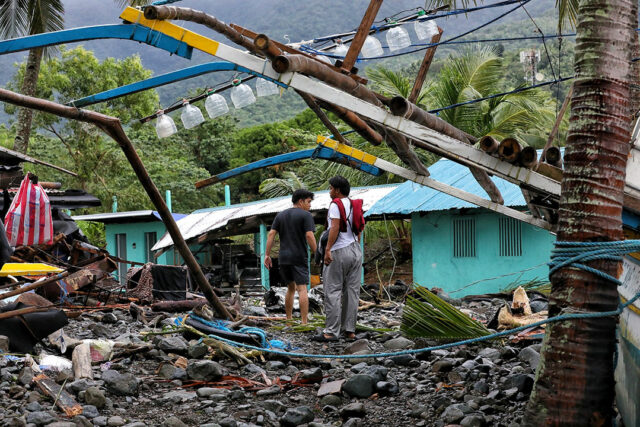
Strong winds and heavy rains brought by Super Typhoon Uwan caused damage to various structures in Barangay Aplaya, Dingalan, Aurora, Nov. 10, 2025. — PHILIPPINE STAR/WALTER BOLLOZOS

THE Philippine government has yet to tap its disaster‑response funds this year, leaving P40.15 billion unspent as of end‑January, according to the Department of Budget and Management (DBM).

In its latest National Disaster Risk Reduction and Management Fund (NDRRMF) report, the DBM showed no disbursements from P23.49 billion for the NDRRMF, P15.33 billion for the Disaster Rehabilitation and Reconstruction Assistance Program, and P1.32 billion for the People’s Survival Fund (PSF).

The PSF budget reflects P1 billion from the 2026 budget plus continuing appropriations from the prior year.

Last year, calamity funds released totaled P20.68 billion, with P322.86 million left undisbursed.

NDRRMF is meant for aid, relief and rehabilitation services to areas affected by human-induced and natural calamities, as well as the repair and reconstruction of permanent structures, including other capital expenditures for disaster operation, and rehabilitation activities.

Meanwhile, the annual PSF is intended for local government units and accredited local/community organizations to implement climate change adaptation projects. — Aubrey Rose A. Inosante

Remote workers’ allowance sought

A WOMAN in a remote meeting via videoconference works from her living room. — REUTERS

A SENATOR has filed a bill seeking to provide better incentives to remote workers in the country, in a bid to institutionalize flexible work arrangements.

Senate Bill No. 1739, filed by Senator Joseph Victor G. Ejercito, proposes to provide telecommuting workers with at least P1,000 monthly non-taxable telecommuting allowance.

He added that the bill seeks to amend Republic Act No. 11165, the Telecommuting Act, which allowed employees in the private sector to work from an alternative workplace.

“This bill aims to amend the Telecommuting Act to further strengthen and institutionalize telecommuting as a mainstream work option in the Philippines and not as a mere contingency plan,” he said in the explanatory note.

The proposed measure states that monthly allowances must not eliminate or diminish supplements, allowances, or other employee benefits serving a similar purpose.

Mr. Ejercito added that the bill proposes guidelines and safeguards to ensure that both employers and employees would benefit from flexible working arrangements.

“It promotes equity, protection, and productivity in a modernized labor environment,” he said.

The proposed measure mandates the Department of Labor and Employment, the Civil Service Commission, the Department of Finance, and the Bureau of Internal Revenue to craft implementing rules and regulations. — Adrian H. Halili

Senate pushed to pass OFW bill

A CONGRESSMAN on Sunday urged the Senate to fast-track its approval of a bill proposing a “reintegration” scheme for returning overseas Filipino workers (OFWs), amid an expected influx in the first quarter.

In a statement, Party-list Rep. Jude A. Acidre said senators should swiftly pass their version of a measure that would support the assimilation of OFWs, helping them transition back into local employment after working abroad.

The House approved House Bill No. 6643 in December 2025, sending it directly to the Senate for their counterpart action, he said.

“Every first quarter of the year, we see OFWs come home with plans to rebuild their lives,” Mr. Acidre, who heads the House Overseas Workers Affairs Committee, said. “This bill ensures they are not left to navigate that transition alone, but are met with clear pathways to work, livelihood, and family stability.” — Kenneth Christiane L. Basilio

Full enforcement of laws vs online child exploitation urged

STOCK IMAGE | Image by Gerd Altmann from Pixabay

THE Commission on Human Rights (CHR) urged the Philippines to shift from awareness campaigns to sustained enforcement as online child sexual abuse and exploitation continue to grow alongside wider digital access and persistent poverty.

The CHR said that future child protection efforts will depend on how effectively authorities implement existing laws and strengthen safeguards in both physical and online spaces, warning that risks have become more complex and entrenched since the pandemic.

“Protecting children now requires sustained vigilance and robust safeguards across both offline and online spaces,” it said in a statement on Sunday.

Data from the commission’s Child Rights Center show more than 2.7 million cyber tipline reports were recorded in 2023, highlighting a sharp rise in online sexual abuse cases driven by economic vulnerability, family involvement, and chronic underreporting.

The CHR stressed the need for full enforcement of Republic Act No. 11930, the Anti-OSAEC (online sexual abuse and exploitation of children) law, alongside the country’s obligations under the United Nations Convention on the Rights of the Child, to ensure accessible, child-sensitive, and trauma-informed systems for reporting, rescue and prosecution.

It said protecting victims will require wider use of measures such as prerecorded testimonies to prevent re-traumatization, as well as expanded psychosocial services and livelihood support for households at most risk.

“Beyond annual observance, protecting children from sexual abuse and exploitation demands a consistent and collective willingness to confront uncomfortable truths, challenge harmful norms, and strengthen protection systems so they can respond more effectively to evolving risks,” said the CHR.

It also called for stronger collaboration with internet service providers and digital platforms to detect and disrupt online exploitation, while continuing to monitor related risks such as child labor, displacement, and early marriage. — Chloe Mari A. Hufana

Migrant workers group calls for release of Mary Jane Veloso

PHILIPPINE STAR/MIGUEL DE GUZMAN

AN OVERSEAS Filipino workers (OFWs) group on Sunday urged President Ferdinand R. Marcos, Jr. to order the release of drug convict Mary Jane F. Veloso, stressing that petitions for her release have long been filed by migrant advocates and rights groups.

“Now, as Marcos, Jr. refuses to hear her every appeal for her freedom, let us collectively amplify Mary Jane’s story and voice from prison to Malacañang and win her the justice and freedom she deserves,” Migrante International Chairperson Joanna Concepcion said in a statement.

The group added that the Marcos administration has already received petitions and appeals to grant Ms. Veloso clemency. Groups have also filed an appeal to the Supreme Court to expedite cases against her recruiters.

Ms. Veloso continues to claim innocence, and echoed calls for her immediate release.

“I wish for nothing more than to be with my family who have been separated from me for more than 16 years. I hope to be given the opportunity to take care of my parents while they are still alive and especially,” she said in a letter sent by Migrante.

“For some reason, after one year, I am still here in prison even though I have not committed any wrongdoing, even in our country,” she added.

She said that her family has experienced difficulties in visiting her in prison, having to travel eight to 10 hours.

Ms. Veloso was arrested in Yogyakarta, Indonesia in 2010 with 2.6 kilograms of heroin concealed in a suitcase, she claims that she was coerced to be a drug mule.

She was spared from death row in 2024 after Manila and Jakarta signed an agreement transferring her custody and is currently being detained in the Correctional Institute for Women in the Philippines. — Adrian H. Halili

P8-B irrigation initiatives to boost Ilocos Region farm productivity

URDANETA CITY, Pangasinan — Some P8 billion worth of irrigation projects are expected to expand irrigated farmlands, stabilize water supply and boost rice production benefitting farmers across the Ilocos Region.

Acting Regional Manager Engr. Geffrey B. Catulin said the funding will support major irrigation lines, rehabilitation of national and communal systems, solar-powered pumps, and critical repairs, with 236 projects lined up for implementation. These are expected to improve farm productivity and reduce farmers’ dependence on rain-fed agriculture, he added.

The National Irrigation Administration (NIA) in the region is also racing to complete 79 irrigation projects from 2025 worth P2.7 billion, with 65.5% already accomplished.

Mr. Catulin said construction schedules are timed around harvest seasons to avoid disrupting farming activities, with most projects expected to be completed before the end of June.

Among the flagship projects is the P37.5-billion Ilocos Norte-Ilocos Sur-Abra Irrigation Project, which aims to open thousands of hectares to irrigation once completed.

Other key initiatives include small reservoir irrigation projects in Ilocos Norte, La Union, and Pangasinan, designed to provide reliable water during dry months and protect crops from climate-related losses.

NIA said the expanded irrigation network will directly support farmers by increasing cropping cycles, lowering production risks, and raising yields — key steps toward achieving rice self-sufficiency in the Ilocos Region and strengthening the agricultural backbone of Northern Luzon. — Artemio A. Dumlao

ASEAN digital economy deal seen lowering business costs

A WOMAN in a remote meeting via videoconference works from her living room. — REUTERS

BUSINESSES are expected to enjoy lower costs and smoother cross-border digital trade within five years at the earliest as the Association of Southeast Asian Nations (ASEAN) prepares for the signing of the Digital Economy Framework Agreement (DEFA) this year, the Philippine Chamber of Commerce and Industry said. 

In a policy brief, the chamber said that although no immediate changes, particularly in Philippine laws, are expected, regulatory alignment and cooperation can begin to take shape in the first three years.

“Bigger benefits such as lower compliance costs and smoother cross-border digital trade are expected over five to 10 years,” it added.

Once signed, the DEFA will set common rules for e-commerce, digital trade, data flows, cybersecurity, digital payments, emerging technologies, and movement of digital talent.

“The stakes are enormous. ASEAN’s digital economy is already on track to reach about $1 trillion by 2030. With DEFA in place, that number could double,” it said.

“For the Philippines — one of the fastest-growing digital economies in the region — this represents a historic opportunity to scale up exporters, attract investment, and position Filipino workers at the center of regional digital value chains,” it added.

The benefits of the agreement include lower compliance costs, more predictable rules, and easier access to customers across the region.

“For micro, small and medium enterprises (MSMEs), it could reduce the uncertainty that often discourages small firms from selling abroad,” it said.

“For the information technology and business process management and digital services sector, DEFA could support trusted data flows, regional recognition of skills, and new demand for high-value services,” it added.

However, the group said that the DEFA is no substitute for domestic reform, which presents the need for the country’s continued investment in broadband, digital skills, logistics, MSME financing, and competition policy.

“The agreement opens doors, but we still need to help Philippine firms and workers walk through them,” it said.

“DEFA positions ASEAN and the Philippines as a serious trade bloc. For Philippine firms, it means more customers, more opportunities, and a clearer path to compete regionally in the digital economy,” it added. — Justine Irish D. Tabile

Refrigerated-container congestion crisis seen looming at Manila port

HAPAG-LLOYD.COM

THE Bureau of Customs (BoC) needs to address congestion at the reefer yard utilization at the Manila International Container Port, with overcapacity raising the threat of spoilage for refrigerated goods, the United Port Users Confederation of the Philippines (UPC) said.

In a letter to Customs Commissioner Ariel F. Nepomuceno on Feb. 3, UPC President Ma. Flordeliza C. Leong flagged the port’s reefer yard utilization rate.

“Operating at over 100% capacity in the reefer segment indicates that the facility has exceeded its designed electrical and spatial limits for temperature-controlled cargo,” she said.

According to a Customs report, reefer yard utilization at Manila International Container Port hit 105.98% on Feb. 2, while overall yard use stood at 81.99%.

By Feb. 6, utilization for refrigerated-container storage had eased to 95.87%, while overall utilization edged up to 82.15%.

Ms. Leong cautioned that power fluctuations and cooling shortfalls could compromise cargo integrity.

She also noted the risk of operational bottlenecks as saturated reefer yards force “double-handling,” slowing truck turnarounds, raising logistics costs for port users, spilling over into general operations.

The UPC urged authorities to fast-track reefer processing and clearance to ease congestion and to review overstaying units.

The group also pressed Mr. Nepomuceno to spell out contingency measures for the 5.98% excess volume at the reefer yard and called for full enforcement of Customs Memorandum Order No. 13-2019 on empty container returns.

Ms. Leong separately appealed to the BoC to order haulers to move empty containers to depots such as EMME Depot Hub in Binakayan, Cavite, which can hold up to 5,000 TEUs, at shipping lines’ expense.

“This can be a temporary or permanent solution for haulers and brokers currently reeling from the problems brought about by these unreturned containers,” she said. — Aubrey Rose A. Inosante

PHL urged to fortify cybersecurity via legislation

REUTERS

THE PHILIPPINES must pass legislation and strengthen its national cybersecurity plan to safeguard critical infrastructure networks, which remain highly vulnerable, cybersecurity advocates said.

“After (open access, the next issue) is improving accessibility and security. Cybersecurity and critical information infrastructure protection should be next step,” Mary Grace Mirandilla-Santos, ICT policy analyst at Secure Connections told reporters on the sidelines of Philippine Telecommunications Summit last week. 

Ms. Mirandilla-Santos was referring to the Konektadong Pinoy Act, also known as the Open Access in Data Transmission Act, which lapsed into law last year. This  law streamlines the licensing process for new entrants, boosting competition in data transmission.

She said that as the government works to expand connectivity, it must also strengthen cybersecurity measures, since opening up connectivity can magnify threats.

“When you have more connectivity, the threat landscape becomes larger. We need to make sure that everything is secure, we need to have minimum cyber security standards across the board,” she said.

The Philippines does not have a cybersecurity law and relies on issuances and policies set by the Department of Information and Communications Technology (DICT).

Ms. Mirandilla-Santos said that while the issuances are effective because the DICT proactively addresses issues, legal barriers remain that need to be resolved.

“We need a law,  a cybersecurity law that will require both the government and the private sector, those who are operating critical infrastructure, to comply with minimum standards for cybersecurity, to make sure that they have personnel that are trained for cybersecurity,” she said. 

Samuel V. Jacoba, founding president of the National Association of Data Protection Officers of the Philippines, said legislation must define a unified cybersecurity framework including government agencies but also critical information industries.

The proposed Philippine Cybersecurity Act seeks to establish a National Cybersecurity Agency as the central authority for safeguarding critical information infrastructure, managing cyberthreats, and strengthening the country’s cyber defenses. — Ashley Erika O. Jose

ADVERTISEMENT
ADVERTISEMENT