Home Blog Page 3238

Growth momentum key to Philippines’ upper middle-income goal

ALEXES GERARD-UNSPLASH

At the BusinessWorld Economic Forum (BWEF) 2024, which was held on May 22 at the Grand Hyatt Hotel, National Economic and Development Authority (NEDA) Secretary Arsenio M. Balisacan reiterated the economic team’s target of having the Philippines become an upper middle-income country (UMIC) by 2025. See this story in BusinessWorld, “PHL on track to reach upper middle-income status, says NEDA chief” (May 24).

A UMIC is a country that has a gross national income (GNI) of between $4,466 to $13,845 per person per year. GNI is computed by taking gross domestic product (GDP) minus net primary income from abroad (NPIA), mainly but not entirely overseas Filipino worker (OFW) remittances. In 2023, the GNI of the Philippines at current or nominal prices was P26.99 trillion while GDP was P24.32 trillion, so the NPIA was P2.67 trillion.

In per capita values in 2023, GNI was P241,165 or $4,335 at an average exchange rate of P55.63/US$ last year, and GDP per capita was P217,300 or $3,906. This means that we only need to increase our GNI per capita by $131 or P7,362 at P56.20/US$ to be a UMIC this year.

We need this kind of increase in per capita income to further attract investments, domestic and foreign. Investors should know that not only is our total population or consumer base rising, but so is the spending capacity per person. So, they will put their money and investments here, or expand existing ones, which will create more jobs and further raise our per capita income.

The average share to total GDP from 2019 to 2023 were: household consumption (C) 73%, capital formation or investment (public plus private) 23%, and government consumption 14%. So, it is C that really drives — pulls up or down — overall GDP and GNI, and we are curious to see what would further raise C. After all, someone’s spending is someone’s production, or a family’s demand is another family’s supply.

I checked the growth rate of GDP and C and compared it with the overall inflation of the Philippines. There is indeed an inverse relationship between the inflation rate and C: When inflation is low, say below 4%, C is high, between 5.5% to 6.2%, and consequently, GDP is high, 6.2% to 6.6%, as it was from 2010 to 2019. When inflation is high, above 4%, C is low — C was only 4% from 2005 to 2009, and 2.5% from 2020-2023. Investment also follows the same trend as C (see the table).

So, if we want to expand C, investment, overall GDP, and, by extension, per capita income, we should pursue policy measures that are investment-friendly, productivity- and supply- enhancing, and waste-reducing. These in turn will reduce inflation, especially food inflation.

Mr. Balisacan said in his speech at the economic forum that “If growth this year is not dampened, [we] should be on track… The good thing is inflation is manageable now. Even though we expected worse for the April [print], it turned out better than expected. So, we hope that will continue.”

Finance Secretary Ralph G. Recto correctly observed that “The Philippines’ rise to upper middle-income status is anchored on sustaining our growth momentum. The trajectory, the policies, and the momentum are in place. To achieve that, we are focused on keeping the economy growing at an elevated pace by maintaining price stability, achieving or even surpassing our revenue targets, and investing in productivity-enhancing sectors.”

Budget Secretary Amenah F. Pangandaman has appropriately pointed out that “our public spending priorities remain focused on improving our human and physical infrastructure, productivity-raising education, transportation (air-land-sea) and communication-enhancing infrastructures that will further increase our overall economic productivity and efficiency.”

I support the economic optimism of the economic team. In particular, I support Mr. Recto’s policy of no-new-taxes, improving revenue collection like controlling smuggling and illicit trade, and improving non-tax revenues. I also support Ms. Pangandaman’s National Government Rightsizing Program (NGRP): control the expansion of the bureaucracy while improving the efficiency of those offices that are retained.

Pursuing high and sustained growth is non-negotiable because it refers to uplifting more Filipinos from poverty and uplifting the middle class to become wealthy households. The pursuit of economic prosperity and material wealth will lead to more environmental sustainability and a more peaceful future.

Yesterday afternoon, May 27, the economic and infrastructure teams held a Philippine Economic Briefing at the Philippine International Convention Center. I will discuss the major points they took up in this column on Thursday.


Bienvenido S. Oplas, Jr. is the president of Bienvenido S. Oplas, Jr. Research Consultancy Services, and Minimal Government Thinkers. He is an international fellow of the Tholos Foundation.


minimalgovernment@gmail.com

Lamudi sees heightened developer confidence with rise in ad spending

ONLINE property marketplace Lamudi Philippines said developers are increasing their spending on online advertising as they continue to launch new projects this year.

“The outlook is bright. We are seeing more confidence from developers as they continue to launch new projects and increase their advertising spending online,” Lamudi Philippines Associate Director for Corporate Accounts Mark Bailey told BusinessWorld on May 5.

Mr. Bailey added that one of the key opportunities this year for developers is international marketing to overseas Filipino workers, following a record year of remittances.

Data from the Bangko Sentral ng Pilipinas showed that cash remittances rose 2.5% to $2.74 billion in March from $2.67 billion in the same month last year.

“While we enable a seamless property search journey online with lamudi.com.ph, there will always be a need for face-to-face interaction when considering an investment,” Mr. Bailey said, referring to the Lamudi Property Fair held from May 3 to 5 at TriNoma Activity Center.

The three-day fair allowed real estate developers to open stalls and offer deals, discounts, and promotions to property seekers.

Mr. Bailey said the fair brought the property-seeking audience closer to its partner developers such as RLC Residences, Ayala Land, Avida, Amaia, Aboitiz Land, PH1 World Developers, Filinvest Alabang, Vista Land, and BPI Buena Mano.

Taylormade Construction and Realty Corp., Picar Development Corp., Community Creators, Inc., Eton Properties, DMCI Homes, Hausland Development Corp., and Primehomes Real Estate Development, Inc. were also present.

Lamudi Philippines Associate Director for Brand Marketing Carlo Rosales said the company is also set to go to Cebu as part of its plan to cater to an expanded audience in the Visayas-Mindanao region.

The anticipated Cebu leg is set for Aug. 16 to 18 at Robinsons Galleria Cebu, marking a comeback from the two-day expo in 2019.

Lamudi said this was brought about by the key insights from its 2023 Real Estate Hotspots Unwrapped, which showed a rising interest among condo buyers in Cebu, coupled with the city’s improving infrastructure. Aubrey Rose A. Inosante

BoJ to proceed cautiously with inflation-targeting frameworks, governor says

FLICKR.COM

TOKYO — The Bank of Japan (BoJ) will proceed cautiously with inflation-targeting frameworks, Governor Kazuo Ueda said on Monday, noting that some challenges are “uniquely difficult” for Japan after years of ultra-easy monetary policy.

In an opening speech to a BoJ-hosted conference in Tokyo on central banking, Mr. Ueda said Japan has “made progress in moving away from zero and lifting inflation expectations.”

To achieve 2% inflation in a sustainable and stable manner, the BoJ “will proceed cautiously, as do other central banks with inflation-targeting frameworks,” he said.

“While many of the challenges we face are similar to those encountered by our counterparts, some are uniquely difficult for us,” the BoJ chief added.

Mr. Ueda noted that estimating the neutral interest rate accurately is particularly challenging in Japan, given the prolonged period of near-zero short-term interest rates over the past three decades.

“The absence of significant interest rate movements poses a considerable obstacle in assessing the economy’s response to changes in interest rates,” he said.

At the same conference, BoJ Deputy Governor Shinichi Uchida said the end of Japan’s battle against persistent deflation is in sight, but acknowledged that anchoring inflation expectations to the 2% target is “a big challenge.”

Labor market conditions have changed structurally and irreversibly, helping resolve the original causes of deflation such as excess labor supply, Mr. Uchida said.

“We returned to a conventional monetary policy framework, aiming at a 2% price stability target through adjustments of the short-term policy rate, which means we have overcome the zero lower bound,” he said.

In a landmark move in March, the BoJ ended eight years of negative interest rates and other remnants of its radical stimulus as it judged that sustained achievement of its 2% inflation target was in sight.

Mr. Ueda has said the central bank intends to hike rates to levels considered neutral for the economy, as long as growth and inflation move in line with its projections.

Markets are expecting the BoJ to soon embark on a full-fledged tapering of bond purchases, sending the 10-year Japanese government bond yield to a 12-year high last week. They are also pricing in an interest rate hike to at least 0.20% by the end of the year. — Reuters

Taiwan’s increasingly political Drag Race queen wows fans on home stage

Nymphia Wind in RuPaul’s Drag Race. — IMDB

TAIPEI — Taiwan’s Nymphia Wind, the first East Asian to take the crown in RuPaul’s Drag Race and an increasingly political figure, wowed hundreds of fans at a big homecoming performance in Taipei.

Wearing her signature yellow outfit, Nymphia took to the stage to wild applause on Saturday night with 50 other drag queens, including fellow RuPaul’s contestants Mirage and Plane Jane.

Her win last month has electrified Taiwan, giving a boost to the proudly democratic island, which China claims as its territory, and which has limited international recognition a boost to its already firmly established liberal credentials.

Nymphia has become an unabashed unofficial ambassador for Taiwan on the world stage and champion of its democratic, freewheeling way of life. Taiwan legalized same-sex marriage in 2019, a first for Asia.

This month Nymphia put on a riotous, emotional performance for outgoing President Tsai Ing-wen at the presidential office, and last week she took part in massed protests against contentious parliament reforms.

“My stance is the same: that we need to safeguard the democracy that we have fought so hard to gain,” she told reporters before headlining the International Drag Festival in Taipei. “I think we should stand up to defend what we care about.”

She added: “I’m still adjusting to everything I’ve experienced. It happened so fast. I’m proud to take on the responsibility of queen.”

Nymphia was already a well-established artist on Taiwan’s thriving drag scene, often wearing over-the-top outfits inspired by bananas, and has done shows at Taiwanese temples and photo shoots at wet markets dressed as a banana. 

Her win has inspired others, including her best friend.

“What we need to do is be ourselves, let everyone knows that everything we are doing is for art,” said Chiang Wei, 26.

While Taipei hosts East Asia’s largest Pride march every October, the community has occasionally faced hostility from conservative groups.

Vera Yang, 27, who watched Nymphia and the other drag queens at the show on Saturday, said she had become more courageous to express herself after watching her journey on the show.

“I feel like I see myself in there. I am not a person who is good at expressing myself due to the environment I’m in, but after seeing what she’s done, I feel that I can give it a try regardless of whether it will succeed,” she said. — Reuters

AboitizPower taps Thai firm for smart power plants

BANGKOK — Aboitiz Power Corp. (AboitizPower) has partnered with Thailand-based REPCO NEX Industrial Solutions to turn its conventional coal power plants in the Philippines into smart facilities.

“This partnership between AboitizPower and REPCO NEX will establish the Philippines’ first smart power plant,” Ronaldo S. Ramos, chief operating officer at unit AboitizPower Thermal Business Group, said at the signing ceremony here on Monday.

He said the company would “harness the power of data science and AI (artificial intelligence) to create a digital twin technology.”

Its “Project Arkanghel” will develop digital twins for the 300-megawatt (MW) Therma South, Inc. in Davao City and the 340-MW Therma Visayas, Inc. in Toledo City, Cebu.

Both assets will serve as pioneer models for future installations at other thermal sites, AboitizPower said in a separate statement.

It added that digital twins are a virtual replica of a power plant that mimics its operational processes and systems, allowing operators to simulate or stress-test scenarios.

The technology will also let them detect faults and glitches earlier and in real time, all within a virtual environment.

A digital power plant will streamline data collection and review for the benefit of asset health monitoring, life cycle management and predictive maintenance, the company said.

“The energy landscape in the Philippines is constantly evolving on the path towards transition,” AboitizPower Chief Finance Officer Juan Alejandro “Sandro” A. Aboitiz said at the ceremony.

“Our economy continues to grow at a rapid pace, requiring new sources of dependable and reliable power supply to support that economic growth,” he added.

In 2022, the Aboitiz group launched its Great Transformation campaign to become the Philippines’ first “techglomerate” by using resources and cross-company synergies to deliver more value. — Sheldeen Joy Talavera

Furiosa, Garfield top disappointing Memorial Day weekend

Anya Taylor-Joy in a scene from Furiosa: A Mad Max Saga. — IMDB

Furiosa: A Mad Max Saga, the latest installment of the dystopian action films, took in $25.6 million in the United States in the first three days of the Memorial Day weekend.

The Warner Bros. Discovery, Inc. picture had been projected to generate between $30 million and $40 million, according to estimates from the research site Boxoffice Pro.

Meanwhile, The Garfield Movie, about the comic strip cat, came in second at $24.8 million, according to data from Comscore, Inc. Its distributor, Sony Group Corp. projected that Garfield would lead the weekend over four days through the Monday holiday.

Either way, the results could be the worst performance for a No. 1 film released on Memorial Day weekend in decades. The industry has been struggling to bounce back from the twin strikes by writers and actors last year and a consumer shift to watching films at home.

The opening of Furiosa was accompanied by a good deal of publicity, including a Cannes Film Festival premiere and much media attention to returning director George Miller and new star Anya Taylor-Joy. — Bloomberg

Fake scientific studies are a problem that’s getting harder to solve

BRANDI REDD-UNSPLASH

FAKING it until you make it may be a common practice in some careers. But it’s clearly unethical for scientists and medical researchers. All the same thousands of fake papers are churned out by so-called paper mills and published every year, many of them in peer-reviewed journals. The issue made headlines recently when Wiley, a respected publishing house, announced it would be dropping 19 of its journals associated with a publisher they had acquired, called Hindawi, in part because they were infested with fake papers. But the problem was known before: The fraud sleuthing blog For Better Science called attention to the “fraud-positive” attitude at Wiley back in 2022. (And I covered the problem of fake research on my Follow the Science podcast back in 2021.)

These aren’t just papers with fudged data — in many cases, all the data and the text have been invented from whole cloth, generated with artificial intelligence, or plagiarized. They’re fake all the way through. The creators of these fake papers have been dubbed paper mills, and they operate by reaching out to scientists and offering to write papers with the scientists’ names at the top — for a price.

Paper mills have proliferated because of a pathology that’s afflicted many areas of science. Scientists are rewarded for the quantity of their research more than its quality. And peer review is non-functional in many journals.

In that disturbed ecosystem, parasitic companies flourish by helping scientists cheat to bolster their resumes, snag competitive academic jobs, and impress funding agencies. Ultimately that causes some precious resources to get routed to cheaters and away from more worthy scientists.

Worse still, some of the fake results can seep into other articles, contaminating the state of medical knowledge, said David Sanders, a biologist at Purdue University who has been tracking scientific misconduct and the paper mill problem. For enough money, the paper mills can make a fake paper look more influential by creating other fake papers that cite it, he said. The paper mill studies can even get cited in seemingly legitimate review papers if the review authors — who are also trying for volume — don’t pay sufficient attention to what they’re reviewing.

Some paper mill papers show obvious flaws, including patently plagiarized graphs, images, and text. Some are translated from English to another language and back — and that can lead to bizarre wordings, such as “lactose intolerance” becoming “lactose bigotry,” said Sanders. Still others show absurdities like an experiment in which half a sample of ovarian cancer patients was male.

Now with the help of ChatGPT, paper mills can create much more coherent, plausible papers cheaply and effortlessly. Scientific fields beset by fake papers might do better to address the roots of the problem rather than trying to chase them down. Ivan Oransky, co-founder of the blog Retraction Watch, has been tracking problematic research for years. He said that paper mill output has been estimated to make up about 2% of papers. That may not sound big, but somewhere between 2 million and 6 million scientific papers are published every year, so 2% adds up to a lot.

Some journals are more than 50%-generated by paper mills, said Sanders. The way he described it, the paper mills find a susceptible journal and then “they completely parasitize it.”

He said he blames not just shoddy peer reviews, but a perverse system of evaluating scientific merit. “Hiring committees or grant committees don’t have the wherewithal to make an actual evaluation,” Sanders said. So, scientists get rewarded based on the number of publications they author and the number of other publications that cite these.

Even many legitimate journal articles don’t advance the state of knowledge, he said, at least in the biomedical arena. Researchers might have gathered a bit of additional data for an ongoing project, which should be deposited into a data bank rather than turned into an unnecessary paper. “I would say the majority of articles that are published now make no contribution beyond the data they present,” he said. “They are not worth reading.”

The whole incentive system is warped, he said, and people are so dependent on grants for their survival that they’ll “do whatever is necessary.”

The fake papers often use a pre-existing template, he said, filling in words and data like a game of Mad Libs. Paper mill creations are more pervasive in fields where papers tend to be formulaic, like nanotechnology, computer science, and an area of cancer research called microRNAs.

But some fault also lies with other scientists who cite these fake papers in review articles — which are proliferating at a rate far beyond what’s beneficial to science or society. Even when initial papers get retracted, their impact re-mains in the form of citations and mentions in review papers.

Eventually, the bad papers can contaminate standards of medical care, said Sanders. Some people are developing cancer diagnostics based on fake papers. He’s seen a paper mill product referenced in a thesis defense. He’s even heard from cancer patients citing a fake paper to inquire about alternative therapies.

Funding agents could help by refusing to fund work that goes into badly reviewed journals laden with fake findings. They could keep a list of approved journals that do rigorous peer review and only fund work aimed at get-ting published in those. Sanders said more funding should also go into fraud detection in science.

People don’t need millions of scientific papers, most of them doing little to advance our knowledge. We need more scientists to put their energy into quality control or slow, careful research. Science is a competitive field and those who make it shouldn’t be fakers.

BLOOMBERG OPINION

Steady rates expected for prime developments in CBDs — Cushman & Wakefield

OJ SERRANO-UNSPLASH

THE OFFICE VACANCY in Grade A and prime offices in Metro Manila rose during the first quarter, according to real estate services firm Cushman & Wakefield.

Office vacancies in Metro Manila increased to 16.53% from 16.16% between the first quarters of 2024 and 2023, Cushman & Wakefield said in a statement last week.

It expects vacancy rates to stay between 15% and 20% in the near to medium term.

This is because of the combined impact of new completions, the return of spaces from right-sizing initiatives by major occupiers, and the delayed expansion plans of certain information technology and business process outsourcing management (IT-BPM) firms, the real estate agency said.

“Despite the setback in overall market vacancies, we are optimistic that the commercial real estate market in Metro Manila will continue its recovery, albeit at a slower pace, for the remainder of 2024,” said Tetet Castro, director and head of Tenant Advisory Group at Cushman & Wakefield.

Meanwhile, the total supply is expected to increase by 0.44 million square meters (sq.m.) in the second quarter but completion delays are imminent.

The real estate agency also noted that the recovery of office space absorption in the office segment hit a snag due to delays in the expansion decisions of local IT-BPM companies.

The negative net absorption of roughly 25,000 sq.m. was due to slower take-up in the first quarter. Ms. Castro noted that average asking rates fell to P1,012 per sq.m. per month from P1,023 per sq.m. in the last quarter as high market and building vacancy rates rose.

The report said that despite a decline in headline rent, the majority of prime and Grade A developments in major central business districts (CBDs) are expected to keep their asking rates steady.

“With the impending passing of the proposed amendments to the Corporate Recovery and Tax Incentives for Enterprises (CREATE) bill, overall vacancies are bound to be affected in the medium term,” Cushman & Wakefield said.

Due to high vacancy rates, several office developments, especially in fringe locations, are being offered at lower rates, eventually reversing the upward growth trend of the overall average asking rates of Prime and Grade A developments in Metro Manila. — A.R.A. Inosante

Japan renews push to keep yen bears in check at Group of Seven meeting

A Japan Yen note is seen in this illustration photo taken June 1, 2017. — REUTERS

STRESA — Japan renewed its push to counter excessive yen falls during a weekend gathering of Group of Seven (G7) finance leaders, after a recent rise in bond yields to a 12-year high failed to slow the currency’s stubborn decline.

The effort by the government and central bank underscores the dilemma policy makers face as they seek to balance the need to arrest sharp yen drops that hurt consumption, while keeping borrowing costs low to underpin a fragile economy.

After lobbying by Japan, the G7 finance ministers reaffirmed in a communique issued after their meeting in Italy on Saturday their commitment cautioning against excess volatility in foreign exchange rates.

The agreement came after Japan’s top currency diplomat Masato Kanda on Friday talked up the chance of renewed currency-market intervention, telling reporters that Tokyo stood ready to act “any time” to counter excessive yen movement.

“If there are excessively volatile moves that have an adverse effect on the economy, we need to take action, and doing so would be justified,” he said.

Bank of Japan (BoJ) Governor Kazuo Ueda, who also attended the G7 meeting, signaled that soft consumption or rising bond yields will not get in the way of normalizing monetary policy.

Mr. Ueda said on Thursday a slump in first-quarter gross domestic product did not change the BoJ’s view that Japan’s economy was on track for a moderate recovery. Analysts have said the BoJ will likely raise interest rates in coming months if the economy moves in line with its forecasts.

He also refrained from speaking against a recent rise in the 10-year bond yield to a 12-year high, that was driven in part by market expectation the BoJ will soon embark on a full-fledged tapering of bond purchases.

“Our basic stance is for long-term interest rates to be set by markets,” Mr. Ueda said when asked about recent rises in Japan’s long-term rates.

The remarks followed a slew of hawkish signals by the BoJ that has heightened market expectation of a near-term hike in interest rates, or a scale-back in its huge bond purchases.

Mr. Ueda has ruled out using monetary policy to influence yen movement. But he escalated his rhetoric against the impact a weak yen could have on inflation, after the currency’s plunge led to suspected yen-buying intervention by the government on April 29 and May 2.

A Reuters poll showed many analysts project the BoJ to hike rates either in the third or fourth quarter this year.

DATA CLOUDS OUTLOOK
Mr. Ueda also signaled the BoJ’s readiness to slow but steadily raise interest rates, if inflation durably hits its 2% target in coming years as projected.

But data so far have not been promising. Consumption is weak as wage hikes have yet to catch up to the rising cost of living.

Service-sector inflation, closely watched by the BoJ as a key indicator of underlying price trends, also remains flat.

“Services inflation likely peaked out,” said Junichi Makino, chief economist at SMBC Nikko Securities. “It doesn’t seem like underlying inflation will accelerate towards 2%.”

Given such weak signs in the economy, some analysts are shifting attention to whether the BoJ will taper its bond-buying as part of efforts to slow the yen’s decline.

Mr. Ueda has ruled out using the BoJ’s bond-buying as a monetary policy tool, after having exited its radical monetary stimulus in March. But markets remain fixated on the BoJ’s market operations for clues on when it will start to taper.

Some analysts expect the BoJ to decide on slashing bond purchases as early as its next policy meeting in June.

Market expectations of a near-term tapering helped pushed the benchmark 10-year Japanese government bond yield to a 12-year high of 1.005% on Friday.

But the rise in yields has failed to give the yen JPY=EBS much boost. It stood at 156.98 to the US dollar on Friday, not far from the more than three-week low of 157.19 touched on Thursday.

“While markets seem excited about the chance of a policy shift, the BoJ is probably cool-headed about all this,” said Daiwa Securities chief market economist Mari Iwashita, who rules out the chance of a taper decision in June.

“Besides, there’s no guarantee such action could stop the yen’s fall.” — Reuters

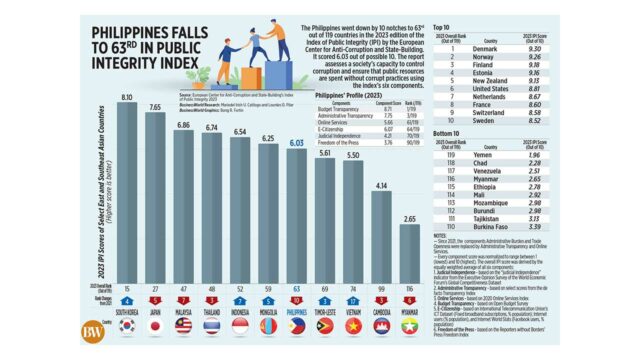
Philippines falls to 63rd in Public Integrity Index

The Philippines went down by 10 notches to 63rd out of 119 countries in the 2023 edition of the Index of Public Integrity (IPI) by the European Center for Anti-Corruption and State-Building. It scored 6.03 out of possible 10. The report assesses a society’s capacity to control corruption and ensure that public resources are spent without corrupt practices using the index’s six components.

Philippines falls to 63<sup>rd</sup> in Public Integrity Index

PSEi member stocks performed — May 27, 2024

Here’s a quick glance at how PSEi stocks fared on Monday, May 27, 2024.


National Reinsurance Corporation of the Philippines to conduct its Annual Stockholders’ Meeting on June 26

NOTICE OF ANNUAL MEETING OF STOCKHOLDERS
JUNE 26, 2024 / 2:00 P.M.

DEAR STOCKHOLDERS:

Please be advised that the Annual Meeting of Stockholders of NATIONAL REINSURANCE CORPORATION OF THE PHILIPPINES (the “Company”) will be held on June 26, 2024, Wednesday, at 2:00 p.m., at the Carlos P. Romulo Auditorium, Podium 4, Tower II, RCBC Plaza, 6819 Ayala Avenue, Makati City, with the following agenda:

  1. Call to Order
  2. Proof of Notice of Meeting and Certification of Quorum
  3. Approval of Minutes of Previous Stockholders’ Meeting held on July 5, 2023
  4. Management Report for the Year Ended December 31, 2023
  5. Ratification of All Acts of the Board of Directors and Officers during the Preceding
    Year
  6. Appointment of Independent Auditors for 2024 and 2025
  7. Increase in Directors’ Per Diem for attendance in Board and Committee Meetings
  8. Election of Directors
  9. Re-election of Mr. Medel T. Nera as Independent Director
  10. Other Matters
  11. Adjournment

Only stockholders of record at the close of business on May 13, 2024 are entitled to notice of, to attend, and to participate in this year’s Annual Meeting. Stockholders who are unable to attend the Annual Meeting in person may execute a proxy or vote in absentia.

Proxy
Proxies must be submitted and addressed to the attention of the Corporate Secretary at the 31st Floor BPI-Philam Life Makati, 6811 Ayala Avenue, Makati City, Philippines or via email at asm@nat-re.com not later than 3:00 p.m. on or before June 14, 2024.

A proxy executed by a corporation shall be in the form of a board resolution duly certified by the Corporate Secretary or in a proxy form executed by a duly authorized corporate officer accompanied by a Corporate Secretary’s Certificate quoting the board resolution authorizing the said corporate officer to execute the proxy. Validation of proxies shall be held on June 21, 2024, at 2:00 p.m. at the principal office of the Corporation.

Voting in Absentia
Stockholders who intend to vote in absentia must submit the requirements by email at asm@nat-re.com or at the registration portal.  Please refer to this link for the list of requirements – https://www.nat-re.com/investor-relations/annual-stockholders-meeting/#rvj.

The link for the online voting facility will be emailed to the concerned stockholders after the Company has validated the submitted requirements. Stockholders may cast their votes in absentia from May 28, 2024, until 11:00 a.m. of June 26, 2024.

On-site Registration
To avoid any inconvenience in registering your attendance at the meeting, you or your duly designated proxy, are required to bring this Notice, and any identification documents containing a photograph and signature, such as a passport, driver’s license, or any government-issued identification. Registration starts at exactly 1:00 p.m. and will close at 2:00 p.m. on June 26, 2024.

Copies of the Notice of the Meeting, Definitive Information Statement, and other related documents in connection with the annual meeting may be accessed through the company’s website and through the PSE Edge portal at https://edge.pse.com.ph.

For any concerns, please reach us through asm@nat-re.com.

For complete information on the Company’s annual meeting, please visit www.nat-re.com/investor-relations/annual-stockholders-meeting.

May 23, 2024, Makati City, Metro Manila.

Access to Notice of Meeting, Agenda Items and Explanation of Agenda Items, Proxy Form, Sample Secretary Certificate, Definitive Information Statement, Management Report, Financial Statements, SEC Form 17A and Minutes of Stockholders’ Meeting dated July 5, 2023 can be downloaded by scanning the QR code provided herewith.

Likewise, you may also download it from the Company’s website by clicking this link https://www.nat-re.com/investor-relations/annual-stockholders-meeting/#files.

Electronic copies of the same documents are also available at the PSE Edge.

For the Board of Directors,

(Original Signed)
NOEL A. LAMAN
Corporate Secretary


Spotlight is BusinessWorld’s sponsored section that allows advertisers to amplify their brand and connect with BusinessWorld’s audience by publishing their stories on the BusinessWorld Web site. For more information, send an email to online@bworldonline.com.

Join us on Viber at https://bit.ly/3hv6bLA to get more updates and subscribe to BusinessWorld’s titles and get exclusive content through www.bworld-x.com.

ADVERTISEMENT
ADVERTISEMENT