Home Blog Page 3170

Bronze-winning Alas team to stay largely intact

ALAS PILIPINAS — PHILIPPINE STAR/RUSSELL PALMA

THE PHILIPPINE National Volleyball Federation (PNVF) said it will keep the Alas Pilipinas team largely intact after it claimed a historic AVC Challenge Cup bronze medal, while adding a few more players to the mix to sustain the squad’s growth.

“The intention is to keep this team intact with additional athletes from the college ranks,” said PNVF president Ramon “Tats” Suzara the day after the Filipinas routed Australia at the Rizal Memorial Coliseum to claim the country’s first podium finish in any Asian-level tournament. “It’s a breakthrough, it’s historic, and the obvious next step is to keep this team intact and make it stronger and much more competitive,” he added.

Mr. Suzara said the federation is planning to insert collegiate stars Bella Belen, Alyssa Solomon and Casiey Dongallo to the pool to further reinforce an already promising roster headed by AVC Challenge Cup best setter Jia de Guzman and best outside spiker Angel Canino. There is also a plan to extend Brazilian coach Jorge Souza de Brito, whose contract expires next month.

Mr. De Brito has yet to decide if he will sign on for a new term.

If all these fall into place, Mr. Suzara said there’s a strong chance the country can compete for a medal in next year’s Southeast Asian Games in Thailand.

“Next year, in the SEA Games, I believe we’ll have a fighting chance,” he said. — Joey Villar

Boxing federation to start awarding cash to Paris Olympic medalists

LIKE athletics, boxing will hand out monetary rewards to Paris Olympics medalists for the first time in history.

The International Boxing Association (IBA) made the announcement recently, saying gold medal winners will receive $100,000 while silver and bronze winners get $50,000 and $25,000, respectively.

This came after World Athletics, track and field’s global governing body, announced in April that it would offer $50,000 to gold winners to its Olympic champions, the first in the history of the quadrennial meet.

According to IBA president Umar Kremlev, half of the prize will go to the winning boxer; the rest will be equally divided by the coach and the national sports association.

Mr. Kremlev said the total money they have committed is worth more than $3.1 million, to be distributed to more than 100 boxers.

The International Olympic Committee stripped IBA of recognition over the latter’s failure to complete reforms on governance, finance and ethical issues.

Because of this, IBA isn’t organizing boxing tournaments in Paris, which are being handled by the IOC.

There are also fears the IOC might exclude boxing in future Olympics as it is not on the initial program for the 2028 Los Angeles Games. — Joey Villar

Towns breaks out of slump just in time

To argue that Karl-Anthony Towns wasn’t pleased with his performance through the first three matches of the West Finals would be to understate the obvious. He hit only six of 20 field goal attempts in Game One, four of 16 in Game Two, and five of 18 in Game Three, prompting not a few to pin the Timberwolves’ losses to the Mavericks on him. Which was why he found himself scrambling to explain away his slump — dating back, really, to the end of the previous series against the Nuggets — as mere bad luck. He contended that he wasn’t lacking in preparation, even exaggerating that he made sure to put up 1,500 shots every day. They just weren’t falling.

Not that Towns was completely off the mark. Mere inches prevented an inordinate number of his tries from hitting the bottom of the net. At the same time, there can be no glossing over the fact that stars make their own fortunes. And he didn’t. There was no consistency to his misses; some were short, some long, some to the left, some to the right, some forced, some ill-timed. And with the Mavericks hellbent on stopping All-NBA second team selection Anthony Edwards, the narrative was that he could not meet the challenge head on and pick up the slack.

Towns’ travails notwithstanding, there was one silver lining: The series was not over. The Mavericks needed one more triumph to secure a spot alongside the Celtics in the Finals, and, until then, there remained an opportunity for redemption. And, yes, it bears noting that Towns didn’t look defeated. He believed, maybe even irrationally under the circumstances, that the tide would turn in Game Four. And, lo and behold, it did. He was nothing short of spectacular the other day, going an efficient nine of 13 and delivering under pressure to help Edwards lead the charge for the Timberwolves.

Today, Towns gets another crack at glory. And when he tries to build on his success, he will, no doubt, be leaning on the support of 19,500 fans at Target Center. Youth fuels the Timberwolves’ confidence, but the nine-year veteran would do well to bank even more on experience as he dares to flirt with the improbable. There have been 154 three-nil leads in playoff history, and not once has the deficit been overcome. Game Four was a start. And as Sisyphean as the task at hand may be, he can, if nothing else, dream big.


Anthony L. Cuaycong has been writing Courtside since BusinessWorld introduced a Sports section in 1994. He is a consultant on strategic planning, operations and human resources management, corporate communications, and business development.

Alibaba Cloud to equip Filipino students with digital technology knowledge and AI expertise

STOCK PHOTO | Image by Innova Labs from Pixabay

Starting May 2024, the Alibaba Cloud Academy Certificate Associate (ACA) Generative AI Engineer Course was made available in the Philippines to boost the digital skills of students and teachers. 

“We are strongly committed to supporting talent in mastering essential digital skills, and we’re excited to continue expanding our training offerings around the world,” Alibaba Cloud Intelligence President of International Business Selina Yuan said in a press release. 

Last year, the Alibaba Cloud Academy Certificate Associate (ACA) Generative AI Engineer Course partnered with the National University (NU) Philippines to expand the knowledge of students and faculty on digital technology and artificial intelligence (AI). 

“Our ACA Generative AI Engineer course aims to help customers, partners, developers, and users of various backgrounds globally to unlock that potential and drive tomorrow’s digital agenda,” Ms. Yuan said. 

Asia Pacific College, part of NU’s consortium, also experienced online training sessions with Alibaba Cloud covering topics like GenAI, cloud computing, security, and databases for students to enhance their technological knowledge. 

According to the technology company, its ACA courses cover “machine learning to natural language processing, encoder-decoders to generative adversarial networks, to leveraging models via retrieval-augmented generation, agents, and more.”  

Through the course’s three-step approach – learn, imagine, and apply, enrolled clients can gain skills to deploy Generative AI applications on Alibaba Cloud platforms. ACA certificates are handed out as well to users who passed and finished the course to signify their knowledge and skills in the field.  

As of April 2023, over 60,000 people around the globe have received certification from Alibaba Cloud, proving the company’s commitment to supporting digital talent and making AI accessible. The company aims to teach 10,000 to 20,000 learners worldwide with basic AI knowledge by the end of 2024. – Almira Louise S. Martinez

FBI takes down massive global army of zombie computer devices used by hackers

BLOOMBERG

THE FEDERAL Bureau of Investigation (FBI) said it has dismantled what is likely the world’s largest botnet — an army of 19 million infected computers — that was leased to hackers for cybercrimes.

The botnet, which was spread across more than 190 countries, enabled financial fraud, identity theft and access to child exploitation materials around the world, according to a statement issued on Wednesday by FBI Director Christopher Wray. Other violations tied to the botnet included bomb threats and cyberattacks, likely leading to billions of dollars in victim losses, according to a statement from the Department of Justice.

The botnet was tied to more than 613,000 IP addresses located in the US, authorities said. Botnets are created when cybercriminals install malware on computers or other connected devices and harness them for nefarious activities, creating a zombie army of devices whose owners are usually unaware of what is happening.

Law enforcement seized internet equipment and assets, and levied sanctions against the alleged administrator of the botnet, YunHe Wang, as well as co-conspirators, Wray said.

Wang, a Chinese citizen, was arrested in Singapore on May 24, charged in connection with allegedly deploying malware and creating a proxy service known as “911 S5.” It was started in 2014 and relied on a network of millions of compromised residential Windows computers, according to the US government. Wang then generated millions of dollars by offering cybercriminals access to these infected IP addresses for a fee, according to the  Justice department. 

The US is now awaiting extradition, according to Brett Leatherman, deputy assistant director with the FBI’s Cyber Division. “We want him, you know, as soon as possible,” Mr. Leatherman told reporters in a call on Wednesday.

The FBI and international partners also executed multiple search warrants and interviews in Singapore and Thailand that could lead to additional arrests, he added.

The law enforcement operation, named Operation Tunnel Rat, also seized luxury goods including expensive cars and watches worth $4 million, as well as more than $29 million in cryptocurrency and about $30 million in real estate in Singapore, Thailand, Dubai and elsewhere, plus 22 domains, officials said.

Residential IP addresses became compromised when users downloaded certain free software or virtual private network apps, which unknowingly contained malware associated with the botnet onto their devices, Mr. Leatherman said. The FBI has issued a web page where members of the public can check if their IP address was among those compromised. — Bloomberg

14 Hong Kong democrats found guilty in landmark subversion trial

REUTERS

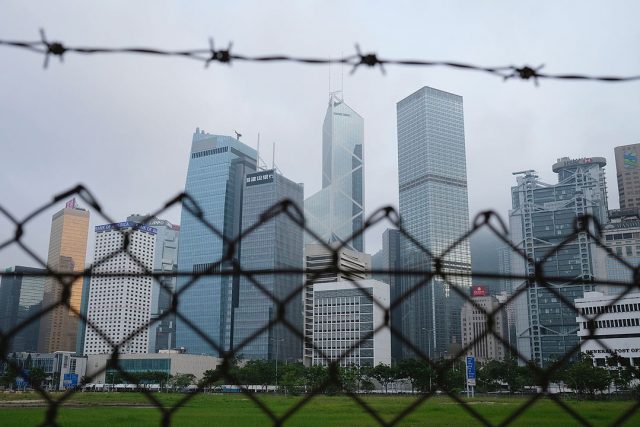
HONG KONG — Fourteen Hong Kong pro-democracy activists were found guilty and two were acquitted on Thursday in a landmark subversion trial that critics say could deal another blow to the city’s rule of law and its reputation as a global financial hub.

The verdicts in Hong Kong’s biggest trial against the democratic opposition come more than three years after police arrested 47 democrats in dawn raids at homes across the city. They were charged with conspiracy to commit subversion under a national security law imposed by China.

Sentencing will come at a later date for those found guilty, with prison terms ranging from three years to life for this offense. Thirty-one defendants pleaded guilty, and four of them have become prosecution witnesses.

The US and some other countries have criticized the trial as politically motivated, calling for the accused to be immediately released. Diplomats from several countries including the U.S. and the European Union attended the hearing.

Security was tight around the High Court, with several foreign diplomats in attendance. Scores of police officers and vehicles patrolled the area. Some supporters queued overnight to secure a spot.

“I came because it’s a critical stage and a historic moment” for Hong Kong, said a man who gave only his surname, Chiu, 35, who began waiting at midnight. The defendants “all stood up for themselves and for Hong Kong people hoping to make a change.”

The defendants are accused of a “vicious plot” to paralyze government in the former British colony and force the city’s leader to resign through a pre-selection ballot in a July 2020 citywide election. The democrats maintain it was an unofficial attempt to select the strongest candidates in a bid to win a historic majority in Hong Kong’s legislature.

Summarizing their verdict, Judges Andrew Chan, Alex Lee and Johnny Chan wrote that if the defendants had succeeded, it would have created “a constitutional crisis for Hong Kong” and led to “serious interfering in, disrupting or undermining the performance of duties and functions in accordance with the law by the (Hong Kong) government.”

Several defendants, including activists Owen Chow and Gwyneth Ho, appeared stony-faced in the dock as the verdicts were delivered to a packed courtroom.

Those convicted also include former democratic lawmakers Leung Kwok-hung, Lam Cheuk-ting and Helena Wong. It was not yet clear whether any would appeal, with court adjourned until an afternoon session.

‘RUTHLESS ILLUSTRATION’
Leung, 68, is the oldest defendant.

“Although he might not be well emotionally and still not yet adapted to prison life… he always told me that he’s innocent,” Mr. Leung’s wife, Chan Po-ying, told Reuters.

Acquitted were barrister Lawrence Lau and social worker Lee Yue-shun.

“There are still other defendants in this case warranting our concern and even love,” Mr. Lau said outside the court. He told reporters he could not say much given the possibility the prosecution might appeal his acquittal.

Mass pro-democracy protests erupted in Hong Kong in 2019 against Beijing’s plans for legislation that democrats argued infringed on freedoms guaranteed when Hong Kong returned to China’s control in 1997.

Beijing in 2020 imposed the sweeping national security law that led to a spate of arrests of democratic campaigners as well as the closures of liberal media outlets and NGOs. Hong Kong’s democratic opposition had sought for decades to pressure Beijing to allow full democracy in the city.

Once-lively street marches, demonstrations and vigils have essentially ceased amid intense policing.

“This unprecedented mass conviction is the most ruthless illustration yet of how Hong Kong’s national security law is weaponized to silence dissent,” Amnesty International’s China director, Sarah Brooks, said in a statement. “It represents a near-total purge of the political opposition.”

Beijing says the national security laws have brought stability to Hong Kong and that human rights are respected.

Most of the accused have been detained since Feb. 28, 2021 and went through marathon bail hearings.

Those who have pleaded guilty include former law scholar Benny Tai, whom the prosecution called a “mastermind” of the “conspiracy,” and activist Joshua Wong. — Reuters

Gold worth tens of billions smuggled to the UAE each year, report says

GOLD BARS are seen in this picture illustration taken at the Istanbul Gold Refinery in Istanbul March 12, 2013. — REUTERS

GOLD SMUGGLING out of Africa, mainly to the United Arab Emirates (UAE), has surged over the last decade, with hundreds of tons of gold worth tens of billions of dollars illegally leaving the continent every year, according to a report published on Thursday.

Analysis by Swissaid, an organization that focuses on development aid and advocacy, found that a total of 435 tons of gold, mostly mined by small-scale miners and worth more than $30 billion, was smuggled out of Africa in 2022.

Swissaid said the UAE was the main destination for Africa’s smuggled gold and took in 405 tons in 2022. Over the previous decade, UAE accepted more than 2,500 tons of smuggled gold with a total value of over $115 billion, the organization said.

Asked to comment on the findings, a UAE official said that the country had taken significant steps to address concerns about gold smuggling and implemented new regulations on gold and other precious metals.

The scale of the flow underscores how small scale, or artisanal, mining has mushroomed into an industry involving millions of people producing volumes of gold on a par with or even bigger than industrial mining.

In 2019, a Reuters investigation found that billions of dollars’ worth of gold was being smuggled out of Africa every year through the UAE, which served a gateway to markets in Europe, the United States and beyond. 

Aside from the loss in tax revenues, experts and governments have warned that smuggling on this scale indicates a vast parallel illicit economy vulnerable to potential money laundering, terrorist finance and sanctions evasion.

Marc Ummel, the commodities lead at Swissaid and one of the authors of the report, said the UAE contributes to gold laundering because large quantities of smuggled gold acquire a legal existence by transiting through the UAE.

“If we keep on seeing more than 400 tons of illegal gold entering the UAE every year, this is a clear sign that the implementation of the regulations in the UAE is seriously lacking.”

DISCREPANCIES
For its analysis, Swissaid compared total gold exports from all African countries with gold imports into non-African countries. The organization filled gaps in UN Comtrade data with individual country statistics and identified errors by comparing the data with figures reported by trade associations and speaking with governments and refineries.

These discrepancies between declared exports and declared imports do not exist for Switzerland and India, the other two major gold importing countries for African gold.

The Swissaid report found that there were 12 countries in Africa involved in smuggling 20 tons or more per year.

In response to accusations that it was not doing enough to enforce regulations on the sector, a UAE Ministry of Economy spokesperson said the UAE cannot be held accountable for other government’s export records.

“Only our own, where we have sophisticated technologies and systems to track and verify the data.”

ARTISANAL MINING
With the gold price having doubled since 2009, the number of people turning to artisanal mining has surged. Swissaid estimates that artisanal and small-scale gold mining in African countries produced between 443 and 596 tons of gold in 2022.

Of this, more than 70 percent is not declared.

By comparison, industrial miners have produced around 500 tons of gold a year.

The report found that the majority of African gold imported into the UAE each year comes from informal artisanal and small-scale mining. These methods provide a livelihood to millions of Africans but often come at a high cost to local communities and to the environment.

“There’s a certain hypocrisy with some of the Swiss refineries,” said Ummel. “They don’t want to source African artisanal gold directly but at the same time import very high quantities of gold from the UAE, which is the main hub for African artisanal gold.”

Between 80% and 85% of Africa’s artisanal gold in 2022 was exported to the UAE, according to the researchers.

A UAE official said the country recognizes the importance of artisanal and small-scale gold mining to the sector and that its “inclusive approach” has allowed artisanal miners to realize more value for their extracted gold. — Reuters

Gaza’s wounded children denied medical aid with Rafah crossing closed

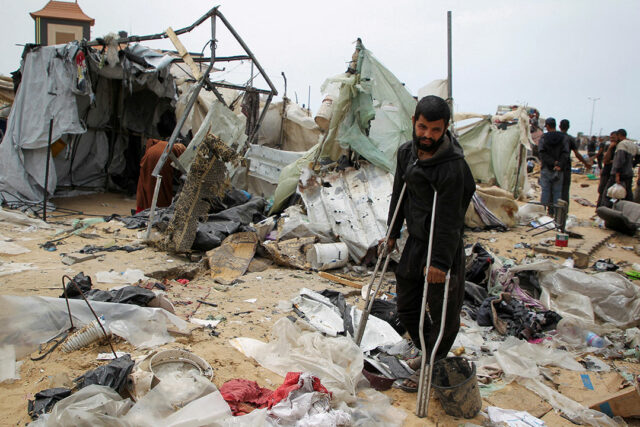
A MAN looks on as Palestinians inspect a tent camp damaged in an Israeli strike during an Israeli military operation, in Rafah, in the southern Gaza Strip, May 28, 2024. — REUTERS

KHAN YOUNIS, Gaza — Ahmed Abu Athab’s Aunt Jamila sobs as she implores the world to get the boy out of Gaza for medical treatment after he was injured by Israeli fire this week and joined the growing list of wounded stuck in the embattled territory without medical aid.

The boy had gone to the beach on Tuesday to wash with a group of children and a munition landed as they came out, hitting him with shrapnel, she said.

He now lies, swathed in bloody bandages, in Nasser Hospital in Khan Younis as Israel’s assault on the border city of Rafah continues, part of a military campaign against Hamas sparked by the group’s deadly Oct. 7 attack.

The attack on Rafah, the only part of tiny, crowded Gaza that Israeli troops had not entered in force, has cut off the main border crossing into Egypt, constricting aid and stopping what had been a trickle of people leaving for medical help.

“Where should I take him? Tell me. Where should I go?” Jamila Abu Athab said.

“I ask all the leaders of the world, anyone with a conscience, to open the border and allow these children to leave. What have they done to deserve this?” she added.

Like the vast majority of Palestinians in Gaza, Ahmed Abu Athab had already lost his home in Israel’s assault on the enclave. He has also lost his mother — not to the war but because she left Gaza for cancer treatment.

When Jamila Abu Athab reached the child, he told her: “Auntie, I was looking for water. I want to bathe. I died, I died,” she said.

TRAPPED
At al-Aqsa Martyrs Hospital in the central Gaza city of Deir al-Balah, spokesperson Doctor Khalil al-Dakran said Israel’s military campaign had unleashed a medical catastrophe.

“All hospitals are struggling due to lack of medicine and medical necessities and fuel,” he said in video obtained by Reuters, adding that thousands of patients needed treatment abroad and were unable to travel after the Rafah border closure.

Israel blames Egypt for the closure, saying it wants to reopen Rafah to Gazan civilians who wish to flee.

Egyptian officials and sources say humanitarian operations are at risk from military activity and that Israel needs to hand the crossing back to Palestinians before it starts operating again. Egypt is also worried about the risk of Palestinians being displaced from Gaza.

Palestinian Health Minister Majed Abu Ramadan said on Wednesday there was no indication of when the Rafah crossing would reopen.

Israel’s ground and air campaign in Gaza has killed more than 36,000 people and wounded more than 81,000, health authorities in Gaza’s Hamas-run administration say. The figures include both civilians and Hamas fighters. The Hamas attack on Israel on Oct. 7 killed 1,200, according to Israeli tallies.

In Al-Aqsa Hospital, Nashat Abed Bari said he had been trying to leave Gaza for medical help since being injured five months ago.

“There are no capabilities here in Gaza at all. I tried to look for doctors or to go around hospitals but no one was able to help me,” he said in video obtained by Reuters.

“The border has been shut for more than 20 days. No one is going in or out. I need an operation urgently because my situation is getting worse every day.” — Reuters

Nicotine-like chemicals in US vapes may be more potent than nicotine, FDA says

REUTERS

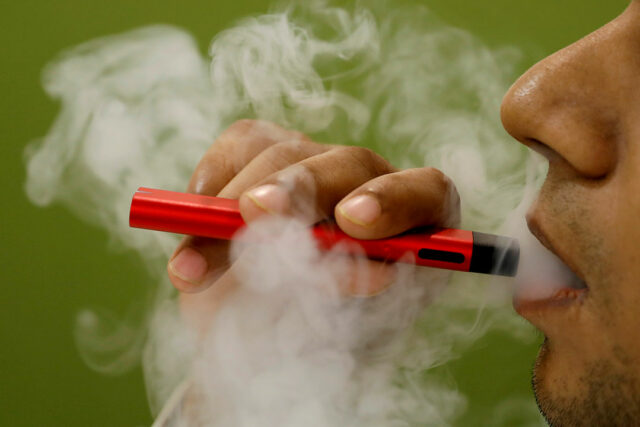
LONDON — Nicotine alternatives used in vapes being launched in the US and abroad, such as 6-methyl nicotine, may be more potent and addictive than nicotine itself, though the scientific data remains incomplete, according to the US Food and Drug Administration (FDA) and independent researchers.

The synthetic substances — which have a chemical structure similar to that of nicotine — are not subject to US tobacco and vaping regulations that are designed to control traditional nicotine, a highly addictive drug.

That means manufacturers can sell vapes containing synthetic nicotine analogues such as 6-methyl nicotine in the United States without seeking authorization from the FDA – a process that can be costly, time-consuming and is often unsuccessful.

Big tobacco firms like Altria Group and British American Tobacco have already lost substantial US sales to an influx of disposable vapes containing traditional nicotine that are being illegally sold without FDA authorization.

Altria, the maker of Marlboro cigarettes in the United States, highlighted the emerging use of 6-methyl nicotine in vapes and other smoking alternatives in a May 9 letter to the FDA, according to a copy of the correspondence posted on its website.

It urged the agency to evaluate the compounds and establish what authority it had over them, warning they posed a “new threat” to regulation of the sector.

“The introduction and growth of chemicals intended to imitate the effects of nicotine, if left unchecked, could present unknown risks to US consumers and undermine FDA’s authority,” the letter said.

It cited SPREE BAR, a vape launched in October by Charlie’s Holdings, Inc. that uses 6-methyl nicotine.

The FDA does not comment on its correspondence with individual firms.

In response to Reuters’ questions about 6-methyl nicotine and other nicotine alternatives, the FDA said in a statement: “Although more research is needed, some emerging data show these nicotine analogs may be more potent than nicotine — which is already highly addictive, can alter adolescent brain development and have long-term effects on youth’s attention, learning and memory.”

Traditional nicotine found in many vapes and pouches is extracted from tobacco leaves. 6-methyl nicotine, in contrast, is made entirely in the lab using chemicals.

The FDA said it was considering the use of such synthetic compounds from an “agency-wide perspective” and would use all of its resources to protect youth from products that may harm their health. As well as tobacco products, the FDA also regulates drugs, foods, cosmetics and more to ensure safety and efficacy.

“The FDA is a data-driven agency, and we’re in the process of reviewing the available data to inform potential actions in this space,” it said in response to Reuters’ questions.

Three academic researchers told the news agency that current studies of 6-methyl nicotine are too limited to draw definite conclusions on the health impact or to what degree it is addictive.

Imad Damaj, a professor in the Department of Pharmacology and Toxicology at Virginia Commonwealth University, said his research showed 6-methyl nicotine may be more potent than nicotine, but more extensive tests were needed to say what impact it has on humans.

The limitations of existing research included that some papers were industry funded, while others focused on the short-term impact on animals or cells and were insufficient to understand 6-methyl nicotine’s effects on human bodies, the researchers said.

Charlie’s Holdings calls the 6-methyl nicotine solution used in SPREE BAR Metatine. SPREE BAR’s website says Metatine “may have a toxicity profile similar to nicotine.”

Charlie’s Holdings co-founder Ryan Stump acknowledged that more research is needed on 6-methyl nicotine, adding that the company dilutes it in its products.

SPREE BAR promises users 6,000 puffs from each device and offers fruity flavours including “blue razz ice” and “creamy melon,” according to its website.

The FDA has yet to approve any flavored vape using traditional nicotine for sale in the United States, saying companies have not been able to show that the health benefits they offer to smokers outweigh the known risks to young people, who may be more attracted by the flavors.

Stump told Reuters that the company only targets adults, adding that flavours played an important role in its mission to help smokers quit cigarettes. He said Charlie’s Holdings respects and abides by laws in every market where it operates.

TARGETING INTERNATIONAL MARKETS
Anes Saleh sells Spree Bar in his vape shop in Denver, Colorado, called Sultan Smoke. He said he has some customers who only buy Spree Bar instead of a nicotine vape and he hasn’t had any negative feedback on the product.

“The only… protest I would hear about people not wanting to try this is that they don’t know what Metatine is or does,” he said.

The American Vapor Manufacturers Association said in a statement that the FDA had banned vaping products that many US smokers used to quit cigarettes. That fuels the black market and risks pushing people back towards smoking, Allison Boughner, the association’s vice president, said.

Stump said that Charlie’s Holdings is working on new varieties of SPREE BAR and new products using 6-methyl nicotine. It will launch SPREE BAR internationally this year. He declined to say where.

The company buys the 6-methyl nicotine solution used in SPREE BAR from another US firm, Novel Compounds, according to Novel Compounds’ founder Samuel Benaim.

Novel Compounds imports 6-methyl nicotine from overseas and alters it to make it easier for manufacturers like Charlie’s Holdings to use in their products. It sells this solution under the trade name imotine.

Tests commissioned by Novel Compounds have found 6-methyl nicotine to be no more harmful than nicotine, Benaim said. But he also said that more research was needed into the chemical.

Benaim added that Novel Compounds had received legal advice that its product is not classified as a tobacco product or drug in the United States. The company is committed to legal compliance, he said.

MORE POTENT THAN NICOTINE?
Sven Jordt, a professor at Duke University, who has authored papers on products like SPREE BAR, said 6-methyl nicotine could be more addictive and toxic than its traditional cousin.

“Do we want to have such a chemical as a recreational product, available to anyone?” he asked. “That’s really questionable.”

Neither Jordt nor Damaj — the professor at Virginia Commonwealth University – have received funding from tobacco or vape makers.

As well as the United States, Novel Compounds also sells its 6-methyl nicotine solution around the world, including in the United Kingdom, Indonesia, India and Japan.

Another company, Aroma King, sells 6-methyl nicotine in the United Kingdom in pouches, which users insert under the lip to get a buzz. The pouches are sold in cans emblazoned with graphics of gorillas in suits and sunglasses.

It said in a February blog post that its 6-methyl nicotine products were “less toxic” “less harmful,” and “less addictive” than regular nicotine products.

In a statement to Reuters, Aroma King cited existing research, its own toxicology and other tests and its supplier, which classifies 6-methyl nicotine as less toxic under the European Union’s Classification, Labelling and Packaging of Substances and Mixtures (CLP) Regulation.

Aroma King said 6-methyl nicotine was self-classified by its supplier. It declined to say who supplies it with the chemical.

Four Chinese companies hold patents in China related to the production of 6-methyl nicotine, including Zinwi Biotech, a company that makes the liquid used in vapes.

Zinwi Biotech confirmed it is researching 6-methyl nicotine but did not answer further questions, including on whether it has sold any 6-methyl nicotine so far. Reuters was unable to find contact details for the other firms. — Reuters


Trust in e-commerce platform, merchants key to purchasing decisions of consumers

STOCK PHOTO | Image by andrespradagarcia from Pixabay

The volume of online fraud contributes to the lack of trust in the e-commerce system in the Philippines, Trade Secretary Alfredo E. Pascual stated. 

“Given the volume of fraud online, it doesn’t come as a surprise that consumers base their purchasing decisions on how much they trust the e-commerce system in general and the online merchant in particular,” he claimed on Filipinos’ relationship with digital trade platforms. 

According to Statista, Gen Zs and Millenials are the most common online shoppers in the country.  

“Those aged between 25 to 34 years old accounted for more than 50 percent of online shopping and are members of the society earning highest among other working groups,” Statista elaborated. 

In an interview during Shopee’s event last May 28, the company’s Regional Marketing Lead Huiyan Pan shared that “Gen Z is being digital native. I think they have lived and breathed this right from the get-go…. So they are the most discerning, they know what they want. And they, I guess, demand for the best experience.”  

The online shopping platform showcased its new feature ‘COD Unbox: Return on the Spot’ that would allow shoppers to check their package or parcel before receiving the item. 

“If you change your mind on something, you can very easily file for easy return. So that gives you peace of mind when you buy. For example, if you are getting COD and you’re missing a parcel, you can just check it before…you accept that. That gives you…peace of mind on Shopee. So these are the structural journeys that we want to create,” she added. 


E-Commerce Roadmap 

In the Department of Trade and Industry (DTI) discussion on the 2024 to 2028 E-Commerce Philippines roadmap last April 8, digital trade platforms were encouraged to strengthen the relationship of its users to promote inclusivity and innovation towards youth, women, persons with disabilities, and senior citizens. 

“Our goal is to strengthen the trust between buyers and sellers. By achieving this, we can foster a more complex economic landscape, enhancing connections and establishing stronger relationships,” Mr. Pascual said. 

He added that the e-commerce platforms, both from the government and private sectors, should represent a shift from “easy commerce” to “exciting commerce. 

Republic Act No. 11967, or the Internet Transactions Act (ITA) of 2023 was also enacted to recognize and value the importance of e-commerce platforms in the digital economy to improve confidence in online shopping. 

“I am confident that this law and the IRR will positively revolutionize e-commerce in the Philippines. By fostering trust in online transactions, we are creating more opportunities for high-quality and better-paying jobs,” the Trade Secretary mentioned in his speech last May 22.   

ITA aims to guarantee: 

  • The protection of consumer rights and data privacy 
  • Encourage innovation 
  • Promote competition 
  • Secure internet transactions  
  • Uphold intellectual property rights 
  • Ensure product standards and safety compliance 
  • Observe environmental sustainability.

Almira Louise S. Martinez

Global shift to renewables slowed in 2023, policy group says

EVGENIY ALYOSHIN-UNSPLASH

 – The global shift to renewables in major energy-consuming sectors slowed in 2023, hindered by regulatory gaps, political pressures and a failure to set clear targets, a policy group said on Wednesday.

The COVID-19 pandemic and the Ukraine war helped ambitions to shift to renewables amid growing concerns about energy security, but governments have failed to build on the momentum, an annual assessment by Paris-based REN21 group said.

By the end of last year, only 13 countries – including the United States, India and China – had implemented policies on renewables that cover buildings, industry, transport and agriculture, with only 12.7% of the energy the sectors consume coming from clean sources, REN21 said.

Many countries have even backtracked on their ambitions: of 69 countries with renewable energy targets for end-users, only 17 extended them beyond 2024, said REN21, which brings together governments, research institutions and NGOs to promote the switch to clean energy.

“Governments have basically stepped back from their ambitions, and energy-consuming sectors don’t have the economic incentives any more,” REN21’s Executive Director Rana Adib said.

The report warned that countries were slow on reforms and the trillions of dollars of subsidies granted to fossil fuels, particularly in industry and agriculture, still hold the energy transition back.

Falling fossil fuel prices in 2023 also shaped policymaking, and debate about the costs of switching to cleaner energy have intensified, especially as many countries head towards elections, Ms. Adib said.

Decarbonizing heavy industry remains a major challenge, with “hard to abate” sectors such as cement and steel arguing that renewables cannot generate the heat required to fire their kilns and blast furnaces.

But while the transition of industry could prove more challenging than transportation, solutions do exist, including the use of electric arc furnaces to make steel, Ms. Adib said.

“‘Hard to abate’ already sends the message that these are sectors that are almost impossible to decarbonize, which is not true,” she said.

China lifts ban on five Australian beef exporters

STOCK PHOTO | Image by 정훈 정 from Pixabay

 – China has lifted bans on imports from five major Australian beef processing facilities, the Australian government said on Thursday, in the latest sign of improving relations between the two nations.

Beijing has now removed restrictions from eight abattoirs but two remain subject to import bans, the government said.

China imposed the bans between 2020 and 2022, around the same time it barred imports of a swathe of commodities including coal, timber and wine from Australia after Canberra called for an independent investigation into the origin of COVID-19.

The bans applied to certain abattoirs but did not affect others, which meant Australia was still able to ship beef to China.

“It was difficult for those particular abattoirs but we still saw beef flowing,” said Matt Dalgleish, an analyst at agricultural consultants Episode 3.

He said the removal of the restrictions should still boost Australian shipments to China, which have already risen to their highest level since 2020 as a shrinking cattle herd in the United States, Australia’s main competitor, reduces U.S. exports.

Lower US supply may have been one reason for China’s action, Dalgleish said.

China was Australia’s second-biggest beef export market last year, receiving 240,000 tons worth around $1.6 billion, Australian trade data show.

Beijing has lifted most of the barriers it imposed on Australian goods since a change of government in Canberra two years ago. A ban on imports of Australian lobsters remains in place.

“We continue to press China to remove the remaining trade impediments, including for Australia’s rock lobster industry,” Australian foreign minister Penny Wong, trade minister Don Farrell and agriculture minister Murray Watt said in a joint statement.

They said China’s trade impediments at their height impacted Australian exports worth A$20.6 billion ($13.6 billion).

The reasons China gave for suspending the Australian beef processors were issues over labelling or contamination or cases of COVID-19 among their workers. – Reuters