Home Blog Page 3056

ARTA: Many agencies not ready for flagship-project streamlining

PHILIPPINE STAR/WALTER BOLLOZOS

THE Anti-Red Tape Authority (ARTA) said delays in digitizing the permit processes of National Government (NG) agencies and local government units (LGUs) are hindering the streamlining of applications for infrastructure flagship projects (IFPs).

On the sidelines of the signing of the implementing rules and regulations of Executive Order (EO) No. 59 on Tuesday, ARTA Secretary Ernesto V. Perez told BusinessWorld: “Right now, not all LGUs and National Government agencies are fully computerized or fully online,” Mr. Perez said.

“This is why the Department of Information and Communications Technology (DICT) is very keen on capacitating LGUs to comply with this requirement,” he added.

EO 59 tasked ARTA with accelerating the progress of IFPs by simplifying the system for obtaining permits before the projects can proceed.

Mr. Perez also said EO 59 can also help ARTA speed up the takeup of its own electronic business one-stop shop (eBOSS) system, by obliging NG agencies to also adopt eBOSS in some form.

“To me this is a test case. If we can be successful in the big-ticket infrastructure projects, we can also apply this even to small businesses,” he said.

Asked about the response of the private sector, he said that the Private Sector Advisory Council, Management Association of the Philippines and Philippine Chamber of Commerce and Industry have been very supportive.

“Even foreign chambers like the British Chamber of Commerce of the Philippines were upbeat,” Mr. Perez said.

“Most of our investors are foreigners and they are very optimistic about EO 59,” he added.

Signed on April 30, EO 59 aims to eliminate delays in the issuance of licenses, clearances, permits, certifications, or authorizations to ensure timely completion of the IFPs.

According to the National Economic and Development Authority, the government has a pipeline of 185 IFPs valued at P9.54 trillion. — Justine Irish D. Tabile

Maxicare officially notifies NPC of data breach

THE National Privacy Commission (NPC) confirmed on Tuesday that it had received a data breach notification from Maxicare Healthcare Corp. 

In a statement, the regulator said that the NPC Data Breach Notification Management System received a notification from the health maintenance organization on June 16.

The breach was first made public on Tuesday in a Facebook post by a cybersecurity advocacy known as Deep Web Konek. Deep Web Konek estimated the breach as having compromised 33 megabytes of Maxicare data.

Member details included 16-digit Maxicare card numbers, account types, dates of birth, sex, mobile numbers, and e-mail addresses, it said.

Separately, the NPC said that it has not received any data breach notification from the Maritime Industry Authority (Marina) as of Tuesday afternoon.

“As of 2 p.m. today, there has been no notification from Marina. But they have 72 hours upon knowledge of the breach to notify the NPC and their data subjects,” the NPC said.

On June 17, Marina reported attacks on four of its web-based systems and said that it was working with the Department of Information and Communications Technology to address the breach.

Marina said it does not expect the breach to have compromised the data of seafarers, adding that it hopes to restore normal operations as soon as possible.

Two weeks ago, the NPC also reported data breaches at Robinsons Land, Toyota Motors, and the Philippine National Police. It has yet to be officially notified of any data breach involving membership shopping club S&R. — Justine Irish D. Tabile

Fish production not seen affected by China threat to detain ‘trespassers’

SCREENGRAB FROM PHILIPPINE COAST GUARD

THE Chinese threat to detain fishing boat crews “intruding” on the territory it claims in the West Philippine Sea (WPS) is not expected to have a significant impact on fish production, according to the Bureau of Fisheries and Aquatic Resources (BFAR).

“In terms of production, yes, the contribution of the West Philippine Sea is significant… But we don’t see the unilateral declaration of China actually having an impact,” BFAR spokesman Nazario C. Briguera said in a briefing on Tuesday.

The Chinese government has authorized its coast guard to detain for 60 days without trial any boat crew members found in the disputed waters.

“First and foremost, the Philippines does not recognize this unilateral declaration of China,” he said.

“The Philippines will continue to fish in the West Philippine Sea because it is part of our waters, as our exclusive economic zone (EEZ),” he added.

The Philippines continued to protest the illegal presence and actions of Chinese vessels within the EEZ.

Mr. Briguera said BFAR has yet to receive reports of China detaining any boat crews from the Philippines.

“We have not heard of any fishermen being arrested and if there is, it is a new provocation on the part of China and it can be considered a new violation of international law, particularly of the United Nations Convention on the Law of the Sea.

China’s coast guard has repeatedly used water cannons to turn Philippine vessels from entering contested areas within the EEZ, including Scarborough Shoal and Second Thomas Shoal.

Fish caught in the WPS amounted to 201,894.49 metric tons last year, according to the Philippine Statistics Authority.  This was up 14.85% from 2022. — Adrian H. Halili

Year-end rice inventory target set at 3.64 million metric tons

PHILSTAR FILE PHOTO

THE Department of Agriculture (DA) said it is aiming for a year-end national rice inventory level of 3.64 million metric tons (MMT), after a reading of just over 2 MMT in early May.

“At the end of the year we are looking at 3.64 MMT, equivalent to nearly 95 days’ demand,” Agriculture Assistant Secretary for Operations U-Nichols A. Manalo said in a briefing.

The national rice inventory rose 10.3% year on year in early May, while corn stocks were up 6.3%, the Philippine Statistics Authority (PSA) said.

In a report, the PSA said the rice inventory was estimated at 2.08 MMT, noting declines in volume held by the National Food Authority and households.

Mr. Manalo added that palay or unmilled rice production was estimated at 8.8 MMT during the first half of the year.

The DA said overall palay production could hit 20.44 MMT this year. This was a downgrade from the initial 20.8 MMT projection to account for the possible effects of El Niño and La Niña.

In a separate report, the PSA said that palay production may have dropped 8.4% year on year to 3.89 MMT during the second quarter.

The government weather service, known as PAGASA (Philippine Atmospheric, Geophysical and Astronomical Services Administration), has declared El Niño to have ended, and estimated the chances of La Niña setting in between July and September at 69%.

“Historically, the damage is greater during La Niña …during rains and typhoons (the damage can hit) 500 to 600 thousand MT,” Agriculture Assistant Secretary and Spokesperson Arnel V. de Mesa said on the sidelines of the briefing.

La Niña event increases the likelihood of above-normal rainfall in parts of the country, especially towards the end of the year.

He added that water management may be difficult during the La Niña months.

“It is more difficult to control, especially if there is too much water (beyond the capacity of flood-control systems),” Mr. De Mesa said.

La Niña may also lead to increased rice imports.

“It is possible that there will be an increase (in imports) especially with a severe La Niña,” he added.

Rice imports amounted to 2.17 MMT as of June 6, according to the Bureau of Plant Industry.

The US Department of Agriculture has upwardly revised its rice import forecast for the Philippines to 4.6 MMT this year, owing to higher consumption and lowered import tariffs.

The National Economic and Development Authority Board has approved a plan to lower tariffs on industrial and farm goods, including the further reduction of rice import tariffs to 15% from 35%, until 2028. — Adrian H. Halili

Metro Manila building materials price growth decelerates in May

WILCON DEPOT/BW FILE PHOTO

GROWTH in the retail prices of construction materials in the National Capital Region (NCR) eased in May, the Philippine Statistics Authority (PSA) reported.

Citing preliminary data, the PSA said the May construction materials retail price index (CMRPI) rose 1%, easing from 1.2% in April and 2.6% in May 2023.

In the first five months, growth in the NCR CMRPI averaged 1%.

The PSA attributed the easing in CMRPI growth to the slowdown in price growth of tinsmithry materials, whose sub-index rose 2.2% in May from 2.6% in April. Tinsmithry materials account for 17.22% of the CMRPI.

Prices of painting materials and related compounds rose 1.6%, easing from 2.2% in April.

Of the seven commodity groups, only the index of carpentry materials posted stronger growth of 0.4% in May, compared with 0.3% in April.

Prices growth of all other categories were steady in May, including electrical materials (0.9%), miscellaneous construction materials (0.8%); plumbing materials (0.3%); and masonry materials (-3%). — Andrea C. Abestano

Master plan contract for 10 ports could be awarded next month

BUREAU OF IMMIGRATION PHILIPPINES FACEBOOK PAGE

THE Philippine Ports Authority (PPA) said it may award the master plan contract for developing 10 ports next month.

“Expected award of the contract is before the end of July 2024, after completion of the detailed evaluation of the technical proposal and opening of the financial proposal,” the PPA said in a statement on Tuesday.

According to the PPA, only two of the initial five consultancy firms submitted bids for the feasibility study and development of the master plan for the 10 ports.

The PPA said after the screening conducted on June 5, consultants Science and Vision for Technology, Inc. and Syconsult, Inc. submitted a bid as a joint venture, which was declared eligible to bid for the project.

The eligible bidder will have until July 4 to submit a technical proposal for the P32.2-million contract.

The study aims to find ways to improve cargo movement and meet the increasing port services required for agro-industrial development. 

The PPA identified the ports as Davila, Pasuquin, Ilocos Norte; Puerto Galera, Oriental Mindoro; Taytay, Palawan; Buenavista, Guimaras; San Carlos, Negros Occidental; Dumaguete, Negros Oriental; Lazi, Siquijor; Catbalogan, Samar; Zamboanga; and Cagdianao, Dinagat Islands. 

The study is due one year after the winning bidder receives the notice to proceed. — Ashley Erika O. Jose

Tourism share of GDP rises to 8.6% in 2023

EL NIDO, PALAWAN — EIBNER SALIBA-UNSPLASH

THE tourism industry accounted for 8.6% of gross domestic product (GDP) in 2023, up from 6.4% a year earlier, due to the post-pandemic reopening, the Philippine Statistics Agency (PSA) reported on Tuesday.

Citing preliminary data, the PSA said the industry’s direct gross value added, which measures the value generated from various tourism-related activities, was P2.09 trillion in 2023, against the revised P1.41 trillion a year earlier.

Tourism-related spending by nonresidents grew 87.7% last year to P697.46 billion.

Tourism contributed 8.6% to the economy in 2023, largest share since 2019

Spending by domestic tourists, including expenditures of nonresidents traveling domestically or as part of an international trip, expanded to P2.67 trillion in 2023, up 72.3%.

Spending on accommodation grew 143.2% to P347.97 billion, followed by food and beverage spending, which rose 131.4% to P568.35 billion.

Workers employed by the industry totaled 6.21 million last year, up 6.4%, and accounted for 12.9% of the overall workforce, the PSA said.

Leonardo A. Lanzona, who teaches economics at the Ateneo De Manila, cited the phenomenon of “revenge consumption” after the pandemic.

“What is more revealing is how the Philippines compares to its ASEAN neighbors. The Philippines in fact pales in comparison to these other countries whose international arrivals have always exceeded ours… with many citing poor infrastructure and lack of smart ecosystems as the reasons for us to lag behind,” he said via chat.

In 2023, Philippines attracted 5.45 million international visitors, well below the numbers posted by Thailand (23 million), Vietnam (12.6 million), and Indonesia (11.68 million).

Issues like overdevelopment in coastal areas, pollution, the degradation of natural attractions, and security concerns hamper the expansion of the tourism industry, Mr. Lanzona said.

“The general perception that we continue to be a poor country can make the Philippines less attractive compared to our more well-off neighbors,” he added.

To expand the industry’s contribution to the economy, Foundation for Economic Freedom President Calixto V. Chikiamco called for more investment in tourism-related infrastructure, improving law and order, and the relaxation of visa policies.

“The Philippines does have immense natural and cultural appeal, so with improved infrastructure, security, environmental protection and marketing, the tourism sector has great untapped potential to grow significantly,” Mr. Lanzona said. “Hence, the problem stems really from mismanagement.”

The government is aiming for 7.7 million foreign visitors this year. — Beatriz Marie D. Cruz

Philippine shares inch lower as rate cut bets ease

BW FILE PHOTO

PHILIPPINE SHARES ended lower on Tuesday amid expectations that the Bangko Sentral ng Pilipinas (BSP) would implement fewer rate cuts this year.

The benchmark Philippine Stock Exchange index (PSEi) inched down by 0.23% or 14.9 points to end at 6,368.80 on Tuesday, while the broader all shares index fell by 0.2% or 7.21 points to close at 3,440.54.

Philippine financial markets were closed on Monday (June 17) in observance of Eid’l Adha or the Feast of Sacrifice.

“The local bourse opened this shortened trading week in the red amid talks that the BSP will implement fewer rate cuts this year, taking cues from the US Federal Reserve moves,” Regina Capital Development Corp. Head of Sales Luis A. Limlingan said in a Viber message.

The BSP will probably cut its policy rate after the Fed, which has signaled it may start easing as late as December, Finance Secretary Ralph G. Recto said last week.

Asked if the BSP would begin its easing cycle once the US central bank cuts rates, Mr. Recto, a member of the Monetary Board, said this was “highly probable.”

BSP Governor Eli M. Remolona, Jr. earlier said the BSP could begin cutting rates as early as August, for a total of 25-50 basis points in easing for the entire year.

Mr. Remolona has also said the BSP does not need to wait for the US central bank to begin reducing rates because its own monetary decisions are “independent” of the Fed.

The Monetary Board has kept its benchmark rate steady at a 17-year high of 6.5% since October 2023. Its next meeting is on June 27.

Meanwhile, the US central bank last week maintained its benchmark overnight interest rate in the current 5.25%-5.5% range, where it has been since last July.

Analysts said this week that the BSP is now expected to deliver fewer rate cuts later this year with the Fed likely to delay its own policy easing.

“The market was down on continued foreign selling,” First Metro Investment Corp. Head of Research Cristina S. Ulang added in a Viber message.

Net foreign selling rose to P262.54 million on Tuesday from the P138.21 million recorded on Friday.

The majority of sectoral indices ended higher on Monday. Industrials rose by 0.83% or 75.08 points to 9,047.08; mining and oil climbed by 0.48% or 42.39 points to 8,728.18; holding firms increased by 0.47% or 26.62 points to 5,581.15; and property went up by 0.03% or 0.88 points to 2,457.28.

Meanwhile, financials declined by 1.97% or 38.9 points to 1,932.80, and services dropped by 0.42% or 8.26 points to 1,940.71.

Value turnover dropped to P2.97 billion on Tuesday with 706.84 million shares changing hands from the P3.11 billion with 298.24 million issues traded on Friday.

Decliners outnumbered advancers, 96 against 86, while 51 names closed unchanged. — RMDO

NFA sees possible savings by discontinuing palay rebagging

PHILSTAR FILE PHOTO

THE National Food Authority (NFA) said on Tuesday that it could realize major savings by no longer re-bagging procured palay (unmilled rice).

“More or less half a billion pesos could be saved by the NFA just tweaking that particular process,” Acting Administrator Larry R. Lacson said at a briefing.

He said that an NFA sack typically costs about P13 while handling costs are at P30 per bag.

The savings from no longer using sacks is roughly P130 million, while the savings in handling costs is P300 million, he added.

Mr. Lacson added that the move is still being studied, “but we’re really going in that direction.”

The NFA typically rebags the palay bought from farmers with NFA-branded sacks to store in its warehouses.

“If the specifications indicated by the farmers on their sacks are correct, there should be no problem,” he added.

According to the NFA, palay delivered by farmers is rebagged to verify that the grain within the sacks is suitable for storage.

“In reality the NFA’s product is not palay but milled rice,” Mr. Lacson added.

The NFA hopes to purchase 60% of the NFA’s requirements during the second half of the year. Its target inventory is 495 thousand MT by the end of the year, equivalent to 6.6 million bags.

Last week, Mr. Lacson said the buffer stock of rice held by the NFA was 3.37 million 50-kilogram bags as of June 13, equivalent to four days’ consumption. — Adrian H. Halili

Peso inches up amid lack of leads

BW FILE PHOTO

THE PESO inched up against the dollar on Tuesday and traded mostly sideways as the market consolidated after the long weekend.

The local unit closed at P58.62 per dollar on Tuesday, rising by three centavos from its P58.65 finish on Friday, Bankers Association of the Philippines data showed.

Philippine financial markets were closed on Monday (June 17) in observance of Eid’l Adha or the Feast of Sacrifice.

The peso opened Tuesday’s session slightly weaker at P58.68 against the dollar. Its worst showing was at P58.73, while its intraday best was at P58.60 versus the greenback.

Dollars exchanged went down to $858.53 million on Tuesday from $1.08 billion on Friday.

The peso-dollar pair consolidated following Monday’s trading break and ahead of the release of US data on retail sales overnight, Security Bank Corp. Chief Economist Robert Dan J. Roces said in a Viber message.

“Last Friday, mid-month demand was tempered by inflow hedging ahead of the long weekend,” Mr. Roces said.

The peso was also supported by the continued growth in remittances, Rizal Commercial Banking Corp. Chief Economist Michael L. Ricafort added in a Viber message.

Cash remittances from overseas Filipino workers coursed through banks rose by 3.1% to $2.562 billion in April from $2.485 billion in the same month a year ago, data from the Bangko Sentral ng Pilipinas (BSP) released on Monday showed.

From January to April, cash remittances rose by 2.8% year on year to $10.782 billion from $10.487 billion.

The BSP expects cash remittances to grow by 3% this year.

For Wednesday, Mr. Ricafort said the peso could move between P58.55 and P55.75 per dollar. — AMCS

LNG to play key transition role as RE infrastructure builds out — DoE

SANMIGUEL.COM.PH

THE Department of Energy (DoE) said liquefied natural gas (LNG) resources will play a crucial role during the development of renewable energy (RE) resources and infrastructure.

“Exploration and development of these (renewable energy) resources including the building of necessary infrastructure will certainly take time, making it essential to have a reliable energy transition source in the meantime,” Energy Secretary Raphael P.M. Lotilla said in his speech on Tuesday at a forum organized by Stratbase ADR and CitizenWatch Philippines.

“This is where LNG plays a crucial role, serving as a cleaner substitute for traditional fossil fuels and a more reliable source than renewable energy,” he added.

Mr. Lotilla said the government is pursuing “a robust natural gas strategy” to offset the variability of renewable energy.

He  added  that  the  Philippine Energy Plan 2023-2050 aims to strengthen the enabling environment for investment and innovation in LNG.

As of May, the DoE had issued four permits to construct and three notices to proceed to proponents of LNG terminals, Mr. Lotilla said.

The proponents that were issued permits to construct are FGEN LNG Corp., Linseed Field Corp., Energy World Gas Operations Philippines, Inc. Corp., and Luzon LNG Terminal, Inc.

The three that were issued notices to proceed are Samat LNG Corp., Shell Energy Philippines, Inc., and Vires Energy Corp.

Linseed and FGEN LNG commissioned their LNG import terminals in Batangas last year.

Currently, the two LNG facilities can support around 8,000 megawatts worth of power-generating capacity, Mr. Lotilla said.

“The DoE is also formulating a Natural Gas Development Plan to provide investors guidance and policy, the legal requirements, and incentives in putting up LNG facilities and other infrastructure requirements, including our future development plans and programs,” he said.

Senator Sherwin T. Gatchalian, vice chairman of the Senate committee energy, said “collaborative efforts of the public and private sectors are crucial in embracing cleaner energy sources like liquefied natural gas.”

Mr. Gatchalian said that he filed the Midstream Natural Gas Industry Development Bill to “fill in the gaps and strengthen existing bridge policies to unlock the potential of natural gas as a vital source of energy for the country.”

Jose Christopher Y. Belmonte, convenor of CitizenWatch Philippines, said that the declining reserves of the Malampaya gas field, the country’s sole natural gas source, underscore the urgency of establishing reliable LNG infrastructure.

“However, the global supply tightness and the lack of long-term contracts make this a challenging endeavor… This legislation will provide the framework to attract the right investors, ensure transparent pricing mechanisms, and establish cost-saving measures that protect consumers from market volatility,” Mr. Belmonte said. — Sheldeen Joy Talavera

US criticizes latest ramming incident, says China threatens regional peace

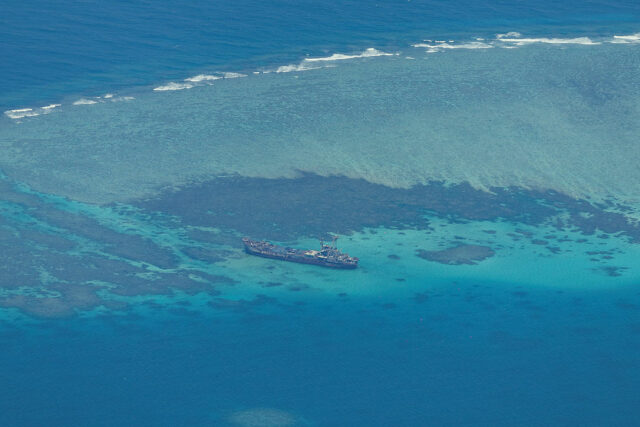
AN AERIAL VIEW of the BRP Sierra Madre at the contested Second Thomas Shoal on March 9, 2023. — REUTERS

THE US State Department on Tuesday condemned what it called “escalatory and irresponsible” actions by China and reaffirmed that its Mutual Defense Treaty with the Philippines applied to any attacks on Philippine armed forces, vessels, or aircraft anywhere in the South China Sea.

A Philippine supply ship dangerously approached a Chinese vessel and collided with it after it illegally intruded into waters near Second Thomas Shoal in the South China Sea, the Chinese Coast Guard said on Monday. Manila has called the claim “deceptive and misleading.”

In a statement, the US State Department called the incident the latest in a series of Chinese “provocations” to impede supplies from reaching Philippine personnel stationed at the BRP Sierra Madre, a World War II-era ship that Manila grounded at Second Thomas Shoal in 1999 to assert its sovereignty.

“This escalatory incident is the latest in a series of PRC (People’s Republic of China) provocations to impede critically needed supplies from reaching service members stationed at the BRP Sierra Madre,” Department of State spokesman Matthew Miller said in the statement posted on the agency’s website.

“PRC (People’s Republic of China) vessels’ dangerous and deliberate use of water cannons, ramming, blocking maneuvers and towing damaged Philippine vessels, endangered the lives of Philippine service members, is reckless, and threatens regional peace and stability,” he added.

The Philippine military on Monday said it would resist Chinese actions in disputed waters.

US Ambassador to the Philippines MaryKay Carlson condemned China’s “aggressive, dangerous” maneuvers in a post on X, saying the collision had “caused bodily injury.”

“Beijing’s actions reflect consistent disregard for the safety of Filipinos and for international law in the South China Sea,” she added.

The Chinese Embassy in Manila did not immediately reply to a Viber message seeking comment.

The Permanent Court of Arbitration in the Hague on July 12, 2016 ruled China’s claim of historic rights to resources within its so-called nine-dash line was illegal.

China has largely ignored the ruling, calling it void. Aside from the Philippines and China, Brunei, Malaysia, Taiwan and Vietnam also have claims to parts of the waterway.

China’s coast guard has repeatedly used high-pressure water cannons to dissuade Philippine vessels from entering highly contested areas within the country’s exclusive economic zone (EEZ) including Scarborough Shoal and Second Thomas Shoal.

In a separate statement, the US State Department said US Deputy Secretary of State Kurt Campbell and Philippine Foreign Affairs Undersecretary Maria Theresa P. Lazaro on Monday spoke via telephone and shared their concerns over China’s obstruction of Philippine resupply missions in the waterway.

“Deputy Secretary Campbell and Undersecretary Lazaro further reiterated the critical importance of the United States-Philippine alliance to maintaining our shared vision for a free and open Indo-Pacific region,” it said.

China’s coast guard took measures after the collision with the Philippine supply vessel including “boarding inspections and forced evictions,” spokesman Gan Yu said in a statement late Monday.

China has warned the Philippines about intruding into what it says are its territorial waters. It issued new rules, effective June 15, enforcing a 2021 law that allows its coast guard to use lethal force against foreign ships in waters it claims.

The rules allow China’s coast guard to detain suspected trespassers without trial for 60 days. 

‘POLITICAL TOOL’
In response, the Philippine Coast Guard said it had ordered the deployment of two vessels to patrol and ensure the safety of Filipino fishermen at Scarborough Shoal — a second flashpoint about 640 km (345 nautical miles) from Second Thomas Shoal.

Separately, the US Pacific Fleet said in a statement it had concluded a two-day joint maritime exercise with the militaries of Canada, Japan and the Philippines within Manila’s EEZ in the South China Sea.

In a statement on Monday, the National Task Force for the West Philippine Sea condemned what it called China’s “illegal and aggressive actions” after Sunday’s collision.

“Despite the illegal, aggressive, and reckless actions by the Chinese maritime forces, our personnel showed restraint and professionalism, refrained from escalating the tension and carried on with their mission,” it said.

“The Philippines is committed to pursuing peaceful and responsible actions in accordance with international law. It is our expectation that China, as a member of the international community, would also do the same,” it added.

The Group of Seven (G7) on Saturday called out China for its increasing use of dangerous maneuvers and water cannons against Philippine vessels. It opposed Chinese “intimidation activities” in the South China Sea.

In a communiqué after the G7 Summit in Apulia, Italy, the leaders of the powerful economic bloc raised concerns about the situation in the East and South China Seas, reiterating their “strong opposition to any unilateral attempt to change the status quo by force or coercion.”

The Philippine Department of Foreign Affairs welcomed the G7’s support of the 2016 arbitral ruling in a statement late Monday, as it called on China to work toward de-escalating the tensions peacefully.

“The Philippines urges China to stop its provocative behavior and distortion of the facts, including through enactment and enforcement of domestic laws and regulations that overreach into the legally settled maritime zones of the Philippines in violation of international law,” it said.

But Chinese Foreign Ministry spokesman Lin Jian said the G7 statement is an attempt to “vilify and attack” China, calling the claims of coercion in the waterway baseless.

“The G7 has long strayed from its original purpose of coordinating for stability in the global economic environment and has increasingly become a political tool to perpetuate US and Western supremacy,” he told a news briefing on Monday. — John Victor D. Ordoñez with Reuters