Home Blog Page 3013

Marcos: Not the right time to invoke Philippine-US Mutual Defense Treaty

SHATTERED. The windshield of Unaizah Mae 4 (UM4) was shaterred after two Chinese Coast Guard vessels fired water cannons to block a Philippine resupply mission to BRP Sierra Madre in Second Thomas Shoal. UM4 was one of the two civilian boats contracted by the Phiippine Navy for the mission. — ARMED FORCES OF THE PHILIPPINES PHOTO

By Kyle Aristophere T. Atienza, Reporter

PRESIDENT Ferdinand R. Marcos, Jr. asserted on Wednesday that it is not the right time for the Philippines to invoke its mutual defense treaty with the United States even as China’s coast guard resorted to violent actions that damaged Philippine vessels and injured Filipino navy personnel. in the South China Sea on Tuesday.

Other countries, including the US, have condemned China’s firing of water cannons at Filipino vessels on a resupply mission to a Philippine detachment in an area well within the country’s exclusive economic zone (EEZ).

The US said it was in talks with the Philippines following the incident, amid questions on whether there’s reason to activate their 1951 Mutual Defense Treaty, which compels both countries to defend each other in case of an armed attack.

Mr. Marcos said he did not think the Chinese Coast Guard’s latest acts of aggression were enough reason to activate Manila’s treaty with the nation that arguably has the world’s most powerful military.

Still, the Philippines views with “great alarm” the Chinese vessels’ “continuing dangerous maneuvers and actions,” the President told reporters before his return to Manila from a three-day special summit between Australia and the Association of Southeast Asian Nations (ASEAN).

Earlier in the day, US State Department spokesman Matthew Miller released a statement of condemnation of China’s actions and reiterated that the treaty covers “armed attacks on Philippine armed forces, public vessels, or aircraft — including those of its Coast Guard — anywhere in the South China Sea.”

On Tuesday, water cannons from two Chinese Coast Guard vessels shattered the windshield of Unaizah Mae 4, one of the two civilian boats contracted by the Philippine Navy for the resupply mission to BRP Sierra Madre, a World War II-era vessel that Manila deliberately grounded at Second Thomas Shoal in 1999 to assert its maritime claims.

The incident caused injuries to “at least four personnel on board,” according to the Philippines’ National Security Council (NSC).

Before the water cannon attacks, a Chinese coast guard vessel executed “dangerous maneuvers” against Philippine Coast Guard’s BRP Sindangan, which was escorting the resupply boat, leading to a minor collision that resulted in “superficial structural damage” to the hull of the escort ship.

The other supply boat, Unaizah Mae 1, managed to deliver supplies to BRP Sierra Madre on Tuesday.

“This time, they damaged the cargo ship and caused some injury to some of our seamen and I think that we cannot view this in any way but in the most serious way,” Mr. Marcos said.

“Once again, we will make our objections known and hope that we can continue to communicate to find a way so that such actions are no longer seen in the West Philippine Sea,” he added.

In a press conference on Wednesday, Mr. Miller said the Philippines and the US were “in discussions” following the Tuesday incident.

Philippine Foreign Affairs spokesperson Ma. Teresita C. Daza said in a briefing with security officials later in the day that “there are ongoing discussions and consultations between the Philippines and the US” on a number of cooperation, including those involving defense.

The Philippines has demanded that Chinese vessels immediately vacate the shoal, which is just 240 kilometers west of the Philippine main island of Luzon and is nearly 900 kilometers from Hainan, the nearest major Chinese landmass.

The Philippine Department of Foreign Affairs (DFA) on Tuesday summoned Chinese Deputy Chief of Mission Zhou Zhiyong to convey the Philippine government’s protest against the Chinese coast guard’s actions.

In a statement on Wednesday, Ms. Daza said: “The Philippines has made sincere efforts to implement leaders’ instructions to lessen tensions and have our Foreign Ministers and foreign ministries hold discussions. China, however, has made references to supposed agreements or arrangements out of these discussions.”

She said the Philippines has not entered into any agreement abandoning its sovereign rights and jurisdiction over its EEZ and continental shelf, including in the vicinity of Ayungin Shoal. 

Philippine Defense Secretary Gilberto C. Teodoro, Jr. said the Chinese actions within Philippine waters are “patently illegal and downright uncivilized.”

Following the incident, China said the Philippine government has “broken its promise,” a claim that it did not elaborate.

Manila also “deliberately staged a provocation and maliciously sensationalized the incident,” it added.

Mr. Teodoro said the People’s Republic of China once again attempted to “justify their illegal acts.”

He said “no right-thinking State” would believe in China’s claims, “which many outright condemn.”

“The PRC’s vain attempt to manufacture and sell this story falters in the face of real inconvertiable facts,” he said.

China has been asking the Philippines to remove its grounded warship from Second Thomas Shoal, which it calls Ren’ai.

Ms. Daza on Wednesday said Manila has never entered into any agreement abandoning its sovereign rights and jurisdiction over its exclusive economic zone and continental shelf.

China claims the South China Sea almost in its entirety, but its expansive activities continue to gain international condemnation — thanks to a Philippine transparency strategy that seeks to expose its aggression at sea.

Mr. Marcos, 66, has been  seeking the support of the US and other Indo-Pacific powers such as Japan and Australia as his government confronts China’s gray-zone tactics within the Philippine EEZ.

The Philippines’ increasing ties with the US is, for one, a result of ASEAN’s failure to come up with a unified approach to tensions in the South China Sea, said Jeffrey Ordaniel, director for maritime security at Pacific Forum and an associate professor of international security studies at the Tokyo International University.

In a joint statement on Wednesday, Australia and ASEAN recognized “the benefits of having the South China Sea as a sea of peace, stability, and prosperity.”

“We encourage all countries to avoid any unilateral actions that endanger peace, security and stability in the region,” it said.

CHINESE BUILDUP AT SHOAL
On Wednesday, a US-based think tank flagged that China’s maritime militia has increased its presence in Sabina Shoal with the deployment of at least 21 vessels there.

The 21 Chinese maritime militia vessels likely began arriving in Sabina Shoal, which falls within the Philippine EEZ, between Feb. 21 and 22 and they were seen “rafted” on March 5, said Raymond M. Powell, Sealight director at the Gordian Knot Center for National Security Innovation.

Chinese militia ships had been spotted at Sabina Shoal two months into April last year and they were mostly spread out at that time, he said in an X message. “From late November until February, we really didn’t see any mutua there at all.”

Mr. Marcos, meanwhile, raised suspicion over the reported presence of Chinese research vessels in Benham Rise, which the United Nations in 2012 declared as part of the Philippines’ continental shelf.

“Once again, this is a clear intrusion into our Philippine maritime territory and it is, as usual, of great concern,” he said at the Wednesday briefing.

“The presence of Chinese ships in the area is absolutely unnecessary because if it is truly a research vessel, both sides could have come to a simple agreement for those research vessels to ply Philippine waters and conduct such research,” he added.

The 24-million hectare Benham was renamed Philippine Rise in 2017.

CHINA CANNOT BLOCK PHL MARITIME ZONES LAW
CHINA does not have the right to block a Philippine measure that would establish its maritime zones in disputed areas in the South China Sea amid the former’s aggression in the waterway, a Philippine senator said on Wednesday

“The Maritime Zones law of the Philippines is not just legitimate but also necessary,” said Senator Francis N. Tolentino, who sponsored Senate Bill No. 2492, which was approved on final reading on Feb. 26.

“China does not have the right to veto this. As a free and independent state, China cannot stop the Philippines from passing the law,” he told a press conference.

Mr. Tolentino said congressmen are still refining their measures seeking to stake the Philippines’ claim on parts of the South China Sea. The House of Representatives has yet to pass its counterpart maritime zones bill and a bill seeking to set up archipelagic sea lanes.

The Senate bill also seeks to set up maritime zones in the Benham rise in the West Pacific. It would allow Philippine authorities to impose a fine of as much as $1 million (P56 million) on foreign actors that build artificial islands, conduct marine research and destroy Philippine marine environments within the maritime zones.

At a news briefing on Tuesday evening, Chinese Foreign Ministry spokesperson Mao Ning said the Philippines should not have included in its proposed law the “illegal” 2016 arbitral award that rejected China’s claims on the waterway.

She said the bill undermines China’s territorial sovereignty and maritime rights over the South China Sea, citing the country’s historical claim over the waterway.

“The rendered award is illegal, null and void,” the Chinese official said. “China neither accepts nor participates in that arbitration, neither accepts nor recognizes the award, and will never accept any claim or action arising from the award.”

Mr. Tolentino said the ministry’s statement showed that China is already worried about the law’s effect on the international community even before it has been enacted.

“This means they cannot ignore this anymore (bill), they already reacted just after it was approved on third reading,” he said in Filipino. “Their opposition to the Philippine Maritime Zones Law shows that they are acknowledging it, though they are trying to put a semblance of insignificance (to it).”

Senator Ana Theresia N. Hontiveros-Baraquel urged President Ferdinand R. Marcos, Jr. to fast-track the filing of a resolution to the United Nations General Assembly to call on China to stop the harassment of Filipinos in the South China Sea.

“At what point can we consider this to be unlawful aggression as understood under international law?” she said in a statement. “Raising this issue to the UN organ may be a way to give Chinese vessels pause before they attack our citizens.” — with a report from John Victor D. Ordoñez


Jose ‘Joecon’ Concepcion, industrialist and patriot, dies at 92

JOSE CONCEPCION gives an interview as the Comelec chairman in this file photo taken during the barangay elections in Makati City on Sept. 5, 2001. — BW FILE PHOTO

PRO-FILIPINO INDUSTRIALIST Jose Concepcion, Jr., who helped ensure Philippine democracy would benefit local manufacturers, died at the age of 92 on Wednesday, according to his family.

Mr. Concepcion, who is also known as “Joecon” in his public and private life, believed in the nation’s “ability to achieve economic development that was inclusive and pro-Filipino,” his family said in a statement. “He was the epitome of the patriot-industrialist.”

Mr. Concepcion advocated for fair and honest elections at a time when the country was struggling with an autocratic regime marked by corruption and human rights violations.

He was the founding chair of the National Movement for Free Elections (Namfrel), which exposed massive cheating in the 1986 snap elections after the Commission on Elections declared strongman Ferdinand E. Marcos as the winner.

Namfrel’s incomplete count showed opposition leader Corazon C. Aquino was ahead of Mr. Marcos, prompting Filipinos to march along the capital region’s major thoroughfare and other parts of the country, in an uprising that saw the 20-year regime’s downfall.

“It is better to light a candle than to curse the darkness,” Mr. Concepcion was famously quoted as having said in 1986.

Mr. Concepcion was a delegate of the Constitutional Convention of 1971, championing principles that sought to democratize the nation’s capital base to allow Filipino manufacturers to thrive, his family said.

In the post-EDSA regime, Mr. Concepcion carried on with his pro-Filipino business crusade, serving as Trade Secretary from 1986 to 1991.

His motto — “Yes, the Filipino can!” — inspired local businesses to compete and improve in an economy that had been hounded by the remnants of dictatorship.

The Department of Trade and Industry (DTI) recognized Mr. Concepcion as a “stalwart of entrepreneurship and business advocacy.”

“His visionary leadership and dedication have left an indelible mark on the Philippine economic landscape,” Trade Secretary Alfredo E. Pascual said in a Viber message.

To honor him, the flags at the department will be at half mast, said DTI Undersecretary Ed Sunico.

It was under Mr. Concepcion’s leadership when RFM Corp. pursued the path of diversification, venturing into animal feed milling, poultry, and livestock, said his son Jose Ma. A. Concepcion III, who founded a foundation for small businesses.

“Staying true to its vision of putting food on every Filipino table, RFM offered products that were mass-based, high-quality and low cost,” he added.

As a civil leader, Mr. Concepcion helped found the Bishop- Businessmen Conference for Human Development, the ASEAN Chambers of Commerce and Industry, and the Pasay Citizens’ League for Good Government.

In his retirement, he also served as chief of Forbes Park, a Philippine village where some of the country’s wealthiest families live, “famously alighting from his vehicle one night to direct traffic himself and unravel a gridlock.”

The Philippine Chamber of Commerce and Industry (PCCI) said Mr. Concepcion helped pave the way for “stronger engagement of the business sector in international trade negotiations” and promoted business practices that are responsive to the needs of the society.

He also pushed for a “community that is vigilant for democratic processes,” it said in a statement.

The Philippine Exporters Confederation, Inc., for its part, recognized Mr. Concepcion as an “industry captain” who significantly helped establish the Filipino brand in the consciousness of domestic and international markets.

“It was from him that we also learned and adopted inclusive growth as the fulcrum of our economic development,” the exporter group added.

Go Negosyo, Mr. Concepcion’s son Jose Ma. A. Concepcion III, said that it was under the leadership of the elder Concepcion when RFM Corp. ventured into animal feed milling, poultry, and livestock.

“These propelled RFM to establish itself as one of the leading food and beverage conglomerates in the Philippines. Staying true to its vision of putting food on every Filipino table, RFM offered products that were mass-based, high-quality and low cost,” Go Negosyo added.

Mr. Concepcion is survived by his wife, his eight children, his 31 grandchildren, and his twin brother, Raul.

“Joecon lived his life in adherence to his principles: that the only thing necessary for the triumph of evil is for good men to do nothing,” his family said. — Kyle Aristophere T. Atienza and Justine Irish P. Tabile

SC junks petitions vs gov’t regulation of POGOs

By Chloe Mari A. Hufana

THE SUPREME COURT (SC) has junked the consolidated petitions questioning the legality of rules and regulations governing Philippine Offshore Gaming Operations (POGO) in the country and denied all requests for a temporary restraining order and writ of preliminary injunction.

In dismissing the petitions for prohibition and/or certiorari filed by three separate parties, the SC En Banc cited their failure to “observe the doctrine of hierarchy of courts and sufficiently establish the elements of judicial review.”

The petitioners — Jovencio H. Evangelista; Union for National Development and Good Governance-Philippines Chairperson Miguel Daniel C. Cruz, and the Anti-Trapo Movement of the Philippines, Inc. — had challenged the constitutionality of the Rules and Regulations on POGO (RR-POGO) on the pretext that the Philippine Amusement and Gaming Corporation (PAGCOR) had no authority to operate and regulate online or offshore gaming operations.

However, the decision penned by Associate Justice Jhosep Y. Lopez pointed out that recourse, in this case, should have first been made to the lower-ranked court exercising concurrent jurisdiction with a higher court.

“This Court, the Court of Appeals, and the Regional Trial Court have concurrent original jurisdiction over petitions for certiorari and prohibition,” read a portion of the decision.

The petitioners justified their decision to direct their case to the High Court as the issues involved were of “transcendental importance,” but the SC ruled otherwise.

“Unfortunately, petitioners failed to show exceptionally compelling reasons to justify direct resort to this Court. Petitioners were not able to clearly explain why preventing PAGCOR from regulating and requiring the registration of offshore gaming operations is of transcendental importance, warranting the immediate attention of this Court and a deviation from the doctrine of hierarchy of courts,” the ruling said.

Disputing Mr. Evangelista’s contention that the PAGCOR charter did not give it the authority to issue the RR-POGO, the SC said it was “issued in the exercise of PAGCOR’s quasi-legislative powers.”

“This is pursuant to PAGCOR’s power under Section 8 of P.D. No. 1869 to promulgate rules and regulations relevant to the registration of persons engaged in gambling,” the SC said.

Moreover, the High Court said a party attacking the legality of a governmental act must prove they have personally suffered some actual or threatened injury due to the alleged illegal conduct of the government.

However, the petitioners failed to show any direct or personal interest in the matter as they weren’t in any imminent danger of sustaining direct injury as a result of the implementation, the Court found.

With this, the SC said it shall “refrain from discussing the constitutionality and legality of the RR-POGO.”

The petitioners also failed to indicate which alleged infringements of their legal and constitutional rights were affected by PAGCOR’s regulation of offshore gaming businesses, failing to satisfy an element of judicial review by the High Court.

Given the foregoing, the SC added: “Petitioners’ prayer for the issuance of a temporary restraining order and/or writ of preliminary injunction is denied.”

P212-M Bangsamoro fund released

BUDGET SECRETARY AMENAH F. PANGANDAMAN — PHILIPPINE STAR/KRIZ JOHN ROSALES

THE DEPARTMENT of Budget and Management (DBM) said on Wednesday it had greenlighted the release of about P212.77 million for social protection programs in the southern region of Bangsamoro.

The funding was allocated for the programs of the Bangsamoro region’s Ministry of Social Welfare and Development for the first half of 2024, including a cash transfer program for the poor and social pension for seniors, Budget Secretary Amenah F. Pangandaman said in a press release.

It is part of the P3.22-billion fund allocated for the Bangsamoro region under the budget of the Philippine social welfare department, she added.

The latest funding would also support the implementation of livelihood and feeding programs as well as a 2016 law that entitles Filipinos aged 100 years old with a P100,000 cash gift.

The Bangsamoro Autonomous Region in Muslim Mindanao, home to some four million Filipinos, was created in 2019 after successful talks between the National Government and Moro separatists.

“Bangsamoro’s economy is still fairly rural and programs for farmers and the most vulnerable members of society — the indigenous peoples, orphans, senior citizens and veteran fighters of the MILF — are needed,” said Georgi Engelbrecht, a senior analyst at nongovernment organization Crisis Group.

He said support to microenterprises and microcredit is very much needed in the region.

While there has been “some progress” on the economic front within its five years of existence, the region still needs to ensure that all its provinces generate enough jobs for their residents and are resilient in the face of extreme weather events, Mr. Engelbrecht said.

“If you look at the poverty incidence, unfortunately it is still a long way to go as not all provinces have been moving forward,” he said in an X message.

“Five years are not enough to fully change the landscape [especially because] we have challenges at the local and even hyperlocal level: barangay and municipal politics, control of the political economy, lack of jobs,” he said.

“Long-term, we also have the challenges of natural disasters and extreme weather events,” he added. — Kyle Aristophere T. Atienza

MMDA: SC decision not yet final

TRAFFIC enforcers stop a motorcycle rider caught using the restricted lane of EDSA devoted only to passenger buses on Monday. — PHILIPPINE STAR/ERNIE PEÑAREDONDO

THE METROPOLITAN Manila Development Authority (MMDA) said on Wednesday that the Supreme Court’s (SC) decision barring local government units (LGUs) from issuing citation tickets is “not final and executory.”

In a press conference yesterday, acting MMDA Chairman Romando S. Artes said LGUs can still issue traffic violation tickets and apprehend erring drivers.

On Tuesday, the SC ruled on the jurisdiction of MMDA in administering traffic rules in Metro Manila.

“What is important is the recognition that the MMDA, through the Metro Manila Council, has the power to pass resolutions regarding traffic. In effect, the SC overturned an earlier decision that says MMDA has no legislative powers,” Mr. Artes said in mixed English and Filipino.

MMDA officials still need to meet and discuss the implications of the decision of the High Court, especially on the traffic conditions in Metro Manila.

Mr. Artes admitted the lack of manpower to manage traffic calls for the help of local traffic enforcers, especially on inner roads.

If local traffic enforcers need to be deputized, qualifications for the position must be established and the MMDA will assign authority to them as enforcers, said Mr. Artes.

The SC decision also ordered that the single-ticketing system (STS) by the MMDA be followed. As such LGU traffic enforcers were ordered to stop issuing citation tickets and confiscating driver’s licenses.

There are 15 LGUs currently implementing the STS. — Chloe Mari A. Hufana

BoC digital payment deal inked

THE BUREAU of Customs (BoC) and the Land Bank of the Philippines (LANDBANK) have signed an agreement for a digital payment system of miscellaneous fees through Link.BizPortal as the bureau works toward full digitalization.

The memorandum of agreement (MoA) was signed on Monday by Customs Commissioner Bienvenido Y. Rubio and LANDBANK President and Chief Executive Officer Lynette V. Ortiz.

“Through LANDBANK’s Link.BizPortal, we are not only facilitating smoother transactions but also fostering greater transparency and accountability,” Mr. Rubio said in a statement.

The LANDBANK’s digital payment system is expected to reduce bureaucratic red tape, bolster operational efficiency, and enhance service delivery of the BoC.

The payment platform could handle small and large-value payments, allow real-time debit from payor’s account as well as batch credit to merchant’s account, and issue a payment confirmation through e-mail.

“By leveraging the capabilities of the Landbank Link.BizPortal, the BoC aims to streamline payment processes, minimize delays, and provide a more convenient and user-friendly experience for stakeholders,” the bureau said.

“This partnership marks a collective effort in the continuous pursuit to enhance, digitize, and simplify government services in accordance with one of President Ferdinand Marcos, Jr.’s eight-point socioeconomic agendas to improve bureaucratic efficiency, prioritize digitalization, harmonize, and standardize governmental processes,” it added.

The BoC earlier said it might delay its push towards full digitalization to 2026, citing procurement delays.

The Philippines Customs Modernization Project was approved by the World Bank in 2020. The project aims to reduce trade costs and improve the efficiency of the agency.

The BoC on Tuesday reported that its collections reached P70.601 billion in February, surpassing its P66.207-billion target for the month by 6.64%.

The collection was also 12.3% higher than its P62.895-billion collection a year ago. — Beatriz Marie D. Cruz

Civilians owning automatic weapons would worsen crime – senators

IMELDA “IMEE” R. MARCOS — SENATE PRIB

ALLOWING civilians to own semi-automatic weapons would lead to more cases of terrorism, arms smuggling and political killings, senators said after the Philippine National Police (PNP) revised its rules on gun licenses, allowing ordinary Filipinos to own these.

“The PNP is shooting itself in the foot and compromising law enforcement efficiency and, above all, public safety,” Senator Maria Josefa “Imee” R. Marcos said in a statement.

“When killings occur, penalties for firearm misuse will offer nothing but cold comfort to the families of victims — policemen, soldiers, and civilians included.”

Trade Assistant Director Domina Pia Salazar earlier told United Nations (UN) officials that the Philippines is enforcing a strict gun licensing system, amid expectations of an uptick in gun-related violence as the campaign period for next year’s midterm elections draws near.

The Philippines has grappled with rampant election-related violence through the years, usually between candidates from elite families.

Nineteen people died and 19 others were hurt in the village and youth council elections in October, according to the Commission on Elections.

PNP spokesperson Colonel Jean S. Fajardo on Monday said her agency had made changes to the implementing rules and regulations (IRR) of the Comprehensive Firearms and Ammunition Regulation Act, allowing civilian ownership of semi-automatic rifles.

Senator Ana Theresia N. Hontiveros-Baraquel said limiting gun ownership would ensure the safety of Filipinos, citing the need to revisit the country’s gun laws to ensure safety.

“We should not allow anyone, especially politicians, business persons and their personnel, to own so many guns,” she said in a statement. “We must fix our gun laws, and stop the rise of political killings and warlordism in our country.”

The Philippines ratified the Arms Trade Treaty in March 2022, which seeks to prevent illegal gun trading and regulate conventional firearms trade. It took effect three months later.

Conventional weapons are widely used and designed for military purposes, without being classified as weapons of mass destruction, according to the UN Office on Drugs and Crime website. These include small and light guns, battle tanks, armored combat vehicles, missiles and missile launchers. – John Victor D. Ordonez

Zubiri eyes approval of anti-financial account scamming bill

A SENATE BILL seeking to impose tougher penalties on online investment scammers, phishers and other fraud schemes is likely to get the Chamber’s approval by the end of the month, the Senate president said on Wednesday.

“Every day we are taking up LEDAC (Legislative-Executive Development Advisory Council) approved measures,” Senate President Juan Miguel F. Zubiri told a news briefing. “Hopefully in the next two weeks, we can pass the anti-fishing, anti-mule, anti-scamming and fraudulent transactions (bill), that’s also a LEDAC measure.”

Senate Bill No. 2560, the Anti-Financial Account Scamming Act (AFASA), reached the Senate plenary for debates on Feb. 21.

SENATE APPROVES REAL PROPERTY VALUATION BILL ON 2ND READING
On late Tuesday, the Senate approved on second reading the Real Property Valuation and Assessment Reform Act, a priority bill seeking to fast-track and boost the monitoring of real property transactions of local government units (LGUs) through digitalization. The measure is expected to boost local revenues.

The Bangko Sentral ng Pilipinas (BSP) earlier said it hopes for the Senate to pass the measure by May to help address the increase in crimes involving banks, e-wallets and other financial institutions.

It is hoping for the Philippines to exit the money laundering “gray list” of the Financial Action Task Force by October this year.

The Senate committee on banks met with central bank, police and communication officials in January to come up with anti-fraud measures and to review the effectiveness of current countermeasures of financial institutions.

“We have to continuously improve our legal system, if possible be two steps ahead of the scammers at all times to effectively protect the public from their nefarious acts,” Senator Mark A. Villar, who heads the committee, told a hearing in January.

Lawmaker seeks bigger maritime defense fund for 2025

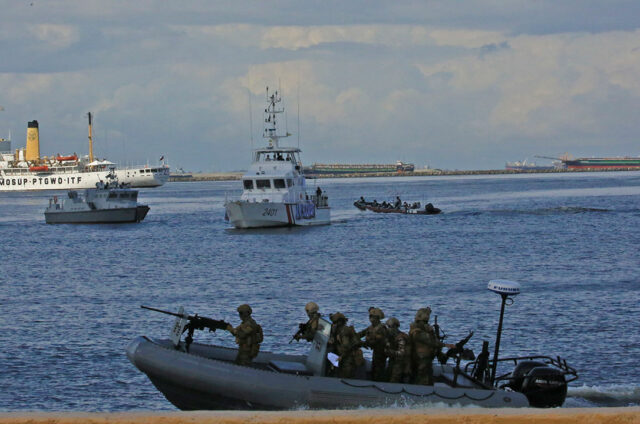
VARIOUS government agency led by the Philippine Coast Guard conduct interagency exercise dubbed as ‘Alalayan 2023’ at Manila Bay in Manila. — PHILIPPINE STAR/EDD GUMBAN

THE GOVERNMENT should increase its budget allocation for maritime security in the Philippine-claimed territories of the South China Sea amid more aggressive actions by China, House Deputy Majority Leader and Mandaluyong Rep. Neptali M. Gonzales, II said on Wednesday.

Mr. Gonzales, who also chairs the House Special Committee on the West Philippine Sea, told a media briefing that the government should look at allocating more budget to security agencies to bolster the capability of the country to defend maritime territories from Chinese incursions.

“It’s about time that the government recalibrates the allocation of funds to include the necessary resources to protect our West Philippine Sea,” said Mr. Gonzales.

He said the government must allocate an increased budget for ships, helicopters, and additional resources that are needed by the Philippine Coast Guard to safeguard territorial seas.

“It’s about time when we do the budget, the national government includes this as a major concern,” he said. “Not only education, not only health, but also the protection of what is supposed to be ours.”

Last Tuesday, China fired water cannons at Filipino vessels in a resupply mission to a grounded ship-turned-outpost at the Ayungin Shoal.

The Ayungin Shoal is home to BRP Sierra Madre, a World War II-era ship deliberately grounded by the country in 1999 to bolster its claim in the region. The contested shoal is 194 kilometers west of Palawan – well within the Philippines’ exclusive economic zone.

The said incident left four Philippine Navy officers injured.

The Philippines also received a report that two Chinese research vessels were loitering in the Philippine Rise last week.

The Philippine Rise, located off the east coast of the country, is said to be rich in marine biodiversity. The area was declared in 2012 as part of the country’s continental shelf. The rise was designated as a “protected food supply exclusive zone” by the Philippines in 2017, therefore mining and oil exploration operations are banned in the area. – Kenneth Christiane L. Basilio

Digital forensics helps curb illegal wildlife trade in Palawan

MONITORING online trade data and digital forensics are seen as new methods to implement the USAID-funded Palawan project against illegal wildlife trade.

“The illegal wildlife trade still continues, not just in the physical market but especially online, in social media and e-commerce sites,” Project Consultant Emerson Y. Sy told a webinar titled on Wednesday.

Mr. Sy said the project, Breaking the Cycle of Illegal Wildlife Trade in Palawan, is set to run for three years under the Diliman Science Research Foundation. It is supported by the United States Agency for International Development (USAID) through the INSPIRE (Investing in Sustainability and Partnerships for Inclusive Growth and Regenerative Ecosystems) Project under the Gerry Roxas Foundation.

He said monitoring the online trade is not only for research purposes but also seeks to provide support to law enforcement.

Web trade monitoring refers to an analyst creating a survey and collating information, this can be on a social media platform listing under the surface web, or the dark web.

Among the tools used is artificial intelligence (AI) through the software web scraper.

Meanwhile, fellow project consultant Kester T. Yu said another approach is through digital forensics from captured evidence.

“For those who might say it might be a violation of data privacy, it is actually legal when applied with a cyber warrant or a court order. It is also admissible to court as evidence,” Mr. Yu said.

He also presented a case study of a trader captured two years ago in Palawan after implementing cyber patrolling and leeching online.

“After his arrest, his phone was confiscated, and we applied the cyberwarrant. From that cellphone alone, during the digital forensic examination, we uncovered 18,406 messages,” he added.

Mr. Yu also noted the disparity of monitored trade cases in 2019-2021 between government agencies and the result of their digital forensic examination.

This includes the Philippine National Police (PNP), National Bureau of Investigation (NBI), the Department of Natural Resources (DENR), the Bureau of Customs (BOR), and the local governments.

In three years, the authorities had 163 wildlife seizures; but Mr. Yu noted how a single trader could trade 169 species on his own.

He also noted the difference in the most common species traded between the two sources. The authorities listed Palawan Hill Myna with 147 heads followed by Philippine Pangolin with 45 heads, and Long-tailed Macaque with 14 heads.

The digital forensic report recorded the Emerald False Gecko with 577 heads topping the list, followed by the Philippine Pit Viper with 376 heads, and the Yellow-headed water monitor with 136 heads captured.

The project used multifaceted strategies for its aim to reduce IWT, he said

It includes identifying the supply chain, a uniform protocol for the chain of custody of confiscated samples, developing information education and communication materials on illegal wildlife trade, and others. — Aubrey Rose Inosante

Abando, Anyang clash with Seoul in EASL Final Four match in Cebu

EASL.BASKETBALL

RHENZ ABANDO, who played for Gilas Pilipinas in the FIBA World Cup, makes his anticipated Philippine comeback with Korean mother club Anyang Jung Kwan Jang in the East Asia Super League (EASL) Final Four at the Hoops Dome in Lapu-Lapu City, Cebu 

Mr. Abando, who suffered multiple back injuries after a freak fall from mid-air in the Korean Basketball League, has fully recovered and already suited up for Anyang last week.

The high-flying winger didn’t skip a beat with a smooth outing of 17 points, four rebounds, three assists and four steals in Anyang’s 92-87 win.

Now, he’s all set for homecoming as Anyang seeks another EASL title against another KBL standout Seoul SK Knights in the Final Four that also features Japan B. league’s Chiba Jets against the New Taipei of the P. League+.

Mr. Abando and Anyang, who are already in Cebu, ruled the EASL Champions Week and the KBL last year against Seoul.

His full recovery, however, coincided with the hand injury of Seoul’s Juan Gomez de Liaño, who underwent a season-ending surgery, to spoil an exciting duel between two Filipino imports in front of Cebuano fans in the Queen City of the South. Anyang takes on Seoul at 5 p.m. Thursday followed by the battle between Chiba and New Taipei at 8 p.m. in the knockout semis with the winners duking it out for the crown on Sunday. At stake in the EASL Final Four, backed by the Philippine Airlines, Dusit Thani Mactan Cebu Resort, TikTok, Anta, McDonald’s and Spalding, is a whopping $1 million grand prize.

Prior to the arrival of EASL teams, Philippine Ambassador to Korea Maria Theresa B. Dizon-De Vega attended the game of Rhenz Abando along with embassy officials and members of the local Filipino community to send off the former NCAA Rookie-Most Valuable Player (MVP) from Letran and the rest of Anyang Jung Kwan Jang in their EASL title bid. — John Bryan Ulanday

CAS clears Simona Halep for immediate return after doping ban cut to 9 months

SIMONA HALEP — WTATENNIS.COM

GENEVA — Former Wimbledon and French Open champion Simona Halep had her four-year doping ban cut to nine months by the top court for global sport on Tuesday, making the former world number one eligible to return to competition immediately.

Ms. Halep was initially banned for four years for two separate anti-doping rule violations. But the Lausanne-based Court of Arbitration for Sport (CAS) ruled that her suspension should be reduced to nine months, a period she has already served.

Now that the 32-year-old Romanian is eligible to compete, she could be granted a wild card to this year’s French Open or Wimbledon.

Ms. Halep was suspended in October 2022 after she tested positive for roxadustat — a banned drug that stimulates the production of red blood cells — at the US Open that year.

She was also charged with another doping offense last year due to irregularities in her athlete biological passport (ABP), a method designed to monitor different blood parameters over time to reveal potential doping.

Ms. Halep, who vigorously denied the charges against her, has said that she would most likely be compelled to retire if the initial four-year ban was maintained.

Halep blamed contaminated supplements for her positive test at the US Open and accused the International Tennis Integrity Agency (ITIA) of charging her with an ABP violation after the group of experts who assessed her profile learned her identity.

In response to the ruling, ITIA Chief Executive Officer, Karen Moorhouse, said: “An essential element of the anti-doping process is a player’s ability to appeal, and the ITIA respects both their right to do so, and the outcome.”

An independent tribunal accepted Ms. Halep’s argument that she had taken contaminated supplements but said the volume she ingested could not have resulted in the concentration of roxadustat found in her positive sample.

However, the CAS Panel said that while Ms. Halep should have been more careful when using the supplement, she did not bear significant fault for the violation.

Also, the ABP charge was dismissed on the basis that it was appropriate to consider that the sample given in late 2022 was shortly before a surgery and that Halep had said she was not going to compete for the rest of that year. — Reuters