Home Blog Page 3

BSP’s 2025 net profit climbs 10% on lower expenses
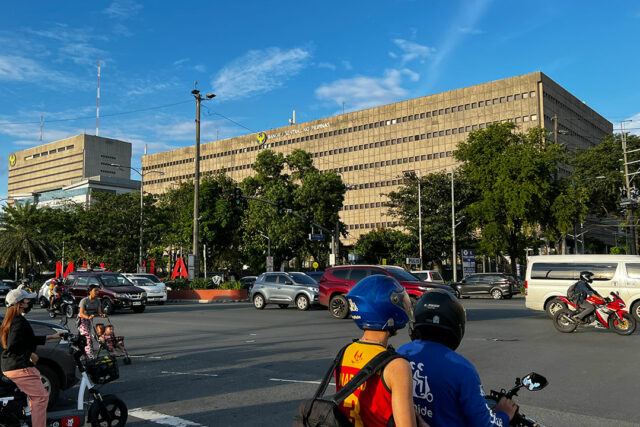
BW FILE PHOTO

THE BANGKO SENTRAL ng Pilipinas (BSP) posted a higher net income in 2025, supported by lower expenses and higher gains from foreign exchange (FX) rate fluctuations, preliminary data showed.

The central bank’s net profit rose by 10.25% year on year to P130.1 billion from P118 billion in 2024, data posted on its website showed.

This came despite a 9.3% decline in its revenues to P272.5 billion from P300.4 billion.

Broken down, interest income, which made up the bulk of the BSP’s revenues, went up by 1.23% to P243.8 billion from P240.8 billion.

Meanwhile, its miscellaneous income, which includes fees, penalties and other operating income, among others, sank by 51.68% to P28.8 billion from P59.6 billion.

On the other hand, the BSP’s expenses decreased by 11.1% year on year to P201.4 billion in 2025 from P226.6 billion in 2024.

This was mainly due to the 22.85% drop in interest expenses to P129 billion from P167.2 billion.

Other expenses, which includes net trading losses, increased by 21.89% to P72.4 billion from P59.4 billion.

These brought the BSP’s net income before net FX gains or losses, income tax expenses or benefits, and capital reserves to P71.1 billion, down from P73.8 billion in 2024.

However, the central bank booked a P59-billion net gain from fluctuations in FX rates arising from its foreign currency-denominated transactions last year, 33.79% bigger than the P44.1 billion recorded in 2024. This pushed up its 2025 bottom line as a result.

ASSETS AND LIABILITIES
Meanwhile, the BSP’s total assets stood at P8.003 trillion at end-2025, growing by 2.5% from P7.81 trillion a year earlier, separate data showed.

This was driven mainly by the 5.99% increase in its international reserves to P6.47 trillion from P6.11 trillion.

Its holdings of domestic securities went down by 17.3% to P929.8 billion from P1.12 trillion.

On the other hand, the central bank’s total liabilities edged up by 0.7% to P7.64 trillion  from P7.59 trillion.

Reserve money, which includes currency in circulation, and reserve deposits of other depository and financial corporations, among others, dropped by 6.91% to P3.73 trillion from P4.01 trillion, according to the data.

Other deposits not included in reserve money also went down by 9.91% to P930.1 billion from P1.03 trillion.

Meanwhile, the BSP’s net worth surged by 61.66% to P360.5 billion from P223 billion as its surplus or reserves jumped by 84.36% to P300.5 billion from P163 billion.

The BSP’s surplus account reflects its unrestricted retained earnings, while its capital reserves are funds set aside for various contingencies.

Surplus or reserves also include unrealized gains or losses from the central bank’s investments in government securities, stocks and other securities, as well as its net income or loss from operations. — A.M.C. Sy


Lipa opens new city hall at Ayala estate Areza

THE CITY GOVERNMENT of Lipa inaugurated its new city hall on April 8 within Areza, a masterplanned estate developed by Ayala Land Estates, Inc., a subsidiary of Ayala Land, Inc.

Areza, a 92-hectare masterplanned estate by Ayala Land, is envisioned as Lipa’s new city center, integrating walkable urban spaces, green corridors, and commercial districts within an infrastructure-supported environment.

The facility, located in Lipa’s emerging urban core, is intended to centralize key government services and improve accessibility for residents, according to a statement on Monday.

Mayor Eric B. Africa said the new city hall is expected to serve as a landmark that will strengthen the city’s identity and support its economic growth.

Ang New Lipa City Hall ay maging isa sa new landmark sa Lipa. Na magbibigay ng pagkakakilanlan sa ating lungsod. Gusali na magiging bahagi ng turismo at sasalamin sa progresibong lungsod at higit na maghihikayat ng mga imbestors na maghahatid ng oportunidad na trabaho sa mga Lipeño (The New Lipa City Hall is expected to become a new landmark in Lipa, helping define the city’s identity. It will form part of the local tourism landscape and reflect a progressive city, while attracting investors that can generate job opportunities for Lipeños),” he said during the inauguration.

The development is expected to help position Areza as Lipa’s next central business and civic district, integrating government, commercial, and community spaces, Ayala Land Estates said.

Gilbert Ramos, Areza project development head, said the partnership between the local government and Ayala Land aims to support long-term urban growth.

“Over the long term, we see Areza evolving alongside the city, supporting its growth by providing a strategic, integrated location for key institutions and economic activity,” he said.

The new city hall has a floor area of about 23,000 square meters and will house key administrative offices to streamline public service delivery. It will also feature a performance hall, an annex building, and a 2,160-square-meter plaza.

Shares in Ayala Land slipped by 0.11% or two centavos to close at P18.06 on Monday. — Juliana Chloe A. Gonzales

Eton tightens delivery standards, centralizes customer experience oversight

Centris Cyberpod Two, EDSA Corner Quezon Avenue, Quezon City — ETON.COM.PH

LISTED property developer Eton Properties Philippines, Inc. is shifting its strategy toward tighter execution and centralized customer experience oversight, its chief executive officer said.

At its 19th anniversary gathering on March 25, the real estate arm of LT Group, Inc. outlined plans to strengthen delivery standards, customer experience governance, and operational discipline across the organization.

The company said the shift forms part of its operating direction called “Eton in Motion,” which focuses on aligning internal processes and accountability measures.

“Eton set out to build more than developments. Nineteen years of commitments honored. Standards held. Trust earned — quietly and consistently — in the daily work that most people never see. Eton in Motion is not an anniversary theme. It is a declaration of how this company moves: with clear standards, consistent delivery, and the discipline to hold the standard even when it is inconvenient,” said Donna Kristine Salgado, assistant vice-president for marketing, public relations, and corporate communications, in a statement on Monday.

Eton said it is strengthening oversight of customer experience through a centralized tracking framework managed by its Customer Experience Committee, which will measure performance based on customer feedback.

The company also introduced an internal handbook covering brand and customer experience standards, aimed at establishing a consistent approach across operations.

“Nineteen years ago, Eton Properties was a promise. Today, that promise is still being kept — and still being earned. There is a lot of work ahead of us,” said President and Chief Executive Officer Kyle Ellis Tan.

“But we are moving in the right direction. Not because of the milestone. Because we have made a deliberate choice to be honest about where we are and disciplined about where we are going.”

Eton executives said the company is focusing on improving coordination across teams, reinforcing accountability in day-to-day operations, and aligning internal processes with performance targets.

Eton Properties Philippines has a portfolio spanning residential, office, commercial, and hospitality developments across key urban areas in the country. — ALB

The end of the Petrostate Era won’t bring peace

REUTERS

By David Fickling

WITH the Middle East in flames and a fifth of the world’s supplies of oil and gas in limbo thanks to the uncertain status of the Strait of Hormuz, it’s tempting to imagine that a clean-energy world might leave such conflicts behind:

“Fuel — oil and gas, particularly — is a security challenge,” former US Secretary of State John Kerry said last month. “You don’t want to be the prisoner of a choke point.”

Rewiring the world with green energy is a “path to peace,” in the words of the late environmental journalist Ross Gelbspan.

“If an alien came to visit, I’d be embarrassed to tell them that we fight wars to pull fossil fuels out of the ground,” astrophysicist Neil deGrasse Tyson once remarked.

And yet the unravelling of the global fossil fuel system may well be a source of chaos rather than calm. Two wars have already erupted in major oil-exporting regions since global leaders started committing to net-zero five years ago.

States that are energy independent may also find themselves less fearful of conflict than ones beholden to foreign suppliers. Have a look at countries that have become less reliant on energy imports in recent decades, and it’s hardly a list of pacifists.

Consider a ranking of “electrostates” — countries that have done most to switch away from fossil-fired engines and boilers, and toward electrical motors, machinery, and heat pumps. In descending order, they are: Norway, Sweden, Israel, Switzerland, Brazil, Vietnam, China, Japan, EU, India, US, UK, Saudi Arabia, Russia, and Iran. China’s surging consumption makes it the archetypal example, but if you consider grid power as a share of energy, the biggest electrostates are Norway, Sweden — then Israel.

It’s a similar picture when you cut the data a different way — the share of energy consumption supplied by imports. Thanks to the discovery of offshore gas fields and the growth of solar and electric vehicles, in Israel this fell 62% between 2010 and 2022. That’s the most dramatic reversal anywhere, and it’s left the country with far greater economic resilience. Since the start of the war with Iran, the shekel is one of the world’s best-performing currencies, up about 2.6%.

Other countries have trodden a similar path. The fracking boom has turned the US from a net importer to a net exporter of oil, and it’s similarly insulated from many of the effects of the crisis in the Strait of Hormuz. At the Waha hub pricing point in west Texas, gas producers will currently pay you about $4.62 per million British thermal units to take their product. Gasoline prices are up, but gas-linked electricity costs should stay low. That’s not making Washington any less bellicose.

China, meanwhile, has built an entire clean energy industry in part to reduce its need for imported oil and gas. Belt and Road pipelines and railways to bypass the Strait of Malacca have been built to blunt the threat of a US oil embargo in the event of war, while dirty domestic coal reserves have been used to trade-proof the grid. If those actions have increased Beijing’s strategic autonomy as intended, they’ll make war more likely, not less.

Similar efforts will now accelerate around the world. Renewable power is cheaper almost everywhere, and is inherently energy-independent. The sun and the wind don’t have to pass through an ocean strait to make it to your generators. Once equipment is connected, it can provide power for decades without a drop of imported fuel. With the US apparently abandoning its role as the guarantor of global freedom of navigation, the strategic value of that consideration has increased drastically.

That doesn’t necessarily bode well for peace. Trade has long been recognized as a restraint on conflict. “The commercial spirit cannot co-exist with war,” Immanuel Kant once wrote. By raising the economic cost of conflict, the deepening integration of the global economy since the Cold War has helped restrain it.

That process has been inextricably linked to carbon. Fossil fuels comprise about 40% of the tonnage that’s moved by sea each year. Crude oil is consistently the most-traded product globally, followed by computer chips, cars, and refined petroleum. Add in gas and coal, and about 12% of the value of global trade comes from carbon-emitting energy alone.

We have seen this play out before. After Britain pushed Germany into famine during World War I by blockading its imports of food and fertilizer, European economies and Japan turned to autarky, a policy of industrial self-sufficiency, to ensure they were never put in the same situation. That in turn fueled the zero-sum competition that eventually sparked another, far more devastating conflict in 1939.

The Iran conflict is sure to spur the world’s transition away from fossil fuels and toward clean energy. If that’s done for national security reasons, though — out of fear of each other, rather than hope for the future — it may push us further away from peace, rather than closer to it.

BLOOMBERG OPINION

Cannes Film Festival announces arthouse-heavy lineup as Hollywood scales back

PARIS/BERLIN — This year’s Cannes Film Festival will pit stalwarts of arthouse cinema such as Poland’s Pawel Pawlikowski and Spain’s Pedro Almodovar against a small pool of newer voices as 21 titles compete for the gathering’s prestigious main prize next month.

The Cannes Film Festival brings together the film industry’s biggest names in the sun-soaked south of France each May to strike deals, pledge their love for cinema and party on yachts.

For directors, winning the festival’s Palme d’Or opens the door to bigger budgets, opportunities, and seals their reputation as leading filmmakers.

In announcing this year’s lineup late last week, Festival Director Thierry Fremaux noted the absence of big studio films as weak box office revenues force Hollywood to avoid taking risks and to scale back production.

“In the US, it’s a moment of transition. When you have such a transition, they don’t have the projects to produce a lot of films, but I’m sure that it will come back, and we will be there waiting,” he told Reuters.

FORMER WINNERS COMPETE WITH NEWCOMERS
Two previous Palme winners return to competition, with Japan’s Hirokazu Kore‑eda exploring childhood and artificial intelligence in Sheep in the Box, while Romanian director Cristian Mungiu’s Fjord stars Norwegian actor Renate Reinsve, fresh from her success in Oscar winner Sentimental Value.

Also back in the running are Mr. Pawlikowski with Fatherland, a portrait of German novelist Thomas Mann, and Hungarian filmmaker Laszlo Nemes, whose new film focuses on French Resistance figure Jean Moulin.

Other competition veterans include Mr. Almodovar, with tragicomedy Bitter Christmas, as well as Iran’s Asghar Farhadi, Japan’s Ryusuke Hamaguchi and France’s Arthur Harari.

Entries featuring big-name actors include US director Ira Sachs’ 1980s AIDS drama The Man I Love, which stars Rami Malek from Bohemian Rhapsody, while Javier Bardem leads The Beloved from Spain’s Rodrigo Sorogoyen.

Five films in competition are directed by women, including first‑time contenders Lea Mysius, with the thriller The Birthday Party, and Jeanne Herry’s drama Another Day starring Adele Exarchopoulos.

OUTSIDE THE MAIN COMPETITION
Outside the main competition, the director of the cult classic Drive, Nicolas Winding Refn, returns after a decade with Her Private Hell, while US directors Steven Soderbergh and Ron Howard premiere documentaries on John Lennon and fashion photographer Richard Avedon, respectively.

John Travolta, whose superstardom as an actor began with Saturday Night Fever and Grease in the 1970s, makes his debut as a director with the out-of-competition Propeller One‑Way Night Coach.

Korean director Park Chan-wook, who took the festival’s best director award in 2022 for Decision to Leave, will preside over the jury.

The 79th Cannes Film Festival runs from May 12-23. — Reuters

Protracted Middle East war narrows Bank of Japan’s rate hike oppositions

BANK OF JAPAN Osaka Branch — COMMONS.WIKIMEDIA.ORG

TOKYO — Once seen as a strong possibility, a Bank of Japan (BoJ) rate hike in April is turning into a fainter prospect as fading hopes of an end to the Middle East conflict keep markets volatile and muddle the outlook for a fragile economy.

The protracted conflict has also heightened communication challenges for the central bank. Having laid the groundwork for a near-term rate hike with hawkish rhetoric this year, the BoJ now has fewer windows to signal to markets a pause before its next policy decision.

The BoJ’s April 27-28 meeting comes a week after the deadline of a fragile ceasefire between the US and Iran that has failed to end Iran’s blockade of the Strait of Hormuz.

BoJ policymakers are divided between those who focus on mounting inflationary risks, and others who prefer to wait to see how the conflict unfolds, say three sources familiar with its thinking. Also complicating the debate, the persistently weak yen continues to present a strong argument to hike, Japan’s trade minister said on Sunday.

All of that suggests the decision would be a close call and heavily dependent on the yen and the fragile two-week ceasefire — much more risk than the BoJ usually deals with.

“It’s up to how the BoJ balances upside risks to inflation and downside risks to growth, which is hard to judge with so much uncertainty surrounding the Iran war,” one of the sources said, a view echoed by another source.

A third source said the chance of an April hike may have diminished given the risk the conflict could inflict stronger-than-expected economic damage.

“If the Middle East conflict persists and works to push down growth while accelerating inflation, it would pose a dilemma and difficult problem for us,” BoJ Deputy Governor Ryozo Himino said on Friday, adding the bank would focus on the scale and duration of the shock.

BoJ COULD STRUGGLE TO SIGNAL POLICY INTENT
Given the conflict’s unpredictable nature, the BoJ may find it hard to drop clear hints on its rate decision, unlike in the past few meetings where executives offered advance signals to avoid surprising markets.

As a result, markets may see volatility regardless of whether the BoJ hikes rates or not in April, analysts say.

“If there’s no additional hints from the BoJ, markets will start reducing bets of an April action. That means if it does hike, the move could surprise markets and push up bond yields,” said Naomi Muguruma, chief bond strategist at Mitsubishi UFJ Morgan Stanley Securities.

“But keeping rates steady could also push up yields and weaken the yen on fear the BoJ is behind the curve in addressing inflation. So either way, markets won’t take it very well.”

Among the few events where the BoJ could drop hints would be a brief speech that Governor Kazuo Ueda was set to deliver on Monday, and his expected news briefing later this week after attending International Monetary Fund and G20 meetings in Washington.

The governor may also speak on policy if summoned to parliament, though the dates are not set in advance.

TOUGH CALL
With inflation hovering around its target for nearly four years, the BoJ has been carefully laying the groundwork for a near-term hike by highlighting mounting price pressures.

Mr. Ueda said in March the central bank won’t rule out raising rates again if the war-induced economic downturn proves temporary, keeping alive the chance of an April rate hike.

The BoJ then released a new gauge showing underlying inflation exceeding its target, and a paper arguing that Japan is more prone to sustained inflation than in the past.

The signals, coupled with the hawkish tone of the BoJ’s March meeting summary, led markets to price in a 60-to-70% chance of an April rate hike.

The BoJ has a strong case to push ahead with rate hikes.

Unlike its US and European peers, its policy rate, at 0.75%, remains below levels deemed neutral to the economy. With inflation running around 2%, the BoJ risks overheating the economy by keeping real borrowing costs deeply negative.

Delaying rate hikes could also cause unwelcome yen falls that push up import costs and broader inflation. Trade Minister Ryosei Akazawa said on Sunday an April hike “could be among options” to support the currency as Japan’s real interest rates remained quite low.

Proponents of an early rate hike point to the risk of higher oil costs driving up prices for a broad range of goods, adding to already mounting price pressures as companies more actively hike wages and pass on rising costs.

But the hawkish momentum is being challenged by fading hopes for an early end to the war with rapidly changing Middle East developments whipsawing markets and clouding the outlook for an economy heavily reliant on fuel imports from the Middle East.

While government subsidies have curbed fuel bills, recent surveys showed business and household sentiment worsened sharply in March. The BoJ’s regional branch managers also warned last week of downside risks to growth.

Doves within the central bank fret that hiking rates amid deep uncertainty and market volatility could hit confidence, the sources said.

The longer the war persists, the bigger the risk of supply shortages that disrupt economic activity.

As a result, the BoJ is expected to cut growth forecasts and revise up inflation projections in a quarterly report due at the April meeting.

“The BoJ will probably raise rates again in April, June or July,” judging from its recent hawkish communication, said former BoJ board member Seiji Adachi.

“But whether it hikes in April would be a tough call, as doing so would mean pulling the trigger when the economic impact of the war remains unclear.” — Reuters

Robinsons Malls expands EV charging network

TESLA’S V4 Supercharger hub at Opus. — ROBINSONS MALLS

ROBINSONS LAND CORP. (RLC), through its Robinsons Malls unit, is expanding its electric vehicle (EV) charging network through partnerships with providers such as Shell Recharge, Tesla, and ACMobility across its properties.

The Gokongwei-led mall operator increased its charging stations to 42 from 14 over the past two years, it said in a statement on Monday.

“Through these partnerships, Robinsons Malls has grown its EV charging network from 14 to 42 points across its properties in a span of just two years,” the company said.

These stations are located at sites such as Opus, Robinsons Galleria, Robinsons Manila, Robinsons Magnolia, Robinsons Tagaytay, Robinsons Iloilo, Robinsons Pagadian, Robinsons Dumaguete, Robinsons Roxas, and Robinsons Ilocos Norte.

Additional charging facilities are planned for Robinsons La Union, Robinsons Tuguegarao, Robinsons Santiago, Robinsons Antique, Robinsons Iligan, Robinsons Valencia, and Robinsons Butuan.

“By providing strategic locations for partners such as Meralco, Shell Recharge, ACMobility, and Tesla, Robinsons Malls helps bring charging solutions closer to more communities, expanding access to cleaner transportation and supporting broader green mobility adoption,” the company said.

The expansion forms part of the company’s broader sustainability efforts.

Shares in RLC declined by 3.80% or 68 centavos to close at P17.20. — Juliana Chloe A. Gonzales

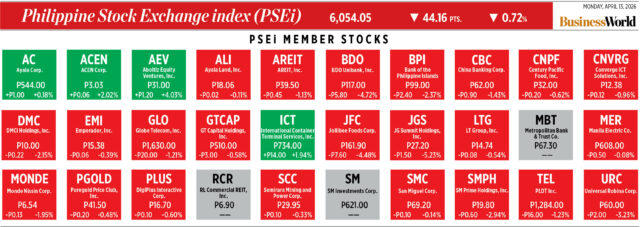
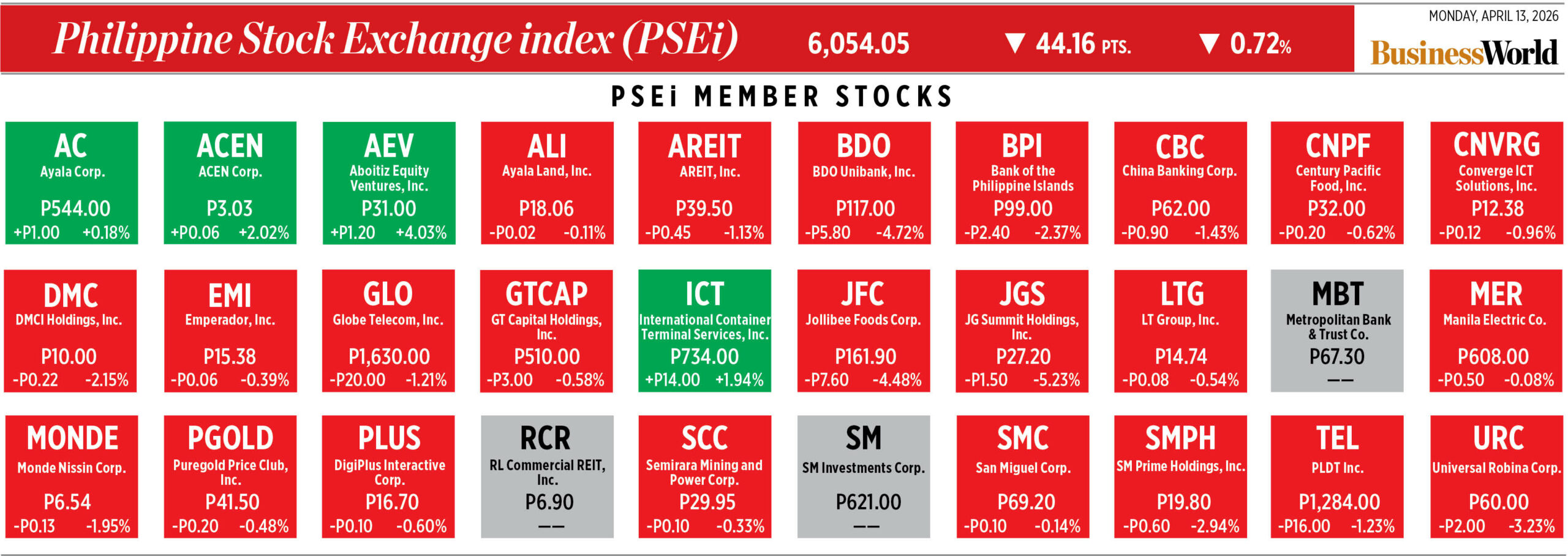
How PSEi member stocks performed — April 13, 2026

Here’s a quick glance at how PSEi stocks fared on Monday, April 13, 2026.


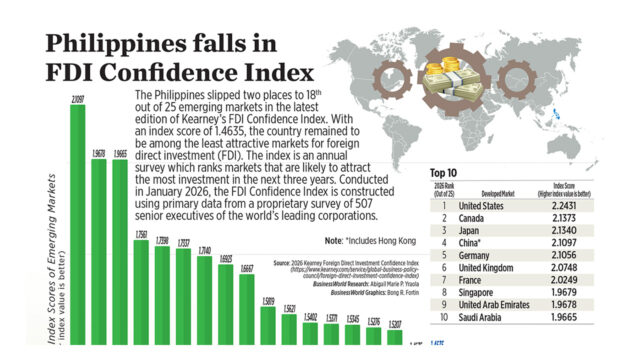
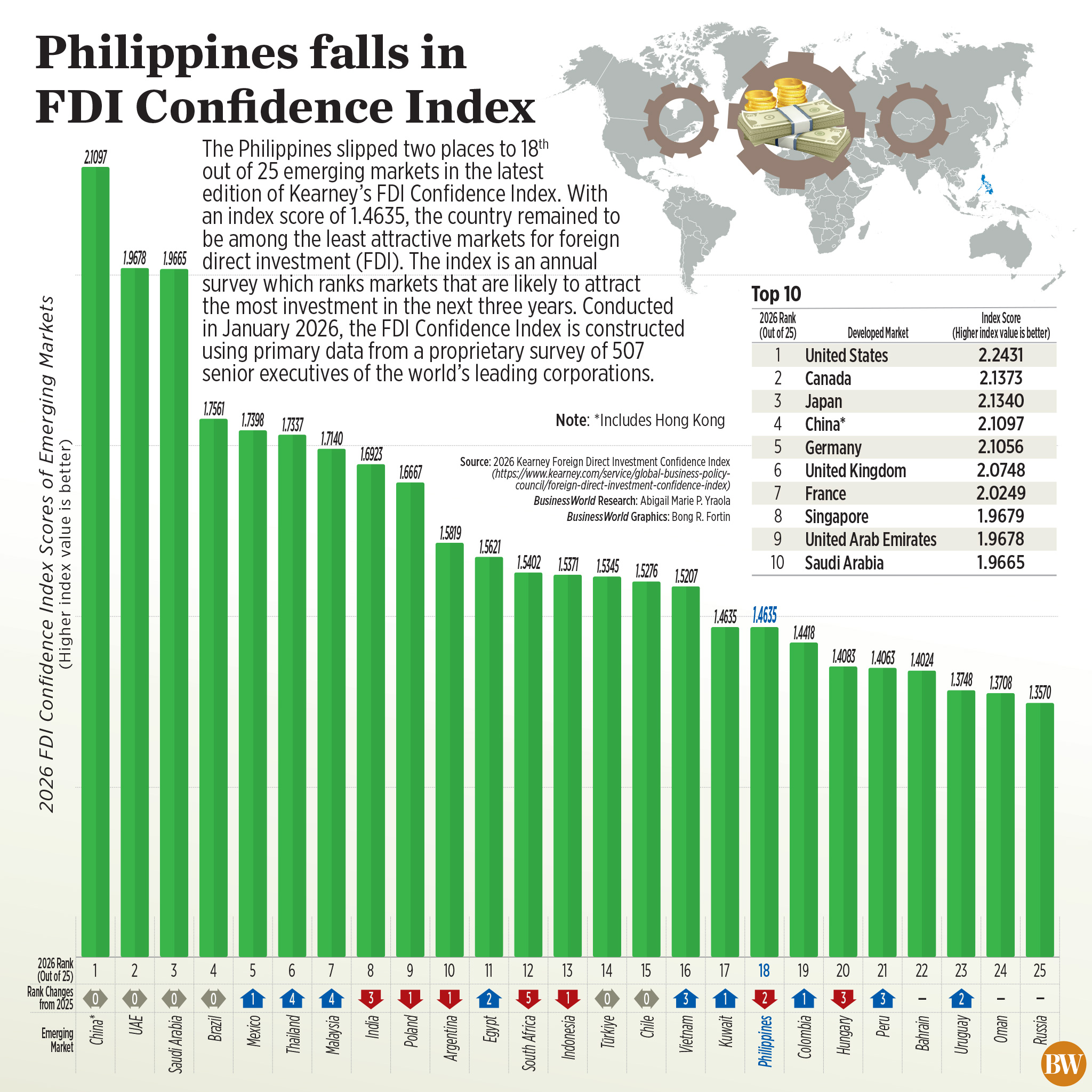
Philippines falls in FDI Confidence Index

THE PHILIPPINES dropped two spots to 18th out of 25 emerging markets in the 2026 Foreign Direct Investment (FDI) Confidence Index by global management consulting firm Kearney. Read the full story.

Manibela sets April 15-17 strike; Malacañang says move untimely

PHILIPPINE STAR/EDD GUMBAN

By Ashley Erika O. Jose and Chloe Mari A. Hufana, Reporters

TRANSPORT GROUP Manibela will stage a three-day nationwide strike starting April 15 to protest high fuel prices and what it described as government inaction, raising the risk of transport disruptions in key urban centers.

“We are declaring a nationwide transport strike to protest against the government, especially the Department of Energy and Department of Transportation’s negligence, and how oil companies are profiting from the oil crisis,” Manibela Chairman Mar S. Valbuena told a news briefing on Monday.

He said other transport groups are expected to join the action, including ride-hailing, taxi and motorcycle taxi drivers, potentially widening the scope of the disruption beyond traditional public utility vehicles (PUVs).

He said the group is calling for a rollback of as much as P57 a liter in fuel prices and the suspension of value-added tax on petroleum products to ease the burden on drivers and operators facing higher costs.

He added that the deferment of fare increases has further squeezed earnings in the sector.

“There should be relief for drivers and operators,” Mr. Valbuena said, referring to the government’s decision to suspend fare adjustments.

The Land Transportation Franchising and Regulatory Board (LTFRB) last month deferred a scheduled increase in PUV fares to help cushion commuters from rising costs, a move that transport groups said shifted the burden to drivers.

Malacañang on Monday said the planned strike is “untimely,” warning that it could worsen the impact of the energy situation linked to war in the Middle East.

“We can see what the President and the administration are doing and have done for the transport sector,” Palace Press Officer Clarissa A. Castro told a separate news briefing in Filipino. “They are being prioritized.”

She said the government is addressing the concerns of transport workers and urged groups to engage in dialogue instead of staging a strike.

The strike would not help address the impact of the Middle East crisis, Ms. Castro said, adding that what is needed is negotiation and cooperation.

Fuel prices have surged in recent weeks following the US-Israel war on Iran, cutting into the take-home pay of drivers and prompting calls for additional government support.

In response, the government has rolled out subsidies, including a P5,000 fuel subsidy for drivers through the Department of Transportation, on top of cash assistance provided by the Department of Social Welfare and Development.

The LTFRB is set to deploy service PUVs on select routes starting April 15 under a service contracting program funded by the 2026 General Appropriations Act. The program compensates drivers and operators to provide free rides to commuters while ensuring continued income for transport workers.

In Metro Manila, the program will cover the EDSA Bus Carousel and routes served by modern and traditional jeepneys, including those linked to Light Rail Transit and Metro Rail Transit stations and other major transport hubs.

Authorities said the program is meant to cushion the impact of reduced transport supply during the strike and support both commuters and drivers affected by rising fuel costs.

The Department of Energy said fuel prices might ease in the near term, with diesel expected to decline by P20.89 per liter, gasoline by P4.43, and kerosene by P8.50 starting on Tuesday due to market adjustments.

However, officials warned that price movements remain volatile and dependent on global developments, particularly in the Middle East, where disruptions to supply routes could trigger further spikes.

Transport groups have also urged President Ferdinand R. Marcos, Jr. to consider using emergency powers to suspend or reduce excise taxes on fuel, a measure that could provide broader relief across the sector.

The President on Monday said he approved the suspension of excise taxes on liquefied petroleum gas and kerosene to soften the impact of rising fuel costs on households, while leaving levies on gasoline and diesel unchanged.

The selective suspension is expected to provide modest relief to household budgets but may have limited effect on transport costs and inflation, which are more sensitive to diesel prices.

ASEAN ministers call for restraint in ME conflict

ASEAN.ORG

FOREIGN MINISTERS of the Association of Southeast Asian Nations (ASEAN) called for restraint and a return to diplomacy amid tensions in the Middle East (ME), warning that prolonged instability could disrupt global trade and energy flows critical to the region.

In a joint statement posted on the ASEAN website on April 13, the ministers said they welcome the recent pause in hostilities and urged concerned parties to sustain dialogue toward a peaceful resolution. They stressed the need to uphold international law and avoid actions that could further escalate the situation.

“We reaffirm the importance of maintaining maritime safety and security, and upholding freedom of navigation in and overflight above straits used for international navigation,” they said.

The ministers also cited the importance of keeping key maritime routes open, particularly the Strait of Hormuz, a vital corridor for global oil shipments.

Any disruption in the waterway could drive up fuel costs and trigger supply chain pressures for Southeast Asian economies that rely heavily on imported energy, they said.

ASEAN said stability in global shipping lanes remains essential to economic activity in the region, where trade and logistics are closely linked to external markets. The group warned that volatility in energy markets could spill over into higher transport and food costs, adding to inflation risks.

ASEAN cited the need to protect civilians and ensure the safe passage of vessels in accordance with international conventions. It also reiterated support for peaceful dialogue as the primary means of resolving conflicts.

ASEAN ministers said they are closely monitoring developments and assessing potential impacts on member economies, including risks to growth and fiscal stability.

They noted that disruptions in oil supply could affect power generation costs, transport fares, and production expenses across industries.

The bloc also pointed to the broader implications for global supply chains, as shipping disruptions could delay goods movement and raise logistics costs. For export-oriented economies in Southeast Asia, such risks could weigh on trade performance if the situation worsens.

The conflict, which began on Feb. 28, has triggered fuel shocks after disruptions in shipping routes through the Strait of Hormuz, a key artery for global oil trade.

On April 8, the US and Iran agreed to a 14-day ceasefire followed by peace talks facilitated by Pakistan on April 10. However, negotiations failed to produce a deal after a 20-hour discussion covering the status of the Strait of Hormuz, Iran’s uranium enrichment program, the unfreezing of $6 billion in Iranian funds and reparations tied to wartime damages.

Less than a day after the ceasefire announcement, Israel — an ally of the US —launched strikes against Lebanon, which reportedly killed 254 people, according to Reuters. The escalation added to concerns that the fragile pause in hostilities could collapse, further destabilizing the region.

Foreign Affairs Secretary Ma. Theresa P. Lazaro told a Senate committee hearing on crisis response that further negotiations remain possible but warned of rising risks.

“There just might be subsequent rounds of negotiations,” she said. “We expect tensions to escalate following President [Donald J.] Trump’s announcement last night of a blockade of all traffic in the Strait of Hormuz.”

US Central Command later clarified that the restriction would apply only to maritime traffic entering and exiting Iranian ports starting April 13, correcting earlier remarks from Mr. Trump that suggested a broader naval blockade. — Kaela Patricia B. Gabriel and NPA

Philippines warns of ‘sabotage’ after cyanide seizure in South China Sea atoll

BRP SIERRA MADRE, a marooned transport ship which Philippine Marines live in as a military outpost, sits on the disputed Second Thomas Shoal, part of the Spratly Islands in the South China Sea. — REUTERS

THE Philippines discovered cyanide on Chinese boats operating around a disputed atoll in the South China Sea, security officials from the country said on Monday.

Authorities said laboratory tests confirmed the presence of the highly toxic substance in bottles seized by the Philippine navy in operations at Second Thomas Shoal last year.

Officials warned the cyanide could have had serious consequences for marine life and weakened the reef supporting a warship that Manila grounded on the atoll to reinforce its maritime claim.

“We wish to underscore that the use of cyanide in Ayungin Shoal is a form of sabotage that seeks to kill local fish populations, depriving Navy personnel of a vital food source,” Cornelio Valencia, National Security Council spokesman, told a press conference, using the Philippines’ name for the atoll. He added that cyanide could damage the reef and “ultimately compromise” the warship’s stability.

The Chinese Embassy in Manila did not immediately reply to a request for comment.

The Philippines has accused China of disrupting resupply missions to troops on the vessel, including a June 17, 2024 incident that turned violent and resulted in a Filipino sailor losing a finger.

China has denied allegations of aggressive conduct during such encounters and accused the Philippines of trespassing in its waters.

The June confrontation later led to a provisional understanding for resupply missions to the grounded ship.

China and the Philippines held high-level talks last month over the South China Sea, exploring preliminary steps towards oil and gas cooperation, and confidence-building measures at sea, including communications between their coast guards.

The Philippines’ Department of Foreign Affairs has said the scope of the coast guard cooperation would be limited and “does not contemplate cooperation in sensitive operational areas,” adding that there had been no discussions on joint patrols.

China claims almost all the South China Sea, including areas claimed by Brunei, Malaysia, the Philippines and Vietnam.

A 2016 ruling by an international arbitral tribunal found Beijing’s sweeping claims had no basis under international law, a decision China rejects. More than $3 trillion in annual ship-borne commerce travels through the key waterway. — Reuters