Home Blog Page 29

Metro Pacific Health bags nine awards at Healthcare Asia

CARDINALSANTOS.COM.PH

Pangilinan-led Metro Pacific Health Corp. (MPH) said it secured nine major awards at the Healthcare Asia Awards 2026 in Singapore.

“With wins across all multiple categories, MVP-led Metro Pacific Health became the Philippines’ most awarded hospital group of the night. These recognitions show how its hospitals work together to give better care and help more Filipinos live healthier lives,” MPH said in a media release.

MPH operates 28 hospitals nationwide, including Metro Antipolo Hospital and Medical Center, Inc., as well as major institutions such as Makati Medical Center, Asian Hospital and Medical Center, Cardinal Santos Medical Center, Davao Doctors Hospital, and Riverside Medical Center.

MPH won Health Promotion Initiative of the Year — Philippines, while Asian Hospital and Medical Center received Marketing Initiative of the Year — Philippines and Technology Innovation of the Year — Philippines.

Cardinal Santos Medical Center received Patient Advocacy Initiative of the Year — Philippines, while Our Lady of Lourdes Hospital won Customer Service Initiative of the Year — Philippines.

Calamba Medical Center was recognized for Infection Control Initiative of the Year — Philippines.

Riverside Medical Center received Workforce Transformation Initiative of the Year — Philippines, while Riverside Bacolod Cancer Care Center earned Health Prevention Awareness Award — Philippines.

Medi Linx Laboratory received Laboratory Initiative of the Year — Philippines.

The Healthcare Asia Awards recognize hospitals that go beyond conventional practices to deliver patient care and contribute to their local communities.

MPH is the healthcare arm of Metro Pacific Investments Corp. (MPIC).

MPIC has said it plans to expand its hospital portfolio to as many as 50 facilities within five years.

MPIC is one of the key Philippine units of Hong Kong-based First Pacific Co. Ltd., alongside Philex Mining Corp. and PLDT Inc.

Hastings Holdings, Inc., a unit of the PLDT Beneficial Trust Fund subsidiary MediaQuest Holdings, Inc., holds a majority stake in BusinessWorld through the Philippine Star Group. — Ashley Erika O. Jose

GSIS offers loan payment refunds as relief measure

GSIS FACEBOOK PAGE

THE Government Service Insurance System (GSIS) is offering to refund its members’ loan payments in cash as part of a relief measure to support the National Government’s efforts to ease Filipinos’ financial burden.

Under the “Balik Ginhawa” modified loan moratorium program, GSIS’ qualified members and pensioners can get cash for their immediate needs by refunding three months’ worth of loan payments.

“Unlike a traditional loan moratorium where members temporarily stop paying and receive the benefit gradually over several months, Balik Ginhawa provides assistance through a refund mechanism, allowing members to receive the equivalent of three months’ loan amortizations in one lump sum,” the GSIS said in a statement on Wednesday.

“Under Balik Ginhawa, GSIS will continue loan deductions. The equivalent of three months of loan amortizations covering December 2025 to February 2026 will be returned to members through direct crediting to their accounts.”

GSIS President and General Manager Jose Arnulfo “Wick” A. Veloso said the program is part of the pension fund’s commitment to support the administration’s efforts to assist government workers.

It supports the whole-of-government approach under the Unified Package for Livelihoods, Industry, Food, and Transport or UPLIFT program of the Marcos administration that aims to cushion the impact of rising costs.

“We are fully aligned with the President’s directive to ease the burden on our government workers. Through the Balik Ginhawa program, GSIS is ready to provide immediate and meaningful financial relief to our members when they need it most,” Mr. Veloso said.

GSIS said based on its available data, which only covers non-housing loans, the average member pays P37,000 in monthly loan amortizations. Based on this example, a member’s lump-sum refund under the relief measure could reach up to P111,000.

“Since the refund is based on actual loan records, some members may receive the equivalent of only one or two months, depending on when their loan payments started,” it said.

“In total, an estimated over 3.2 million members and pensioners are expected to benefit from the program, with around P19 billion set to be refunded.”

Participation in the program is voluntary. Members who want to avail the refund program can apply via the GSIS Touch mobile application.

“Once approved, the loan term will be extended by three months without additional interest or penalties.”

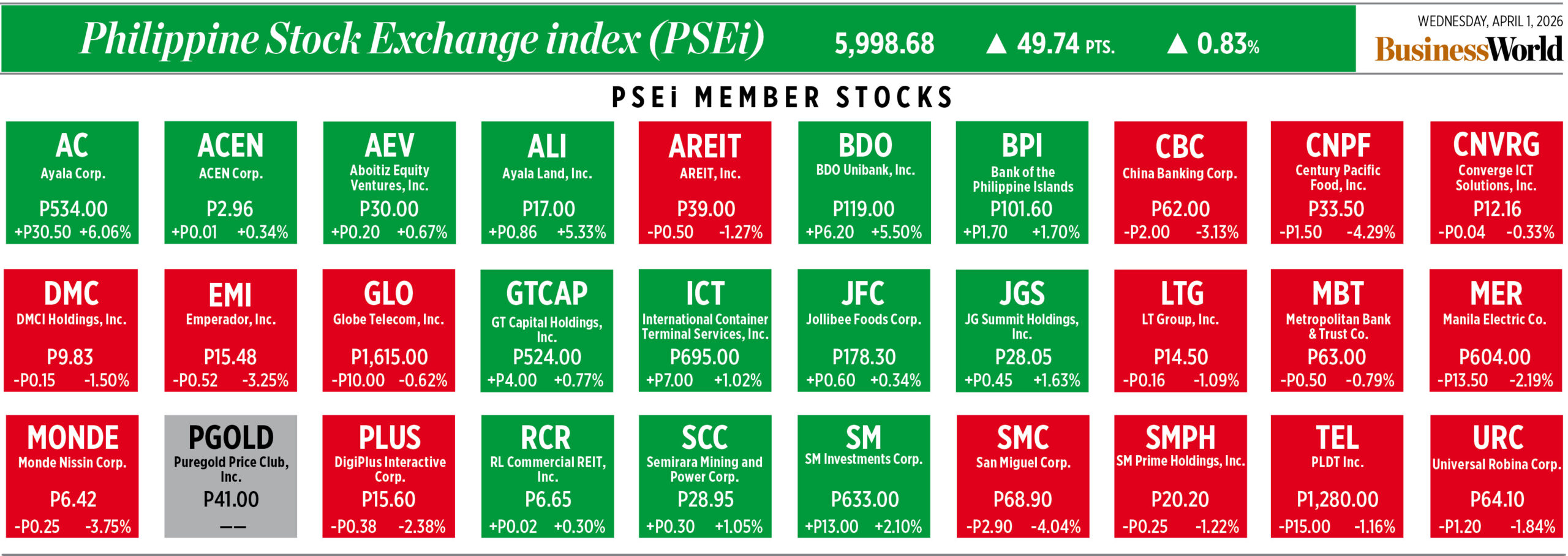
How PSEi member stocks performed — April 1, 2026

Here’s a quick glance at how PSEi stocks fared on Wednesday, April 1, 2026.


Philippine NG debt hits record high P18.16 trillion in February

REUTERS

By Justine Irish D. Tabile, Senior Reporter

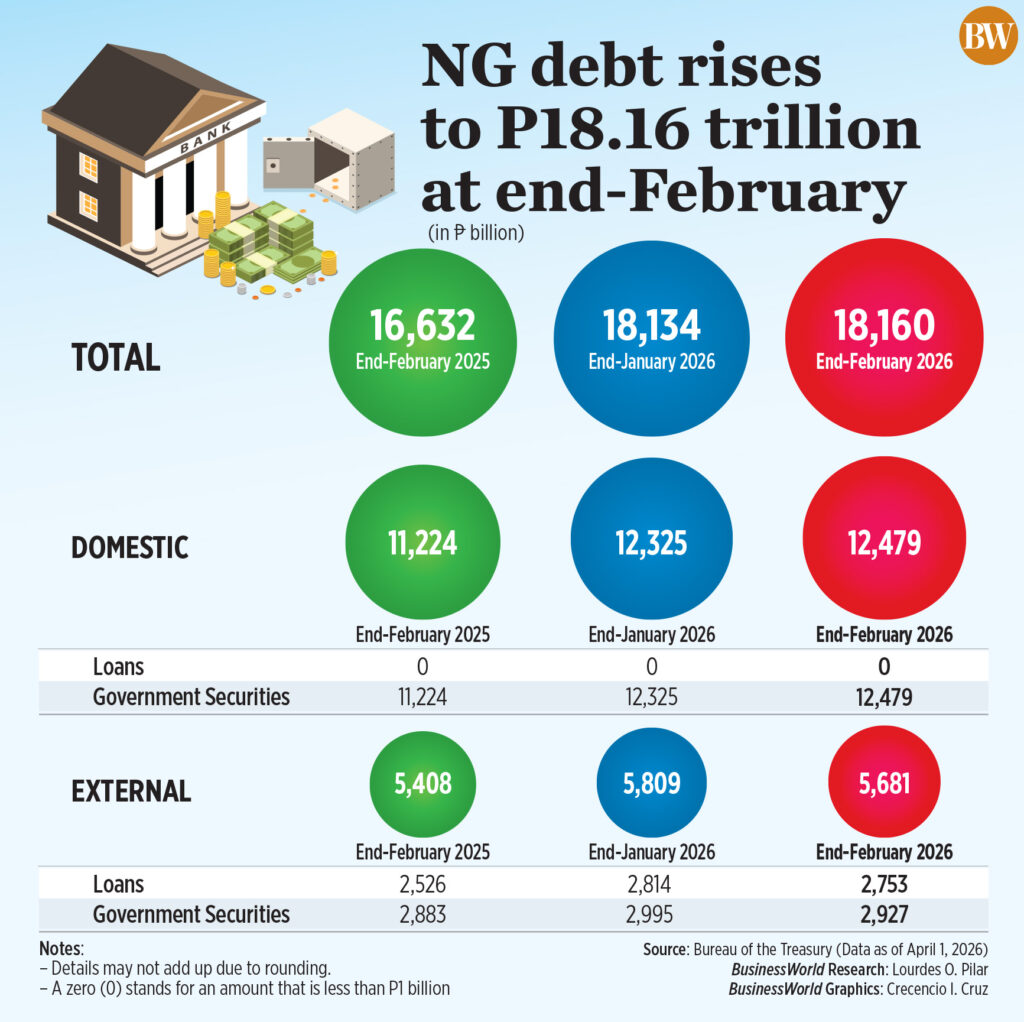
THE National Government’s (NG) outstanding debt hit a fresh high of P18.16 trillion as of end-February, reflecting a stable and well-managed debt position, the Bureau of the Treasury (BTr) said on Wednesday.

Latest data from the Treasury showed that the debt inched up by 0.14% from P18.13 trillion at the end of January.

Year on year, outstanding debt went up by 9.19% from P16.63 trillion at end-February 2025.
“The modest uptick underscores the government’s stable and well-managed debt position amid evolving global financial conditions,” the BTr said in a statement.

“This was largely driven by the continued prioritization of domestic financing to protect the government’s debt position from unfavorable external developments,” it added.

NG debt is the total amount owed by the Philippine government to creditors such as international financial institutions, development partner-countries, banks, global bondholders and other investors.

The bulk or 68.7% of the total debt stock came from domestic sources, while the rest were external borrowings.

“With domestic debt accounting for 68.7% of the total, the NG maintains a prudent debt profile that minimizes vulnerability to foreign exchange (forex) fluctuations,” BTr said.

Domestic debt, which was composed of government securities, rose by 1.25% to P12.48 trillion at end-February from P12.32 trillion at end-January, “as the government issued more securities amounting to P158.14 billion to raise funds for national development.”

Year on year, it jumped by 11.19% from P11.22 trillion in the same period.

“The impact of currency movements on foreign currency-denominated domestic securities remained minimal, reducing valuations by P3.75 billion,” it added.

Meanwhile, external debt dropped by 2.21% to P5.68 trillion as of end-February from P5.81 trillion at end-January.

However, external debt jumped by 5.03% from P5.41 trillion in February 2025.

BTr said that the drop is “primarily driven by favorable forex rate movements, which decreased the peso value of US dollar- and third currency-denominated obligations by a combined P136.43 billion.”

“These valuation gains more than offset net external loan availment amounting to P7.78 billion,” it added.

The peso closed at P57.665 against the dollar at end-February, appreciating by P1.195 from its P58.860-per-dollar finish at end-January.

External debt was composed of P2.93 trillion in global bonds and P2.75 trillion in loans.

“Despite the decline in external debt stock, the NG continued to access external financing strategically. As of end-February 2026, total external financing reached P203.10 billion, including the successful issuance of $2.75 billion in triple-tranche global bonds with tenors of 5.5, 10, and 25 years,” it said.

“This reflects sustained investor confidence in the country’s credit profile and the NG’s ability to tap international markets on reasonable terms.

Year-to-date, NG external debt rose by P88.98 billion, or 1.59%, from P5.59 trillion as of end December.

Meanwhile, NG’s guaranteed obligations increased by 10.11% to P379.98 billion as of end-February from P345.08 billion in the previous month.

“The increase was primarily driven by new guarantees extended to the Power Sector Assets and Liabilities Management (PSALM) Corp., which is partially offset by net repayments and favorable currency movements,” it said.

Michael L. Ricafort, chief economist at Rizal Commercial Banking Corp., said that the increase in outstanding debt does not reflect yet the impact of the war in the Middle East, which started in March.

“But it could still partly reflect some government underspending since the latter part of 2025 due to the anomalous flood-control projects,” he said in a Viber message.

The minimal increase, he said, reflects the stronger peso exchange rate at P57 levels in February “which somewhat tempered the peso equivalent of external debts.”

For the coming months, Mr. Ricafort said the budget deficit is expected to widen amid an increase in government spending which would require more NG borrowings.

“Further, the record high US dollar-peso exchange rate above P60 recently could lead to a higher peso equivalent of foreign debt,” he said.

The Marcos administration projected the outstanding debt level to reach P19.06 trillion in 2026. Of this, around 70% or P13.28 trillion are domestic debt, while P5.78 trillion are external debt.


PHL net external liabilities ease

REUTERS

INCREASED INVESTMENTS in foreign debt instruments by the Bangko Sentral ng Pilipinas (BSP) and other banks caused the country’s net external liabilities to ease by 9.3% in the third quarter of 2025.

The country’s net external liabilities fell to P3.307 trillion at end-September from P3.646 trillion in the second quarter last year, based on data from the BSP’s balance sheet approach (BSA).

Year on year, it dropped by 2.9% from P3.406 trillion.

“This was driven by higher investments of the Bangko Sentral ng Pilipinas and other depository corporations in foreign debt instruments, partly offset by increased government securities and loans owed by the general government to nonresidents,” the central bank said in a statement released late in Tuesday.

The BSA contains a comprehensive overview of the Philippine economy’s financial position with the rest of the world. It is published one quarter later than the International Investment Position, which serves as a key data source for the BSA and other sources for sectoral balance sheet data.

In the third quarter, nonfinancial corporations (NFCs) and the general government remained net debtors, while households, the central bank, the other depository corporations (ODCs), and other financial corporations (OFCs) were net creditors.

“The central bank and other depository corporations posted stronger overall net creditor positions, reflecting changes in their domestic and external financial assets and liabilities,” the BSP said.

NFCs’ net debtor position went up by 2.4% to P12.08 trillion from the P11.801 trillion in liabilities in the second quarter and by 2% from P11.838 trillion the previous year.

Most of the sector’s financing came from loans as well as equity and investment fund shares, which were mainly extended by the rest of the world and ODCs.

Meanwhile, the net external liabilities of the general government, including those of the National Government, its extra-budgetary units, local government units and social security funds, increased by 3.8% to P10.832 trillion at end-September from P10.433 trillion at end-June.

Year on year, this rose by 18.6% from P9.135 trillion.

“(T)he general government’s net debtor position expanded due to higher holdings of government securities by nonresidents and other financial corporations, increased loan obligations to nonresidents, and lower deposits with the central bank,” the BSP said. “Government securities remained the sector’s main funding instrument.”

Of its total obligations, 68.9% were local currency denominated, which the central bank said made it less vulnerable to exchange rate fluctuations.

Meanwhile, higher holdings of foreign-issued debt securities and lower deposit liabilities to the general government also boosted the BSP’s net credit position to P1.846 trillion as of September, jumping by 23.1% from the P1.499 trillion a quarter prior and by 40.9% from P1.31 trillion in the same period the previous year.

ODCs’ net creditor position widened by 0.7% to P1.373 trillion as of end-September from P1.363 trillion in the second quarter but narrowed by 0.3% year on year from P1.377 trillion.

OFCs’ net creditor position also went up by 43.2% to P525.4 billion in the third quarter from P366.8 billion in the April-June period but was 4.1% lower than the P548.1 billion the prior year.

On the other hand, households’ net financial asset position improved by 3.3% quarter on quarter to P15.861 trillion from P15.358 trillion. It also rose by 10.7% year on year from P14.332 trillion.

“The (households) continued to be highly solvent in Q3 2025, with gross financial assets remaining at nearly three times their gross financial obligations,” the BSP said. — Katherine K. Chan

Tiger Woods stepping away for treatment after DUI arrest, will miss Masters

Tiger Woods / REUTERS

Tiger Woods said on Tuesday he is stepping away to seek treatment and focus on his health after pleading not guilty to DUI charges stemming from his rollover crash in Florida last week.

Woods, a 15-time major champion and the greatest golfer of his generation, was arrested last Friday afternoon on a charge of driving under the influence after his Land Rover rolled over on a two-lane road near his Jupiter Island home. No one was injured in the crash and Woods was released on bail later that night.

“I know and understand the seriousness of the situation I find myself in today,” Woods posted on social media.

“I am stepping away for a period of time to seek treatment and focus on my health. This is necessary in order for me to prioritize my well-being and work toward lasting recovery.”

Woods, 50, added that he was committed to taking the time needed to return in a “healthier, stronger, and more focused place, both personally and professionally,” and requested privacy.

Following Woods’ announcement, Augusta National Golf Club, home of the year’s first major, confirmed the five-time Masters champion would not be on site next week.

NOT GUILTY PLEA
Court documents filed on Tuesday showed that Woods has pleaded not guilty to DUI charges and requested a trial with a jury.

Woods’ next court appearance was scheduled for May 5, though he does not have to appear in person for any proceeding prior to a trial, court records show.

According to a probable-cause affidavit seen by Reuters earlier on Tuesday, Woods told authorities he was looking down at his phone and did not realize the truck in front of him had slowed down.

Authorities also said in the affidavit that Woods had two hydrocodone pills in his pocket and that officers observed him to be lethargic, slow, “sweating profusely,” with bloodshot eyes and pupils that were “extremely dilated.”

When asked during the criminal DUI investigation if he took any prescription medication, the report said the 50-year-old golfer replied, “I take a few,” while adding he had done so earlier in the morning.

Woods’ manager did not immediately respond when asked to comment on details of the probable-cause affidavit.

LOOKING AT CELL PHONE BEFORE CRASH
A Martin County Sheriff’s deputy wrote in the report that Woods, when asked about the March 27 collision, said he was looking at his cell phone and changing the radio station which caused him not to see a truck slowing down before the crash.

The officer said in the report he observed Woods “limping and stumbling” and added that the golfer told him he has had seven back surgeries and over 20 operations on his leg.

The officer also noted in the report that Woods was “extremely alert and talkative” and had “hiccups during the entire investigation.”

Woods told the officer he has a limp and that his ankle seizes while walking.

The deputy who walked Woods through a series of field sobriety tests said in the report that based on his training, “I believed that Woods’ normal faculties were impaired, and he was unable to safely operate the motor vehicle.”

WOODS TO MISS YEAR’S FIRST MAJOR
Woods had just returned to competitive golf for the first time since missing the cut at the British Open in July 2024 when he joined his team for the TGL Finals last week, an indoor league that combines simulated golf with real chipping and putting and so requires significantly less walking than traditional golf.

After the match, Woods said he was trying to get his battered body ready for the April 9-12 Masters at Augusta National.

Even if he decided against competing, Woods planned to be at Augusta National for next week’s Champions Dinner but the club confirmed on Tuesday that he will not be on present at all during the year’s first major.

“Augusta National Golf Club and the Masters Tournament fully support Tiger Woods as he focuses on his well-being,” Augusta National Chairman Fred Ridley said in a statement. “Although Tiger will not be joining us next week, his presence will be felt here in Augusta.” – Reuters

Philippine factory activity falls to 3-month low in March amid spike in energy costs

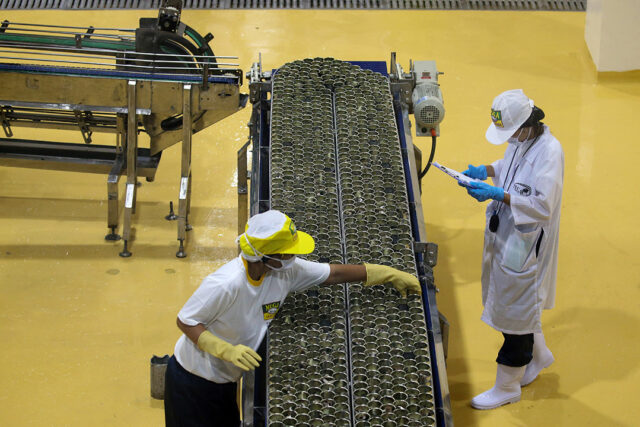
Workers are seen inside a manufacturing plant in Sto. Tomas, Batangas, March 1, 2023. — PHILIPPINE STAR/KRIZ JOHN ROSALES

By Justine Irish D. Tabile, Senior Reporter

PHILIPPINE FACTORY activity in March slumped to a three-month low in March as output and new orders declined amid the war in the Middle East, S&P Global said on Wednesday.

S&P Global Philippines Manufacturing Purchasing Managers’ Index (PMI) slipped to 51.3 in March from 54.6 in February. This was the weakest PMI reading in three months or since the 50.2 recorded in December.

A PMI reading above 50 denotes better operating conditions than in the preceding month, while a reading below 50 shows deterioration.

Despite the sharp slowdown in growth, March marked the fourth straight monthly improvement in the Philippine manufacturing sector.

“The war in Middle East weighed on the performance of the Philippines manufacturing sector, March PMI data showed,” Maryam Baluch, economist at S&P Global Market Intelligence, said in the report.

“With vast majority of the country’s oil supply coming from the Gulf countries now under threat, the President has declared a national energy emergency. Filipino manufacturers are exposed to shocks in oil and fuel prices rippling through global markets, as signaled via notable hikes in costs and charges, and softer demand conditions,” she added.

The Philippines is under a one‑year state of national energy emergency as it faces heightened risk of fuel supply disruptions due to the US-Israel war on Iran which started in early March. As a net oil importer, the Philippines remains highly exposed to global price swings.

Some Association of Southeast Asian Nations (ASEAN) countries also saw muted manufacturing activity in March, as the region’s PMI slipped to 51.8 in March from 53.8 in February.

The Philippines lagged behind Thailand (54.1) and Myanmar (51.5), but ahead of Vietnam (51.2), Indonesia (50.1) and Malaysia (50.7).

For the Philippines, S&P Global said the slower growth momentum for output and new orders were largely due to customer uncertainty amid the Middle East war, citing anecdotal evidence.

“Dampening the pace of increase in total new orders was a fresh decline in new export sales. While the latest downturn was modest, it marked the first month of contraction since last December. Firms noted that the war in the Middle East had led to weaker demand from foreign clients,” it said.

Philippine firms adjusted their production levels, but the pace of growth was “much softer” than the expansion in February. Output was the weakest in three months.

“Reports of higher prices for gas and fuel as well as material shortages led to a further deterioration in vendor performance and, more importantly, renewed increases in operating expenses and factory gate charges,” S&P Global said.

Manufacturers also paused purchasing activity in March, just below the neutral 50.0 mark, which helped ease some pressure on supply chains.

“Higher energy (including fuel and gas) costs and material scarcity, stemming from the war in Middle East resulted in both costs and charges rising in March. This followed slight reductions in the month prior. Moreover, the rates of inflation across both price gauges were historically sharp,” S&P Global said.

In March, job creation continued for a third month in a row, but the rate of growth was marginal and the weakest in three months.

However, Filipino manufacturers were confident that production will pick up in the next 12 months, as they remain hopeful that demand conditions will improve and drive growth.

“The duration and intensity of the war will directly impact the sector’s trajectory in the coming months, as inflationary pressures constrain sales and pricing power,” said Ms. Baluch.

Reyes Tacandong & Co. Senior Adviser Jonathan L. Ravelas said that the March PMI data signals a temporary soft patch rather than a slowdown.

“The decline was mainly driven by weaker domestic demand, cautious consumer spending, and higher cost pressures, which prompted firms to scale back new orders and production,” he said in a Viber message.

“That said, business sentiment hasn’t collapsed. If inflation eases and demand normalizes, we could see PMI stabilize or even rebound next month. For now, it’s more of a pause than a downturn — and companies are clearly staying cautious,” he added.

DOST opens PROPEL hub to link startups with industry partners

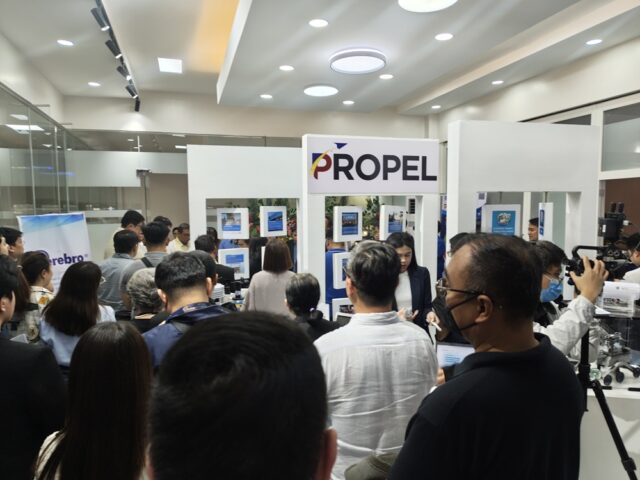
The PROPEL hub in Taguig City.— EDG EVA

The Department of Science and Technology (DOST) on Tuesday launched a business and exhibit center that will serve as a collaborative hub for startups, innovators, and industry partners.

Located at the newly renovated office space within the DOST complex in Bicutan, Taguig City.

The hub, called PROPEL (Accelerating Innovation in the Philippines, Propelling Innovation from the Philippines), will serve as a functional space where stakeholders can foster innovation and partnerships.

“For years, we have invested in research, strengthened our laboratories, and nurtured Filipino talent. Today, we affirm that our work does not end with discovery,” DOST secretary Renato U. Solidum Jr. said in his keynote speech during the launch event.

“It must continue until innovation reaches the marketplace, benefits communities, creates jobs, and improves lives,” he added.

Mr. Solidum also said that the hub is complementary to existing DOST innovation hubs across the country and will work in partnership with universities, research institutions, and regional stakeholders.

Apart from fostering partnerships, the hub is also expected to showcase programs, projects, innovations, and knowledge products supported by the PROPEL program, DOST’s commercialization arm for transforming science and technology innovations into viable enterprises.

Among the technologies featured in the PROPEL hub is Hiraya Technology Solutions Inc., a Filipino startup that uses artificial intelligence (AI) to automate water management and detect leaks in residential and commercial systems.

The PROPEL Business Hub and Exhibit Center also incorporates platforms designed to assist stakeholders at every stage of their innovation journey.

“These platforms create a dynamic, interconnected system, with PROPEL at its vibrant center,” Napoleon K. Juanillo Jr., DOST assistant secretary for technology transfer, communications, and commercialization, said in his keynote speech.

These include PHITEST, or the Philippine Technology Evaluation Standards for Testing, which serves as a rigorous validation and certification framework ensuring that Filipino innovations meet international standards.

Another platform is aiJUANAKnow, an AI-powered business development engine that provides innovators with deep market intelligence.

Also included is Piso-Piso Partnerships (PPP), a platform designed to democratize investment in science and technology, particularly for local startups, by making it accessible to everyone.

Starting at P1, anyone across the globe can contribute to startups they want to support.

“With even the smallest contribution, you become a part of building something bigger,” Mr. Juanillo said.

Moving forward, Mr. Juanillo told reporters he is optimistic that the PROPEL Business Hub and Exhibit Center will gain more attention in the coming years and help more local startups and innovators. — Edg Adrian A. Eva

Marikina-based PharmaServ specializes in cold-chain logistics for vaccines, pharmaceuticals

PHILIPPINE STAR/ MICHAEL VARCAS

PharmaServ Express Inc., a Marikina-based healthcare logistics firm, is specializing in the cold-chain management of medicines and biological products.

Founded in 2015, it was established to address one of the most overlooked challenges in Philippine healthcare, which is access to safe, reliable, and temperature-compliant handling of medicines and biological products.

Unlike general logistics providers, it focuses exclusively on cold-chain management for life science products, the firm said.

This is to ensure that temperature-sensitive items such as vaccines and pharmaceuticals are handled under strict conditions throughout the supply chain.

During the COVID-19 pandemic, PharmaServ Express handled vaccines for the national government, meeting strict cold-chain requirements for storage and delivery.

“The company is driven by a single mandate: to provide solutions not just logistically, but in terms of access to safe healthcare products through a positive patient care experience,” PharmaServ Express said in a statement.

Its logistics network includes temperature-validated vehicles such as refrigerated trucks, vans, and motorcycles, supported by real-time GPS (global positioning system) and temperature monitoring systems.

Each shipment is accompanied by data-logging devices that record temperature conditions throughout the delivery process.

PharmaServ Express also said it combines technology with human oversight, with trained specialists supervising operations from dispatch to delivery.

Customer service teams are also available 24/7 to assist clients.

Last week, the company launched a consumer mobile application that allows patients to have medicines delivered to their homes under strict temperature control.

“What we have built for healthcare institutions, we are now making available to every Filipino home,” Andrian A. Perez, president of PharmaServ Express Inc., said in a statement.

“This app is our answer to problems that have gone unaddressed for too long—long lines at the pharmacy, incomplete medicines, and drug products losing their potency before they reach the patient,” he added.

Through the PharmaServ Express app, patients can have prescriptions, medical devices, and personal care products delivered from their preferred drugstore in Metro Manila and nearby areas, with expert guidance from online pharmacists.

Each order is packed in temperature-controlled boxes with data loggers to ensure quality throughout delivery.

Looking ahead, the platform will also launch a Diagnostic Test Booking and Scheduling feature this year.

PharmaServ Expres operates two facilities, with the main operations center in Marikina City and a cold storage warehouse in Pasig City.

According to Future Market Report, an India-based commercial market research provider, the global pharmacy delivery app market was estimated to value at US$13.2 billion in 2024 and is projected to reach US$28.05 billion by 2033.

The market has compound annual growth rate (CAGR) of 9.6% starting 2025. — Edg Adrian A. Eva

Omega Healthcare ramps up US-licensed Filipino nurse hiring by 40%

PHILSTAR FILE PHOTO

Outsourced medical services provider Omega Healthcare Philippines said it will increase its workforce of United States-licensed Filipino nurses to about 40% to meet the rising demand for healthcare outsourcing services abroad.

“This reflects the increasing demand for experienced clinicians who can support overseas healthcare providers while earning competitively at global rates,” Omega Healthcare Philippines Director of Clinical Services Delivery Henriech Libay told BusinessWorld in an e-mail interview.

According to the National Institutes of Health, about 4% to 4.5% of registered nurses in the United States (US) are Filipino.

The National Council of State Boards of Nursing (NCSBN) also projects a steady demand of around 250,000 nurses annually from 2020 to 2030, largely due to the aging population and the growing technical requirements of the healthcare system.

As demand increases, the World Health Organization (WHO) revealed that a possible shortfall of 11 million health workers could occur by 2030.

With the projected shortage, Mr. Libay said that healthcare organizations, particularly in the US, have relied on internationally trained professionals and outsourcing clinical support teams to assist healthcare providers overseas.

“Instead of relying solely on overseas hiring, many providers are now working with partners that can deliver clinical and operational support remotely,” he said.

The company’s employment is also driven by the growing number of healthcare professionals who prefer staying close to home while working within the global healthcare system.

“Filipino healthcare workers remain among the most sought-after globally because of their strong clinical training, English proficiency, and ability to adapt to international standards,” he said.

“This approach helps meet global demand while also giving Filipino professionals more flexible career options without the need to migrate,” he added.

AI IN THE HEALTHCARE SECTOR
According to Mr. Libay, Filipino healthcare professionals have “adapted well” to the changes brought by artificial intelligence (AI) in healthcare operations globally.

“Many roles today require not only medical knowledge but also familiarity with digital platforms,” he said. “Rather than replacing clinicians, AI is making their roles more specialized and increasingly dependent on experience and critical thinking.”

He added that nurses with bedside experiences and who are open to learning new systems are transitioning well into “technology-enabled” roles brought by AI. “This is one of the reasons Filipino clinicians continue to be in demand even as the healthcare industry evolves.”

Among the new technology-enabled roles in the sector are those under Utilization Management, Case and Disease Management, Population Health Management, and Provider Support.

As AI slowly integrates into the healthcare system, the risk of sensitive data exposure also increases.

Data from the Healthcare Cybersecurity Report 2026 by Netskope Threat Labs revealed that the healthcare sector accounts for 89% of all data policy violations occurring in the context of genAI usage, significantly higher than the cross-industry average of 31%.

The report also added that 43% of healthcare workers globally use personal generative AI (genAI) accounts at work, which are not properly monitored by security teams.

To address this challenge, organizations have deployed “company-approved genAI applications with security controls. Healthcare workers using organization-managed genAI tools rose from 18% to 67% in the past year, outpacing cross-industry averages of 26% to 62%.

“While building defenses against external threats is essential… addressing internal risk is equally important, especially in such a highly-regulated industry and a context of fast-paced cloud and AI adoption,” Ray Canzanese, director of Netskope Threat Labs, said in a statement.

“Deploying company-approved applications… along with relevant security tools, should be a high priority for healthcare organizations to strike a balance between modernization and security,” he added. — Almira Louise S. Martinez

AI integration to drive e-commerce growth

FREEPIK

ARTIFICIAL INTELLIGENCE (AI) is expected to be a key growth driver for e-commerce platforms this year as these technologies can help improve product discovery and personalize consumers’ shopping experience, according to global mobile marketing analytics company Adjust.

April Tayson, regional vice president for INSEAU (India, Southeast Asia, Australia, and New Zealand) at Adjust, said that AI-driven discovery and personalization are the key trends in 2026, making online shopping more intuitive.

AI use cases for e-commerce include AI-powered personal shopping agents, sizing assistants, and item recommendations, Adjust said in its Mobile app trends 2026 report.

These can also include agentic commerce that helps consumers find sale items and automate purchases.

“For consumers, this means less time searching and more relevant recommendations that match their preferences or behavior, whether it is a product, deals, or content,” Ms. Tayson said in an email interview.

“For sellers, it creates an opportunity to connect with customers more effectively.”

AI in the global e-commerce market was valued at $8.37 billion in 2025 and is projected to grow to $36.23 billion by 2035, Orion Market Research said in a separate report. It is projected to have a compounded annual growth rate of 15.8% starting this year.

“As a mobile-first market with a highly engaged digital population, the Philippines reflects broader shifts seen across the industry, where there is a growing focus on personalization, convenience, and content-driven discovery to stand out and retain users,” Ms. Tayson said.

Early adopters of AI in e-commerce are likely to be more digitally mature businesses that have made major investments in data, automation, and performance marketing, she said, and these players are better positioned to integrate AI into their workflows and scale its impact across personalization and customer engagement.

Retailers of fashion, electronics, and lifestyle products are expected to benefit the most from AI-driven discovery and personalization.

As for micro, small, and medium enterprises (MSMEs), adoption is expected to be gradual but is steadily gaining momentum, Ms. Tayson said.

The National Artificial Intelligence Research and Innovation Center of the Department of Science and Technology (DoST) launched in February to unify AI adoption efforts nationwide could help accelerate integration among MSMEs, she added.

The center will assist MSMEs through upskilling and helping them adopt AI tools, DoST Secretary Renato U. Solidum Jr. told BusinessWorld during its launch.

Among the e-commerce platforms available locally that have started adopting AI is Shopee. In February, the platform introduced a suite of AI-powered tools that help brands reach potential buyers. It also rolled out AI Livestream, AI Script Generator, and AI Comment Assistant last year. — Edg Adrian A. Eva

Banks’ foreign currency loans climb to $15.6 billion at end-2025

A worker counts US dollar bills inside a money changer in Metro Manila, Philippines, Feb. 7, 2018. — REUTERS

OUTSTANDING LOANS granted by banks’ foreign currency deposit units (FCDU) at end-2025 slipped year on year but edged up from the previous quarter, the Bangko Sentral ng Pilipinas (BSP) said late on Tuesday.

Central bank data showed that loans disbursed by banks’ FCDUs reached $15.561 billion as of December, down 1.64% from the $15.82 billion seen a year prior.

However, this climbed by 2.9% from $15.126 billion at end-September.

FCDUs are units of local banks or local branches of foreign banks authorized by the BSP to service transactions involving foreign currencies, including deposits and loans.

Resident and nonresident borrowers, including individuals and businesses like importers, use these loans for their foreign currency payables or needs.

The end-December tally reflected $8.32 billion in new loans disbursed and $7.87 billion in loan payments made in the fourth quarter.

According to the BSP, $10.391 billion or 66.8% of the total amount was lent to local borrowers from the private sector.

Broken down, 25.6% were extended to merchandise and service exporters; 24.1% to towing, tanker, trucking, forwarding, personal, and other industries; and 16.7% to power generation companies.

The rest or 33.2% of banks’ outstanding FCDU loans valued at $5.17 billion were extended to nonresidents.

In terms of maturity profile, $12.318 billion of the loans were medium- to long-term debt, or those payable in a year or more. This accounted for 79.2% of the total, slightly lower than the previous quarter’s 79.8% share but above the 77.1% at end-December 2024.

Meanwhile, $3.243 billion or 20.8% were short-term debt, exceeding the prior quarter’s $3.057 billion (20.2%) but below the prior year’s $3.618 billion (22.9%).

By creditor type, domestic banks granted the most loans during the period at $12.92 billion or 83% of the total. Commercial banks lent out $12.897 billion, while $23 million came from thrift banks.

Foreign currency loans extended by foreign banks stood at $2.641 billion at end-December, making up 17% of the total.

Preliminary BSP data also showed that banks’ FCDU deposit liabilities increased by 7.88% year on year to $59.828 billion at end-December from $55.46 billion in 2024. However, this was 1.49% lower than the $60.732 billion at end-September.

This brought the FCDU loans-to-deposits ratio to 26%, down from 28.5% the previous year but up from 24.9% at end-September. — Katherine K. Chan