Home Blog Page 2878

Too much like Cao Cao: China’s claim for territories

PEGGY AND MARCO LACHMANN-ANKE FROM PIXABAY

Cao Cao was a fiery Chinese warlord and a shrewd politician who strategized his rise to power towards the turbulent end of the Eastern Han dynasty. He effectively became head of the Han central government during that period by holding the young emperor Xian under his control. Cao Cao fought and won several wars purportedly to regain territories of the Han which were threatened to be taken by rebel groups. He expanded territory for himself until it became the state of Cao Wei, established by his son and successor Cao Pi, to whom the Han emperor eventually ceded power and control.

It was Cao Cao’s own lust for power and territory that spearheaded the preliminary partitioning of the divided China into the Three Kingdoms, until all coalesced under the Jin dynasty. These three kingdoms, Wei, Shu, and Wu, battled for control in a long series of wars. This was one of the bloodiest times in Chinese history — according to census data, the population decreased from 50 million to 16 million (lumenlearning.com).

The Romance of the Three Kingdoms is a 14th century historical novel by Luo Guanzhong that romanticizes this period, which ran from 220–280 BCE in China. It is one of the four classics in ancient Chinese literature, along with Journey to the West, Water Margin, and Dream of the Red Chamber.

The ambitious and ruthless general Cao Cao, depicted as a thoroughgoing villain, ruled the north. Liu Bei, who is descended from Han emperors but grew up in poverty, is portrayed as virtuous. He becomes emperor of the Shu-Han dynasty and attempts to keep the Han alive after Cao Cao’s son, Cao Pi, is ceded the throne and founds the brief Wei dynasty. Sun Quan controls the south and eventually becomes the first emperor of the Wu dynasty. He is portrayed in Romance of the Three Kingdoms as being marginalized or in shaky alliances with Cao Cao or Liu Bei (according to britannica.com).

Cao Cao is the main antagonist in this classic epic as in history — strategizing and fighting, intimidating and betraying friends and foes alike. He had ordered the execution of hundreds, with no regard for rank or nobility, nor culpability. He personally lopped off the heads of those who betrayed him or even simply disappointed him. His ruthlessness and cruelty were not only folklore but factual history — around this time, Cao Cao had the famous literary scholar Kong Rong put to death along with his family — for “insouciance” (carefree idleness, or in Pilipino, “tamad”). So the story goes.

Annotations to Records of the Three Kingdoms (Chen and Pei, 1977) points out that through to modern times, the Chinese equivalent of the English idiom “speak of the Devil” is “speak of Cao Cao and Cao Cao arrives.”

“After the Communists won the Chinese Civil War in 1949, there were perceived similarities between Mao Zedong and Cao Cao, so propagandists began a long-term and sustained effort to improve Cao Cao’s image in popular culture. In 1959, Peng Dehuai wrote a letter to Mao, in which he compared himself to Zhang Fei (brother of Lu Bei, enemy of Cao Cao). Because of Mao’s popular association with Cao Cao, Peng’s comparison implied that he had an intuitively confrontational relationship with Mao. Mao had the letter widely circulated in order to make Peng’s attitude clear to other party members and proceeded to purge Peng and end his career” (Chen and Pei, op. cit.).

Today, China seems like Cao Cao as it continues to try to expand its territory beyond its boundaries. Since 1947, China has been wanting to own the entire South China Sea and its islands and reefs.

China, under the rule of the nationalist Kuomintang party, demarcated its territorial claims in the South China Sea with an 11-dash line on a map. The claim covers the majority of the area, including the Pratas Islands, the Macclesfield Bank, and the Paracel and Spratly Islands, which China regained from Japan after World War II. The People’s Republic of China (PRC) was established in 1949, and Communist leader Mao Zedong (a.k.a. Cao Cao according to oppositionist Peng Dehuai) reconfirmed the 11-dash line territorial claims. In 1953, the Chinese Communist Party (CCP)-led government removed the portion encompassing the Gulf of Tonkin, simplifying the border to nine dashes. To this day, China invokes the nine-dash line as the historical basis for its territorial claims in the South China Sea.

In 1974, a year after the Paris Peace Accords which ended US involvement in the Vietnam War, China forcibly occupied the western portion of the Paracel Islands, planting flags on several islands and seizing a South Vietnamese garrison. Beijing built a military installation, including an airfield and artificial harbor, on Woody Island, the largest of the Paracels. After the fall of Saigon and the reunification of Vietnam, the newly formed Socialist Republic of Vietnam upheld the South’s former claims to the Spratlys and Paracels. To this day, China maintains around 1,000 troops in the Paracels. (timeline from cfr.org.)

In 1988, after roughly a decade of relative calm in the South China Sea, China and Vietnam clashed on the Johnson Reef, marking China’s first armed conflict over the Spratly archipelago. The Chinese navy sank three Vietnamese vessels, killing 74 sailors in one of the most serious military confrontations in the South China Sea. This was after Beijing, pursuing a more assertive stance in the area, established a physical presence on Fiery Cross Reef in the Spratlys in January 1987.

After three decades of negotiations, the third and final United Nations Conference on the Law of the Sea, or UNCLOS, made a resolution on Nov. 14, 1994, that defined the rights and responsibilities of nations in their use of surrounding waters based on exclusive economic zones (EEZ) and continental shelves. However, UNCLOS does not address sovereignty issues related to the South and East China Seas, and its vague wording has prevented it from serving as a credible body of law in resolving territorial disputes.

China signed the UNCLOS text in 1982 (when it became a member of the United Nations and ratified it in 1996). Yet it continued to transgress the EEZs of other nations in the South China Sea, setting up military structures in reefs and creating islands within its self-serving nine-dash line demarcation.

The Philippines initiated an international arbitration case under UNCLOS over Chinese claims of sovereignty to the Spratly Islands and Scarborough Shoal originating from the April 2012 clashes, acting on decades of stalled attempts at resolution. China rejected the process, forcing the court and its arbitration to continue without its participation. On July 12, 2016, the Arbitral Tribunal in the South China Sea Arbitration (The Republic of the Philippines v. The People’s Republic of China) issued a unanimous award largely favorable to the Philippines. The tribunal found China’s declared “nine-dash line” to have no legal basis for its claims to historic rights to resources in the South China Sea (sections renamed “West Philippine Sea” by the Philippines in 2011). The case marked the first time a country has brought a claim against China under UNCLOS regarding the issue.

Still, skirmishes with Chinese vessels frequently happened in the South China Sea/West Philippine Sea. “In 2020, the first year of the COVID-19 pandemic, Beijing was especially abrasive in the South China Sea — the North Natuna Sea run-in with Indonesia, standoff over the West Capella oil drilling platform with Malaysia off Sarawak, and into early 2021, Whitsun Reef incident with the Philippines then under the helm of a relatively Beijing-friendly Duterte administration” (channelnewsasia.com, Sept. 19, 2023).

At the end of August 2023, China’s Ministry of Natural Resources released an updated official map of the geographical territories that the People’s Republic of China (PRC) now claims. This map, departing from the previous nine-dash line standard, now includes a tenth dash, the placement of which officially encompasses the island of Taiwan into its core territory, reinforcing that and other claims made by the PRC in Southeast Asia (bostonpoliticalreview.org, Dec. 22, 2023).

“I control the world,” the ruthless strategist Cao Cao said in The Romance of the Three Kingdoms. “I’d rather let the world down than to allow the world to let me down.”


Amelia H. C. Ylagan is a doctor of Business Administration from the University of the Philippines.

ahcylagan@yahoo.com

More Singapore-based firms eyeing PHL opportunities — InfraAsia

JC GELLIDON-UNSPLASH

MORE Singapore-based companies are keen on exploring investment opportunities in the Philippines, according to Singapore’s project facilitation office Infrastructure Asia (InfraAsia).

“International companies in Singapore have expressed interest to explore more investment opportunities in the Philippines,” Infrastructure Asia Executive Director Lavan Thiru said in an e-mail interview.

“Infrastructure Asia is continuously looking for a window to bring the demand and supply side together,” he added.

The regulatory environment in the Philippines attracts private sector participation, he noted.

The government has taken the lead in creating “a more conducive business environment” for private sector companies to invest in sustainable infrastructure growth, he said.

This includes lifting restrictions on foreign ownership public services and renewable energy assets.

“With the recent government spending on infrastructure projects and heightened interest in renewable energy projects, the Philippines is on track to develop more sustainable infrastructure to benefit the people it serves,” Mr. Thiru said.

The government’s expenditures for infrastructure and other capital outlays rose by 18.7% to P1.2 trillion in 2023, according to the Department of Budget and Management.

Mr. Thiru said that there is a need to ensure that the infrastructure being developed is “the right fit for the people it serves.”

“Sometimes the initial request for a project may be different from what is needed. Dialogue and research are key first steps because it doesn’t matter how much resilience is built into the project if the infrastructure isn’t impactful for the wider communities,” he said.

Citing a report from the Asian Development Bank Institute, over 70% of the infrastructure investments in Asia are still funded by public resources, “which remain a key challenge for many countries with limited budgets and fiscal constraints.”

“We can mitigate this by encouraging public-private partnerships, enhance the attractiveness of investments through blended finance or other innovative financing models like green bonds or other infrastructure impact bonds to promote investments to the project,” Mr. Thiru said.

InfraAsia is a project facilitation office set up by Enterprise Singapore and the Monetary Authority of Singapore “to support Asia’s social and economic growth through infrastructure development.”

It works with both private and public sector organizations in Singapore and the region.

InfraAsia will hold its flagship event called Asia Infrastructure Forum on June 4-5 in Singapore, where its partners, such as in the Philippines, will share more details about their upcoming projects. 

Various officials from the government and private sectors, as well as experts across the infrastructure ecosystem in the region will convene to discuss the opportunities in infrastructure, financing and innovation for sustainable infrastructure development.—Sheldeen Joy Talavera

ACMobility now has 37 EV charging stations

ACMOBILITY

ACMOBILITY (formerly AC Motors), Ayala Corp.’s “end-to-end mobility platform,” said that it now boasts 37 electric vehicle (EV) charging stations in 18 sites helping to “reassure safe, secure, and reliable travels ahead for Filipinos who own EVs and for those considering electric mobility.”

The Philippine distributor of Kia and BYD electric vehicles, ACMobility banners long-range EVs including the Kia EV6 (528 kilometers of range), the BYD Dolphin hatchback (405km), the BYD Atto 3 (480km), the BYD Han luxury sedan with (521km), and the BYD Tang seven-seat crossover (530km).

“ACMobility’s commitment to providing value and quality customer service for Filipino customers is evident in its investments in the country’s electric vehicle charging ecosystem and its aspirations to build an electric vehicle platform that will provide people with a variety of mobility choices,” the company said in a release.

Its charging network is expected to allow EV owners to comfortably drive around the metro and nearby provinces. The company is planning to add 100 charging stations in at least 40 locations within the year to provide even wider coverage for electric vehicle owners.

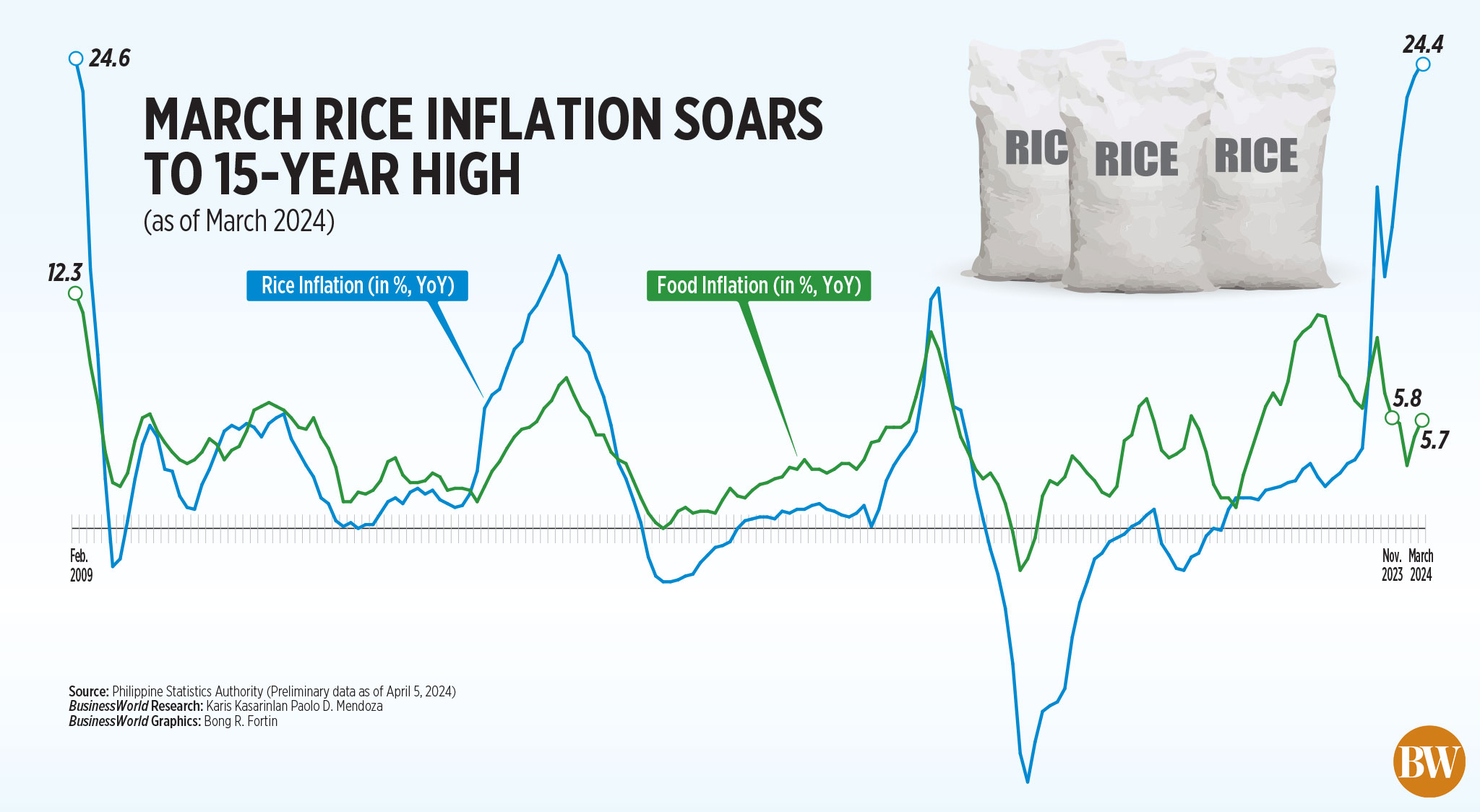
March rice inflation soars to 15-year high

Headline inflation quickened for a second straight month in March as prices of rice continued to surge, the Philippine Statistics Authority (PSA) reported. Read the full story.


March rice inflation soars to 15-year high

SSS targets to grow investible funds

BW FILE PHOTO

SOCIAL Security System (SSS) is looking to grow its investibles this year as market conditions stabilize and amid a strong economic outlook.

The state-run pension fund is also looking to tap more banks to manage funds worth P1 billion each this year, its officials told reporters on Thursday.

“There are two sources of growth. We’re very optimistic on new contributions and there haven’t been any calamities so far. We expect to grow on that front. We’re also optimistic on investments. The stock market is strong and stable. We have investments there already, so we expect to grow with the Philippine economy and the stock market,” SSS Fund Management Group Senior Vice-President Ernesto D. Francisco, Jr. said.

The investible fund of the SSS stands around P750 billion to P800 billion, depending on market value, he said. Of the total, about 15% or more than P130 billion is invested in the stock market.

“It’s (the market) now up and was very promising in the first quarter. We expect a good recovery year for the stock market,” Mr. Francisco said.

He said the SSS will continuously invest 15-20% of its equity returns into the Worker’s Investment and Savings Program (WISP).

“We expect roughly P60 billion coming from there. So, on a regular basis, we’re just investing the equity fund there,” he added.

Meanwhile, government securities make up almost 50% of SSS’ investments, Mr. Francisco said. SSS also invests in corporate bonds and real estate investment trusts (REIT).

The pension fund will continue to watch interest rate movements as it is reliant on fixed-income investments, he said.

“It’s an opportunity for us to accumulate while rates are higher for longer. We continue to monitor the movement of interest rates… We take advantage since it’s long term. We keep on locking in,” Mr. Francisco said.

SSS will also continue to outsource the management of its funds, he added, noting they could tap five to six more banks this year.

SSS previously tapped the Land Bank of the Philippines, the Development Bank of the Philippines, Rizal Commercial Banking Corp., Bank of the Philippine Islands, Security Bank Corp., and ATRAM Trust Corp, to manage its funds.

“We outsource on a very competitive process. Normally, we give out two- to three-year mandates. I think we like giving mandates as big as 9-10 mandates depending on the type of mandate, whether it be a balanced fund, fixed-income mandate, or pure equity mandate,” Mr. Francisco said.

“After that, we’re also looking at outsourcing overseas. We have to get the legal backing and basis and we have a lot of requirements to get such as global custodians, and we’re doing that. So, maybe it will be clearer later in the year how we’ll outsource abroad,” he added.

Only about 2% of SSS’ investible fund is being handled externally, he noted.

CONTRIBUTION HIKE
Meanwhile, SSS Senior Vice-President and Chief Actuary Edgar B. Cruz said he expects the scheduled contribution hike in 2025 to push through as its fund life is currently only expected to last until 2054.

Under Republic Act No. 11199 or the Social Security Act of 2018, SSS members’ contribution rate will increase by one percentage point to 15% in 2025.

“Our unfunded liability is expected to grow because our demographic is shifting. That’s just the nature of social insurance schemes. Because of the aging population, our unfunded population is expected to grow,” Mr. Cruz said.

SSS also expects benefit payouts to outpace contributions by 2039, he said.

“Right now, there are more people contributing than the money that we’re paying out, which is why our reserve funds increase every year,” Mr. Cruz said. “There will now be more benefits going out than contributions coming in, so the reserve fund will slowly go down until it reaches zero. That’s when the fund life ends.”

Higher contributions will also mean increased benefits for SSS members, he added. — A.M.C. Sy

Capital One recognized as one of the Best Workplaces in 2024

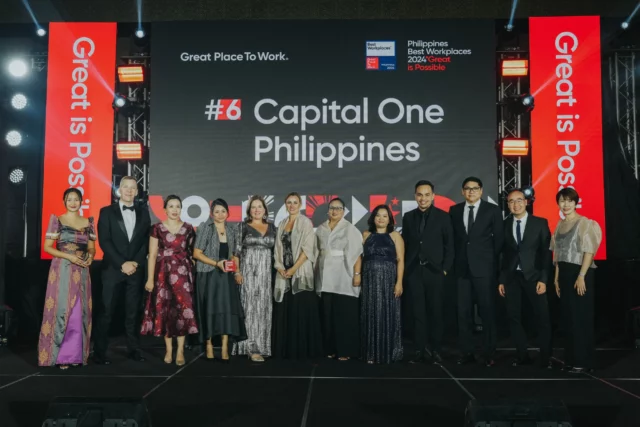
Great Place To Work™ honored Capital One Philippines by naming the organization among the Philippines Best Workplaces (Large)™ last March 19, 2024.

This is another first for Capital One Philippines, who came in at No. 6 on the list, just on the heels of receiving its first Great Place To Work certification in August 2023. Being included in this list meant that Capital One Philippines has surpassed rigorous benchmarks, establishing itself as one of the best places to work in the country.

“Earning this certification was truly a team victory,” said Capital One Philippines President and Head of Global Operations Sara Murphy. “It validated all the hard work our teams put in every day to create a culture where people feel engaged, valued, and heard.”

Joseph Paperman, who recently stepped in as Capital One Philippines’ Head of Country adds, “This recognition inspires us to further step up our efforts to create a workplace that nurtures an open environment and where our associates can thrive and make a positive impact in our communities.”


Spotlight is BusinessWorld’s sponsored section that allows advertisers to amplify their brand and connect with BusinessWorld’s audience by publishing their stories on the BusinessWorld Web site. For more information, send an email to online@bworldonline.com.

Join us on Viber at https://bit.ly/3hv6bLA to get more updates and subscribe to BusinessWorld’s titles and get exclusive content through www.bworld-x.com.

Armani company put in receivership amid labor exploitation probe

MILAN — An Italian court placed under judicial administration a company owned by Italian fashion group Armani accused of indirectly subcontracting production to Chinese companies that exploited workers.

The judges in Milan ordered a one-year receivership for Giorgio Armani Operations, described as an industrial arm of the Armani Group, according to a 31-page ruling seen by Reuters on Friday.

During this period, the company will continue operating, but under a court-appointed administrator.

According to the ruling, Giorgio Armani Operations had outsourced the production of bags, belts, and leather goods to two firms which in turn subcontracted the work to four Chinese companies whose workshops were based on the outskirts of Milan.

These companies paid people €2-3 euros ($2.16-3.25) per hour to work 10 hours per day on average, in some cases seven days a week, to make bags that were sold to Armani’s subcontractors for €93, re-sold to Armani for €250, and put on the market for about €1,800, investigators said.

Armani Group said in a statement it had “always had control and prevention measures in place to minimize abuses in the supply chain,” adding it would work with the authorities to clarify its position.

The Milan public prosecutors’ office has for years been investigating the outsourcing of production by large groups in fashion and other sectors to subcontractors who allegedly exploit workers.

Fashion company Alviero Martini, which had its bags made in Chinese workshops, was recently also placed under judicial supervision.

Italy is home to thousands of small manufacturers that cover 50-55% of the global production of luxury clothing and leather goods, consultancy Bain calculates, against 20-25% for the rest of Europe.

WORKERS FORCED TO EAT AND SLEEP IN FACTORIES
The Armani subcontracting went on from 2017 at least until February 2024, when police last raided the workshops, Milan judges wrote, noting that labor code breaches were an example of unfair business practices.

“The investigations uncovered irregular practices so deeply rooted and established, that they can be considered part of a wider business growth strategy,” judges said.

Police found Chinese and Pakistani migrants, often with no legal papers, forced to eat and sleep in the factories in degrading conditions, and employed without any work contracts, they said.

Workers used machinery with safety devices “purposely and maliciously removed,” were exposed to potentially dangerous chemical substances, and were denied medical examinations or training, the court ruling added.

The owners of the contracting and subcontracting companies are under investigation for exploiting workers and employing people off the books, while Armani Operations is not facing any probe.

The Armani unit was nevertheless placed under administration “for culpably failing to check the production chain and remaining inactive despite being aware of the outsourcing of production by the supplying companies.”

Judicial papers indicated that the Chinese-owned workshops also produced goods for other fashion brands.

“This is the second measure of this kind against a fashion company. We need to sit down and discuss with authorities and the operational problems of this market sector, which is so relevant for Italy,” Milan Court President Fabio Roia said. — Reuters

PhilRice eyes inbred rice yields of 5 MT/ha

THE Philippine Rice Research Institute (PhilRice) said it is seeking to increase the average yield of the inbred rice seed handed out to farmers.

Flordeliza H. Bordey, PhilRice director for the Rice Competitiveness Enhancement Fund (RCEF) Program Management Office, said the agency is planning to improve the yield of the rice seed variety to beyond 5 metric tons (MT) per hectare (/ha).

“We started with 3.6 (MT per hectare). So we have seen improvements over the years. Pero medyo baka mabitin tayo dun sa 5 (MT per hectare) (But we might fall short of the stretch target of 5 MT)” Ms. Bordey said in an interview.

RCEF Seed and Rice Extension Services programs are components of Republic Act 11203, or the Rice Tariffication Law, which sets aside P10 billion a year from rice import tariffs to make rice farmers more competitive.

The program’s target is to increase yields to 5 MT per hectare by 2025.

“So that’s what we’ll try to do in the next phase… we’ll definitely set a new target,” she added.

PhiRice said that the average yield of inbred seeds provided by RCEF increased to 4.36 MT per hectare last year, from 3.63 MT per hectare in 2022.

Among the government’s goals is to increase self-sufficiency for rice to 95% by 2028.

Ms. Bordey said that this could be attained through the distribution of both inbred and hybrid seed to production areas where they are best suited.

She added that under RCEF, inbred seed is distributed to 42 provinces with low to medium yields, while hybrid seed is given to 25 high-yielding areas.

The inbred seed is distributed to Negros Occidental, Leyte, Samar and Panay, while hybrid seed varieties are sent to 15 provinces, including Nueva Ecija, Isabela and Pangasinan.

“According to the Philippine Statistics Authority (PSA), rice harvest (is set to) increase slightly for the first quarter compared to the previous year… so prospects are good. We are hoping that the harvest would improve or at least not be lower than 2023,” she said.

The PSA is projecting the palay or unmilled harvest to increase 1.1% to 4.83 million MT.

The Department of Agriculture is projecting a palay harvest of above 20 million MT this year. The harvest in 2023 was 20.05 million MT, equivalent to about 13 million MT in milled rice. — Adrian H. Halili

We stand for integrity

SASUN BUGHDARYAN-UNSPLASH

The Philippine government has achieved milestones when it comes to the campaign for integrity in the healthcare community. In 2011, the Mexico City Principles for Voluntary Codes of Business Ethics for the Biopharmaceutical Sector was endorsed by Asia-Pacific Economic Cooperation (APEC) member economies, including the Philippines.

The Philippine Food and Drug Administration also adopted and implemented the Mexico City Principles in September 2013. The Department of Health (DoH), meanwhile, created a Committee for the Creation and Adoption of the Mexico City Principles (MCP) and Kuala Lumpur Principles for Medical Device Sector Codes of Business Ethics. In enforcing the MCP, the DoH has put in effect Administrative Order No. 2015-0053 relating to the Implementing Guidelines on the Promotion and Marketing of Prescription Pharmaceutical Products and Medical Devices.

All these have been put in place due to the recognition that ethical interactions between the pharmaceutical industry and the healthcare community benefit the patients as well as propel the advancement of science and medical information.

Prior to the adoption of the APEC Mexico City Principles, the Pharmaceutical and Healthcare Association of the Philippines (PHAP) adopted its own Code of Practice in the early 1990s. As a member of the International Federation of Pharmaceutical Manufacturers and Associations (IFPMA), PHAP fully subscribes to the rigid international code.

The Code is a requirement for PHAP membership, a non-negotiable component to be part of our roster. Previous members who could not comply with the Code for various reasons, including their failure to understand the importance of being bound by a stringent code of conduct, left the association. Our current members, composed of 40 pharmaceutical companies, are those that have been at the forefront of the research and development of medicines and vaccines for COVID-19, among others.

Among the principles that the Code espouses are trust, care, quality, innovation, quality, fairness, and integrity.

Specifically, “trust” is where all PHAP members are expected to act with integrity and honesty to improve patient care and build trust with those they serve. Also crucial in promoting this principle is respecting the independence of healthcare providers, patients, and other stakeholders.

Another principle is “care” where PHAP members must protect the safety of those who use their medicines and vaccines — from the conduct of clinical trials and throughout the product life cycle. The next principle is “quality” which is about the commitment to providing high quality medicines and vaccines that have proven clinical efficacy and have a reliable safety profile. Also crucial is “fairness” which supports and respects fair trade practices and open competition.

“Integrity,” on the other hand, is acting responsibly, ethically, and professionally. This refers to not offering, promising, providing, or accepting anything of value in order to inappropriately influence a decision, or gain an unfair advantage.

These principles are backed by specific provisions and rigid enforcement mechanisms. The Code of Practice is implemented through an independent Ethics Committee comprised of leading ethicists and health luminaries.

For example, Section 11.2 of the Code states that venues that are considered as beach resorts as well as those that primarily offer leisure or recreational facilities and those that operate casino and or golf courses within their premises are considered inappropriate venues for events. The PHAP has time and again been asked to comment on a venue’s appropriateness by various groups, including medical societies, and our stance has always been to refer to said Section 11.2.

Meanwhile, Section 12 of the Code, titled “Independence of Healthcare Professionals,” states that PHAP member companies’ relationships with healthcare professionals and other stakeholders are intended to benefit patients and to enhance the practice of medicine. Interactions should be focused on informing healthcare professionals about medicines, providing scientific and educational information, and supporting medical research and education.

The said provision adds that no financial benefit or benefit-in-kind may be provided or offered to a healthcare professional in exchange for prescribing, recommending, purchasing, supplying, or administering products or for a commitment to continue to do so. Gifts of any kind for the personal benefit of healthcare professionals are not allowed, irrespective of value, kind, or occasion.

The Code is cascaded to PHAP members through a pioneering module called the Integrity and Proficiency Program for the Pharmaceutical Sector (IPPS). The IPPS, registered under the Professional Regulation Commission, offers not just science-related information. It also provides modules on various laws and codes that must guide all interactions with healthcare professionals, the government, and patients among others.

In the healthcare community, unethical behavior hurts not just businesses. It also brings harm to patients and deprives them of the quality and appropriate healthcare they deserve. Ethical interactions, meanwhile, help ensure that medical decisions are made in the best interests of patients. They also level the playing field and encourage robust competition in the industry.

Due to the unique role of ethical behavior in positively affecting the health and lives of patients, the pharmaceutical industry must always be committed to ethical behavior. For this reason, we are, we will, and we continue to stand for integrity.


Teodoro B. Padilla is the executive director of Pharmaceutical and Healthcare Association of the Philippines (PHAP). PHAP represents the biopharmaceutical medicines and vaccines industry in the country. Its members are in the forefront of research and development efforts for COVID-19 and other diseases that affect Filipinos.

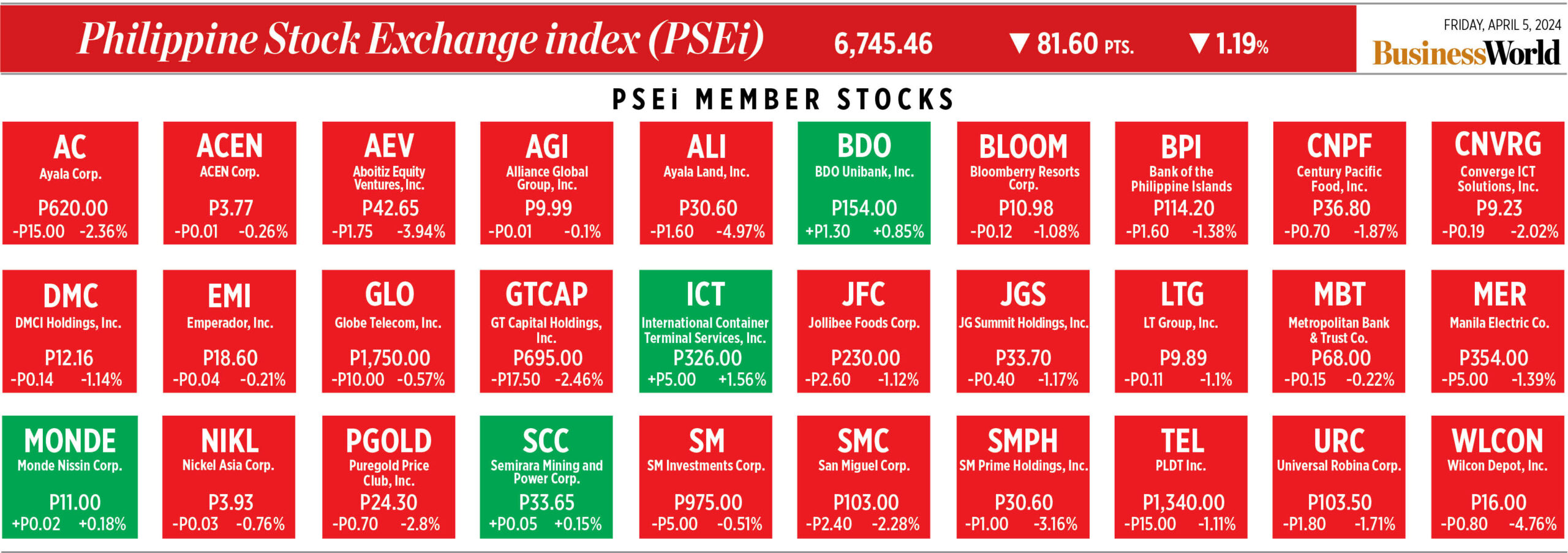
How PSEi member stocks performed — April 5, 2024

Here’s a quick glance at how PSEi stocks fared on Friday, April 5, 2024.


Stocks may drop as BSP holds policy meeting

BW FILE PHOTO

PHILIPPINE STOCKS could decline further this shortened trading week as the Philippine central bank is set to hold its policy meeting on Monday and amid a lack of fresh catalysts.

On Friday, the benchmark Philippine Stock Exchange index (PSEi) dropped by 1.19% or 81.60 points to close at 6,745.46, while the broader all shares index fell by 0.7% or 25.14 points to end at 3,555.18.

Week on week, the PSEi fell by 2.29% or 158.07 points from the 6,903.53 close on March 27.

“The local bourse started the week strong, hitting above 7,000, but sentiment quickly soured after the release of US Federal Reserve comments plus the Philippine inflation print for March,” online brokerage firm 2TradeAsia.com said in a market note.

Federal Reserve officials including US central bank chief Jerome H. Powell on Wednesday continued focusing on the need for more debate and data before interest rates are cut, a move financial markets expect to occur in June, Reuters reported.

“Recent readings on both job gains and inflation have come in higher than expected,” Mr. Powell said in a speech to the Stanford Graduate School of Business. While policy makers generally agree that rates can fall later this year, he said this will happen only when they “have greater confidence that inflation is moving sustainably down” to the Fed’s 2% target.

Meanwhile, Philippine headline inflation quickened to 3.7% year on year in March from 3.4% in February. This was slower than the 7.6% clip in the same month last year.

March inflation was within the Bangko Sentral ng Pilipinas’ (BSP) 3.4-4.2% forecast for the month. This was also slightly below the 3.8% median estimate in a BusinessWorld poll of 17 analysts and marked the fourth straight month that inflation was within the BSP’s 2-4% target range.

For the first three months, inflation averaged 3.3%, below the BSP’s 3.6% forecast for this year.

This week, the PSEi could take cues from the BSP’s policy meeting on Monday, Philstocks Financial, Inc. Senior Research Analyst Japhet Louis O. Tantiangco said in a Viber message.

“While policy rates will most likely be held at current levels, investors are expected to watch out for the BSP’s cues on their policy outlook. Cues of prolonged monetary tightening are expected to dampen sentiment, while cues of rate cuts are expected to do the opposite,” Mr. Tantiangco said.

“With last week’s decline, bargain hunting opportunities are seen. However, with the bearish factors at play, and the lack of a positive catalyst, we may not see a strong rally yet from the market. A further decline for the bourse is still possible,” he added.

Mr. Tantiangco put the PSEi’s major support at the 6,700 level.

Meanwhile, Rizal Commercial Banking Corp. Chief Economist Michael L. Ricafort placed the PSEi’s immediate minor support at 6,630-6,700 and immediate major support at 6,360-6,500.

2TradeAsia.com put immediate support at the 6,800 level and resistance at the 7,000 level. — R.M.D. Ochave with Reuters