Home Blog Page 2876

Now’s your chance to find your dream property in Cebu! See you at the Lamudi Property Fair from Aug. 16 to 18

Come one, come all! If you’re looking for your dream home or next investment property, head to the Lamudi Property Fair at Robinsons Galleria Cebu from Aug. 16 to 18, 2024. The country’s top developers will showcase their projects and offer exclusive discounts to attendees. Registration is free!

More Filipinos can discover their dream home and diversify their property portfolio now! In partnership with GFiber Prepaid and co-presented by IKEA, Lamudi Property Fair 2024 in Cebu is bringing houses, lots, condominiums, and other property options closer to property seekers in the Queen City of the South. Top developers and real estate players are participating in the biggest property event in the Philippines.

The Lamudi Property Fair reflects Lamudi’s long-term goal of providing a one-stop platform for home buyers and property investors. It gives live attendees access to some of the country’s most attractive properties alongside limited-time offers and exclusive discounts from participating developers.

Live attendees of the Cebu property fair also have a chance to win exciting raffle prizes.

Secure Exclusive Deals from Top Developers

Attendees of the Lamudi Property Fair in Cebu can look forward to exclusive promos and limited-time discounts that will bring them closer to owning assets in renowned estates, residential communities, condominium developments, and commercial districts. Available properties include houses and lots, lot-only properties, condominium units, rental spaces, and more!

Cebu property buyers can also interact with real estate agents face-to-face for inquiries, potential site visits, and home-buying advice. Event sponsors will keep live attendees on their feet through engaging presentations and fun booth activities.

Just like the previous Lamudi Property Fair events, the three-day expo in Cebu includes the country’s top real estate players. It is in partnership with GFiber Prepaid and co-presented by IKEA. Other event partners include platinum sponsor RLC Residences and gold sponsors Ayala Land, Avida, and Cebu Landmasters.

Live attendees can gain access to various exclusive deals prepared by these top real estate players. For example, those who visit the RLC Residences booth can get a 1.5% discount on Mantawi Residences along with a free souvenir photo and other freebies. Terms and conditions apply. Meanwhile, guests can visit the Security Bank booth to inquire about its 5-year 6.8% promo rate.

Here’s the complete list of event partners for the biggest property event in the Philippines:

  • GFiber Prepaid
  • IKEA
  • RLC Residences
  • Ayala Land
  • Avida
  • Cebu Landmasters
  • Aboitiz Land
  • Vista Land
  • Security Bank
  • Primeworld Land Holdings
  • BPI Buena Mano

Lamudi Property Fair Cebu’s media partners are SUNSTAR, Cebu Daily News Digital, Philippine Daily Inquirer, Inquirer Property, Manila Bulletin, The Philippine Star, Manila Standard, BusinessWorld, The Manila Times, and Malaya Business Insight.

The event’s media support includes Real Estate Blog PH, Media Blast Digital, Nego Sentro, Property Finds Asia, Village Connect, Executive Chronicles, Yo Manila, World Executive Digest, and Bravo Filipino.

Get a Chance to Win an Apple iPhone 15 and Other Exciting Raffle Prizes

The Lamudi Property Fair in Cebu has a lot in store for property buyers and investors. In addition to prime real estate options, limited-time discounts, and learning sessions, live attendees can participate in the daily raffles and win home appliances, gadgets, and more exciting prizes.

Here’s the complete list of raffle items that all live attendees have a chance to win:

  • 6 Starbucks Gift Certificates worth Php 500
  • 6 Uniqlo Gift Certificates worth Php 500
  • Fili Cafe Dinner Buffet (NUSTAR Resort & Casino) for two people
  • Apple AirPods (3rd Gen)
  • Sharp 6.0KG Fully Automatic Washing Machine
  • NUSTAR Resort & Casino Cebu Overnight Stay for two adults and two children
  • Fujidenzo 6 Cu. Ft. 2-Door Refrigerator
  • Skyworth 32″ HD Google TV
  • Apple Watch (SE)
  • iPhone 15 128 GB

Live attendees can head to the registration booths around the event area to learn how to take home one of these prizes, along with other giveaways. All attendees will get a Lamudi Property Fair wristband and ticket passport upon registration. To participate in the daily raffle, attendees must visit at least five participating booths and get their passports signed by booth managers.

See You at the Biggest Property Event in Cebu

The Lamudi Property Fair connects home buyers and real estate investors with their property of choice. The participating developers will showcase prime properties, including houses, houses and lots, lot-only properties, condominium units, and more. Attendees can also expect informative presentations and learning sessions from some of the country’s top developers and real estate players.

Of course, just being there and exploring the booths can give attendees a chance to take home gadgets, appliances, and other giveaways. Attendees will also have the opportunity to talk face-to-face with developer representatives and real estate agents, boosting confidence in their property-buying choices.

Moreover, property buyers and investors can interact with PAG-IBIG representatives throughout the three-day event to learn more about their acquired assets.

See you at the country’s biggest property expo at Robinsons Galleria Cebu from Aug. 16 to 18, 2024! Register for free at https://www.lamudi.com.ph/propertyfair/.


Spotlight is BusinessWorld’s sponsored section that allows advertisers to amplify their brand and connect with BusinessWorld’s audience by publishing their stories on the BusinessWorld Web site. For more information, send an email to online@bworldonline.com.

Join us on Viber at https://bit.ly/3hv6bLA to get more updates and subscribe to BusinessWorld’s titles and get exclusive content through www.bworld-x.com.

South Korea holds emergency meeting as EV fires stir consumer fear

PHILSTAR FILE PHOTO

 – South Korean officials met on Monday to discuss electric vehicle safety and whether to require car firms to disclose battery brands amid growing consumer concern after an EV blaze in an underground garage extensively damaged an apartment block.

The fire on Aug. 1, which appeared to start spontaneously in a Mercedes-Benz EV parked below a residential building, took eight hours to put out, destroying or damaging about 140 cars and forcing some residents to move to shelters.

The country’s vice environment minister is leading the meeting, which is also being attended by the transport and industry ministries and the national fire agency, an official said, with the government due to announce new rules soon.

On Tuesday, transport ministry officials will hold talks with automakers, including Hyundai Motor Group, Mercedes-Benz Korea and Volkswagen Group Korea, to discuss the proposal to disclose battery brands used in EVs, media reports said.

The ministry did not immediately provide a comment on the reports. Hyundai Motor Group, Mercedes-Benz Korea and Volkswagen Group Korea did not immediately respond to a request for comment.

Images published in media of dozens of charred cars with only their metal frames remaining in the parking lot fire have fueled consumer fears about EVs, likely exacerbated because so many people in South Korea live in apartments, often with parking lots below.

Early this month, Kia Corp’s 000270.KS electric crossover EV6 with South Korean battery maker SK On’s batteries also caught fire in a parking lot, fire authorities said.

Car experts say that EVs burn differently to cars with internal combustion engines, with fires often lasting longer and harder to extinguish as they have a tendency to reignite.

The Seoul Metropolitan Fire & Disaster Headquarters in a report published in February said 1,399 fires occurred in underground parking lots in South Korea between 2013 and 2022, with 43.7% attributed to vehicles. It said electrical sources accounted for 53% of car fires in underground garages.

The Chosun Ilbo newspaper reported last week that South Korea planned to require EV makers to disclose the brand of batteries in cars.

Automakers currently need to provide certain information about vehicles, such as fuel efficiency, but only limited details on batteries and do not have to name the manufacturers, the newspaper said.

On Saturday, Hyundai Motor Co. identified manufacturers of batteries used in their 13 EV models, including three models from its Genesis brand on its website, after receiving many enquiries about EV battery makers.

Hyundai and Genesis EVs use batteries from companies including South Korea’s LG Energy Solution (LGES) 373220.KS and SK On, as well as China’s CATL 300750.SZ, the website showed.

Moon Hak-hoon, professor of automotive engineering at Osan University, said simply requiring car companies to provide the make of an EV battery would not prevent fires. But what would be more helpful is to certify the fire hazards of each battery brand, he said.

Park Moon-woo, lead author of a report on the response to EV fires in underground garages, said disclosure would give buyers more choice, but noted that currently there was no definitive data on which EV battery brands are more prone to fires. – Reuters

Hong Kong court dismisses bid by media tycoon Jimmy Lai to overturn conviction

WESLEY TINGEY-UNSPLASH

 – Hong Kong’s top court on Monday unanimously dismissed the bid to overturn the convictions of media tycoon Jimmy Lai and six other pro-democracy campaigners for an unauthorized assembly in 2019.

Mr. Lai, 76, the founder of the pro-democracy newspaper Apple Daily, and six others including veteran democrat Martin Lee had been found guilty of organizing and participating in an unauthorized assembly in August 2019 during months-long pro-democracy protests in the China-ruled city.

While a lower court had overturned their conviction for organizing the unauthorized assembly, but their conviction for taking part in an unauthorized procession was upheld.

Their appeal centered on whether the conviction was proportionate to fundamental human rights protections, a principle set down in two non-binding decisions of Britain’s Supreme Court known as “operational proportionality”.

Chief Justice Andrew Cheung and Judge Roberto Ribeiro wrote in the main judgement that the two UK decisions should not be followed in Hong Kong, as there’s differences between the legal frameworks for human rights challenges in Hong Kong and the U.K.

David Neuberger, a former head of Britain’s Supreme Court, was one of the five judges on the Court of Final Appeal (CFA) who heard the case, adding to the debate over whether foreign judges should continue to sit on the city’s highest court amid a national security crackdown.

The judgment came two months after the resignations of two British judges from Hong Kong’s Court of Final Appeal (CFA), Lawrence Collins and Jonathan Sumption. Sumption said Hong Kong was becoming a totalitarian state and the city’s rule of law had been “profoundly compromised“.

Mr. Neuberger told Reuters in mid-June he would remain on Hong Kong’s highest court “to support the rule of law in Hong Kong, as best I can”.

Mr. Neuberger said he agree with the main judgement, adding the “issue has been fully and impressively considered” and “gives important guidance as to the proper approach to what has been called “operational proportionality”.

Mr. Neuberger added the constitutional differences in Hong Kong and the U.K. “do not mandate a different approach when considering whether a restriction on the right of assembly is proportionate”, but they “do require a different approach if the court concludes that the restriction is or may not be proportionate”.

Beijing imposed a national security law in 2020 after months of pro-democracy protests in 2019 and the Hong Kong legislative council passed a new national security law, also known as Article 23 in March.

For organizing and taking part in an unauthorized assembly in 2019, Lai and three former lawmakers Lee Cheuk-yan, 67, “Long Hair” Leung Kwok-hung, 68 and Cyd Ho, 70 were jailed between eight and 18 months. They received a reduced sentence of 3 to 6 months after their conviction for organizing was quashed.

Martin Lee, 86, a founding chairman of Hong Kong’s Democratic Party, barrister Margaret Ng, 76 and veteran pro-democracy politician Albert Ho, 72 were given suspended sentences.

“We just want to take the occasion to thank our legal team and all the people who have been supporting us,” Ng told the media outside the court.

Mr. Lai has been held in solitary confinement for more than three years since December 2020. He is now facing a separate national security trial and serving a sentence of five years and nine months after being convicted of violating a lease contract for his now shuttered newspaper’s headquarters.

According to the Security Bureau, 301 people were arrested over acts or activities that endanger national security. Among them, 176 persons and 5 companies were charged. – Reuters

Anti-terror tech group worried Musk’s X membership threatens its credibility, The Sunday Times reports

TWITTER.COM/ELONMUSK

A tech industry counter-terrorism organization is concerned over content posted on Elon Musk’s X by Palestinian militant group Hamas and is worried about the social media platform’s membership on its board, The Sunday Times reported.

Members of the Global Internet Forum to Counter Terrorism (GIFCT) believe the group’s credibility is undermined by X’s membership and position on its board, according to The Sunday Times. The GIFCT also includes major social media groups Facebook, Microsoft, Twitter and Alphabet’s YouTube.

X Corp and the Global Internet Forum to Counter Terrorism did not immediately respond to requests for comment.

The Sunday Times said that X, formally known as Twitter, is now the easiest social media platform to find Hamas videos, citing the Community Security Trust (CST), a charity that combats extremism and antisemitism.

It said within 10 minutes CST researchers were able to find on X propaganda videos from UK government proscribed terrorist groups Hamas, Hezbollah, and Palestinian Islamic Jihad.

According to The Sunday Times a statement in the GIFCT’s independent advisory committee annual 2023 report expressing concern over online trust and safety was directed at X.

The advisory body said it had become “increasingly concerned by significant reductions in online trust and safety capabilities for certain platforms, and a perceived decrease in the priority of the issue, negatively impacting companies’ ability to moderate extremist content online”.

The Sunday Times said Musk had let banned extremists back on to X, allowed anyone to pay for a verification mark and sacked a large part of its content moderation team, as part of the billionaire’s strategy of turning X into a “free speech” platform.

The GIFCT was created in 2017 under pressure from US and European governments. The Sunday Times said X, a founding member of the organization, was now failing to make its full financial contribution to the anti-organization. – Reuters

US arrests of Mexican drug lords could bring fresh charges in home country

STOCK PHOTO | Image by rawpixel.com from Freepik

 – Mexico is now investigating two drug lords arrested in the United States last month for their involvement in a slew of alleged crimes committed in their home country in order to get them stateside, federal authorities said on Sunday.

US authorities captured Ismael “El Mayo” Zambada, co-founder of the Sinaloa Cartel, and Joaquin Guzman Lopez, the son of Mr. Zambada’s former partner Joaquin “El Chapo” Guzman, in a stunning arrest late last month near El Paso, Texas.

The two have given differing accounts of how they ended up on a plane bound for the small-town airstrip, with Mr. Zambada saying on Saturday he was tricked by El Chapo’s son and ambushed.

Guzman, who is about 38 years old, meanwhile, has denied taking Mr. Zambada by force and called the handover a voluntary surrender after extended negotiations between the two drug traffickers and the U.S. government.

Mexico’s federal attorney general’s office said in a statement on Sunday that the crimes committed along the way could include murder, kidnapping and unlawful detainment of a person, illicit use of a flight, illicit use of aerospace facilities as well as immigration and customs violations.

Mexican authorities did not directly charge Mr. Zambada and Mr. Guzman on Sunday, but rather said the alleged crimes were part of the investigation the two were involved in.

Mr. Zambada, who is in his late seventies, on Saturday claimed in a statement sent by his lawyer that he was lured to a meeting with Guzman in the state of Sinaloa, the cartel’s heartland.

Sinaloa officials including Governor Ruben Rocha, and Hector Cuen, who had recently been elected as federal lawmaker for the upcoming congressional period, were also supposed to be present at the meet-up on a ranch outside Sinaloa’s state capital Culiacan, Mr. Zambada said.

Rocha said on Saturday that he was not in Mexico when the meeting occurred, while according to Mr. Zambada, Mr. Cuen was killed at the ranch.

Sinaloa authorities had previously said that Mr. Cuen was believed to have been killed in a carjacking at a Culiacan gas station.

The federal attorney general’s office on Sunday said Rocha would be asked to speak to state investigators, while it also requested to bring the state’s investigation into Mr. Cuen’s death under federal purview.

The office added that it had searched the ranch and a nearby landing strip which could have been used to take Mr. Zambada and Mr. Guzman to the US, as well as the airport outside El Paso. – Reuters

Philippines fishermen worry solar farm on lake will hurt incomes

PHILSTAR FILE PHOTO

 – Fishing has been a lifeline for Alejandro Alcones for the past four decades, but he now fears his small boat may be replaced by a floating solar farm on the Philippines’ largest lake.

Mr. Alcones is part of a group of fishermen opposed to the government’s plan to place solar panels atop Laguna de Bay, one of the country’s biggest sources of freshwater fish, as it looks for renewable energy sources to meet growing demand for power.

“Laguna Lake gives life and income to fishermen like us who didn’t finish school. It also gives many displaced workers here an alternative way to earn by fishing,” said Mr. Alcones, a 55-year-old father of two who lives near the lake.

An archipelago of more than 7,000 islands, the Philippines is hampered by limited land resources as it pursues a target to produce half of its electricity from renewable sources by 2040, compared with just a fifth in 2021.

Unlike traditional solar farms on land, floating photovoltaics – or solar panels installed on reservoirs, ponds and offshore waters – are an attractive alternative for fossil fuel-dependent countries with scarce land and high population density.

Last year, Indonesia opened Southeast Asia’s largest floating solar facility on a man-made reservoir.

But these novel projects may compete with people who depend on fishing and agriculture, according to a January report by the Responsible Energy Initiative of Forum for the Future, a collective of nongovernmental organizations pushing for “ecologically safe and socially just” renewable energy.

The report described the Laguna Lake project as a “testing ground” for the technology and the world’s first large-scale photovoltaics operation on a natural lake.


POTENTIAL HAZARDS

Under the project, Laguna Lake, which spans 91,000 hectares southeast of Manila, will host three floating solar projects atop 2,000 hectares of water that will generate about 2 gigawatts of electricity to supply the Laguna area and the capital by 2026.

Contracts have already been awarded to three companies that must still undergo an environmental impact assessment before construction can start.

Mr. Alcones is one of the 13,000 people who depend on the lake for their livelihoods, according to the Laguna Lake Development Authority (LLDA), a state agency responsible for the preservation, development and sustainability of the area.

The LLDA regularly meets with fisher groups to hear their concerns and the government “doesn’t want to dislocate them as much as possible” when the solar project gets underway, said Mhai Dizon, the LLDA’s renewable energy project coordinator.

But the Philippines’ largest fishermen’s alliance, the National Federation of Small Fisherfolk Organizations in the Philippines, or Pamalakaya, accused the LLDA of only consulting local government officials and small groups of Laguna fishermen.

Following a request by Pamalakaya, it met with the LLDA in Manila in July, when it raised concerns that the Laguna solar project could impact more than 8,000 fishermen, including 2,000 people who work in aquaculture, according to Ronnel Arambulo, Pamalakaya’s vice chairperson.

“We are worried that the floating solar farms will further shrink our fishing grounds that have already been reduced by past development projects,” Arambulo told The Thomson Reuters Foundation outside of the meeting, which was closed to press.

Fishermen from Pamalakaya fear the project would reduce catches and pose hazards to communities if they become untethered during strong typhoons and rising water levels, Arambulo said. The panels could also impede boats and destroy docks, he said.

Waterborne solar panels are still being tested and raise “numerous questions” about potential long-term effects on the environment and local communities, according to the Responsible Energy Initiative report.

Coastal soil erosion, increased sedimentation and siltation, disruption of photosynthesis and diminished fishing yields as the ecosystem changes are among potential risks.

“Depending on their specific location and scale, floating solar can reduce access to fishing grounds by independent fishermen,” said Marvin Lagonera, Forum for the Future’s energy transition strategist in Southeast Asia.

He described a “a rights-based approach” in clean energy transitions as essential.

“This includes meaningfully engaging with impacted communities,” including civil society, environmental groups and local communities, he said.


RACE FOR RENEWABLES

The Laguna Lake project would generate enough electricity to supply 2 million homes, Mylene Capongcol, assistant secretary at the Department of Energy, said in a statement.

“The Department of Energy supports the development of floating solar projects as this will contribute to the government’s target of a 35% renewable energy share in the power generation mix by 2030 and 50% by 2040,” she said.

Transitioning to renewable energy is becoming ever more urgent for the Philippines.

It is now Southeast Asia’s most coal-dependent country, with about 62% of its electricity production fired by the dirty fossil fuel last year, according to a report from the energy think tank Ember.

The slow adoption of clean energy is due in part to competition with agriculture for space, with just 18% of the island nation’s total land deemed arable.

But floating solar panels can help defuse tensions over land rights that have plagued solar development elsewhere, research firm Rystad Energy said in a report.

At present, floating solar farms account for just 500 megawatts of power production across Southeast Asia, but another 300 MW would come online this year alone, it estimated.

“Countries such as the Philippines, Indonesia and Thailand are well-positioned to be at the forefront of this growing trend,” the report said, and pointed to the Philippines’ inland lakes as suitable for solar farms.

Mr. Lagonera also saw the technology as a chance for the Philippines to accelerate its shift to green energy.

“With the Philippines’ ambitious renewable energy targets, floating solar systems present an innovative alternative and opportunity to scale renewable energy,” he said.

“However, as floating solar scales, it also risks similar competition for limited resources.”

Three dozen towns whose inhabitants depend on the lake for food, water and income line Laguna’s shores.

Each year, fishermen haul up to 90,000 tons of fish, including mudfish, catfish and ayungin, a silver perch endemic to the Philippines, from its waters.

They are also among the poorest: Almost a third of all Filipino fishers live below the poverty line. Mr. Alcones earns an average 5,000 Philippine pesos ($87) a month.

He has already seen a decline in the quantity and variety of fish and blames stresses on Laguna arising from its use as a flood reservoir and waste sink, as well as for irrigation and hydropower.

The LLDA believes the floating solar farms could actually boost Laguna fisheries in the future.

“Based on studies … the bottom of the panels can be used as breeding ground for fishes,” Ms. Dizon said.

While some Laguna fishers have welcomed the solar project, others believe they have more to lose than gain.

“We recognize the energy transition or the shift to renewables. But this should be put up in areas that are no longer productive, unlike Laguna Lake,” Mr. Arambulo said. – Reuters

US publicly announces submarine move to Middle East amid Israel-Iran tensions

DEFENSE.GOV
DEFENSE.GOV

 – US Defense Secretary Lloyd Austin has ordered the deployment of a guided missile submarine to the Middle East, the Pentagon said on Sunday, as the region braces for possible attacks by Iran and its allies after the killing of senior members of Hamas and Hezbollah.

While the USS Georgia, a nuclear-powered submarine, was already in the Mediterranean Sea in July, according to a US military post on social media, it was a rare move to publicly announce the deployment of a submarine.

In a statement after Austin spoke with his Israeli counterpart, the Pentagon said Austin had ordered the Abraham Lincoln strike group to accelerate its deployment to the region.

“Secretary Austin reiterated the United States’ commitment to take every possible step to defend Israel and noted the strengthening of US military force posture and capabilities throughout the Middle East in light of escalating regional tensions,” the statement added.

The US military had already said it will deploy additional fighter jets and Navy warships to the Middle East as Washington seeks to bolster Israeli defenses.

Ismail Haniyeh, the political leader of Iran-backed Hamas, was assassinated in the Iranian capital Tehran on July 31, an attack that drew threats of revenge by Iran against Israel, which is fighting the Palestinian Islamist group in Gaza. Iran blamed Israel for the killing. Israel has not claimed responsibility.

The assassination and the killing of the senior military commander of the Iran-backed Lebanese group Hezbollah, Fuad Shukr, by Israel in a strike on Beirut, have fueled concern the conflict in Gaza was turning into a wider Middle East war.

Iran has said the US bears responsibility in the assassination of Haniyeh because of its support for Israel.

Reuters reported several US and coalition personnel were wounded in a drone attack on Friday in Syria, in the second major attack in recent days against U.S. forces amid soaring tensions in the Middle East. – Reuters

Philippines to file protest with China over South China Sea air incident

DFA.GOV.PH

 – The Philippines will file a diplomatic protest with China over a recent incident involving Air Force planes in airspace over a South China Sea shoal, Manila’s Foreign Secretary Enrique Manalo said on Monday.

The Southeast Asian nation will continue maritime patrols in South China Sea despite the “dangerous and provocative” actions of China’s Air Force last week, military chief Romeo Brawner told reporters. The Philippines’ military has complained of dangerous actions by two Chinese aircraft that dropped flares in the path of a Philippine Air Force aircraft conducting a routine patrol over the Scarborough Shoal on Aug. 8.

Defence Secretary Gilberto Teodoro said he hoped China would comply with international law and on the need to de-escalate tensions.

On Sunday, Philippines President Ferdinand Marcos said China’s actions were “unjustified, illegal and reckless”.

China’s embassy in Manila did not immediately respond to a request for comment. On Saturday, Southern Theater Command of the Chinese People’s Liberation Army said the Philippine aircraft had illegally intruded despite repeated warnings. – Reuters

Beyond a target market definition: Map your Consumers’ Journey

Acumen offers a program named Growth Accelerator™ designed to address the business challenge of how to sustainably grow revenue through a rigorous, data-driven approach.

In Acumen, we use both head and heart to know consumers

We have heard time and time again about the importance of deep consumer understanding in building business. But why is it really that important to know our target consumers? And what do we need to know to be able to say we ‘deeply’ know them?

The market is an ever-changing landscape. As consumers move from one life stage to another and with competition regularly coming up with innovations to address their needs, consumer preferences also change.

The strategies that may have brought a company to where it is now may no longer be what it needs to keep growing. Hence, the need to regularly update and validate their understanding of their target consumers is imperative.

Consumer journey mapping is one way a company can organize and capture its understanding of its target market. It is the visual mapping of the various stages a consumer goes through and their decision criteria for buying a product/service and remaining loyal as a user.

Normally, businesses stop at painting the picture of their target market. It is an overall description of the target market’s life and how the product or service may fit their needs. That is a good start but may not be enough.

The reality is that consumers go through stages in the way they interact with any product/service. It starts from recognizing that they have a need, moving to an awareness of their options, to trial/purchase, repurchase, and loyalty.

At any point in time, the consumer has an option to stay or to leave the product/service.

At every stage, they make decisions based on what they know, their actual experience at the first point of contact, and their experience with the succeeding purchase or usage until loyalty. That is why it is important to understand consumers deeply at every stage and not to stay at the overall target market definition.

DISCOVERY

Acumen has a program called Growth Accelerator™ to help companies answer the business challenge of “How to sustainably grow revenue?” using a rigorous data-driven process. It starts with a comprehensive Discovery phase where we analyze our client’s business and identify the key business drivers. At the end of this phase, we define the key strategic imperatives, i.e. the most important issues that need to be addressed.

Often, a key issue is the unclear definition of the target market, and therefore the need to use existing data and/or to conduct more research to understand the consumers better.

We work with our clients to define their target market not just in terms of demographics but also behavioral and psychographic standpoints. We visually map what consumers look for in a product or service from the time they realize they have a need, where they get their information, what considerations they have in evaluating their options, what will prompt them to buy or try, what would make them repeat and become loyal to the point that they would becomes advocates and create positive word-of-mouth.

We also look at how the brand/product is performing versus competition, where each of the consumer options is tripping, falling, or even failing to convert consumers and why. This consumer journey map also identifies the various touch points of a consumer with the brand or product, so it helps in the development of the go-to-market execution.   

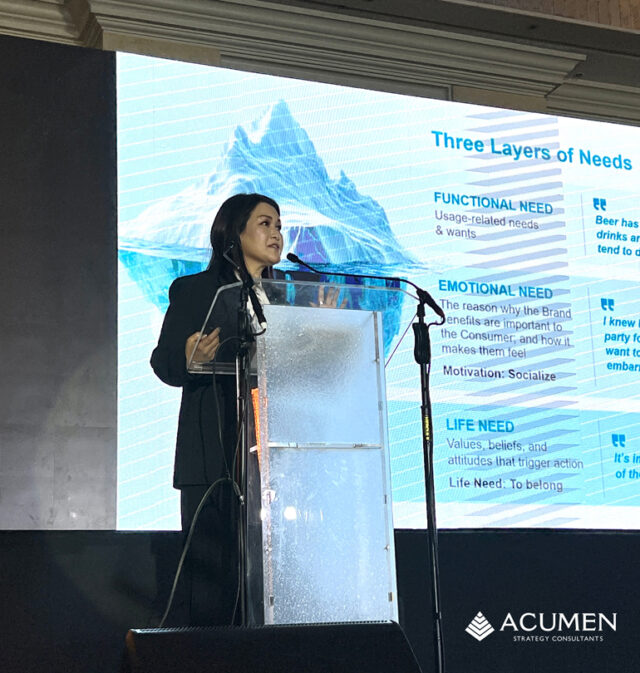
While Acumen uses a lot of data in consumer understanding, it goes much deeper than using data. We understand that 95% of the consumers’ decisions and behaviors are driven by emotion. Consumers have more than the functional need a product can serve, they also have emotional and even life-needs that need to be understood. We work collaboratively with our clients to identify the motivations, pain points, and desires that drive their target markets’ behaviors.

In Acumen, we use both head (analytical) and heart (understanding and empathy) to gain a deep knowledge of consumers. We use quantitative and qualitative research to answer the business questions of our clients to include mapping out their target market’s consumer journey.

KEY PARTNER

For over 20 years, Acumen has had the honor to be a trusted advisor for many of the top 100 corporations in the Philippines like JG Summit Holdings Inc., Cebu Pacific, URC, BPI and Globe, and some multinational companies like Hershey’s and Reckitt Benckiser. It has worked with companies in practically all major industries including but not limited to banking and finance, fast moving consumer goods, and telecommunications.

Many of the companies that have worked with Acumen in the past continue to work with us up to now. Tanduay is one of them and it has been a key partner in the last decade. In 2014, Acumen was instrumental in turning around its business performance and its collaborative work with the client has brought forth the successful campaign “Tibay ng loob, Tibay Tanduay”, which remains its campaign until now. Armed with the right strategies and plans and three years of Tanduay’s hard work, it became the no. 1 rhum in the world. A deep understanding of the business, strong collaboration in understanding its consumers, and consistent execution of the right strategies and plans have been key reasons for the success of Tanduay.

Why would a company want to work with Acumen in addressing their business issues?

There are at least 3 reasons:

1) Acumen Strategic Consulting company has over 20 years of experience in providing strategic advisory services to clients in the Philippines with a strong record of success,

2) It has a very deep and wide bench of senior consultants who were C-suite general management and brand management practitioners in a wide range of industries and they have deep knowledge of the Philippine market,

3) Its key differentiator is in RVA — Relevant, Value-Added, and Actionable recommendations. RVA is what sets Acumen apart from other consultancy companies, it takes pride in ensuring that strategic recommendations can be actionable and of value to the clients and not simply good on paper.

— Barbara Young, Vice-President Commercial Strategy, Acumen Strategy Consultants, acumen.com.ph

[B-SIDE Podcast] What does it take for an employee to stay?

Follow us on Spotify BusinessWorld B-Side

Alcohol drinking has been a vital part of various Filipino celebrations and festivals, creating camaraderie and a celebratory spirit.

Some Filipinos turned to alcohol as a coping mechanism for stress, as it slows down brain function and can induce feelings of relaxation and calmness.

During the pandemic in 2021, more Filipinos became alcohol drinkers, with the Department of Health (DOH) reporting that 40%, or 4 out of 10 Filipinos, were alcohol drinkers.

The DOH warns the public that any amount of alcohol, whether in small or large quantities, is not considered safe for health.

Addressing this concern, Paul Filomeno, a medical doctor and representative of the Philippine Addiction Specialists Society, has discussed the risks of alcohol drinking.

He will also discuss the Sin Tax Coalition’s initiatives to make alcohol products less accessible and marketable among Filipinos.

Interview by Edg Adrian A. Eva
Audio editing by Jayson John D. Mariñas

Follow us on Spotify BusinessWorld B-Side

Flowing To Panalo: Show off the best hand choreo to Flow G’s bars to win exclusive prizes from Puregold

Puregold bolsters its groundbreaking P-Pop and OPM collaboration with a brand-new TikTok challenge from rapstar Flow G. “FLOWers,” rap fans, and Puregold patrons who rejoiced when he dropped his original “Nasa Atin Ang Panalo” single can now leave their own mark on this historic milestone in OPM history — and win exclusive prizes.

The Puregold #PanaloNaWalangHalo TikTok Challenge will have fans trying at a set of Flow G-themed hand choreo all month long, as winners will be selected every week until Aug. 30, 2024.

To join the contest, fans must have a TikTok account and follow the official Puregold TikTok page, @puregoldph. Once that’s done, they must record their performance while using the “Nasa Atin ang Panalo” Hand Choreo filter on TikTok. Each participant must showcase their best hand moves and choreography in their video entries to accompany Flow G’s “Nasa Atin ang Panalo” single. These must be posted on TikTok with captions that include the hashtags #PuregoldNasaAtinAngPanalo, #PuregoldxFlowG, and #PanaloNaWalangHalo.

Every week, 10 participants will be selected, with each winning a complete set of “Nasa Atin ang Panalo” merchandise. This includes an exclusive t-shirt, canvas bag, and a karaoke box.

Given the sheer scale of this Puregold collaboration, with Flow G, BINI, SunKissed Lola, and SB19 leading the way, this is a can’t-miss opportunity for fans looking to own a piece of the “Nasa Atin Ang Panalo” collab for themselves.

Moreover, following the great reception from Flow G’s heartfelt and uplifting bars on his “Nasa Atin Ang Panalo” single, this contest is a perfect way for fans to demonstrate what the single and overarching collaboration means to them. In line with Flow G’s lyrics, this TikTok challenge will spur fans to express how their own experiences led them to believe in themselves, to take chances, and acknowledge the fact that all challenges can be overcome.

“We hope Flow G’s music will continue to be an inspiration to all,” said Puregold Senior Marketing Manager Ivy Hayagan-Piedad. “All of us at Puregold look forward to seeing the talent and creativity on display through this TikTok challenge.”


Spotlight is BusinessWorld’s sponsored section that allows advertisers to amplify their brand and connect with BusinessWorld’s audience by publishing their stories on the BusinessWorld Web site. For more information, send an email to online@bworldonline.com.

Join us on Viber at https://bit.ly/3hv6bLA to get more updates and subscribe to BusinessWorld’s titles and get exclusive content through www.bworld-x.com.

Poll: BSP to cut rates by 25 bps on Aug. 15

SHOPPERS are seen at the Greenhills shopping center in San Juan City. — PHILIPPINE STAR/MIGUEL DE GUZMAN

By Luisa Maria Jacinta C. Jocson, Reporter

THE BANGKO SENTRAL ng Pilipinas (BSP) may cut rates for the first time in nearly four years at its policy-setting meeting this week, according to a majority of analysts polled by BusinessWorld.

A BusinessWorld poll conducted last week showed that nine out of 16 analysts surveyed expect the Monetary Board to deliver a 25-basis-point (bp) rate cut at its meeting on Thursday (Aug. 15), bringing the target reverse repurchase (RRP) rate to 6.25% from the current over 17-year high of 6.5%.

On the other hand, seven others expect the BSP to keep rates steady this week.

Analysts’ Expectations on Policy Rates (August 2024)The last time the BSP reduced rates was in November 2020, when it delivered a 25-bp cut and brought the key rate to 2% to support economic recovery amid the coronavirus pandemic.

From May 2022 to October 2023, the BSP hiked borrowing costs by 450 bps.

Analysts said that the central bank will likely take into consideration the second-quarter gross domestic product (GDP) growth data, which reflected “anemic” household spending amid high interest rates and elevated inflation.

“We expect the BSP to cut the RRP by 25 bps on Aug 15. We think the BSP took note of the components of second-quarter GDP growth showing a sustained weakness in household consumption demand and sustained anemic performance of private construction,” Bank of the Philippine Islands Lead Economist Emilio S. Neri, Jr. said.

Philippine GDP expanded by 6.3% in the second quarter, faster than 5.8% in the previous quarter and 4.3% a year ago. This was also the fastest pace of growth in five quarters or since 6.4% in the first quarter of 2023.

In the second quarter, household consumption also slowed to 4.6% from 5.5% a year ago. Private consumption accounts for about three-fourths of the economy.

“We expect the BSP to cut rates by 25 bps at the Aug. 15 monetary policy meeting, driven by several factors. While second-quarter GDP growth was strong year on year, the quarter-on-quarter growth of 0.5% fell well below the 1.5% trend, suggesting waning momentum,” Security Bank Corp. Chief Economist Robert Dan J. Roces said.

On a seasonally adjusted basis, GDP grew by 0.5% in the second quarter, slowing from 1.1% in the prior quarter.

“The decision remains finely balanced against the strong annual GDP figure and inflation uptick, making the upcoming meeting a close call between maintaining current rates and implementing the expected cut. The outcome will be particularly significant for the Philippines’ economic outlook,” Mr. Roces added.

Metropolitan Bank & Trust Co. Chief Economist Nicholas Antonio T. Mapa said BSP Governor Eli M. Remolona, Jr. has earlier signaled it can cut ahead of the US Federal Reserve.

“If Mr. Remolona adopts a forward-looking approach to monetary policy, we could see the BSP follow through with a rate reduction as early as next week,” he said in a report.

“After carrying out an aggressive tightening cycle in the face of similar US Fed rate hikes and domestic inflation, as well as an ‘emergency’ rate hike last October, it appears Mr. Remolona is pining to cut rates at the soonest opportunity,” he added.

HOLD RATES?
On the other hand, some analysts said they expect the BSP to keep rates steady as the inflation outlook is a bit clouded.

If the BSP holds on Aug. 15, it would mark the seventh straight meeting that the central bank would leave rates unchanged.

“With GDP growth upbeat on an annual basis, but sharply lower quarter on quarter, with a technical recession ‘only’ for consumption, the BSP may delay its rate cut on the 15th, as policy makers will prioritize the return of disinflation later in the year,” Ruben Carlo O. Asuncion, chief economist at Union Bank of the Philippines, Inc., said in an e-mail.

Household spending fell by 0.1% quarter on quarter, extending the 0.2% dip seen in the first quarter.

National Economic and Development Authority Secretary Arsenio M. Balisacan last week said the GDP growth was not as strong as expected, amid the impact of elevated inflation and high interest rates.

Sarah Tan, an economist from Moody’s Analytics, said that the BSP could stand pat amid concerns that inflation could potentially reaccelerate.

“Even though we expect July’s inflation reading to be the peak, the outlook for Philippine inflation has become a little murkier of late. Damage caused by Typhoon Carina could linger over the coming months and electricity rates are also expected to tick up,” she said in an e-mail.

Headline inflation accelerated to a nine-month high of 4.4% in July. The July print also ended seven straight months of inflation settling within the central bank’s 2-4% target band.

For the first seven months, headline inflation averaged 3.7%, above the central bank’s 3.3% full-year forecast.

Mr. Remolona last week said that they are “a little bit less likely” to cut rates at the August meeting amid “slightly worse-than-expected” inflation print.

The central bank chief said they could consider cutting if growth is ‘unexpectedly weak” and if inflation expectations suggest lower inflation going forward. 

Mr. Asuncion expects the BSP to cut rates by October, in line with the Fed’s schedule.

“More broadly, the BSP is unlikely to leapfrog the US Federal Reserve. We expect the Fed’s first rate cut to come in September, with the BSP following suit in October,” Ms. Tan added.

The Fed at the end of July kept the policy rate in the same 5.25%-5.5% range it has been for more than a year but signaled that a rate cut could come as soon as September if inflation continued to cool, Reuters reported.

De La Salle University economist Mitzie Irene P. Conchada also noted other external developments that could prompt the BSP to keep rates unchanged.

“Given the recent developments (slowdown) in the stock market in major economies such as the US, I think the BSP will maintain its rates this Aug. 15.  The possible recession in the US could affect developing economies such as the Philippines,” she said in an e-mail.

OUTLOOK
Patrick M. Ella, economist at Sun Life Investment Management and Trust Corp., said the central bank should be able to push through with its easing cycle for the rest of the year.

“Any inflation uptick for July or even August should not distract from the rate-cutting plan of the BSP as these inflationary trends in July and August are transitory due to the weather disturbance,” he said.

HSBC economist for ASEAN (Association of Southeast Asian Nations) Aris D. Dacanay said that the BSP could cut rates by a total of 50 bps this year, bringing the benchmark rate to 6% by yearend.

“For 2025, we expect the BSP to ease monetary policy faster than the Fed, reaching the end of its easing cycle at 5% by the third quarter of 2025,” he added.

Analysts also noted the possibility of an off-cycle rate cut.

“An off-cycle BSP rate cut, if the Fed initiates rate easing in September, cannot be dismissed as well. We are expecting a modest 25-bp cut if the BSP does proceed with the off-cycle rate cut,” Mr. Asuncion said.

Mr. Remolona earlier said that they are “always open” to off-cycle rate cuts.

The BSP last delivered an off-cycle move in October 2023, when it hiked rates by 25 bps.

“Still, we won’t be surprised if BSP waits for one or two more inflation prints before they decide to carry out their first 25-bp cut. If not in August, they can do an off-cycle reduction in early September or during their scheduled meeting in October,” Mr. Neri said.

Mr. Mapa said the expected BSP easing could help “reinvigorate investment outlays which have been dominated by government spending of late.”

“If BSP opts to pause next week, we believe the rhetoric from both the BSP governor and Finance secretary suggests that rate cuts may be carried via an ‘emergency’ policy meeting, potentially once the August inflation is reported in early September,” he said.

After Aug. 15, the Monetary Board’s remaining policy-setting meetings this year are on Oct. 17 and Dec. 19.

ADVERTISEMENT
ADVERTISEMENT