Home Blog Page 2826

Manufacturing Purchasing Managers’ Index (PMI) of select ASEAN economies, April 2024

PHILIPPINE MANUFACTURING activity in April expanded at its fastest pace in five months amid an increase in output and new orders, S&P Global said on Thursday.  Read the full story.


Manufacturing Purchasing Managers’ Index (PMI) of select ASEAN economies, April 2024

GSIS written insurance premiums rise by 12% in Q1

GSIS FACEBOOK PAGE

GOVERNMENT Service Insurance System (GSIS) saw its written insurance premiums grow by 12% in the first quarter to P2.98 billion from P2.65 billion, it said on Thursday.

“The GSIS General Insurance has issued 52,644 total policies, with total sum insured amounting to P798.4 billion,” the state-run pension fund said in a statement.

This resulted in a 35% increase in net income to P3.3 billion, up from P2.4 billion in the same period last year.

The net worth of the GSIS General Insurance Fund (GIF) grew by 7% to P54.63 billion at end-March from P51.26 billion at end-2023.

“The sustained momentum of the performance of the GSIS has proven to be a catalyst of the economic development of the Philippines through supporting both the public and the private sectors,” GSIS President and General Manager Jose Arnulfo “Wick” A. Veloso said.

“GSIS is aggressively campaigning for the protection of all government insurable assets and interests. We protect the government’s budget and individual programs against unexpected insurable losses such as fire, earthquakes and typhoons. And more importantly, we are able to pool long-term funds and put them in investments to help grow the overall economy,” he added.

GSIS Senior Vice-President for Insurance Valerie K. Marquez added that the state pension fund will soon be issuing parametric insurance for local government units. The policy will pay out benefits based on the occurrence of a pre-defined event, such as earthquakes of a specific magnitude or typhoon winds breaching a specific speed.

“We believe this type of insurance will help many LGUs as this does not require the traditional process of claims adjustment after a loss event. GSIS will pay out automatically when the triggering condition is met,” Ms. Marquez said. — A.M.C. Sy

Pro-China ‘independent foreign policy’ and other fallacies

CARLOS DE SOUZA-UNSPLASH

It was probably Jordan Peterson who pointed it out: considering that slavery is immoral, and considering further that the continent that had most of its people enslaved was Africa, and considering, finally, that most of the enslavement was done by their fellow Africans, the question now becomes: is slavery more immoral if those doing the enslaving are your fellow people?

A pretty good question when one considers the humongous lies, gaslighting, and fallacious arguments that have arisen because of the West Philippine Sea issue.

And yet, this thought: it’s bad enough for China’s communist government to be spouting such lies and fallacies, even though they themselves may believe it or perhaps believe that such — even if untrue — will ultimately serve their national interests. Yet, how much more contemptible, how utterly loathsome, how profoundly disgusting can it be when it’s our fellow Filipinos doing the lying, gaslighting, and fallacious spouting — all in the ser-vice of either themselves, short-term political gain, or a foreign country?

And yet, here we are.

One such fallacy bloviated ad nauseam by the pro-China propagandists is the strawman argument, which goes like this: “Those that are so passionate about defending Philippine territory actually just want to go to war with China because they hate China.”

But the argument doesn’t make sense because as late as a decade and a half ago, nobody was really critical of China. In fact, for a time, Beijing and Shanghai’s economic leap from sleepy towns to mega-cities was the subject of near unanimous admiration. The only reason China is getting a negative reception nowadays is because it insists on being the international bully. Any belligerency in the Pacific was initiated by it.

Furthermore, no one opposing China wants to go to war. That is why the plea of any reasonable person (and right now the reasonable people are on the pro-Philippine territory side) is for China to regain its senses and ad-here instead to the rule of law, particularly international law.

Which leads to another fallacious argument: “Why oppose China when the latter asserts its territorial claims? This will lead to war.”

This is the fallacy of false dichotomy. Opposing China should not necessarily lead to war. If that were so, then Vietnam, Thailand, and India would be at war with China right now. In fact, the absolutely senseless thing to do is to show weakness, a lack of resolve in defending our country. Why? Because it is precisely that, not opposing the other country’s claims, that actually invite a war. Hence, the dictum: “If you want peace, prepare for war.”

Which leads to this odious fallacy: “If you really are against China, then you and your children should enlist in the military and be ready to fight. If not, then stop saying we should defend our territory.”

This is a “won’t and shouldn’t” fallacy, a form of ad hominem. The point is, just because you are not willing to enlist your children (as example) to fight the Chinese, it doesn’t mean that the policy of defending the national territory is wrong.

In any event, such a defeatist fallacy is neither here nor there. Nearly 80% of our people are willing to fight for our country. Nobody wants a war, but there are some things we have to be willing to do. Frankly, 100% should be there to fight for our country but apparently there are some that are just too corrupted or misguided for that to be possible.

Which leads us to a lie: The claim that the Philippines, by seeking security alliances with Japan, the US, and other Western countries, violates the constitutional mandate to have an “independent foreign policy.”

First of all, “independent” is not what’s really the issue. What the pro-China propagandists prefer is we deal with China alone.

Furthermore, set aside the troll commentators criticizing the Marcos foreign policy simply because they failed to get an appointment with the current Administration. Instead, talk to any of the rabid pro-China advocates and you will soon find out that it is not merely the alliance with the West that bothers them, but the very being and character of the Filipino: an adherence to constitutional rights, with values anchored on inherent human dignity. In short, they hate it that the Philippines is not China (or part of it).

For such people, the authoritarian, collective, Confucian values are what they believe are so inherently superior that the Philippines must simply bow down to it. But this itself is a profound delusion: the fact that China’s economic progress is proving to be ultimately unsustainable is rooted in the fact that it is anchored on a wholly unsuitable metaphysic.

“Independent” is the Philippines freely (as is relatively possible) deciding what its foreign policy shall be. If, to avoid being coerced by China, we chose to align with those countries supporting our claim, such becomes precisely then the very definition of an “independent foreign policy.”

The views expressed here are his own and not necessarily those of the institutions to which he belongs.


Jemy Gatdula is the dean of the Institute of Law of the University of Asia and the Pacific and is a Philippine Judicial Academy lecturer for constitutional philosophy and jurisprudence. He read international law at the University of Cambridge.

https://www.facebook.com/jigatdula/

Twitter  @jemygatdula

No promotion? Ask for a transfer

I’ve been in my current job for five years and feels unhappy about my career development under my boss. Can I request a transfer to another department? — Tinder Box.

It depends on four factors — company policy, vacancy in the other department, your qualifications, and the willingness of the other manager to accept you into the fold. Even if all these are in your favor, your current boss can still make things difficult for you. So what would be the best approach to get what you want?

It won’t be easy. You have to play by the rules. Whatever the circumstances are, the first thing you should do is to be diplomatic and kind to your boss even with all the hard feelings. I know. It’s difficult to be sincere with people who don’t support you. But there’s no other way.

Understand that in the workplace, there’s always the possibility of conflict. The reasons include conflict between two or more managers, a manager and a worker in another department, and of course managers and their direct reports.   

It’s imperative to look yourself in the mirror. What’s preventing you from achieving your career goal? Surely, it boils down to your performance. If you don’t exceed the expectations of your boss, you will not be able to advance, no matter how you look at it.

Examine your track record, at least for the past three years. What’s the grade given to you by your boss? If you’re an average worker, that means you’re not yet ready for a transfer, unless management allows it for reasons like multi-tasking, among others.

OTHER OPTIONS
Take stock of your strengths and weaknesses. Know them by heart. Then, find a way to talk to your boss about your career aspirations. If you’re an average performer, create a performance improvement plan with the help of your boss. Talk to your boss.

Do it casually at the right time when the load is easy and when he appears in a good mood. Prepare yourself emotionally for such event with the following list in mind:

One, be appreciative of what the boss has done to you. Think of all the good things the boss has done for you, no matter how trivial. Don’t exaggerate. Be truthful to avoid any hint of bootlicking. Being grateful starts everything right for both of you. Be mindful of your boss’ reaction when you do this out of the blue.

Two, ask the boss on how you can improve your performance. Revisit your record. Study your weaknesses and plan to improve on them. Don’t be defensive. Be receptive by getting more details from your boss. Then, ask for assistance in correcting your weak points, which may include sending you to some training programs.

Three, request a different job within the department. Sometimes, boredom can be a root of the problem and can be easily cured by changing the environment at work.

Explore the possibility of being assigned at least temporarily to another section with a different job function. This could be done for six months to one year until the desired effect is achieved.

Four, offer assistance for a smooth transition. This is related to number three above. Reciprocal training is important to achieve the best possible result. One challenge to this approach is the absence of another person willing to change jobs. The cure, however, is when your boss decides that multi-tasking is important for everyone.

Last, consider a transfer request to another department. If the above four options are not feasible, then consider a request for transfer to a different boss who is willing to take you in. This could be more difficult unless you’ve done a preliminary discussion with all concerned bosses while taking into consideration their different personalities.

TRAINING
Career development is an obligation of both workers and managers. To do this, the organization must have a framework aimed at improving everyone’s performance. The framework may include training as the backbone of career development.

Although training and development are used interchangeably, we must understand the subtle differences. Training focuses on learning the necessary skills to perform a job. On the other hand, development focuses on the preparation needed so a person can perform other tasks within the organization.

If a particular worker has been identified as a potential successor to the boss, the former must undergo a systematic development process to be ready to assume the job in the future.

Therefore, training and development as a twin organizational requirement must be a continuing process as a cure for mediocrity and obsolescence.


Bring Rey Elbo’s leadership program called “Superior Subordinate Supervision” to your line leaders, supervisors, and managers. Follow him on Facebook, LinkedIn or X for his daily management insights or e-mail elbonomics@gmail.com or via https://reyelbo.com

Entertainment News (05/03/24)


BGC celebrates Cinco de Mayo

THERE will be a night of food and fun at Bonifacio South Street on May 4, in celebration of Cinco de Mayo. The street’s restaurants and bars — Bolero, Cochi, Tartufo, Bueno, Wong Place, and Wantusawa — will welcome a live DJ and a mariachi band and dancers. Entrance is free for all as early as 5 p.m. Early birds will also get a free drink at these establishments. Bonifacio Global City’s (BGC) Cinco de Mayo festivities will last from 5 to 10 p.m. on May 4 at the Bonifacio South Street, BGC, Taguig.


Henry Moodie to busk in Manila

POP SINGER Henry Moodie will hold a free busking session on May 4 at Level 3 of the Mall of Asia’s (MOA) Entertainment Mall. He will also participate in an exclusive meet and greet and question and answer with select Filipino music fans who have been supportive of his music journey. Admission to the busking session is free. For more details on the time and location of his performance, visit the MOA social media pages.


FEU bamboo band set for special concert

TO kick off the month of May, the Far Eastern University Center for the Arts and the Far Eastern University (FEU) Bamboo Band are presenting a special concert entitled Ang Tangi Kong Ikaw, on May 4 at 6 p.m. in the FEU Auditorium. It will commemorate the school’s 96th anniversary and the auditorium’s 75th anniversary. The concert will feature some of the most renowned kundiman or Philippine art songs from the past decades, under the supervision of artistic director Norberto Cads, Jr. For further information, visit the Facebook page of the Far Eastern University Bamboo Band.


National Museum holds heritage conservation talks

THE MUSEUM Foundation, in partnership with the National Museum of the Philippines, is presenting a series of talks this month titled “Heritage Conservation: Preserving Our Past for the Future.” The talks will be held at the National Museum Auditorium every Saturday (May 4, 11, 18, and 25). They aim to provide a platform for everyone to engage in insightful discussions about heritage identification, preservation, and protection of cultural, historical, and national heritage sites. On May 4, the topic is “Sacred Spaces: Repaint, Overpaint or Restore” led by Tats Manahan. On May 11, Dr. Gerard Lico will discuss “Conserving Modern Heritage.” On May 18, heritage planning around rivers will be tackled by Paulo Alcazaren in “A Tale of Two Rivers.” Finally, May 25 will have “Law and the Setting for Heritage,” with Mark Evidente as the speaker. Admission to all talks is free.


Rent in Manila

THE THEATER group 9 Works Theatrical presents the latest production of the musical Rent. Set in the 1990s in the middle of the raging HIV/AIDS epidemic, the musical is an updated version of La Boheme and follows a group of society’s outcast and fringe dwellers who find solace and support amongst each other. Directed by Robbie Guevara, it stars Reb Atadero, Anthony Rosald, Jasmine Fitzgerald, Fay Castro, Thea Astley, Garrett Bolden, Lance Reblando, and Markki Stroem. It has performances until June 1 at the Carlos P. Romulo Auditorium, RCBC Plaza, Ayala Ave., Makati. Tickets, ranging from P2,000 to P4,000, are available via Ticket2Me.


K-Culture Next Door fest brings Korea to Manila

THE vibrant world of Korean culture is coming to Manila through the K-Culture Next Door festival, organized by the Korean Cultural Center (KCC) in the Philippines. This year, the festival takes place at the SM Mall of Asia Music Hall on May 4 and 5, and later on at the SM Seaside City Cebu’s Mountain Wing Atrium and Skyhall on June 15 and 16. The opening of the festival on May 4 will see Korea’s top indie rocker Jannabi performing a set. The doors are also open for Filipino individual and group performers, as part of the Mini K-pop Busking Concert. Qualified participants will showcase Filipino talents while embracing their love for K-culture. For more details on the festival events, visit the KCC’s social media pages.


Big Bad Wolf Sale in Cebu to give out more prizes

FOR the final week of the Big Bad Wolf Book Sale in Cebu, a Buy 5 Get 1 free promo is being offered. For every five books purchased, customers get an extra one for free, while also qualifying for a chance to win vouchers. A massive selection of books at low prices await readers until May 5 only. Swedish home furnishing brand Ikea is also treating customers to a chance to win up to P50,000 worth of prizes. For more information about the Big Bad Wolf Book Sale Cebu’s remaining promos for the last few days, visit the fair’s official social media pages.


MMFF 2024 winner Firefly now on Prime Video

GMA Pictures and GMA Public Affairs’ internationally acclaimed film Firefly will now reach more viewers globally on the streaming platform Prime Video. It stars GMA Sparkle child star Euwenn Mikaell as a boy who embarks on a journey to find the mystical island of fireflies from the bedtime stories told by his mother, played by award-winning actress Alessandra de Rossi. Also in the ensemble cast are Ysabel Ortega, Miguel Tanfelix, Cherry Pie Picache, Epy Quizon, Yayo Aguila, and Kokoy de Santos, with Max Collins and Dingdong Dantes. The coming-of-age road trip film is based on the original story of GMA Public Affairs Senior AVP Angeli Atienza and is directed by Zig Dulay. It is out now on Prime Video.


Gabi Na Naman Productions celebrates 9th year

GABI Na Naman Productions (GNN), an events production company, is throwing a birthday party to celebrate nine years of producing local and international shows for the Filipino audience. Dubbed #GNN9, the special showcase will take place at 123 Block in Mandaluyong City on May 25, from 6 p.m. onwards. This year’s edition includes some of GNN’s personal favorites, including UDD, Ang Bandang Shirley, Cheats, Ena Mori, Clara Benin, Gabba, and Chicosci. Tickets to #GNN9 are available via bit.ly/gnn9 for P800 (early bird price).


Warren Hue releases new single

THE 21-YEAR-OLD rising star Warren Hue, fresh from making his mark with the 1999 Write the Future music collective, has dropped his most personal single yet, “SPLIT.” Out now via 88rising with an official music video, it introspectively examines the highs and lows of being in a cross-country relationship. “I wanted to create a song based on split lifestyles and how pressure and insecurity can take over your emotions. Trust is a big theme in the song, telling my significant other to believe in me and vice-versa,” Mr. Hue said in a statement. The day-in-the-life music video captures his lifestyle, a mix of finding his place in a new city and letting loose while pursuing his dreams. The alternative hip-hop track is produced by frequent-collaborator, Chasu. “SPLIT” is out now on all streaming platforms.


Korean crime drama Crash to debut on Disney+

IN Crash, a brand-new Korean police procedural drama, a Traffic Crime Investigation (TCI) team becomes more competitive when a genius new team member joins. A top mathematician with impeccable looks and next to no social skills, Cha Yeonho (played by Lee Minki), is turning things around with the ability to simulate the exact cause of an accident using only the facts and his impressive cognitive abilities. However, an incident from his past comes back to haunt him. Others in the cast are Kwak Sunyoung as team leader Min Sohee and Heo Sungtae as TCI head Jung Chaeman. It starts streaming on Disney+ on May 13.


SEVENTEEN teams up with Spotify for anniversary

K-POP group SEVENTEEN has released their greatest hits album, 17 Is Right Here, commemorating their 9th anniversary. In connection with this, Spotify has also released special content prepared with the group, only available on the platform. This includes a CGI video, behind-the-scenes glimpses, and exclusive events like the ZIP Party, featuring challenges and personal song recommendations from the members. The exclusive digital sharecard for the content will be given to top listeners in the Spotify app.

National Government outstanding debt

THE NATIONAL GOVERNMENT’S (NG) outstanding debt slipped to P14.93 trillion as of end-March, the Bureau of the Treasury (BTr) reported. Read the full story.


National Government outstanding debt

Of metrics and indicators

I like reading about studies and surveys comparing the Philippines with other countries. They provide not only a good benchmarking exercise, but also some analytical comparisons and correlations of different metrics and indicators to make sense of the hype and clutter in the news. This time of the year is when most of these studies come out. Let’s examines some of them.

The Asian Development Bank projects the Philippines to sustain strong GDP growth in 2024 and 2025, with anticipated expansions of 6% and 6.2%, respectively. This positions the Philippines among the fastest-growing economies in Southeast Asia. In fact, The Economist recently published a piece titled, “Without fanfare, the Philippines is getting richer.”

At the backdrop is the headline that more Filipinos are hungry in the first quarter of 2024, according to the latest survey by the private pollster Social Weather Stations (SWS), which revealed that 14.2% of Filipino families experienced hunger or lacked food at least once in the past three months, exceeding the hunger incidence of 12.6% from the previous quarter.

In another recent SWS survey revealed that 46% of Filipino families felt poor in March 2024, which is merely 2% lower than the 48% annual average self-rated poor families in 2023.

On the other hand, the combined fortune of Forbes’ list of the 50 most affluent in the country grew by 11% from US$72 billion to US$80 billion in 2023, which was due to “robust consumer demand” in consumer goods, property, and retail, according to the report of South China Morning Post.

So, is the economic growth of the Philippines not trickling down to its people? Or perhaps it’s leading to the development of human capital in the country. Let’s examine.

The Philippines ranked 77th out of 81 countries globally in reading, mathematics, and science proficiency for 15-year-old learners, according to the 2022 Programme for International Student Assessment (PISA) rankings conducted by the Organization for Economic Co-operation and Development (OECD). Despite a 2-point increase from the national average of 353 points in PISA 2018, the Philippines still ranked among the lowest in the 2022 assessment.

In another study, the Philippines fell six places in the Institute for Management Development (IMD) World Competitiveness Center’s annual World Talent Ranking (WTR) 2023, landing at 60th out of 64 countries, compared to 54th out of 63 economies the previous year. In the Asia-Pacific region, the Philippines ranked 13th out of 14 countries, surpassing only Mongolia in talent competitiveness.

So, our country is lagging in human capital development, how about in infrastructure? Let’s examine this.

Metro Manila claimed the top spot in the 2023 TomTom Traffic Index among 387 cities across 55 countries, with the slowest travel time. On average, it takes 25 minutes and 30 seconds to travel 10 kilometers within Metro Manila.

Manila, the capital of the Philippines, descended six spots to 121st out of 142 cities globally in the latest Smart City Index, according to the 2024 Smart City Index (SCI) by IMD World Competitiveness Center’s Smart City Observatory. The index combines data and survey responses to gauge how technology aids cities in addressing challenges and enhancing inhabitants’ quality of life, focusing on human-centric approaches. Manila’s decline was attributed to concerns regarding health services, corruption/transparency, and unemployment.

No wonder Philippine workers ranked the most stressed in Gallup’s State of the Global Workplace 2023 Report which revealed that 45% of Filipino employees experienced a substantial level of stress in the preceding day before the survey was conducted.

As a rejoinder, the prospect of the Philippine economy is, indeed, bright. But its growth is not enough to be felt by many Filipinos in the coming years. Historically, the Philippine economy has grown in the vicinity 6% at best, with only two instances in the last three decades with more than 7% GDP growth, i.e. in 2010 (7.3%) and in 2022 (7.6%).

On the other hand, Vietnam’s economy has grown at a faster rate than that of the Philippines in the last three decades, resulting in it overtaking the Philippines in terms of per capita income in 2020; and at the rate that Cambodia’s economy has been consistently growing, it will overtake the Philippines soon.

But why can’t the Philippines grow at a faster and consistent pace?

Based on the 2023 Corruption Perception Index (CPI) report, the Philippines scored 34 out of 100 which is below 50, indicating “serious corruption problems”; and this score barely moved over the years since 2012.

There are obvious leaks in the system. The indicators in human capital and infrastructure developments likewise do not augur well.

Surely, the Philippine economy will grow, but not at spectacular levels relative to the experience of neighboring countries. Unless the government, the private sector, and the populace collectively change the director of critical metrics and indicators.

The views expressed herein are his own and does not necessarily reflect the opinion of his office as well as FINEX.


Reynaldo C. Lugtu, Jr. is the founder and CEO of Hungry Workhorse, a digital, culture, and customer experience transformation consulting firm. He is a fellow at the US-based Institute for Digital Transformation. He is the Chair of the Digital Transformation IT Governance Committee of FINEX Academy. He teaches strategic management and digital transformation in the MBA Program of De La Salle University. The author may be e-mailed at rey.lugtu@hungryworkhorse.com

PANA, AIM team up to offer marketing course

THE Philippine Association of National Advertisers (PANA) said it hopes to equip young marketers with skills in brand-building trends amid an evolving business landscape through its seminars.

Brand Academy is a four-Friday seminar on brand building, industry-specific knowledge, and skills essential for excelling in the competitive marketing arena.

“We’re already having to be full-time marketers, so not just having to build awareness and generate demand, but close that sale digitally, whether it’s TikTok shops, Lazada, etc.,” Colgate-Palmolive Marketing Director Bea Atienza said during a roundtable discussion on Thursday.

Marketers must thoroughly understand brand building and converting consumers across various channels, according to Ms. Atienza.

Asian Institute of Management (AIM) Business Development Senior Manager Jay Clement L. Coson supported this, highlighting e-commerce growth surpassing physical stores during the pandemic.

The seminars will cover TikTok strategies, brand trust, digital brand resonance, creative disruption, music marketing, and other relevant topics.

The classes take place face-to-face over four consecutive Fridays, beginning on June 7 and ending on June 28.

In its second year, PANA collaborated with the Asian Institute of Management to offer the course to the advertising industry, extending beyond its members.

“We started with an exclusive partnership with PANA two years ago… to PANA members who wanted to pursue postgraduate study but this time, it’s more specific and we made it very inclusive to non-members,” PANA Executive Director Robert Simborio said.

It costs P65,000 to enroll and attend the four sessions, as well as two additional courses that credit as five units.

“Upon completion, students can earn postgraduate units, a diploma, or a certificate,” said Ayala Land Corporate and Estates Group Head of Marketing and Communications Christine Roa.

PANA aims to double the 65 graduates from last year.  Aubrey Rose A. Inosante

How PSEi member stocks performed — May 2, 2024

Here’s a quick glance at how PSEi stocks fared on Thursday, May 2, 2024.


Shares drop further on rate, inflation concerns

BW FILE PHOTO

SHARES fell on Thursday as the US Federal Reserve remained hawkish and amid expectations of faster Philippine inflation last month.

The Philippine Stock Exchange index (PSEi) fell by 0.8% or 53.94 points to end at 6,646.55 on Thursday, while the broader all shares index dropped by 0.6% or 21.36 points to close at 3,504.58.

“This Thursday, the local market dropped by 53.94 points (-0.8%) to 6,646.55 as investors worry that inflation for April may grow faster than March’s 3.7% and even exceed the upper end of the government’s target range based on the Bangko Sentral ng Pilipinas’ (BSP) latest forecast,” Philstocks Financial, Inc. Research and Engagement Officer Mikhail Philippe Q. Plopenio said in a Viber message.

“Adding to the woes was the Fed’s statement, which expressed the lack of greater confidence on the US’ inflation. The statement further tempered early rate-cut hopes from the Fed and consequently the BSP. It also caused concerns towards the local currency, which has an effect on the local bourse,” he added.

The BSP’s month-ahead forecast showed that inflation likely settled within the 3.5%-to-4.3% range in April. This is slower than the 6.6% print in April 2023.

The upper end of the forecast would exceed the 2-4% target band for the first time in four months. On the other hand, the lower end would be slower than the 3.7% inflation recorded in March.

Meanwhile, the US Federal Reserve held interest rates steady on Wednesday and signaled it is still leaning towards eventual reductions in borrowing costs, but put a red flag on recent disappointing inflation readings that could make those rate cuts a while in coming, Reuters reported.

Indeed, Fed Chair Jerome H. Powell said that after starting 2024 with three months of faster-than-expected price increases, it “will take longer than previously expected” for policy makers to become comfortable that inflation will resume the decline towards 2% that had cheered them through much of last year.

“Local shares declined for the second consecutive day as investors processed news of resumed talks on a minimum wage hike, which could potentially impact companies’ financial performance,” Regina Capital Development Corp. Head of Sales Luis A. Limlingan added in a Viber message.

Holding firms dropped by 2.05% or 127.10 points to 6,062.67; industrials retreated by 1.76% or 158.95 points to 8,855.39; property went down by 1.28% or 32.11 points to 2,477.38; mining and oil declined by 0.95% or 83.42 points to 8,701.16; and financials inched down by 0.33% or 7.1 points to 2,087.10.

Meanwhile, services rose by 2.11% or 39.28 points to 1,896.18.

Value turnover dropped to P4.77 billion on Thursday with 501.32 million issues switching hands from the P22.31 billion with 1.5 billion shares traded on Tuesday.

Decliners beat advancers, 110 to 76, while 54 issues closed unchanged.

Net foreign selling fell to P87.84 million on Thursday from P16.58 billion on Tuesday. — R.M.D. Ochave with Reuters

Peso strengthens vs dollar after Fed policy decision

BW FILE PHOTO

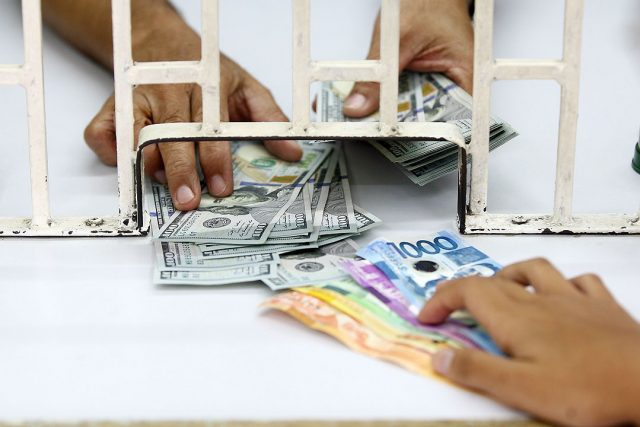
THE PESO appreciated against the dollar on Thursday after the US Federal Reserve kept rates unchanged at its policy meeting.

The local unit closed at P57.535 per dollar on Thursday, strengthening by 22.5 centavos from its P57.76 finish on Tuesday, Bankers Association of the Philippines data showed.

The peso opened Thursday’s session stronger at P57.70 against the dollar. Its intraday best was at P57.435, while its weakest showing was at P57.74 versus the greenback.

Dollars exchanged went down to $1.54 billion on Thursday from $1.89 billion on Tuesday.

“Following the Federal Reserve’s decision on Wednesday, which was perceived as dovish by investors, most Asian currencies, including the Philippine peso, strengthened against the dollar. This came after Fed Chair Jerome H. Powell dismissed the possibility of further rate hikes,” Security Bank Corp. Chief Economist Robert Dan J. Roces said in a Viber message.

The dollar was weaker across the board due to Mr. Powell’s comments after the Federal Open Market Committee’s meeting, Union Bank of the Philippines, Inc. Chief Economist Ruben Carlo O. Asuncion likewise said in a Viber message.

The dollar fell on Wednesday after the US Federal Reserve signaled it is still leaning toward eventual reductions in borrowing costs, but repeated that it wants to gain “greater confidence” that inflation will continue to fall before cutting rates, Reuters reported.

“In recent months, there has been a lack of further progress towards the Committee’s 2% inflation objective,” the Fed said in its statement.

The statement was largely as expected while Mr. Powell also said at a press conference that it is unlikely that the US central bank’s next move will be a hike, easing some concerns about the Fed potentially pivoting to a more hawkish stance.

The dollar index fell 0.44% to 105.85, after earlier reaching 106.49, the highest since April 16. A break above 106.51 would be the highest since early November.

For Friday, Mr. Asuncion said the market could continue to digest the Fed’s latest policy statement. He sees the peso moving from P57.20 to P57.80 per dollar, while Mr. Roces expects it to range from P57.40 to P57.80. A trader sees the peso moving between P57.35 and P57.70. — A.M.C. Sy with Reuters

Philippines again summons Chinese envoy over latest water cannon attack

PHILIPPINE COAST GUARD PHOTO

By John Victor D. Ordoñez, Reporter

THE PHILIPPINES on Thursday summoned China’s envoy to protest its coast guard’s use of water cannons that damaged two of Manila’s vessels in the South China Sea this week.

In a statement, the Department of Foreign Affairs (DFA) said it had also protested the harassment, ramming, shadowing and other “dangerous maneuvers of the Chinese maritime vessels against the Philippine Coast Guard” near the Scarborough Shoal.

“The Philippines demanded that Chinese vessels leave Bajo de Masinloc (Scarborough Shoal) and its vicinity immediately,” it said, citing the agency’s meeting with Zhou Zhiyong, deputy chief of mission of the Chinese Embassy in Manila.

The Chinese Embassy in Manila did not immediately reply to a Viber message seeking comment.

Philippine officials have said a PCG ship and a fishery vessel were damaged when Chinese coast guard vessels fired water cannons at them while on their way to the disputed Scarborough Shoal to help Filipino fishermen.

“The DFA should not bend down in calling the attention of the Chinese envoy in Manila every time they practice maritime coercion and unjust behavior to our Filipino coast guardians,” Chester B. Cabalza, founding president of Manila-based International Development and Security Cooperation, said in a Facebook Messenger chat.

“The Chinese envoy should be reminded to stop their aggressive water cannons in our rotation and reprovisioning missions since this is a routinary practice of our maritime law enforcers. We need to hear the justification of China to maintain our sound and unbiased judgment,” he added.

The Philippines should also use diplomatic dialogue to “showcase to the world how it handles China’s unacceptable hostility in our exclusive economic zone, Mr. Cabalza said.

Manila’s coast guard on Tuesday said two China Coast Guard ships had used jet stream water cannons against its vessel sailing some 1,000 yards away from the Scarborough Shoal, resulting in damage to its railing and canopy.

A Bureau of Fisheries and Aquatic Resources vessel’s electrical, navigation and radio systems were also damaged after being rammed thrice by Beijing’s coast guard vessels, it said.

On Tuesday, the PCG said its Chinese counterpart had installed a 380-meter floating barrier that “covers the entire entrance of the shoal.”

In March, Manila summoned the same envoy after the Chinese Coast Guard fired a water cannon at a Philippine resupply mission near Second Thomas Shoal, where Manila grounded a World War II-era ship in 1999 to assert its sovereignty.

The Philippines has filed 153 diplomatic protests against China under the Marcos administration, 20 in all this year, Philippine Foreign Affairs spokesperson Ma. Teresita C. Daza told reporters in a WhatsApp message.

The European Union, France, United Kingdom, Japan, Australia, Canada and Finland have expressed concern over the latest water cannon incident and other “dangerous maneuvers” by China in the waterway.

A spokesperson at the Chinese Embassy in Manila on Wednesday said Scarborough Shoal, which it calls Huangyan Dao, “has always been China’s territory” and urged the Philippines to “stop making infringement and provocations at once and not to challenge China’s resolve to defend our sovereignty.”

PCG spokesman Jay Tristan Tarriela told a news briefing on Wednesday that China has “elevated the tension and the level of their aggression” in the South China Sea after attacking Manila’s coast guard vessel.

“This is the first time that we can say that a coast guard vessel has been subjected to a direct water cannon with that kind of pressure that even resulted in structural damage,” he said, noting that “Goliath is becoming more Goliath.”

“They don’t hesitate to use brute force to violate international law,” he added.

Tensions between the two countries have worsened in the past year as China’s coast guard continues to block Philippine resupply missions to Second Thomas Shoal.

In 2016, a United Nations-backed tribunal in the Hague voided China’s expansive claims in the South China Sea. It also upheld the rights of small-scale Filipino and Chinese fishermen to fish at Scarborough Shoal.

The shoal is 240 kilometers west of the main Philippine island of Luzon and is nearly 900 kilometers from Hainan, the nearest major Chinese landmass.