Home Blog Page 2794

South America weather experts see La Nina, El Nino frequency rising

 – The climate phenomena known as El Nino and La Nina, which bring waves of heat, cold, rain or drought, will be more frequent and extreme in coming years, after South America suffered the most intense El Nino in decades, weather experts said on Thursday.

According to the Ecuador-based International Center for Research on the El Nino Phenomenon (CIIFEN) and the Peruvian meteorology and hydrology agency SENAMHI, the recent El Nino was among the five strongest since 1950.

“The pattern has changed a lot,” said Yolanda Gonzalez Hernandez, director of CIIFEN, at a press conference after a meeting of experts from the region in Lima on climate.

“Where before there was no significant impact of the El Nino phenomenon, now they are occurring with more intensity.”

Ms. Gonzalez said temperature changes from one to the other will be faster, with a La Nina expected for the second half of this year, replacing the El Nino that is starting to weaken.

El Nino and La Nina hit different parts of the world distinctly. In Latin America they have affected crops such as wheat, soy and corn, damaging regional economies often highly dependent on farming.

“We are permanently breaking records at the local, national and global level in temperature anomalies,” said Ms. Gonzalez.

Temperatures are estimated to be above normal in much of South America, although below normal on the coast of Ecuador, northern Peru, and southern Argentina and Chile.

With the recent El Nino, Peru had the warmest winter in the last 60 years, according to CIIFEN, while in Colombia, temperatures reached records in different parts of the country.

Argentina and Chile saw more rain, which in the former helped soy and corn production after a drought the year before. – Reuters

Indigenous people protest Brazil not protecting ancestral lands

STOCK PHOTO | Image by LhcCoutinho from Pixabay

 – Several thousand Indigenous demonstrators marched chanting to drum beats on Thursday to the seat of power in Brazil’s capital to protest against the government’s failure to protect their ancestral lands.

The annual event this year focused Indigenous anger over plans to build a railway to transport grain from farm states to Amazon ports for export that they fear will destroy the environment of tribal communities near the Tapajos river.

For a mock-up of the Ferrograo railway the marchers used a tractor-trailer truck dubbed the “Rails of Destruction” and painted with the names of multinational grain traders ADM, Bunge, LDC and Cargill.

“Ferrograo is the train of death, of deforestation,” said Alessandra Korap Munduruku, winner of the Goldman environmental prize. “The railroad is not going to carry people, as they claim, but grain production of international companies financing this project.”

Kleber Karipuna, head of Brazil’s largest Indigenous umbrella organization APIB, said the communities had not been consulted on the railway, whose announcement by the government has set off a wave of land grabbing along its planned path.

President Luiz Inacio Lula da Silva received a group of Indigenous leaders who led the march to a square located between the Planalto presidential palace and the Supreme Court.

Their main complaint was the failure of his government to deliver on promises to officially recognize Indigenous reservations that have completed the demarcation process establishing that they are ancestral lands. The recognition is vital to protect their territories from invasion by illegal loggers, wildcat gold miners and land grabbers at the front of an agricultural frontier that is expanding into the Amazon.

Lula’s minority government is also undecided on whether to approve the railway project that has strong backing from Brazil’s powerful farm lobby.

The farm caucus in Congress said it is pressing for the execution of a project that was first proposed in 2015 for a 950-km railway to carry soy from Mato Grosso state to the port of Miritituba on the Tapajos, an affluent of the Amazon river.

“We are in favor of Ferrograo, a federal government project of extreme importance for the shipment of grains,” the caucus said in a statement to Reuters. The railway will cut freight costs by 25% and release less CO² into the atmosphere that the trucks that currently carry the grain.

Indigenous leaders on Wednesday also urged the country’s Supreme Court to rule on a pending case on the fundamental right of their people to ancestral lands as established in the Constitution, a right that Congress has voted to limit in time.

They criticized lawmakers for advancing bills that would allow commercial agriculture and mining on reservation lands, which they fear will increase illegal logging and deforestation. – Reuters

CCIFP holds the 2024 edition of Tastin’ France Manila

Wines celebrate much more than their culture and history; they also allow people to connect and bond with each other. With what wine can do for people, the recent Tastin’ France Manila takes that to new heights by inviting wine & spirits producers and local importers, retailers, and distributors to participate in a business trade event last April 8, with relevant activities related to learning more about the wine and spirit industry. The event’s success is thanks to Team France Export through a collaboration between the French Chamber of Commerce in the Philippines and Business France.

From wine exhibitors producers in different regions of France, guests and attendees could enjoy a wide variety of wines at the trade event. Exhibitors include Loire Vins Domaine from Loire Valley; Alain Corcia and Domaine Gille from Bourgogne; Same River Twice Wines from Rhone Valley; Les Vins De Roquebrun, LGI Wines, Vignobles Vellas and Wines Tree; Vignobles Mauve & Co (Les Grand Châteaux) from Languedoc/Bordeaux; and Wines Overload, Les Petit Clos, ABK6 Cognac, and Godet Freres Cognac from multi-region.

The day started in the morning with a market presentation including a panel discussion with five invited speakers who gave relevant insights on the wine industry in the Philippines. The featured speakers had many things to share about as they had their specialties in the wine and spirit industry, which are the following: Julian Gagliardi, general manager of Happy Living; Jorinda Badilla-Flour, owner and sales director of Le Cellier French Wine Selection; Jean Philippe Guillot, general manager of the Philippines from A Wine Company (AWC) and Winedrop; Matthieu Gaillard, founder and partner of Manila-Wine; and Vincent Landais, owner of Dr. Wine.

After a filling lunch, the afternoon session was welcomed by Filipino attendees, with a record of more than 75 guests participating in the French wine trade delegation. With the whole afternoon dedicated to networking and building connections, with French wines and spirits of course, Tastin’ France Manila has achieved their mission of strengthening the connection of France and the Philippines together for this event.


Spotlight is BusinessWorld’s sponsored section that allows advertisers to amplify their brand and connect with BusinessWorld’s audience by publishing their stories on the BusinessWorld Web site. For more information, send an email to online@bworldonline.com.

Join us on Viber at https://bit.ly/3hv6bLA to get more updates and subscribe to BusinessWorld’s titles and get exclusive content through www.bworld-x.com.

Okada Manila hosts Barbie’s 65th anniversary celebration: A tribute to empowerment and dreams

Okada Manila is thrilled to announce an exceptional event celebrating the 65th Anniversary of Barbie, the quintessential icon of inspiration and empowerment across generations. Dubbed “Barbie 65th Anniversary – Inspiring Stories, Shaping the Future,” this grand celebration will unfold at Cove Manila from April 27 to June 2, 2024, commemorating Barbie’s profound influence on encouraging dreams and aspirations since her inception in 1959. This celebration is designed to bring together Barbie fans of all ages, highlighting her significant impact on culture and society.

Event Highlights

The Barbie 65th Anniversary celebration will see Cove Manila transformed into a colorful journey through Barbie’s storied history. Highlights include:

Barbie Interactive Tunnel (Crystal Pavilion): A spotlight feature where attendees can traverse Barbie’s iconic moments. It includes a beautifully lit Barbie acrylic logo with spaces for visitors to engage in activities such as sharing inspirational stories on a post-it note wall and expressing how Barbie has inspired their futures.

Barbie Dream Camper: For the first time ever, a life-sized Barbie open camper will be presented, divided into three play areas for an immersive experience into Barbie’s world.

Barbie Diorama: An extensive exhibition featuring over 130 Barbie Career Dolls from 1959 to the present day, showcasing the evolution of Barbie’s roles and professions.

Barbie Ice Cream Cart and Food Truck: Offering toys-inspired treats and actual food, creating a delightful experience for kids and families.

“You Can Be Anything” Pop-Up Booth: Lighted booths depicting various Barbie careers to inspire visitors about the endless possibilities they can achieve.

Barbie Activity Area and 65th Photo Op Box: An area dedicated to interactive activities including a diorama display, a free play table, and a TV for webisode playback. It also features a mini-mirror for kids’ selfies and an interactive wall where visitors can post their dreams.

The beach club of the iconic Cove Manila

Year-Round Family Getaway at Cove Manila

In addition to the Barbie celebration, Cove Manila continues to be a premier family destination throughout the year. Its 9,000-square-meter dome, equipped with temperature control and UV protection, offers a unique beach club experience right in the heart of the city. It’s the perfect year-round getaway for families seeking fun and relaxation.

Empowering the Next Generation

This event transcends mere nostalgia, aiming to inspire the next generation with interactive and engaging exhibits that encourage children to dream without limits.

“We are honored to host the 65th Anniversary of Barbie at Cove Manila, showcasing her lasting impact in empowering young minds to break traditional boundaries,” said Vikki Aquino, Director of Spas, Recreation, and Kids’ Club at Okada Manila. “We invite everyone to join us in this inspirational celebration.”

Moreover, the celebration includes a “Daycation” package, allowing guests to experience Barbie’s world firsthand, exploring her house and the myriad of careers she has represented over the years.

Mark your calendars for this memorable event at Cove Manila, Okada Manila, from April 27 to June 2, 2024. It’s an opportunity to honor Barbie’s enduring legacy and the unlimited possibilities she symbolizes. The ticket price for this once-in-a-lifetime event is PHP1,988, inclusive of a set meal, promising a celebration that will be both inspiring and fun.


Spotlight is BusinessWorld’s sponsored section that allows advertisers to amplify their brand and connect with BusinessWorld’s audience by publishing their stories on the BusinessWorld Web site. For more information, send an email to online@bworldonline.com.

Join us on Viber at https://bit.ly/3hv6bLA to get more updates and subscribe to BusinessWorld’s titles and get exclusive content through www.bworld-x.com.

Coal plant moratorium to stay — DoE

PIXABAY

By Ashley Erika O. Jose, Reporter

The Department of Energy (DoE) is maintaining a moratorium on the development of greenfield coal-fired power plants even as most hydropower plants are currently running on derated capacities, resulting in insufficient power supply affecting the main grids.

“The moratorium (stands, if the LNG or liquefied natural gas) power plants would have a higher degree of reliability, then the private sector may opt for that rather than put up coal plants,” Energy Secretary Raphael P.M. Lotilla said in a virtual press briefing on Thursday.

In 2020, the Energy department issued a moratorium on the development of new coal-fired power plants, as the country sought to reduce its dependence on coal.

Mr. Lotilla said the DoE sees no reason to lift the moratorium for now as more than 4,000 megawatts (MW) of power supply is expected to boost the country’s overall supply.

At least 4,164.92 MW of power projects are expected to come online this year, which are expected to boost the country’s overall power supply.

Broken down, 4,030 MW will be in Luzon, 80.25 MW are in Visayas and 52.50 MW are in Mindanao.

About 1,224.655 MW will begin operations within the second quarter, while 1,352.167 MW will go online in the third quarter and 1,571.154 MW by yearend.

At present, 161.20 MW of these committed projects are now in full commercial operation, while 835.888 MW are under the commissioning and testing stage.

The DoE said these power projects are a combination of both renewable energy and conventional power plants and even liquefied natural gas (LNG) powered plants.

The higher-than-expected temperatures this summer months caused hydropower plants to run on derated capacities, the Institute for Climate and Sustainable Cities (ICSC) said.

YELLOW ALERT

On Thursday, a yellow alert status was raised over the Luzon and Visayas power grids for the eighth time this month, the National Grid Corp. of the Philippines (NGCP) said.

The Energy department said yellow alert will continue affecting the country’s main grids until next month due to higher-than-expected temperatures and rising power demand.

According to the grid operator’s advisory, a yellow alert was raised over Luzon from 1-5 p.m and 7-11 p.m. as 19 power plants are still on forced outage while one power plant is running on derated capacity. This resulted in the unavailability of 1,424.3 MW to the grid.

Of the 19 power plants, NGCP said that four have been offline since last year, while three were on forced outage since January. Twelve plants have been on forced outage since April.

Yellow alerts are issued when the supply available to the grid falls below a designated safety threshold. If the supply-demand balance deteriorates further, a red alert is declared.

Luzon’s power demand on Thursday reached 13,941 MW against available capacity of 14,568 MW.

Visayas power grid was also placed under yellow alert from 1-4 p.m., 6-7 p.m., and 8-9 p.m. due to the unavailability of 670.8 MW to the grid.

A total of 24 power plants are offline in Visayas, while 12 are running on derated capacities.

Luningning G. Baltazar, assistant director of the DoE’s Electric Power Industry Management Bureau, said Luzon has already breached the projected peak demand for the year.

Data provided by the DoE showed Luzon hit a peak demand of 14,016 MW on Wednesday against a projected peak demand of 13,917 MW this year. Peak demand in Visayas and Mindanao on Wednesday hit 2,586 MW and 2,534 MW, respectively. Visayas and Mindanao have a projected peak demand of 2,891 MW and 2,584 MW, respectively, for the year.

Energy Undersecretary Rowena Cristina L. Guevara said more yellow alerts, and possibly red alerts are expected until May.

The Energy Regulatory Commission (ERC) said it has already called on six power generation companies to explain the recent power plant outages.

“The ERC expects to have preliminary findings by the first week of May to determine whether show cause orders need to be issued to the relevant stakeholders, in view of possible violations of outage allowances,” ERC said in a statement.

The power regulator declined to identify the six power generating plants as its investigation is still ongoing.

“The Commission is diligently studying additional measures we can put in place under this extraordinary increase in demand, as a result of the effects of El Niño, and unavailability of supply or reserves,” ERC Chairperson Monalisa C. Dimalanta said.

The ERC said it is also monitoring the price of the Wholesale Electricity Spot Market (WESM) as the spot market prices climbed 47% this week.

“While we are completing our investigation on the outages, we are not losing sight of the fact that consumers — households and businesses alike — will bear the brunt of unavailable supply and/or high WESM prices. That is why, early on, we have emphasized to distribution utilities the importance of contracting for power supply to at least avoid exposure to price spikes in the WESM,” Ms. Dimalanta said.

Last year, the ERC said it had imposed a total of P60 million worth of penalties against generation companies for breaching the allowable number of outage days.

Peso fall won’t spur rate hike yet, says Recto

BW FILE PHOTO

THE PHILIPPINE peso’s current slump is unlikely to prompt the central bank to raise its key interest rate from a 17-year high at this time, according to Finance Secretary Ralph G. Recto.

The Bangko Sentral ng Pilipinas’ (BSP) next policy move “will be dependent on inflation data,” Mr. Recto said in a mobile-phone reply to Bloomberg News. Asked if a rate hike is being considered as the local currency slipped to as low as P57.96 against the dollar on Thursday, Recto said: “For now, I don’t think so.”

The peso fell to a fresh 17-month low against the dollar, staying past the closely watched P57-level for the second week as central banks grapple with the outlook of higher-for-longer US rates and tensions in the Middle East.

Mr. Recto, one of seven members of the BSP’s monetary panel, is signaling patience, even after a resurgent dollar prompted its neighbor Indonesia on Wednesday to unexpectedly raise interest rate to defend its currency.

Aside from the exchange rate, inflation and economic growth will also weigh on the BSP’s next policy decision on May 16. Price gains accelerated for a second month in March, and BSP Governor Eli M. Remolona, Jr. sees rising risk that inflation may breach the central bank’s 2%-to-4% goal for a third straight year.

The BSP chief said last week that the central bank is still on course to cut rates later this year or in early-2025 despite the peso’s weakness.

National Economic and Development Authority (NEDA) Secretary Arsenio M. Balisacan on Thursday, meanwhile, said tight monetary policy could crimp growth, as he underscored the need for non-monetary measures to tame inflation.

“Even though interest rate hikes — a monetary policy tool utilized by the BSP — can decelerate inflation by discouraging consumption and investment activities, it may also dampen demand and reduce economic opportunities made available to Filipino workers,” Mr. Balisacan said in a statement that backs a plan to ease importation rule — Bloomberg

HSBC expects BSP to begin easing in Q4

Bangko Sentral ng Pilipinas main office in Manila. — BW FILE PHOTO

THE BANGKO SENTRAL ng Pilipinas (BSP) is expected to delay its policy easing as upside risks to inflation have worsened, but rate hikes are unlikely, HSBC Global Research said.

“The easing cycle may be delayed, but we don’t think there will be any rate hikes ahead with non-monetary policies at work,” HSBC economist for ASEAN (Association of Southeast Asian Nations) Aris D. Dacanay said in a report on Thursday.

HSBC said the central bank is expected to start easing with a 25-basis-point (bp) cut in the fourth quarter, later than its earlier forecast of rate cuts in the third quarter.

It now sees the benchmark rate falling to 6.25% by yearend from 5.75% previously.

“Nonetheless, we continue to expect the BSP to bring its policy rate down to as much as 5% by the end of 2025.”

The Monetary Board has hiked borrowing costs by 450 bps from May 2022 to October 2023, bringing the policy rate to a near 17-year high of 6.5%. The BSP stood pat for a fourth straight meeting in April.

Mr. Dacanay cited recent developments that have added to upside risks to the inflation outlook, such as volatile oil prices.

“Risks to inflation have risen over the past two weeks. Tensions in the Middle East have brought oil prices up, while global rice prices remain elevated,” he said.

HSBC also noted the dollar’s recent strength, coupled with sticky inflation in the United States, may push the US Federal Reserve to keep rates tight for longer.

BSP Governor Eli M. Remolona, Jr. earlier said that expectations of rate cut delays by the Fed have caused weakening in other currencies against the dollar, including the peso.

Fed Chairman Jerome H. Powell has said they might have to keep “restrictive” policy rates for longer amid persistent inflation in the US. Markets are now seeing the Fed cutting rates by September instead of initial expectations of June.

“Market players already expect headline inflation to breach the BSP’s 2-4% target band in the few months ahead due to base effects being unflattering,” HSBC added.

Inflation accelerated for a second straight month to 3.7% in March. This brought the first-quarter inflation average to 3.3%.

April inflation data will be released on May 7.

The BSP expects full-year inflation to settle at 3.8%. The central bank also earlier warned that inflation could overshoot the 2-4% target over the next two quarters amid persistent upside risks.

“To better support the peso and tighten one’s grip on inflation expectations, the BSP will likely stick to its word and begin its easing cycle late this year. And the BSP can easily do this with robust growth,” Mr. Dacanay added.

He also cited other macroeconomic indicators that give the BSP room to delay its easing, such as strong labor market conditions, faster credit growth, stable exports, and improved manufacturing.

“We also downplay the risk of further rate hikes. Although inflation risks have emerged in the form of high oil and rice prices, these risks are supply-side in nature,” HSBC said.

Mr. Dacanay said the most efficient way to mitigate the potential impact is through supply-side interventions.

Mr. Remolona earlier said that current policy settings are “already tight.” The central bank would only consider further tightening if inflation expectations are deanchored. — Luisa Maria Jacinta C. Jocson

NCR economic output grew by 4.9% in 2023

Buildings are seen from the Mabini Bridge in Manila, June 16, 2023. -- PHOTO BY MIGUEL DE GUZMAN, The Philippine Star

METRO MANILA’S economic output expanded by 4.9% in 2023, the slowest pace in two years, due to base effects and weaker output of key sectors, the Philippine Statistics Authority (PSA) said on Thursday.

Preliminary PSA data on the latest regional accounts showed that the National Capital Region’s (NCR) economic growth slowed sharply in 2023 from the 7.2% expansion in 2022.

This was Metro Manila’s weakest economic growth since the 4.4% print in 2021.

NCR growth was also slower than the Philippines’ 5.5% gross domestic product (GDP) print last year.

“NCR’s growth, although slower, was still in positive territory. An easing from the 2022 figure which reflected the economy’s reopening was only expected,” PSA-NCR Regional Director Paciano B. Dizon said during the briefing.

He also said that base effects are at work with the normalization of the post-pandemic boom becoming apparent in the 2023 GDP growth.

At constant 2018 prices, the economy of NCR amounted to P6.57 trillion last year, 5% higher than P6.27 trillion in 2022.

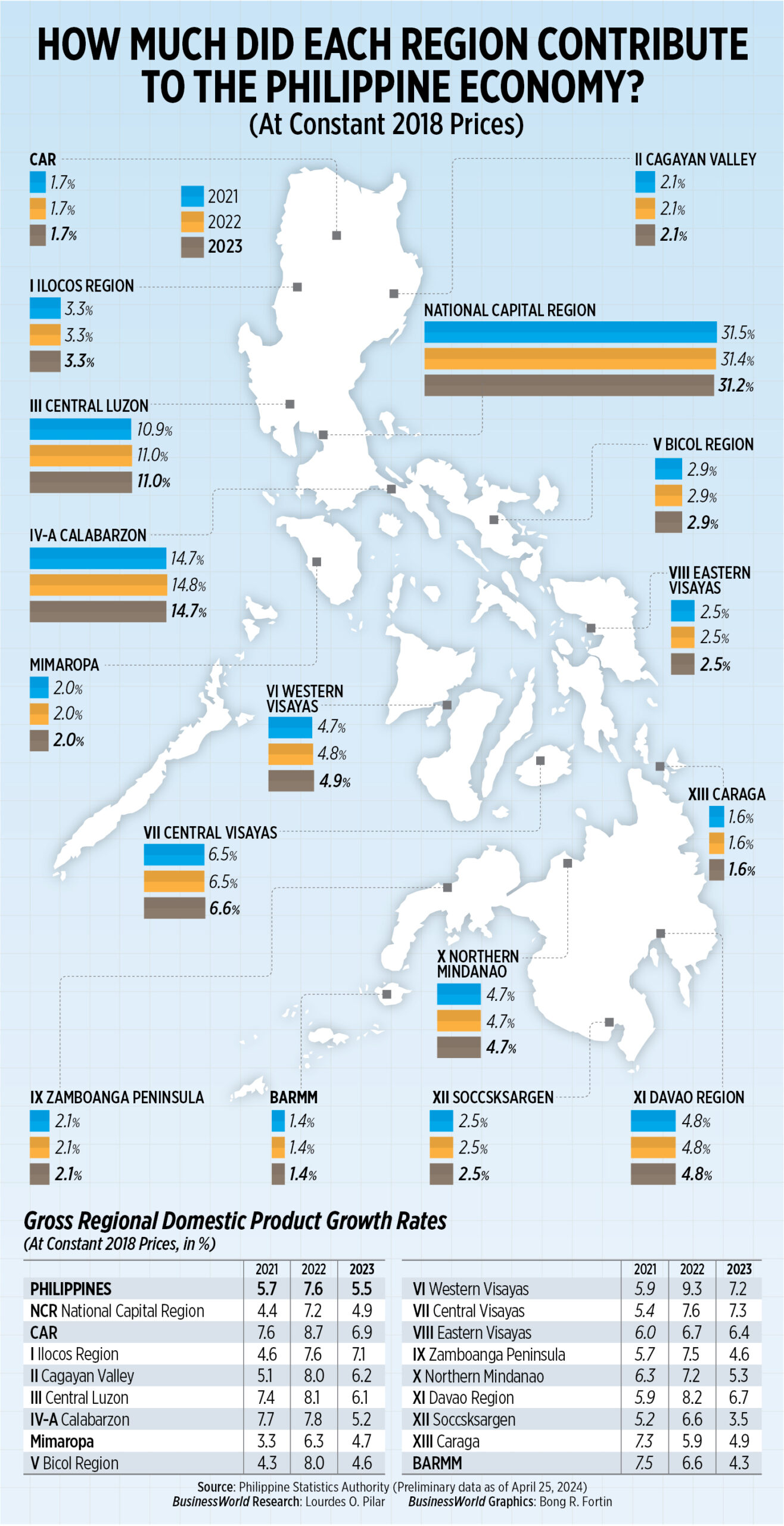
NCR contributed the largest share to the overall Philippine economy last year at 31.2%, followed by Calabarzon (14.7% share) and Central Luzon (11%).

All 17 regions posted growth in 2023, although slower than the prior year. Eight regions posted economic growth faster than the national average.

Central Visayas was the fastest-growing region at 7.3%, easing from 7.6% in 2022. This was followed by Western Visayas at 7.2% (from 9.3%) and Ilocos Region at 7.1% (from 7.6%).

Meanwhile, Soccsksargen recorded the slowest growth among the regions with 3.5% in 2023, from 6.6% in 2022. It was followed by the Bangsamoro Autonomous Region in Muslim Mindanao (4.3% from 6.6%), Bicol Region (4.6% from 8%), and Zamboanga Peninsula (4.6% from 7.5%).

Metro Manila’s economy was primarily driven by services, which accounted for 82.7% of its economy. Services increased by 5.7% last year, slowing from 8.2% in 2022.

Wholesale and retail trade, which accounted for more than a fourth of services, grew by 4.4% in 2023, slower than 7.2% in 2022.

Financial and insurance activities, which made up 24% of services, expanded by 8% last year versus 7.1% in 2022. Professional and business services growth slowed to 5.8% last year from 9.6% in 2022.

Meanwhile, industry, which accounted for 17.3% of the NCR economy, grew by 1.3% last year, slower than the 3.2% in 2022.

Agriculture, which accounted for 0.01% of NCR’s economy, was the only major sector that posted annual growth. Agriculture expanded by 5.4% in 2023 versus 3.5% in 2022.

“Contributing to [NCR’s] slowdown despite the country’s full reopening include inflationary pressures amidst high policy rate,” Security Bank Corp. Chief Economist Robert Dan J. Roces said in a Viber message.

The Monetary Board has hiked borrowing costs by 450 bps from May 2022 to October 2023, bringing the policy rate to a near 17-year high of 6.5% Headline inflation averaged 6% last year.

“The (NCR) growth is slower than what it should be due to the higher interest rates, volatility in the market, and supply chain constraints,” John Paolo R. Rivera, president and chief economist at Oikonomia Advisory & Research, Inc., said in a Viber message.

By sectoral output, Western Visayas had the quickest growth in services to 10.2% last year but slower than the 13% in 2022. It was followed by Cordillera Administrative Region (8.9% from 10.9%) and Mimaropa (8.8% from 11.7%).

Cagayan Valley led the industry sector with 8.5% growth last year, easing from 11.5% in 2022.

Central Visayas posted the fastest growth in agriculture output with 8%, reversing the 4.7% contraction of the previous year.

On the expenditure side, BARMM posted the highest growth in household spending (7.5% from 6.2%).

Government spending growth was the fastest in Northern Mindanao at 4.3% last year from 4.2%.

Western Visayas had the quickest expansion in gross capital formation, the investment component of the region’s economy, at 12.9% last year. This was still lower than the 14.8% in 2022.

NCR remained the largest gross regional domestic product (GRDP) on a per-capita basis at P460,969 last year, up by 3.8% from P443,976 figure in 2022.

“Looking ahead, the [NCR’s] GRDP is projected to pick up pace based on resilient commercial activities, increased public infrastructure spending, and the growth of digital financial services,” Mr. Roces said, “provided inflation is managed effectively.”

PSA will release April inflation data on May 7. — Andrea C. Abestano

Middle East tensions may impact OFW remittances, inflation

Analysts warned that oil prices may spike amid the unrest in the Middle East. -- REUTERS

By Luisa Maria Jacinta C. Jocson, Reporter

THE ONGOING Israel-Iran conflict may hurt remittances from Middle East-based overseas Filipino workers (OFWs), as well as increase volatility in oil prices that may stoke inflation, analysts said.

“This might be exacerbated by the potential effect on Filipino OFWs. While in the past, alternative jobs were explored by Filipino contract workers outside the war zone, still any serious outbreak of a war could definitely make a dent on workers’ remittances,” Diwa C. Guinigundo, country analyst for the Philippines of GlobalSource Partners, said in a Viber message.

“In turn, we might be looking at lower remittances, lower consumption expenditure and lower economic growth,” he added.

Markets were rattled after Iran launched hundreds of drones and missiles against Israel last week in retaliation for an alleged airstrike by Israel on the Iranian consulate in Syria earlier this month.

Remittances may be affected if the conflict intensifies and the government sees it necessary for OFWs to return home, Jonathan L. Ravelas, senior adviser at professional service firm Reyes Tacandong & Co., said in a phone call.

Latest data from the Department of Foreign Affairs showed that there are about 30,000 Filipinos in Israel and 2,000 in Iran.

Cash remittances in the first two months of the year rose by 2.8% to $5.48 billion, data from the central bank showed.

In the January-February period, Middle East countries were among the top sources of remittances.

Saudi Arabia was the third-highest source of overall remittances, equivalent to $307.981 million or 5.6% of the total. The United Arab Emirates also accounted for $206.29 million or 3.8% of remittances during the period.

Remittances from Israel stood at $24.402 million in the first two months of the year, inching down by 1.5% from the previous year. The BSP did not record any remittances from Iran.

RISING OIL PRICES

Analysts also warned that oil prices may spike amid the unrest in the Middle East.

“The escalation of tensions in the Middle East poses a threat to the Philippine economy in the form of higher oil prices. As the Philippines is a net oil importer, it is vulnerable to global oil spikes,” Sarah Tan, an economist from Moody’s Ana-lytics, said in an e-mail.

Iran, the third-largest producer among members of the Organization of the Petroleum Exporting Countries (OPEC), produces about 3 million barrels of oil per day (bpd). Iran’s output accounts for around 3% of total world output, Reuters re-ported.

Ms. Tan said that higher oil prices will add to energy and fuel costs, lifting the cost of production across the country.

“Rising oil prices due to geopolitical tensions pose a significant upside risk to the outlook on inflation as well as current account deficits in the Philippines,” Nomura Global Markets Research Chief ASEAN Economist Euben Para-cuelles said in an e-mail.

Mr. Guinigundo said the increase in petroleum prices will have “pervasive” effects on inflation, the peso and overall economic growth.

“Some observers even now are looking at a possible $100 per barrel in case of a more serious outbreak of war. Recall that in 2018 there was an unprecedented rise in oil prices that pushed inflation beyond 5%,” he said.

The Development Budget Coordination Committee (DBCC) adjusted the assumptions for Dubai crude oil to $70-$90 per barrel this year but kept the assumptions at $65-$85 per barrel from 2025 to 2028.

Ruben Carlo O. Asuncion, chief economist at Union Bank of the Philippines, Inc., said in a Viber message that if oil prices continue to be elevated, this will weigh on inflation.

“Indeed, the escalation of tensions threatens to derail the country’s already choppy progress on inflation,” Ms. Tan added.

Inflation accelerated for a second straight month to 3.7% in March from 3.4% in February.

Transport inflation rose to 2.1% in March from 1.2% in the previous month amid an increase in the prices of oil products.

The BSP said it expects inflation to temporarily overshoot the 2-4% target range over the next two quarters as upside risks remain. The central bank sees inflation averaging 3.8% this year.

“Any hit on the peso due to higher fuel imports could upset actual inflation and inflation expectations,” Mr. Guinigundo said.

The peso closed at P57.78 per dollar on Thursday, depreciating by 23 centavos from its P57.55 finish on Wednesday. This was its worst finish in more than 17 months or since its P58.19 a dollar close on Nov. 10, 2022.

“The BSP will likely become more vigilant of a scenario where headline inflation could breach its 2-4% for longer and the risk of further currency weakness given the double whammy from higher oil imports and a hawkish Fed,” Mr. Para-cuelles added.

‘MINIMAL IMPACT’

On the other hand, analysts said the spillovers from the geopolitical tensions may not be as severe, though the central bank will still need to remain vigilant about risks to inflation.

“The spillover effects will be minimal on the Philippine economy and on monetary policy making at the central bank,” Moody’s Analytics Chief Asia and Pacific (APAC) Economist Steve Cochrane said in an e-mail.

“It does, however, put the BSP on high alert regarding the evolving shape of the conflict in the Middle East, and other geopolitical risks such as China’s aggressiveness in the South China Sea,” he added.

Miguel Chanco, Pantheon Macroeconomics chief Emerging Asia economist, said that the potential spillovers to global oil prices seems “fairly contained” at the moment.

“But it’s obviously impossible to predict, and what’s undeniable is that the risk of much higher oil prices is more acute today than they were late last year,” he said in an email.

Mr. Cochrane also noted that the volatility in oil prices would subside since there was no “sharp response” from Iran.

Despite this, Mr. Cochrane said that the BSP will still need to remain cautious.

“The BSP will want to be sure that external sources of inflation, such as imported energy, do not generate upside pressure on prices. And with the US Federal Reserve appearing to be positioned to keep the Federal Funds Rate at its current cyclical peak for longer, the BSP will likely keep its policy rate unchanged for longer as well,” Mr. Cochrane said.

For Mr. Chanco, any further escalation that would lead to a material spike in global prices would have an impact on inflation in the Philippines, “likely keeping it stickier for a little longer and, by extension, preventing the BSP from considering monetary policy easing in the foreseeable future.”

Analysts said that the Philippine central bank will likely extend its policy pause if upside inflation risks remain.

“It is clear that the BSP is in a waiting game. Until inflation stabilizes firmly within the BSP’s 2-4% target range, BSP will stand pat. Should it take longer than earlier anticipated, this will push back the prospect of rate cuts and see the BSP delay monetary easing,” Ms. Tan said.

The central bank stood pat for a fourth straight meeting in April, keeping its benchmark rate at a near 17-year high of 6.5%.

“My baseline remains at this stage that the BSP’s cutting cycle starts only in October, but clearly this could easily be delayed,” Mr. Paracuelles said.

BSP Governor Eli M. Remolona, Jr. said that the central bank may postpone policy easing as late as the first quarter of 2025 if macroeconomic conditions worsen.


PHL’s ongoing transition to a cashless society

Photo from freepik/macrovector

In a country with strong digital presence, many Filipinos has adopted digitalization into their lifestyles. An apparent evidence of this is the growing adoption of digital payments among individuals and businesses, which is paving the way towards a cashless society.

Aiming for the country’s transition towards a “cash-lite” society, the Bangko Sentral ng Pilipinas (BSP) has effectively been shifting retail payments to digital channels, paving the way for more businesses to join the new revolution of digital payment and banking. Cashless payments, which include cards, mobile wallets, and QR codes, are continuing to play a significant role in the growth of digital payments in the country.

BSP Deputy Governor Mamerto E. Tangonan previously noted that the use of digital payments has reached its peak during and after the coronavirus disease 2019 (COVID-19) pandemic. He noted that digital retail payments began with 1% in 2013, then jumped to a 42.1% share in 2022, and finally hit the 50% mark in 2023.

In 2022, the BSP reported that the total transaction volume reached 4.85 billion, with 2.04 billion done through digital platforms. The report also said the main driving forces behind this growth were merchant payments, person-to-person transfers, salaries, and wage payments.

Adding to this is a recent study by Visa, which showed most Filipinos are not only familiar with contactless cards but also using them for transactions. The data indicated that digital payments are gaining reaction across different age groups, with 55% utilizing QR codes and 32% opting for contactless cards.

Looking at these numbers, the progress of digital payments in the country is looking positive, opening opportunities for easier access to financial services.

Global management consulting firm McKinsey & Company said that the rise of digital financial services and mobile wallets are leading the way to such success. With the whole buzz of fintech innovation, industry players are moving quickly to bring digital banking and services across sectors, especially in rural areas and sectors that are often overlooked, where accessing financial services can be a struggle.

McKinsey highlighted that the country’s banking population is expected to reach 85 million by 2030, showing a significant 30% increase from 65 million in 2022. This growth is fueled by the tech-savvy customer base, who are actively seeking out innovative financial services.

Photo from unsplash/David Dvořáček

Moreover, according to Visa’s recent study, younger generations are the ones driving the growth of cashless or digital payment in the country. The data revealed that mobile wallets are on the lead, being used in 87% of transactions, while contactless payments accounted for 70% of the transactions. The study also showed that 78% of mobile wallet users scan through QR codes, whereas 38% pay through QR codes.

Going cashless is not only convenient for local transactions, but also for making purchases abroad. To ensure a hassle-free trip, for instance, many Filipinos opt for digital payment or cashless transactions. Visa has reported that 55% of Filipino consumers use cashless payment; and now, QR codes are catching the eye of Filipinos, even while traveling.

The trend of using contactless payments in transactions and in-stores has resulted in a significant number of Filipinos (43%) carrying less cash in their wallets as most establishment and services are the leading users of digital payment in recent years.

To accelerate the adoption of digital payments in the country, initiatives from the public sector are seen. Bills Pay PH, for instance, is a simplified platform which allows users to pay their bills. This initiative caters to all Filipinos, improving access to financial services more conveniently. QR PH, a national standard for quick response codes, enables merchants and consumers to carry out digital transactions smoothly and conveniently. In addition, Paleng-QR PH program maximizes the use of QR codes as digital payments in public markets and tricycle hubs.

Boost from digital banks

With such strides taken towards digitalizing payments and transactions over the years, gone indeed are the days of carrying around wads of cash as Filipino consumers are fully embracing the cashless society. And digital banks are seen to be further pushing this transition forward.

At the BSP’s recent 5th Regional Macroeconomic Conference Series, Maria Lourdes Jocelyn S. Pineda, vice-president of the Digital Bank Association of the Philippines, stressed that going digital is necessary for the sector, especially as the country fully embraces digital transactions.

Following the increased use of digital payments in recent years, the BSP announced digital banking as a new banking category. Thanks to its easy-to-use features, 24/7 operations, and higher interest rates, digital banking is setting a new standard for banking in the digital age. The country currently has six BSP-licensed digital banks, namely Maya Bank, GoTyme, Overseas Filipino Bank, Tonik Bank, UnionDigital and UNOBank.

With technology being at the core of digital banks, cybersecurity measures are essential to protecting consumers. To do this, digital banks have made strides in strengthening their cybersecurity practices, risk management, and policies. Due to these advancements, digital banks can expect a significant increase in their loan books this year.

“We are always vigilant, and we invest heavily on technology because we can’t afford to commit mistakes,” Ms. Pineda said.

The cashless landscape will indeed continue, as more Filipinos are shifting to cashless payments and industry players are feeling optimistic about it.

“Filipinos are becoming more comfortable with cashless payments, and we are confident that they will continue to embrace new innovations in the digital payment landscape,” Jeff Navarro, country manager for Visa, said in an article on Visa’s website discussing the rise of cashless transactions. — Angela Kiara S. Brillantes

Megaworld targets to open P1.2-B Mactan World Museum by 2027

TAN-LED property developer Megaworld Corp. said it is building a P1.2-billion modern museum inside its 30-hectare The Mactan Newtown in Lapu-Lapu City, Cebu.

The company aims to complete and open the Mactan World Museum by 2027, Megaworld said in a statement to the stock exchange on Thursday.

The museum will be built along Newtown Boulevard, right in front of Megaworld’s 8 Newtown Boulevard residential condominium.

It will display a collection of historic artifacts curated by Dannie Alvarez, president of the Alliance of Greater Manila Museums, Inc. and former head of the Committee on Museums of the National Commission for Culture and the Arts, the company said.

“The museum will lend a visual retelling of the travel and arrival of Portuguese explorer Ferdinand Magellan and his crew in Mactan, his defeat against fearless tribal leader Lapu-Lapu, and the Hispanic heritage of the Manila Galleon trade,” Megaworld noted.

“The museum will feature five main exhibit galleries on the second-floor showcasing collections, artifacts, replica mementos, and interactive virtual displays related to various influences and historical events between the Philippines and Spain. These subjects include Spain’s quest for spices, the Kingdom of Sugbu, Magellan’s early expeditions, and the Battle of Mactan, among others,” it added.

It will also feature two performance halls: Flamenco Studio and a Multimedia Room. These can be combined into one main hall, accommodating approximately 270 people.

Additionally, Megaworld said that the Mactan World Museum will offer various activities centered on Filipino-Spanish traditions and culture. These activities include a seasonal bazaar showcasing Cebu’s main delicacies, a guitar-making and retail area, and a self-operated Filipino-themed photo studio.

“It has always been part of our townships’ mission and identity to celebrate the arts, culture, and heritage of every location where we are present. We are excited to bring our plans to fruition for the Mactan World Museum here in Lapu-Lapu City, a destination that plays a big historical significance as far as the Philippines-Spanish heritage is concerned,” Megaworld Lifestyle Malls Head Graham M. Coates said.

“Being at the center of The Mactan Newtown, this museum will provide locals and tourists with a creative avenue to connect, share interests as a community, expand knowledge, and form a deeper appreciation not only for Mactan but also for our nation’s history,” he added.

In addition to the museum, the Mactan Township will include the two-level Mactan Expo Center.

The township features various properties, including the 547-room Savoy Hotel Mactan Newtown, the 550-room Belmont Hotel Mactan, and the Mactan Newtown Beach.

It also includes residential condominium developments, office towers, schools such as the Newtown School of Excellence, retail shops, service outlets, and restaurants.

On Thursday, Megaworld shares went down by 0.56% or one centavo to P1.79 apiece. — Revin Mikhael D. Ochave

Megawide bags contract to build Landers Aseana City

SAAVEDRA-LED Megawide Construction Corp. has secured the contract to build a new Landers Store in Aseana Business Park, Parañaque City.

Landers Aseana is an 18,710.91 square meter development, with construction expected to be finished by March 2025, Megawide said in an e-mailed statement on Thursday.

The ceremonial concrete pouring for project was done on March 20.

Landers Aseana will be Megawide’s fifth project for the Landers brand with Southeast Asia Retail, Inc. (SEARI), following other outlets in Alabang, Muntinlupa City; Balintawak, Quezon City; Arcovia, Pasig City; and Otis, Manila.

“Our foray into these kinds of modern, designed-for-convenience facilities showcases the breadth of our portfolio and our long experience in the commercial segment,” said Megawide Construction Chief Operating Officer Frederick T. Tan.

Megawide said the project will be constructed using the company’s proprietary brand of precast technology, composed of up to 80% precast materials including half slabs, footing tie and intermediate beams, girders, columns, and retaining walls.

The proportion marks an increase from previous builds, where only 20% precast was incorporated, the company said.

“Precast will be vital to meet SEARI’s requirement for a December 2024 soft launch of its newest branch, in time for this year’s Yuletide season. Facilitating a shorter timetable will significantly enhance our brands,” Mr. Tan said.

Megawide returned to profitability, logging a consolidated net income of P269 million in 2023, compared to the P1.87 billion net loss the prior year. The company’s consolidated revenue surged by 26% to P18.6 billion.

On Thursday, Megawide shares dropped by 1.02% or three centavos to P2.90 per share. — Revin Mikhael D. Ochave