LONDON — A new episode of the Beatles Anthology, 30 years after the original landmark series, shows the impact on Paul McCartney, George Harrison, and Ringo Starr of being in the biggest rock band in history, its writer and director said.
The original eight-part documentary, broadcast in 1995, spanned the band’s gritty early days in Liverpool and Hamburg to the phenomenon of Beatlemania and global superstardom and the break-up in 1970.
The Anthology project included the single “Free as a Bird,” created in the 1990s from a demo recorded by John Lennon in 1977, three years before he was murdered.
The remastered series, with a ninth episode including unseen 1990s footage of Messrs.McCartney, Harrison and Starr, debuts on Disney+ on Wednesday.
“The new episode is untethered from the chronology of the original episodes,” writer and director Oliver Murray said.
“One to eight is the literal birth of the Beatles through to their break-up in 1970, and episode nine is able to speak to the inward-looking sense of what it was like to be a Beatle.”
The film was restored by an Apple Corp. production team working with Peter Jackson’s Park Road Post company in New Zealand, with technology Jackson used to make The Beatles: Get Back documentary, which premiered in 2021.
“The whole of the Beatles archive has been restored and is now digital,” Mr. Murray said. “Every time we went into the edit suite it was almost like stepping back in time to the mid-’90s.”
He said Mr. Jackson’s documentary changed the mythology of the Beatles, which until then had been etched in stone.
“What Get Back did was break down those stereotypes, and we see them more as very young men,” he said.
The new episode gives fans an opportunity to learn about the band from scratch, with an understanding of who they were as people, he said.
“The reason that the Beatles story still resonates is because it’s 20th century folklore,” he said.
“It is a timeless story of some lads from Liverpool who share a dream and go on to conquer the world.” — Reuters
MEGAWORLD CORP.’S hospitality unit has teamed up with French hotel operator Accor SA to rebrand the Grand Westside Hotel in Parañaque City as the world’s biggest Mövenpick property, the listed developer said on Thursday.
The 19-story, two-tower property within Megaworld’s 31-hectare Westside City township is set to open as Mövenpick Manila Bay Westside by late 2026, the listed property developer said in a disclosure.
The deal with Megaworld Hotels & Resorts includes brand alignment, system integration and operational upgrades to the existing hotel.
“This landmark hotel reflects our shared ambition to bring elevated, experience-driven hospitality to one of the country’s most dynamic destinations,” Garth Simmons, Accor’s chief operating officer for Asia’s premium, midscale and economy brands, said in a statement.
The move follows Accor’s conversion of Belmont Hotel Mactan into Mercure Mactan Cebu, as the French operator continues to strengthen its footprint in the Southeast Asian hospitality market.
The property will feature four specialty food and beverage outlets, a pool deck overlooking Manila Bay and a sky bridge linking it to the Westside City Integrated Casino and Entertainment Complex and the Grand Opera House.
Accor, which operates about 45 brands globally — including Fairmont, Raffles, Pullman, Mercure and ibis Styles — is expanding in the Philippines with hotels in Manila, Makati, Mandaluyong, Clark, Boracay, Panglao and Cebu City. The company sees opportunities in growing domestic travel and rising visitor arrivals.
Megaworld Hotels & Resorts manages 15 properties with a total of 7,000 rooms. The company posted a P5.23-billion net income in the third quarter, up 1.16% from a year earlier.
“Mövenpick Manila Bay Westside will benefit from Accor’s proven operational prowess, incorporating their superior guest service protocols and powerful global reservation system, while allowing the hotel to retain and amplify the beloved, local-inspired Sampaguita brand of hospitality unique to Megaworld Hotels & Resorts,” Megaworld said.
Megaworld shares rose 0.5% or a centavo to close at P2.02 each. — Beatriz Marie D. Cruz
CARD PAYMENTS in the Philippines are expected to grow to P4.2 trillion this year, driven by sustained financial inclusion efforts and improved infrastructure, according to GlobalData’s Payment Cards Analytics.
The total card payment value in the Philippines is seen rising by 18.8% to reach P4.2 trillion ($72 billion) this year from P3.5 trillion ($61 billion) in 2024, the data and analytics company said.
However, this pace would be slower than the 20.5% increase last year.
“Card payments in the Philippines are expanding from a relatively low base, supported by a rising banked population, targeted financial inclusion policies, and a steady build out of acceptance infrastructure,” GlobalData Lead Banking and Payments Analyst Ravi Sharma said in a statement on Thursday.
GlobalData said the transaction growth is being driven by the introduction of basic deposit accounts, the emergence of digital or digital-centric banks, and the rise of electronic payments.
“Regulatory initiatives from Bangko Sentral ng Pilipinas (BSP), including the National Strategy for Financial Inclusion 2022-2028, are reinforcing consumer trust in formal financial services while nudging both individuals and merchants towards greater card usage. As cards become more widely issued and accepted, they are steadily capturing share from cash in both physical and remote commerce,” Mr. Sharma added.
Most of the expected total card spending comes from credit and charge cards at 64.9% despite the low penetration rate.
“This is largely due to the compelling value-added propositions such as rewards, cashback, air miles, and merchant discounts, which encourage cardholders to route high ticket and discretionary spending through credit lines rather than debit.”
Based on BSP data, banks’ credit card receivables were at P1.04 trillion at end-June 2025, up from P791.18 billion a year prior.
Meanwhile, the remaining 35.1% of the total expected card payment value this year comes from debit cards, which GlobalData said is driven by increased bank accounts and financial access points. In particular, it cited the BSP’s move to introduce basic deposit accounts, which have simplified requirements and no minimum balance or fees.
“Beyond card issuance, several factors are reinforcing the shift to card payments. The acceptance network is steadily expanding. However, high POS (point of sale) installation costs and merchant service fees continue to constrain uptake among small merchants. To mitigate this, providers are rolling out more economical mobile POS and SoftPOS offerings,” it said.
Moving forward, Mr. Sharma said card payments in the Philippines are forecasted to almost double between 2024 and 2029 as more Filipinos become part of the formal financial system, with credit card ownership likely to rise as banks roll out promos to expand their consumer segments.
The expansion of POS and low-cost acceptance solutions could also drive growth in card transactions, he said.
“Although annual growth is expected to slow from 18.8% in 2025 to 12.2% by 2029 as the market matures, the structural shift from cash to cards will keep the Philippines among the faster growing card payment markets in the region.”
Based on data from the World Bank Findex, 8.1% of Filipino adults owned a credit card in 2021, up from 1.9% in 2017. Meanwhile, debit card ownership was at 29.8% in the same year from 21% previously.
Meanwhile, The Global Findex Database 2025 report showed that 50.2% of approximately 82 million Filipinos aged 15 years old and above had financial accounts in 2024, lower than the 51.4% recorded in 2021 but higher than 26.6% in 2011.
The data showed that 33.5% of Filipino adults had accounts with banks or similar formal financial institutions, while 28.8% had mobile money accounts. Some 32.7% said they had digitally enabled accounts, or those used with a card or phone.
In 2024, online payments made up 57.4% of retail transactions by volume and 59% by value, according to the BSP’s 2024 Status of Digital Payments in the Philippines report. These were up from 52.8% and 55.3%, respectively, in 2023. — A.M.C. Sy
CEBU-BASED Vivant Corp. has obtained a P3-billion three-year term loan from China Banking Corp. (Chinabank) to refinance maturing debt and support its power and water projects, the company said on Thursday.
Vivant, which operates in power generation, distribution and retail electricity, is also expanding into water supply, wastewater treatment and desalination.
Its projects include a 6-megawatt (MW) hydropower plant in Negros Occidental, a 15-MW bunker-fired plant in Pampanga, a 22-MW solar project in Bulacan, a 206-MW wind farm in Northern Samar and a P2-billion desalination plant in Cordova, Cebu.
For the nine months ending September, Vivant reported a 12% rise in net income to P1.9 billion, boosted by strong electricity trading margins.
Vivant Chief Executive Officer Arlo G. Sarmiento said the company expects a strong year-end performance, aided by a recent acquisition of a minority stake in a Bataan solar plant.
Vivant shares closed at P18.46, unchanged from Wednesday. — Sheldeen Joy Talavera
LOS ANGELES — For Oscar-winning actor Ke Huy Quan, Disney’s animated buddy cop comedy, Zootopia 2, has a healthy message about the importance of confiding in others for emotional support.
Mr. Quan, who voices Gary De’Snake — a pit viper determined to help his family — told Reuters, “I grew up in a very traditional Chinese family and was taught to really internalize a lot of my feelings and not share them.”
However, the Everything Everywhere All at Once actor added that it’s unhealthy to keep emotions bottled up.
For him, the sequel creates an avenue for people to explore the importance of sharing their experiences to foster empathy.
Zootopia 2 continues the story of the highly acclaimed 2016 film Zootopia, which follows rookie police officer rabbit Judy Hopps, voiced by Ginnifer Goodwin, and the con artist fox named Nick Wilde, voiced by Jason Bateman, as the unlikely pair team up to investigate the disappearance of predator animals.
The sequel picks up where the first film left off, quickly sending Judy and Nick on their latest adventure to uncover the truth surrounding the new reptilian character, Gary De’Snake.
The second installment is co-directed by Byron Howard and Jared Bush, who also worked on the first film.
The voice cast includes actor Idris Elba as Chief Bogo, the Zootopia police chief, singer Shakira as the pop star gazelle named Gazelle, and newcomers Patrick Warburton as Mayor Brian Winddancer, a stallion, and Fortune Feimster as the beaver named Nibbles Maplestick.
In Zootopia 2, Judy, the overachieving bunny, and Nick, the laidback fox, must come to terms with their differences to become a stronger team.
For Mr. Bateman, the core of what the movie is conveying is that “differences can be a plus” for those who have the courage and curiosity to be with someone unlike themselves.
Echoing Mr. Bateman, Mr. Howard felt that Judy and Nick needed to show both the pros and cons of a new professional partnership.
“Nick and Judy needed to be at the center of this film,” he said.
“There are new things to get used to. There’s different baggage that you’re each carrying from your upbringing,” he added.
Mirroring his own real-life collaboration with others to create the film, Mr. Howard said that “each of us has superpowers.”
However, several characters do have to be vulnerable to communicate their needs before coming together, which is something that Ms. Feimster thought was timely for the audiences who watch the film.
“I think we should be entering into a time where it’s considered a positive thing to say how you feel and to be more in touch with your feelings because, why not? The antithesis of that is so much pent up aggression,” the comedian said.
Zootopia 2 is now out on Philippine cinemas. — Reuters
THE USE of artificial intelligence (AI) in lending processes could accelerate Philippine banks’ credit growth to 15-18%, according to financial technology (fintech) company Intellect Design Arena Ltd.
Bank lending growth could pick up as banks address bottlenecks in the lending process with the use of AI, Intellect Design Arena Executive Vice President Lending Head Brajesh Khandelwal said in a group interview on Thursday.
“See, the way it would happen is the market as a whole might take some time, but the banks who adopt the AI-based lending practices, they reimagine the lending with artificial intelligence, with the enterprise-grade AI platform, and carefully design their workflows using AI. They would be able to command the growth and others will follow,” he said.
“As a market, there is a potential. It all depends upon how banks are adopting the AI, how they are choosing the right platforms, how they are managing the change.”
As of September, bank lending grew by 10.5% to P13.704 trillion from P12.401 trillion a year earlier, preliminary Bangko Sentral ng Pilipinas (BSP) data showed.
This eased from the 11.2% annual increase in August and was the slowest in 14 months or since the 10.4% seen in July 2024.
With this current trend, Mr. Khandelwal said there “huge potential” for growth in the credit gap seen for micro, small, and medium enterprises (MSMEs), which is largely due to slow loan processing and management.
“The time of getting the loan goes for days and sometimes several weeks as well. So, we do see a huge potential for improvement in the productivity, in the efficiency and making the banks more competitive in the region.”
Banks can also use AI to manage loan repayments, he added.
“I think that governance is very important because growth without that guardrail is not going to work at all. It will not sustain. For the growth to sustain, nonperforming loans have to be in the manageable range.”
As banks adopt AI, guidelines that focus on personal data protection and transparency should be implemented as Philippine institutions remain in the experimental stage compared to their peers in the region, he said.
“There is an expectation of non-bias when you implement an AI-based model. It should not be biased. Then there is always the expectation of a human in-look. While AI can do a job to an extent, then there has to be a right strategy to decide where the human will be brought in the loop.” — Aaron Michael C. Sy
INTERNATIONAL Container Terminal Services, Inc. (ICTSI) is set to assume full operations of the North Pier at Batu Ampar Port in Indonesia by Dec. 1 through its unit Batu Ampar Container Terminal (BACT).
In a statement on Thursday, ICTSI said BACT, Interport Mandiri Utama and PT Batam Terminal Petikemas were designated as the sole operators of the North Pier, giving them full management rights and responsibilities. The move is part of Batu Ampar’s broader plan to transform itself into a modern, competitive international port.
“Starting Dec. 1, BACT and Batam Terminal Petikemas will officially operate as the single port operator of Batu Ampar Port’s North Pier, supporting Batu Ampar’s transformation into a modern and competitive international port,” BP Batam Port Management Director Benny Syahroni said.
The North Pier, a modern facility designed to handle high-volume cargo, has an annual capacity of 900,000 twenty-foot equivalent units (TEU). It is equipped with five quay cranes, 12 rubber-tired gantry cranes and 10 electric terminal trucks, with the fleet set to expand to 25 units.
ICTSI said the single-operator model is expected to boost operational efficiency, shorten vessel turnaround time and enhance overall service reliability.
BACT Chief Executive Officer Hsin Kai Huang said the company is committed to developing a highly skilled local workforce aligned with ICTSI Group standards to support performance and operational excellence.
ICTSI got a 30-year contract in August with state-backed PT Batam Terminal Petikemas to develop and operate Batu Ampar Container Terminal under a 75/25 joint venture with Interport.
For the third quarter, ICTSI posted an attributable net income of $267.72 million, up 26.27% from a year earlier, driven by higher cargo volumes and improved port revenues. Total revenues for the three months ended September rose 20% to $827.74 million, even as gross expenses climbed 13% to $356.61 million.
Shares of ICTSI fell 1.8% or P10 to close at P546 each on the local bourse. — Ashley Erika O. Jose
LONDON — The natural history program Prehistoric Planet returns for a third series on Wednesday, bringing back to life the animals of the Ice Age.
From woolly mammoths to diprotodons — rhino-sized relatives of wombats — Prehistoric Planet: Ice Age follows creatures roaming Earth millions of years after the extinction of the dinosaurs, the focus of the Apple TV+ series’ first two seasons.
Presented using scientific knowledge and stunning visual effects, snow sloths and saber-toothed cats are among the species seen in the five-part series, narrated by actor Tom Hiddleston.
In an interview with Reuters, executive producer Mike Gunton, creative director of the Natural History Unit at Britain’s BBC, and chief scientific consultant Darren Naish spoke about making the show. Below are excerpts edited for length and clarity.
Q: What can audiences expect?
Gunton: When we finished the second series… it struck me the other great time in Earth’s history, when there was a lot of turmoil, a lot of extraordinary animals … was the Ice Age. It’s always been a personal favorite of mine because I just think it’s so romantic.
Q: How does scientific understanding of these animals help bring to screen?
Naish: On the one hand, they’re unfamiliar… on the other hand, mammoths are a kind of elephant and saber-toothed cats are obviously cats. So these are animals that nearly everybody knows quite well. That makes it even more of a challenge to get them absolutely right… this enormous challenge that the team building them and bringing them to life had to face in terms of… how their tissues moved and what their fur is like. Massive challenge.
And a key decision behind the making of the series is this is the golden age in terms of our understanding of these animals for reasons relating to climate change. We are learning a lot more about bodies preserved in the permafrost of Siberia and Alaska.
Q: How does doing this compare to filming real wildlife?
Gunton: We use a lot of the experience of how we film real animals, both the grammar of it, the narrative of it, the emotional connections of it. Those are the parameters by which we do this, because in a VFX world you can do anything, you can put a camera anywhere, you can tell any story you like, you’re limited by imagination. We have said, “no, you must not do that,” because then it is inauthentic. All the stories have to feel they are based in science, but also they’re informed by what we… have seen in the natural world today… and that also is replicated in the photography.
Q: What is the biggest misconception about the Ice Age?
Naish: When people hear of the Ice Age, they imagine pole-to-pole everywhere is snowy; whereas of course, in fact, the ice caps at the north and south were much bigger. So northern North America, northern Eurasia was covered in ice sheets … but further south, the tropics, they were still tropical. — Reuters
Representatives from Coca-Cola Foundation Philippines (CCFPI), Central Philippine University (CPU), and the Iloilo City Government attended the orientation session for the new Solid Waste Management Information System (SWM-IS) under Project AGUBAY.
According to the City Environment Office (CENRO), Iloilo City, home to nearly half a million residents, faces a growing waste crisis, generating more than 314 metric tons of waste daily — nearly 40% of which is plastic1. To address this urgent challenge, Coca-Cola Foundation Philippines, Inc. (CCFPI),Central Philippine University (CPU), and the Iloilo City Government have launched Project AGUBAY, a first of its kind data-driven Solid Waste Management Information System (SWM-IS) covering 180 barangays.
The project’s name, AGUBAY — derived from the Ilonggo word meaning “to support, to guide, to help” — also stands for Awareness, Guidance, Unity, Biodiversity, Action, and Yield. This reflects its mission of empowering communities with tools and knowledge to create more sustainable waste solutions.
Addressing Iloilo City’s waste challenge
Iloilo City’s waterways and coastal areas have long been vulnerable to plastic pollution, worsened by the surge in single-use plastics during the COVID-19 pandemic. With nearly half a million residents across 180 barangays, including 26 situated in riverine and coastal areas, inefficient collection systems and non-functional material recovery facilities (MRFs) have left waterways vulnerable to pollution.
“This project aims to ensure no barangay is left behind in the city’s fight against waste,” said Cecile Alcantara, President of Coca-Cola Foundation Philippines, Inc. “By investing in digital tools and community empowerment, Project AGUBAY shows how collaboration between business, academia, and local government can turn sustainability goals into real, on-the-ground progress.”
Smarter, Faster Waste Solutions
At the heart of Project AGUBAY is the Solid Waste Management Information System (SWM-IS) — a centralized digital platform that generates real-time reports to help barangays and the city government:
Formulate and update Barangay Ecological Solid Waste Management (BESWM) Programs in 152 barangays.
Build a centralized SWM database for stronger city-wide monitoring and governance.
Deploy Barangay Material Recovery System (BMRS) equipment to improve segregation, collection, and diversion.
Train barangay leaders and city stakeholders in implementing sustainable waste solutions.
“Each barangay has unique waste challenges. With real-time data, we can design solutions that truly fit community needs — saving time, resources, and strengthening accountability,” said Dr. Mary O’ Penetrante, Project Team Lead from CPU.
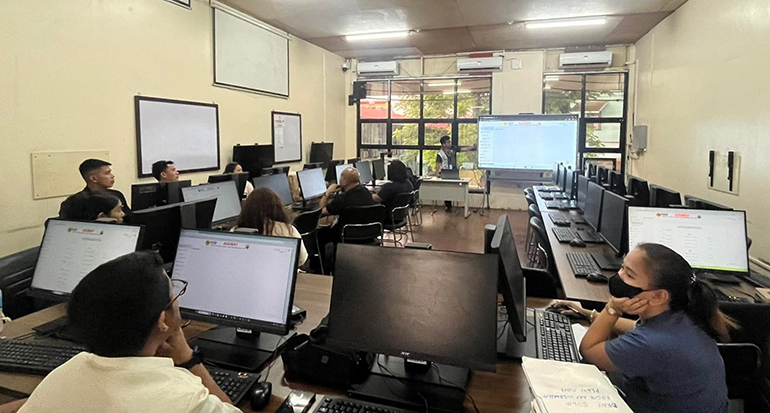
Barangay officials from Iloilo City undergo digital training to familiarize themselves with the SWM IS, equipping them with tools to track, report, and improve waste management practices in their communities.
Through the SWM-IS, barangay officials are now equipped to track and electronically report their waste management programs, while the City General Services Office can respond more quickly to barangay needs. This digital shift promotes stronger accountability, transparency, and collaboration across the city.
With the new system in place, Iloilo’s General Services Office can respond more effectively to barangay needs, while barangays themselves are empowered to draft, update, and electronically report their waste management programs. The result is a stronger partnership between barangays and the city, promoting accountability and scalability for future adoption.
Beyond Iloilo: A Model for Other Cities
Project AGUBAY expects to be turned over to the Iloilo City Government by January 2026, to help ensure sustainability beyond the grant period. Its potential success could pave the way for adoption in other cities, especially as barangays improve digital literacy and adapt the system to their local contexts.
“This program demonstrates Coca-Cola Foundation Philippines, Inc.’s commitment to collective action to support improved collection and recycling infrastructure, such as working with local barangays to better understand how we can improve waste collection, sorting and recycling.”
1City Environment Office (CENRO), Report on Iloilo City Ecological Solid Waste Management Strategic Plan for 2017-2026: Iloilo City, 2017, p.3.
Spotlight is BusinessWorld’s sponsored section that allows advertisers to amplify their brand and connect with BusinessWorld’s audience by publishing their stories on the BusinessWorld Web site. For more information, send an email to online@bworldonline.com.
Join us on Viber at https://bit.ly/3hv6bLA to get more updates and subscribe to BusinessWorld’s titles and get exclusive content through www.bworld-x.com.
DEPOSITS in Philippine banks went up by 7.55% year on year to P21.059 trillion as of September from P19.581 trillion a year ago, based on the latest data from the Bangko Sentral ng Pilipinas (BSP).
This is as the number of deposit accounts also climbed by 20.38% year on year to 166.523 million from 138.335 million. Depositors likewise increased by 18.68% to 147.612 million from 124.378 million.
Some P8.981 trillion of the Philippine banking system’s deposit liabilities at end-September were in savings accounts. This consisted of regular savings amounting to P7.444 trillion, kiddie and teen savings at P54.877 billion, and other savings worth P1.452 trillion.
Meanwhile, time deposits made up P6.307 trillion of the total, while demand deposits amounted to P5.771 trillion.
Universal and commercial banks held deposits valued at P19.65 trillion at end-September, 7.01% higher than the P18.362 trillion recorded last year. They recorded 99.891 million in deposit accounts and 91.631 million depositors.
Deposits in thrift banks likewise rose by 24.37% to P1 trillion as of September from P804.118 billion the previous year. They had 10.105 million deposit accounts and 9.879 million depositors.
Meanwhile, deposits held by rural and cooperative banks fell by 11.63% to P289.189 billion from P327.26 billion a year prior. The sector logged 25.83 million deposit accounts and 25.691 million depositors in the period.
Lastly, digital banks’ total deposits reached P119.548 billion, growing by 36.8% from P87.391 billion in the comparable year-ago period. These banks had a total of 30.697 million deposit accounts and 20.411 million depositors.
“Larger cash inflows, particularly in the areas of global trade and remittances during the period, may have contributed to having large budget surpluses among households and businesses. This has helped in the rising deposit figures since more cash is now available,” Reinielle Matt M. Erece, economist at Oikonomia Advisory and Research, Inc., said in a Viber message. — Katherine K. Chan
MANILA ELECTRIC CO. (Meralco) will retire the remaining P2.87 billion of its P7-billion 12-year bonds next month, it said in a stock exchange filing on Thursday.
The notes, part of Meralco’s P18.5-billion fixed-rate issuance in 2013, will mature on Dec. 12. The 12-year tranche carries a 4.875% annual coupon. Bondholders redeemed P4.13 billion early in 2023, reducing the outstanding balance.
Meralco said the remaining bonds would be paid at par plus accrued interest through the Philippine Depository & Trust Corp., which will credit proceeds to investors’ settlement accounts.
Meralco, the country’s biggest power distributor, serves about 8 million customers across Metro Manila and nearby provinces.
Meralco’s controlling shareholder is Beacon Electric Asset Holdings, Inc., partly owned by PLDT Inc. Hastings Holdings, Inc., a unit of the PLDT Beneficial Trust Fund’s MediaQuest Holdings, Inc., has an interest in BusinessWorld via the Philippine Star Group. — Sheldeen Joy Talavera
LONDON— Filmmaker Shih-Ching Tsou takes audiences to a bustling Taipei night market in family drama Left-Handed Girl, weaving in personal and “collected” experiences.
Chosen to represent Taiwan at the 2026 Oscars, the movie marks Ms. Tsou’s solo directorial debut.
She co-directed 2004’s Take Out with Oscar winner Sean Baker and the two became frequent collaborators. The Anora filmmaker co-wrote, edited and produced Left-handed Girl.
Around two decades in the making, Left-Handed Girl stemmed from her grandfather telling Ms. Tsou off for using her left hand, traditionally believed to be the devil’s hand.
Ms. Tsou shared the story with Mr. Baker after meeting him at university in New York and they set out to make a movie, finishing a draft script in 2010 and traveling to Taiwan to scout locations, but the project proved difficult to finance.
Ms. Tsou kept in touch with the night market vendors over the years and found new inspiration when she became a mother.
“I’d always go back to visit them, getting to know their stories and the life in the night market… it’s like collecting stories and also maturing this whole idea,” she said.
TAIPEI NOODLE STAND In Left-Handed Girl, a single mother and her two daughters return to Taipei to open a noodle stand after living in the countryside. Settling into new routines, they face new challenges and past secrets resurface after the youngest child is scolded for using her left hand by her conservative grandfather.
The movie is shot on iPhones, the only option for filming in a busy market, said Ms. Tsou.
“I always knew I wanted to shoot in a real night market but to do that, you have to hide everything because when people see you filming on location, they always want to know who is the star. If you’re using an iPhone… they wouldn’t think that’s a movie,” said Ms. Tsou.
The approach also helped show the young protagonist’s perspective on the world around her.
“We want the audience to see it through this little girl’s eyes. It’s like a sense of wonder,” said Ms. Tsou, who juxtaposed the vibrant scenes with an intergenerational family story.
“I wanted to keep the whole family dynamic really strong. You can see how women survive in this society that’s male-dominated,” said Ms. Tsou. “It’s really important to show that dynamic and to have the audience think about their own family.”
Left-Handed Girl premieres on Netflix on Friday. — Reuters