Home Blog Page 2684

Peso at 6-month high before Fed cut

BW FILE PHOTO

THE PHILIPPINE peso appreciated to a six-month high against the dollar on Monday amid market expectations of a US Federal Reserve rate cut this week.

It closed at P55.888 a dollar, 10.7 centavos stronger than its P55.995 finish on Friday, Bankers Association of the Philippines data showed. This was the peso’s strongest close since P55.58 on March 16.

The peso opened at P55.94, which was also its weakest showing. It strengthened to as much as P55.83 against the greenback. Dollars exchanged fell to $1.2 billion from $1.497 billion on Friday.

“The peso strengthened amid persistent market views of a potential 50 basis-point policy rate cut from the US Federal Reserve this week,” a trader said in an e-mail.

The Federal Reserve will lower interest rates by 25 bps at each of the US central bank’s three remaining policy meetings in 2024, according to most economists in a Reuters poll that found only nine of 101 expected a half-percentage-point cut next week.

With inflation approaching the Fed’s 2% target and some signs of an economic slowdown, policy makers have made it clear “the time has come” to start reducing the federal fund rate, which has stayed at 5.25%-5.50% since July 2023, Reuters reported.

After the release on Friday of a mixed job report for August, interest rate futures contracts briefly priced in more than a 50% chance of a half-percentage-point cut next week, but the chances have narrowed to about one in four. Rate markets are still pricing in more than 100 basis points of cuts this year.

The peso’s rise followed the dollar’s decline on Monday, Michael L. Ricafort, chief economist at Rizal Commercial Banking Corp., said in a Viber message.

The dollar index fell by 0.2% to 100.8 on Monday while Asian currencies rose, with the Malaysian ringgit and Korean won up by 0.8% each and leading gains, Reuters reported.

The trader expected the peso to continue strengthening on Tuesday ahead of a likely softer US retail sales report.

The trader said the peso was likely to move between P55.75 and P56 a dollar, while Mr. Ricafort expects it to trade at P55.80 to P56. — Aaron Michael C. Sy
PSEi rallies as markets expect Fed rate cut

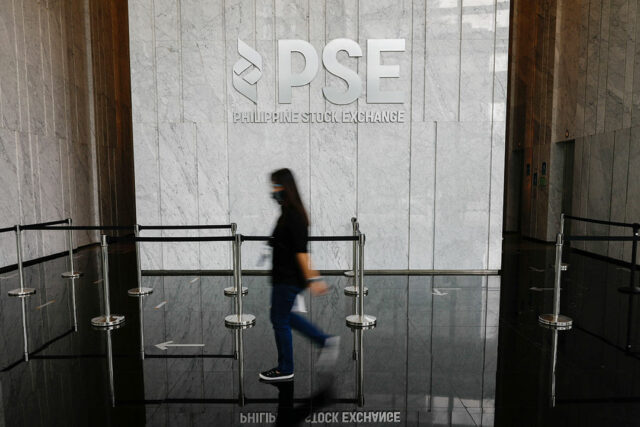
The lobby of the Philippine Stock Exchange in Taguig City, Sept. 30, 2020. — REUTERS

PHILIPPINE shares rallied on Monday amid expectations of a US interest rate cut this week, as well as a more optimistic forecast for the local economy.

The benchmark Philippine Stock Exchange Index (PSEi) went up by 1.15% or 81.35 points to close at 7,104.20. The broader all-share index gained 0.82% or 31.37 points to 3,820.

“Optimism towards a possible rate cut by the Federal Reserve in their meeting this week drove the local bourse higher,” Japhet Louis O. Tantiangco, a senior research analyst at Philstocks Financial, Inc., said in a Viber message.

“The local currency, which exhibited strength against the dollar in today’s trading, also contributed to the market’s climb,” he added.

The Fed is expected to cut its benchmark rate for the first time in more than four years at its policy meeting on Sept. 17-18.

The peso closed at P55.888 a dollar, 10.70 centavos stronger than its P55.995 finish on Friday, based on Bankers Association of the Philippines data. This was the peso’s strongest close in almost six months.

Markets were also buoyed by the World Bank’s growth forecast for the Philippines this year, Luis A. Limlingan, head of sales at Regina Capital Development Corp., said in a Viber message.

“Philippine shares started the week positively, buoyed by the World Bank’s forecast of a 5.8% gross domestic product (GDP) growth for 2024, driven by lower interest rates boosting domestic consumption,” he said.

World Bank lead economist Gonzalo J. Varela last week said the lender is confident about the country’s economic growth. It expects the economy to grow by an average of 5.9% from this year until 2026.

All of the market’s sectoral indices closed higher. Mining and oil rose by 1.58% or 125.09 points to 8,004.81, while financials increased by 1.43% or 30.80 points to 2,183.09. The industrial index went up by 1.37% or 127.54 points to 9,429.51.

Holding firms gained 1.29% or 77.03 points to 6,021.97, while the property index added 0.64% or 18.05 points to 2,837.56. Services rose by 0.39% or 8.69 points to 2,225.41.

Value turnover dropped to P3.96 billion from P5.41 billion. Traded stocks rose to 724.3 million from 695.45 million on Friday.

Advancers beat decliners 115 to 85, while 53 stocks were unchanged. Net foreign buying fell to P158.29 million from P188.92 million. — Revin Mikhael D. Ochave

National ID registrations approaching 89 million

PHILSTAR FILE PHOTO

AROUND 89.7 million registrations have been logged for the Philippine Identification System (PhilSys) card, or the National ID, the Philippine Statistics Authority (PSA) said on Monday.

The signups constitute 97% of the government’s 90-million target for the year, Assistant National Statistician Emily R. Pagador told reporters on the sidelines of a forum.

By next year, the PSA aims to have the entire population registered, Ms. Pagador said.

While the PSA has yet to deliver 35 million physical National ID cards, those registered under PhilSys may use the digital version of the IDs in government and bank transactions.

The PSA is also working with other banks to accept the National ID for authentication. It recently began the pilot use of National ID authentication services with the Land Bank of the Philippines East Avenue branch.

“We have issued an advisory about the acceptance of the digital National ID. It has the same validity as the physical ones,” Ms. Pagador said.

Last month, the Bangko Sentral ng Pilipinas (BSP) issued a memorandum requiring all BSP-Supervised Financial Institutions to accept all forms of the National ID, including the digital version.

Entities that have integrated the National ID into their operations include Asia United Bank, GCash, GoTyme, Bank of the Philippine Islands, Home Credit Philippines, the Government Service Insurance System, the Home Development Mutual Fund or Pag-IBIG, and the Philippine Health Insurance Corp.

Ms. Pagador added that complaints regarding organizations not accepting the National ID have fallen to the single digits. They topped 100 in 2021.

The National ID has helped lower the cost and time for residents seeking to obtain a business permit by 75%, World Bank Senior Digital Development Specialist Naoto Kanehira told the forum.

Meanwhile, Republic Act No. 11055 or the Philippine Identification System Act still requires the delivery of the physical National ID cards.

“We are working on something to continue the printing of the (physical) cards,” Ms. Pagador said.

The central bank terminated its printing contract with AllCard, Inc., and the dispute has gone to arbitration. The BSP is overseeing the printing of physical ID cards.

The National ID is expected to help boost growth in the next decade by helping the vulnerable and the unbanked access key government and financial services, Information and Communications Technology Secretary Ivan John E. Uy told the forum.

“The National ID will be instrumental in driving the nation’s economic growth. It is projected to contribute significantly, up to 10%, in GDP (gross domestic product) over the next 10 to 15 years,” he said.

The PSA has partnered with the University of the Philippines and the Modular Open Source Identity Platform to launch a research and design center to realize the potential benefits of the National ID. — Beatriz Marie D. Cruz

Port snags could delay expected fall in rice prices

REUTERS

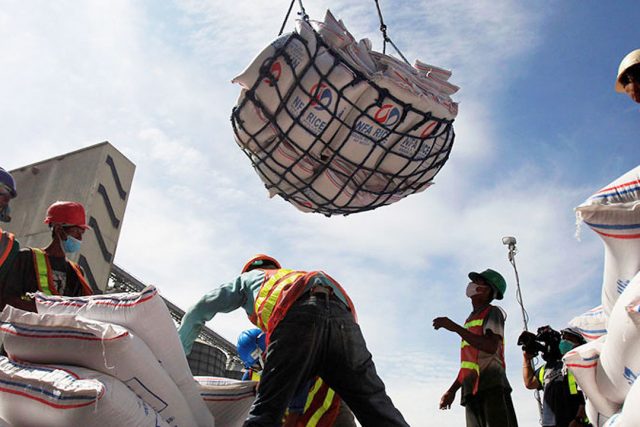
THE Department of Agriculture (DA) said on Monday that bottlenecks at Philippine ports have been delaying the unloading of rice imports, which are deemed vital in lowering the price of the staple and in turn keeping inflation in check.

“As of today, there’s only about 60,000 (metric tons) that have arrived, and we’re already at mid-September,” Agriculture Secretary Francisco P. Tiu Laurel, Jr. said at a briefing organized by the Makati Business Club.

He said the Philippines lacks specialized port facilities for agricultural goods arriving in the Philippines.

“The idea is to unload immediately when shipments arrive. I think boats now have been waiting for a week or two,” Mr. Laurel said, noting that such delays cost shippers at least $7,000 per day, raising the cost of logistics and the prices that end-users pay.

“If we had the right number of agriports all over the country, the cost of feed, rice, fertilizer, and seed would go down,” he added.

He added that rice imports during the first half have been in volumes that allow the buildup of rice reserves.

“From January to June, almost 400,000 MT (per month on average) has entered… there’s an excess of about 80,000 MT a month for buffer stocking,” Mr. Laurel said.

He added that the logistics snags are likely to delay the expected drop in rice prices.

“I would expect that price should go down by mid-October based on the new shipments that have arrived,” Mr. Laurel said.

In June, President Ferdinand R. Marcos, Jr. signed Executive Order No. 62 which lowered the tariff on imported rice to 15% from 35% until 2028, citing the need to contain rice prices. The order took effect in July.

The DA has said that the lower tariffs on rice would lead to a P5 to P7 per kilogram drop in imported rice prices.

The average price of imported well-milled rice in Metro Manila markets was P51.45 per kilogram, while local well-milled rice was sold at P50.83 per kilo, according to DA price monitor reports for the Sept. 9-14 period. — Adrian H. Halili

PEZA expects CREATE MORE to unlock more investments

THE Philippine Economic Zone Authority (PEZA) said that its investment approval targets — set at P200 billion this year — will be achievable when amendments to the Corporate Recovery and Tax Incentives for Enterprise (CREATE) Act take effect.

PEZA Director General Tereso O. Panga told BusinessWorld that he expects the passage of the CREATE to Maximize Opportunities for Reinvigorating the Economy (CREATE MORE) bill to spur more investment.

“With the impending passage of the CREATE MORE bill, we remain hopeful that more investors will register their projects with PEZA and other investment promotion agencies (IPAs),” Mr. Panga said via Viber.

“This is in preparation for the expected upturn, particularly in the global electronics industry, including demand for electronics products and electric vehicles,” he added.

Last week, the Senate ratified a bicameral conference report on the CREATE MORE bill, which seeks to lower taxes on domestic and foreign companies to 20% from 25%.

Apart from lowered taxes, the bill also seeks to return to investment promotion agencies the power to approve or deny tax incentives up to a certain threshold, farming out some of the powers currently held by the Fiscal Incentives Review Board.

According to a preliminary report from the Philippine Statistics Authority, electronics exports grew 2.5% in the seven months to July to $23.88 billion, representing 56% of all exports during the period.

PEZA reported approvals of P6.9 billion worth of investment applications at a board meeting on Aug. 27.

The latest approvals brought PEZA’s total greenlighted investments in the first eight months to P61.62 billion, or 30% of its target for the year.

Mr. Panga said PEZA will be maintaining its P200-billion investment approval target for the year.

“The ASEAN outlook in 2024 remains robust, and so is the Philippine economy with our declining inflation rate and consistent gross domestic product growth forecast, which makes the country one of the best-performing economies in the region,” he said.

“As such, we in PEZA are keeping our P200-billion investment approval target for the year within reach,” he added. — Justine Irish D. Tabile

CREATE MORE needs 10-year review clause — Plaza

SCIENCEPARK.COM.PH

THE measure that will amend the Corporate Recovery and Tax Incentives for Enterprises (CREATE) Act of 2021 needs to have a 10-year performance review mechanism to signal to investors that the incentive regime will remain stable for a predictable amount of time, the former head of the Philippine Economic Zone Authority (PEZA) said. 

“A provision must be written in the CREATE MORE for a review of these incentives every 10 years,” former PEZA Director-General Charito B. Plaza said via text message.

She added that the review will serve as a performance evaluation by measuring whether incentives have helped increase investment, aided in the growth of local government units (LGUs) hosting the locators, and addressed poverty.”

The CREATE Act is in the process of being modified by legislation known as CREATE MORE (Maximize Opportunities for Reinvigorating the Economy).

Ms. Plaza contends that the move to amend CREATE after only three years has given off the impression that the government “keeps on changing our rules in the middle of the game and keeps on fixing things that are not broken.”

Last week, Congress ratified the proposed CREATE MORE bill. The new measure address concerns raised by investors about issues like how much work must be physically performed in economic zones for locators to continue enjoying their incentives.

The new bill also clarifies who can grant incentives to locators, known as registered business enterprises (RBEs).

Under CREATE MORE, the President will be given the power to grant nonfiscal incentives to enterprises without the need for a recommendation by the Fiscal Incentives Review Board (FIRB).

The FIRB’s powers have been defined as exercising “policymaking, oversight, regulatory, and quasi-judicial functions on the administration and grant of tax incentives by the investment promotion agencies (IPAs) and other government agencies administering tax incentives.”

CREATE MORE also expands the powers of IPAs to grant incentives.

The new measure increases the investment threshold for projects that IPAs can approve on their own to P15 billion from less than P1 billion previously. The current law empowers only the FIRB to approve projects worth P1 billion or more.

CREATE MORE also gives the FIRB the authority to cancel, suspend, or withdraw fiscal incentives, upon the recommendation of IPAs.

Eleanor L. Roque, tax principal at P&A Grant Thornton, said the new measure ensures that the FIRB exercises oversight over fiscal incentives granted to RBEs.

“If there were abuse of discretion in the past or conflicting interpretation of the laws, the FIRB can supervise the various agencies and exercise regulatory functions,” she said via Viber.

However, Filomeno S. Sta. Ana III, coordinator of Action for Economic Reforms, said the CREATE MORE bill weakens the FIRB’s capacity as a regulatory body that can rein in the IPA tendency to offer incentives inappropriately.

“The past has shown that IPAs are motivated by attracting investments mainly through incentives, even if such incentives are redundant or inappropriate. The IPAs are not mindful of the huge opportunity costs arising from the forgone revenue,” he said via Viber.

CREATE MORE is a priority bill, as identified by the Legislative-Executive Development Advisory Council. The bill has yet to be transmitted to Malacañang for President Ferdinand R. Marcos, Jr.’s signature. — Beatriz Marie D. Cruz

Marubeni, MinebeaMitsumi pitched on expanding footprint in Philippines

BW FILE PHOTO

THE Department of Trade and Industry (DTI) said on Monday that it sounded out two Japanese companies on expanding their operations in the Philippines, possibly in industries deemed high priority by the government.

The DTI said Acting Trade Secretary Cristina A. Roque met with Marubeni Corp. and MinebeaMitsumi, Inc., inviting Marubeni in particular to establish a bigger Philippine footprint in renewable energy, infrastructure, and technology.

“The Philippines is open for business. We are committed to creating an environment where businesses of all sizes can flourish, particularly those involved in ‘new generation’ industries that cater to the evolving needs of Filipinos,” she said.

“We are pleased to see Marubeni’s growing portfolio of investments in the Philippines. Their presence is a testament to the country’s strong economic fundamentals and the vast potential that lies ahead,” Ms. Roque said. 

“We invite Marubeni and other global companies to join us in shaping the future of the Philippine economy,” she added.

Marubeni, with a longstanding presence in the Philippines, has invested in a centralized clinical laboratory called Medi Linx Conceive IVF Manila, Inc., and an artificial intelligence-based fintech service known as etomo.

“Both the DTI and Marubeni acknowledged the need to balance economic growth with responsible environmental stewardship, touching on the importance of sustainable development and environmental protection,” the DTI said. 

“They discussed potential collaboration on projects that promote renewable energy, resource conservation, and climate resilience,” it added.

Dita Angara-Mathay, the DTI’s Tokyo commercial counselor, said that the Philippines is also seeking to acquire competencies in battery technology.

“This focus is driven by the fact that the country was the world’s second-largest producer of nickel ore in 2023, a key component in the production of batteries for electric vehicles,” she said. 

“To capitalize on this, the Philippines is keen to attract more investment that involves the transfer of battery technology from Japan,” she added.

In a separate statement, the DTI said Ms. Roque also pitched renewable energy, electric vehicles, and food manufacturing and inspection ventures to MinebeaMitsumi.

“We see immense potential in partnering with MinebeaMitsumi to further develop our priority sectors. Their technological prowess and commitment to excellence align perfectly with our vision for a robust and future-ready Philippine economy,” she added.

According to the DTI, MinebeaMitsumi’s operations in the Philippines account for a significant portion of the company’s global footprint.

“The company expressed appreciation to the DTI for their growing manufacturing business in the country,” the DTI said.

“MinebeaMitsumi reaffirmed its intent to continue investing in the country’s semiconductor manufacturing industry,” it added. — Justine Irish D. Tabile

Solicited bids more competitive, analysts say, as challengers to Aboitiz InfraCapital fail to emerge for Laguindingan Airport

ABOITIZ INFRACAPITAL, INC. has a solid track record in running airports, but the Laguindingan Airport contract could have benefited from more competition via an open auction for the concession deal, analysts said.

Aboitiz InfraCapital, which has an unsolicited offer on the table to upgrade and operate the Northern Mindanao facility, also holds the operations and maintenance deal for Mactan-Cebu International Airport (MCIA), “which is bigger and has more complicated operations than that of Laguindingan so I am confident they can do that easily,” Nigel Paul C. Villarete, senior adviser on public-private partnerships (PPP) at the technical advisory group Libra Konsult, Inc., said via Viber.

“Airport privatization attracts little interest, especially if it is small and not a gateway. Hence, no surprise about the lack of counterproposals,” Rene S. Santiago, former president of the Transportation Science Society of the Philippines, said via Viber.

The Department of Transportation (DoTr) has indicated that the contract to operate and maintain Laguindingan will be awarded to Aboitiz InfraCapital after no parties challenged its P12.75-billion unsolicited proposal.

“Aboitiz is banking on lessons from its Mactan Airport takeover,” Mr. Santiago said in a Viber message.

The Mactan-Cebu International Airport is operated by Aboitiz InfraCapital GMCAC under a 25-year concession deal. 

“With its previous acquisition of the Mactan Cebu International Airport, Aboitiz Infra has gained experience and technical know-how in airport operations and development,” according to Terry L. Ridon, a public investment analyst and convenor of think tank InfraWatch PH. 

The expertise the group gained from MCIA should also be expected in Laguindingan airport, Mr. Ridon said.

The complicated nature of unsolicited bids is not inviting to other parties, Libra Konsult’s Mr. Villarete said, adding that the leverage given to the original proponent scares away other parties. 

“Preparing the proposal, or the challenge thereof, costs a lot of money. On top of that, even if you do have an offer that is better than the original proponent, the latter can simply match your proposal to get the project. So, no one is really excited to submit a counterproposal,” he said.

“I think this is something the government may want to study further if there are future updates of the PPP Code,” Mr. Villarete said.

For government transportation and infrastructure projects, the government should take the solicited route, Mr. Villarete said.

“The solicited route is better because the government procures exactly what it wants and provides the specifications and conditions it prescribes for the long term,” he added.

Aboitiz InfraCapital also holds the original proponent status for the New Bohol-Panglao International Airport, which the DoTr said would be subject to a Swiss Challenge by November. — Ashley Erika O. Jose

BSP says climate risks can be mitigated by regulatory action

PHILIPPINE STAR/EDD GUMBAN

CENTRAL BANK regulatory action can cushion the impact of climate risks on the financial system, Bangko Sentral ng Pilipinas (BSP) Governor Eli M. Remolona said.

He cited the potential of measures such as designating systemically important banks or assigning appropriate capital levels for risks taken.

“These tools can be harnessed to push for greater climate adaptation,” Mr. Remolona was quoted saying in a speech earlier this month.

The governor called climate risk the “ultimate systemic risk.”

Meanwhile, the BSP called on the private sector to ramp up its support for sustainability and climate change-related projects.

“We need to encourage innovative financing mechanisms that allow projects to access international capital. This goes hand in hand with our efforts to develop our domestic capital market, to provide alternative sources of financing,” BSP Assistant Governor Pia Bernadette Roman Tayag said.

Ms. Tayag noted the need to boost sustainability efforts, especially for vulnerable parts of the economy such as small businesses.

Meanwhile, BSP Assistant Governor Lyn I. Javier said that the central bank works closely with its supervised institutions to enhance risk management.

Capacity-building is also crucial, Ms. Javier added.

“This is where development partners, such as the Asian Development Bank (ADB), come in because they can bring in experts that could capacitate the industry.”

The BSP has said it is considering more incentives to encourage banks to finance green and sustainability projects.

These include relaxing regulations on normal credit operations for refinanced green loans, as well as setting rules for sustainability-themed unit investment trusts, among others.

Last year, the BSP approved the temporary increase to 15% in banks’ single-borrower limit to allow them to extend loans or finance investments for eligible green or sustainable projects, including transitional activities.

It also approved the gradual reduction of the reserve requirement ratio (RRR) on sustainable bonds issued by banks. This year, the RRR is set at 1% for new and existing sustainable bond issuances. — Luisa Maria Jacinta C. Jocson

PHL bond market growth slows in Q2

GROWTH of the Philippine bond market slowed in the second quarter following a decline in corporate issuances during the period, according to the September Asia Bond Monitor issued by the Asian Development Bank (ADB).

Outstanding local currency (LCY) bonds grew 1.9% from a quarter earlier to $214 billion in the three months to June. The growth rate had been 2.2% in the first quarter, the Asia Bond Monitor reported.

Among 10 economies in Asia that posted quarter-on-quarter expansions, Indonesia’s and Singapore’s bond markets posted the strongest growth at 6.1% and 5.5%, respectively. The average for the Emerging East Asia region was 2.3% on outstanding LCY bonds. The Thai, Hong Kong and Vietnam markets contracted by 0.2%, 0.4% and 3.7%, respectively.

Year on year, the Philippine bond market grew 7.1%.

Outstanding government and Treasury bonds grew 2.8% to $178 billion in the second quarter, against the 2.7% expansion in the previous quarter. This accounted for 83.3% of the total debt stock during the period.

Bond maturities fell during the quarter, the ADB said.

Outstanding central bank securities expand 6.8% quarter on quarter to $14 billion, accounting for 6.5% of the total. The segment’s expansion slowed from the 20.2% posted a quarter earlier.

Corporate bonds contracted 7.7% to $22 billion, making up 10.2% of the Philippines’ total LCY debt stock during the period. This followed an 8.2% decline in the previous quarter.

LCY bond issuances in the Philippines contracted 15.7% quarter on quarter but rose 21.3% year on year to $45 billion at the end of June, the ADB said.

“Issuance of Treasury and other government bonds declined 51.7% q-o-q in Q2 2024 mainly due to the exceptionally high issuance volume in the previous quarter, driven by the sale of Retail Treasury bonds (RTBs) in February,” it said.

The government raised P585 billion from an offering of five-year RTBs in February, exceeding the initial P400-billion target.

Meanwhile, issuances of central bank securities grew 10.1% to $32 billion in the second quarter.

On the other hand, corporate bond issuance declined 41.2% in the quarter to $1 billion as companies held off bond issues in anticipation of lower rates in the latter part of the year.

“The largest corporate bond issuances during the quarter came from SM Prime Holdings and Energy Development Corp., which accounted for 58.0% and 23.2%, respectively, of the Q2 2024 corporate issuance total,” the ADB said.

The emerging East Asian bond market grew 15.4% to $2.55 trillion, driven mainly by government bonds.

Year on year, the regional market expanded 9.4%.

“Increased issuance of Treasury bonds in the People’s Republic of China (PRC) helped offset slower growth in the rest of emerging East Asia,” the ADB said.

Outstanding government and Treasury bonds grew 27% to $1.075 trillion in the second quarter, making up 27% of the total debt stock. This represented a pickup from the 1.3% expansion in the previous period.

“The stock of corporate bonds grew 1.5% q-o-q in Q2 2024, up from 1.2% in Q1 2024, due to increased issuance in the People’s Republic of China and most members of the Association of Southeast Asian Nations (ASEAN),” the ADB said. — Aaron Michael C. Sy

NCR building materials wholesale price growth slows in August

JCOMP-FREEPIK

WHOLESALE PRICE GROWTH of construction materials in Metro Manila eased in August, while retail price growth remained unchanged, the Philippine Statistics Authority (PSA) reported on Monday.

According to preliminary data, the PSA said the August construction materials wholesale price index (CMWPI) slowed to 0.3% from 0.5% in July and 5.6% a year earlier.

This was the weakest pace in over 14 years or since the 1.85% decline in October 2009.

Year to date, the CMWPI averaged 0.7%, significantly lower than the year-earlier 7.1%.

Robert Dan J. Roces, chief economist at Security Bank Corp., said construction materials prices in Metro Manila cooled, pointing to a lowering in project costs for builders.

“Factors like easing inflation are likely contributing to this trend,” Mr. Roces said via Viber.

John Paolo R. Rivera, senior research fellow at the Philippine Institute for Development Studies, said the slowdown in construction materials prices reflects weak demand.

The state of demand may be gleaned from weak construction permit approvals, the resulting slowdown in construction activity, and relatively high interest rates, he said via Viber.

Headline inflation in August slowed to 3.3% from 4.4% in July and 5.3% in August 2023, the weakest reading in seven months.

Inflation for that month settled within the Bangko Sentral ng Pilipinas’ (BSP) 2-4% target for the year.

 In its Aug. 15 Monetary Board Meeting, the BSP cut benchmark interest rates by 25 basis points (bps) to 6.25%, its first cut in nearly four years.

BSP Governor Eli M. Remolona, Jr. also signaled another rate cut before the end of the year.

Prior to the rate cut, the central bank kept its policy rate at an over 17-year high of 6.5% for six straight meetings following cumulative hikes totaling 450 bps between May 2022 and October 2023.

The PSA said that the deceleration in the August CMWPI was led by the slowdown in the metal products sub-index to 0.3% from 1.1% in July.

Slower growth was also recorded in commodity groups like fuels and lubricants (3.5% in August from 12.9% in July) and electrical works (2.9% from 3.1%).

The following commodity groups also saw their growth rates ease: painting works (1.2% from 1.3%), hardware (0.9% from 2.6%), plywood (0.4% from 1.1%), structural steel (0.2% from 0.7%), and G.I. sheets (0.4% from 0.1%).

Meanwhile, price growth accelerated in PVC pipes (1.4% from 1.3%), doors, jambs, and steel casements (1.2% from 1%), and plumbing materials (1.1% from 1.0%).

Price declines were recorded in the sub-indices of reinforcing steel (-1.2% from -1% a year earlier), followed by tileworks (-1.2% from -0.8%).

Metal products also contracted in August by 0.3%, a turnaround from the 1.15% posted a year earlier.

The CMWPI is based on constant 2018 prices.

In a separate report, PSA preliminary data showed that retail price growth in construction materials was flat in August at 1.1% but lower than the 1.4% posted a year earlier.

The August reading represents the weakest rise in two months or since the 1% posted in June.

In the eight months to August, the CMRPI averaged 1.1%, well below the year-earlier 3.1%.

“We might see faster movements when construction activities go full blast again when construction companies find it lucrative to borrow,” Mr. Rivera said. — Abigail Marie P. Yraola

National rice inventory up 14% in early August

Workers load sacks of flour in a delivery truck in Manila, July 11, 2022. — PHILIPPINE STAR/ MIGUEL DE GUZMAN

THE Philippine rice inventory rose to 1.87 million metric tons (MMT) in early August, up 14.4%, according to preliminary data from the Philippine Statistics Authority (PSA).

“Of this month’s total rice stocks, 62.4% were held by the commercial sector, 29.6% by households, and 8.1% by National Food Authority (NFA) depositories,” the PSA said.

NFA and commercial warehouses grew their holdings, while household rice stocks fell during the period.

Rice held by commercial establishments amounted to 1.17 MMT, 23.3% higher from the 1.32 MMT a year prior.

The NFA’s reserves more than doubled to 150,700 MT.

Rice held by households declined 13.3% year on year to 551,900 MT.

Month on month, rice stocks fell 14.2% from July.

“Decrements were noted from the households (21.9%), as well as in the commercial sector (12%). The rice inventory in NFA depositories increased 2.4%,” it added. — Adrian H. Halili

ADVERTISEMENT
ADVERTISEMENT