Home Blog Page 268

Apple TV sets October launch for Mattel’s Matchbox car movie

Matchbox (2026)
Matchbox (2026)

LOS ANGELES — Apple TV will debut Matchbox The Movie in October, betting that Mattel’s classic car toys — tiny enough to slip into matchboxes — can spark a fresh franchise in a thriller about a framed soldier racing to clear his name.

Apple TV said at a press day event on Tuesday that it will begin streaming the film globally on Oct. 9, based on the famous miniature car brand launched in the early 1950s.

John Cena, Jessica Biel, Sam Richardson, Teyonah Parris, and Arturo Castro star in the film and discussed the legacy of the palm-sized cars and why it remains timely for the 2026 action-adventure flick.

Ms. Parris said they relished tapping into childhood memories of the palm‑sized die-cast collectors’ items while Mr. Richardson, an avid Matchbox collector, joked he wished he could have kept the life-size cars used on set.

The film follows Sean, played by Mr. Cena, a former soldier who is kidnapped and framed after completing a mission and reuniting with his friends. The group must clear their names and navigate the bonds of their friendship.

The movie, directed by stuntman Sam Hargrave, is a collaboration between Mattel and Skydance Media.

PUSH FOR MATTEL-BRAND ENTERTAINMENT
Mattel is pushing deeper into brand‑driven entertainment.

Its other upcoming toy-inspired films include the animated Bob the Builder movie and a live-action Masters of the Universe: Chronicles film, based on the He-Man action figure and arriving in theaters on June 5.

Apple TV’s 2026 release aims to build on its post-Barbie momentum as Hollywood hunts for familiar IP with global pull. Barbie dolls and accessories are Mattel’s biggest brand. The toy company’s portfolio also includes Hot Wheels, Fisher-Price, American Girl, Masters of the Universe, Polly Pocket, and UNO.

In 2025, Mattel combined its film and television units to form Mattel Studios in a move to produce entertainment driven by its brands and potentially repeat the commercial success of the 2023 Barbie movie.

Apple TV’s press day also included first-look previews of various shows, including the Emmy-nominated TV series Shrinking, and the upcoming shows Lucky, Imperfect Women, and The Dink. Reuters

SEC clears Century Properties’ P5-B bond offer

CENTURY-PROPERTIES.COM

THE SECURITIES and Exchange Commission (SEC) has approved listed developer Century Properties Group, Inc.’s (CPG) planned P5-billion bond offer, which is expected to support its nationwide residential project pipeline.

In a stock exchange disclosure on Thursday, CPG said it received from the SEC an order of registration and a certificate of permit to offer securities for the bond sale.

The offering consists of a base principal amount of P3 billion, with an oversubscription option of up to P2 billion.

The coupons are set at 6.5080% per annum (p.a.) for four-year Series D Fixed Rate Retail Bonds due 2030, and 7.6280% p.a. for seven-year Series E Fixed Rate Retail Bonds due 2033. The bonds will be listed and traded through the Philippine Dealing & Exchange Corp.

China Bank Capital Corp. Managing Director Juan Paolo E. Colet said funds from the bond sale will support CPG’s expansion in both its affordable and premium residential segments.

“CPG has one of the best investment stories in its category and the bonds have attractive rates, so we are confident in market demand for this offering,” he said in a Viber message.

Last year, the Antonio family-led developer announced plans to launch two horizontal projects in Pampanga and Cavite targeting the premium residential segment.

Meanwhile, its affordable housing brand, PHirst Park Homes, Inc., has 31 active projects across Cavite, Laguna, Batangas, Quezon, Bulacan, Pampanga, Bataan, Nueva Ecija, and Bacolod City.

In June 2025, the CPG unit said it plans to launch 10 residential projects over the next two years, focusing on seven key regions in the Philippines.

For the first nine months of 2025, CPG posted a 17% increase in net income to P2.1 billion, driven by strong demand in its affordable housing business.

At the local bourse on Thursday, CPG shares rose 2.6% or two centavos to close at 79 centavos each. — Beatriz Marie D. Cruz

In defense of the Holy Fiscal Deficit: Accounting and economics

BW FILE PHOTO

Part II: The reality of how the government spends and taxes, and other misunderstandings

By Jesus Felipe and Mariel Monica Sauler

In  Part I of this article, we showed that fiscal deficits generate net worth for the private sector and that, given that the Philippines runs current account deficits, the private sector can run a surplus only if the government runs a deficit.

A fundamental problem in the discussion of what the government does is the misunderstanding of how it pays for infrastructure, civil servant salaries, etc., and what happens to taxes.

When the Philippine government pays a contractor to build a road, a school, etc. it uses (every time) new money created by the central bank (Bangko Sentral ng Pilipinas or BSP). This is done “out of nothing,” ex nihilo. Pesos are not scarce, and hence cannot be treated as a resource like oil. This money is called “reserves balances” and the BSP is not financially constrained.

This is stated in RA 7653 (Central Bank Republic Act). The other way around, the taxes that we pay do not sit in a government account and wait to be sent back to us when it pays for a new project. Your bank transfers reserve balances to the Treasury’s account at the BSP. Taxes disappear in the process. The system in place (the same as in any other country) treats spending as a legal instruction to the BSP, and taxes as Treasury receipts, not funding instruments. Sections 89, 110, 113, and 114 of RA 7653, imply the following: a.) All National Government receipts are credited to Treasury accounts at the BSP; b.) All Government payments are made through the BSP; c.) Every Peso of reserve used to settle government spending is created by the BSP, not collected via taxes; d.) Spending is operationally a reserve credit decision by the BSP, subject to authorization, not funding availability; and, e.) Reserve availability is a policy variable, not a Treasury constraint.

Operationally, when Congress authorizes spending, Treasury instructs the BSP to pay, the BSP credits bank reserve accounts, and banks credit private deposits. Taxes reduce bank reserves earlier (banks need reserve balances before they can settle tax payments), increase Treasury deposits, and they are accounting offsets, not payments. Summing up: spending and taxation are separate and delinked operational processes. Taxes are not parked in a special account to be used to pay for infrastructure projects. No theory. It is the law, an operational reality.

It is true that the Philippine legal framework (budget process rules like PD 1177 and the Constitution) requires that the government have appropriations and revenue sources before spending. However, the requirement to have balances prior to spending does not mean that the government is financially constrained like a household or a firm. Payments proceed as explained above. We likewise emphasize that it is a mistake to think that taxes go back into the system to finance government spending. Taxes play several important roles in the economy (so we need to maintain them), but they do not finance spending. Taxes free up real resources in the economy (for the government) that otherwise would have been used by the private sector for private ends. They thus allow the government to spend without coming up against the inflation constraint that would be created once all resources are fully utilized.

So, what is the role of bond issuance if payments occur as explained above, and taxes do not finance spending? This brings us to the connection with the Bangko Sentral ng Pilipinas. Our central bank sets an interest rate to try to achieve its inflation target (its main goal and role), the so-called overnight reverse repurchase rate. This has been the backbone of our modern monetary policy since the early 2000s, together with the corridor system in place since 2016. What happens to this interest rate, key to managing the economy, and anchor of the interest rates in the banking system, when the government runs a fiscal deficit?

A fiscal deficit implies that there are excess reserve balances in the banking system (government pays us through the banking system and we pay taxes also through the banking system). This, invariably, puts downward pressure on interest rates, including on the central bank’s policy rate (to zero), not upward pressure, as many believe. The central bank cannot allow this to happen.

The solution? The excess reserves have to be drained. How? By coordinating with the Treasury department. It issues Treasury bills and offers them to the so-called primary dealers (major financial institutions), who are very happy to buy them because T-bills offer a great alternative to keeping the funds idle. It is just a portfolio exchange. Whoever thinks that bond issuance is an act of submission of the government with respect to the private sector should witness an auction in action. The government is clearly not borrowing from the private sector, much less in the sense that we are asked to believe, that the government is at the mercy of the private sector.

Apart from the fact that a fiscal deficit pushes interest rates downward, notice also that the initial possible inflationary impact of government spending (private spending is also inflationary) on prices is neutralized by the bond issuance, as excess liquidity (reserve balances) is mopped up. Peso depreciation as a result of using our own currency to build schools? Certainly not. But if this were the case, the groups advocating that we need a significant depreciation of the currency should jump for joy.

Primary dealers can later offer T-bills to households and firms in the secondary market. These also purchase them gladly. For us in the private sector, it is wealth. Yet, most people call this “national debt” and have a negative view of it simply because of the word, debt. In reality, it is just an accounting record of the Treasury bills in the hands of the private sector (its wealth), P17 trillion currently. Those obsessed with the national debt claim it represents over 60% of our GDP. This ratio is irrelevant. One can choose how to call it, debt or wealth, as long as what it is and who owns it is clear.

The average Filipino does not owe about P130,000. This statement is ludicrous. Yet newspapers and commentators repeat it over and over. If anything, the truth is that, on average, each Filipino owns this amount, though in reality the ownership of T-bills is highly concentrated in the financial system and households with high income.

Another important point to highlight is that T-bills are issued as an interest rate maintenance operation, not government borrowing, as is most often understood. It is intriguing to hear bankers complain about the fiscal deficit. Bond (debt) issuance brings stability to our financial system, and a large portion is in the asset side of our banks’ balance sheets.

It is important to differentiate between debt in pesos and debt in a foreign currency. The Philippine government will always pay peso-denominated debt simply because it will always have pesos to honor it. This represents about 70% of the total national debt. The other 30% is foreign-denominated. This is the potentially problematic one because the government has to make sure it has the foreign currency to pay it. This is not a large share, and, so far, the government has been able to honor it.

There might be good reasons why the Philippine government sometimes borrows dollars, for example to purchase defense equipment. What is less clear is when the government claims that foreign borrowings are for budgetary support, if this means for items in the national budget such as education, civil servants’ salaries, and the like, denominated in pesos.

For those obsessed with the debt-to-GDP ratio, they should follow just foreign-currency denominated debt. Moreover, while economists have spilled uncountable volumes of ink worrying about government debt, there is no particular “debt ratio” that even their most sophisticated theories say governments should target — while the most popular empirical studies were later debunked for having simple Excel errors.

No economy has entered into a crisis as a consequence of running fiscal deficits and issuing debt — such as Treasury bills — denominated in its own currency. The rating agencies and international institutions unnecessarily raise a red flag when the ratio of public debt-to-GDP increases. The debt that matters is that of the private sector and that in a foreign currency. If the world economy collapses, as some predict, it will be the result of private sector debt, not public.

Related to the above, a perennial complaint is that interest payments on debt represent a significant portion of the national budget. These pesos, some claim, could be used more productively. This complaint shows significant lack of understanding.

Follow this example: the government spends, say, P1,000 on infrastructure (a payment that goes to a company in the private sector) and collects only P500 in taxes. The difference is the fiscal deficit. Second, Treasury and the BSP offer the private sector (through the primary dealers) a great deal: the excess P500 — money that entered the economy through government spending — is swapped for a piece of paper called a Treasury bill, which is willingly purchased because the sovereign Treasury of the Philippines is expected to repay (zero default risk unless this is a political decision) the principal P500 with interest of, say, P25. How does Treasury pay interests on debt?

The same way as any other payment: through the BSP by creating new money. Apart from the fact that the government paid a company to build infrastructure (corruption has nothing to do with what we are explaining here), the operation provides the private sector with additional funds in the form of interest, additional disposable income. Businesspeople seem to complain about the fact that interest payments on debt are income that goes to their pockets. We rest our case.

(To be continued.)


Jesus Felipe is a distinguished professor and research fellow at the Carlos L. Tiu School of Economics, De La Salle University. Mariel MonicA Sauler is an associate professor and chair of the Carlos L. Tiu School of Economics, De La Salle University. The authors are grateful to Eunice Gerenia, economics student, De La Salle University, for her excellent research assistance.


Visa sees AI-powered shopping taking off

PIXABAY/PHILSTAR FILE PHOTO

GLOBAL PAYMENTS technology company Visa expects agentic commerce, or artificial intelligence (AI)-powered automated online shopping, to gain traction in the Philippines once worldwide adoption widens.

“This is one of the exciting innovations and trends that we’re seeing. Our role as Visa is we detect and see how things are progressing and ensure that we enable towards that and prepare for it. So, as and when it happens, definitely it will largely be driven [by adoption] in some parts of the world, and then it comes to us,” Visa Philippines Country Manager Jeffrey F. Navarro said at a media briefing on Thursday.

He added that pilots for agentic e-commerce are already happening in the Americas.

Last year, the company announced that it will be rolling out Visa Intelligent Commerce in Asia-Pacific, which will bring integrated application program interfaces and a commercial partner program to AI platforms. Visa said it was in talks with Ant International, Grab, and Tencent to grow AI commerce.

Mr. Navarro added that Visa will work with regulators to help set industry standards and regulations for the technology.

“So, in the evolution of agentic commerce, where payment is a key component of completing the commerce, Visa also participates in really agreeing on what the standards are so that it becomes very seamless,” he said.

“When it comes to Philippines, and given that this is relatively new, then most likely there will be discussions, and we’re going to talk about it with the central bank as and when we feel that there’s traction already.”

For now, Mr. Navarro said Visa is working to ensure that the country’s payments infrastructure is ready to handle these kinds of new technologies via its clients.

“But I think what’s very important is being ready, and being ready means let’s not wait for it to happen or not. There are things that are very foundational that clients need to do like passkeys or tokenization. Whether that happens or it doesn’t, that needs to happen because that’s the foundation for security and preventing fraud.”

APPLE PAY
Meanwhile, Mr. Navarro said there is strong demand from Philippine banks for the integration of Apple Pay as players await its domestic availability following the launch of Google Pay here last year.

He said Visa is in talks with its clients and is prepared to help them with the possible rollout as demand for contactless payments continues to grow in the country. — A.M.C. Sy

How to cure demotivation

I’m the operations manager of a multinational. After working for five years, I am no longer as motivated as I was. At times I’d like to quit and do something else, including starting a business or applying for another job. Please advise. — Night Heron. 

​Wait a bit longer. Don’t be trigger-happy. But first, find out why you’re “no longer as motivated as before.” Otherwise, you could be jumping from the frying pan into the fire. In other words, you may be moving into a worse situation than before. 

​First things first. Being demotivated and being burned out are related but are two different things. The World Health Organization defines burnout as a recognized occupational phenomenon. It happens when there’s chronic workplace stress.

​You’ll need relief from what’s bugging you at work. As an unapologetic Kaizen advocate, I suggest you do a systematic self-reflection by using a practical tool like the Fishbone Diagram with the help of your spouse, objective work colleague, or best friend.

​While commonly used to detect process issues, the Fishbone or Ishikawa Diagram can help give you a clear picture of your situation. This weekend, draw a simple fishbone that contains six categories like Manpower, Method, Machine, Material, Measurement, and Milieu. Come up with as many reasons as you can, then decide on the number one reason.

​For Manpower, this may include your relationship with your boss, work colleagues, or customers. For Method, define all processes that make your job difficult. Machine may include a defective computer or other office equipment. Examples of Material factors include policies that guide your work or things that adversely affect your health and safety.

​Measurement refers to poorly designed or misaligned performance management systems. It may also include an unreasonable, high production quota. Milieu can cover things as seemingly minor as poor air conditioning and ventilation.

SEVEN APPROACHES
Having a feeling that you’re demotivated or having a burnout is not automatically a motivation problem. Rather, it boils down to a system or situational issue. That’s why I recommended using the Fishbone Diagram. Solving burnout starts by looking hard at your work design and not resort to blaming management or other people.

​When you can review your purpose, seek autonomy, and pursue other interventions, you may recover your energy in due time. Address workloads and clarify priorities. A positive workplace doesn’t mean squeezing your energy. Here are some important points to help you bring your best every day:

One, fix your workload before fixing your attitude. Most of the time, it’s a system and situational. You can’t be motivated if you’re already drowning in non-value-added things. Identify your top priorities. Balance them. Don’t attend or create low-value meetings and formal reports. Do all these with the consent of your boss.

​Two, ask management for a bit of autonomy. Independence is oxygen. Request your boss to empower you in certain things. Ideally, an operations manager is given a great amount of authority and responsibility. More importantly, this lightens the load of your boss. It also doesn’t cost money but gives you energy.

​Three, accept things that you can’t change. But don’t sugarcoat. Acknowledge reality.

Nothing demotivates faster than being forced to think there’s nothing wrong. Surely, there’s something wrong and it’s beyond your control. Just the same, listen without jumping to an instant solution. Sometimes, acceptance could be the motivation that you’re looking for.

​Four, make progress visible to you and others. Burnout happens right away if there’s no improvement. Try breaking down your work into short, winnable milestones. Celebrate completed work, not heroic effort. Show how your work connects to real progress. There’s nothing like momentum to prod motivation.

​Five, identify what work means to your life. As soon as you can discover this, it will help you find a reason to stick around. Most people don’t mind hard work. What they hate is meaningless work. Ask yourself: “If I stopped working, what would happen to me?” Nothing energizes like rediscovering your purpose.

​Six, try recovering or redefining your purpose. Sit back and relax. If necessary, ask for an extended vacation someplace. If you can afford it, go to a foreign country where you can learn the perspective of other cultures. Spend more time with your family. They could help you rediscover why you’re working.

​Seven, review your current pay and perks. If you’re underpaid and overworked, you’ll surely burn out quickly and become disengaged. But be professional in handling this issue with your boss. Identify what you can and cannot fix. Transparency builds trust while silence burns it down.

BOTTOM LINE
​Being demotivated or feeling burned out isn’t a personal failure. It’s a signal that you may be doing it wrong. Pause before looking at drastic options. Again, reset priorities, ask for support, delegate without guilt, and treat your health as a Key Performance Indicator.

​When a manager models recovery, clarity returns, decisions improve, and the team learns that sustainable performance beats heroic exhaustion every time. You can’t motivate yourself by wallowing in your current situation. You can only improve by identifying and removing what’s draining your energy at work.

​If you do that, you’ll bring energy back to life naturally.


Consult your workplace issues for free with Rey Elbo. E-mail elbonomics@gmail.com or DM him on Facebook, LinkedIn, X or via https://reyelbo.com. Anonymity is guaranteed.

‘Angel Meloni’ scrubbed off Rome church painting on priest’s orders

ROME — An angel restored with the face of Italian Prime Minister Giorgia Meloni has been scrubbed off a wall painting in a central Rome church on the orders of the parish priest, following a political and clerical uproar.

One of two angels in a chapel of the Basilica of St. Lawrence in Lucina, close to government headquarters, was altered to look virtually identical to the 49-year-old right-wing leader, Italy’s first woman premier.

The image was spotted on Saturday by center-left newspaper la Repubblica and stirred outrage among opposition figures and irritation from Cardinal Baldo Reina, Vicar General for the diocese of Rome.

When the church opened on Wednesday, the Meloni-like face had been painted over, leaving the angel headless.

“I always said that if (the Meloni image) proved divisive we would remove it,” the church priest Daniele Micheletti told Italian news agency ANSA. “There was a procession of people that came to see it instead of listening to Mass or praying. It wasn’t acceptable.”

The amateur artist who restored the painting, Bruno Valentinetti, was quoted by Repubblica on Wednesday as saying he had been asked to erase it by the Vatican.

A spokesperson for the Holy See declined to comment. The Rome diocese said it would release a statement later.

On Saturday, Cardinal Reina expressed “bitterness” over the incident, ordered an investigation and warned that “images of sacred art and Christian tradition cannot be misused or exploited.”

The Italian Culture Ministry also announced an inquiry, while Ms. Meloni laughed off the incident. She posted a picture of the disputed painting on Instagram, with the caption “No, I definitely don’t look like an angel,” and a laughing emoji.

The altered wall painting was done in 2000, and is not under any heritage protection. Mr. Valentinetti is its original author and was asked to restore it to fix water damage, priest Micheletti said on Saturday. — Reuters

NEO Office PH partners with Holcim to co-process office waste

NEOOFFICE.PH

SUSTAINABLE OFFICE developer NEO Office PH has partnered with Holcim Philippines, Inc. to adopt cement kiln co-processing for waste collected in its office buildings, aiming to reduce landfill waste.

The partnership leverages Holcim’s global waste management brand Geocycle to ensure responsible co-processing of post-consumer waste from NEO’s office towers, the company said in a statement.

Qualified residual waste will be converted into alternative fuels and raw materials for cement production. Waste collected from NEO buildings will be processed at Holcim’s Norzagaray Cement Plant in Bulacan.

“Together, we are turning everyday building waste into valuable resources, proving that responsible development can drive both environmental impact and business value,” NEO Group Chief Executive Officer Raymond D. Rufino said.

The move supports NEO’s push for a low-carbon office portfolio by integrating circular economy practices.

“By bringing Geocycle’s co-processing technology into our waste management approach, we’re reinforcing our commitment to circular economy principles, turning waste into value and helping deliver real, measurable ESG (environmental, social, and governance) outcomes,” NEO Co-Managing Director and Chief Sustainability Officer Gie L. Garcia said.

NEO’s portfolio spans 289,000 square meters across seven office buildings in Bonifacio Global City — One/NEO, Two/NEO, Three/NEO, Four/NEO, Five/NEO, Six/NEO, and Seven/NEO.

Its towers have been recognized by local and international green building certifications, including the 5-Star Building for Ecologically Responsive Design Excellence (BERDE), Advancing Net Zero Philippines (ANZ/PH), International Finance Corporation’s EDGE Zero Carbon, and the WELL Health-Safety Rating under the International WELL Building Institute. — Beatriz Marie D. Cruz

Antidote to noise

STOCK PHOTO | Image by GarryKillian from Freepik

Is the world making too much noise? Are we drowning in toxic sound?

On the streets one hears tooting horns, sirens wailing, motorcycles revving up, and cars zooming around. It seems that sounds are amplified beyond decent decibel levels. The radio has blaring music. Television has hard news about disasters and violence. Restaurants and bars have loud music that make the customers cringe. People walk around with earphones and headphones, oblivious.

Noise is loud, hyper, and disconcerting.

Humans react in diverse ways to the sounds in the environment. Constant exposure conditions the mind and allows the individual to accept, reject, or adapt certain sounds as part of his lifestyle.

At the office, people are accustomed to the various sounds of computers, monitors, intercoms, telephones and cellphones, and chatter.

As one goes up the corporate ladder, sounds become mellow.

Executives prefer to be insulated from office chaos. They and their staff speak in hushed tones and modulated voices. Footsteps in the hallways are muted as well.

In the service industries, employees hear stressful noise that causes migraines and heart palpitations. Factory workers are subjected to deafening repetitive mechanical noise. Soldiers, firemen, policemen, humanitarian workers, and airport crew are bombarded by ear-splitting sounds of panic, riots, sirens, traffic, disasters.

Party animals, rock stars, pop musicians and their fans, players and fans of basketball, boxing, and other sports all develop steel eardrums. They learn how to withstand ear-shattering synthesized music, pounding drums and cymbals clashing, whooping cheers, screaming, and suffer the resultant brain damage.

Is noise toxic?

Prolonged exposure to hazardous sounds causes hypertension, and ear and brain damage. Some people have internal coping defense mechanisms.

Weary eardrums tune out — selectively or permanently. Perhaps this explains a social affliction among creatures of the night — acquired hearing impairment or premature deafness.

Social celebrations are occasions where one can learn about people. By switching off the sound, body language is more revealing — gestures, posture, eye and facial expressions. A sensitive ear would discern speech patterns, intonations, and accents. Or distinguish aural differences among nationalities, regions, and classes.

On another level, the volume of sound corresponds to a specific class of people. How a person sounds says a lot about them, like appearance and behavior do.

Well-born, well-bred, cultured individuals are discreet, genteel, and quiet. Their subtle gestures and dignified mannerisms reflect good breeding. Loud and brassy people crave attention. Exaggerated gestures, vulgar words, and rough mannerisms are seen in rowdy politicians, tacky showbiz celebrities, and declassee social mountaineers.

At business and social affairs, class differences become more apparent. The low-key, well-bred individuals tend to downplay their presence, unless they are guests of honor or celebrants.

At a deluxe hotel’s lobby, braggarts discuss money and stocks. The flashy types strut about while speaking on their cellphones. Loud mouths gloat and compare new acquisitions toys, possessions, houses, cars, club shares, and girls.

Ladies who lunch make an interesting case study. The vamps are in tight stretch minis. The lacquered matrons glisten in glittering jewelry and shrill voices. Their inane chatter covers gossip about scandals and foreign trips, shopping orgies, petty rivalries, and fashion trends and events.

On vacations, the rules of acceptable behavior still apply. The sophisticated blend in discreetly. They are simple, elegant, proper, and wear appropriate clothes. No fuss and fanfare. The upstarts are the opposite as they advertise money and power. They flaunt things and act contrived, loud.

In contrast, nature lovers and contemplative types can savor the sounds of the outdoors — cooing bird calls, chirping crickets, the rushing wind, breaking waves, rain showers, the sounds of petals and leaves and snow flurries. These are the sounds that calm and inspire creatives.

Musicians are hypersensitive to the nuances of sound. Composers, conductors, and artists transform random notes into melodies, sonatas, etudes, and symphonies inside their minds. They produce music for opera and concerts that nourish the spirit, relax the mind and body, and soothe the heart.

If only we could switch off all the offensive, grating, discordant noise, the battlefield bombs, the cries, and explosions of war.

We could bask in a long period of silence.

These precious heavenly moments would make us feel sane and serene.

Can wishful thinking become reality?


Maria Victoria Rufino is an artist, writer and businesswoman. She is president and executive producer of Maverick Productions.

mavrufino@gmail.com

January inflation quickens to 11-month high

PHILIPPINE INFLATION accelerated to its fastest pace in nearly a year in January amid a faster rise in rents and electricity rates, the Philippine Statistics Authority (PSA) reported. Read the full story.

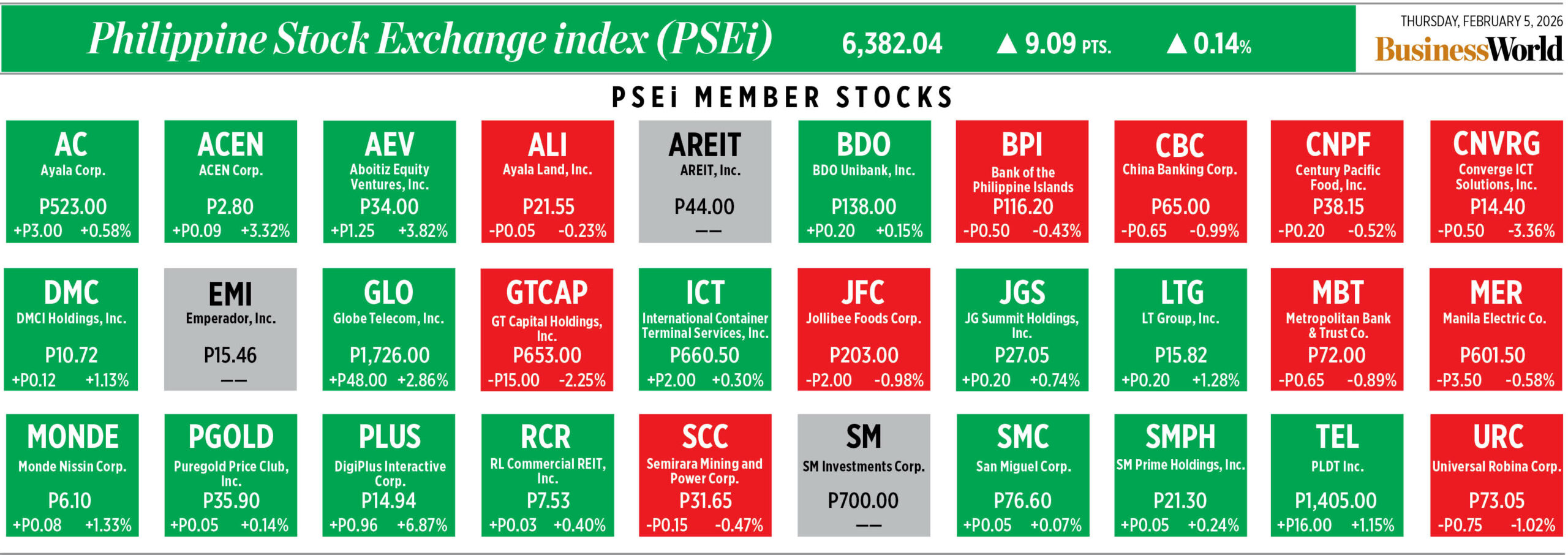
How PSEi member stocks performed — February 5, 2026

Here’s a quick glance at how PSEi stocks fared on Thursday, February 5, 2026.


PHL shares move sideways as inflation picks up

BW FILE PHOTO

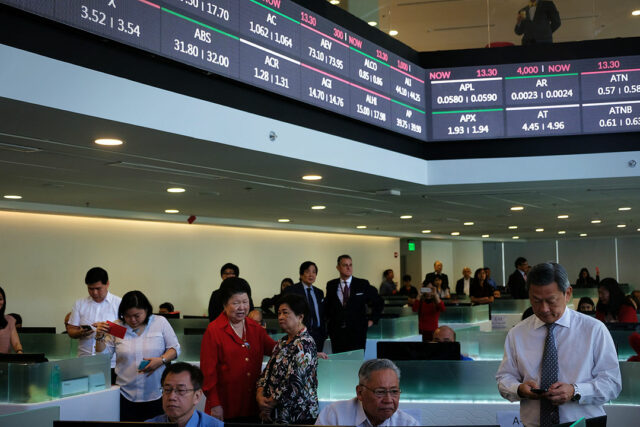
PHILIPPINE SHARES moved sideways on Thursday as investors were cautious following the release of data showing that inflation picked up to a near one-month high in January.

The Philippine Stock Exchange index (PSEi) inched up by 0.14% or 9.09 points to close at 6,382.04, while the broader all shares index increased by 0.92% or 32.83 points to 3,587.83.

“The PSEi ended almost flat following the release of a slightly higher-than-expected inflation rate. Market sentiment remained cautious as investors digested the inflation data,” Luis A. Limlingan, head of sales at Regina Capital Development Corp., said in a Viber message. “Attention turned to the potential impact of these figures on the upcoming BSP (Bangko Sentral ng Pilipinas) policy meeting.”

The main index posted slight gains as the data showed that inflation remained “controlled” despite the pickup, Philstocks Financial, Inc. Research Manager Japhet Louis O. Tantiangco said.

“S&P Global Ratings saying the Philippines is still on track for a possible credit rating upgrade also helped in Thursday’s session,” he said.

“The PSEi closed higher on Thursday… as investor sentiment was supported by optimism over the Philippines’ sovereign credit outlook. This followed S&P Global Ratings’ indication of a potential rating upgrade over the next one to two years, citing improving fiscal and external balances,” Unicapital Securities, Inc. Research Head Wendy B. Estacio-Cruz said.

Headline inflation rose to 2% in January from 1.8% in December, but was slower than the 2.9% in the same month last year, the government reported on Thursday.

This was the fastest in 11 months or since the 2.1% in February 2025, which was also the last time the monthly print was within the central bank’s 2%-4% annual target.

It was also higher than the 1.8% median forecast from a BusinessWorld poll of 18 economists, but was within the BSP’s 1.4%-2.2% estimate for the month.

Meanwhile, S&P said in a Feb. 3 report that the Philippines remains on track for a possible credit rating upgrade as improving fiscal and external balances outweigh risks from the government’s flood control controversy

Sectoral indices ended mixed. Services climbed by 0.57% or 15.12 points to 2,662.06; holding firms increased by 0.46% or 23.44 points to 5,052.84; and property rose by 0.17% or 3.87 points to 2,208.49.

Meanwhile, mining and oil dropped by 1.08% or 190.07 points to 17,267.75; industrial retreated by 0.38% or 35.13 points to 9,095.71; and financials decreased 0.23% or 4.90 points to 2,121.09.

Value turnover went down to P6.70 billion on Thursday with 1.07 billion shares traded from the P6.94 billion with 1.13 billion issues exchanged on Wednesday.

Advancers outnumbered decliners, 98 versus 90, while 73 names were unchanged.

Net foreign selling was at P22.65 million, a reversal of the P279.62 million in net buying recorded in the previous session. — Sheldeen Joy Talavera

Lufthansa Technik in talks to set up $400-M Clark facility

LUFTHANSA TECHNIK FACEBOOK PAGE

LUFTHANSA TECHNIK Philippines is currently in talks to establish a $400-million 15-hectare aircraft maintenance and repair operation at the Clark Aviation Capital that can service jets as large as the Airbus A380, the Bases Conversion and Development Authority (BCDA) said.

BCDA President and Chief Executive Officer Joshua M. Bingcang said Lufthansa Technik “sent a letter of proposal to us, so we are negotiating right now,” he told reporters on Thursday, noting that the operation could eventually occupy a bigger area.

“Our target is to close this deal by the first quarter,” he said, adding that the initial facility is expected to take two or three years to build.

“Because of the quality of the runway at Clark Airport, they will be building hangars for the A380, the biggest commercial aircraft,” he added.

Lufthansa Technik also operates a facility at the Ninoy Aquino International Airport (NAIA).

Lufthansa “has done the initial survey and ground assessment. So ginastusan na nila ’yong pre-development activities, nagtatawaran na lang ng commercial lease (It has invested in pre-development activities, and we are discussing commercial lease terms),” he said.

He said that the contract is expected to run for 25 years, renewable for another 25.

The BCDA is investing P7 billion for improvements at the airport, including a new apron, runway, and taxiway.

“Right now, there is a shortlist of consultants. By March, it will be awarded. This is going to be a milestone contract,” he said, referring to the apron project.

He said the apron will cost P2 billion, and forms part of the BCDA’s commitment to Federal Express Corp., which is planning to expand its 3,000-square-meter facility.

“The investment of FedEx for the facility will cover 80,000 square meters; that is bigger than NAIA Terminal 1 and NAIA Terminal 2 and is almost as big as the Clark Airport,” he said.

“FedEx really made Clark their Southeast Asian hub. Right now, they have three to four flights a day, but when their new headquarters is finished, it is going to be 20 planes a day,” he added.

He said the FedEx headquarters alone will require an investment of $80 million.

Pero, ’yong laman (But the contents), the equipment, I think is worth twice,” he added, estimating the company’s investment in the expansion at around $240 million.

FedEx plans to open the new facility by the third quarter of 2027, putting pressure on the BCDA to complete the apron.

“Dapat two months kaming mauna kasi i-tetest pa nila. (We need the apron completed two months in advance to allow FedEx to run tests). “They have chosen a developer, and permits have been applied for,” he added. — Justine Irish D. Tabile