Home Blog Page 256

Sual Power submits lowest bid for Meralco’s 200-MW supply

SMCGLOBALPOWER.COM.PH

SAN MIGUEL Group’s Sual Power, Inc. is advancing to the final review stage after submitting the lowest offer to supply Manila Electric Co.’s (Meralco) 200-megawatt (MW) baseload requirement.

Sual Power emerged as the leading bidder among six generation companies that submitted proposals with a combined offering capacity of 531 MW, the power distributor said in a statement on Tuesday.

The power generator offered P4.2955 per kilowatt-hour (kWh) for the entire 200-MW requirement, which was declared the best bid.

Sual Power, a subsidiary of San Miguel Global Power Holdings Corp., operates the 1,200-MW thermal plant in Pangasinan province. The plant is the largest coal-fired power facility in the Philippines by installed capacity and has been supplying power to the Luzon grid since 1999.

Other bidders included Mariveles Power Generation Corp., which offered P4.3805 per kWh for the full supply; Bac-Man Geothermal, Inc., which submitted P4.5187 per kWh for 35 MW; and San Manuel Solar, Inc., which offered P4.5787 per kWh for 25 MW.

Next on the list were ACEN Corp., offering P5.2087 per kWh for 25 MW, and First Gen Hydro Power Corporation, with P5.4906 per kWh for 25 MW.

Mariveles Power is another unit of San Miguel Global Power and is developing a 600-MW coal-fired plant in Mariveles, Bataan. Bac-Man Geothermal and First Gen Hydro are renewable energy firms under the Lopez group, while ACEN is the listed energy platform of the Ayala group.

“As in previous years, this CSP has successfully secured the required power supply for customers at the lowest possible cost, achieved through an open and transparent process,” Meralco Bids and Awards Committee for Power Supply Agreements (BAC-PSA) Chairman Lawrence S. Fernandez said.

The BAC-PSA will conduct a post-qualification evaluation before issuing a notice of award and executing the power supply agreement with the winning bidder.

Distribution utilities hold a competitive selection process (CSP) to secure power supply agreements (PSA) at the lowest cost.

The resulting PSA from this CSP will cover Meralco’s 200-MW baseload requirement over four years to comply with the Renewable Portfolio Standards (RPS), which require distribution utilities to source a portion of their energy supply from eligible renewable energy sources.

The deal remains subject to approval by the Energy Regulatory Commission (ERC).

“As a highly regulated entity, Meralco conducted the CSP in full compliance with the rules and regulations issued by the ERC and the Department of Energy,” the company said.

Meralco’s controlling shareholder, Beacon Electric Asset Holdings, Inc., is partly owned by PLDT Inc. Hastings Holdings, Inc., a unit of PLDT Beneficial Trust Fund subsidiary MediaQuest Holdings, Inc., has an interest in BusinessWorld through the Philippine Star Group, which it controls. — Sheldeen Joy Talavera

Education: Basics before AI

STOCK PHOTO | AI Generated Image from Freepik

There is no shortage of conversations today about artificial intelligence (AI), digital transformation and the future of universities. We debate credentials, micro-certifications and whether traditional degrees still carry weight. But before we get carried away by the future, we need to confront a harder question.

Are we even getting the basics right?

The uncomfortable reality is that the Philippines continues to lag much of ASEAN in foundational learning. In PISA 2022, Filipino students remained near the bottom in reading, mathematics and science. The World Bank has warned of severe learning poverty, with many children struggling to read and understand a simple text by age 10. These are not abstract statistics. They are warning signals.

We can talk about artificial intelligence all we want. But if a child cannot read with comprehension, cannot write clearly and cannot compute accurately, everything else becomes fragile. Advanced skills do not stick when the foundations are weak.

In many boardrooms, leaders express frustration over rising tuition costs and graduates who struggle with communication and problem-solving. The instinct is to blame schools or policymakers. But education cannot be treated as someone else’s problem. It is deeply tied to economic competitiveness and workforce quality.

This does not mean the private sector must suddenly become educators. But it does mean business leaders can be more deliberate partners — supporting mentorship programs, collaborating on curriculum alignment, providing structured internships and investing in teacher development initiatives. Education is not just a social issue. It is a productivity issue. It is a national issue.

If we are serious about competing in ASEAN, we must recognize what other countries are doing differently.

Singapore has treated education as a long-term national strategy for decades. Strong literacy and numeracy are emphasized early and relentlessly. Critical thinking is embedded in curriculum design, not treated as an optional add-on. Even as Singapore integrates AI and digital tools in classrooms, it does so on top of strong foundations.

Malaysia has also strengthened industry-academe collaboration, especially in technical and vocational tracks. Universities and polytechnics work closely with industry clusters to ensure alignment between training and real economic demand. The message is clear: build the base, connect to industry, then scale innovation.

In contrast, we often rush to talk about future skills without repairing foundational cracks. I cringe every time I see articles or hear conversations about investing in AI education as the future of Philippine education, as if it will be a magic pill, because it definitely is not.

So what should “shaking up education” actually mean?

First, make foundational literacy and numeracy nonnegotiable — not as slogans, but as measurable outcomes. Reading with comprehension by Grade 3 should be treated like a national security objective. If a child cannot read, every subject becomes harder, including science, math, history and even values formation. We should stop romanticizing passing rates and start insisting on mastery.

Second, restore the basics without embarrassment. Writing. Spelling. Grammar. Arithmetic. Mental math. These are not old-school. These are power tools. Every advanced skill rests on them. Coding is logic plus language. Data is math plus judgment. Strategy is comprehension plus clarity. We cannot build a digital economy on weak spelling and shaky arithmetic.

Third, teach critical thinking explicitly, not implicitly. Most students are not taught how to reason. They are taught how to comply. Critical thinking is not just being opinionated. It is the ability to interpret text, spot assumptions, check sources, compare arguments and decide under uncertainty. In an AI world flooded with plausible nonsense, this becomes survival.

Fourth, redesign assessment for the AI era. If our tests reward memorization, then AI will beat humans every time. If our tests reward reasoning, explanation and applied problem-solving, then humans still win. Universities should lean into oral defenses, real-world projects, portfolios and supervised demonstrations. Credentials should reflect competence, not just completion.

Fifth, treat teachers as the frontline of national competitiveness. If we want better learning, we need better support for teaching quality and classroom practice. The World Bank itself has linked learning poverty to teaching quality and systemic issues. We can buy devices and platforms forever, but if instruction does not improve, outcomes will not improve.

Beyond policy, there is also a cultural dimension we must confront.

We have built an environment that celebrates speed over depth. We scroll more than we study. We react more than we reflect. Visibility sometimes outranks mastery. In such a culture, foundational skills erode quietly.

This is where families, schools, and yes, even employers, play a reinforcing role. Companies can value clear writing and analytical rigor in hiring and promotion decisions. Communities can celebrate academic discipline as much as athletic or entertainment success. Parents can demand comprehension, not just completion.

None of this requires hostility toward technology. On the contrary, strong foundations make technology more powerful. Artificial intelligence rewards those who can frame good questions, evaluate outputs critically and apply results wisely. It exposes those who cannot.

The future economy will not reward those who merely consume content. It will reward those who can interpret, synthesize, decide and execute.

Before we dream of becoming an AI leader in ASEAN, we must ensure that our students can read contracts, analyze data tables, construct logical arguments and defend ideas with clarity. Without these skills, no amount of digital infrastructure will deliver sustainable competitiveness.

Back to basics is not regression. It is strategy.

If we get literacy, numeracy and critical thinking right, skills will follow. If skills follow, innovation will come. But if the foundations remain weak, we will continue to produce diplomas without depth and credentials without competence.

The conversation about the future of education is important. But for the Philippines, the more urgent conversation is about its foundations.

We can continue to debate models and modalities. Or we can do the harder work of rebuilding from the ground up.

AI is coming whether we are ready or not. The only choice we have is whether we use it as a crutch or a catalyst.

If we choose catalyst, then the agenda is clear: back to basics, then forward to skills. Fix the foundations, then scale the future.

Because in an AI-powered economy, the “educated” will not be the people with the most information. It will be the people who can read deeply, think clearly, compute accurately and decide wisely.

And that is a race we cannot afford to lose.


Dr. Donald Patrick Lim is the founding president of the Global AI Council Philippines and the Blockchain Council of the Philippines, and the founding chair of the Cybersecurity Council, whose mission is to advocate the right use of emerging technologies to propel business organizations forward. He is currently the president and COO of DITO CME Holdings Corp.


European countries’ finance chiefs pushing for bigger global role for euro

Fifty-euro notes are seen in this file photo. — REUTERS

EURO-AREA finance chiefs are pushing to expand the single currency’s global role, as US President Donald J. Trump roils markets and the US dollar weakens.

“In light of recent geopolitical events in our current geopolitical context, there are risks that the international financial and monetary system is being used as a political tool,” said Greek Finance Minister Kyriakos Pierrakakis, who chairs the meetings of his euro-area peers. “It is thus existential for us to safeguard the international role of the euro as it is quite pertinent for the EU’s (European Union) monetary sovereignty.”

The comments come just after the European Central Bank (ECB) introduced its strongest move yet to promote the euro. Over the weekend, the monetary-policy institution announced that it’s prepared to offer euro liquidity to central banks from around the world.

That proposal is one of the ideas included in a European Commission paper prepared ahead of the ministers’ meeting in Brussels on Monday.

The document — seen by Bloomberg — called for reinforcing euro diplomacy by reassuring partner countries about access to the common currency. “With the United States potentially less inclined to supply dollar liquidity during periods of stress, offering euro-denominated liquidity to partner countries could serve as a valuable complement to the EU trading strategy and boost the international role of the euro,” the document said.

The document explored ways to promote the use of the euro in issuance and transactions, especially in key sectors such as the energy, critical raw materials, air transport and defense sectors.

The ECB has repeatedly stressed the need to boost the euro’s international standing, and Bundesbank President Joachim Nagel on Monday reiterated that sentiment, calling on governments to “channel efforts.”

RAPID ACTION
“International investors want to diversify, they are looking for contact with Europe, that’s why we want to be a safe haven for the capital investments from the entire world,” said German Finance Minister Lars Klingbeil, who together with his French counterpart pushed for more rapid action.

“Faced with massive challenges across the world, the EU has to be stronger, the EU has to be faster, the EU has to work on its competitiveness and its ability to be powerful and independent,” Roland Lescure said. “Europe is very good at moving well — we also need to make it better at moving faster and this is what we’re gonna do.”

Still, French officials want a deeper understanding of how such a move may harm exporters by driving up the euro against the dollar, a finance ministry official said, briefing journalists on condition of anonymity.

EU Economy Commissioner Valdis Dombrovskis, speaking after Monday’s meeting, said the bloc must carefully watch for these spillover effects.

“In a context of a stronger international role for the euro, we also must consider what implications it would mean for exchange rate,” he said.

Ministers also addressed the rise of global imbalances during Monday’s gathering, bringing in the Canadian Finance Minister Francois-Philippe Champagne to discuss the matter. Mr. Dombrovskis said China and the US are driving the growing imbalances.

“The current Chinese and US policies are the biggest contributors to the rise of imbalances, but the EU, however, also has work to do,” he said. “There is a scope for an increase in investments, especially when it comes to putting private investments to work.”

He urged leaders to come together on the issue, warning that inaction may hamper the global economy.

“The world’s largest economies should not leave these balances unaddressed,” he said. “They pose real risks, such as furthering trade tensions but also macroeconomic and financial risks. So there is a shared interest to manage and reduce them together.” — Bloomberg

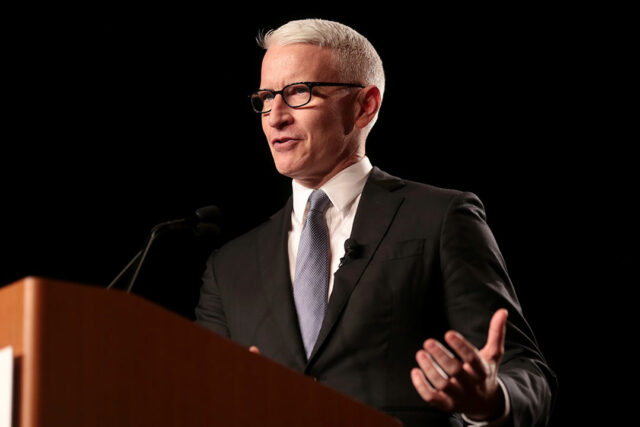
Anderson Cooper leaving ‘60 Minutes’ program in latest CBS News shake-up

ANDERSON COOPER — GAGE SKIDMORE/FLICKR

ANDERSON COOPER is leaving CBS News’ 60 Minutes program after nearly two decades, in the latest staffing shake-up to hit the storied news magazine and network.

Mr. Cooper has been a 60 Minutes correspondent through a deal between Paramount Skydance-owned CBS News and Warner Bros. Discovery’s CNN since the 2006-2007 season, according to his page on the CBS News website.

“For nearly twenty years, I’ve been able to balance my jobs at CNN and CBS, but I have little kids now and I want to spend as much time with them as possible, while they still want to spend time with me,” Mr. Cooper said in a statement on Monday.

Mr. Cooper is the latest high-profile journalist to cut ties with CBS News since the arrival of Bari Weiss as the network’s new editor-in-chief in October following Paramount Skydance’s purchase of her outlet The Free Press.

Commenting on Mr. Cooper’s exit, CBS News said, “We’re grateful to him for dedicating so much of his life to this broadcast, and understand the importance of spending more time with family.” Ms. Weiss unveiled her strategy in January, saying she would add 19 new contributors and focus on bringing a “streaming mentality” to the network, which has consistently trailed in ratings to rivals ABC and NBC.

She is trying to revive the third-placed broadcast news network, which has been losing viewers in the age of social media and online information.

Ms. Weiss had expressed interest in bringing Mr. Cooper to CBS News on a full-time basis, including the possibility of him anchoring the CBS Evening News program, according to a Puck news report.

Paramount Skydance did not immediately respond to Reuters’ request for comment.

Since the launch of CNN’s prime-time television news program Anderson Cooper 360, Mr. Cooper has covered major global news events, ranging from US presidential inaugurations and political conventions to the Newtown, Connecticut school shooting.

He joined CNN in 2001 and has reported on the Iraq War, Hurricane Katrina and the Gulf of Mexico oil spill. Mr. Cooper signed a new contract with CNN last year.

Lachlan Cartwright’s Breaker newsletter first reported Mr. Cooper’s departure from 60 Minutes. — Reuters

Xure targets 500 sellers as it expands collector marketplace

XUREDEAL.COM

By Beatriz Marie D. Cruz, Reporter

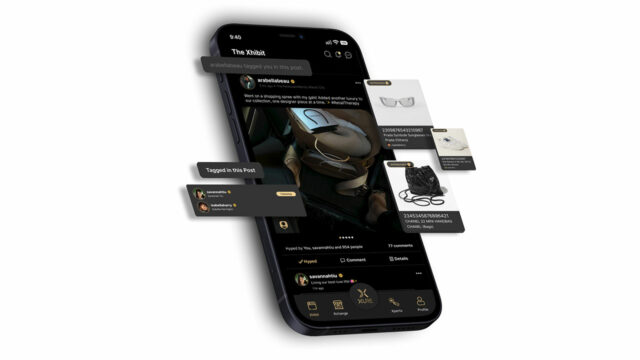
XURE, a mobile marketplace for collectors, is seeking to expand the number of sellers and appraisers on its platform, betting on growing demand for a legitimate, tech-driven marketplace tailored to serious collectors.

“For 2026, we are targeting approximately 500 accredited Xstores composed of both local and international sellers,” founder and Chief Executive Officer Joseph Sarmiento said in an e-mailed reply to questions.

“As we expand our auction formats and enhance seller tools such as timed auctions, live auctions, and pre-selling mechanics, we expect continued adoption from independent collectors and established retailers seeking a more trusted, collector-focused platform,” he added.

The company aims to drive growth in its user base and gross merchandise value by expanding collectible categories, strengthening referral and incentive programs and rolling out improved auction formats, Mr. Sarmiento said.

Since launching in 2023, Xure has recorded more than 5,600 registered users. It is among six startups selected for the 13th cohort of the IdeaSpace Startup Accelerator Program, backed by MUP Group.

The platform offers Xstore, which lets users sell collectible items through the mobile app, and Xpert, which supports people building networks in authentication and appraisal services.

Xure aims to address common issues in online collectible trading, including lack of trust in peer-to-peer transactions, counterfeit or misrepresented items and fragmented buying and selling channels.

“Many transactions today still happen in informal chat groups and online communities where there is limited protection and transparency,” Mr. Sarmiento said.

Unlike traditional marketplaces focused mainly on listings and transactions, Xure allows users to record, share and manage their collections within the app for sale or appraisal.

“Instead of being a generic marketplace, Xure integrates community, trust, confidentiality and commerce into a structured digital infrastructure designed specifically for serious collectors,” he said.

Its Xchange feature supports timed auctions, pre-order mechanics and best-offer negotiations to better reflect how collectibles are traded in practice. Buyers can also view authentication or appraisal details directly within the platform.

Collectors can follow one another, build their profiles and discover rare items.

Inspired by practices in the art world, Xure lets users remain anonymous or hide pricing information within their “Virtual Closet,” giving collectors control over how visible their holdings are.

The company is also integrating artificial intelligence-driven price analysis and smart pricing recommendations to help sellers benchmark fair market value based on transaction data and market trends.

IWG aims for 80% occupancy as flexible workspaces gain demand

FREEPIK/YANALYA

By Beatriz Marie D. Cruz, Reporter

MULTINATIONAL OFFICE space provider International Workplace Group Plc (IWG) is looking to maintain 80% occupancy across its locations, as flexible workspaces cater to “work-near-home” trends while supporting business continuity during disasters.

“A flexible workspace is no longer a luxury during uncertain times, it’s actually a survival strategy,” IWG Country Manager for the Philippines Rowena Bravo-Natividad said in a virtual interview with BusinessWorld last week.

Global economic uncertainties are expected to increase demand for hybrid work formats as part of companies’ risk management plans, she said.

She also cited the company’s business-continuity management solutions, which allow companies to access any of its locations nationwide in case of work disruptions caused by disasters or power outages.

“That is also one of the drivers for the provincial sites,” Ms. Bravo-Natividad added.

At present, IWG has 47 locations nationwide under the brands Regus, Spaces, and Signature by Regus. The company is planning to launch 29 more branches in 2026 and expects to operate 76 locations by yearend.

The company hosts a mix of tenants, including global capability centers, small and medium-sized enterprises, and information technology-business process management firms.

She also noted that many Filipinos, who typically live in multi-generational households, prefer to work in a flexible workspace nearby to ensure productivity.

About 28% of Filipino households live in extended households, with relatives opting to cohabit to share housing and other costs, according to a 2025 study by the Philippine Institute for Development Studies (PIDS).

Ms. Bravo-Natividad cited the complex process for construction permits as a key challenge.

“What we plan to do is to emphasize earlier permitting engagement, while trying to improve schedule forecasting and flexibility to kind of mitigate the regulatory delays,” she said.

In 2025, flexible office spaces accounted for 7% of demand in the country’s office market, according to real estate services firm Savills Philippines.

The AI panic ignores something important — the evidence

STOCK PHOTO | AI Generated Image from Freepik

By Parmy Olson

LAST WEEK, a post written by tech entrepreneur and investor Matt Shumer went viral on social media. Titled “Something big is happening,” it was a rundown of all the ways artificial intelligence would, in short order, decimate professional jobs. Tools like Claude Code and Claude Cowork from Anthropic PBC would displace the work of lawyers and wealth managers, he wrote. To get ready, we all needed to practice using AI for an hour a day to upskill ourselves and keep ahead of the tsunami.

The post ripped through the internet and has been seen more than 80 million times on X. In the words of the young and very online, people are shook. Shumer’s post has struck a nerve in the middle of huge selloffs of finance and software companies whose products seem ripe for replacement.

That market meltdown is one reason the public may be particularly vulnerable to dramatic storytelling about AI right now. Another is that many are tinkering with the latest tools, spinning up a website in hours with Claude Code or using its newer cousin Cowork to answer LinkedIn messages. Collective awe at the agents’ remarkable capabilities has triggered another ChatGPT moment — and soul searching about “what it all means” for our livelihoods.

But the viral reaction to Shumer’s post also helps explain the market turmoil: AI is trading on vibes and anecdotes.

Of the 4,783 words in “Something big is happening,” none point to quantifiable data or concrete evidence suggesting AI tools will put millions of white-collar professionals out of work any time soon. It is more testimony than evidence, with anecdotes about Shumer leaving his laptop and coming back to find finished code or a friend’s law firm replacing junior lawyers.   

Some critics claim the author has made exaggerated claims in the past about tech, but that is beside the point. A single compelling story about AI has created ripples of worry just when the market has become so narrative-driven that it’s giving investors whiplash. One minute AI is overhyped and the next we’re on the verge of the singularity.

Remember in mid-November 2025 when the Dow fell almost 500 points? Or the following month, when shares in Oracle Corp. and CoreWeave, Inc. dropped? In both cases the market was rattled by concerns that an AI bubble was on the verge of bursting.

Then earlier this month shares took a beating again, this time after Anthropic released 11 plugins for Claude Cowork, including one that carried out legal tasks. Now, investors were worried that AI threatened the equities in which they’d long parked themselves.

And yet through all these narrative swings, the underlying data hasn’t changed that much. National productivity statistics are up slightly, but generally within their historic range. The Yale Budget Lab has found no discernible disruption to the broader labor market since ChatGPT’s launch. And a randomized controlled trial conducted by research group Model Evaluation and Threat Research (METR), which Shumer himself cherry picks from, found last year that experienced software developers took 19% longer to complete tasks when they used AI tools.

It’s worth retaining a healthy dose of skepticism about the speed of this transformation, and remembering that those who spread the most viral claims about it will likely benefit the most. Anthropic Chief Executive Officer Dario Amodei grabbed headlines when he predicted AI would wipe out half of all entry-level white-collar jobs in the next one to five years, while Microsoft’s AI head Mustafa Suleyman took things further last week, saying that “most if not all” professional tasks would be automated within 18 months.     

Questionable decisions abound for those who only listen to the rhetoric. A Harvard Business Review survey of more than 1,000 executives found that many had made layoffs in anticipation of what AI would be able to do. Only 2% said they’d cut jobs because of actual AI implementation. Swedish fintech firm Klarna Group Plc had to rehire humans last year after its move to replace 700 customer service staff with AI led to a decline in quality.     

We’ve seen this pattern before. When stories got ahead of reality in the early 2000s, we got the dot-com crash. The internet turned out to be as transformative as people claimed, but it took longer than expected to play out.

A slow and deliberate approach to the nuanced impact of AI is needed today, as well as some humility over the fact that none of us — not even the AI labs — have any idea what is around the corner. OpenAI’s leaders didn’t expect ChatGPT to spark a market boom and Anthropic was shocked at the impact of its latest products, staff there tell me.

Two things can be true at the same time: AI’s impact can be both overhyped and real. But striking that balance means prioritizing evidence over testimony, and tracking things like productivity statistics, hiring rates and rigorous studies such as those carried out by Berkeley-based METR.

Artificial intelligence is a genuinely useful technology, but its impact will be uneven, gradual and impossible to predict. That’s the boring truth, however unlikely it is to go viral.

BLOOMBERG OPINION

MSMEs told to practice basic cyber-hygiene

FREEPIK

FILIPINO micro, small and medium enterprises (MSME) should practice basic cyber-hygiene to protect themselves against most cyberattacks, according to an industry expert.

“For MSMEs, basic cyber-hygiene begins with your business, especially if you have fewer than five people,” Samuel V. Jacoba, founding president of the National Association of Data Protection Officers of the Philippines (NADPOP), said on the sidelines of a recent BusinessWorld cybersecurity forum.

“Secure your devices by keeping your software basic. Software should be licensed,” he said, adding that system patching and software updates should be performed consistently once available, as these help fix critical security vulnerabilities.

About four in 10 cyberattacks in 2023 targeted small and medium enterprises (SME), according to a 2025 global report by BD Emerson, a US-based cybersecurity and consulting firm.

These attacks resulted in average total costs as much as $7 million for SMEs. The report also found that 60% of small businesses shut down within six months of a cyberattack, and 75% said they could no longer continue operations if hit by ransomware.

Global tech giant Microsoft Corp. said practicing cyber-hygiene prevents 99% of cyberattacks, adding that businesses should adopt these habits to safeguard themselves against threats and ensure continuous operations.

Microsoft said every organization should adopt stronger login protections such as phishing-resistant multi-factor authentication. It also recommended practicing a “Zero Trust” approach — assuming no system is safe until verified — by validating every transaction and asserting least-privilege access, among other measures.

Microsoft likewise advised using modern anti-malware tools to detect and block threats, keeping systems updated and protecting sensitive data through proper classification and access controls.

Apart from practicing proper cyber-hygiene, Mr. Jacoba said MSMEs should attend cybersecurity-related forums because these help them learn strategies to further protect themselves against cyberthreats.

Grounded in the desire to help MSMEs and organizations strengthen cybersecurity, NADPOP’s initiative CyberBayan, launched last year, will be relaunched this year.

The program aims to boost the country’s cybersecurity posture and digital workforce through online training covering topics such as data privacy, governance, risk and compliance.

“In 2026, we’re going hyperlocal,” Mr. Jacoba said. “We want to set up a nationwide network of local communities protecting, supporting each other and learning together how to safeguard our organizations.”

This year’s iteration will focus on MSMEs and organizations in Metro Manila, Central Luzon and Southern Luzon.

CyberBayan aims to train 1.44 million Filipinos over the next five years, helping boost the country’s cyber and digital workforce, he said in an earlier statement. — Edg Adrian A. Eva

LANDBANK raises P50 billion from ASENSO bonds

BW FILE PHOTO

THE Land Bank of the Philippines (LANDBANK) raised P50 billion from its dual-tenor sustainability bond offering as it saw strong demand from both institutional and retail investors.

This was above its initial P30-billion target as total orders for the bank’s Agriculture, Sustainability, Environment, and Socioeconomic Development (ASENSO) Bonds reached over 10 times the P5-billion minimum offer, prompting it to close the offer period early, it said in a statement on Tuesday.

The 1.5-year Series B tranche was priced at 5.1714% per annum, while the three-year Series C papers were sold at 5.5615% per annum.

The bonds were listed on the Philippine Dealing and Exchange Corp. on Monday.

“Proceeds will fund green and social projects nationwide — covering renewable energy, food security, affordable housing, employment, and socioeconomic empowerment — benefiting farmers, fishers, MSMEs (micro, small, and medium enterprises), and households while advancing LANDBANK’s mission of inclusive, climate‑resilient growth,” the bank said.

“Project evaluation and selection will be conducted in accordance with LANDBANK’s Sustainable Framework, and an allocation report will be prepared within one year from issuance of the ASENSO Bonds.”

The ASENSO Bonds are the first corporate bond offering in the country that was available via direct in-app purchase, which was done on the LANDBANK Mobile Banking App (MBA).

The bank said the offering saw 16,914 retail investors subscribing to the issue via LANDBANK MBA, through in-branch transactions, and via its authorized selling agents.

Its mobile app facilitated over 7,000 completed transactions across the two tenors, it added.

“Beyond the scale of capital raised, this issuance stands out for its inclusivity and innovation. For the first time, corporate bonds were made accessible for direct purchase through a mobile banking application. This is finance with purpose. This is capital aligned with national progress. And for LANDBANK, this is only the beginning,” said LANDBANK President and Chief Executive Officer Lynette V. Ortiz said.

China Bank Capital Corp. (Chinabank Capital) was the sole issue manager for the bond offering, with LANDBANK and Chinabank Capital acting as selling agents.

The state-run bank’s net income grew by 24.38% year on year to a record-high P43.98 billion in 2025. — A.M.C. Sy

Ambitious TV adaptation of Allende’s House of the Spirits premieres in Berlin

ISABEL ALLENDE’S novel The House of the Spirits, spanning several generations of women, was tough to translate to the screen, said the showrunners of an upcoming TV adaptation, but working with a Latin American cast made the challenge a joy.

“It was about time that we told the story ourselves,” Francisca Alegria told Reuters at the Berlin Film Festival, where the first three episodes were screened on Monday.

“For us, the novel, and for, I would say, all Latin America, is such an important piece of work. It talks so much about our identity, our history,” added Ms. Alegria.

“It’s just kind of like a dream come true.”

AN AMBITIOUS ADAPTATION
Ms. Alegria, along with Fernanda Urrejola and Andres Wood, are the creative trio behind the eight-part Spanish-language series that is set to stream on Amazon’s Prime Video this April.

Mr. Wood recalled that they felt a heavy responsibility to properly adapt the novel, but working on the project with a Latin American crew and cast in Chile was also a dream.

Ms. Allende, who is an executive producer, gave the team complete freedom to adapt her 1982 debut novel, they said.

The 83-year-old is one of the most widely read living writers in the Spanish language. Her books, which often blend historical events with magic and fantasy, have been translated into more than 40 languages.

A previous attempt in 1993 at a film adaptation featuring Meryl Streep and Glenn Close was a commercial flop.

AHEAD OF HER TIME
The TV series is told through granddaughter Alba’s perspective in the 1970s as she uncovers her family’s past and her country’s turbulent history through the diaries of her grandmother written half a century earlier.

Alba is played by Rochi Hernandez, who starred in the Argentine TV series La caida, while Clara is played by three actors: Francesca Turco, Nicole Wallace and Dolores Fonzi.

Ms. Urrejola pointed out that Ms. Allende never mentioned Chile explicitly, a decision the showrunners also kept as they see the story as a universal tale of the region’s history.

Ms. Allende was ahead of her time in exploring intergenerational trauma long before it was an accepted concept, she added.

“Talking about healing generational trauma — it’s huge. And to understand how important memory is in order for us not to repeat the story. And we need that now,” said Ms. Urrejola. — Reuters

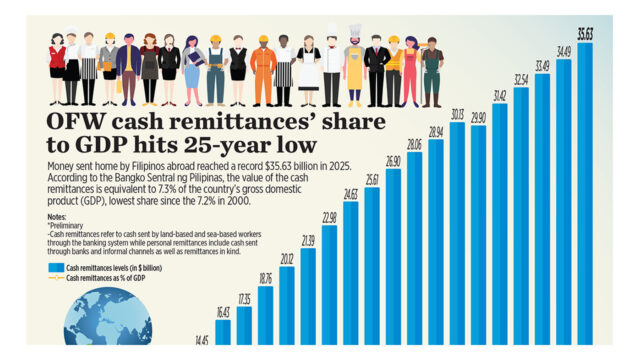
OFW cash remittances’ share to GDP hits 25-year low

MONEY SENT HOME by Filipinos abroad jumped to a record high of $35.634 billion in 2025, with the weak peso boosting gains from dollar conversion, the Bangko Sentral ng Pilipinas (BSP) reported on Monday. Read the full story.

Volatile trading seen as market awaits BSP meet

REUTERS

THE STOCK MARKET may see volatile trading when trading resumes on Wednesday as investors await the Philippine central bank’s policy decision.

On Monday, the Philippine Stock Exchange index (PSEi) dropped by 0.25% or 16.03 points to close at 6,368.55, while the broader all-share index decreased 0.92% or 32.97 points to end at 3,527.29.

Philippine financial markets were closed on Tuesday (Feb. 17) for the Lunar New Year holiday.

Analysts said market players could move cautiously as they await the Bangko Sentral ng Pilipinas’ (BSP) policy statement on Thursday for hints on its easing path.

“Activity will be compressed into a shortened week, which could amplify volatility ahead of Thursday’s BSP policy decision. The expected 25-bp (basis point) cut is largely priced in, so the market’s reaction will likely depend more on the tone of the BSP’s guidance,” F. Yap Securities, Inc. investment analyst Marky Carunungan said in a Viber message.

He said the PSEi may trade within the 6,300-6,450 range for the rest of the week, with movements to depend on the central bank’s policy hints.

“A dovish tone signaling further easing could push the index toward the upper end of that band, while a more neutral tone may trigger short-term profit taking back toward 6,250-6,300,” he added.

“Overall, we anticipate cautious positioning and range-bound trading, with investors waiting for clearer signals on the path of rates before taking stronger directional bets.”

Trading volumes could be thin on Wednesday as some institutional investors could still be on holiday mode, AP Securities analyst Shawn Ray R. Atienza said in a Viber message.

“We expect local investors to position ahead of the Monetary Board meeting, where the BSP is widely seen to deliver another 25-bp cut as the dollar’s depreciation could cushion pressures induced by the narrowing interest rate differential between the US and our country,” he said.

The BSP is widely expected to deliver a sixth straight cut at its meeting on Thursday to support a weakening economy as inflation remains manageable. All analysts in a BusinessWorld poll see the Monetary Board lowering benchmark interest rates by 25 bps this week to bring the policy rate to 4.25%.

In 2025, the central bank cut borrowing costs by 125 bps via five consecutive cuts. This brought its cumulative reductions since August 2024 to 200 bps.

BSP Governor Eli M. Remolona, Jr. has left the door open for further easing to support domestic demand, but reiterated that price stability remains their primary mandate and their easing cycle is nearing its end.

Headline inflation picked up to 2% in January from 1.8% in December. It marked the first time in nearly a year that inflation was within the central bank’s 2%-4% annual target. — Alexandria Grace C. Magno