Home Blog Page 2559

Peso may slide to P59:$1 if BSP cuts early

BW FILE PHOTO

By Luisa Maria Jacinta C. Jocson, Reporter

THE PESO may breach the P59-per-dollar level if the Philippine central bank cuts rates as early as August, Fitch Solutions’ unit BMI said.

“In our view, we think that such an early cut remains out of the question, even if price pressures ease,” Shi Cheng Low, BMI Asia country risk analyst, said in a webinar on Tuesday.

If the Bangko Sentral ng Pilipinas (BSP) cuts in August, Mr. Low said this would mean that the central bank is “practically signaling that they are giving up currency stability in exchange for economic growth.”

An August rate cut could also lead to the peso breaching the P59-per-dollar level and possibly even hitting the P60 mark, he added.

The peso had reached a record low of P59 against the dollar in October 2022, prompting BSP intervention in the foreign exchange markets and a rate hike.

BMI said the biggest barrier to the BSP’s monetary easing is currency stability.

“The Philippine peso has emerged as one of the poorest performing currencies in the region. As such, the BSP will be extremely mindful of a preemptive return to policy easing for fear of exacerbating weakness in the already weak peso,” Mr. Low said.

The peso has been trading at the P58-per-dollar range since May. The central bank has attributed the peso’s weakness to safe-haven demand for the dollar amid geopolitical tensions as well as hawkish signals by the US Federal Reserve.

“I think that currency stability will be the biggest constraint going forward and that will depend if the BSP is willing to give up on that to support the economy at least this year,” Mr. Low said.

BMI expects the BSP to only begin cutting rates in October this year for a total of 50 basis points (bps) for 2024 and 150 bps in 2025.

BSP Governor Eli M. Remolona, Jr. has said that the central bank can begin its easing cycle by August. While the BSP monitors the movements of the Fed, he has insisted its moves are independent of the US central bank.

“With the governor keeping the door open for monetary loosening in August, policy makers are holding a different view from us. They are signaling the peso weakness would not be the deciding factor to policy easing,” Mr. Low said.

“As such, the BSP could very well surprise us with a cut next month if inflationary pressures recede faster than we currently expect,” he added.

Mr. Low cited recent measures that would help further tame inflation, such as the recent executive order that slashes tariffs on rice imports.

“Our estimates show that the tariff cut can lower headline inflation by up to 1.3 percentage points over the coming months. This will, however, take some time before its full impact feeds through to rice prices,” he said.

President Ferdinand R. Marcos, Jr. last month issued an order slashing rice import tariffs to 15% from 35% until 2028 in a bid to bring down prices of the staple grain.

Meanwhile, Mr. Low also noted the impact of an August rate cut on the economy would be seen in the fourth quarter.

“If there’s a rate cut in August, then monetary transmission will go through and we’ll see some form of it or some impact of it materializing down maybe in the fourth quarter and we’ll see investment pick up once again, which obviously supports the Philippine economy.”

“But let’s just say if they cut in October, then it might be slightly too late for its impact to materialize this year at the very least,” he added.

The economy grew by 5.7% in the first quarter. The government is targeting 6-7% growth this year.

Second-quarter gross domestic product data will be released on Aug. 8.
NCR wage hike unlikely to hurt economy — NEDA

Minimum wage earners in Metro Manila will receive a P35 increase starting July 17. — PHILIPPINE STAR/RYAN BALDEMOR

By Kyle Aristophere T. Atienza, Reporter

THE NATIONAL Economic and Development Authority (NEDA) on Tuesday said the wage hike in Metro Manila would have little-to-no impact on growth targets, adding that it could be offset by an investment-driven expansion of the economy.

The P35 increase in the daily minimum wage of workers in the National Capital Region (NCR) would affect only about “one-tenth of 1%” of the Philippines’ gross domestic product, NEDA Secretary Arsenio M. Balisacan said at a Palace briefing.

“Our estimates so far suggest that the national output or gross domestic product would be impacted negatively, but it’s a very small impact,” he said.

The NCR wage board approved the hike, which will take effect on July 17, days before President Ferdinand R. Marcos, Jr.’s third State of the Nation Address. This was made against the backdrop of labor groups’ calls for a legislated wage hike ranging from P100 to P750.

The wage hike could affect 40,000 to 140,000 workers if small businesses end up closing shop or reducing their personnel Mr. Balisacan said, but added the number is “negligible.”

“As long as the economy is expanding because of other things like investments coming in, then the offsets would be there,” he said. “The economy can still grow.”

The Philippines’ GDP expanded by 5.7% in the first quarter, from 6.4% a year ago and 5.5% in the fourth quarter.

But economists said it does not necessarily reflect the state of the Philippine economy, with Fitch Solutions’ unit BMI citing the 4.6% drop in household spending, which was the slowest since the 4.8% drop in the first quarter of 2021.

“We do agree that the NCR wage hike will not impact on economic growth because the amount given is negligible at just 0.9% of Metro Manila establishments’ profits and because the wage hike is barely adding to the purchasing power of worker families,” said Jose Enrique “Sonny” A. Africa, executive director of think tank IBON Foundation.

“Greater aggregate demand from wage hikes driving greater consumption spending is a more sustainable and reliable incentive for investments than a cheap labor regime,” he said in a Facebook Messenger chat.

Mr. Africa noted that only six regions issued wage orders this year. The last wage orders in 11 other regions were issued in September to December 2023.

Mr. Balisacan said the growing economy would be able to provide alternative jobs for people who may be affected by any wage increase.

“New jobs open up in the economy and our economy continues to grow at 6 to 7% this year so that we’ll be accompanied by quite a lot of jobs,” he noted.

The jobless rate hit a four-month high of 4.1% in May from 4% in April as the size of the labor force expanded.

Mr. Balisacan said the recent employment data should not be compared with April 2024 due to seasonality factors.

Many of the 600,000 new jobs created in May were in manufacturing, industry, and services sectors, he noted.

“The indicators of the quality of jobs also are encouraging,” he added, noting that the underemployment rate or the number of people seeking additional jobs dropped to 9.9% in May from 11.7% a year ago. “That’s very encouraging.”

But Mr. Africa said a number of new jobs created in May involve construction work, which is among the worst paying sectors with P540 average daily wage.

“The majority of wage and salary work pays so poorly that simply being classified as wage and salary work is an unreliable indicator of the quality of work,” he said.

“Underemployment has traditionally been used as an indirect indicator of the quality of work but these days any decline may just mean that Filipinos have stopped looking for additional work rather than that they are already earning enough from the work they have,” he added

Labor Secretary Bienvenido E. Laguesma said at the same briefing that the agency conducted about 2,000 job fairs last year.

He said DoLE will link workers affected by the wage hike to job opportunities. It will conduct reskilling and upskilling programs for them, he added.

Meanwhie, Mr. Laguesma said that “job generation and job creation is actually the domain of the private sector.”

“Government’s responsibility is to be able to create an enabling environment conducive to business.”

Calls for wage hikes across the country have been renewed amid elevated inflation which averaged 3.5% in the first six months of the year.

Inflation-adjusted wages were 17.5% to 24.6% lower than the current daily minimum wages across the country, according to a BusinessWorld research. After accounting for inflation, the real wage in Metro Manila is now at P503.51.

Mr. Balisacan said NEDA is “optimistic” that inflation will ease further since the El Niño weather pattern, which was marked by extreme droughts in the Philippines, is “now over.”

But he did note continuing disruptions to the global rice markets amid export curbs by India and Vietnam.

PHL-US civil nuclear deal enters into force

A CIVIL NUCLEAR cooperation agreement between the United States and the Philippines, which will pave the way for US companies to export nuclear technology and material to the country, entered into force on July 2.

“The Agreement will enhance our cooperation on clean energy and energy security and strengthen our long-term bilateral diplomatic and economic relationships,” the US State department said in a statement.

Washington and Manila signed the Agreement for Cooperation Concerning Peaceful Uses of Nuclear Energy, also known as the “123 Agreement,” in November last year. The deal provides the legal framework for the export of nuclear materials, equipment and components from the US to the Philippines.

As many as 40 US companies would be interested in contributing to the development of the nuclear energy industry in the Philippines, Paul Taylor, commercial counselor at the US Embassy in the Philippines, said on Tuesday.

“Over the last couple of years, the work in the civil nuclear space energy sector has been focused on the regulatory framework,” Mr. Taylor said at a media seminar in Iloilo City.

“Now that the 123 Agreement has gone into force… We are kind of beginning to shift gears and really focus much more on commercial promotions that help American companies connect with their potential partners here in the Philippines,” he added.

Mr. Taylor said that the US government limits the ability of American companies to export civil nuclear technology without a 123 Agreement in place.

To ramp up commercial activities, he said that the US Embassy has created an industry-led working group composed of US companies that are looking to bring their technologies to the Philippines.

Asked about how many American companies are interested in investing in the Philippines, he said: “So, we have 14 currently, and our goal is to hit 40. So, I think somewhere between 14 and 40 will be your answer. ”

Mr. Taylor said the industry-led group will have its first meeting on July 31, which will be attended by representatives from the Department of Energy (DoE).

He said the US Commercial Service is also working with the DoE to organize a supplier forum in the second week of November.

“We are expecting US companies to attend in person and have the opportunity to discuss partnerships with the Philippine DoE and really begin to take very concrete steps to building the supply chain that will be needed for civil nuclear energy development projects here in the Philippines,” he added.

Meanwhile, Trade Secretary Alfredo E. Pascual said in a Viber message that the 123 Agreement underscores the government’s commitment to clean and sustainable energy, which is vital in achieving the country’s climate and economic goals.

“Nuclear energy will enhance our energy security and support economic growth. The (Department of Trade and Industry) sees this agreement as a key opportunity to attract investments in clean energy, bolstering our position as a prime investment destination,” Mr. Pascual said on Tuesday.

“DTI is dedicated to promoting sustainable industrialization and inclusive growth, and we are optimistic about the positive impacts this collaboration will bring to our nation’s energy resilience and sustainability,” he added.

During President Ferdinand R. Marcos, Jr.’s visit to Washington, D.C. in May last year, Ultra Safe Nuclear Corp. and NuScale Power Corp. expressed interest in bringing nuclear energy facilities to the Philippines.

Mr. Taylor said that NuScale is a subsidiary of a big engineering company called Fluor Corp., which is known for its small modular reactor technology.

“They have been very active in approaching power generation developers here in the Philippines and, in some cases, signing at least nondisclosure agreements (NDAs), if not specific memoranda of understanding (MoUs), to identify the path forward for that partnership,” he said.

For Ultra Safe, he said that the company was part of the US Presidential Trade and Investment Mission to the Philippines earlier this year, led by US Department of Commerce Secretary Gina M. Raimondo.

“There are 22 companies that came along with Secretary Raimondo, and Ultra Safe was one of those companies. They sent their chief executive officer so that he would have an opportunity to engage directly with their potential partners here,” he said.

“So, similar to Fluor, they are in the process of signing either NDAs or MoUs with some of the power generation partners here in the Philippines,” he added.

Mr. Marcos has said his government sees nuclear energy becoming part of the country’s energy mix by 2032. — Justine Irish D. Tabile

New taxes key to generate higher revenues — report

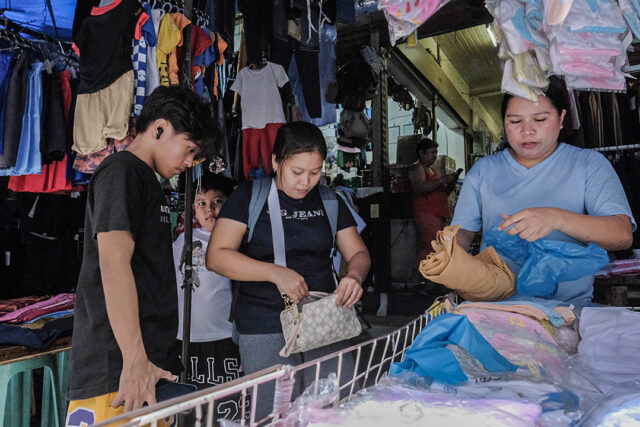
A woman buys uniforms for her children at a stall in Divisoria, Manila. — PHILIPPINE STAR/RYAN BALDEMOR

THE NATIONAL GOVERNMENT (NG) may need to impose new taxes or raise tax rates in order to meet its revenue goals, GlobalSource Partners said.

In a report, GlobalSource country analyst Diwa C. Guinigundo said that the government is “bent on depending on intensified tax collection to fund the deficit.”

“This course may have its natural limits and sooner or later, additional or higher tax rates may be inevitable,” he said.

“With the persistent issues in governance, the old formula of intensifying tax collection and ensuring compliance with tax laws may not deliver sufficient revenues,” he added.

Finance Secretary Ralph G. Recto has reiterated there are no plans to introduce new taxes apart from the reform measures pending in Congress.

Instead, the Finance department is seeking to rely on enhanced tax administration and ramping up nontax revenues, such as privatizing state assets.

The latest data from the Bureau of the Treasury (BTr) showed that the NG’s budget deficit in the January-May period widened by 24.06% to P404.8 billion as spending outpaced revenue growth.

“Since fiscal goals are anchored to growth targets, setting high gross domestic product (GDP) targets amidst external headwinds risks revenue shortfalls,” Mr. Recto said in a forum on Monday.

“This would strain our deficit and potentially increase borrowing. But tempering these targets does not diminish our commitment to fiscal consolidation. Instead, it reflects a confident and conservative approach to fiscal policy making,” he added.

The latest data from the Finance department showed that revenue collections jumped by 14.5% to P2.13 trillion in the first half of the year.

For the full year, the government is aiming to generate P4.27 trillion in revenues, including P3.83 trillion in tax revenues.

“The legislative process could also be protracted if new tax laws are required so it is critical to already line up priority tax bills,” Mr. Guinigundo said.

He noted some of the administration’s priority tax measures, such as the Passive Income and Financial Intermediary Taxation Act, value-added tax on digital service providers, and excise tax on single-use plastics.

These measures, along with the mining fiscal regime, the motor vehicle road user’s change, and amendments to the Corporate Recovery and Tax Incentives for Enterprises law and Package 4 of Comprehensive Tax Reform Program, are expected to yield P42 billion in annual revenues, the DoF said earlier.

Rizal Commercial Banking Corp. Chief Economist Michael L. Ricafort said that introducing taxes may be a “final resort” by the government.

“Upon exhausting existing tax laws and intensified tax collections, including stricter enforcement such as running after tax cheats, then new taxes and higher taxes would be the final resort, especially if inflation stabilizes further since new taxes and higher taxes could lead to faster inflation,” he said in a Viber message.

Mr. Guinigundo also said the government may need to increase its borrowings, but also ensure effective utilization of the budget.

“Apart from judicious budget utilization, sustainable financing of the increasing fiscal deficit is key to higher economic growth,” he said.

The Department of Budget and Management (DBM) is proposing a 10% increase in next year’s budget to P6.352 trillion.

“The bigger magnitude (of the budget) is no guarantee of any significant gains in economic growth or development,” he said.

“The bottom line is the ability of the Philippine government to make wise use of the budget to establish more critical infrastructure like power, address the fundamental issues in health and education, strengthen the country’s connectivity and digitalization, make headway in promoting rule of law and reducing poverty.” — Luisa Maria Jacinta C. Jocson

Operational synergies crucial in JFC’s acquisition spree — analysts

By Aubrey Rose A. Inosante and Revin Mikhael D. Ochave, Reporter

FAST-FOOD giant Jollibee Foods Corp. (JFC) is actively pursuing acquisitions, a strategy that, according to some analysts, carries inherent risks, including potential challenges in maintaining operational focus.

“While acquisitions can drive growth, there are risks in spreading itself too thin,” First Grade Finance, Inc. Managing Director Astro C. del Castillo said in a Viber message. 

Success “hinges on effectively integrating new acquisitions while maximizing operational synergies across their portfolio,” he added.

He said that JFC’s string of acquisitions demonstrates its aspirations for expansion, “but prudent management and execution will be crucial to sustain momentum.”

JFC’s history of strategic acquisitions includes notable brands like Greenwich Pizza Corp. (1994), Chowking (2000), Red Ribbon Bakeshop (2005), and Mang Inasal (2010). The company also acquired Burger King, Smashburger, The Coffee Bean & Tea Leaf (CBTL), and ventured with Panda Express and Yoshinoya in the Philippines. JFC also expanded with brands such as Yonghe King, Hong Zhuang Yuan, SuperFoods, Tim Ho Wan, and South Korea’s Caffe Ti-Amo.

“Since acquisition, Jollibee has significantly expanded outlets, particularly for Chowking and Mang Inasal, though to a lesser extent for Greenwich and Red Ribbon,” said Ben Paul B. Gutierrez, a professor at the University of the Philippines. Jollibee streamlined Smashburger, reducing outlets in the initial post-acquisition years, he noted.

In 2023, JFC faced challenges, reporting losses from the closure of its Vietnamese noodle house chain, Pho24.

“Jollibee manages numerous brands unlike its Western counterparts such as McDonald’s, necessitating a focused strategy,” Mr. Gutierrez said. “This isn’t the first time Jollibee divests smaller brands to concentrate on larger ones.”

In 2010, JFC discontinued its Manong Pepe business to prioritize larger quick-service restaurants like Mang Inasal, Mr. Gutierrez added, noting, “Managing more brands disperses management attention.”

On July 2, JFC announced acquiring a majority stake in South Korean value coffee brand Compose Coffee for $340 million, boosting its coffee and tea business. Earlier in March, JFC bought a 10% stake in US-based beverage tech firm Botrista, Inc. for $28 million.

Juan Paolo E. Colet, managing director at China Bank Capital Corp., said that Compose Coffee aligns with JFC’s ambition to lead in the coffee and tea segment globally, providing a substantial footprint in promising foreign markets.

Similarly, Mr. Del Castillo highlighted Compose Coffee as an “excellent fit,” offering immediate access to a lucrative market and a proven business model, leveraging JFC’s experience in integrating coffee chains, as seen with CBTL.

He said that success hinges on effectively integrating Compose Coffee, managing debt levels, and maintaining focus on core brands while leveraging beverage sector experience.

Jeff Radley C. See, head trader at Mercantile Securities Corp., noted that current brands are plateauing, prompting JFC’s focus on international expansion and franchising to stimulate growth.

JFC’s robust financial health and cash flow position it for further acquisitions, supported by managing a global portfolio of 18 brands, according to Mr. Colet.

“This portfolio strategy benefits JFC with diverse revenue streams catering to a wide consumer base across countries,” he noted.

Mc Reynald S. Banderlipe II,  a faculty at De La Salle University School of Economics, highlighted JFC’s ability to trial acquired brands in the Philippine market, stressing the importance of market connection for consumer satisfaction and loyalty.

“Good thing enough that Jollibee has enough resources to do trial and error on some of the brands they previously acquired to know if it’s going to be a hit in the Philippine market.”

SUSTAINING GROWTH
JFC remains poised for sustained growth following recent acquisitions, said Jose Antonio B. Cipres, research analyst at AP Securities, Inc.

“Most acquired brands have demonstrated sustained growth since acquisition, which should continue,” he said.

However, challenges persist, with brands like Smashburger facing profitability issues.

Mikhail Philippe Q. Plopenio, research and engagement officer at Philstocks Financial, Inc., highlighted mixed results from JFC’s recent quarterly report, noting operational challenges affecting certain units.

“Despite challenges, most acquired brands have benefited under JFC’s ownership, enhancing market positions through innovation,” he noted.

Investor caution persists regarding JFC’s acquisition strategy, said Mr. Plopenio, referencing an 8% stock price drop post-CBTL acquisition in July 2019.

In the first quarter, JFC reported a 26.9% increase in attributable net income to P2.62 billion, with systemwide sales up 10.4% to P86.83 billion and revenue climbing 11.3% to P61.3 billion.

As of March, JFC expanded its global store network by 5.3% to 6,886 stores, with 3,337 in the Philippines and 3,549 internationally. Key brands by outlet count include Jollibee (1,676), CBTL (1,165), Highlands Coffee (782), and Chowking (616).

Arturo Luz’s minimalist works of art

Cities of the Past (1997)

ONE New Year’s Eve in the early 1950s, Filipino artist Arturo Luz saw three men on a rickety bicycle maintaining perfect balance as they rode down the street. The lean figures of the men were etched in his mind, and later informing his body of work, as first seen in his 1952 oil painting Bagong Taon (New Year).

Unlike most new year’s resolutions, the approach of using lines to create disciplined designs stuck with Mr. Luz, who was later made a National Artist. Displaying linear and geometric elegance and strength, many of Mr. Luz’s paintings, including works that haven’t been seen for decades, are currently on view until July 13 at SM Megamall in Ortigas, Mandaluyong City.

The artist found that his meticulous nature suited the choice to paint a variety of visual elements mainly with lines, be they cyclists, acrobats, musicians, performers, ancient pottery, and even Asian architecture.

“In my own little world, I know precisely what I want to do. And for me, the greatest satisfaction comes from creating works of art. Nothing can compare to it,” Mr. Luz once said.

Art critic Cid Reyes, who curated the exhibition and previously published a book on the Filipino icon’s life and work, said at the exhibit launch on July 2 that there are many reasons Mr. Luz deserves the mini-retrospective.

“Even among the Thirteen Moderns, his style was a stand-out. It has nothing to do with the subject matter; it has mainly to do with a way of thinking, a way of approach to reality, and also the style and technique of what we call minimalism,” he said in an opening speech.

“The taste for minimalism was introduced by Mr. Luz at a time when the aesthetic taste of the Filipino bordered on the extravagant, the excessive.”

The exhibit, organized by the Renaissance Art Gallery, shows a variety of his works — paintings, collages, sculptures, sketches — from his early days to his death in 2021.

STREAMLINED
Among the highlights is a series titled Cities of the Past, which began in the 1990s. The works were born from Mr. Luz’s frequent travels when he was inspired to paint Asian temples, forts, and palaces.

Gracing the launch were National Artists Virgilio Almario (for Literature) and Ramon Santos (for Music), who told BusinessWorld that Mr. Luz was a very quiet man who was full of talent.

“His imagination as an abstractionist is unique, very different from his peers. Even when I wasn’t very conscious about art, I already liked his works,” said Mr. Almario.

Mr. Santos pointed out the beauty in his subtle form of cubism. “It’s fantastic how he drew a musician, a cyclist, and a juggler using the same type of lines. It’s very simple. The word here is subtlety,” he said.

Despite receiving praise and admiration for his contributions to Philippine contemporary art, Mr. Luz was known to maintain a humble demeanor, the two added.

Mr. Reyes, who had interviewed Mr. Luz extensively in the past and had written a book on him, explained that minimalism used to be unfamiliar in the Philippines.

“Most of the paintings of the past were over-decorative, over-indulgent in terms of form and color. It was Mr. Luz who decided to clean all the unnecessary details of a painting. That is the reason this exhibition is called ‘Streamlined’,” he said.

“By taking a dot from here to down there that comprises a line, and with lines alone, creating masterpieces.”

“Streamlined: The National Artist Arturo Luz Exhibition” is on display until July 13 at the Art Center on the 4th floor of SM Megamall Bldg. A in Mandaluyong. For more information, visit renaissanceartph.com.Brontë H. Lacsamana

Megawide, DoubleDragon start construction of Hotel 101 in Quezon City

DOUBLEDRAGON.COM.PH

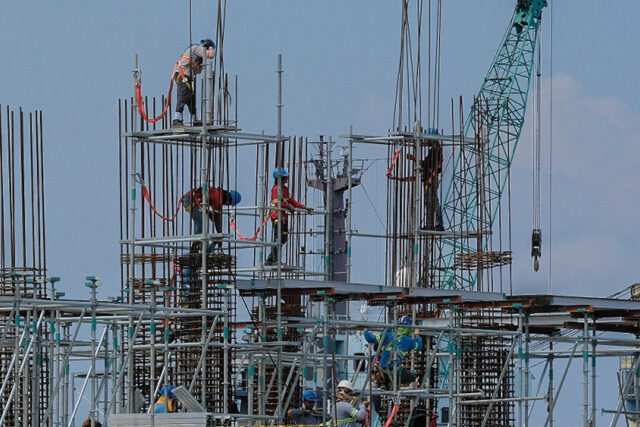
MEGAWIDE Construction Corp. said it has started the construction of DoubleDragon Properties Corp.’s Hotel 101 project in Quezon City, scheduled for completion by the fourth quarter of 2026.

The leisure hotel will have a total of 702 units and will sit on a 2,547-square-meter property within the Bridgetowne Estate in Libis, Quezon City, Megawide said in a statement on Tuesday.

Hotel 101 is the flagship property of Hotel of Asia, Inc., the hospitality arm of DoubleDragon. 

The company said it aims to use its  precast technology to ensure faster results.

“We continue to explore avenues to incorporate and maximize our brand of innovation in the local engineering and construction arena by closely working with our precast and construction solutions unit to offer efficient project turnaround, while reducing long-term outlays for our valued clients,” Megawide Construction Chief Executive Officer Frederick T. Tan said.

The construction of the leisure hotel in Quezon City represents the sixth project between Megawide and DoubleDragon. 

The two companies have recently completed four projects: DD Center East and West, which are commercial buildings accommodating office and retail tenants; and DD Plaza and DD Tower.

Megawide also said that construction is ongoing for DoubleDragon’s luxury serviced residences buildings, including DD Meridian Tower and Ascott-DD Meridian Park Manila.

At the stock exchange on Tuesday, shares in Megawide ended three centavos higher or 1.03% at P2.95 each; while shares in DoubleDragon also gained 36 centavos or 2.99% to end at P12.40 apiece. — Ashley Erika O. Jose

The essence of Japanese ceramics

TEA WARE used for tea ceremonies — BRONTË H. LACSAMANA

NATURAL aesthetics are celebrated in Japanese culture. In ceramics, high-fire techniques result in unglazed wares that show how the goal of ceramic pieces is not to be as polished as possible, but instead are valued for their functionality in everyday life. Today, it is an art all over the world, encompassing new and unconventional expressions that have made it a contemporary, in addition to a functional, art form.

Scholars estimate that, in Japan, utilitarian earthenware date back to the pre-feudal Heian period, as early as the year 794.

Currently on view at the Metropolitan Museum of Manila (The M) is the exhibit “Yakishime: Earth Metamorphosis” — an initiative of the Japan Foundation Manila — which tackles the history, evolution, and examples of Japanese ceramic ware known as yakishime.

The exhibition occupies the museum’s North Gallery on the second floor and is ongoing until July 31.

Yaki or yaku means fire or burn, and shime or shimeru means heightened or combined. I’d like you to recall and imagine the time when the artists of ancient times sat on the soil and stared at the fire that burned their works,” Ben Suzuki, director of the Japan Foundation in Manila, said at the exhibit’s launch on July 3.

On view at the gallery are pots, bowls, and jars from before the 12th century, and tea ware from the Momoyama period in the 16th century. Some pieces, however, are only represented by photographs due to the original pieces being too fragile for international transport.

The exhibition also includes new and unconventional expressions of yakishime by noted Japanese ceramicists Takashi Ikura, Kyoko Tokumaru, and Makiko Hattori.

Filipino ceramic artist Jezzel Wee, who studied in Japan for three years and now teaches at the University of the Philippines, told BusinessWorld that yakishime makes use of very painstaking techniques.

“Even the angle by which you place [the clay item] over the fire affects how the texture on its surface will turn out,” she said while leading a tour around the exhibition. “You can control the quality of the piece through the thickness of the clay and the intensity of the fire.”

She pointed out the various textures that contemporary ceramicists can create in their works, highlighting how ceramic ware can range from simple and functional for serving food and making tea, to experimental and creative as objet d’arts.

For National Commission of Culture and the Arts chair Victorino Manalo, yakishime doesn’t just reflect a distinct Japanese sensibility and aesthetic — it is also something Filipinos can learn from.

“It teaches about finding the universal in small, seemingly ordinary things. Perhaps it is time we examine our own unglazed pottery which we dismiss as the humble palayok. If we look through the lens of the Japanese, we may find more beauty in it,” said Mr. Manalo at the launch.

The exhibit has toured the world since 2016, featuring objects that span the chronicles of yakishime. After its run at The M, the exhibit will move to Iloilo in August, where it will be hosted by the Iloilo Museum of Contemporary Art (ILOMOCA).

The Philippine leg of the international tour is supported by the Embassy of Japan in the Philippines and features hands-on workshops and special events to be announced on the Japan Foundation Manila’s social media pages.

“Yakishime: Earth Metamorphosis” runs until July 31 at The M in Bonifacio Global City. Admission is free to the public. — Brontë H. Lacsamana

CTA denies Nippon Express’ P20-M tax refund

CTA.JUDICIARY.GOV.PH

THE COURT of Tax Appeals (CTA) has denied Nippon Express Philippines Corp.’s claim for a tax refund of over P20 million.

“For the 3rd quarter of taxable year 2018 or the period from July 1, 2018, to Sept. 30, 2019, [Nippon Express] has no unutilized input VAT (value-added tax) attributable to its zero-rated sales which may be the subject of a claim for refund,” the 67-paged decision penned by Associate Justice Marian Ivy F. Reyes-Fajardo read.

The court ruled that to be entitled to a refund, the input VAT claimed must be substantiated by supporting documents.

It added that these documents must comply with the invoicing requirements under the National Internal Revenue Code.

In denying Nippon’s petition, the court said that Nippon had no unutilized input taxes available for refund.

Nippon sought a refund of input VAT worth P20,899,347.46, which constituted a portion of its claimed total allowable input tax amounting to P107,798,471.06.

Nippon claimed input VAT attributable to zero-rated sales amounting to P49,992,599.37 was partially applied against its reported output VAT liability amounting to P29,093,251.91, hence it was seeking a P20,899.347.46 refund.

The court followed the same computation: after deducting the amount of P43,617,528.13 in valid input VAT allocated to VATable sales/receipts from its output VAT liability of P86,899,123.31 on the paid sales/receipts, Nippon has a net output VAT payable of P43,281,595.48.

Since Nippon’s input VAT attributable to VATable sales is not enough to cover its output VAT liability, the valid input VAT attributable to zero-rated sales will be used against the remaining output VAT liability, the CTA said.

However, the court said the valid input VAT attributable to zero-rated sales of P37,722,008.95 is apparently lower than the net output VAT payable of P43,281,595.48.

Thus, the court said Nippon has net output VAT still due amounting to P5,559,586.52. — Chloe Mari A. Hufana

Psychogeographies of Mandaluyong

LYMAN HANSEL GERONA-UNSPLASH

By Juaniyo Arcellana

WHEN first we moved to the city shortly after the turn of the millennium, we tried our best to take mental notes of the landmarks to help navigate through the maze of a new environment — the grocery, schools, jeepney stops and routes, church, and market. One of the worthy guides at the outset was the neighborhood barber, whose clients included professional basketball players, who as the wont of others in his trade had a ready analysis on politics, sports, other current events not necessarily limited to the barangay, while snipping hair, or whatever was left of it.

“Have you ever tried it,” he said, “jogging in the mental hospital compound nearby?”

This remark nearly gave birth to a song, “Jogging sa Mental,” whose lyrics never got out of square one, and since then there were other barbers, other sundry exercises, mostly walking, sometimes past the mental compound and its rows of acacia trees and baletes where the demons of the distressed behind those high walls take refuge, or so old folks like to believe.

Been in this city for more than 20 years, but the three spent during the pandemic, give or take a few months, were harsh. It might be an understatement to say the landscape changed or went through constant rearrangement — stores and businesses closed or moved shop, others sprouted in their place, only to go through their own evolution from hole in the wall to mom-and-pop startup, to pseudo establishment that could never even dream of becoming a POGO.

Needless to say, there was an online renaissance. One son who was forced to work from home had to purchase gadgets just to boost the internet connection, only to give up and switch providers altogether, else he’d likely be laid off. Recently the same phone company sent a notice that they’d “temporarily be disconnecting” the landline for nonpayment of dues for a phone that has been out of order for months.

Catch 22: pay or your phone gets disconnected versus why pay for a phone that isn’t working? Besides, there’s Viber. But surely it is a great disadvantage when ordering delivery if there’s no landline. Willing to wait? While the muzak plays on.

Better to venture out into the streets again now that hardly anyone wears face masks anymore and you can finally see their faces and expressions, smell their bad breaths as they speak for this or that candidate, though there are still rare days when you miss everyone looking like a holdupper — don’t stand so close to me.

In the second iteration this year of the mammoth book fair Big Bad Wolf, held in nearby Glorietta if we be allowed to cross the Guadalupe bridge for a second from Tiger City, we stumbled across the pocket book Psychogeography by Merlin Coverley, which could well sum up what we’ve been trying to do in recent writing exercises, including this one.

Not exactly a philosophy but a means of approaching things with a clear enough head, specifically in modern and postmodern neighborhoods through which the writer walks in a low-key, ostensibly unremarkable adventure of discovery and, who knows, self-discovery.

A number of authors are mentioned, several familiar from high school literature courses like William Blake, Thomas de Quincey, Robert Louis Stevenson, whose Dr. Jekyll and Mr. Hyde is cited as a prime example of how London’s streets are never what they seem, or the streets of any city for that matter, e.g., Mandaluyong in the 21st century.

Establishments that have closed shop since the pandemic include the Monterey meat shop across the condominium along Boni; the PLDT headquarters, also on the same avenue, in front of Rizal Technological University, the building resembling a dirty white elephant; Masterpiece auto shop where we would go for quick purchases for change oil and tune-ups; while the LBC moved to a much smaller space a block away with the onset of e-wallets and digital kwarta padala.

Also, the public hospital, which road had been blocked off during the time of coronavirus, was finally closed down and moved to Martinez, one of those roads that emanate like spokes from a wheel that is Maysilo or municipal hall.

There’s a new Potato Corner near the corner of Barangka and Boni, a couple of Dali groceries where German and Vietnamese beers are at a bargain, some new panciterias where hopefully the servers and waiters don’t sleep off the lax hours.

We’re still reading through Coverley’s book, between forays to the neighborhood for the usual chores and errands, but this was never meant to be a review. Just an update on this eastern part of the metro, where once we dreamed of putting up a community paper, the Mandaluyong Sun. There are too many newspapers though, more than enough to wrap smoked fish or wipe windshields in ambulant carwashes with.


Juaniyo Arcellana is a semiretired/senior desk editor at BusinessWorld’s sister publication The Philippine Star. Thirty years ago he had a sports column called The Mopman in BusinessWorld.

PSALM says financial obligations trimmed to P283B

FREEPIK

STATE-RUN Power Sector Assets and Liabilities Management Corp. (PSALM) said its outstanding financial obligation stood at P283.28 billion as of the end of May.

This amount represents a decrease of P957.32 billion from the P1.24-trillion debt accumulated in 2003, according to PSALM’s data.

The latest financial obligation figure is lower than the P292.49 billion recorded as of the end of April.

The company said the reduction was a result of the “continuous implementation of liability management programs and strategies.”

Its total debt stands at P247.76 billion, while its lease obligations to independent power producers was at P35.52 billion.

In terms of currency composition, approximately 42% of PSALM’s financial obligations amount to P119.34 billion in US dollars, while the remaining 58%, totaling P163.94 billion, are denominated in pesos.

PSALM was established under Republic Act No. 9136, also known as the Electric Power Industry Reform Act (EPIRA) of 2001, with the mandate to oversee the privatization of generation and transmission assets formerly held by the National Power Corp. and the National Transmission Corp.

Originally slated to conclude in June 2026, or 25 years after the enactment of EPIRA, PSALM’s corporate existence would end. In the event of its dissolution, all assets and liabilities would revert to the National Government.

Finance Secretary Ralph G. Recto has said that the corporate life of PSALM should be extended by possibly another 25 years as it still has a lot of assets for sale and financial obligations to settle.

Assets under PSALM include the 796.64-megawatt (MW) Caliraya-Botocan-Kalayaan (CBK) hydroelectric power plant complex in Laguna.

The CBK hydro facilities are currently under a 25-year build-rehabilitate-operate-transfer scheme run by independent power producer CBK Power Co. Ltd., which will expire in 2026.

The company has also a rehabilitation and asset management plan for the Agus-Pulangi hydropower complex which is targeted for implementation in 2026.

The complex consists of seven run-of-river hydroelectric power plants located in southern and central Mindanao with a combined installed capacity of 1,001.1 MW. — Sheldeen Joy Talavera

Arts & Culture (07/10/24)


Jethro Jocson solo exhibition at Alliance Française

WITH a palette of vibrant colors, playful textures, and nostalgic motifs, the exhibit “Resurrect” by Jethro R. Jocson acts as a portal to the past and a bridge to the present self and beyond. By utilizing whimsical and childlike elements that evoke memories of childhood, he invites the audience to re-examine what possible new meanings or feelings they can derive from their unique and personal experiences. “Resurrect” is open for public viewing until July 24 at the Alliance Française de Manille Gallery, 209 Nicanor Garcia St., Makati City.


Pop art group exhibit at Imahica Art

IMAHICA Art is opening a group show titled “Neon Dreams: Through the Prism” on July 13 at 4 p.m. It will explore pop art in traditional and digital media with cultural reflections in vibrant and striking colors. The contemporary Filipino artists in the exhibit are Alver de Ocampo, Astrid Anabo, Obags, Genzel San Jose, J.Iimayo, J Simo Bello, JOLY BEART!, Joyce Igancio, KRING, Miclcee, Mr. E, Mustache Boii, and Nantz Matienzo. “Neon Dreams: Through the Prism” will run until July 31 at Imahica Art Gallery, 2A Lee Gardens, Shaw Blvd., Mandaluyong.


Filipino children’s book talents celebrated

THE CULTURAL Center of the Philippines (CCP), in collaboration with the Philippine Board on Books for Young People (PBBY), celebrates National Children’s Book Day this July. This year, the PBBY-Salanga Prize recognizes the literary brilliance of Eric R. Roxas for his book entitled Monina’s Many Moles that transcends boundaries and inspires young minds. Meanwhile, illustrator Marcus Vito Z. Nada receives the PBBY-Alcala Prize for his artistic prowess in enriching the world of children’s literature with captivating visuals. The celebration and awarding ceremony are scheduled for July 16, starting at 9:30 a.m., at the Tanghalang Ignacio Gimenez (CCP’s Blackbox Theater), featuring a musical performance by Ginger Karganilla and Billy Joel del Rosario, composed by Greg Zuniega; storytelling by the Philippine Information Agency (PIA) puppeteer; and the unveiling of new children’s books. The Payapa book fair will be held at the basement level of the venue. To join the festivities, a children’s book must be donated to the registration desk on the day of the event.


Theater play shop for kids at AFM

THE ALLIANCE Française de Manille (AFM) and Kalipayan Education will be holding ThéÂRTelier, a theater play shop for children ages six to 11 starting on July 23 at AFM. The workshop aims to develop the children’s communication and collaboration skills through modern, experimental, and improvisational theater techniques. The nine-day workshop concludes with a recital at the AFM Multipurpose Hall on Aug. 3. It costs P16,500 for the entire workshop and recital. For an early bird rate, participants can register until July 14.


Dancers spotlight feminism, gender oppression

A SERIES of performances titled Cycles: From Conversations to Choreography are meant to shed light on feminism and misogynistic issues. The 75-minute mixed bill repertoire will unveil original and innovative dance styles inspired by the narratives of systemic oppression experienced by female adolescents in the Philippines. It will showcase the contemporary and open-style choreographies of the Dance Program students from the De La Salle-College of Saint Benilde (DLS-CSB). Cycles: From Conversations to Choreography will be held on July 19 at 6 p.m. and July 20 at 1 and 6 p.m. at the 5th Floor Theater of the Design + Arts Campus, 950 Pablo Ocampo St., Malate, Manila. Tickets are available for P500 at rb.gy/0q7wzw.


Virgin Labfest announces plays for 20th edition

AFTER the successful three-week run of its 19th edition, the Virgin Labfest has announced the 12 new plays culled from over 200 submissions that it will be presenting next year. Co-presented by the Cultural Center of the Philippines (CCP), Tanghalang Pilipino Foundation Inc. (TP) and the Writer’s Bloc, Inc., the playwrights festival of untried, untested, and unstaged plays announces the new “virgin” plays, namely: Minating ni Mariah ang Manto ng Mommy ni Mama Mary by Eljay Castro Deldoc, Unang Araw by Ivan Villacorta Gentolizo, Anniversary by Nelsito Gomez, Ang Problema sa Trolley by Imuthis (Harvey Rebaya Sallador), Mga Magindara sa Siyudad by Chris Joseph Junio, Mommy G by Jobert Grey Landeza, Don’t Meow for Me, Catriona by Ryan Machado, Presidential Suite 2 by Siege Malvar, The Late Mr. Palma by Rolin Migyuel Cadallo Obina, The Orphan and the Rat by Liane Carlo R. Suelan, Polar Coordinates by Ade Valenzona, and TBT: Takbo, Batang Tondo by Mikaella Yoj.


Double win for Manila Symphony Jr. Orchestra

THE MANILA Symphony Junior Orchestra (MSJO) has topped two international competitions in Europe. First it won the Gold Prize and Grand Prix at the 6th Bratislava International Music Festival in Slovakia on July 4, then on July 7 it won First Place, with Outstanding Success for String Orchestra Category at the 16th Summa Cum Laude International Music Festival in Vienna, Austria. Asian orchestras did well at the Austrian festival, with first place also awarded to the Hsing Lung String Orchestra from Taiwan while 2nd place went to the Hong Kong Youth Strings and the Taipei Municipal Zhongzheng Junior High School, and 3rd Place going to the Singapore National Youth String Orchestra. The MSJO is currently on tour in Europe and will return to the Philippines on July 13. The 2024 European Tour of the MSJO was sponsored by Standard Insurance.