Home Blog Page 2555

Age no barrier for octogenarian South Korean model defying stereotypes

SEOUL — South Korean grandmother Choi Soon-hwa dreamed of becoming a fashion model when she was in her 20s, but faced with life’s pressures it would take another five decades to achieve her goal.

The silver-haired Ms. Choi, 81, recently made history by becoming the oldest contestant at a Miss Universe Korea competition, after the pageant dropped age restrictions that had only allowed women aged 18-28 to participate.

“After hearing that the age restrictions were removed I thought — wow that’s great. I cannot miss this opportunity,” Ms. Choi said.

While she did not win, Ms. Choi made it to the finals and was given the “Best Dressed Award” among her younger rivals.

Her dreams of becoming a fashion model or a movie star when younger had to be put aside so she could take on regular jobs in order to care for her children and meet financial commitments.

It was only while working as a hospital caregiver that her dream became a reality after one of her patients suggested she apply to be a senior model when she was 72.

Ms. Choi, who signed up for a modelling academy, recounts how when it was quiet at night in the hospital she practiced being on a catwalk and posing in front of a mirror.

Since then, Ms. Choi’s new career has taken off and she has appeared at multiple fashion shows and her image has been splashed in magazines and her story covered by television shows.

“I won in the second half of my life. In the first half, I was just running around without scoring any goals, but I finally scored in the second half,” she told Reuters.

Yun Mi-young, 59, who is another senior model, said she was inspired by Ms. Choi.

“The first time I saw her was on TV, she looked so cool. I thought that I want to be a senior model just like her.”

Ms. Choi also shares tips on how to stay in shape, including starting each day with a healthy breakfast of boiled eggs and fruit and regularly taking walks in a nearby park.

South Korea is on course to become a “super-ageing” society by next year when more than a fifth of its population will be over 65 and Ms. Choi wants her success to inspire others in this age group.

“I hope other seniors can find courage through my story,” Ms. Choi said. — Reuters

Gov’t debt yields go up on Fed bets

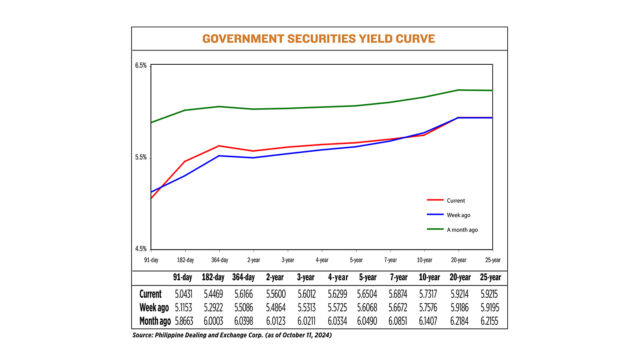
YIELDS on government securities (GS) mostly rose last week as better-than-expected US jobs and inflation data dampened bets of a big rate cut by the US Federal Reserve.

Bond yields, which move opposite to prices, went up by an average of 3.95 basis points (bps) week on week, based on the PHP Bloomberg Valuation Service Reference Rates as of Oct. 11 published on the Philippine Dealing System’s website.

The short end of the yield curve ended mixed, with the 91-day Treasury bills (T-bills) falling by 7.22 bps to fetch 5.0431%. Meanwhile, the 182- and 364-day T-bills climbed 15.47 bps and 10.8 bps to 5.4469% and 5.6166%, respectively.

At the belly, yields rose across all tenors. Rates of the two-, three-, four-, five-, and seven-year Treasury bonds (T-bonds) rose by 7.36 bps (to 5.56%), 6.99 bps (5.6012%), 5.74 bps (5.6299%), 4.36 bps (5.6504%), and 2.02 bps (5.6874%), respectively.

At the long end, the yield on the 10-year debt paper declined by 2.59 bps to 5.7317%, while rates of the 20- and 25-year bonds went up by 0.28 bp (to 5.9214%) and 0.2 bp (5.9215%), respectively.

Total GS volume traded stood at P52.22 billion on Friday, lower than the P53.18 billion recorded as of Oct. 4.

Benchmark yields were higher last week after as markets repriced their US rate cut bets, Alessandra P. Araullo, chief investment officer at ATRAM Trust Corp., said.

“Key market movers [last] week were the release of the Fed minutes and the US CPI (consumer price index) prints,” Ms. Araullo said in a Viber message.

“Fed Chair Jerome H. Powell already commented that 25-bp rate cuts may be more likely for November and December. The strength of the recently released jobs data also leans against the likelihood of a larger rate cut in November,” she added.

Minutes of the September meeting showed that a “substantial majority” of US Federal Reserve officials supported the hefty 50-bp rate cut to start the turn toward easier monetary policy, there appeared more universal agreement that the initial move would not commit the Fed to any particular pace of rate reductions in the future, Reuters reported.

Meanwhile, US CPI rose by 0.2% in September after 0.2% in August, the Labor department’s Bureau of Labor Statistics said. On an annual basis, September inflation picked up 2.4%. That was the smallest year-on-year increase since February 2021 and followed a 2.5% advance in August.

“Secondary T-bonds traded defensively to start the week after the spike in US yields [on Oct. 4] as the US nonfarm payrolls saw a 254,000 increase versus the 150,000 expected. Retail Philippine government bonds traded on a knee-jerk response to higher US rates,” Security Bank Corp. Vice-President and Head of Fixed Income Dino Angelo C. Aquino said in an e-mail. 

“With the impression that the Fed remains focused on the labor market, expectations remain intact for a 25-bp cut by the Fed next month. Local markets took the news in stride and saw continued buying momentum,” he added.

For this week, the market will monitor the Bangko Sentral ng Pilipinas’ (BSP) policy meeting on Wednesday, both analysts said.

“With the BSP meeting, the local market will continue to track US bond movements given the lack of fresh leads,” Mr. Aquino said. “Market is pricing in a 25-bp cut by the BSP on Oct. 16 after September inflation surprised to the downside at 1.9%. Market guidance is still biased for a gradual rate reduction which would be supportive for local bonds.” — J.R.C. Alvarez with Reuters

ICTSI shares fall despite developments

BERTH 7 of the Manila International Container Terminal — ICTSI.COM

SHARES in Razon-led International Container Terminal Services, Inc. (ICTSI) fell last week following a South African court’s injunction against the port operator’s bid for Durban Container Terminal Two (DCT2), as well as global macroeconomic factors, according to analysts.

Data from the Philippine Stock Exchange showed that ICTSI was the second most actively traded stock in terms of value turnover, with P2.71 billion worth of 6.36 million shares exchanging hands from Oct. 7 to 12.

The listed port operator’s shares closed at P407.80 each on Friday, which was 2.9% lower than its Oct. 4 close of P420. Year to date, the stock has increased by 65.2%.

Andrei Jorge G. Soriano, research associate at China Bank Securities Corp., said in an e-mail that the major development which affected the listed port operator is the South African court’s decision to issue an injunction against ICTSI’s bid for the Durban Container Terminal Two.

He added that investors are likely concerned given that DCT2 is a major terminal in South Africa with an annual capacity of two million twenty-foot equivalent units.

For Arielle Anne D. Santos, equity analyst at Regina Capital Development Corp., the port operator was driven by operational developments and global macroeconomic factors.

“While [ICTSI] has announced significant growth moves, like its expansion in Batangas and its increased capacity in Iloilo, the global shipping and logistics sector remains vulnerable to fluctuations in trade volumes, global interest rates, and currency risks,” Ms. Santos said in an e-mail.

ICTSI said it will challenge the ruling of the Kwazulu Natal Division of the High Court of South Africa, which has issued an injunction against Transnet, halting the privatization of Durban Container Terminal Pier 2.

According to international reports, DCT2 is Transnet’s largest container terminal, handling 72% of the Port of Durban throughput and 46% of South Africa’s traffic.

Back in July 2023, ICTSI won a tender process conducted by Transnet to invest in and operate the terminal under a 25-year concession.

Though ICTSI was the selected bidder and secured its contract in March this year, APM Terminals contested the award, citing concerns about ICTSI’s solvency calculation.

APM Terminals is a unit of Maersk’s Transport and Logistics Division.

This deal then faced opposition, which delayed its implementation.

The injunction prevents Transnet from finalizing the contract or engaging in any negotiations with ICTSI or third parties until a final ruling is made.

ICTSI said that they fully respect this decision but disagree with the court ruling.

Meanwhile, other reports also show that ICTSI’s business unit, Visayas Container Terminal in Iloilo, started using two new mobile harbor cranes. The use of these cranes is expected to improve the efficiency and competitiveness of the Iloilo port as a trade gateway for Western Visayas.

Additionally, its East Java Multipurpose Terminal (EJMT) operations in Lamongan Regency, Indonesia began on Oct. 2. Its construction began in March 2023, and within 18 months, the terminal was fully equipped to serve diverse trade needs. EJMT is a sought-after and versatile addition to Indonesia’s port infrastructure.

Recent news also said that the port operator has acquired a 27-hectare property in Batangas to expand its 900-meter berth terminal, which will be used for its expansion plans, especially for its new 900-meter berth terminal, although the exact amount of the transaction was not disclosed.

Ms. Santos said that the introduction of these mobile harbor cranes is expected to improve efficiency at the Iloilo port and may have a positive impact on ICTSI’s long-term competitiveness in regional markets, likely boosting both sentiment and operations in the domestic sphere.

Moreover, its operations at EJMT in Indonesia mark a significant milestone in expanding ICTSI’s global footprint.

“The facility’s ability to handle diverse trade needs is well-aligned with Indonesia’s growing export-import market, potentially driving future revenue growth in [Southeast Asia],” she said.

Additionally, the acquisition in Batangas is likely a signal to expand capacity at a key domestic port.

Ms. Santos added that while the market is still digesting the news of expansion, this strategic move aims to capture more volume and is likely to improve long-term revenue streams.

The overall market conditions, including inflation pressures, slowing global trade, and persistent interest rate hikes in major economies, may have dampened enthusiasm toward global port operators in general, she added.

“Furthermore, the mixed performance of other PSE-listed stocks, driven by broader market sentiment, would likely influence ICT as part of a macro-driven sell-off or rebound,” Ms. Santos said.

For Mr. Soriano, these developments bode well with respect to the port operator’s prospects, such as additional services, possible tariff increases, and margin expansion, but said that market players have primarily focused on the port operator’s DCT2 bid.

“While the resolution of the DCT2 case is the utmost consideration among investors right now, we are still upbeat on ICT given continued tariff increases in certain terminals and expansion opportunities to boost earnings prospects,” he said.

Additionally, he said that attractive dividend yields would also be a key consideration among investors to consider ICTSI.

In the second quarter, ICTSI’s attributable net income grew by 32.3% to $210.67 million from $159.19 million a year earlier. Meanwhile, consolidated revenues increased by 13.6% to $714.11 million.

For the first half of the year, net income grew by 34% to reach $420.55 million, whereas consolidated revenues for the six-month period grew by 14.6% to $1.4 billion.

Mr. Soriano sees earnings forecasts for the full year 2024 will reach $814 million, while for the full year 2025 at $884 million.

“We see current support at P400 while resistance at P420,” Mr. Soriano said.

For Ms. Santos, given the global reach of the Razon-led port operator, earnings for the third quarter could likely reflect some operational improvements from these expansions.

“The Visayas and East Java terminal enhancements should drive incremental revenue growth, while cost efficiency measures may also protect margins,” she said.

Ms. Santos added that earnings growth for the current quarter is expected to be in the mid- to high single digits, while full-year earnings growth could be around the teens.

She pegged support levels at P404 while resistance levels at P419.80, respectively. — Abigail Marie P. Yraola


Supporting breast cancer survivors

ICANSERVE FOUNDATION, INC.

Breast cancer survivorship and long-term supportive care are underrepresented, particularly in middle-income countries like the Philippines. The World Health Organization (WHO) reported 33,079 new cases of breast cancer in 2022, a figure that is among the highest in Asia. A study by the Philippine Cancer Society and the Department of Health (DoH) Rizal Cancer Registry revealed a rise in breast cancer incidence from 1980 to 2022. This upward trend underscores the urgent need for comprehensive care, early detection, and a national focus on improving survivorship and support for breast cancer patients.

To help address these gaps, the ICanServe Foundation (ICS) convened Patient Power Philippines, an informal coalition of breast cancer support groups in the country, to hold a two-day workshop which aimed to serve as a multistakeholder platform to discuss the integration of a multi-disciplinary, wholistic support within existing healthcare frameworks in the country.

Entitled “Leading with Care: Building a Supportive Future for Breast Cancer Survivors,” the workshop also sought to encourage collaboration among patient groups to pool resources for more accessible and sustainable supportive services. It was organized in partnership with AstraZeneca, Roche, Novartis, MSD, Healthway Cancer Care Hospital, and the Pharmaceutical and Healthcare Association of the Philippines (PHAP), among other partners.

Now on its fourth edition, the workshop featured panel discussions, presentations, and breakout sessions designed to equip participants with practical strategies to develop personalized survivorship care plans. A distinguished roster of speakers presented models from countries where comprehensive survivorship care clinics or “one-stop shops” have been successfully implemented that could serve as potential blueprints for the Philippine healthcare system.

Setting the tone for the workshop was the inspirational message of breast cancer survivor Keri Zamora, First Lady of San Juan City, who was diagnosed with Stage 3 breast cancer in 2019 at age 39. At that time, she and her older sister were caregivers to their mother who was diagnosed with breast cancer just 12 weeks earlier. “It felt like it was the end of the world. At that time, I thought cancer meant immediate death. I felt so heartbroken for my family,” she shared.

Now on her fifth year as a breast cancer survivor, Ms. Zamora celebrates her survivorship by providing support to her fellow breast cancer survivors and other Filipino women through the two foundations she heads. The Caring Keri Foundation works to help women and children with their needs by providing medical assistance, livelihood programs, mental health seminars, and free screening for breast and cervical cancer among others. Also, the Metro Manila Mayors’ Spouses Foundation implements projects that benefit cancer patients and promote a healthier and cleaner environment in the National Capital Region.

“To women who have been recently diagnosed with breast cancer and are undergoing treatment, have hope and draw strength from your loved ones,” said Ms. Zamora. She advised breast cancer patients to get a second opinion if they have any doubts, keep busy with activities that make them happy, be patient with their healing, not compare their journey with others, do online research to help them prepare for their treatment and self-care, and pray.

ICS founding president Kara Magsanoc-Alikpala delivered the opening remarks while Jeff Dunn, president of the Union for International Cancer Control (UICC), gave the keynote speech.  Dr. Don Dizon, a medical oncologist and professor specializing in women’s cancers, shared his insights on survivorship and supportive care.

The session on mental health featured writer, editor, and breast cancer survivor Alya Honasan and psychologist Lia Delgado-Infante who offered guidance on effective self-care strategies, particularly for families navigating the emotional challenges of cancer.

Former congresswoman Chiqui Roa-Puno moderated the session on financial navigation throughout the cancer journey featuring Exequiel Sy from PhilHealth, Romeo Marcaida from the Philippine Cancer Society, and Dr. Jan Aura Llevado from the Department of Health as resource speakers. Former Health Secretary Dr. Jaime Galvez-Tan and internist-nutritionist Dr. Maricar Esculto-Khan Tan led the conversations on nutrition, while a session on lymphedema, and hair and skin care, moderated by TV host Suzi Entrata-Abrera, was spearheaded by Dr. Francis Ciabal and Dr. Claire Habito.

Broadcast journalist Tina Monzon Palma moderated a session on hospice and palliative care featuring Dr. Mae Corvera, President and CEO of The Ruth Foundation for Palliative and Hospice Care, and Fatima “Girlie” Lorenzo, Executive Director, National Hospice and Palliative Care Council of the Philippines, as resource persons. The session on “Exercise as Medicine,” moderated by ICS spokesperson Bibeth Orteza, featured exercise physiologist Dr. Rob Newton. The panel discussion on institutionalizing multidisciplinary survivorship and supportive care in both the public and private sectors was led by Emmanuel Ledesma, President and CEO of PhilHealth, together with Dr. Claire Soliman of the East Avenue Medical Center, Dr. Mae Corvera, Dr. Ramy Roxas of Healthway Cancer Care Hospital, and Melina Avila of Living Hope. Dr. Madeleine Valera of Vital Strategies moderated the session.

The session on Global Breast Cancer Initiative, moderated by ICanServe volunteer Mimi Martin, featured Dr. Cecile Montales, ICanServe Board of Trustees Member; Elick Narayan of WHO Western Pacific; and Dr. Herdee Luna, a member of the Philippine Society of Medical Oncology, as guest speakers. They tackled health promotion, early detection, and quality cancer management. ICanServe volunteers Irene Lee, Marivic Bugasto, and Betty Senador shared Stories of Hope. ICanServe board member Doris Nuval wrapped up and concluded the Day 1 session, while ICS president Nikoy de Guzman led the closing ceremony on Day 2.

PHAP supports the ICanServe Foundation as they pave platforms for the creation of policies that aim to provide every breast cancer survivor with access to the care and support they deserve.


Teodoro B. Padilla is the executive director of Pharmaceutical and Healthcare Association of the Philippines which represents the biopharmaceutical medicines and vaccines industry in the country. Its members are in the forefront of research and development efforts for COVID-19 and other diseases that affect Filipinos.

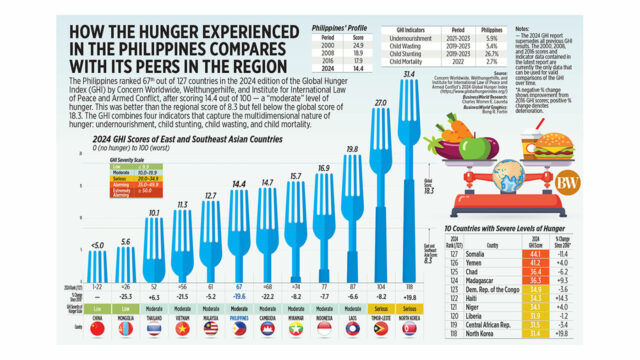
How the hunger experienced in the Philippines compares with its peers in the region

The Philippines ranked 67th out of 127 countries in the 2024 edition of the Global Hunger Index (GHI) by Concern Worldwide, Welthungerhilfe, and Institute for International Law of Peace and Armed Conflict, after scoring 14.4 out of 100 — a “moderate” level of hunger. This was better than the regional score of 8.3 but fell below the global score of 18.3. The GHI combines four indicators that capture the multidimensional nature of hunger: undernourishment, child stunting, child wasting, and child mortality.

How the hunger experienced in the Philippines compares with its peers in the region

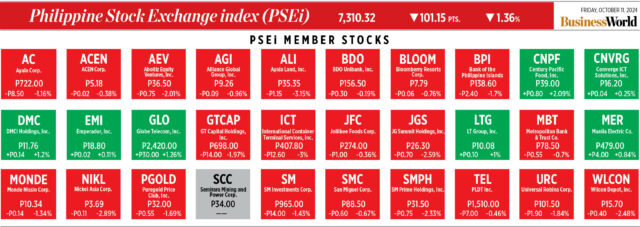
How PSEi member stocks performed — October 11, 2024

Here’s a quick glance at how PSEi stocks fared on Friday, October 11, 2024.


Index may retest 7,400 before BSP policy meet

BW FILE PHOTO

By Sheldeen Joy Talavera, Reporter

THE MAIN INDEX could retest the 7,400 mark this week as the market awaits the Bangko Sentral ng Pilipinas’ (BSP) policy meeting on Wednesday, with a rate cut expected to boost sentiment.

On Friday, the bellwether Philippine Stock Exchange index (PSEi) dropped by 1.36% or 101.15 points to end at 7,310.32, while the broader all shares index shed 0.55% or 22.36 points to close at 4,015.16.

Week on week, the PSEi declined by 2.11% or 157.60 points from its 7,467.92 finish on Oct. 4.

“Last week, negative developments were seen in the local bourse. After five straight weeks of rallying, the market pulled back, giving up its position at the 7,400-7,500 range in the process. Trading has toned down as seen in the thinning value turnover and foreigners have turned net sellers for the past three trading days,” Japhet Louis O. Tantiangco, senior research analyst at Philstocks Financial, Inc., said in a Viber message.

For this week, the market may rebound on bargain hunting before the BSP’s review, he said.

“A rate cut, if delivered, may give the market a boost. Investors are also expected to watch out for clues on the BSP’s policy outlook. If hints of more policy easing would be given, then it is expected to spur optimism amongst investors,” Mr. Tantiangco said.

“We could see a resurgence of selling pressure on Wednesday as investors await the BSP’s policy decision… We believe markets will closely monitor how the recent positive inflation surprise, and rising geopolitical tensions in the Middle East would factor into the BSP’s policy decision and guidance,” Rastine Mackie D. Mercado, research director at China bank Securities Corp., said in an e-mail.

A BusinessWorld poll conducted last week showed that 16 of 19 analysts expect the Monetary Board to cut benchmark interest rates by 25 basis points for a second straight meeting at its policy review on Oct. 16 (Wednesday). This would bring the policy rate to 6% from the current 6.25%.

Jayniel Carl S. Manuel, an equity trader at Seedbox Securities, Inc., said sentiment may be mixed this week “as both technical and fundamental factors weigh in.”

“On the technical front, the PSEi has recently pulled back after peaking near 7,415, now sitting around 7,310, down 1.36%. This decline suggests that the index may enter a consolidation phase or face further downside pressure,” he said.

Mr. Mercado placed the PSEi’s support at 7,100 and resistance at 7,550-7,600.

“The market may retest the 7,400-7,500 range. If it manages to come back to this area, then this will be considered as its support while resistance would be at 7,700. If it fails, however, then this will be its resistance while support would be at 7,150,” Mr. Tantiangco said. “Key downside risks seen for the market are the movement of our currency as well as the tensions in the Middle East.”

Peso may move sideways before BSP policy review

BW FILE PHOTO

THE PESO may trade sideways against the dollar in the coming days ahead of the Bangko Sentral ng Pilipinas (BSP) policy meeting and following mixed US data released last week.

The local unit closed at P57.205 per dollar on Friday, strengthening by 15.5 centavos from its P57.36 finish on Thursday, Bankers Association of the Philippines data showed.

Week on week, however, the peso sank by 91 centavos from its P56.295 finish on Oct. 4.

“The dollar-peso closed lower amid strong selling pressure on profit taking amid dovish comments from US Federal Reserve officials that they will still cut rates despite the higher-than-forecasted inflation rate,” a trader said by phone.

The peso dropped amid retreating US Treasury yields, the trader added.

The US dollar was flat against major currencies on Friday as markets digested a slew of economic data that supported the Federal Reserve’s current monetary policy path, Reuters reported.

A gauge of US producer prices was unchanged in September, the Labor department reported, the latest economic data to indicate the Fed will likely cut rates again next month.

Consumer prices in September rose 0.3%, according to data released on Thursday, slightly hotter than expected, while weekly jobless claims surged, pointing to labor-market weakness.

The dollar index was flat at 102.91, taking a breather after a recent steady climb that took it above 103 on Thursday, its highest since mid-August on the back of traders reducing bets on further jumbo interest-rate cuts by the Federal Reserve at its remaining meetings this year.

Markets are betting a nearly 91% chance of a 25-basis-point (bp) cut at the Fed’s next meeting and 9% probability of no cut, according to the CME’s Fedwatch tool.

For this week, the trader said the US producer price index data released on Friday is likely to drive foreign exchange trading.

Meanwhile, Rizal Commercial Banking Corp. Chief Economist Michael L. Ricafort said in a Viber message that the peso will move sideways before the BSP’s policy meeting.

A BusinessWorld poll conducted last week showed that 16 out of the 19 analysts surveyed expect the Monetary Board to reduce rates by 25 bps at its policy meeting on Wednesday (Oct. 16). This would bring the policy rate to 6% from the current 6.25%.

The trader expects the peso to move between P57 and P57.40 per dollar this week, while Mr. Ricafort sees it ranging from P56.90 to P57.40.

Reyes Tacandong & Co. Senior Adviser Jonathan L. Ravelas told reporters on Friday that the peso has corrected to the P57 level following some overvaluation due to Fed cut expectations.

He added that the local unit could weaken to as low as P60 per dollar in the coming months if Donald J. Trump wins the US presidential elections.

“When Trump became president in 2016, the peso was at P48, by 2020 when he ended his term, we were at P53. So, if you compute the difference… we could reach P60,” he said. “The tariff war will trigger a peso depreciation.” — A.M.C. Sy with Reuters

Smaller nuclear power plants deemed more suitable for PHL

HOLTEC

BUILDING small modular reactors (SMRs) and micro modular reactors (MMRs) could address the variability of renewable energy as opposed to large facilities, an analyst said.

“If the Philippines adds nuclear power to its supply mix, smaller nuclear plants like SMRs and MMRs should be installed rather than large plants,” Pedro H. Maniego, Jr., senior policy advisor of the Institute for Climate and Sustainable Cities, said via Viber.

SMRs are advanced nuclear reactors of up to 300 megawatts (MW) while MMRs have even smaller footprints better suited for regions with no access to reliable power, according to the International Atomic Energy Agency.

”Considering DoE’s target of reducing GHG emissions, power technologies which generate less pollution should be prioritized. However, there must be balanced supply to meet base, mid-merit and peak load requirements,” Mr. Maniego said. “Note that nuclear is base load and not load following.”

With the Philippine Development Plan also aiming at increasing the share of renewable energy, he said that since nuclear plants “cannot ramp up and down and must operate at a relatively constant rate, it could not address the variability of renewable energy supply.”

Mr. Maniego said the Philippines should have “distributed generation” rather than a “centralized” system to suit its archipelagic geography.

Last week, the Department of Energy (DoE) and Korea Hydro & Nuclear Power Co., Ltd., signed a memorandum of understanding on energy cooperation, paving the way for a comprehensive technical and economic feasibility study on the potential rehabilitation of the mothballed Bataan Nuclear Power Plant (BNPP).

The feasibility study, which is targeted to commence in January 2025, will be carried out in two phases. The first phase will assess the current condition of the BNPP and its components while the second phase will evaluate whether the plant can be refurbished optimally.

The BNPP, in Morong, Bataan, was completed in 1985, two years behind schedule, according to the Philippine Nuclear Energy Program.

The removal of the first President Marcos from power as well as the Chernobyl nuclear meltdown left the BNPP idle.

The National Power Corp., as designated caretaker of the power plant, placed it in preservation mode.

The DoE aims to have commercially operational nuclear power plants by 2032 with at least 1,200 MW, gradually increasing to 4,800 MW by 2050.

“Pre-development and development of nuclear power plants take time,” Mr. Maniego said. “2032 looks like a reasonable target year to revive the Bataan Nuclear Power Plant if found to be feasible.”

He said, however, that the country could be tapping nuclear power eight years from now.

“The Philippines needs to quickly augment its power supply to meet its rapidly growing needs. We need sufficient and reliable power supply now, not tomorrow,” he said.

Terry L. Ridon, a public investment analyst and convenor of think tank InfraWatch PH, said expectations need to be managed in regard to the BNPP.

“Even if reviving the BNPP on technical grounds is feasible, there will certainly be concerns on how the revival will be funded, either through government or private funds, or a mixture of both,” he said via Viber.

“More importantly, nuclear proponents should provide a clear value proposition for the revival if other types of generating facilities can provide the same amount of electricity but without the political, social and environmental concerns being raised by nuclear opponents,” he added. — Sheldeen Joy Talavera


This article has been updated to clarify the context in which the source made his remarks.

PHL agri market access project rated ‘satisfactory’ by funder WB

PHILIPPINE STAR/ MICHAEL VARCAS

THE World Bank (WB) said it returned a “satisfactory” rating on progress made by the Department of Agriculture in enhancing farmer and fisherfolk market access.

The government borrowed $600 million from the World Bank for the Rural Development Project Scale-Up Project last year. The ultimate goal in improving market access is to boost incomes across selected agri-fishery value chains. 

“The overall project’s initial implementation performance is considered Satisfactory,” the bank said in an Oct. 9 implementation status and results report.

The scale-up project aims to support access for micro- to medium-scale agricultural and fishery enterprises to resources, knowledge, and income-generating activities. It also seeks to increase the participation of women in farming and fishery activities.

The bank also issued a “Moderate” overall risk rating for the project.

“Implementation and institutional arrangements are in place and working, including its systems and procedures which build on the experiences and lessons learned from another World Bank-assisted project.”

The bank was referring to the Philippine Rural Development Project, which was expanded by the scale up project.

“This initiative has been instrumental in strengthening the agriculture and fisheries sectors, bolstering rural infrastructure, and enhancing connectivity. The expansion aims to stimulate further growth in these critical sectors and strengthen the nation’s rural economy,” the World Bank said in a June 2023 statement.

To date, 45 infrastructure subprojects (SPs) have been approved with 35 have started procurement. Around 11 enterprise SPs are still undergoing validation.

The rural scale-up project consists of five components: national and local level planning; rural infrastructure and market linkages; enterprise development; project implementation and support; and contingent emergency response.

The World Bank said it has disbursed $35.95 million or 5.9% of the total loan proceeds.

The closing date of the loan is June 30, 2029.

The Philippine Statistics Authority ranks fisherfolk and farmers among the country’s poorest in 2021, with poverty incidence rates of 30.6% and 30%, respectively. — Beatriz Marie D. Cruz

Growth to be sustained with MSME support, upskilling — Philexport

Students answer test questions at a state high school in Manila. — REUTERS

THE Philippine Exporters Confederation, Inc. (Philexport) cited the need to support the expansion of the micro, small and medium enterprises and to resolve the education crisis to sustain growth.

At a general membership meeting last week, Philexport President Sergio R. Ortiz-Luis, Jr. said making MSMEs competitive internationally will help strengthen the middle class.

“(This includes) export promotion, trade facilitation, capacity building, as well as (attracting) foreign direct investment that can help facilitate linkages with and technology transfer from multinational enterprises,” he said.

He cited the need to integrate trade, technology, and tourism into the Department of Trade and Industry’s (DTI) five-point MSME plan.

Meanwhile, he said a robust education and skills development ecosystem is also needed to sustain economic growth, the better to reap the benefits of favorable demographics.

“The inability to absorb more workers into the labor force may negate the benefits of the Philippines’ demographic ‘sweet spot,’” which describes countries with a large cohort of young working-age people.

  “This ‘window of opportunity’ has started for the Philippines as its working-age population is now growing faster than the overall population,” he added.

Mr. Ortiz-Luis called for the implementation of the government’s Trabaho Para sa Bayan plan and the Green Jobs Act.

He also cited the need to support manufacturing and agribusiness amid the declining share of these industries in gross domestic product.

“While consumption and the services sector do promote economic growth, it is also critical to arrest the decline of the manufacturing sector’s share of GDP in the country’s poverty reduction efforts,” he said.

“After all, the export and manufacturing sectors can offer stable, regular, and well-paying jobs for unskilled or semi-skilled workers,” he added.

During the meeting, DTI Competitiveness and Innovation Group Director Lilian Salonga noted opportunities in seizing share in the global market for creative services as production and distribution of creative goods continue to go online.

Ms. Salonga said that the Philippine music streaming market has generated $77 million in revenue, representing 31.4% compound annual growth from 2019 to 2023.

Over the same period, exports of creative goods peaked at $1.2 billion.

“Additionally, P-pop’s (Philippine pop) rising popularity has driven about an 800% increase daily in Spotify and also other streaming platforms,” she added.

Citing the Global Innovation Index report released last year, she said that the Philippines ranked 56th among the 132 economies and ranked 10th in creative goods exports within ASEAN.

“This highlights the country’s growth position in global trade. Of course, there is still a vast opportunity if we look into gaining leadership,” she added.

The United Nations Conference on Trade and Development’s (UNCTAD) Creative Economy Outlook 2024 valued global creative service exports at about $1.4 trillion in 2022, up 29% since 2017.

“The UNCTAD report said creative services now represent 19% of all global service exports, up from 12% a decade ago,” she added. — Justine Irish D. Tabile

Bridging the cybersecurity and business strategy gap

IN BRIEF:
• Today’s cyber risks go beyond technical vulnerabilities, where a breach can disrupt supply chains, damage brand reputation, and lead to significant financial losses.

• To mitigate cyber risks and protect business interests, cybersecurity must be integrated into the highest levels of decision-making, aligning security measures with the business’s overall objectives to enhance both security and performance.

• By embedding cybersecurity into the organization’s DNA, C-suite leaders can protect their assets, enhance innovation, and strengthen customer trust.

In the digital era, cybersecurity is no longer just a technical concern — it is a strategic imperative. As organizations embrace new technology to drive growth, the urgency for robust cybersecurity has escalated. However, many businesses still see cybersecurity as a separate function rather than a critical component of their overarching strategy. This disconnect can be costly, as cyber incidents have far-reaching consequences that threaten every facet of the enterprise.

For C-suite executives, integrating cybersecurity into the core business strategy is essential. Cyber threats are increasingly sophisticated, targeting intellectual property, business continuity, and customer trust. To effectively safeguard these assets, companies must bridge the gap between cybersecurity and business objectives, aligning them for maximum protection.

CYBERSECURITY: MORE THAN AN IT ISSUE
Traditionally, cybersecurity was relegated to IT departments as a defensive measure against data breaches, malware, and other threats. However, today’s cyber risks go beyond technical vulnerabilities. A breach can disrupt supply chains, damage brand reputation, and lead to significant financial losses. The average cost of a data breach in 2023 reached $4.45 million, underscoring the financial impact of cyber incidents.

High-profile ransomware attacks on global companies demonstrate that cyber threats are not just IT issues — they are business risks that demand executive attention. For businesses to thrive, cybersecurity must be viewed as a strategic priority that permeates all levels of the organization.

THE COST OF MISALIGNMENT
The misalignment between cybersecurity and business strategy stems from how risk is perceived at the executive level. While financial, market, and operational risks are often discussed in boardrooms, cybersecurity remains the domain of technical experts. As a result, cybersecurity measures frequently lag behind business initiatives like mergers, acquisitions, or digital transformation projects, leaving companies vulnerable.

This reactive approach can lead to crisis management scenarios rather than proactive risk mitigation. For example, adopting cloud solutions without fully assessing security implications exposes sensitive data to potential attacks. When cybersecurity is treated as an afterthought, companies are forced to respond to breaches rather than preventing them, resulting in increased costs and lost opportunities.

To mitigate cyber risks and protect business interests, cybersecurity must be integrated into the highest levels of decision-making. The goal is not just to prevent breaches but to align security measures with the business’s overall objectives, enhancing both security and performance.

EMBEDDING CYBERSECURITY IN DIGITAL TRANSFORMATION
Digital transformation initiatives aim to enhance customer experience, optimize operations, and streamline processes. However, these efforts can introduce new vulnerabilities if security is not embedded from the outset. For example, integrating internet of things (IoT) technologies or migrating data to the cloud can open up new attack vectors.

Cybersecurity should not be seen as a barrier to innovation but as an enabler. By incorporating security considerations into digital transformation, businesses can mitigate risks while maximizing the benefits of new technologies.

CYBERSECURITY AS A VALUE PROPOSITION
In industries such as financial services, healthcare, and e-commerce, where data breaches can have severe consequences, demonstrating robust cybersecurity practices can differentiate a business in the market. Customers are increasingly aware of how their data is handled, and a strong cybersecurity framework can foster trust and loyalty and create a competitive advantage.

By communicating the company’s commitment to data security, executives can build trust and position their brand as a leader in privacy protection.

INTEGRATING CYBERSECURITY INTO RISK MANAGEMENT
Cybersecurity is not just a technical challenge; it is a critical component of enterprise risk management. A cyber incident can affect a company’s finances, operations, and reputation, making it essential to integrate security into the broader risk framework.

C-suite leaders and board members should regularly review cybersecurity performance metrics, monitor emerging threats, and ensure that security investments align with the company’s risk profile. This proactive approach enables companies to anticipate and address cyber risks before they escalate, protecting both the business and its stakeholders.

Effective cybersecurity requires collaboration across all business functions. From HR to finance and operations, each department plays a role in maintaining security. For example, HR can drive a security-first culture through regular training, while finance can ensure that security investments align with business goals.

The C-suite must foster cross-functional collaboration to create a unified approach to cybersecurity. Breaking down silos ensures that security considerations are embedded into every aspect of the business, enhancing resilience and maximizing RoI.

THE ROLE OF LEADERSHIP IN CYBERSECURITY INTEGRATION
Successful integration of cybersecurity into business strategy requires strong leadership from the top. Executives must champion cybersecurity as a core business priority, actively participating in shaping security strategies and ensuring alignment with business objectives.

This begins with a shift in mindset: understanding that cybersecurity is not just about preventing breaches but enabling secure, long-term business growth. Regular communication between cybersecurity teams and the board ensures that the organization remains agile and prepared for emerging threats.

In an era of escalating cyber risks, companies that fail to align cybersecurity with their business strategy do so at their own peril. By embedding cybersecurity into the organization’s DNA, C-suite leaders can protect their assets, enhance innovation, and strengthen customer trust. Those that bridge the gap between cybersecurity and business strategy will be better positioned to navigate the complexities of the digital age, turning security from a defensive measure into a strategic advantage.

To thrive in the digital age, executives must integrate cybersecurity into their business strategies, emphasizing the importance of aligning security with organizational goals for a holistic, proactive approach. 

This article is for general information only and is not a substitute for professional advice where the facts and circumstances warrant. The views and opinions expressed above are those of the author and do not necessarily represent the views of SGV & Co.


Carlo Kristle G. Dimarucut is a technology consulting partner of SGV & Co.

ADVERTISEMENT
ADVERTISEMENT