Home Blog Page 2549

Megaworld names Kevin Andrew Tan as executive director

MEGAWORLD CORP.’s Kevin Andrew L. Tan

LISTED property developer Megaworld Corp. has appointed Kevin Andrew L. Tan as executive director.

The company named him executive director after his election to the board, the property developer told the stock exchange on Monday.

Mr. Tan replaced his mother, Katherine L. Tan, the wife of tycoon Andrew L. Tan.

She relinquished her position as a member of the board due to “personal reasons.”

Prior to his appointment, Mr. Tan was Megaworld’s executive vice-president and served as chief strategy officer.

Mr. Tan is the vice-chairman, president, and chief executive officer (CEO) of the listed holding company Alliance Global Group, Inc., which has interests in travel and leisure, spirits manufacturing, property development, and quick-service restaurants.

He is also the director, president, and CEO of Megaworld’s real estate investment trust, MREIT, Inc.

Mr. Tan earned his bachelor’s degree in business administration, majoring in management, from the University of Asia and the Pacific.

For the first half, Megaworld’s attributable net income grew by 8.6% to P8.55 billion from P7.88 billion in 2023.

From January to June, consolidated revenue increased by 22% to P39.1 billion from P32.04 billion last year, led by higher real estate sales.

On Monday, Megaworld shares were unchanged at P2.21 per share. — Revin Mikhael D. Ochave

T-bill rates rise as bets of big Fed cut fade

BW FILE PHOTO

THE GOVERNMENT made a full award of the Treasury bills (T-bills) it offered on Monday at higher rates due to dampened expectations of a larger cuts by the US Federal Reserve following strong jobs data out of the world’s largest economy.

The Bureau of the Treasury (BTr) raised P20 billion as planned from the T-bills it auctioned off on Monday as total bids reached P38.5 billion, nearly twice as much as the amount on offer but lower than the P76.445 billion in tenders seen the previous week.

Broken down, the Treasury borrowed P6.5 billion as programmed from the 91-day T-bills as tenders for the tenor reached P12.22 billion. The three-month paper was quoted at an average rate of 5.414%, 21.8 basis points (bps) higher than the 5.196% recorded last week, with bids ranging from 5.2% to 5.7%.

The government also made a full P6.5-billion award of the 183-day securities, with bids for the tenor reaching P12.42 billion. The average rate of the six-month T-bill stood at 5.474%, up by 46.9 bps from the 5.48% fetched last week and with accepted bid yields at 5.244% to 5.749%

Lastly, the Treasury raised P7 billion as planned via the 364-day debt papers as demand totaled P13.86 billion. The average rate of the one-year debt went up by 5.3 bps to 5.54% from the 5.487% quoted last week, with accepted rates ranging from 5.4% to 5.64%.

At the secondary market before the auction, the 91-, 182-, and 364-day T-bills were quoted at 5.1153%, 5.2922%, and 5.5086%, respectively, based on PHP Bloomberg Valuation Service Reference Rates data provided by the Treasury.

T-bill yields climbed to track the increase in US Treasury rates as the strong nonfarm payrolls report had investors “trimming bets of sizeable Fed cuts,” a trader said in a text message.

“T-bill rates rose due to some risk-off sentiment from the geopolitical risks in the Middle East and higher US nonfarm payrolls last Friday, so buying pressure eased,” another trader said by phone.

On Friday, US Treasury yields rose to their highest level since early August as traders ditched bets that the Fed will cut rates by half a percentage point next month after the stronger-than-expected jobs report, Reuters reported.

Traders now see a roughly 97% probability the Fed will cut rates by only a quarter percentage point in November, up from roughly 68% on Thursday, CME Group’s FedWatch tool showed.

The yield on benchmark US 10-year notes rose 12.5 bps to 3.975% from 3.85% late on Thursday while the 30-year bond yield rose 7.9 bps to 4.259%.

The 2-year note yield, which typically moves in step with interest rate expectations, rose 21.8 bps to 3.9321% from 3.714% late on Thursday.

US job gains increased by the most in six months in September and the unemployment rate fell to 4.1%, pointing to a resilient economy that likely does not need the Fed to deliver large interest rate cuts for the rest of this year.

In addition to the bigger-than-expected increase in nonfarm payrolls reported by the Labor department on Friday, wages rose at a solid pace last month. The closely watched employment report also showed the economy added 72,000 more jobs in July and August than previously estimated.

The report followed on the heels of annual benchmark revisions to national accounts data last week that showed the economy is in much better shape than previously estimated, with upgrades to growth, income, savings and corporate profits.

This improved economic backdrop was acknowledged by Fed Chair Jerome H. Powell last week when he pushed back against traders’ expectations for another half-percentage-point rate cut in November, saying “this is not a (policy-setting) committee that feels like it is in a hurry to cut rates quickly.”

Nonfarm payrolls increased by 254,000 jobs last month, the most since March, the Labor department’s Bureau of Labor Statistics said. Economists polled by Reuters had forecast payrolls would rise by 140,000 positions after advancing by a previously reported 142,000 in August.

Estimates for September’s job gain ranged from 70,000 to 220,000. The three-month average of monthly job growth increased to 186,000 from 140,000 in August.

The flow of strong data, including consumer spending, since the US central bank kicked off its policy easing cycle with an unusually large 50-bp reduction last month, had some economists wondering if policy makers had panicked.

The Fed cut its policy rate by 50 bps last month to the 4.75%-5% range, its first rate reduction since 2020. It hiked rates by 525 bps in 2022 and 2023.

Details of the household survey from which the unemployment rate is derived were equally upbeat, though 121,000 more people were working multiple jobs. The drop in the unemployment rate from 4.2% in August reflected an increase of 430,000 jobs in household employment, which more than absorbed the 150,000 people who entered the labor force.

The jobless rate has jumped from 3.4% in April 2023, in part boosted by those aged 16 to 24 and a rise in temporary layoffs during the annual automobile plant shutdowns in July.

It has now declined for two straight months. The employment-to-population ratio, viewed as a measure of an economy’s ability to create employment, rose to 60.2% from 60% in August. Fewer people worked part-time for economic reasons.

Meanwhile, Hezbollah rockets hit Israel’s third-largest city of Haifa, police said early on Monday, and Israeli media reported 10 injured in the country’s north on the first anniversary of the Gaza war, which has spread in the Middle East.

Iran-backed Hezbollah, an ally of Hamas, the Palestinian militants group fighting Israel in Gaza, said it targeted a military base south of Haifa with a salvo of “Fadi 1” missiles.

On Monday, Israelis marked the first anniversary of the devastating Hamas attack that triggered a war which has sparked protest worldwide and risks igniting a far wider conflict in the Middle East.

Security forces were on high alert across Israel on Monday, the military and police said, anticipating possible Palestinian attacks planned for the anniversary of Oct. 7, 2023, when the worst bloodletting in the decades-old Israeli-Palestinian conflict began.

The BTr plans to borrow P145 billion from the domestic market this month, or P100 billion via T-bills and P45 billion through Treasury bonds.

The government borrows from local and foreign sources to help fund its budget deficit, which is capped at P1.48 trillion or 5.6% of economic output this year. — A.M.C. Sy with Reuters

Alternergy unit seeks approval for P1.85-B connection facility

THE SUBSIDIARY of Alternergy Holdings Corp. is seeking the approval of the Energy Regulatory Commission (ERC) to develop and operate a transmission facility to connect its wind power project in Quezon province to the Luzon grid.

Alabat Wind Power Corp. (AWPC) aims to construct dedicated point-to-point limited transmission facilities with a total estimated cost of P1.85 billion, the company said in its filing with the ERC.

The interconnection project will be undertaken by GEDI Construction Development Corp., the company said.

AWPC intends to negotiate with the National Grid Corp. of the Philippines (NGCP) regarding the operation and maintenance of the interconnection facility.

Based on the application, the company is proposing to build the Alabat Wind Power Project (AWPP) in Quezon province, which has a generating capacity of 49.9 megawatts (MW).

“The total generation output of the wind project will be limited to 49.9 MW so as not to overload the 69-kilovolt (kV) transmission line.”

The wind farm has an estimated project cost of P7 billion and is targeted for completion by November 2025.

In May, Alternergy announced the start of the construction of the AWPP with an installed capacity of 64 MW.

AWPC is proposing to connect the interconnection facility to the Luzon grid through a tapping point or switching station along the NGCP’s Gumaca-Lopez-Tagkawayan 69-kV transmission line.

“The construction of the Interconnection Project is a prerequisite for the testing and commissioning, and ultimately, the commercial operations of the AWPP. A provisional authority is, thus, urgently needed to enable AWPP to achieve the target COD (commercial operations date) and avoid adverse consequences to AWPC,” the company said.

Alternergy is targeting to increase its renewable energy capacity to 500 MW by 2026.

At the local bourse on Monday, shares in the company rose by 2.3% to close at P0.89 apiece. — Sheldeen Joy Talavera

Making our country resilient: Lessons from Sweden and Ukraine

PHILIPPINE STAR/EDD GUMBAN

The 29-page summary paper published by the Swedish Civil Contingency Agency (SCCA/MSB) late last year entitled “Building Resilience for the Future: Lessons from Ukraine” is an eyeopener to many of us who are concerned and fearful about the future of our country. The aggressive and non-stop bullying and harassment by an unmentionable country not just in the West Philippine Sea (WPS) but in other aspects of our lives as a nation and as a people (if we believe what is coming out in the media) such as espionage, cyber security, human trafficking, money laundering etc. as well, has created a serious situation of nationwide volatility, uncertainty, complexity, and ambiguity or VUCA. This can deteriorate quickly into a catastrophe. The Swedish article helps us put things in perspective.

What did the article say about the lessons from Ukraine? The paper starts with the statement that “Ukraine’s continuing ability to stand up against Russia’s invasion starting in 2014 with the illegal annexation of Crimea and the two-year (and counting) full-scale invasion of Ukraine highlights the importance of ensuring whole-of-society resilience.” Ukraine has demonstrated its ability to maintain the continuity of vital societal functions such as the provision of food, water, electricity, telecommunications, and transportation. Meanwhile, the population has helped to protect the country from cyberattacks and propaganda campaigns, and volunteer organizations, companies, and local communities have made significant contributions to the country’s capacity to defend Ukraine from the Russian aggression.” This is whole-of-society in action!

And so, what are the lessons learned from Ukraine? There are six, according to the paper:

1. Strategic communications — a key capability;

2. Achieving a willingness to defend — unleashing the power of individuals and civil society, (This is the Power of We);

3. Investing in cybersecurity — from individual awareness to international cooperation;

4. Involving the private sector in solving problems — innovation, adaptation, and flexibility;

5. Emergency and rescue services — a valuable asset with a high symbolic value; and,

6. Culture fosters resilience and unity — safeguarding cultural heritage and social infrastructure.

Readers are encouraged to read the whole 29-page article as it explains in detail the six lessons from Ukraine. (Google “MSB Report on Resilience in English”).

Last month, fellow Management Association of the Philippines (MAP) members Popoy del Rosario, Alex Cabrera, and myself were part of a contingent of the Armed Forces of the Philippines (AFP) Multisectoral Governance Council (MSGC) that was flown over most parts of the West Philippine Sea with a brief stopover at the Pagasa Island where we were met by a large group of soldiers and civilians from the various uniformed services (Army, Navy, Air Force, Coast Guard, and the Philippine National Police).

Theirs was a lonely posting but they accepted their assignment wholeheartedly. Morale, despite the remoteness and loneliness of the place, was surprisingly high. They are already unsung heroes. We were told that there were hundreds of civilians who populate the island and who live spartan lives.

We were then flown to Palawan to do a courtesy call on provincial government officials after which we were given a comprehensive and thorough briefing by a military officer of the Western Command on the actual situation in the WPS.

One thing we learned from the briefing was that the situation is much more dangerous than what we are reading from news reports. The frequency of the bullying and aggression is much more than what are being reported. (By the way, it was only when we were at the WesCom headquarters that the pilot of our plane informed the group that while at the vicinity of the WPS, two planes were tailing ours and one challenged our pilot. When we asked him what he did, his response was: “I challenged him back”).

I relate this experience because it was only then that I realized that we and our country are in grave danger from the bully and aggressor. More provocation or even an accident can trigger a greater conflict and, sad to say, we, the people and the country, are not prepared for the escalation of hostilities. That is why I was appreciative of an MAP colleague and friend, Cliff Eala, who shared with me the Swedish Resilience article. It got me to think about Russia and Ukraine and the unnamed superpower bully and the Philippines.

Russia’s population is roughly 144 million, about 3.8 times that of Ukraine’s 38 million. The GDP of Russia stands at $2 trillion, 11 times bigger than Ukraine’s GDP of $179 billion. Russia is vastly superior in size and economic resources. On the other hand, our unnamed Superpower bully has a population 12 times the Philippines’ (1.4 billion vs. 119 million) and an economy 13 times larger ($18.6 trillion vs. $1.4 trillion). We obviously do not have the headcount nor the economic resources to stand up to the bully. Like the Ukrainians, we are the heavy underdogs, us probably much more so.

And so, what chances do we have in an escalated conflict? We learn from Ukraine. Review the six lessons mentioned earlier. In short, “Be Resilient!” What can we citizens do to avoid annihilation? We need to prepare. Not for war but for survival. What are the priorities?

I will start with prayers. The Catholic Bishops’ Conference of the Philippines has suggested the “Oratio Imperata for Peace.” Catholics have been praying this during daily masses for many months now. Other denominations may have already prescribed their own prayers for peace. Whichever prayer for peace, pray we must.

And, perhaps, if we really want peace, aside from just praying for it, we can offer personal sacrifices to put more resolve to those prayers. I remember in the past when South Korea was going through tough times, its citizens offered their personal jewelry (gold) to be melted for use by their government to help the country survive the crisis. We can do the same as a people. Besides, sacrifice is always good for the soul. And so, if we offer sacrifices for our country, it will also be good for our souls.

And then, and only then, we act. Prayers, sacrifice and action — in that order.

First of all, food. Food supply and food security. We can start fixing our generations-old malpractices in agriculture and aquaculture so we can achieve more and higher productivity in staples, vegetables, fruits, poultry, swine, fish, etc. We can start slowly accumulating non-perishable canned goods without creating panic shopping. We can start urban gardening and produce more food than we need so we can share with neighbors who are going hungry. And convince greedy middlemen to stop exploiting the farmers!

Secondly, let us conserve our water resources. Stop being wasteful in water consumption. Invest in cisterns or storage facilities for water. Try rain gathering methods. Go slow on washing the cars and watering your gardens daily. Take no more than three minutes to shower.

Third, conserve energy and electricity. Judicious use of electricity, on a collective basis, can result in very substantial savings and can buy us more time to survive the less-power days. Stop irresponsible drivers from idling their cars while waiting for their bosses in parking lots. And bosses, tell your drivers so. If you can afford it, invest in a solar system for the house with a standby generator for brownouts.

Fourth, learn how to do CPR, first aid, and embrace a healthier lifestyle with proper nutrition and regular exercise. When you are healthy you will not need the hospital bed that might be needed for the victims of war.

Fifth, volunteer to be part of the reserve force or even the civil defense force. Go on training. Part of Ukraine’s resilience (and Israel’s, too) is the huge number of their reserve volunteers. Martial arts can be useful so learn the basics.

Sixth, be vigilant. In your communities, whether barangays, villages, or condominium buildings, look out for suspicious characters who may be sleepers of a liberation army. “The  price of Liberty is eternal vigilance,” said Jefferson.

These are just some of the things that the citizens can do to help us survive as a country and as a people. And what about the government, you may ask. What should the government do, and what should government officials do?

We have a national budget of roughly P6 trillion. If media reports are correct in saying that at least 40% of the national budget or P2.4 trillion is lost annually to corruption, the first suggestion therefore for the corrupt and dishonest government officials is to moderate their greed. Huwag naman cuarenta porsyento (not 40%).  Be patriotic — no more than 10% for you, 30% for the country. We need billions upon billions to modernize our military, to build more schoolhouses that can be converted into evacuation centers during conflicts, to secure food, water, and electricity (e.g., to buy out the interests of a foreign country in the National Grid Corp. of the Philippines), and to build more hospitals to take care of the wounded and the sick. Besides, if our country is run over by the bully, they will execute the corrupt and the thieves anyway. So, please moderate the greed. You might be saving your own skin.

The problem with the government coming up with a survival plan is that it will appear to the bully that we are preparing for war and, being a bully, they will consider that as a hostile act and they will act accordingly. How many times have they rammed our ships and boats and they argue perversely that we were at fault?

We leave the military preparations to the military. We have a brave, gallant, intelligent, patriotic, and committed armed forces. I have faith that, as we speak, they are continually reviewing the options and avoiding committing acts that will be misinterpreted as provocation for hostilities without compromising their positions. Besides we have allies under our mutual defense treaties who will come to our assistance.

The responsibility for the preparation for survival and the drive for resilience probably rests on our Secretary of Department of National Defense (DND) and his undersecretary for Civil Defense. If the country needs to craft a survival strategy (not to prepare for war but a roadmap for survival), perhaps the President can form a Civil Defense Cluster composed of department secretaries to craft and implement said survival strategy. This group, to be headed by the DND Secretary can include the secretaries of the Departments of Agriculture, Trade and Industry, and the National Water Resources Board for food and water, the Department of Energy, Public Works and Highways, Transportation, Information and Communications Technology (for energy needs, infrastructure, transportation, and telecommunications), Health (for retrofitting the hospitals), and the Department of Education and Commission on High Education for schools. This group should be given no more than three months to produce a Civil Defense and Survival Roadmap that will be used in case the imminent threats of conflict are elevated.

In summary, to survive the looming crisis, we need the whole-of-society approach to resilience as the Swedes are suggesting. Just as important, we need our people to be united and act as One Philippines fighting for the survival of our country. It should begin today.

God help us.

This article reflects the personal opinion of the author and does not reflect the official stand of the Management Association of the Philippines. 


Rex C. Drilon II is the governor-in-charge of the MAP Cluster on ESG and Shared Prosperity and the vice-chair of Center for Excellence in Governance.

map@map.org.ph

rex@drilon.com

BSP drafts rules to implement credit quota for innovation

BW FILE PHOTO

THE BANGKO SENTRAL ng Pilipinas (BSP) has released draft implementing rules for a law mandating that banks allocate 4% of their loanable funds for innovation development, identifying qualified borrowers as well as several modes of compliance.

“The Bangko Sentral recognizes that innovation plays a vital role in driving inclusive development and promoting the growth and national competitiveness of micro, small, and medium enterprises (MSMEs),” the central bank said in a draft circular outlining the implementing rules for the mandatory credit allocation for innovation development provided for under Republic Act (RA) No. 11293 or the Philippine Innovation Act, which was signed in 2019.

“Innovation encourages creative thinking, which, in turn, increases productivity and economic output. The banking system plays a crucial role in providing the credit necessary to support the development of new technologies and other innovation-related activities,” it said.

Under the Philippine Innovation Act, all public and private banks are required to set aside at least 4% of their total loanable funds for innovation development credit.

This credit quota will be reviewed by the National Innovation Council (NIC) and the BSP three years after the effectivity of the implementing rules to determine if the law has been effective in accomplishing its goals.

Based on the BSP’s draft rules, borrowers eligible for innovation development credit include “MSMEs, startups, innovation centers, business incubators and other entities that facilitate and support the development of new technologies, product innovation, process innovation, organizational innovation, and marketing innovation.”

“In extending innovation development credit, banks shall observe the credit risk management guidelines, including the assessment of creditworthiness and repayment capacity of borrowers, as provided under BSP regulations,” the central bank said.

The BSP identified the modes of compliance with the mandatory credit requirement, namely direct and alternative compliance.

Direct compliance “shall consist of loans granted to qualified borrowers after Aug. 6, 2019 for innovation development. This shall also include the purchase of said eligible loans on a “without recourse” basis from other banks and financial institutions (FIs) after Aug. 6, 2019,” it said.

Meanwhile, the allowable alternative compliance include investments in bonds issued by the Development Bank of the Philippines and Land Bank of the Philippines with proceeds used exclusively for on-lending for innovation development, as well as in debt securities with proceeds going to innovation development, and loans to or investments in financial entities, excluding banks, that provide supply chain financing for MSMEs that promote innovation.

Loans to or investments in projects or companies providing technology-based solutions to MSMEs for promoting e-commerce, investments in crowdfunding platforms for MSME financing, sustainable finance instruments used to finance eligible green or sustainable projects that contribute to innovation development, and investments in the equities of startups can also be counted as compliance with the credit quota, among others.

“Innovation development loans that were granted for the benefit of agricultural sector workers and businesses and meet the qualification requirements of the agriculture, fisheries and rural development financing requirement shall be considered as compliance with the same,” the BSP added.

It said compliance with the mandated credit shall be allowed on a group-wide basis so that excess compliance of any lender in the group can be used as compliance for any deficient bank if the subsidiary is at least directly or indirectly majority owned by the parent.

The draft rules also detail penalties for noncompliance or under compliance with the credit quota.

These penalties shall be computed at one half of 1% (0.5%) of the amount of noncompliance or under compliance and will be directed towards innovation development.

It added that 90% of the total penalties collected will be remitted by the BSP to the Innovation Fund, which is administered by the NIC. The remaining 10% will be kept by the central bank to cover administrative expenses. — Luisa Maria Jacinta C. Jocson

PPA reviewing processes to stop importers from using ports for storage

THE PHILIPPINE Ports Authority (PPA) is seeking new policies to discourage importers and other port users from using ports as storage areas.

“We are coordinating with the Bureau of Customs (BoC)… for importers not to delay the filing of their importation entry,” PPA General-Manager Jay Daniel R. Santiago said in a media release on Monday.

“We are slowly reviewing our processes in PPA and in coordination with BoC,” he added.

Mr. Santiago said the PPA is now coordinating with the BoC to streamline their processes to prevent ports from becoming storage areas.

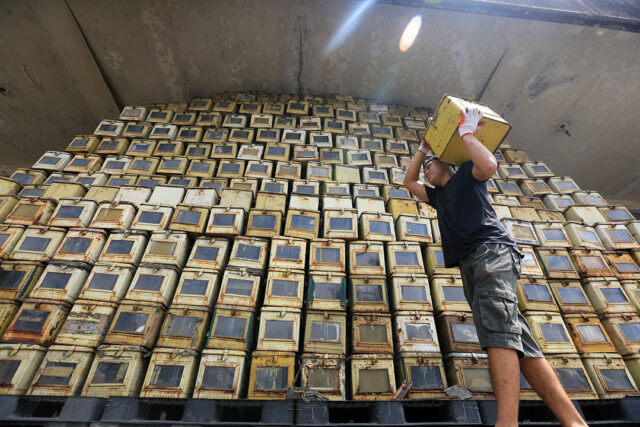
This came after the PPA said hundreds of rice containers, chicken meat, pork, and onions have been unclaimed and overstaying at Manila port.

Mr. Santiago said ports under the PPA are designed to move cargoes and are not storage areas for users.

“Some importers delay the filing of the import entry since they can save on storage cost (at the ports) compared to if they store goods in private warehouses,” Mr. Santiago said.

“They pay only P700 a day (per container). For a month, that is P21,000 which is a small amount compared to the value of the shipment,” he added.

The PPA said that importers have a 30-day window to remove their cargo once it has been cleared by the BoC; otherwise, the goods will be considered condemned.

Mr. Santiago said that the PPA has provided the Department of Agriculture with a list of 20 consignees who did not retrieve over 500 twenty-foot equivalent units (TEUs) of rice and other agricultural products at the Manila ports by Sept. 30.

He added that in a letter dated Oct. 1, 2024, the PPA provided Agriculture Secretary Francisco Tiu Laurel with a list of consignees for unclaimed pork, chicken, and onion shipments at the ports, including those exceeding the 30-day dwell time.

He said the PPA’s mandate is limited to port management and does not extend to overseeing consignees.

The PPA said it has directed the head of operations and engineering of Asian Terminal, Inc., the operator of Manila South Harbor, to report overstaying containers to the BoC for appropriate action under Section 1129 of the Customs Modernization and Tariff Act.

“We believe having this information on a regular basis will help both PPA and DA identify trends, address any challenges promptly, and improve overall service delivery,” Mr. Santiago said.

The PPA said it has increased its monitoring of pork, chicken, and onion inventories in preparation for the Christmas season.

The agency said it also provided the Agriculture department with a detailed inventory of shipments at Manila ports as of Sept. 30, including 135 TEUs of pork, 101 TEUs of chicken, and 24 TEUs of onions.

The PPA likewise reported that 21 pork containers have stayed at the port for over 30 days, with five exceeding 1,000 days, despite BoC clearance.

For chicken, 22 containers cleared by the BoC are still at the port, with 12 exceeding 600 days. Four onion containers have not yet received OLRS (On-Line Release System) clearance, the agency said.

Separately, the PPA has issued an invitation to bidders for the expansion of the Port of Masbate for P162 million.

All interested parties can submit bids until Oct. 25, the port regulator said.

The contractor for the project must complete the expansion within 450 calendar days, PPA said, adding that bidders should have completed a similar contract to the Masbate Port expansion. — Ashley Erika O. Jose

The PPO goes to the movies

THE PHILIPPINE Philharmonic Orchestra (PPO) will hold a fundraising concert that will showcase timeless cinematic pieces of music on Nov. 22, 7:30 p.m., at the Samsung Performing Arts Theater in Circuit Makati.

The concert aims to support various PPO initiatives, like the training and development of its members, the promotion of international performances, and the expansion of outreach programs throughout the country.

“The prime consideration is to be able to transport the audience to a kind of world which is magical, using iconic pieces that never seem to die since they are classically popular and still existing in the modern times,” said the orchestra’s creative director Alexander Cortez at a press conference in Makati City on Oct. 1.

“How can you have a show without a Michel Legrand medley, and a Thomas Courtenay? I think all these songs will be very familiar to you, to kind of a more senior age demographic. Anyway, seniors are the ones who can pay.”

The concert, titled Music, Movies, Magic, is presented by the Cultural Center of the Philippines (CCP) and the Philippine Philharmonic Orchestra Society, Inc. (PPOSI).

It will star theater and musical luminaries such as the Alice Reyes Dance Philippines (ARDP), the Philippine Madrigal Singers (Madz), and the PPO, led by the show’s music director and conductor Gerard Salonga.

The concert will open with Johann Strauss II’s Die Fledermaus Overture, famously featured in the 1938 film The Great Waltz. The PPO will also perform Pyotr Ilyich Tchaikovsky’s Swan Lake; Edward Elgar’s Enigma Variations: IX. Nimrod from the 1981 film Chariots of Fire; and Ennio Morricone’s Se from the legendary 1988 film Cinema Paradiso.

Opera singer Camille Lopez-Molina will deliver a rendition of Umberto Giordano’s “La Mamma Morta,” from the 1993 film Philadelphia. Concert violinist Diomedes Saraza, Jr. will perform Jules Massenet’s Thaïs: Meditation, a piece famously featured in the film Titanic. Award-winning soprano Lara Maigue will enchant with the aria “Queen of the Night” from Mozart’s The Magic Flute from the film Impromptu.

Cris Villonco will continue with a medley of Michel Legrand’s classics from The Thomas Crown Affair, The Happy Ending, and Yentl. Then, Arman Ferrer will pay homage to homegrown compositions with a medley of George Canseco’s “Paano Bang Mangarap” and “Gaano Kadalas ang Minsan.”

The Madz will take on Ryan Cayabyab’s “Iduyan Mo,” from the film Aguila. A notable collaboration will be between the PPO with Mr. Ferrer, Ms. Lopez-Molina, and Ms. Maigue, alongside choral conductor Jonathan Velasco and the ARDPH, to present “Tonight (Quintet)” from Leonard Bernstein’s West Side Story.

The show will conclude with festive cheer as the PPO and Madz will perform pieces from the Home Alone soundtrack by John Williams.

“I think it’s a very balanced program because, in terms of composition, we have enough classical pieces in it like Tchaikovsky, but also contemporary composers,” said Nestor Jardin, PPOSI vice-president, at the press briefing.

It is the lack of funding in Philippine arts and culture that makes fundraising events such as this so important, said CCP president Margie Moran-Floirendo.

“One part of it is audience education,” she said. “We have a lot of talented people. If you watch the PPO, there are about a hundred musicians on stage and it’s really a delight to watch these top performers.”

Music, Movies, Magic will take place on Nov. 22, 7:30 p.m., at the Samsung Performing Arts Theater in Circuit Makati. Tickets range in price from P500 to P8,000. They are available via TicketWorld and the CCP Box Office. — Brontë H. Lacsamana

Don’t curse the ‘bobotantes.’ Expose the crooks among their favorite candidates

PHILIPPINE STAR/EDD GUMBAN

President Ferdinand “Bongbong” Marcos, Jr. announced during the Alyansa Para Sa Bagong Pilipinas Convention the other week the senatorial slate of the administration for the 2025 midterm elections. In the slate are Interior Secretary Benhur Abalos, Makati City Mayor Abby Binay, Senators Pia Cayetano, Lito Lapid, Francis Tolentino, Imee Marcos, and Bong Revilla, former senators Manny Pacquiao, Ping Lacson, and Tito Sotto, Deputy Speaker Camille Villar, and former Social Welfare and Development Secretary Erwin Tulfo. He called on them to maintain their honesty and love for the country.

That call was uncalled for. All 12 nominees are or have been high-ranking government officials. They are presumed to have proven their honesty and love of country. Asking them to remain honest and true to the country suggests doubt on the part of the President about their integrity and patriotism.

Asked by a broadcast political commentator what he thought of President Marcos’ nominees for the Senate, former Senate President Franklin Drilon said it is composed of people who can sing or dance. In another interview with another TV talk show host, he described the slate as a hodgepodge of personalities driven by name recall.

It was a frank putdown of the administration’s candidates for the Senate. He has a basis for his low assessment of them. He spent many years in the Senate with half of the nominees.   

Netizens’ reactions are just as disparaging. Here are some comments about the lineup in social media:

• Lord, have mercy on us Filipinos

• A senatorial ticket just right for the bobotantes*

• Comebacking trapos

• New alliance, old politicians

• Multiple dynasties in the making

• Government service turned into family business

• The list of candidates voters should not vote for   

• A bunch of showbiz people

• A slate that discourages one to vote

• San Lorenzo Ruiz, San Pedro Calungsod,  save us Filipinos from opportunists

I understand the disappointment, nay dismay, even disdain of the more discerning citizens over the administration’s candidates for senator. The Senate is that assembly of people mandated to enact laws and enunciate national policies that promote the people’s welfare, empower the poor and weak, stimulate economic growth, institute good governance, promote the rule of law, strengthen democracy, protect the environment and the nation’s rich cultural heritage, and build an equitable, prosperous, and orderly society.

The Senate is usually referred to as the “august body.” Pronounced with the accent on the second syllable, august means majestic, dignified, imposing. When I was in college in the latter half of the 1950s, I would go to the Senate during semestral and summer breaks to listen to the debates on the Senate Hall. The Senate was indeed majestic, dignified, and imposing for it was composed of erudite and eloquent men like Claro M. Recto, Jose P. Laurel, Lorenzo Tanada, Camilo Osias, Quintin Paredes, Jesus Mariano Cuenco — statesmen all.

Not anymore as it is now populated by people with popular names, popularity gained as a movie actor or television show host. Next year the Senate will likely be overpopulated with such people. The Pulse Asia survey conducted in September indicates that eight of Bongbong’s nominees will be elected senators in 2025. They are Tulfo, Sotto, Cayetano, Binay, Revilla, Lacson, Pacquiao, and Marcos — the hodgepodge of personalities driven by name recall, as former Senate President Drilon described them.

The Senate will actually be that next year if the discerning voters just stand by and watch the bobotantes excitedly and gleefully cast their votes for their singing and dancing idols. They can choose to tell the bobotantes the kind of persons their idols are — not fit to be in the Senate.

If a candidate is a thief or a vicious person, then the voting public should be told about him or her. Without negative campaigns, voters would not have full information about the candidates. No candidate will say anything negative about himself.
But the deliberate spreading of such information must be motivated by the honest desire of the campaigner to warn others against the negative impact on society of the election to public office of a dubious character. Negative campaigns undertaken by neutral non-partisan organizations like the Philippine Council of Evangelical Churches or the Management Association of the Philippines would be most effective.

In 1995, just four years after he returned from his exile in Hawaii, Bongbong Marcos ran for senator. The remnants of the civil society group formed to fight for political reforms following Ninoy Aquino’s assassination waged a vigorous campaign against his election to the Senate. They portrayed him in comic books as nothing but a lazy boy who lived fabulously abroad on money stolen by his parents. He failed to land one of the 12 Senate seats to be filled up. He placed at only No. 16.

During the impeachment trial of President Joseph Estrada in 2000, Senators Robert Jaworski, Blas Ople, Juan Ponce Enrile, Miriam Santiago, Nikki Coseteng, Tessie Oreta, Gregorio Honasan, John Osmeña, Ramon Revilla, Sr., Francisco Tatad, and Tito Sotto voted not to open an envelope believed to contain evidence so damning to the President that people thought it would lead to his conviction and consequent removal from office. The “No” vote of the 11 senators saved Estrada from conviction. But the people were so infuriated by the blatant display of cowardice by 11 senators that they took it upon themselves to chase Estrada out of Malacañang.

Civil society groups also made the spineless senators — mnemonically remembered by the first letter of their surnames as JOE’S COHORTS but derisively branded as The Craven Eleven — pay for their cowardice by campaigning against their re-election. As The Craven Eleven were elected to the Senate in different years, they ran for re-election in different elections. Except for Revilla, who chose not to run again, each of the other 10 craven senators was repudiated at the polls the next time he or she ran for senator.

In June 2005, when audio recordings of a phone conversation between President Gloria Macapagal Arroyo and Election Commissioner Virgilio Garcillano about rigging the 2004 presidential elections were made public, the minority members of the House of Representatives initiated impeachment proceedings against President Arroyo. But her allies blocked the move. Congressman Prospero Pichay said there was nothing wrong with President Arroyo talking to Commission on Elections officials as all candidates talk to them to protect their votes.

In August of that year, Environment Secretary Mike Defensor called on Congress to review and authenticate all versions of the supposed recordings of the alleged conversation, which had come to be known as the “Hello Garci Scandal.” He had stressed the tapes might have been made to appear that Mrs. Arroyo and the election official she was supposedly talking to at the other end of the line were planning to rig the results of the May 10, 2004 presidential election.

Pichay and Defensor ran for senator in 2007 under the TEAM Unity coalition backed by the Arroyo administration. Again, civil society groups banded together and campaigned actively against the two saviors of the discredited Arroyo.

In 2012, the surveys on voter preferences showed senatorial candidate Juan Ponce Enrile among those likely to be elected to the Senate in 2013.  At one time, he ranked No. 4 in the opinion polls. Survey respondents must have thought it was Senate President Juan Ponce Enrile who was running for re-election. It was his son Jack who was running.

As the son of a very powerful man during the Martial Law years, Jack had developed a notorious reputation growing up —that of Bad Boy. Afraid that a bad boy would be elected to the Senate, former school mates and friends of those he had crossed during his younger years dug up his past and fed the media sordid stories about him.

When survey respondents realized that the Juan Ponce Enrile they had expressed a preference for was the “bad boy” son of the old man of the Senate, Jack’s ranking in the opinion polls started to plunge. He placed 15th in the Senate race of 2013.

So, citizens for good government, don’t curse the bobotantes. Expose the crooks and the opportunists among the favorites of the bobotantes.

*Bobotante is used to refer to misguided voters. It is a portmanteu of “bobo” or “stupid” and “botante” or “voter.”


Oscar P. Lagman, Jr. has been a keen observer of Philippine politics since the late 1950s.

How Marco Polo’s rebrand is catering to business and leisure travelers

MARCO POLO Hongkong Hotel Exterior Level 6

By Aubrey Rose A. Inosante, Reporter

MARCO POLO Hotels, a wholly owned subsidiary of The Wharf Holdings Ltd., has rebranded to serve the “bleisure” market, targeting travelers who combine business and leisure activities in the Philippines.

“Part of our touch points for Marco Polo, and especially in connotation to the rebranding, is Marco Polo events,” Holger Jakobs, vice-president for sales and marketing at Wharf Hotels, told BusinessWorld in a video call on Oct. 4.

“All these ideas circle around the fact that our guests need locations and spaces to spend time together, either in a discussion, in a meeting, or in a group,” he added.

Marco Polo Hotels have club floors and continental club lounges, and accommodation with full business facilities, Mr. Jakobs said.

Bleisure trips or workcations are expected to continue growing due to the demand for work-life balance and the expectations of a modern workforce, the company said.

Among the hotel additions is SAVVY — a modern day-to-night restaurant offering shared plates with a focus on Italian-inspired food and local specialties.

“Both of the hotels have extensive meeting facilities on a bigger level. If somebody would want to bring a group of travelers, I think we are well geared for that, and if it is on a conference level,” he said.

Mr. Jakobs said the company’s Ortigas location is equipped with a ballroom that has a maximum capacity of over 500 square meters (sq.m.), and the one in Cebu an even larger 800 sq.m.

“The hotel in Davao closed during the pandemic and is currently undergoing review for renovations by the owner,” he said.

For Manila as a metro market, the brand reported 63% occupancy in its hotels in the Philippines while revenue per available room increased by 5.5%, which is higher than the Asia-Pacific average.

“I think that correlates also to the growing arrival figures into the Philippines, where I think the targets that the central government has given out have been surpassed several times this year already, which is where I think both business travel as much as leisure and then a combination of both have contributed,” Mr. Jakobs said.

Business travelers in the Philippines usually stay for about three nights, while leisure guests stay for around two nights on average.

“If you travel to Singapore, no matter what you do after your meetings are done, you’re still in the city. While in the Philippines, we have our hotel in Ortigas in Manila, and you could travel to our sister hotel, which is Marco Polo Cebu,” he said.

He said guests can extend their stay by visiting the company’s Cebu hotel, allowing them to attend meetings in Manila and then enjoy leisure time in a hotel in Cebu.

Japan’s top currency diplomat warns against speculative moves as yen falls

A Japan Yen note is seen in this illustration photo taken June 1, 2017. — REUTERS

TOKYO — Japan’s top currency diplomat on Monday issued a warning against speculative moves on the foreign exchange market as the yen fell below 149 per dollar.

“We will monitor currency market moves including speculative trading with a sense of urgency,” Atsushi Mimura told reporters, reviving a verbal warning tactic that his predecessor, Masato Kanda, frequently used.

Mimura declined to comment on the specifics of the current market situation.

Separately, Katsunobu Kato, the nation’s newly appointed finance minister, said the government would monitor how rapid currency moves could potentially impact the economy and would take action if necessary.

“The government will consider what action should be taken while monitoring the impacts,” Mr. Kato said in an interview with a small group of reporters on Monday.

The yen depreciated to 149.10 versus the dollar in early trading on Monday, the weakest since Aug. 16, after a surprisingly strong US jobs report for September led traders to cut bets that the Federal Reserve will make further large interest rate cuts.

Japan last conducted yen-buying intervention in late July to support its currency after it tumbled to a 38-year low below 161 per dollar.

The yen has also been under pressure since new Japanese premier Shigeru Ishiba stunned markets when he said the economy was not ready for further rate hikes, an apparent about-face from his previous support for the Bank of Japan’s (BoJ) unwinding decades of loose monetary policy.

In Monday’s interview, Mr. Kato said the government would leave specific policy steps to the Bank of Japan (BoJ), when asked whether the policy rate should be maintained at 0.25%.

“The government hopes that the BoJ will communicate with markets thoroughly and take appropriate policy to achieve its 2% inflation target in a stable and sustainable manner,” he said.

The BoJ in March delivered its first rate hike in 17 years, arguing the pace of price and wage increases showed Japan was finally shaking its entrenched deflationary mindset. The central bank unexpectedly increased rates again in July, triggering a shakeout in domestic markets. — Reuters

PNOC eyes 20-MW rooftop solar systems

STATE-RUN Philippine National Oil Co. (PNOC) is looking to set up rooftop solar photovoltaic (PV) systems with a capacity of up to 20 megawatts (MW) through its partnership with government agencies.

“This year, maybe we will only have modest 1.5 MW, but next year, we’re targeting to set up 20 MW of rooftop solar,” PNOC President and Chief Executive Officer Oliver B. Butalid said during a signing ceremony on Monday.

Mr. Butalid said, however, that attaining the target would depend on the availability of reliable installers that will join the company’s program.

“So, our typical size is 50 to 200 kilowatt-peak (kWp). So, we are enticing these reputable suppliers to join our bidding even if they are small compared to what they are accustomed to, which are one-megawatt factories,” he said.

PNOC aims to position itself as a service agency to government entities, providing innovative energy solutions to meet national development goals.

The company had already signed agreements for the installation of rooftop solar systems with a total capacity of 750 kWp in the past weeks, and adding to its portfolio is its latest agreement with the Technical Education and Skills Development Authority (TESDA). 

Under the memorandum of agreement, PNOC will install an 80-kWp rooftop solar PV system at TESDA’s National Capital Region training center.

“This is a small step for PNOC and TESDA. But in the coming years, I’m very hopeful that this will be scaled up significantly,” Mr. Butalid said.

He also said that they are looking at utility-scale ground-mounted solar systems for off-grid islands to support areas relying on diesel-powered generation. — Sheldeen Joy Talavera

Lady Gaga’s Joker: Folie à Deux is almost as miserable as its lead character

Daniel Day-Lewis, along with Vicky Krieps, in a scene from Phantom Thread, the last film he made before retiring from acting. — IMDB

By Esther Zuckerman

Movie Review
Joker: Folie à Deux
Directed by Todd Phillips

I DID not like 2019’s Joker, Todd Phillips’ film about the Batman villain that won Joaquin Phoenix an Oscar. I found it self-important yet shockingly hollow in its attempts to say something about how society warps the lonely. And yet I’ll admit I was excited for its sequel Joker: Folie à Deux. It’s a musical co-starring Lady Gaga. How bad could it be, really?

Turns out: Very bad.

Folie à Deux is a punishingly dull affair. It’s a pointless sequel with very little plot. It wastes the talent on screen, and it squanders the genuinely intriguing conceit of its characters breaking into song. Those musical sequences, of which I had such high hopes, are lacking in creativity and fail to justify their own existence. But they’re still better than the rest of the movie, which is filled with endless dialogue that simply rehashes the events of the first movie.

If Joker was implicitly influenced by Taxi Driver — I said it was self-important — Folie à Deux announces its references right out of the gate in a Looney Tunes-inspired animated sequence in which a cartoon Joker fights with his own shadow. In the background of these scenes you can see posters for classic Hollywood musicals Sweet Charity, The Band Wagon, and Pal Joey, all a preview of the soundtrack to come.

This opening is perhaps the most inspired moment of the whole film, introducing a new visual language that is quickly discarded when the animation gives way to the dour live action version of Arkham Asylum where Phoenix’s Arthur Fleck is imprisoned. He is awaiting trial for the five murders he committed the last time we saw him. (He actually killed a sixth person, his mother, but no one knows about that yet.)

In the grim institution, he’s mocked by the guards who shepherd him to meetings with his altruistic lawyer played by Catherine Keener. She thinks she can spare him the death penalty by proving that her client has a separate, split personality from Joker, the killer. Good luck, girl.

In these early scenes, Phoenix’s Arthur is a hollow shell with deadened eyes. But he perks up when he is allowed to attend a music class in another, less severe, ward of Arkham. That’s where he meets Lee, played by Gaga, as the inmates sing “Get Happy,” a tune most associated with Judy Garland.

Lee, of course, is this universe’s version of Harley Quinn, most famously portrayed by Margot Robbie in the Suicide Squad movies as a chirpy antihero. Gaga makes Lee a sullen, sultry creature who is obsessed with Joker, wooing him with tales of her own hardscrabble upbringing. During movie night — where the crowd is watching Fred Astaire in The Band Wagon, naturally — she sets a piano on fire and they dance and sing among the chaos.

But then Lee leaves Arkham just as Arthur is about to go to trial. She promises to be in the courtroom to support him while she prepares a life for them on the outside. He’s smitten. Her motives are a little more suspect.

Alas, there’s not much more to that relationship considering the rest of the movie is spent on the legal proceedings which mostly feel like an excuse to remind the audience of everything that happened in the previous installment of this saga. Familiar faces take to the stand and recount their versions of events. Occasionally, there are pauses for some singing, most of which takes place inside of Arthur’s head, but sometimes happens diegetically, like when Lee decides to serenade him with Burt Bacharach’s “Close to You.”

The film itself seems embarrassed by its musical elements, never willing to fully commit to the endeavor. The fantasy sequences, despite some excellent production design that turns Gaga and Phoenix into Gotham City incarnations of Cher and Sonny, are staged listlessly and feel extraneous. Meanwhile, when these love birds sing in the context of the actual narrative, they do so in strained voices, as if to further prove how disturbed these people truly are. (Gaga only releases her full belt a couple of times — a true shame.)

I began to get the suspicion that Phillips believes the only people who really love musicals are lunatics — and his disdain for both categories is palpable. Arthur’s mental health is treated carelessly, with physical and psychological abuse blithely used as a talking point. Through all of this, Phoenix adds no new dimensions to the character. He still looks emaciated, and he brings an intensity to Arthur’s mania, but we learn nothing new about this man who we’re either supposed to pity or fear.

Gaga livens things up with a volatile swagger whenever she’s on screen, and yet she’s hindered by the fact that the character is brutally underwritten. Her only personality is her attraction to Joker. Beyond that she’s a blank slate with some great eye makeup.

As Folie à Deux creeps toward its underwhelming yet also laughable finish you can’t help but wonder how this all went so wrong. The trial is meaningless, the romance is half-hearted, and the musical bits, starring Lady Gaga no less, have no pizzazz. It all feels like, well, a cruel joke. — Bloomberg