Home Blog Page 2531

Marcos thanks Israel for OFW help

PRESIDENT FERDINAND R. MARCOS, JR. — PCO.GOV.PH

PHILIPPINE President Ferdinand R. Marcos, Jr. on Wednesday thanked Israel for supposedly taking care of Filipinos amid its clashes with militant groups opposed to its occupation of Palestine.

“Israel’s swift assistance in ensuring their [Filipinos] safety, especially during these challenging times, means a great deal to us,” he said in a statement late on Wednesday, following a phone call with Israeli President Isaac Herzog.

Mr. Marcos did not fully disclose what he and Mr. Herzog had discussed during their phone call.

He nevertheless said Israel remains one of the Philippines’ “trusted bilateral partners in the Middle East region, citing “historic friendship that predates the establishment of the Israeli state.”

“We remain hopeful for a swift path to peace, and together, may we continue to build on the strong bonds between our nations.”

The Israeli military earlier this month launched a wave of air raids on southern Lebanon as Jerusalem marked the anniversary of Hamas attacks on Oct. 7, 2023. 

Israel’s air raids and ground invasion of southern Lebanon were at neutralizing “Hezbollah targets” that it said were “immediate threat” to northern Israeli communities.

Hezbollah militants have shown resistance to Israeli forces amid the Israel-Hamas war in the Gaza Strip.

The Lebanese health ministry said Israeli airstrikes across southern Lebanon and the capital Beirut killed 27 people on Wednesday, based on an Al Jazeera report.

The United Nations peacekeeping mission in Lebanon known as United Nations Interim Force in Lebanon (UNIFIL) said Israeli forces continued to fire at its watchtower in the south, amid growing international criticism of Israel’s attacks on UNIFIL peacekeepers over the past days.

“Yet again we see direct and apparently deliberate fire on a UNIFIL position,” the peacekeeping mission said in a statement on Wednesday.

“This morning, peacekeepers at a position near Kfar Kila observed an IDF Merkava tank firing at their watchtower,” it added. “Two cameras were destroyed, and the tower was damaged.”

UNIFIL on Sunday said Israeli troops “forcibly entered” its position near the village of Ramia with two tanks crossing the UN-mandated blue line and fired smoke rounds near peacekeepers.

The Philippines last month joined 123 other countries in favoring a United Nations resolution urging Israel to end its occupation of Palestinian territories within a year.

Israeli settlement activities involved the transfer of its nationals “into the occupied territories, the confiscation of land, the forced transfer of Palestinian civilians, including Bedouin families,” according to the November resolution.

The settlements also involved “the exploitation of natural resources, the fragmentation of territory and other actions against the Palestinian civilian population,” among other issues.

The Gaza Strip is one of the two territories occupied by Palestinians — the other being the West Bank, which the Israeli government has been trying to invade in recent years. The two areas, along with East Jerusalem, came under Israeli occupation after the 1967 Arab-Israeli war. Since the war, Israel has responded to Palestinians’ demand for a homeland through military force. — Kyle Aristophere T. Atienza
MCIA to set up green framework

BW FILE PHOTO

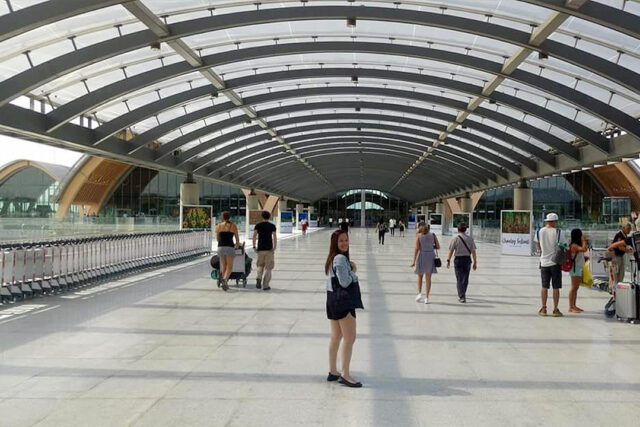
THE MACTAN-CEBU International Airport (MCIA) has signed an agreement with Airports Council International (ACI) Asia-Pacific & Middle East to establish a sustainability framework as part of its commitment to reach net zero ambition.

“We aspire to inspire other airports across the Philippines and Asia to follow suit. Together, we can drive sustainable tourism, ensuring that destinations worldwide offer enriching and responsible experiences for generations to come,” Athanasios Titonis, chief executive officer of Mactan-Cebu International Airport, said in a statement on Thursday.

In a media release, MCIA, managed by Aboitiz InfraCapital GMR Megawide Cebu Airport Corp. (Aboitiz InfraCapital GMCAC), said it signed a memorandum of understanding to develop a comprehensive framework on green and sustainable efforts to reach net zero.

Net zero refers to reducing greenhouse gas emissions to as close as zero as possible while offsetting any remaining greenhouse gases in the atmosphere.

The net zero roadmap will include carbon footprint projection, adoption of governance frameworks, and proposals in utilizing greener and sustainable options in areas like fuel consumption, and operations.

The program will also provide capital expenditure guidance on planning, implementation strategies, carbon offsetting measures, while also connecting airports with financial institutions for possible funding.

“As the industry continues to face increasing pressure to minimize its carbon footprint, we recognize that robust action is required to ensure that airports are prepared for a sustainable future. Through our Net Zero Roadmap program, we offer tailored support to airports like Mactan Cebu International, helping them create practical, effective plans,” ACI Asia-Pacific & Middle East Director General Stefano Baronci said. — Ashley Erika O. Jose

P90-M smuggled fuel seized

PHILSTAR FILE PHOTO

THE Bureau of Customs (BoC) on Thursday said it impounded a tanker found transferring P90 million worth of fuel to four trucks to avoid paying taxes.

On Wednesday, a fuel tanker and four lorries were caught transferring smuggled fuel at the Batangas port, the BoC said in a statement.

The subsequent fuel marking testing on the subject fuel showed failed results, “which meant that the fuel did not have proper markings indicating payment of duties and taxes.”

The seized vessel has an estimated value of P300 million, BoC said. Its cargo contains 1.8 million liters with a cost of P50 per liter, valued at around P90 million.

Likewise, the trucks were valued at P3 million each, or P12 million in total.

Juvymax R. Uy, who serves as deputy commissioner at the Customs’ intelligence group said that two lorry trucks contained 40,000 liters and 14,000 liters of unmarked fuel, respectively.

Customs Intelligence and Investigation Service Director Verne Y. Enciso, said it has been monitoring the “paihi” modus, in which larger tankers off-load fuel to smaller vessels to escape tax payments.

To determine whether the proper taxes are paid, the bureau uses a unique chemical to mark imported and locally refined petroleum products. This would help avoid smuggling and misdeclaration of fuel products.

“Our operation against these individuals and groups is not a one-time thing. We have been monitoring them for months and finally, they are now in our hands,” Customs Commissioner Bienvenido Y. Rubio was quoted in the statement.

Offenders will face possible charges for violating the Customs Modernization and Tariff Act and the Tax Reform for Acceleration and Inclusion Law. — Beatriz Marie D. Cruz

NCR malls open until 11 p.m. starting Nov. 18

MAJOR shopping malls in the National Capital Region will adjust their mall operating hours from 11 a.m. to 11 p.m. starting Nov. 18 to ease traffic congestion ahead of the “holiday rush”, the Metropolitan Manila Development Authority (MMDA) said on Thursday said in a circular.

The adjusted mall hours will be in place until Dec. 25, it added. Prior to this, malls opened at 10 a.m.

Shopping mall operators will also submit traffic management plans to MMDA for their mall sales and promotional events two weeks before Nov. 18, the circular read.

Malls will also conduct deliveries only during nighttime from 11 p.m. to 5 a.m. the next day, it added, noting the exemption of perishable goods.

Mall-wide sales will only be permitted on weekends, but sale on certain stores inside the mall is allowed even on weekdays, it said.

In a briefing on Wednesday, MMDA said it will talk to the Department of Transportation to discuss the extension of operating hours of the railway systems and the EDSA Carousel bus lines.

Reconsider ‘shared voting’ system in cooperative code, Senate told

BW FILE PHOTO

THE Philippine Chamber of Cooperatives, Inc. (PCCI) on Thursday asked senators to reconsider a provision on “shared voting” in its proposed amendments to the cooperative code, saying this could limit the power of cooperatives to a few.

Senate Bill No. 2811 proposes an option for “shared voting,” wherein “the voting rights of the member-cooperatives shall be proportionate to the number of their paid-up shares.” The measure is up for second reading at the plenary.

“The number of shares a member holds must not give them more voting power, as this would lead to a few members with more shares having more control and potentially monopolizing the cooperative,” the PCCI said in a statement.

In a recent Senate hearing, CLIMBS Life and General Insurance Cooperative President Roel D. Raboy cited openness to allowing 40% share capital holdings in a federation, given that such shares do not carry voting rights.

Mr. Raboy said a shared voting system would turn cooperatives into a “corporation-like” model.

The cooperative model currently follows the one-member, one-vote principle, while the corporate model follows a shared voting system.

“If share voting schemes become part of the law, it would be difficult to ensure that they continue to serve their democratic purpose.”

“In the Senate’s version, they are giving operations for either a cooperative vote system or a shared vote system,” Edwin A. Bustillos, executive director, told reporters on the sidelines of a forum.

However, a shared voting system may allow corporations to disguise themselves as a cooperative and evade taxes, Mr. Bustillos said.

“Some may create a corporation, have this registered as a cooperative, and eventually avail of the tax exemption. But it is controlled by a few, And that’s not the value and principles of cooperative,” he said in mixed English and Filipino.

The groups also opposed the Senate’s proposal to remove tax perks for cooperatives, noting that its members are already subject to tax in the form of income and value-added taxes. — Beatriz Marie D. Cruz

Alternative energy sources top concern of business leaders in Mindanao

JEROME CMG-UNSPLASH

DAVAO CITY — Business leaders emphasized that finding alternative sources of energy is the top concern of the business sector in Mindanao following the Mindanao Development Authority’s (MinDA’s) forecast that the island will be facing a power shortage in the next five years.

General Santos City Chamber of Commerce and Industry President Miguel Rene Alcantara Dominguez told Businessworld that one of the topics presented by MinDA Assistant Secretary Romeo Montenegro in a forum last month was the growing concern that Mindanao be losing power by 2027 to 2028.

“MinDA foresees that we will most likely lose power by 2027 to 2028. Back to the experience we had in 2010,” Mr. Dominguez said.

According to Mr. Montenegro, the rate of the annual growth of demand for energy in Mindanao is around 5% to 7%, which is about 100 megawatts every year needed to be able to keep up with the growing demand due to the expansion of the property sector, agri-business, industries, and household expansions.

“Therefore, the reserve that we have today will start to go down unless new capacities come in to replace the ones that are being used already by the growing demand,” he said.

Joji Ilagan-Bian, chair of the Philippine Chamber of Commerce and Industry Committee on the Brunei Darussalam–Indonesia–Malaysia–Philippines East ASEAN Growth Area (BIMP-EAGA), said the business sector in Mindanao has informed President Ferdinand Marcos, Jr. in a resolution that the priority of the business sector in Mindanao is to look for alternative sources of power because it was said that after two or three years, we will have shortage of power.

Ms. Bian said a stable power supply consequently improves the economy and entices more investors to come in.

“If we are not able to work at the power problems these investments would not be in proportion to the source of power. We are looking at power investors, and private partnerships with the government and we are also looking at all sources of investment including outside of the country, foreign investors to look at it also for the Philippines. Power is what makes the economy roll and without that economy would be at a standstill,” she said.

Mr. Dominguez said among the options that were discussed to address the looming power shortage is the availability of the Agus-Pulangi Hydropower Complex, which is eyed to be rehabilitated in 2026.

“If Agus Pulangi is rehabilitated, we will most likely have an additional 300 to 350 megawatts,” he said.

Meanwhile, Mark Christian P. Marollano, supervising science research specialist at the Department of Energy, said that the department is continuously monitoring power projects to help meet the future power demand in the country particularly in Mindanao.

“Due to economic developments, demand will also continue to increase, that is why we have put up power plants in Mindanao,” he said in mixed English and Filipino. — Maya M. Padillo

Cop dies in South Cotabato road mishap

COTABATO CITY — A police patrolman, who is actively involved in the interfaith solidarity promotion projects of their unit, died instantly after his car collided head-on with a 10-wheeler truck in Barangay Glamang in Polomolok, South Cotabato on Wednesday afternoon.

Brig. Gen. James E. Gulmatico, director of the Police Regional Office-12 (PRO-12), told reporters on Thursday that the accident fatality, Patrolman Fahad A. Masula was under the Regional Mobile Force Battalion (RMFB) 12, a large rapid reaction unit of PRO-12.

Mr. Masula, who belonged to a Muslim clan in Koronadal City, helped push forward the police-community relations thrusts of the RMFB 12, according to his companions and superiors in the unit.

He was immediately buried by his relatives in keeping with Islamic tradition of burying the dead within 24 hours after death.

Mr. Masula’s car, a Toyota Vios hit the side of a 10-wheeler truck approaching from the opposite direction of the Koronadal-General Santos Highway in Barangay Glamang in Polomolok.

Witnesses had told barangay officials and police probers that Mr. Masula may have lost control of the wheel due to mechanical trouble, having seen his car wiggled first before hitting the frontal left side of the large green truck.

He was declared dead on arrival by doctors in a hospital where he was brought by emergency responders from the Polomolok local government unit for treatment.

Mr. Gulmatico said the driver of the truck that figured in the accident, Ronnie Anggot Torino, voluntarily yielded to policemen who responded to the incident and turned over to them his driver’s license. — John Felix M. Unson

Philippine shares down on dovish BSP comments

BW FILE PHOTO

LOCAL SHARES declined on Thursday due to profit taking and following dovish remarks from the Bangko Sentral ng Pilipinas (BSP) governor.

The Philippine Stock Exchange index (PSEi) dropped by 0.49% or 36.67 points to close at 7,400.33 on Thursday, while the broader all shares index lost 0.52% or 21.32 points to end at 4,076.24.

“Profit taking again weighed on the index, despite the BSP Monetary Board’s decision to cut rates by 25 basis points (bp) yesterday (Wednesday),” AP Securities, Inc. Research Head Alfred Benjamin R. Garcia said in a Viber message.

Stocks declined “because the tone of the BSP was tempered in terms of monetary policy actions moving forward. The BSP used the words ‘baby steps,’” AB Capital Securities, Inc. Vice-President Jovis L. Vistan said in a Viber message.

The Monetary Board on Wednesday cut benchmark interest rates by 25 bps, as expected by 16 of 19 analysts in a BusinessWorld poll, as price pressures remain manageable. This brought its policy rate to 6%.

The BSP in August kicked off its easing cycle with a 25-bp reduction, marking its first rate cut in nearly four years.

BSP Governor Eli M. Remolona, Jr. said at a briefing that they could cut benchmark rates by another 25 bps at their Dec. 19 meeting, noting that a one-time 50-bp reduction could be “too aggressive a cut,” except in a hard landing scenario.

Mr. Remolona added that they could slash rates by 100 bps in 2025, but said they prefer to take “baby steps” in their policy easing cycle.

“Last-minute profit taking brought the local market down this Thursday. Contributing to the market’s decline is the lingering weakness of the local currency,” Philstocks Financial, Inc. Senior Research Analyst Japhet Louis O. Tantiangco said in a Viber message. “Foreign investors, which were net sellers for the day, added to the market’s drop.”

On Thursday, the local unit ended at P57.80 per dollar, down by 10 centavos from its P57.70 close the previous day, according to Bankers Association of the Philippines data.

Net foreign selling reached P47.87 million on Thursday versus the P841.27 million in of net foreign buying recorded on Wednesday. 

Almost all sectoral indices closed lower. Holding firms declined by 1.17% or 73.85 points to 6,217.34; mining and oil dropped by 1.05% or 91.19 points to 8,578.30; industrials went down by 0.54% or 54.80 points to 10,047.79; property retreated by 0.51% or 15.25 points to 2,929,32; and services inched down by 0.25% or 5.69 points to 2,256.37.

Meanwhile, financials rose by 0.38% or 9.17 points to 2,410.91.

Value turnover decreased to P5.91 billion on Thursday with 938.004 million shares traded from the P6.95 billion with 831.76 million issues that changed hands on Wednesday.

Decliners outnumbered advancers, 102 to 92, while 64 names were unchanged. — Revin Mikhael D. Ochave

Peso weakens anew as markets await ECB move

BW FILE PHOTO

THE PESO declined against the dollar on Thursday on expectations of another rate cut by the European Central Bank (ECB).

The local unit closed at P57.80 per dollar on Thursday, down by 10 centavos from its P57.70 finish on Wednesday, Bankers Association of the Philippines data showed.

The peso opened Thursday’s session at P57.79 against the dollar. It climbed to as high as P57.60, while its weakest showing was at P57.86 versus the greenback.

Dollars exchanged went up to $1.47 billion on Thursday from $1.38 billion on Wednesday.

The peso weakened as the dollar was generally stronger as markets awaited a rate cut from the ECB, a trader said by phone.

The peso-dollar pair initially traded sideways as investors recalibrated their bets on the pace of the US Federal Reserve’s easing cycle ahead of the presidential election, the trader added.

The euro slid to a more than two-month low on Thursday ahead of an expected European Central Bank rate cut, while the dollar hit its highest in 11 weeks on the prospect that Donald J. Trump, whose policies the market considers more bullish, will win the US election, Reuters reported.

Weak economic data in the euro area and dovish comments from ECB officials have prompted traders to price in that the ECB will deliver a third rate cut since June, diminishing the euro’s appeal.

The ECB was expected to cut its deposit rates by a quarter-point overnight. Money markets almost fully price in three further reductions through March 2025 to tame the most protracted inflation in the euro zone in a generation.

The euro slipped 0.1% $1.085325, falling for the seventh straight session.

In the broader market, the dollar scaled an 11-week high against a basket of peers at 103.65.

The dollar has drawn support from a run of upbeat data on the US economy, which has in turn caused traders to reduce their expectations of Fed rate cuts, but also on the higher chances of a victory by Republican presidential candidate Mr. Trump at next month’s election.

Analysts expect the dollar to strengthen in the event of a Trump victory and for bonds to come under pressure.

Meanwhile, the local unit declined “after the markets digested the more gradual or measured monetary easing signals from local monetary authorities,” Rizal Commercial Banking Corp. Chief Economist Michael L. Ricafort added in a Viber message.

The Bangko Sentral ng Pilipinas (BSP) on Wednesday cut benchmark interest rates by 25 basis points (bps), as expected by 16 of 19 analysts in a BusinessWorld poll. This brought its policy rate to 6%.

The Monetary Board in August started its policy easing cycle with a 25-bp reduction, marking its first rate cut in nearly four years.

BSP Governor Eli M. Remolona, Jr. said at a briefing that they could cut benchmark rates by another 25 bps at their Dec. 19 meeting, noting that a 50-bp reduction could be “too aggressive a cut,” except in a hard landing scenario.

Mr. Remolona added that they could slash rates by 100 bps in 2025, but said they prefer to take “baby steps” in their policy easing cycle.

For Friday, the trader sees the peso moving between P57.60 and P57.90 per dollar, while Mr. Ricafort expects it to range from P57.70 to P57.90. — A.M.C. Sy with Reuters

DENR digital mining permit system to go national next year

FREEPIK

THE Department of Environment and Natural Resources (DENR) said it hopes to launch its digital application platform to all regions next year.

“We have rolled out our digital application process in three regions… pagka okay na lahat ’yan (when the trial is complete), we will roll out to all the regions,” DENR Undersecretary Carlos Primo C. David told reporters during a forum organized by the Chamber of Mines of the Philippines on Thursday.

He added that the platform promises to expedite the application process for mining permits.

Mr. David said the digitalized process will also cover Environmental Compliance Certificates  and other permits.

The DENR estimates that digitalization will cut down the approval process for mining permits by at least two or three years.

“(Our) first commitment is less than two years for any application. I know that is still quite long, but some miners would cite six to 11 years needed for approval,” Mr. David said.

The DENR said it will adopt parallel processing of mining permits by next year, instead of a serial process of approvals. This means that all requirements not needing pre-requisites will be processed simultaneously.

In a Senate budget hearing last week, the DENR said it is planning to issue at least 715 mining contracts, assuming the applications are fully compliant.

Mr. David said the DENR will propose a draft executive order (EO) to President Ferdinand R. Marcos, Jr. to clear up duplication in mining laws.

“There is also the issue of conflicting interpretations of the law on mining royalties, which needs to be addressed, through the EO,” he added.

Legislators are set to deliberate a measure that will boost the government’s share of mining industry profits through a simplified five-tier royalty tax system.

Senate Bill No. 2826, proposes a five-tier windfall profit system that charges 1-10%. It will require large-scale miners operating in mineral reservations to pay a royalty of 5% based on gross output.

Mining firms currently pay corporate income tax, excise tax, royalty, local business tax, real property tax, and fees to indigenous communities. — Adrian H. Halili

Wet season palay procurement budget set at P9 billion — NFA

PHILIPPINE STAR/KRIZ JOHN ROSALES

THE National Food Authority (NFA) said on Thursday that its procurement budget for unmilled rice for the remainder of the year has been set at P9 billion, which will go towards grain acquisition for wet season rice.

“The funding will help the government support rice farmers during the wet season, when palay prices typically decline due to increased harvests and limited drying facilities,” the NFA said in a statement.

Agriculture Secretary Francisco P. Tiu Laurel, Jr. said that the Department of Budget and Management (DBM) will release the funds in equal installments over the remaining months of the year.

The NFA has used up its P8 billion carry over funding for palay procurement from last year.

NFA acting Administrator Larry R. Lacson said the NFA plans to procure about 7.2 million 50-kilo bags of palay at P25 per kilo.

“This volume aligns with the NFA’s wet season palay procurement target of 6.4 million to 8.7 million bags,” Mr. Lacson added.

The NFA has adopted a new pricing scheme for palay, now offering between P23 and P25 per kilo from the previous P25-P27.

“Even at this adjusted price, farmers will continue to benefit from their hard work, especially given the improved price range we implemented earlier this year,” Mr. Laurel added.

In the first half, the NFA used P5.3 billion to purchase 175,000 metric tons (MT) of palay, equivalent to 3.5 million bags, from domestic farmers.

The NFA is targeting a palay inventory of 435,000 MT by the end of the year. It is required to maintain a rice reserve equivalent to about nine days’ demand. — Adrian H. Halili

PHL fossil fuel reserves valuation declines in 2023

BW FILE PHOTO

THE VALUE of the Philippines’ fossil fuel reserves declined sharply in 2023, the Philippine Statistics Authority (PSA) said on Thursday.

The PSA said the value of Class A coal, oil, natural gas, and condensate reserves declined 46.5% to P317.65 billion.

Natural resource classifications, such as “Class A,” typically refer to resources that are validated, akin to the category of “proven reserves” in petroleum economics.

The value of Class A coal reserves fell 48.7% to P271.57 billion.

Class A oil reserves were valued at P15.99 billion, down 16.2%.

The value of natural gas reserves dropped 67.9% to P7.28 billion.

Meanwhile, condensate reserves declined to P22.807 billion in 2023 from P22.810 billion a year earlier.

“The total resource rent of the four non-renewable energy resources contributed P46.59 billion or 0.2% to the gross domestic product of the Philippines in 2023,” the PSA said.

Resource rent is the surplus value accruing to the extractor or user of an asset, calculated after all costs and normal returns have been taken into account, according to the PSA.

Class A coal stocks were estimated at 411.71 million metric tons (MT) last year, up 17.8%. Coal extracted rose 21.5% to 19.56 million MT.

Reserves of Class A condensate increased 19.3% to 8 million barrels last year. Extracted reserves, on the other hand, dropped 29.6% to 1.90 million barrels.

Meanwhile, Class A oil reserves totaled 30.41 million barrels of oil (bbl oil) in 2023, down 1.6%. The extraction of oil decreased to 501.20 thousand bbl oil or 10.2%.

“Class A natural gas reserves decreased by 80.5% from 100.21 standard cubic feet of gas (scf) in 2022 to 19.55 billion scf in 2023,” the PSA said.

“The extraction of natural gas also declined by 28.1% from 112.17 billion scf in 2022 to 80.66 billion scf in 2023,” it added.

Citing the System of Environment-Economic Accounting 2012 Central Framework classification, the PSA defined Class A energy reserves as “commercially recoverable resources that are confirmed to be economically viable by a defined development project or operation.”

“The Energy Accounts of the Philippines aims to provide information on the volume and value of stocks and changes in stocks of coal, oil, natural gas, and condensate resources in the country,” the agency said. — Sheldeen Joy Talavera