Home Blog Page 2447

Airlines eyeing to expand operations with boost in PHL-S.Korea flights

LOCAL AIRLINES said they are now planning to capitalize on the increased weekly seat capacity between the Philippines and South Korea by introducing new routes and expanding their flight services.

“With the additional 10,000 seats, we now have greater flexibility to expand operations in South Korea, whether it be by introducing new routes, increasing flight frequencies, or using larger aircraft to boost tourist traffic,” Cebu Pacific President and Chief Commercial Officer Alexander G. Lao said in a Viber message on Tuesday.

This comes after the signing of the bilateral air services agreement between the Philippines and South Korea which allows an increase in the seat entitlements for flights between the two countries. 

Under the new agreement, the Philippines and South Korea will have an additional 10,000 seats per week to 30,000 from the existing capacity of 20,000, the Department of Transportation said in a statement.

Cebu Pacific described the new agreement as a significant development for the aviation industry.

Currently, it offers  flights to Seoul from Manila, Clark, and Cebu.

“PAL management constantly reviews opportunities to further expand its global network,” said Philippine Airlines (PAL) Spokesperson Cielo C. Villaluna.

Currently, PAL operates daily flights between Manila and Seoul and daily flights between Manila and Busan.

The flag carrier also operates daily services between Seoul and Cebu, Seoul and Kalibo, and Tagbilaran and Seoul.

Low-cost carrier AirAsia Philippines likewise said that it will strategize to leverage the increase in seat entitlements by optimizing current capacity and integrating this into its forthcoming flight expansion plans to South Korea.

AirAsia Philippines offers daily flights to Seoul. — Ashley Erika O. Jose

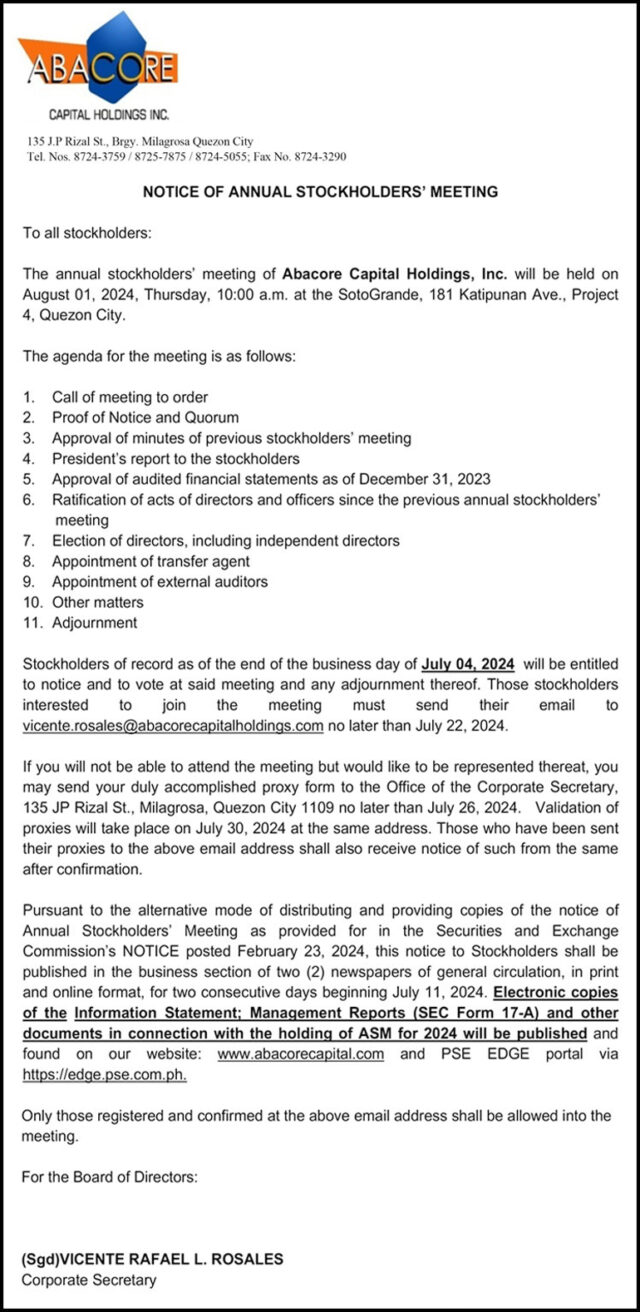
Abacore Capital Holdings, Inc.’s Annual Stockholders’ Meeting to be held on Aug. 1


Spotlight is BusinessWorld’s sponsored section that allows advertisers to amplify their brand and connect with BusinessWorld’s audience by publishing their stories on the BusinessWorld Web site. For more information, send an email to online@bworldonline.com.

Join us on Viber at https://bit.ly/3hv6bLA to get more updates and subscribe to BusinessWorld’s titles and get exclusive content through www.bworld-x.com.

The great climate change wealth transfer is here

FREEPIK

THERE’S RARELY been a better time to be a seller of fossil fuels — nor a worse time to be exposed to their effects.

Thanks to resilient crude prices and lackluster investment activity, shareholders in oil and gas companies are enjoying a bonanza. Of the $569 billion in dividends paid by businesses with at least $10 billion in net income over the past 12 months, more than a third — $206 billion — has come from fossil energy. Almost half of that has come from just one firm, Saudi Arabian Oil Co. America is producing more oil and more gas than any nation in history. The S&P 500’s index of energy companies hit a record high in April.

Even as sums are rising on the credit side of fossil fuel’s ledger, they’re climbing on the debit side, too.

Losses from natural disasters hit $280 billion last year, according to reinsurer Swiss Re, a sum that more than offsets the payouts to oil company shareholders. Not all of that amount can be laid at the door of a warming planet — but even counting only costs directly attributable to climate change, global losses over the first two decades of this century averaged about $143 billion a year, a 2023 study found.

Parts of Texas are bracing for more than a foot of rain from Monday as Tropical Storm Beryl gathers strength toward hurricane force over the unnaturally warm waters of the Gulf of Mexico. In Jamaica, the early-season storm left two-thirds of the population with power outages and almost all of the banana crop destroyed. In Saint Vincent and the Grenadines and northern islands of Grenada, more than 90% of houses and infrastructure suffered damage as Beryl rolled through.

That’s just a microcosm of what has happened so far this year. Each of the 12 months through May saw the world’s temperatures at their highest levels since at least 1850, with the mercury rising above 50° Celsius (122° Fahrenheit) in India. Flooding in Brazil has killed more than 170 people while three consecutive waves of inundation in Bangladesh affected 2 million people. More than a dozen were killed in Nepal after heavy rain triggered landslides and more flooding.

All these events are connected by one vast global transfer of wealth. Climate damage is paid for in nickels and dimes, by individuals in rich countries and poor ones.

Homeowners unable to pay for their home coverage, or quitting their suburbs altogether because of increased risk of flood or wildfire, are bearing the cost in the form of insurance premiums and reduced property values. In less affluent corners of the world, the expenditure is even more devastating, as money that should be invested in growth is spent instead on repairing the effects of natural disasters. Of about $687 billion in annual damages that one influential study estimates will be caused in a 2030 world under 2.7° Celsius of warming, $426 billion will be incurred in developing countries.

The profits from this despoliation, however, accrue to companies, whether privately- or state-owned.

It’s dispiriting that the improving economics of clean power, and the rising devastation caused by atmospheric carbon, haven’t prompted a more dramatic shift in the politics of this question.

Instead, the opposite has happened in recent years. Direct subsidies paid by governments to make fossil fuels cheaper almost doubled to $1.3 trillion in 2022 from $500 billion in 2020, though they’re likely to have reduced a bit since then thanks to cheaper oil and gas prices. Combine that with the tariffs increasingly imposed on electric vehicles, batteries, and solar panels, and governments are deploying their fiscal powers to raise the cost of clean energy, while reducing the cost of carbon pollution — a desperately counterproductive state of affairs.

Signs of a turning point in humanity’s fossil fuel addiction are everywhere, from evidence that China’s emissions are peaking this year, to the ongoing failure of crude oil output to climb above levels it hit in 2018.

Still, emissions need to not just plateau, but fall dramatically over the coming decade, and then the decade after that. At this point, politics and profit are making it harder for us to hit that target.

BLOOMBERG OPINION

Buckingham Palace opens room with famous balcony to visitors

RCT.UK

LONDON — Visitors to Buckingham Palace in London this summer will get to stand behind the famous balcony that the British royal family often poses on.

For the first time, the palace is opening the building’s East Wing, which includes the Center Room where the iconic balcony is located.

“This room was part of the edition of the East Wing, made by Queen Victoria and Prince Albert. And it was Prince Albert who suggested the balcony,” said Nicola Turner Inman, curator of Decorative Arts at Royal Collection Trust.

“It was first used in 1851 for waving off the troops for the Crimean War. So, it’s been in use for quite a long time,” she said.

Visitors will not be allowed to stand on the balcony.

But as well as being able to look through the net curtain down The Mall, there is also a newly restored 19th century glass chandelier shaped like a lotus flower to admire.

“For the public to be able to see the chandelier, not a glimpse of it from the mouth, but actually be in the room where it hangs is an exciting prospect,” said Turner Inman.

Ticket holders will also be able to go inside the Yellow Drawing Room, which features 18th century items such as recently restored hand-painted Chinese wallpaper and a Kylin clock.

While there have been guided tours of parts of the palace since 1993, access to this section has been made possible after five years of renovations as part of the ongoing Buckingham Palace reservicing program.

Other highlights include Chinese imperial silk wall hangings presented to Queen Victoria, as well as artwork from the likes of 18th century British painter Thomas Gainsborough on display in the Principal Corridor.

As well as seeing the East Wing rooms, often used for receptions and meetings as well as balcony moments, the £75 ($95.90) tickets include access to the State Rooms.

The summer opening of the State Rooms and the East Wing rooms is from July 11 to Sept. 29. Cheaper tickets are available to the State Rooms only, but anyone keen to see the newly opened wing will have to wait until next year, as those tickets have sold out. — Reuters

PPA awards Puerto Princesa port expansion contract 

PPA PMO PALAWAN FACEBOOK PAGE

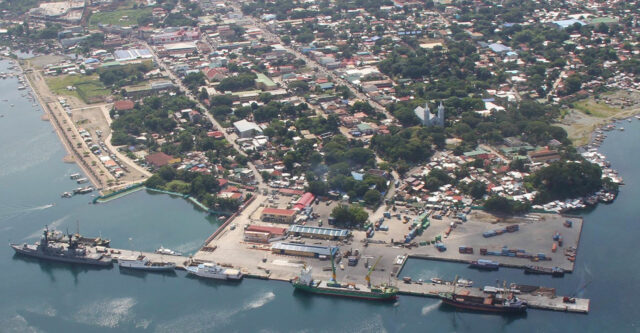
A MANILA-BASED construction company has bagged the P597.03 million contract for Puerto Princesa port expansion phase 1 project, the Philippine Ports Authority (PPA) said.

In a notice of award, PPA said that it awarded the contract to Elimared Construction and Trading, Inc. and MRBII Construction Corp., which have formed a joint venture for the project.

According to the PPA, the Puerto Princesa Port expansion project phase 1 has attracted 12 parties; with Elimared Construction and MRBII’s joint venture being declared the lowest calculated and responsive bidder for the project.

 Its bids and awards committee identified the other bidders as WTG Construction & Development Corp.; Luzviminda Engineering; Goldridge Construction & Development Corp.; MAC Builders Corp.; Octagon Concrete Solutions, Inc.; Khan Kon Chi Construction & Development Corp.; SB Construction Corp.; Sunwest, Inc.; Vicente T. Lao Construction; and UKC Builders, Inc.

In May, the PPA invited  bidders for the first phase expansion of the Puerto Princesa Port.

In PPA’s invitation to bid notice, it said it is investing P599.15 million for the phase 1 expansion of the Port of Puerto Princesa.

The contractor will have 660 days to complete the project, PPA said. 

The PPA has earlier expressed its intention to enhance and develop ports to improve their efficiency and capacity.

 In the next four years, until 2028, the PPA is earmarking about P16 billion to fund its infrastructure projects, including its 14 flagship projects slated to be completed during the period. — Ashley Erika O. Jose

Identity verification provider iProov looks to enter PHL mart

FREEPIK

By Aubrey Rose A. Inosante

LONDON-BASED identity verification provider iProov is planning to enter the Philippine market to offer its services amid growing cases of fraud and deepfakes in the country, its top official said.

“We are investing in developing the market in the Philippines,” iProov Chief Executive Officer Andrew Bud told BusinessWorld in a video call on June 28.

“The British ambassador to the Philippines visited our office. For us, the Philippines is a large, exciting, and important market, and we are doing everything we can to enable citizens and employees to benefit from the trust and security that bring to online transactions,” he added.

iProov said it can verify identities with a 98% success rate in 1.2 attempts that take just about six seconds to determine if the person is real or a deepfake.

Among iProov’s current clients are the Australian federal government and tax office, Britain for travel immigration authorization, and the United States Department of Homeland Security and Internal Revenue Service, among others.

Asia-Pacific has been an important territory for the company since 2019, which was when it began working with the Singaporean government on Singpass, a digital identity for its residents that allows them to access state services online, Mr. Bud said.

iProov is also active in the banking sector, he added.

Mr. Bud said between the first and second semesters of 2023, the company saw a 704% increase in attacks using the digital injection of deepfake face swap.

Deepfakes are now no longer detectable by the naked eye and even trained and experienced scientists, he noted, which is where the use of artificial intelligence systems can provide assistance.

“In our servers, we look at how the faces are reflecting that illumination and how that illumination is being affected by the unpredictable ambient light,” Mr. Bud said about their process of identity verification.

He said the way light is reflected on one’s face helps them tell if the person in the video is a live, skin-covered, three-dimensional human face-shaped object or not.

“We can confidently say from our most recent measurements that there is no statistically significant bias between different ethnicities, skin tones, or ages above 18,” he added.

iProov was founded in 2011. It began operations in 2013 and is now present in 180 countries.

Redesigning tollways

PHILIPPINE STAR/MIGUEL DE GUZMAN

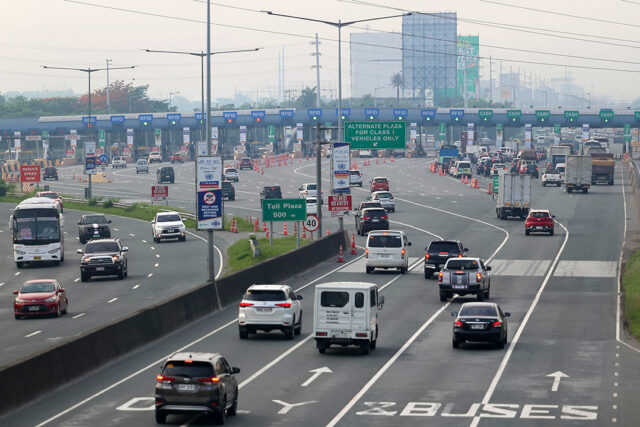
San Miguel Corp. is reportedly set to start in the next 12 months on three tollways in Luzon that will cost an estimated P300 billion. The three projects are the Northern Access Link Expressway or NALEX, the Southern Access Link Expressway or SALEX, and the first phase of South Luzon Expressway Toll Road 5.

NALEX will run from the National Capital Region (NCR) to the international airport in Bulacan which is now being built, and then to Masantol in Pampanga and then Tarlac City. SALEX, meantime, will connect the Bulacan airport to the NAIA complex in Pasay City via a shoreline tollway. The Bulacan airport is a San Miguel project, while the same group also won the bid to rehabilitate NAIA.

Over in Southern Luzon, the first phase of SLEX Toll Road 5 will run from Lucena to Gumaca in Quezon. SLEX T5 is planned to go all the way to Matnog in Sorsogon. San Miguel currently operates SLEX all the way to Sto. Tomas, Batangas, and then the STAR tollway to Batangas City. It also operates the Skyway from Alabang to Balintawak.

I believe the construction of new tollways is a good opportunity for us to improve transportation efficiency. But we should also take advantage of these new projects to incorporate sustainable practices. After all, roads take up space. In short, by using a limited resource like land for roads, this will be at the expense of something else, like a farm, for instance.

Thus, in planning new roads, we must already integrate innovative features that can also enhance our quality of life. These may include, as far as practicable, solar panel parasols over bike and pedestrian lanes, the use of plastic in road construction, greenery, water impounding systems, EV charging stations, and emergency brake ramps, among others.

Sustainable road construction is not easy and can be expensive. But this should not deter us from building infrastructure that is environmentally friendly, resilient, and inclusive. I advocate that the government require these elements, despite the additional cost they entail, in all new road constructions, especially those that are proposed by the private sector.

My limited research points to the following benefits: solar panel parasols covering bike and pedestrian lanes have the dual benefit of generating energy and at the same reducing carbon footprint. They also offer much-needed shade from direct sunlight for cyclists and pedestrians. The energy produced can be used to power streetlights and traffic signals, or small buildings. They might produce enough energy to power even in charging stations for electric vehicles.

An example is the SolaRoad project in the Netherlands, which integrates solar panels into bike paths. The project powers streetlights and nearby homes. Another example is the 32-kilometer highway Daejon and Sejong in South Korea which has a bicycle lane in the middle that shields cyclists from the sun and generates power at the same time.

Pathways and bike lanes shaded by solar-panel parasols also make cycling and walking more comfortable. It can encourage more people to use sustainable modes of transport, and thus help reduce traffic congestion and vehicle emissions. Solar parasols also power lighting for the safety of night-time users.

Another suitable intervention is the use of recycled plastic waste in road construction. Technologies for “plastic roads” have been pioneered in India and the UK, where recycled plastic is added to asphalt. In Chennai, India, over 1,600 kilometers of roads built used plastic waste, which reportedly improved road durability while reducing construction costs. Plastic-infused asphalt can reportedly withstand extreme temperatures and heavy traffic better than traditional materials.

Then there is the need to integrate greenery along highways, such as planting trees and shrubs, which can help reduce noise pollution and improve air quality. It is highly recommended as well that native species are used along roadways, to create “green corridors” that provide habitats for wildlife. Greenery is also known to reduce stress and improve mental well-being for drivers and pedestrians.

More important is the effective integration of flood mitigation and water impounding systems that can help manage stormwater runoff and reduce the risk of flooding. These systems should be able to capture and store rainwater, so as not to overwhelm drainage systems. Impounded water can have non-potable uses such as for fire emergencies and irrigating road greenery. Properly managing stormwater runoff can also help prevent contaminants from roads, such as oil and heavy metals, from entering rivers and lakes and bays.

Another item noticeably missing from our tollways are emergency brake ramps or runaway ramps for vehicles, especially trucks, with brake failure. Emergency brake ramps are essential safety features for highways, especially in areas with steep gradients, as they can prevent catastrophic accidents in case of brake failure. We need escape routes for out-of-control vehicles.

There is also now the urgent need for charging stations for electric vehicles or EVs. This can encourage the use of EVs, and thus help reduce greenhouse gas emissions from the transportation sector. Accessible charging infrastructure along highways will also allow long-distance travel feasible for EV owners. EV charging stations, which can be powered by solar panel parasols along the highway, can also create jobs and opportunities for local economies.

Requiring all new highway and tollway constructions to incorporate these initiatives can help address environmental concerns and enhance safety, comfort, and inclusivity for road users. They can improve the overall user experience, making journeys more pleasant and reducing stress. We need a holistic approach to infrastructure development, ensuring that highways and tollways serve the needs of present and future generations while protecting the environment and promoting economic growth.


Marvin Tort is a former managing editor of BusinessWorld, and a former chairman of the Philippine Press Council

matort@yahoo.com

Term deposit yields slip on BSP’s rate cut hints

Bangko Sentral ng Pilipinas main office in Manila — BW FILE PHOTO

YIELDS on the term deposits slipped on Wednesday as market players expect the Bangko Sentral ng Pilipinas (BSP) to begin its policy easing cycle as early as next month.

The central bank’s term deposit facility (TDF) attracted bids amounting to P268.701 billion on Wednesday, above the P250 billion on the auction block but lower than the P321.657 billion seen a week ago for a P230-billion offer.

Broken down, tenders for the seven-day papers reached P134.407 billion, higher than the P130 billion auctioned off by the central bank but lower than the P159.459 billion in bids recorded the previous week.

Banks asked for yields ranging from 6.495% to 6.53%, marginally wider than the 6.495% to 6.525% band seen a week ago. This caused the average rate of the one-week deposits to inch down by 0.49 basis point (bp) to 6.5105% from 6.5154% the previous week.

Meanwhile, bids for the 14-day term deposits amounted to P134.294 billion, lower than the P120 billion on the auction block and the P162.198 billion in tenders seen for the P110-billion offer on July 3.

Accepted rates were from 6.535% to 6.569%, narrower than the 6.5245% to 6.575% margin recorded a week ago. With this, the average rate for the two-week deposits dropped by 1.35 bps to 6.5546% from 6.5681% logged in the prior auction.

The BSP has not auctioned off 28-day term deposits for more than three years to give way to its weekly offerings of securities with the same tenor.

The term deposits and the 28-day BSP bills are used by the central bank to mop up excess liquidity in the financial system and to better guide market rates.

TDF yields went down on Wednesday amid continued rate cut signals from the BSP, Rizal Commercial Banking Corp. Chief Economist Michael L. Ricafort said in a Viber message.

“The TDF auction yields were slightly lower week-on-week after local monetary officials recently reiterated a possible local policy rate cut as early as August 2024 and could even come ahead of a possible Fed rate cut,” Mr. Ricafort said in a Viber message.

BSP Governor Eli M. Remolona, Jr. last month said the Monetary Board may deliver its first rate cut in over three years at its Aug. 15 review — the only policy meeting scheduled in the third quarter — as they expect inflation to continue easing this semester.

The Monetary Board could reduce borrowing costs by 25 bps in the third quarter and by another 25 bps in the fourth quarter, he said.

Mr. Ricafort added that TDF yields were affected by “signals on additional National Government foreign bond sales… that could somewhat hedge and help reduce the need for more local borrowings.”

The government is looking to issue Japanese yen-denominated and US dollar-denominated bonds within the year, Finance Secretary Ralph G. Recto said on Monday. It plans to borrow $5 billion this year, of which $2 billion was raised from the issuance of global bonds last May. — Luisa Maria Jacinta C. Jocson

Harvey Weinstein under investigation for additional sexual assaults, prosecutor says

COMMONS.WIKIMEDIA.ORG

NEW YORK — Prosecutors are probing “additional violent sexual assaults” they say former Hollywood movie mogul Harvey Weinstein committed and intend to seek a new indictment after his previous conviction was overturned, a prosecutor said on Tuesday.

Prosecutor Nicole Blumberg said in a hearing before Justice Curtis Farber in New York state criminal court in Manhattan that the additional assaults Mr. Weinstein allegedly committed were still within the statute of limitations to be charged as crimes.

Mr. Weinstein was found guilty on rape allegations in 2020 in a milestone for the #MeToo movement, in which women accused hundreds of men in entertainment, media, politics, and other fields of sexual misconduct.

A jury found the 72-year-old Miramax film studio co-founder sexually assaulted former production assistant Miriam Haley in 2006 and raped aspiring actress Jessica Mann in 2013. They are among more than 80 women who have accused him of sexual misconduct.

He was sentenced to 23 years in prison, but the New York Court of Appeals in April found that Judge James Burke, who presided over the trial, made a critical mistake by allowing three women to testify about alleged sexual assaults by Mr. Weinstein that were not part of the criminal charges against him.

The court said that testimony about “prior bad acts” violated his right to a fair trial.

Mr. Weinstein has denied having non-consensual encounters with anyone. Arthur Aidala, Mr. Weinstein’s lawyer, said on Tuesday it was unfair for prosecutors to seek to add additional victims to the case after the conviction was overturned. “Once again we have a hotline: ‘1-800 Get Harvey,’” Mr. Aidala said in court.

Mr. Weinstein is suffering from a host of medical problems while being held in solitary confinement at New York City’s Rikers Island jail, Mr. Aidala said. He accused prosecutors of using delay tactics to keep Mr. Weinstein incarcerated, which Ms. Blumberg denied.

“As we said in 2020, there were women who were not ready to proceed with the legal process. Some of those women are now ready to proceed,” Ms. Blumberg said.

Prosecutors would be ready to try the case in the fall, Ms. Blumberg said, but no trial date was set. Mr. Weinstein is due back in court on July 19.

Mr. Weinstein was also sentenced to 16 years following a separate rape trial in California. That conviction was not affected by the New York court’s decision, and he has not begun serving the California sentence.

Miramax’s hit movies included Shakespeare in Love and Pulp Fiction. Mr. Weinstein’s own eponymous film studio filed for bankruptcy in March 2018. — Reuters

Philex eyes fundraising for second phase of Silangan project

PHILEX Mining Corp. is eyeing further fundraising for the continued development of its Silangan mine project, its chairman said.

“Before we start commercial operations next year, we may consider starting phase two of the development, and who knows, we may do a follow-on in late 2025 or 2026,” Philex Chairman Manuel V. Pangilinan said on the sidelines of a stockholders’ meeting late Tuesday.

Mr. Pangilinan added that the company would focus on the first phase of the project before raising funds for the second phase.

“Once that is finished, then we will start with phase 2,” he said.

Phase one of Silangan covers the Boyongan deposit, which contains 81 million tons of mineable material. It is comprised of 0.67% copper and 1.13 grams of gold per ton, and it has a lifespan of 28 years.

The company said that once the Bayugo ore body is mined it could increase annual production to 6.5 million tons.

In February, the company said that it had completed its $170-million loan needed to begin operations of the company’s Silangan copper and gold mine in Surigao del Norte. It is expected to begin commercial operations by the first quarter of next year.

In 2021, the company placed the development cost at $224 million for an estimated 571 tons worth of mineral resources. The project will initially process 2,000 tons of ore per day until it reaches 12,000 tons, or four million tons annually, upon its completion.

The first phase of the Silangan mine is expected to start producing gold ore by December 2025 and copper ore during the first quarter of 2026.

Philex Mining is one of three Philippine units of Hong Kong-based First Pacific Co. Ltd., the others being Metro Pacific Investments Corp. and PLDT Inc.

Hastings Holdings, Inc., a unit of PLDT Beneficial Trust Fund subsidiary MediaQuest Holdings, Inc., has interest in BusinessWorld through the Philippine Star Group, which it controls.

Shares in Philex Mining closed at P2.65 apiece on Wednesday, down by 1.12%, or three centavos. — Adrian H. Halili

China leads the world in adoption of generative AI tools, survey shows

UNSPLASH

BEIJING — China is leading the world in adopting generative artificial intelligence (AI), a new survey shows, the latest sign the country is making strides in the technology that gained global attention after US-based OpenAI’s ChatGPT launched in late 2022.

In a survey of 1,600 decision-makers in industries worldwide by US AI and analytics software company SAS and Coleman Parkes Research, 83% of Chinese respondents said they used generative AI, the technology underpinning ChatGPT.

That was higher than the 16 other countries and regions in the survey, including the United States, where 65% of respondents said they had adopted GenAI.

The global average was 54%.

The industries surveyed included banking, insurance, healthcare, telecommunications, manufacturing, retail, and energy.

The results underscore China’s rapid progress in the generative AI field, which gained momentum after Microsoft-backed OpenAI released ChatGPT in November 2022, prompting dozens of Chinese companies to launch their own versions.

Last week, a report by the United Nations’ World Intellectual Property Organization showed China was leading the GenAI patent race, filing more than 38,000 between 2014 and 2023 against 6,276 filed by the United States in the same period.

While many leading international generative AI service providers, including OpenAI, face curbs in China, the country has developed a robust domestic industry, with offerings from tech giants such as ByteDance to startups such as Zhipu.

Enterprise adoption of generative AI in China is expected to accelerate as a price war is likely to further reduce the cost of large language model services for businesses.

The SAS report also said China led the world in continuous automated monitoring (CAM), which it described as “a controversial but widely-deployed use case for generative AI tools.”

This technology can collect and analyze vast amounts of data on users’ activities, behavior and communications, which can lead to privacy infringements as they are not aware of the extent of the data being collected or how it is used, said Udo Sglavo, vice-president of applied AI and modelling at SAS.

Mr. The algorithms and processes used in CAM are often proprietary and not transparent,” Mr. Sglavo added.

“This can make it difficult to hold the entities using CAM accountable for misuse or errors.”

He added, “China’s advancements in CAM contribute to its broader strategy of becoming a global leader in artificial intelligence and surveillance technologies.” — Reuters

Nuclear energy for economic growth

The Department of Energy (DoE) announced last Tuesday, July 9, that the “Agreement for Cooperation Concerning Peaceful Uses of Nuclear Energy” or the “123 Agreement” signed by the US and the Philippines in San Francisco on Nov. 16, 2023, came into force on July 2. It is a beautiful agreement because it provides for the safe and efficient use of nuclear energy for peaceful purposes — in agriculture, healthcare, industry, and power generation applications.

On nuclear energy development in particular, DoE Secretary Raphael P.M. Lotilla said that the Nuclear Energy Program-Inter-Agency Committee (NEP-IAC) “is now finalizing the country’s nuclear energy program roadmap which outlines key targets that must be achieved for the successful use of nuclear energy for power generation. Under the 2023-2050 Philippine Energy Plan (PEP), the entry of nuclear power generation capacities is targeted in 2032 with at least 1,200 megawatts (MW), and additional 1,200 MW by 2035 and 2,400 MW by 2050.”

Thank you, Secretary Lotilla for this clear timeline — although I wish that the Bataan Nuclear Power Plant (BNPP) could be refurbished soon and start operation before 2030. And that micro modular reactors (MMR) and small modular reactors (SMR) would be given the green light while the BNPP is being refurbished, then large nuclear power plants be commissioned in the next decade.

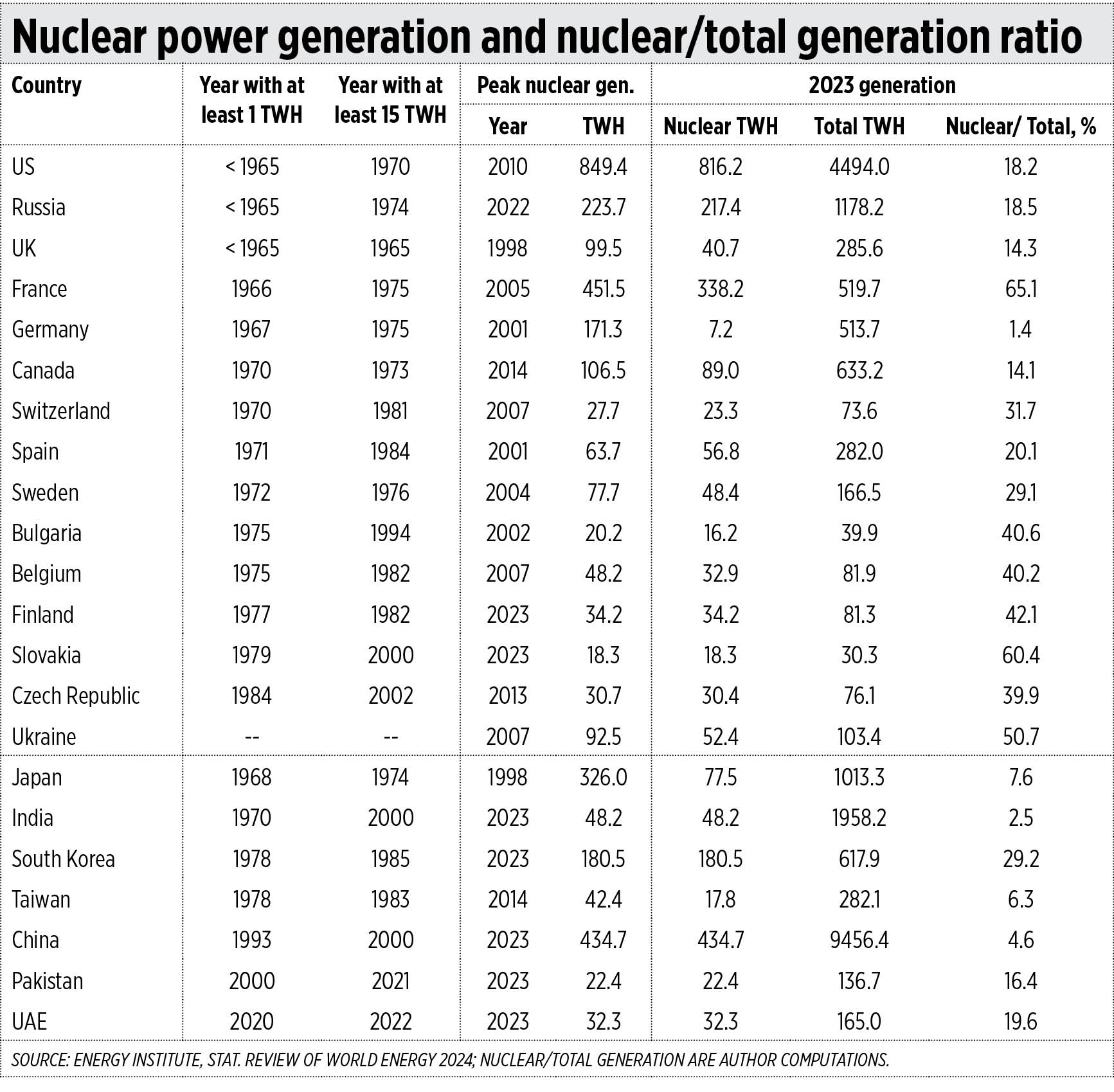
Several Asian countries embraced nuclear energy many decades ago. Japan produced at least 1 terawatt-hour (TWh) of nuclear energy in 1968 while India did the same in 1970. China is a late comer, producing at least 1 TWh only in 1993. The most surprising is the United Arab Emirates (UAE), an oil-gas producing and exporting giant, which started building huge nuclear power plants of 1,345 MW capacity yearly for four years from 2012 to 2015. So, now it has 5,380 MW of nuclear power capacity. They started producing a little electricity in 2020, rising in succeeding years to 32 TWh in 2023 alone. Our BNPP had a capacity of only 620 MW and could have generated about 4.6 TWh of electricity every year.

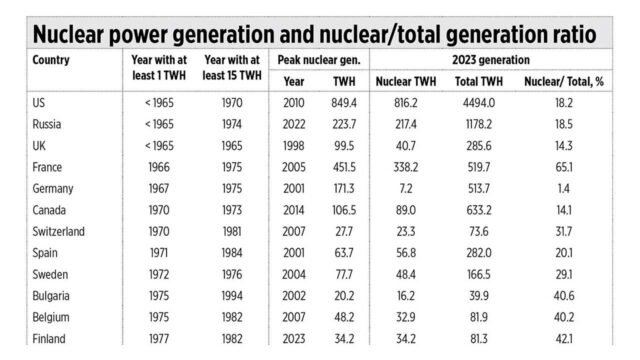
The US and UK started using nuclear power in the 1950s, Russia in the early 1960s. France remains the biggest nuclear-powered country in Europe and is now the third largest in the world behind the US and China (see the table).

The decline from the peak nuclear/total generation ratio to 2023’s ratio is notable in the following countries: the UK which, from a peak of 27.4%, went down to 14.3% in 2023; Germany which went from 29% to 1.4%; Sweden, from 51% to 29%; Belgium, from 55% to 40%; Switzerland, from 41% to 32%; Japan, from 31% to 7.6%; and Taiwan, from 16% to 6.3%.

In contrast, India, South Korea, China, Pakistan, and the UAE keep raising their nuclear generation capacity yearly.

In the Philippines, two energy companies have made explicit plans to develop nuclear energy — Aboitiz Power (AP) and Meralco. Both are looking at the role of manpower training and education in nuclear engineering.

AP’s Vice-President for Corporate Affairs Ronald “Suiee” Suarez — who was with us in Toronto during the Philippines Nuclear Trade Mission to Canada last March, organized by the Embassy of Canada in Manila — made a good observation. He said that “when we visited McMaster University and Ontario Tech, they showed that educators are at the forefront of cultivating the talent pipeline of engineers and industry professionals who will either operate the nuclear technologies, run the business, or regulate the industry. The academe has the tools and know-how to push the envelope and present society with options for a broader application of nuclear science. In the developed world, beyond the generation of electricity, nuclear has been instrumental in the development of isotopes used in medicine, materials engineering, particle research, and industry, which benefit the greater economy.”

On July 1, Meralco officially introduced the pilot batch of scholars under its Filipino Scholars and Interns on Nuclear Engineering (Fission) program. Five Meralco engineers will participate in the two-year nuclear engineering program abroad, at the University of Illinois Urbana in the US, and at Harbin University in China. After completion of the academic program, the Fission scholars will be sent to nuclear technology companies for their internships. When they return to the Philippines in 2028, they will be reintegrated into Meralco and be assigned to its nuclear power generation unit.

Meralco Executive Vice-President and Chief Operating Officer Ronnie L. Aperocho is optimistic. He said that “Fission is a major step in accelerating the education and training of technical and regulatory talents in the highly specialized field of nuclear engineering. This manifests Meralco’s steadfast commitment in continuously developing the workforce in the energy sector.”

Meralco Chairman and Chief Executive Officer Manuel V. Pangilinan is more emphatic, saying that “This country — and Meralco — should be prepared for and committed to nuclear energy. Supporting aspiring energy professionals will help build a talent pipeline of nuclear energy experts, paving the way for a smarter and greener future for our country.”

Very good, gentlemen. We need fast growth, sustained fast growth, in the Philippines. Meaning that power demand will rise fast, and high energy-density nuclear power can easily fill the big supply gap. Intermittent renewables like wind-solar and bulky gas plants will have a hard time providing the huge baseload power needed for the fast-rising power demand.


Bienvenido S. Oplas, Jr. is the president of Bienvenido S. Oplas, Jr. Research Consultancy Services, and Minimal Government Thinkers. He is an international fellow of the Tholos Foundation.

minimalgovernment@gmail.com