Home Blog Page 2421

US, French navies hold military drills in Philippine Sea for ‘free’ Indo-Pacific

PHILIPPINE SEA (Aug. 13, 2024) – The Arleigh Burke-class guided-missile destroyer USS Dewey (DDG 105) sails alongside the French Navy Aquitane-class frigate FS Bretagne (D 655) during bilateral operations in the Philippine Sea, Aug. 13, 2024. Dewey is forward-deployed and assigned to Destroyer Squadron (DESRON) 15, the Navy’s largest DESRON and the U.S. 7th Fleet’s principal surface force. — PHOTO COURTESY OF FRENCH NAVY

THE UNITED States and French navies held war games in the Philippine Sea on Tuesday to advance their interoperability “in support of a free and open Indo-Pacific,” the US 7th Fleet said in a statement on Thursday.

The operations included US Navy Arleigh Burke-class guided-missile destroyer USS Dewey and the French Navy Aquitane-class frigate FS Bretagne (D655).

“The US 7th Fleet takes regular steps to advance our interoperability with allies and partners in the Indo-Pacific, as we did during this week’s bilateral operation with our longstanding French Navy allies,” Vice Admiral Fred Kacher, commander of the fleet, said in the statement.

“The work we do together strengthens the combined capabilities of our professional maritime forces and enhances our ability to deter conflict in the region,” he added.

The ships conducted formation sailing, combined communication and simulated refueling at sea, the US 7th Fleet said.

“Our bilateral training affirms the high level of interoperability between French and American navies,” Captain Audrey Boutteville, commanding officer of Bretagne, said in the statement.

“The newly swapped crew of the FS Bretagne continues to ride with high spirits established during RIMPAC (Rim of the Pacific) as demonstrated with our cooperation with the US Navy in the Philippine Sea,” she added.

The US Navy regularly operates alongside its allies in the Indo-Pacific region as a demonstration of our shared commitment to the rules-based international order, according to the statement.

“Bilateral operations such as this one provide valuable opportunities to train, exercise and develop tactical interoperability across allied navies in the Indo-Pacific,” it added.

In the same statement, Commander Nicholas Maruca, commanding officer of the USS Dewey, said professional engagement with allies, partners and friends operating in the region allows them to build upon strong relationships and learn from each other.

“These sails are great opportunities to enhance interoperability, information sharing and combined warfighting capabilities with our partners and allies through realistic scenarios across a number of warfare areas.”

Dewey is forward-deployed and assigned to Destroyer Squadron 15, the US Navy’s largest destroyer squadron and the US 7th Fleet’s principal surface force.

The US 7th Fleet is the US Navy’s largest forward-deployed numbered fleet, and “it routinely interacts and operates with allies and partners in preserving a free and open Indo-Pacific region.”

Also on Thursday, the Philippine Coast Guard (PCG) said its Chinese counterpart has been using militia vessels as part of its maritime operations, citing interactions between the two forces at Sabina Shoal.

A Chinese Coast Guard (CCG) vessel registered under China’s Western and Central Pacific Fisheries Commission that arrived in Sabina did not inspect Chinese maritime militia vessels gathered within the shoal for compliance with fishery laws.

FAMILIAR ACQUAINTANCES
“Instead of conducting inspections, they interacted with the crew of the Chinese maritime militia as if they were familiar acquaintances, sharing meals together,” PCG spokesman Jay Tristan Tarriela said in an X post.

“It is evident that no formal boarding procedures were carried out by the China Coast Guard to question the Chinese maritime militia’s intentions, despite their prolonged presence without any signs of fishing,” he added.

The Chinese Embassy in Manila did not immediately reply to a Viber message seeking comment.

Mr. Tarriela said this showed that the Chinese maritime militia is recognized by the Chinese Coast Guard (CCG) as an integral part of its maritime operations, “aiding in encroaching upon the exclusive economic zones of other countries throughout the South China Sea.”

“These state-subsidized maritime militia support the CCG and the People’s Liberation Army Navy in intimidating neighboring maritime states such as Vietnam, Malaysia, Indonesia and the Philippines,” he added.

Mr. Tarriela said the Chinese Coast Guard should not be entrusted with the responsibilities of the Western and Central Pacific Fisheries Commission to board fishing vessels, noting that their “true objective is not to combat illegal, unreported or unregulated fishing.”

“The People’s Republic of China’s aim appears to be the innovative legitimization of its unlawful presence and activities in the West Philippine Sea, disguised under the pretense of maritime law enforcement,” he said, referring to parts of the South China Sea that are within the Philippines’ exclusive economic zone.

The US-based Asia Maritime Transparency Initiative in February said an average of 195 Chinese militia ships were present near disputed areas of the South China Sea including Philippine features on any given day last year, a 35% increase from a year earlier.

These were composed of professional militia vessels out of Hainan province and the “Spratly Backbone Fleet,” which consists of commercial vessels subsidized to operate in disputed waters to support Chinese sovereignty claims, it said.

The Philippines has been monitoring the presence of Chinese vessels at Sabina Shoal, which is part of the Spratly Islands and falls within the Philippine EEZ. It is 123.6 nautical miles from Palawan Island, which is facing the South China Sea.

Earlier this month, the Philippine Navy noted that Chinese research vessel Ke Xue San Hao, which is equipped with advanced technology designed for marine environment observation, was still near Sabina over a week after it left a major Chinese military outpost in the South China Sea.

Its “zig-zag” movement “indicates something else,” which is no longer an innocent passage, it said.

The Navy said it had spotted Ke Xue San Hao, 12 Chinese maritime militia vessels and one China Coast Guard ship at the shoal from July 30 to Aug. 4. — Norman P. Aquino and Kyle Aristophere T. Atienza

Philippines, Singapore to boost climate agenda ties

By Kyle Aristophere T. Atienza, Reporter

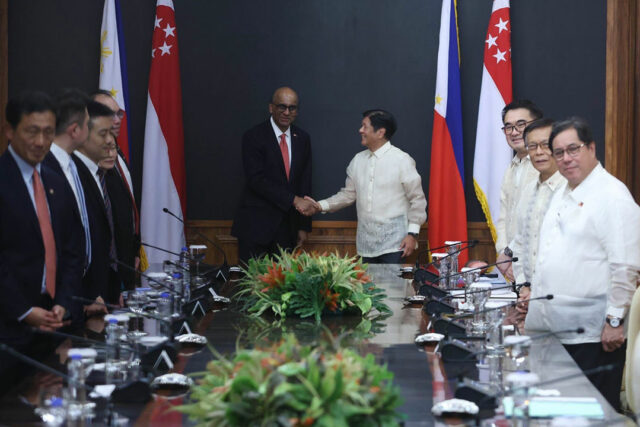
PHILIPPINE President Ferdinand R. Marcos, Jr.  met with his Singapore counterpart on Thursday, as they seek to boost ties in the climate agenda and healthcare workforce.

The two nations would sign a deal on carbon credits, in line with the Paris Agreement, he told Singapore President Tharman Shanmugaratnam during their meeting, according to the presidential palace.

The Southeast Asian neighbors will also sign a deal on the recruitment of healthcare workers, he added.

“I note as well that our respective agencies are actively discussing proposed MoUs (memorandum of understanding) in the areas of health and maritime security,” Mr. Marcos said.

The Philippine leader visited Singapore in May to deliver the keynote address at the Shangri-La Security Dialogue, where he alluded to China as a nation that was undermining regional stability.

Mr. Marcos also visited Singapore in September 2023 at the invitation of its former president Halimah Yacob.

Don Mclain Gill, who teaches international relations at De La Salle University in Manila, said the Singaporean leader’s visit comes at a time when the Philippines is boosting security ties with its Southeast Asian neighbors.

He noted that the two nations have signed a defense cooperation agreement, “reflecting their desire to institutionalize and deepen defense collaborations.”

“While Singapore is not a claimant state in the South China Sea dispute, active engagements with maritime Southeast Asian neighbors will complement the Philippines’ goal of creating stronger linkages with immediate neighbors amid China’s expansionism in the region,” he said in a Facebook Messenger chat.

He added that closer ties among Southeast Asian countries would make it “harder for China to pursue its divide-and-conquer approach.”

Mr. Marcos, in his opening remarks, said the Philippines was optimistic about “fostering closer and enhanced cooperation with Singapore” in defense and security, trade and investment, and new areas such as sustainability and energy.

“MoUs in the fields of health and maritime security are already in the pipeline and are anticipated to be finalized in the very near future,” he added.

“There will also be the planned signing of MoUs by Philippine local government units and their Singapore private sector partners,” he said.

“This is also a benchmarking opportunity for Manila under President Marcos to learn from Singapore’s miracle and sustainable economy, upper-middle income economy, world class public transportation and healthy citizens,” Chester B. Cabalza, president at think tank International Development and Security Cooperation, said via Messenger chat.

Meanwhile, Mr. Shanmugaratnam recognized Filipino athlete Carlos Yulo in his meeting with Mr. Marcos, noting that he’s the first person from any Southeast Asian nation to win two Olympic gold medals.

“He is the only athlete from an ASEAN nation who’s had two Olympic golds ever in any sport,” he said.

“It’s a real milestone for all of us. I mean, we shine a bit of the reflected glory of the Philippines,” he added.

Transfer of anti-Maoist body’s budget to education sought

PHILIPPINE STAR/ MICHAEL VARCAS

By Kenneth Christiane L. Basilio, Reporter

THE GOVERNMENT should transfer P7.8 billion of the budget of the country’s anti-communist task force to education and health, a congressman said on Thursday, citing the body’s slow fund use.

“This is not the first time that the NTF-ELCAC’s (National Task Force to End Local Communist Armed Conflict) fund utilization has been this slow,” Party-list Rep. Raoul Danniel A. Manuel said in Filipino during a House of Representatives hearing on the agency’s budget.

He noted that as of June, the task force has only spent 96% of its P16.4-billion village budget for 2021.

“I strongly insist that we defund NTF-ELCAC, including its Barangay Development Program for 2025,” he said. “Instead, we should realign the funds directly to national agencies working on education, health and other social services.”

The NTF-ELCAC’s village program seeks to address “development gaps” in infrastructure and basic services of villages freed from the influence of communist rebels.

Next year’s proposed funding for the barangay development program more than tripled to P7.8 billion from P2.2 billion this year.

The amount will be used to build farm-to-market roads, schools, water and electrification projects for 780 conflict-prone villages nationwide, according to the 2025 National Expenditure Program.

Meanwhile, the state has yet to begin its implementation of 885 village development projects for 2024, Interior and Local Government Undersecretary Marlo L. Iringan told congressmen.

The Budget department had just released the budget to local governments, he said. “That’s why they are still in the process of procuring the projects.”

Mr. Manuel raised concerns about the timely implementation of village development projects, saying the government “only has four whole months left for the year” to accomplish them.

Only 841 out of 1,253 projects in 2023 have been implemented as of June, Mr. Iringan said.

“Despite its flaws, the development program illustrates that the military knew it needed to pursue a more holistic approach to end the communist insurgency,” Georgi Engelbrecht, a senior analyst at international conflict think tank Crisis Group, said in an X message.

However, it should be refined and streamlined to improve socioeconomic conditions in conflict-affected areas, he added.

“While development projects may enjoy short-term success, their long-term effects are often uncertain,” he told BusinessWorld. “Building roads may be an essential step… but corridors from the countryside to urban centers, which are crucial to boosting rural livelihoods, are often missing from the plans.”

The proposal to realign the NTF-ELCAC funds to social services should still target “the poorest and most conflict-affected barangays” in the country, Mr. Engelbrecht said.

The government should also improve its amnesty program by providing more opportunities to rebel returnees, Chester B. Cabalza, founding president of Manila-based International Development and Security Cooperation, said in a Facebook Messenger chat.

“More funds are needed to roll out developmental programs to returnee rebels and insurgents who sought amnesty from the government,” he said. “While their reintegration to the nation and communities is costly, it is effective.”

Bill on Shari’ah courts signed into law

PRESIDENT FERDINAND R. MARCOS, JR. — PHILIPPINE STAR/RYAN BALDEMOR

PRESIDENT Ferdinand R. Marcos Jr. has signed into law a bill that will create three more Shari’ah judicial districts and 12 circuit courts across the country, ahead of the Bangsamoro region’s first parliamentary elections.

Republic Act.  No. 120181 amended a 1970s presidential decree that created five Shari’ah judicial districts for the provinces of Sulu, Tawi-Tawi, Zamboanga del Norte and Zamboanga del Sur, as well as in the cities of Pagadian, Zamboanga and Dipolog.

The first five Shari’ah judicial districts also included the provinces of Lanao del Norte, Lanao del Sur, Maguindanao, North Cotabato, Sultan Kudarat and the cities of Iligan, Marawi and Cotabato.

Shari’ah is a religious law that lays down the governing principles that must be followed by Muslims.

The new law created three additional Shari’ah districts including the sixth district for Bukidnon, Misamis Oriental, Misamis Occidental, Camiguin, Cagayan de Oro City and provinces in the Davao and Caraga regions.

The seventh district, meanwhile, covers provinces in Western, Central and Easter Visayas. The eighth district covers Metro Manila, provinces in the Cordillera Administrative Region, Ilocos Region, Cagayan Valley, Central Luzon, Calabarzon, Bicol and Mimaropa.

The law also increased Shari’ah circuit courts by 12 to 63. These will serve the newly created judicial districts.

The five circuit courts will be in the sixth district, three in the seventh district and four in the eighth Shari’ah district.  

In 2023, the Supreme Court ruled that Shari’ah courts are autonomous bodies that are independent from regular civil courts. — Kyle Aristophere T. Atienza

SC issues order on fund transfer

BW FILE PHOTO

THE PHILIPPINE Supreme Court (SC) on Thursday ordered the government to comment on a lawsuit that seeks to prevent the transfer of P90 billion in excess funds from the Philippine Health Insurance Corp. (PhilHealth) to the National Treasury.

“The court required the respondents to file their comment to the petition and prayer for [a temporary restraining order] within a nonextendible period of 10 days from notice,” SC spokesperson Camille Sue Mae L. Ting told a news briefing.

The full court issued the order on Aug. 13.

Plaintiffs led by Senator Aquilino Martin L. Pimentel III earlier said the funds should be used to increase the benefits given to the state insurer’s members. — Chloe Mari A. Hufana

DTI, PDEA battle drug-infused vape

PHILIPPINE STAR/ RUSSELL PALMA

THE DEPARTMENT of Trade and Industry (DTI) has partnered with the Philippine Drug Enforcement Agency (PDEA) to combat the sale of vape products infused with illegal drugs.

In a statement on Thursday, DTI said the agencies signed a memorandum of understanding on Aug. 8.

“This agreement leverages the combined resources and expertise of the DTI and the PDEA to ensure product safety and protect the public from the infiltration of illegal drugs, including marijuana-infused vapes,” Trade Assistant Secretary Agaton Teodoro Uvero said. — Justine Irish D. Tabile

P56-M illegal drugs seized at NAIA

PHILIPPINE STAR/MIGUEL DE GUZMAN

CUSTOMS agents seized P56.56 million worth of illegal drugs at the Ninoy Aquino International Airport (NAIA) in two days this week.

In a statement, the Bureau of Customs-NAIA said agents seized 5.3 kilos of crystal meth worth P35.8 million from a passenger from Abu Dhabi on Aug. 13.

On Aug. 14, the agents confiscated 14.8 kilograms of kush, a variety of marijuana, worth P20.76 million from a passenger from Thailand.

“Both passengers were subjected to rigorous baggage screening processes, including X-ray scanning, K9 inspection and thorough physical examinations, which led to the discovery of the illicit substances,” the Bureau of Customs said. — Beatriz Marie D. Cruz

House to boost athlete incentives

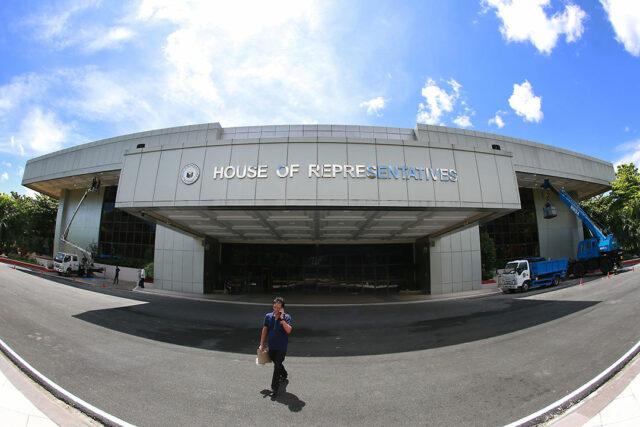
The House of Representatives is seen at the Batasang Pambansa Complex in Quezon City. — PHILIPPINE STAR/MIGUEL DE GUZMAN

THE HOUSE of Representatives is looking at boosting state financial and material support for national athletes by amending a law that gives them incentives, Speaker and Leyte Rep. Ferdinand Martin G. Romualdez said on Thursday.

“We will conduct a review of our legislation, among others, Republic Act No. 10699 or the National Athletes and Coaches Benefits and Incentives Act,” he said in a statement in mixed English and Filipino. “We need to amend this law to provide support and aid needed by our athletes.” — Kenneth Christiane L. Basilio

Student job readiness pushed

K-TO-12 STUDENTS at a high school in Marikina City during their in-person graduation ceremony on July 2, 2022. — PHILIPPINE STAR FILE PHOTO/WALTER BOLLOZOS

A PHILIPPINE senator on Thursday pushed a bill that seeks to boost coordination between the government and private sector in developing better work immersion programs for senior high school students, citing the need to ensure workforce competitiveness.

“If we can enact the Batang Magaling Act, we will further strengthen the relationship between our schools and the private sector to ensure that our senior high school graduates are job-ready,” Senator Sherwin T. Gatchalian said in a statement in Filipino.

Senate Bill No. 2367 seeks to set up a council that will develop the national work immersion program composed of the Labor department, private sector representatives and labor groups. — John Victor D. Ordoñez

DAR to finish digitalization in 2025

THE DEPARTMENT of Agrarian Reform (DAR) on Thursday said it seeks to finish digitalization efforts by October next year.

Agrarian Reform Secretary Conrado M. Estrella III told a congressional hearing land reform data were in disarray when he took over in 2022, prompting the agency to enforce digitalization efforts.

It involves consolidating land ownership and reform data, including sold or leased tilling land and the number of farmers still in possession of state-provided farms.

“When we took over, the data were all over the place,” he told congressmen in Filipino during DAR’s budget hearing. “This is the very reason why we will engage in an honest-to-goodness digitalization project.” — Kenneth Christiane L. Basilio

E-governance master plan sought

SEN. ALAN PETER CAYETANO FACEBOOK PAGE

SENATOR Alan Peter S. Cayetano on Thursday pushed a bill that creates an e-governance master plan to quicken the delivery of basic services through digital technology, saying it would reduce bureaucratic red tape and corruption.

“This isn’t just a gradual change; it’s a quantum leap from slow, corruption-riddled processes to fast, transparent operations,” he said in a statement.

Senate Bill No. 2781 also proposes an internet-based payment system for government agencies. — John Victor D. Ordoñez

Changes to Right of Way law pushed

PHILIPPINE STAR/GEREMY PINTOLO

SENATOR and former Public Works Secretary Mark A. Villar on Thursday pushed changes to the country’s law on right of way acquisition to speed up infrastructure projects, citing the need to align it with the recently signed Real Property Valuation law.

He told a Senate public works committee hearing private property owners affected by government projects must be duly compensated.

“Resolving this bottleneck in right-of-way acquisition will enable us to deliver high-impact infrastructure projects in a timely and efficient manner,” Mr. Villar said. — John Victor D. Ordoñez