Home Blog Page 242

Nvidia CEO Huang sees strong demand for Blackwell chips

Nvidia CEO Jensen Huang. — NVIDIA NEWSROOM

HSINCHU, Taiwan — Nvidia Chief Executive Officer (CEO) Jensen Huang on Saturday said the semiconductor giant is experiencing “very strong demand” for its state-of-the-art Blackwell chips, as its appetite for wafers from Taiwan Semiconductor Manufacturing Co. (TSMC) grows.

“Nvidia builds the GPU (graphics processing units), but we also build the CPU (central processing units), the networking, the switches, and so there are a lot of chips associated with Blackwell,” Huang told reporters at an event held by Nvidia’s longtime partner TSMC in Hsinchu.

TSMC CEO C.C. Wei said that Huang had “asked for wafers,” but that the number was confidential.

“TSMC is doing a very good job supporting us on wafers,” Mr. Huang said during his fourth public trip to Taiwan this year, adding that Nvidia’s success would not be possible without TSMC.

Nvidia made history in October when it became the first company to reach a $5-trillion market value and TSMC’s Mr. Wei called Huang a “five-trillion-dollar man.”

When asked how concerned he was about memory shortages, Huang said that business was growing strongly and there would be shortages of “different things.”

“We have three very, very good memory makers — SK Hynix, Samsung, Micron — are all incredibly good memory makers, and they have scaled up tremendous capacity to support us,” Mr. Huang said.

Mr. Huang also said Nvidia has received the most advanced chip samples from all three memory makers.

When asked about possible memory price increases, he said: “it’s for them to decide how to run their business.”

South Korea’s SK Hynix said last week it had sold out all its chip production for next year and planned to sharply boost investments, expecting an extended chip “super cycle” spurred by the AI boom.

Samsung Electronics also said last week it was in “close discussion” to supply its next-generation high-bandwidth memory chips, or HBM4, to Nvidia.

On Friday, Mr. Huang said there were “no active discussions” about selling Blackwell chips — Nvidia’s flagship artificial-intelligence chip — to China. The Trump administration has prevented such sales, saying they could aid the Chinese military and the country’s AI industry. — Reuters

Migrant vessel sinks off Malaysia-Thailand border, hundreds missing

REUTERS

KUALA LUMPUR — Hundreds were missing on Sunday after a boat sank near the Thailand-Malaysia border, as 10 survivors and one body were recovered, the Malaysian maritime authority said.

More victims might still be found at sea some three days after the sinking of the vessel, which left Buthidaung, Myanmar, with about 300 people on board, said First Admiral Romli Mustafa, the maritime authority director of the northern Malaysian states of Kedah and Perlis.

Among the survivors found in the waters off Langkawi were three Myanmar men, two Rohingya men and one Bangladeshi man, while the body was that of a Rohingya woman, state media Bernama said, citing Kedah police chief Adzli Abu Shah.

Members of the mainly Muslim Rohingya minority periodically flee majority-Buddhist Myanmar, where they are seen as foreign interlopers from South Asia, who are denied citizenship and face abuse.

The Malaysia-bound people initially boarded a large vessel but as they neared the border, they were instructed to transfer onto three smaller boats, each carrying about 100 people, to avoid detection by the authorities, Mr. Adzli was quoted as saying.

The status of the other two boats was not known, and a search-and-rescue operation was ongoing, he said. — Reuters

Philippine growth shock sparks doomsayer debate with investors

A MAN looks at a mural with an anti-corruption message in Quezon City, Sept. 20. — PHILIPPINE STAR/MIGUEL DE GUZMAN

The Philippines’ sharp growth slump lays bare how revelations of massive graft have gutted confidence, even as top officials insist the nation is still on track.

Gross domestic product expanded just 4.0% in the three months through September from a year earlier, the statistics agency said Friday. That compares to a 5.5% pace in the second quarter and economist predictions of 5.2%.

The data snapped a string of robust third-quarter readings across Asia, with Taiwan, Malaysia and Vietnam all surprising on the upside. The much larger economies of China and Indonesia both also expanded slightly more than estimated, and easily outpaced the Philippines.

Growth in the sprawling island nation has spluttered after evidence of widespread government corruption related to flood mitigation projects triggered massive protests. That’s led to the government slowing projects and taking more time to award contracts. Business and consumer confidence meanwhile has slumped.

In the wake of Friday’s disappointing print, the peso weakened and stocks — the Philippines is already the world’s worst-performing market — dropped to a three-year low. Still, the bourse chief slammed pessimists.

“There have been a few doomsayers pontificating on the moribund state of our stock market,” Philippine Stock Exchange President and Chief Executive Officer Ramon Monzon said. “These doomsayers constantly propound in public the problems they perceive, thereby reinforcing the already negative perceptions of the investing public.”

Mr. Monzon’s comments sound like “denialism,” said Miguel Chanco, chief emerging Asia economist at Pantheon Macroeconomics. “The ongoing stock slump is quite concerning as it has a direct bearing on the real economy, given that business confidence metrics are quite sensitive, naturally so, to the market’s performance.”

Still, Mr. Chanco said the attitude “isn’t a surprise, considering the government’s recent track record of overestimating the economy’s growth prospects. How many times have we seen the government’s projection downgraded over the past few years?”

The Philippines, one of the region’s fastest-growing economies until the corruption scandal erupted, only last year widened its growth forecast for 2025 to 6% to 8%, but in June cut the range back to 5.5% to 6.5%.

Friday’s GDP numbers came days after more than 100 people died when Typhoon Kalmaegi slammed into the central Philippines, underscoring why people are so angry at the misuse of public funds earmarked to alleviate flooding. The country is now grappling with another storm, Fung-Wong, which is threatening lives and livelihoods across the north.

Announcing the data, Economic Planning Secretary Arsenio Balisacan said growth will pick up, although he did acknowledge the country’s underlying challenges.

“The third-quarter performance reminds us of the urgent need to address key challenges and strengthen our foundations for rapid, sustained and inclusive growth,” he said at a briefing in Manila. “What I think lagged behind and we should have worked on harder is the governance and institutional mechanisms.”

In the near-term, officials will focus on helping those affected by the twin typhoons. On Thursday, President Ferdinand Marcos Jr. announced a state of “national calamity” and a day later, the government released a 60-day freeze on the price of basic goods, including bread, salt, bottled water, powdered milk, tinned meat and candles.

“We expected the weakness in investment, but not such a large pullback in household spending,” economist Tamara Mast Henderson wrote in a report for Bloomberg Economics, predicting the Bangko Sentral ng Pilipinas will cut its key rate a further 25 basis points in December.

Some of the softness in government consumption and investment may be able to be reversed in coming months, said Lavanya Venkateswaran, senior Asean economist at Oversea-Chinese Banking Corp. But while more rate cuts may be “in play,” their effectiveness is questionable.

The weakness in household spending despite the central bank’s “aggressive rate cutting cycle and low inflationary pressures potentially underscores a worsening in confidence,” Venkateswaran said. — Bloomberg

ICC issues arrest warrant for ally of Philippine ex-President Duterte over drug war, ombudsman says

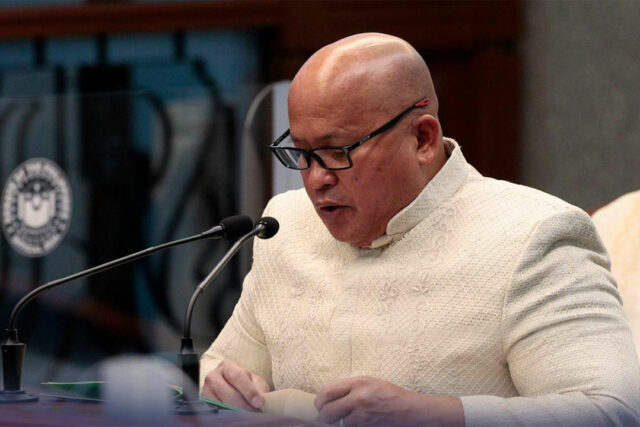
SENATOR RONALD "BATO" DELA ROSA — FACEBOOK.COM/SENATEPH

MANILA – The International Criminal Court has issued an arrest warrant for Philippine Senator Ronald Dela Rosa, who oversaw then-President Rodrigo Duterte’s war on drugs, the nation’s ombudsman said on Saturday, although the ICC denied the assertion.

Mr. Duterte, in office from 2016 to 2022, was arrested and taken to The Hague in March on a warrant linking him to murders committed during his war on drugs, in which thousands of alleged narcotics peddlers and users were killed.

Ombudsman Jesus Crispin Remulla told Reuters in a text message that the information about Dela Rosa’s warrant had been relayed to him by the officer-in-charge of the Department of Justice.

Asked for comment, DOJ spokesperson Polo Martinez said the ministry was still verifying the information.

“We have not yet received a copy of said arrest warrant. We shall provide further details as soon as it becomes available,” Martinez said in a text message.

ICC spokesperson Fadi El Abdallah, when asked whether there was an arrest warrant, said: “No. ICC news can only be found on ICC official communications channels and press releases.”

The office of Mr. Dela Rosa, a police chief under Duterte, did not immediately respond to a request for comment. He and Duterte, who is in detention at The Hague, have petitioned the Philippine Supreme Court to compel the government to stop cooperating with the ICC.

President Ferdinand Marcos Jr’s office has yet to independently verify the information about Mr. Dela Rosa’s warrant, Executive Secretary Lucas Bersamin told reporters.

A document containing the charges prosecutors want to bring against Duterte mentioned Mr. Dela Rosa, including statements he made as police chief.

Mr. Dela Rosa was quoted in a Senate photo release in April as saying he received a communication from the ICC “regarding the extra-judicial killings of suspected drug dependents and other personalities, which constitute crimes against humanity.”

Mr. Duterte and his lawyers maintain his arrest was unlawful. Last month, Mr. Duterte appealed the ICC’s decision to continue its case against him and sought his release.

Ombudsman Remulla said the extradition rules approved by the Supreme Court will be applied in the case of Mr. Dela Rosa. — Reuters

Signal No. 5 up in Catanduanes, nearby areas as Super Typhoon Uwan further strengthens

https://www.facebook.com/photo/?fbid=1284902213681429&set=pcb.1284902600348057

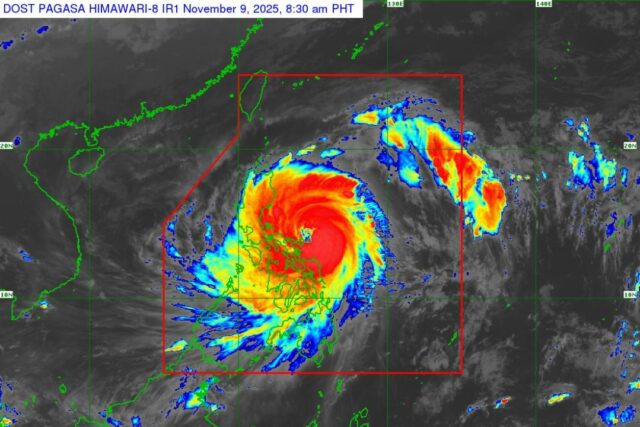
The state weather bureau on Sunday morning raised tropical cyclone wind signal No. 5 over Catanduanes and nearby areas as Super Typhoon Fung Wong, known locally as Uwan, intensified further, unleashing life-threatening winds and torrential rains as it barreled toward Luzon.

The Philippine Atmospheric, Geophysical and Astronomical Services Administration (PAGASA) in its 8 a.m. bulletin, also placed Polillo Islands, the northern portion of Camarines Norte and eastern portion of Camarines Sur under Signal No. 5.

Surrounding provinces, including Albay, Quezon, and parts of Bicol, remain under Signal No. 4, facing winds up to 184 kph.

Metro Manila, central Luzon, and large swaths of Northern Luzon are under lower signals but remain at risk of storm-force winds, heavy rains, and coastal flooding as Uwan approaches.

Uwan was packing maximum sustained winds of 185 kilometers per hour near the center and gusts reaching 230 kph, making it one of the most powerful storms to hit the country this year.

The system was last located 125 kilometers east-northeast of Virac, Catanduanes, moving west-northwest at 25 kph.

The super typhoon is expected to make landfall over Aurora province late on Sunday or early on Monday, possibly at peak intensity, before weakening as it crosses Northern Luzon’s mountainous terrain.

PAGASA warned that “life-threatening conditions” are already being felt in Catanduanes, with widespread damage to homes, power lines, and trees likely.

It added heavy rainfall, storm surges, and strong gusts could persist even in areas outside the storm’s direct path.

Local government units also suspended classes for Monday, Nov. 10, in anticipation of the impact of Uwan.

The Philippines—one of the world’s most disaster-prone countries—faces around 20 tropical cyclones each year.

Uwan comes as authorities continue relief efforts for areas still recovering from Typhoon Kalmaegi (Tino), which caused deadly flash floods in the Visayas and Mindanao earlier this month.

President Ferdinand R. Marcos, Jr. last Thursday placed the country under a state of calamity to allow for the easier disbursement of funds. — Chloe Mari A. Hufana

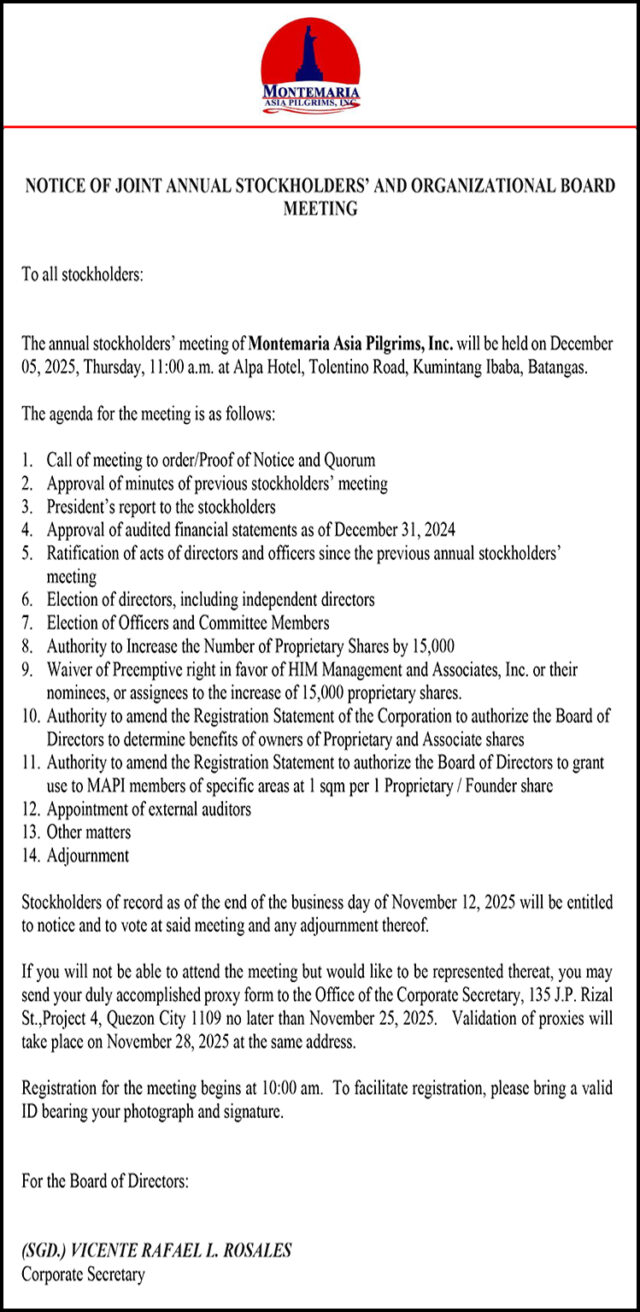
Montemaria Asia Pilgrims, Inc. to hold Annual Stockholders’ and Organizational Board Meeting on Dec. 5


Spotlight is BusinessWorld’s sponsored section that allows advertisers to amplify their brand and connect with BusinessWorld’s audience by publishing their stories on the BusinessWorld Web site. For more information, send an email to online@bworldonline.com.

Join us on Viber at https://bit.ly/3hv6bLA to get more updates and subscribe to BusinessWorld’s titles and get exclusive content through www.bworld-x.com.

EU weighs pausing parts of landmark AI act in face of US and big tech pressure, FT reports

REUTERS

The European Commission is proposing to pause parts of its landmark artificial intelligence (AI) legislation amid intense pressure from big tech companies and the US government, the Financial Times reported on Friday.

The move follows months of urging by tech giants like Meta and Alphabet , and pressure from the Trump administration, which has warned against measures that could provoke trade tensions.

The EU has been “engaging” with the Trump administration on adjustments to the AI act and other digital regulations as part of a wider simplification process, which is due to be adopted on November 19, a senior EU official told the FT.

Reuters could not immediately verify the report. The EU did not immediately respond to Reuters requests for comment.

In July, a spokesperson for the European Commission dismissed calls from some companies and countries for a pause, saying the AI rules would be rolled out according to the legal timeline in the legislation.

Talks were continuing within the commission regarding potential delays to “the implementation of targeted parts of the AI act,” a spokesperson for the EU told the FT. They added that while various options were being considered, the EU remained “fully behind the AI act and its objectives.”

The legislation came into force in August 2024 but many of the provisions are staggered to come into effect in coming years. — Reuters

Philippine Q3 GDP growth slows sharply as corruption mess stalls public spending

Portions of the revetment wall along the Tullahan River collapsed in North Fairview, Quezon City, Aug. 29, 2025. — PHILIPPINE STAR/MIGUEL DE GUZMAN

By Aubrey Rose A. Inosante, Reporter

PHILIPPINE economic growth slowed a more than four-year low of 4% in the third quarter as public construction was hit by a corruption scandal involving state infrastructure projects that has dampened consumer and investor sentiment.

Gross domestic product (GDP) expanded by an annual 4% in the three months through September, sharply decelerating from the 5.5% growth in the second quarter and the 5.2% clip in the same quarter in 2024, data from the Philippine Statistics Authority (PSA) released on Friday showed.

This was substantially lower than the 5.3% median estimate in a BusinessWorld poll of 18 analysts and economists.

On a seasonally adjusted quarter-on-quarter basis, GDP grew by 0.4%, easing from 1.46% a year ago.

“The Philippine economy continues to grow, but the third quarter’s performance reminds us of the urgent need to address key challenges and strengthen our foundations for rapid, sustained, and inclusive growth,” Department of Economy, Planning, and Development Secretary Arsenio M. Balisacan said at a briefing.

The third-quarter clip was the slowest growth logged since the 3.8% contraction in the first quarter of 2021, when the country was still reeling from the impact of the coronavirus pandemic that brought economic activity to a halt.

Excluding the pandemic, this was the weakest expansion since the 3% growth in the third quarter of 2011.

This brought the nine-month average to 5%, slower than 5.9% in the same period last year and putting the government’s 5.5%-6.5% full-year GDP growth goal further out of reach.

Mr. Balisacan said that meeting even the low end of the target would be “very challenging,” especially as more storms are expected to hit the country this quarter but added that they are optimistic that private spending could rebound on expectations of increased consumption and remittances amid the holiday season.

“While we may not be able to fully recover the economic losses within the year, we believe these are temporary setbacks. With sustained interventions and improved resilience, we expect the economy to rebound in 2026.”

In the third quarter, household final consumption expenditure, which accounts for over 70% of the economy, grew by a slower 4.1% from 5.3% in the second quarter and 5.2% a year ago.

This was the slowest since the 4.8% contraction in the first quarter of 2021. Counting out the pandemic years, it was the slowest growth in private spending since the 2.6% increase in the third quarter of 2010.

“Widespread cancellations of school, work, and travel activities due to typhoons likely dampened spending,” Mr. Balisacan said.

“Moreover, consumer confidence may have been affected by the ongoing probes and discussions on government infrastructure spending, prompting many households to postpone purchases, especially durable goods… These trends both reflect and affect consumer and business expectations and provide a clear signal for the government to act boldly and decisively.”

PUBLIC CONSTRUCTION
Meanwhile, government spending rose by 5.8% last quarter, easing from the 8.7% pace in the previous quarter, but faster than the 5% growth in the same period in 2024.

This came as corruption allegations surrounding state flood-control projects flagged by President Ferdinand R. Marcos, Jr. during his State of the Nation Address in July stalled public construction activity. Investigations into the graft scandal allegedly involving lawmakers, government officials, and private contractors are ongoing.

Gross capital formation, the investment component of the economy, contracted by 2.8% in the third quarter versus the 12.8% growth a year ago and the 1.2% expansion in the second quarter.

National Statistician Claire Dennis S. Mapa attributed this slowdown to the 26.2% contraction in general government construction, worse than the 8.2% fall in the second quarter and the biggest drop since the 28.6% decline in the third quarter of 2011.

“In the aftermath of these scandals, we see that there’s so much space for improving the quality of spending,” Mr. Balisacan said. “In recent years, we have been aiming for 5% to 6% of GDP for infrastructure spending just to catch up with the rest of our neighbors — and we needed to do that for the next decade or so. But as we are seeing now, the productive capacity that we had wanted to happen was muted by all this corruption.”

“Of course, everybody knew that there was corruption… But it’s just so shocking to see how extensive it was.”

He said bolstering investor and consumer confidence by making institutions stronger and improving governance are important in ensuring the economy’s recovery.

On the other hand, private construction “remained respectable” in the third quarter, but investment in durable equipment was subdued, Mr. Balisacan said.

He added that the external sector performed well in the third quarter compared to the net export decline seen in the prior three-month period even as the 19% tariff on the Philippines’ exports to the United States took effect.

“Unfortunately, there’s so much decline in the other sectors of the economy that the positive effects of the external sector were muted.”

The industry sector expanded by 0.7% in the third quarter, sharply slowing from the 5% growth a year ago and 2.1% in the second quarter.

“On the supply side, services and industry posted weaker growth, with a sharp contraction in public construction due to stricter validation measures for DPWH’s (Department of Public Works and Highways) civil works, as well as the implementation of stricter requirements that delayed billings and disbursements for government projects,” Mr. Balisacan said.

The services sector, which had the biggest contribution among major industries, expanded by 5.5% in the third quarter, slower than 6.3% a year ago.

Meanwhile, agriculture output grew by 2.8% in the third quarter, a reversal of the 2.7% decline a year ago but slower than the 7% growth in the second quarter.

The PSA added that among the main contributors to the third-quarter growth were wholesale and retail trade, repair of motor vehicles and motorcycles (5%), financial and insurance activities (5.5%), and professional and business services (6.2%).

Gross national income posted an annual 5.6% growth in the third quarter, slower than the 8% expansion in the previous quarter and 6.8% a year ago.

Net primary income went up by 16.9% in the third quarter, slower than the 20% in the same period in 2024.

RECOVERY IN DOUBT
Hongkong and Shanghai Banking Corp. economist for ASEAN Aris D. Dacanay said the contraction in public construction last quarter was expected given the graft probe.

“Without any immediate policy or institutional reform, history has shown us that the fiscal drag can persist for longer than a year,” he said, adding that every 10% fall in government infrastructure spending risks dragging growth by 0.4-0.6 percentage point.

ANZ Research economist Arindam Chakraborty and Chief Economist for Southeast Asia and India Sanjay Mathur said in a report that a near-term recovery is unlikely due to the impact of the graft scandal.

“We do not anticipate a turnaround in government spending until governance issues are resolved. Both business and household confidence surveys do not portend much improvement in spending. Credit growth has decelerated over the last three months, suggesting that the impact of rate cuts has been weak until now. Overall, it appears that the official 2025 GDP forecast of 5.5–6.5% will not be achieved,” they said.

They now expect the Philippine economy to expand by 4.9% this year, down from 5.4% previously, while they also lowered their 2026 forecast to 5% from 5.2% earlier.

Chinabank Research also said that the public construction component “may continue weighing down economic growth, as investigations continue and due to the proposed reallocation of some DPWH funding to other priority sectors in next year’s national budget.”

“In the fourth quarter, catch-up efforts in government spending could help lift growth, while natural calamities pose risks to consumption activities,” it said.

Weak economic prospects and a manageable inflation outlook would give the Bangko Sentral ng Pilipinas (BSP) ample room to continue its easing cycle, the analysts said.

The ANZ Research economists said they expect two more 25-basis-point (bp) cuts from the central bank.

Meanwhile, Mr. Dacanay said the base case is for a 25-bp reduction at the Monetary Board’s Dec. 11 meeting, but the slowdown opens the door for a larger cut, depending on the US Federal Reserve’s stance.

In October, the BSP trimmed benchmark rates by 25 bps for fourth straight meeting to bring the policy rate to 4.75%. It has now lowered borrowing costs by a total of 175 bps since its easing cycle began in August 2024.

BSP Governor Eli M. Remolona, Jr. has signaled further easing until next year to help support domestic demand as the corruption mess has hit investor sentiment and economic prospects.


Saya All November: Get 25% off on Smart Prepaid Load via JuanHand

This November, it’s time to enjoy supercharged savings with Smart and JuanHand! Through the Load Now, Pay Later program, Smart subscribers can enjoy a massive 25% OFF on select Smart Prepaid Loads, an unbeatable deal that lets you stay connected while spending less.

Mark those calendars, because the Double Day Deals are happening on Nov. 6-7 and Nov. 13-14 for unbeatable savings! But wait, there’s more! Keep the savings rolling all the way to Nov. 21 and 28.

Take your pick from your favorite load promos: Power All TikTok 99, Power All TikTok 149, Power All FB 99, Power All FB 149, Saya All 99, and Saya All 149.

Thanks to the partnership of Smart’s nationwide network and JuanHand’s innovative lending app, staying connected has never been more affordable. Don’t let this amazing deal slip away!

JuanHand, operated by WeFund Lending Corp., continues to empower millions of Filipinos with accessible financial solutions. With over 15 million registered users and more than P75 billion in loans disbursed, the app has become a trusted ally for Filipinos seeking reliable financial assistance. And the best part? You can apply in just five minutes with only 1 valid ID, making it the fastest and most convenient online loan app in the country today.

Download the JuanHand app now to enjoy this special Smart offer!


Spotlight is BusinessWorld’s sponsored section that allows advertisers to amplify their brand and connect with BusinessWorld’s audience by publishing their stories on the BusinessWorld Web site. For more information, send an email to online@bworldonline.com.

Join us on Viber at https://bit.ly/3hv6bLA to get more updates and subscribe to BusinessWorld’s titles and get exclusive content through www.bworld-x.com.

Maynilad shares stay close to IPO price in market debut

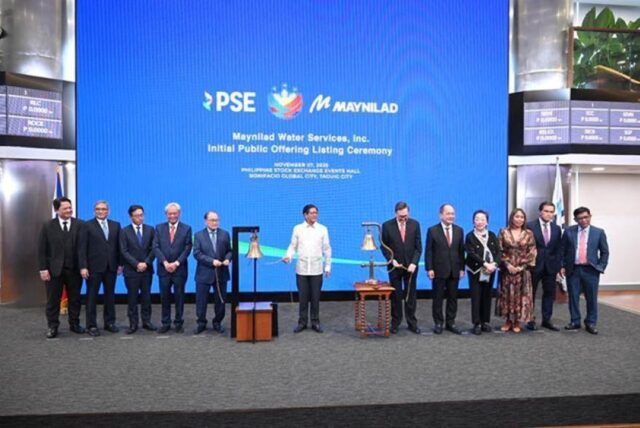
President Ferdinand R. Marcos Jr. joined Maynilad Water Services, Inc. and Philippine Stock Exchange (PSE) officials in ringing the bell to mark Maynilad’s official listing on the PSE on Nov. 7, 2025, held at the PSE Events Hall in Bonifacio Global City, Taguig.--MAYNILAD

Maynilad Water Services, Inc. closed slightly lower on its first trading day on Friday at P14.98 per share from its initial public offering (IPO) price of P15.

The shares slipped by P0.02 or 0.13% after opening at P15 and touching a low of P14.98, data from the Philippine Stock Exchange (PSE) showed. Around 100.81 million shares were traded, valued at P1.51 billion.

Maynilad’s debut placed its market capitalization at about P113.2 billion, with a free float level of 30.18%. A total of 7.62 billion common shares were listed under the industrial sector’s electricity, energy, power, and water sub-sector. Foreign ownership in the company is capped at 40%, in line with public utility regulations.

In a statement, Maynilad said the listing marks a “historic milestone” as President Ferdinand R. Marcos, Jr. joined company and PSE officials in ringing the bell to mark its official debut at the PSE Events Hall in Bonifacio Global City, Taguig.

“Through this IPO, Maynilad strengthens its capacity to fund major expansion and modernization programs for water and wastewater infrastructure across the West Zone—further advancing its mission to provide safe, reliable, and sustainable water and wastewater services to millions of Filipinos,” the company said.

The company’s P15-per-share IPO raised P34.3 billion in gross proceeds, which will be used for capital expenditures and general corporate purposes.

At a press briefing following the listing ceremony, Maynilad President and Chief Executive Officer Ramoncito S. Fernandez said the results of the IPO reaffirm investor confidence in the company’s fundamentals.

“We believe that Maynilad has very strong fundamentals and a long-term value proposition. We [also] believe that Maynilad is a solid investment, delivering essential water services with very predictable cash flows,” he said. “We got very positive feedback from both domestic and foreign investors, attesting to the company’s operational performance, capex (capital expenditure) plans, and dividend policy.”

During the same briefing, Maynilad Chief Financial Officer Ricardo F. Delos Reyes said total demand for the IPO reached 2.7 times the number of shares offered.

“As far as I know, we were oversubscribed, and the geographic distribution was: Asia investors accounted for 53.6%, European investors 14.7%, local investors 29.6%, and the U.S. finally at 1%,” he said.

Maynilad becomes the second and last company to list on the PSE this year and the largest since Monde Nissin Corp.’s P48.6-billion offering in 2021 with its IPO price.

PSE President and Chief Executive Officer Ramon S. Monzon said during the listing ceremony that Maynilad’s IPO demonstrated renewed foreign investor confidence in the local market.

“Maynilad had two foreign multilateral lenders, Asian Development Bank (ADB) and International Finance Corp. (IFC), investing in this IPO as anchor investors, along with six other foreign investors participating as cornerstone investors. Clearly, this disproves the doomsayers’ claim of foreign investor disinterest in our market,” Mr. Monzon said.

He added that the Securities and Exchange Commission awarded the country’s first Philippine Green Equity Label to Maynilad for its adherence to sustainability standards.

In his remarks during the ceremony, Mr. Marcos said the listing underscores confidence in the country’s capital markets and commitment to public accountability.

“With its IPO, Maynilad welcomes scrutiny and accountability. And in doing so, Maynilad can expand our capital markets and our shared belief that private enterprise can serve the public good,” the president said.

“Maynilad’s public listing signals what I have been telling the world: that the Philippines is open, ready, and eager to do business with you,” he added.

“Given the market’s prevailing bearish sentiment, it’s not surprising that Maynilad failed to gain traction on its market debut,” DragonFi Securities, Inc. Equity Research Analyst Jarrod Leighton M. Tin said in a Viber message.

“The stock’s current stability appears to be supported primarily by the stabilization fund, which, once exhausted, could lead to further downside pressure. Sentiment worsened following the softer-than-expected third-quarter gross domestic product (GDP) print released earlier, significantly missing forecasts.”

The Philippine economy expanded by 4% in the third quarter, the slowest pace since early 2021, bringing the year-to-date growth average to 5%, below the government’s 5.5%-6.5% target.

“The demand and liquidity were robust with MYNLD topping the list of most actively traded stocks, although that’s to be expected with market debuts. We will have to see the next few days if MYNLD can hold the line even amidst the weak market sentiment,” AP Securities, Inc. Research Head Alfred Benjamin R. Garcia said in a Viber message.

Metro Pacific Investments Corp., which holds a majority stake in Maynilad, is one of three Philippine subsidiaries of First Pacific Co. Ltd., alongside Philex Mining Corp. and PLDT Inc.

Hastings Holdings, Inc., a unit of PLDT Beneficial Trust Fund subsidiary MediaQuest Holdings, Inc., holds an interest in BusinessWorld through the Philippine Star Group, which it controls.–Alexandria Grace C. Magno and Arjay L. Balinbin

A family endeavor turns into an enterprise

“CDO Foodsphere, Inc. was initially established in 1975 to help augment the family income of its founder, Corazon D. Ong.

Interview by Patricia Mirasol
Video editing by Jayson Mariñas

Aquino pushes for CADENA bill to deter gov’t corruption

Senator Paolo Benigno "Bam" Aquino IV — CATHY ROSE GARCIA

Senator Paolo Benigno “Bam” Aquino IV said that the Philippines needs to transition out of age-old mechanisms and systems as the country continues to struggle with its fundamentals.

At the 6th Management Association of the Philippines NextGen Conference, Mr. Aquino said that the country is struggling in many aspects, including infrastructure, mobility, housing, jobs, food, and education.

“For the next generation, we find ourselves in that interesting space where we have to handle the fundamentals and at the same time look towards the future and see all of these opportunities for growth and change,” he said.

As the country addresses corruption issues on flood control projects, he said that using blockchain technology in national transactions could help deter corruption.

In particular, the senator proposed the Citizen Access and Disclosure of Expenditures for National Accountability (CADENA) Act, which will mandate the full disclosure of all government transaction documents.

“We had two hearings, we had a technical working group, we now have three roundtables, and next week I will be sponsoring the CADENA Act,” he said.

“We are getting a lot of support for this bill. Very, very interesting. People are now looking at technology to solve corruption issues,” he added.

Once realized, he said that it will make the Philippines the first country to put its national budget and transactions on the blockchain, online, for everybody to see.

“I am sponsoring this in Nov. 12, and right now with the momentum we are getting from the people and with the momentum we are getting from the government to push for this act, maybe by the first quarter of 2026, this can already be law,” he said. — Justine Irish D. Tabile