Home Blog Page 2412

Easy… like Sunday morning

Not long ago, a company using a bank’s payroll package was simply passing on the responsibilities of accounting, payroll preparation, and disbursement responsibilities. For employees, from management to rank and file, the priority was getting paid on time and accessing their money quickly.

But now, in the digital age, payroll systems have become much more exciting for employees. Forward-thinking banks have recognized this shift and created opportunities beyond just receiving a paycheck.

BDO’s Payroll Package is exactly what employees are seeking today. Its versatility and benefits can significantly enhance their lives. Whether for a large corporation or a growing SME, the BDO Payroll Package highlights how much a business values its greatest asset: its people.

Carlo B. Nazareno, Senior Vice-President and Head of BDO’s Cash Management Services

“With the BDO Payroll Package, we aim to provide employees with seamless access to various financial tools that enhance their day-to-day lives. Whether it’s through convenient banking services, flexible installment options, or competitive loan offerings, we are committed to empowering employees to achieve their personal and financial goals. Ultimately, our goal is to make their lives easier and more rewarding,” said Carlo B. Nazareno, Senior Vice-President and Head of BDO’s Cash Management Services.

BDO ensures ease of access and convenience, whether you prefer face-to-face interaction or handling things online, with its extensive network of over 1,700 branches and more than 5,500 ATMs across the country, and efficient digital channels. Being part of the BDO Payroll Package gives employees unrivaled access to BDO’s range of products and services — all hassle-free, making your financial management a breeze.

Imagine an office worker named Pedro at the mall with his family, needing quick access to cash for a toy or ride his kids are excited about — BDO Payroll makes it possible. Or a BPO Associate named Carla, who is shopping for essentials or treating herself to some pampering, efficiently manages it through BDO Payroll. The option to avail of accessible installment offers, subject to company agreements with BDO, is an advantage that needs to be discussed more.

Through BDO Payroll, settling your monthly utility bills is a breeze. You can also access housing or car loans, opening up a world of possibilities that simplify life and allow you to focus on what truly matters.

If you aim to make life ‘Easy… like Sunday morning,’ trust BDO to find ways to make it happen.


Spotlight is BusinessWorld’s sponsored section that allows advertisers to amplify their brand and connect with BusinessWorld’s audience by publishing their stories on the BusinessWorld Web site. For more information, send an email to online@bworldonline.com.

Join us on Viber at https://bit.ly/3hv6bLA to get more updates and subscribe to BusinessWorld’s titles and get exclusive content through www.bworld-x.com.

100+ startups across the Philippines compete for top honors at KMC Startup Awards 2024

KMC Solutions hosts second edition, celebrating innovation, resilience, and impact with 300+ entries from the Philippine startup ecosystem

After the success of its inaugural edition, KMC Solutions, a leading provider of flexible office spaces, has attracted a record number of 300+ entries from over 100 startups across the Philippines for the KMC Startup Awards 2024, honoring pioneering ideas and recognizing forward-thinking innovators who are shaping the future of the Philippine economy.

In collaboration with Philippine Startup Week, Ideaspace | QBO, Kaya Founders, Web3PH, and Uniquecorn Strategies, this year’s awards have drawn entries across sectors like fintech, agritech, construction, logistics, and healthcare. The increased participation underscores the event’s prestige and the local startup community’s dedication to innovation.

“We are inspired by the overwhelming number of entries we’ve received for the KMC Startup Awards this year. Each startup brought forward not just an application but a story filled with milestones, resilience, and a vision for impact. More than the awards, we want to offer these trailblazing startups the privilege of being valued and recognized, giving them a memorable experience in true KMC style. This event is our way of celebrating these dedicated innovators as they share, connect, and build a future that inspires us all,” said Michael McCullough, co-founder of KMC Solutions.

This year’s awards will recognize gold, silver, and bronze honorees across 10 business categories: Startup of the Year, Emerging Leader of the Year, Innovative Product of the Year, Innovation in Marketing Award, Tech Innovator Award, Customer Excellence Award, Social Impact Award, and Sustainability Award, as well as two new categories, the Growth Champion and the Best Newcomer Awards. Each category focuses on a unique aspect of innovation, growth, and social contribution, underscoring the awards’ dedication to honoring the broad spectrum of startup excellence.

The winners will be announced at a gala night on Nov. 15, 2024, where the top 30 entries will be honored, adding suspense as startups discover their placements live. Aside from the award recognitions, the event will also provide a unique opportunity for startups to showcase achievements, connect with investors, and network with key industry stakeholders.

Entries for the KMC Startup Awards 2024 underwent a rigorous judging process by some of the country’s most influential figures in the startup and business community, including Michael McCullough, co-founder of KMC Solutions; Alwyn Rosel and Ben Alderson, deputy directors of QBO Innovation Hub; Dean Bernales, founder and CEO of Uniquecorn Strategies; Quenby Go, executive director of MAIN.PH; Ray Alimurung, general partner of Kaya Founders; Raya Buensuceso, managing director of Kaya Founders; and Steve Sy, co-founder of Great Deals. These leaders bring expertise across e-commerce, venture capital, startup development, and tech innovation, setting a high standard for competition.

The Philippines is currently ranked sixth among startup ecosystems in Southeast Asia and 60th globally, and the KMC Startup Awards attest to this thriving community by recognizing top emerging businesses and entrepreneurs driving the country’s acceleration in the startup scene.

Last year’s inaugural event highlighted exceptional startups from various industries, such as sari-sari store enabler Packworks (Startup of the Year), digital bank GoTyme Bank (Tech Innovator Award), agritech social enterprise Sakahon (Social Impact Award), pet telehealth platform PetPal Asia (Outstanding Marketing Campaign), and Patrick Gentry, CEO of end-to-end HR solutions provider Sprout Solutions (Emerging Leader of the Year).

The KMC Startup Awards serve as a platform to foster connection, mentorship, and inspiration within the startup community. This event demonstrates KMC Solutions’ commitment to strengthening the startup ecosystem in the country.

Join us in celebrating the Philippines’ top startups at the KMC Startup Awards 2024. For more information about this year’s awards and to stay updated on the winners, visit  https://kmc.solutions/spaces/startup-awards-2024 and follow the KMC Solutions Facebook page.

Philippine annual inflation quickens to 2.3% in October

INDIVIDUALS shop for food items inside a supermarket in Quezon City, Jan. 16, 2023. — PHILIPPINE STAR/ MIGUEL DE GUZMAN

MANILA – The Philippine central bank said on Tuesday it will take a “measured approach” in its policy easing cycle as annual inflation accelerated in October on higher food and transport prices.

The consumer price index rose 2.3% in October from the previous month’s 1.9% print, the statistics agency said on Tuesday, below the 2.4% forecast in a Reuters poll of economists.

Core inflation, which strips out volatile food and energy items, was at 2.4% in October, steady with September’s rate.

Last month’s inflation print brought average inflation in the first 10 months of the year to 3.3%, within the central bank’s 2% to 4% target range.

The Bangko Sentral ng Pilipinas (BSP) bank said in a statement inflation will trend closer to the lower end of its target, even as risks to the outlook for next year and 2026 shift to the upside.

“The Monetary Board will maintain a measured approach in its easing cycle to ensure price stability conducive to sustainable economic growth and employment,” the BSP said.

An inflation rate within the central bank’s target range would help justify further easing to match rate cuts of the U.S. Federal Reserve, said Michael Ricafort, an economist at Rizal Commercial Banking Corp in Manila.

A Reuters poll of economists expects the U.S. Fed to cut its key interest rate by 25 basis points on Nov. 7, with a huge majority expecting another easing of the same magnitude in December.

In October, BSP Governor Eli Remolona flagged the possibility of a third quarter-point rate cut at its final meeting for the year next month, and up to 100 basis points of additional cuts next year.

The government is working to keep food available and prices steady, particularly for essential commodities, following weather disturbances, including tropical storm Trami that hampered food supply, National Economic and Development Authority Secretary Arsenio Balisacan said in a statement. — Reuters

Manufacturing growth slows in Oct.

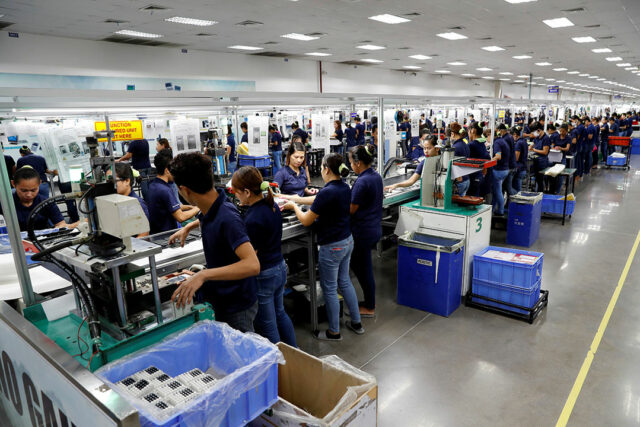
Women work at the assembly line of an electronics factory in Malvar, Batangas, Aug. 10, 2018. — REUTERS

By Aubrey Rose A. Inosante, Reporter

PHILIPPINE manufacturing expanded for a 14th month in a row in October, but the pace of growth slowed month on month amid a softer rise in new orders and output, S&P Global said on Monday.

At the same time, manufacturing firms ramped up hiring, with job creation hitting an 88-month high.

The S&P Global Philippine Manufacturing Purchasing Managers’ Index (PMI) stood at 52.9 in October, slowing from the 27-month high of 53.7 in September. This was the second-fastest reading since January 2023.

Manufacturing Purchasing Managers’ Index (PMI) of select ASEAN economies, October 2024

An above 50 PMI reading signals an improvement in operating conditions, while a reading below 50 indicates a deterioration.

“October PMI data indicated a slight easing in — but still solid — growth across the Filipino manufacturing sector. The expansion in new orders was again robust, allowing goods producers to raise their output again,” Maryam Baluch, economist at S&P Global Market Intelligence said in a report.

The Philippines’ PMI — a composite single-figure indicator of manufacturing performance — has posted an above 50 reading every month since September 2023.

The Philippines logged the highest PMI reading among the five Association of Southeast Asian Nations (ASEAN) countries in October, followed by Vietnam (51.2) and Thailand (50).

Meanwhile, Malaysia (49.5), Indonesia (49.2), and Myanmar (48.4) recorded contractions in October.

Philippine PMI was also above the region’s average reading of 50.5, which was unchanged from September, S&P Global said.

The headline PMI measures manufacturing conditions based on the weighted average of five indices. It includes new orders (30%), output (25%), employment (20%), suppliers’ delivery times (15%) and stocks of purchases (10%).

S&P Global said Philippines PMI data reflected a “sustained and solid” improvement in manufacturing operating conditions in October.

Despite a slowdown, new orders grew for the 15th consecutive month, while output expanded for a seventh straight month.

“The recent increases outpaced their series averages, driven by a growing customer base that strengthened underlying demand trends,” it said.

Stronger demand allowed manufacturing firms to significantly raise staffing levels in October.

“Filipino goods producers ramped up hiring, with the recent wave of job creation marking the most significant increase since mid-2017,” it said.

With more workers, manufacturing firms managed to address the slight buildup of backlogs and keep up with current production requirements.

At the same time, the improvement in demand allowed companies to boost purchasing activity, but at a weaker pace than the previous month.

“Firms stated that higher prices of raw materials often dissuaded firms from purchasing inputs,” S&P Global said.

This prompted firms to use their existing inventory for orders, with pre-production inventories falling for the first time since February. Stocks of finished goods were depleted for a third month in a row, and at the sharpest rate since January 2022.

Supply chains continued to be stretched in October, with shortages of raw materials due to port congestion.

“Firms revealed supply-side challenges, with material shortages resulting in longer delivery times, and cooling buying activity. It was also one of the key factors for rising input prices, which was further exacerbated by the depreciation of the peso against the dollar,” Ms. Baluch said.

S&P Global noted the rate of input price inflation rose to an eight-month high in October.

The peso closed at P58.10 per dollar on Oct. 31, weakening from the P56.03 close on Sept. 30.

Manufacturing firms are positive that current demand trends will continue in the next 12 months.

“Nonetheless, firms remain optimistic with more than half of respondents anticipating expansion in the year ahead,” Ms. Baluch said.

‘BRIGHT SPOT’
“The Philippines is the only real lone bright spot in terms of recent momentum, though its September pop to 53.7 cooled to 52.9 last month and the impact of this still-sturdy gain won’t really be felt regionally due to the country’s relatively small manufacturing sector,” Pantheon Macroeconomics said in an e-mailed statement.

For the ASEAN region, Pantheon said the result was “softer than we expected” as the manufacturing sector recovered from typhoons.

“The generally improved PMI rates in the last two months can be attributed to pent-up demand which had been released by lower inflation rates as the easing of interest rates,” Leonardo A. Lanzona, an economics professor at the Ateneo de Manila University told BusinessWorld via Facebook Messenger.

He noted that companies typically boost production in the months ahead of the holidays in anticipation of stronger demand.

“As the country’s manufacturing base increases and the Christmas season completes by the end of the year, expect the growth rate of PMI to be much lower,” Mr. Lanzona said.

However, he noted supply-side issues, including the lack of skills and the poor adaptation of new technologies, continue to weigh on the manufacturing sector.

“Manufacturing may continue to grow given increased local demand during the holidays and foreign demand as trade liberalization takes further effect,” John Paolo R. Rivera, president, and chief economist at Oikonomia Advisory & Research, Inc. told BusinessWorld via Viber Message.

Meanwhile, Ma. Teresita Jocson-Agoncillo, executive director at the Confederation of Wearable Exporters of the Philippines, said wearables manufacturing remains slow as of end-September.

“We are at an average — 3% to 5% growth vis-a-vis at the same period last year. The recent wage hike increase across major regions — Regions 3, 4A and B, Region 7, and NCR — had an impact on Spring-Summer 2025 orders. These orders were directed to more competitive ASEAN countries,” she told BusinessWorld in a Viber message.


DA expects lower palay output this year due to bad weather

AN AERIAL VIEW of the floods in Calumpit, Bulacan on Aug. 1, 2023. — REUTERS

By Justine Irish D. Tabile, Reporter

THE DEPARTMENT of Agriculture (DA) on Monday said palay (unmilled rice) production likely declined this year due to the damage caused by El Niño-induced droughts and several strong typhoons.

“We can expect that the output will be lower compared to last year because of the huge damage due to El Niño and the series of typhoons even before Kristine,” DA Assistant Secretary and Spokesperson Arnel V. de Mesa told reporters at a briefing.

The department previously estimated palay production to drop to 19.41 million metric tons (MT) in 2024, 3.24% lower than the 20.06 million MT in 2023.

Mr. De Mesa said the country’s major rice-producing regions and areas were affected by Severe Tropical Storm Kristine.

“With Kristine, even though we put out an advisory to do an early harvest, there are still areas that cannot be harvested and were left behind. So, we are really seeing huge agricultural damage nationwide,” he said. 

“We will know how big the damage is later. But there will be a decrease in output, especially in rice produce.”

A report by the National Disaster Risk Reduction and Management Council (NDRRMC) on Monday showed Severe Tropical Storm Kristine and Typhoon Leon caused P5.9 billion worth of damage to agriculture.

Mr. De Mesa said the damage from tropical cyclones this year is already higher than the annual average of 500,000 MT to 600,000 MT.

“The damage is a bit bigger this year, more than the regular losses that we expect,” he added.

Citing the assessments of DA Regional Field Offices as of Nov. 2, Mr. De Mesa said that damage to agriculture and crop losses due to Kristine have so far amounted to P5.75 billion.

“The biggest damage is recorded in the rice subsector at P4.25 billion, followed by high-value (crops) at P847 million, while fisheries recorded a P403 million loss in production,” he said.

“The biggest damage was recorded in the Bicol Region at almost P3 billion, followed by Mimaropa at P746 million, and third is in Cagayan Valley at P621 million,” he added.

The DA said Kristine has affected 131,661 farmers and fisherfolk covering 109,871 hectares of crops, which resulted in 557,851 MT in production loss.

Earlier this year, El Niño caused droughts and dry spells that affected crops in parts of the country. In its final bulletin on the effects of El Niño, the DA said that agricultural damage and losses in 15 regions were estimated at P15.3 billion. 

Agricultural output declined by 3.3% to P413.91 billion in the second quarter, worsening from the 1.2% contraction a year earlier, reflecting the impact of El Niño.

For the first half, the value of production in agriculture and fisheries slipped by 1.5%, a reversal of the 0.4% growth a year ago.

Third-quarter agricultural output data will be released on Wednesday.

Sought for comment, Federation of Free Farmers National Manager Raul Q. Montemayor said that he expects a single-digit decline in production this year after the dismal output in the first half.

“I think it will still be single digit because harvests seem to be alright in areas not severely affected by the typhoons,” said Mr. Montemayor in a Viber message.

“But our supply deficit will continue to increase due to the drop in production coupled with the increase in demand or population,” he added.

Mr. Montemayor said output in the second half will most probably decline because of the effect of the typhoons.

“So, overall, we are looking at a drop in annual production,” he added.

Despite the projected decline, Mr. De Mesa said rice supply will be sufficient with the increased imports.

“Even if there is a decline, what is good here is that this will be supplemented by our import arrivals. As of mid-October, it is already at 3.6 million MT, which almost surpassed the total importation last year,” he added.

He said that they expect rice imports to be cheaper due to the lowered tariffs on rice and India’s lifting of its ban on the exports of white rice.

“Hopefully, the peso exchange rate will improve so that the price of imported rice will also further decline. Because this will help ensure that we will have enough supply and that prices will not be affected,” he added.

The US Department of Agriculture projects Philippine rice imports to hit 4.7 million MT this year.

Rice inflation seen to further ease

Workers unload sacks of rice in this file photo. — PHILIPPINE STAR/RYAN BALDEMOR

By Luisa Maria Jacinta C. Jocson, Reporter

THE CONTINUED DECLINE in rice prices, which typically accounts for nearly half of overall inflation, is set to pave the way for further monetary easing, analysts said.

“With the price of the biggest staple in the Filipino consumer basket set to ease further, we think the door for the central bank to continue its measured easing cycle remains wide open,” Aris D. Dacanay, economist for ASEAN (Association of Southeast Asian Nations) at HSBC Global Research said.

“With low tariffs and the harvest season, rice prices in Metro Manila appear to be on a downtrend,” Metrobank Research said in a report.

The executive order slashing tariffs on rice imports, which took effect in July, has led to a decline in rice prices on a monthly basis.

President Ferdinand R. Marcos, Jr. ordered rice tariffs to be cut to 15% from 35% previously, until 2028.

At end-October, the average price of well-milled rice ranged from P43 to P54 per kilogram, lower than the P47-to-P55 range at end-September, data from the Agriculture department showed.

Meanwhile, regular milled rice cost P40-P50 per kilogram from P45-P50 per kilogram a month ago.

“Still, costs of the grain remain above their October 2023 levels. We expect annual rice inflation to be positive in October, though it should remain in the single digits due to a high base from a year ago,” Metrobank Research said.

Rice inflation sharply slowed to 5.7% in September from 14.7% in August and 17.9% a year ago. This also marked the lowest rice inflation since the 4.2% print in July 2023.

Headline inflation likely quickened to 2.4% in October from 1.9% in September, according to a BusinessWorld poll of 11 analysts conducted last week.

“We believe inflation quickened to 2.3% in October from 1.9% in September. We expect that the recent typhoons resulted in higher prices for key food items such as vegetables, fruits, and fish,” Philippine National Bank economist Alvin Joseph A. Arogo said in an e-mail.

Mr. Dacanay said that while base effects caused inflation to reaccelerate in October, overall, the headline print is seen to “have remained benign.”

“The biggest deflationary pressure was rice as global rice prices finally eased,” he added.

Chinabank Research said that inflation will likely continue to stay below 3% amid the lower rice tariffs and base effects.

“Looking ahead, we expect inflation to remain within target, barring any unexpected shocks… This favorable inflation outlook, combined with anticipated further rate cuts from the Fed, boosts the case for another rate cut by the BSP at its next policy meeting in December,” it added.

Bangko Sentral ng Pilipinas (BSP) Governor Eli M. Remolona, Jr. has said that the Monetary Board could possibly cut rates by another 25 basis points (bps) at its last meeting this year on Dec. 19.

The central bank has so far cut borrowing costs by a total of 50 bps since it began its easing cycle in August.

Mr. Remolona has also signaled further rate cuts next year, possibly by a total of 100 bps.

Metrobank Research also expects inflation to continue to settle within the 2-4% target band.

“Should price risks — from oil and other commodities amid geopolitical tensions and extreme weather disturbances — not materialize, Metrobank Research maintains that full-year headline inflation should remain within the BSP’s target,” it added.

On the other hand, Federation of Free Farmers National Manager Raul Q. Montemayor said that rice prices have not fallen fast enough even with the tariff cut.

“The reduction in prices for both regular and well-milled rice are far off initial expectations of a P6-7 fall in prices per kilo arising from the tariff cut,” he said in a Viber message.

“Clearly, the tariff reduction has not worked in reducing retail prices. In the meantime, tariff revenues have fallen together with palay prices.”

Mr. Montemayor said that retail prices normally fall during harvest months due to the added supply.

“But the recent typhoons could temper the reduction in retail prices because of their impact on supply,” he said.

“Imports continue to come in, but it seems that the importers and traders are keeping most of the tariff savings for themselves instead of passing it on to consumers,” he added.

The Department of Agriculture earlier said that palay (unmilled rice) production will likely decline by 3.24% this year amid crop losses due to adverse weather conditions.

Fed easing cycle to encourage EM issuers to tap debt markets

PHILSTAR FILE PHOTO

EMERGING MARKETS (EM) like the Philippines will be able to tap into debt markets and further cut rates amid improved liquidity conditions due to the US central bank’s easing cycle, Fitch Ratings said.

“The turn of the global interest rate cycle, underlined by the US Federal Reserve’s 50-basis-point (bp) Federal Funds target rate cut in September, should ease foreign-currency debt repayment burdens and refinancing challenges for many emerging market (EM) issuers,” it said in a report.

The Fed’s rate-cutting cycle is seen to “encourage investment-grade (IG) EM issuers that have favorable access to debt markets to take advantage of improved liquidity conditions.”

“Sovereigns such as China, Indonesia, Peru and the Philippines were among those issuing foreign-currency debt in the third quarter, for example,” it added.

Latest data from the central bank showed external debt payments declined by 7.6% to $7.693 billion in the first seven months from $8.329 billion in the same period a year ago.

Outstanding external debt hit a record $130.182 billion at the end of June, separate data showed.

This year so far, the National Government has raised $2 billion from the issuance of US dollar-denominated dual-tranche global bonds in May, and another $2.5 billion in August from triple-tranche dollar bonds.

Fitch Ratings expects the US central bank to cut by another 25 bps each in November and December, as well as a total of 100 bps worth of cuts in 2025.

“Lower rates in key developed markets (DMs) should reduce global benchmark borrowing costs, easing liquidity and funding conditions for EM borrowers, particularly those with high dependence on foreign-currency debt,” it said.

“However, for many borrowers marginal borrowing rates in 2025 may still be higher than their current effective cost of borrowing, implying overall interest costs could still rise.”

The Fed launched its easing cycle in September with a 50-bp cut, bringing the Fed funds rate to the 4.75%-5% range.

The credit rater said that looser US monetary policy will also “create additional space for domestic monetary easing in many EMs — particularly in those economies whose currencies are managed against or pegged to the US dollar.” 

“This will provide support to EM economic growth prospects, as well as reducing repayment burdens for those issuers that have borrowed on domestic debt markets,” it said.

“Nevertheless, lower rates may hit net interest margins and earnings for EM banks, depending on individual banks’ sensitivity to interest-rate movements.”

Fitch Ratings sees most EM central banks to further reduce policy rates as the Fed makes its own cuts in the fourth quarter and until next year.

Bangko Sentral ng Pilipinas (BSP) Governor Eli M. Remolona, Jr. has signaled a possibility of another 25-bp rate cut at the Monetary Board’s Dec. 19 meeting, its last for the year.

The BSP chief also brought up the possibility of up to 100 bps worth of cuts in 2025.

The Monetary Board has reduced rates by 50 bps this year so far, bringing the key rate to 6%. It began its easing cycle in August, the first time it lowered borrowing costs in nearly four years. — Luisa Maria Jacinta C. Jocson

Planters Products, Inc. to hold Annual Stockholders’ Meeting on Dec. 5 via Zoom


Spotlight is BusinessWorld’s sponsored section that allows advertisers to amplify their brand and connect with BusinessWorld’s audience by publishing their stories on the BusinessWorld Web site. For more information, send an email to online@bworldonline.com.

Join us on Viber at https://bit.ly/3hv6bLA to get more updates and subscribe to BusinessWorld’s titles and get exclusive content through www.bworld-x.com.

AI adoption may slow office space demand — Cushman & Wakefield

IN THE THIRD quarter, the market saw an influx of 114,000 square meters of new office space. — BW FILE PHOTO

THE adoption of artificial intelligence (AI) among businesses, especially in the information technology-business process outsourcing (IT-BPO) industry, may slow the growth in demand for office spaces, according to real estate services firm Cushman & Wakefield.

“The increasing use of AI advancements, especially in the IT-BPM industry, could potentially limit the demand growth for office spaces in key markets if stakeholders do not fully adapt to these changes,” Claro dG. Cordero, Jr., director and head of research, consulting & advisory services at Cushman & Wakefield, said in a report released on Monday.

“AI-driven technologies like virtual assistants, chatbots, and automated customer service interfaces have replaced human roles due to their improved efficiency, service quality, and cost-effectiveness,” he added.

Despite AI advancements, Mr. Cordero also said, human intervention is needed for data analytics and complex customer service.

Last month, BMI, a unit of Fitch Solutions, said the Philippines’ BPO industry might shrink as AI use in workplaces grows.

AI helps companies bring call centers back to developed countries at a lower cost, BMI Head of Asia Country Risk Darren Tay said in a webinar.

“It is crucial for industry stakeholders to develop policies and programs that equip and upskill workers…with the necessary technical skills,” Mr. Cordero said.

AI is just one of the key factors disrupting the market, alongside global geopolitical events, according to Cushman & Wakefield.

In the Philippines, the immediate challenges are the total ban on Philippine Offshore Gaming Operators (POGOs) and the implementation of the CREATE MORE Bill, which supports flexible work arrangements and will likely result in more vacant spaces, according to the real estate services firm.

By the end of the third quarter, the vacancy rates for prime and grade “A” office buildings in Metro Manila increased by 280 basis points (bps) from the previous quarter and by 136 bps year over year, Cushman & Wakefield said.

The average vacancy rate hit 18.2%, the highest recorded by Cushman & Wakefield Research since the second quarter of 2004, reflecting a rise of over 1,380 bps since the second quarter of 2020.

In the third quarter, the market saw an influx of 114,000 square meters (sq.m.) of new office space.

Coupled with a substantial amount of office space being vacated as major corporations reassessed their office requirements, this has led to an increase in the overall volume of vacant office space, the consultancy firm said.

Average asking rents for prime and grade A office spaces saw a slight decline in the third quarter, continuing a trend of four consecutive quarters of decreases.

The average headline rent for these developments in Metro Manila settled at P1,003 per sq.m. per month, down by 67 bps from P1,010 per sq.m. per month in the previous quarter, and by 363 bps from P1,041 per sq.m. per month in the same quarter last year, the firm said.

“The Metro Manila office market is exhibiting a slower-than-expected recovery in Q3 2024. Overall vacancy rates have steadily increased and average headline rents have marginally declined again this quarter, making the market more favorable for tenants,” said Tetet Castro, director and head of Tenant Advisory Group at Cushman & Wakefield.

“The initial effects of the total POGO ban and amendments to the CREATE Bill are already being felt in Q3 2024. Several returns of office space are observed, this coupled with the completion of new developments, have resulted in the increase in overall vacancies. In the medium term, elevated vacancy rates and lower headline rents in the Metro Manila office market are expected.” — B.M.D. Cruz

Alternergy directs P2.9B to wind, solar projects

PHILSTAR FILE PHOTO

ALTERNERGY Holdings Corp. (ALTER) has injected capital amounting to P2.9 billion as of September to finance the ongoing construction of its two wind power projects and a solar power project.

Broken down, a total of P1.5 billion has been infused into Alternergy Tanay Wind Corp. for the 128-megawatt (MW) Tanay Wind Power Project in Rizal province and P1.1 billion into Alabat Wind Power Corp. for the 64-MW Alabat Wind Power Project in Quezon province, the company said in a statement on Monday.

For the 28-megawatt-peak Hermosa Solar Power Project in Bataan, a total of P342 million has been infused into Solana Solar Alpha, Inc.

Alternergy owns 100% of the three companies created as special purpose vehicles for the said projects.

“With the capital infusion so far, ALTER is keen to ensure timely completion of the three projects,” Alternergy President Gerry P. Magbanua said.

The Tanay and Alabat Wind Power Projects are expected to be completed by the end of 2025, based on the committed delivery date under the government’s green energy auction program last year.

The Hermosa Solar Power Project is slated for completion by the second quarter of 2025.

The initial equity infusions for the three projects as of September partly came from the use of proceeds from the initial public offering and the P2-billion green finance loan secured from BDO Unibank, Inc.

Mr. Magbanua said that additional funds from its project lenders under the signed omnibus loan and security agreement are expected to flow immediately following drawdowns.

The Tanay Wind Power Project secured P8 billion in syndicate project finance from the Bank of the Philippine Islands and Security Bank Corp.

The Alabat Wind Power Project, on the other hand, obtained P5.3 billion in project finance from Rizal Commercial Banking Corp.

The three projects are part of Alternergy’s target to reach 500 MW of generating capacity by 2026 as it continues to beef up its pipeline of projects beyond the target.

At the local bourse on Monday, shares in the company closed at P0.94 apiece. — Sheldeen Joy Talavera

IMI trims losses on rightsizing, lower expenses

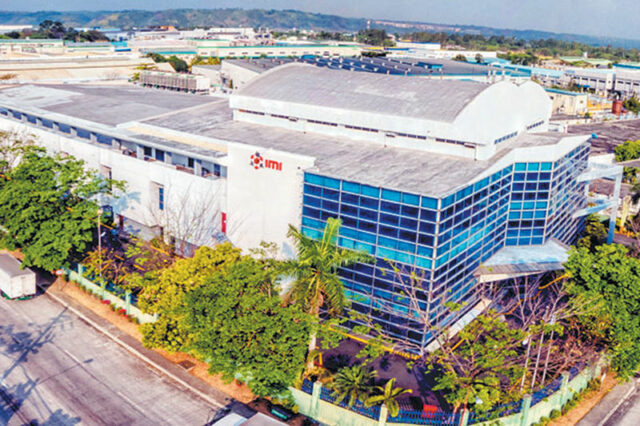
GLOBAL-IMI.COM

LISTED Integrated Micro-Electronics, Inc. (IMI) trimmed its attributable net loss for the third quarter to $467,000 from $1.6 million a year ago, following rightsizing efforts and lower operating expenses.

Revenue from July to September dropped by 19.2% to $275.21 million from $340.75 million last year, IMI said in a statement to the stock exchange on Monday.

Operating expenses fell by 26.9% to $21.75 million from $29.74 million in 2023.

IMI also reduced its nine-month attributable net loss by 89.2% to $9.24 million from $85.26 million a year ago, which included restructuring expenses and other non-operational one-offs.

“While securing order demand remains a challenge, we have managed to mitigate the impact of the headwinds we face. Through targeted rightsizing initiatives, we have been able to reduce core fixed overhead and selling, general, and administrative expenses, which will result in approximately a $25 million annualized reduction for the year,” IMI Chief Executive Officer Louis Sylvester Hughes said.

Revenue for the January to September period went down by 18.6% to $841.02 million from $1.03 billion in 2023 due to rightsizing efforts and lower utilization.

The company’s operating expenses also decreased by 9.5% to $73.48 million from $81.16 million a year ago.

“The automotive market’s continued uncertainty, coupled with industrial customers’ rightsizing of inventory levels, has led to reduced ordering patterns and pushouts of new product ramp-ups. These have resulted in lower utilization across multiple IMI sites, affecting profitability for the company,” IMI said.

VIA optronics AG, in which IMI has a 50% stake, saw a 37% decline in revenue to $83 million as of September due to a weaker laptop business, loss of orders from some automotive customers, and the bankruptcy of another customer in the mobility camera segment.

IMI said VIA is implementing restructuring initiatives to boost profitability. In April, VIA notified the New York Stock Exchange of the planned voluntary delisting of its American depositary shares.

“By operating more efficiently with a flatter, leaner support structure, we are positioning ourselves to enhance profitability as customer ordering patterns normalize. Furthermore, we are increasingly more selective of the projects we pursue, focusing on businesses that align with our core competencies,” Mr. Hughes said.

“IMI is actively exploring all opportunities to address the issues we face from non-core activities. Our prolific sales team is also actively looking to grow our industrial segment and bring better balance to the portfolio concentration within our business,” he added.

IMI produces electronics for the automotive, industrial, power electronics, communications, and medical industries.

On Monday, IMI declined by 1.74% or three centavos to P1.69 apiece. — Revin Mikhael D. Ochave

A hub for the art of collectibles

A DISPLAY for Hironos, an iconic Pop Mart designer toy character. — BRONTË H. LACSAMANA

Pop Mart opens pop-up store in the Philippines

TRENDING designer toy characters, now viral online among Filipinos, led to Pop Mart opening a pop-up store at SM Mall of Asia, Pasay City. The company behind the dolls and figurines of Molly, Crybaby, Hirino, Dimoo, Peach Riot, and the recently popular Labubu, among others, hopes to take advantage of the demand with the brand-new store.

Jeremy Lee, Pop Mart’s Southeast Asia market director, said that there is definitely a boom in these collectibles in the region. In the Philippines, certain influencers — the likes of actresses Heart Evangelista and Kathryn Bernardo, and TV host Vice Ganda — to name a few have popularized the designer toys, particularly Labubu.

“More than just a company that makes toys, Pop Mart is an innovator that sits at the intersection of art, culture, and entertainment,” Mr. Lee told the press at the pop-up’s launch on Oct. 31.

“These are designed for all age groups and personalities alike,” he added.

Actress Marian Rivera, another celebrity who is credited with the toys’ rise in popularity, graced the opening. Unboxing, showing off, and trading Labubus serve as “a precious bonding activity” for her and her daughter Zia, according to Ms. Rivera.

Nangongolekta ako dati pero Sanrio, mga Hello Kitty. Bumalik lang ako ngayon para something new (I used to collect but they were items from Sanrio, like Hello Kitty. I returned to the habit because there’s something new now),” she said.

Online community marketplace Carousell found that keyword searches for Labubu and related items in the Philippines saw an uptick over the past few months. It stated in a press release that “Labubu surged to become the top keyword search in October, climbing from rank 74 in July,” going on to say that “Keyword searches for Labubu and related items started increasing in July 2024; over 24X increase comparing June vs. October 2024.”

It is not just the number of searches that has been increasing. The number of Labubu-related listings “have been increasing since July this year and continue to grow in October, with an increase of over 21 times when comparing June to October.”

Pop Mart, which began as a variety store in Beijing in 2010, now has over 500 stores in over 30 countries and regions. They also manage and represent artists from all over the world, populating their roster of characters.

The company’s first official pop-up store in the Philippines, at SM Mall of Asia, opened in November. It will run for three months as part of “a key step in Pop Mart’s expansion across Southeast Asia, following overwhelmingly positive feedback from fans in the region.”

As Southeast Asia market director, Mr. Lee told the press that “it is vital” to bring more branches in the region in the upcoming year.

But working with local artists will take time, he said.

“At some point in time, yes, we will collaborate with Filipino artists as well,” he added, “But it will take time. It takes time to look out for potential artists and study the local art scene.”

The pop-up branch features a life-sized statue of Hirono Mime Devilry, designed to serve as an interactive photo spot for fans who visit the store.

Mr. Lee said that, following the opening of the pop-up, Filipinos can expect a full, official physical store to open as early as 2025.

“It’s coming very, very soon!” he said. — Brontë H. Lacsamana