Home Blog Page 2388

AllDay Marts reports 7.7% rise in first-half profit to P185 million

AllDay Supermarket

VILLAR-LED premium segment supermarket operator AllDay Marts, Inc. posted a 7.7% increase in attributable net income for the first half to P185 million from P172 million last year.

Revenue for the January-to-June period rose by 0.8% to P4.9 billion, AllDay said in an e-mailed statement on Wednesday.

Gross profit increased by 2.6% to P1.027 billion, while earnings before interest, taxes, depreciation, and amortization grew by 11.2% to P504 million.

“On the operational side, we looked into every opportunity to increase efficiency. While taking special care to preserve — even improve on — the unique AllDay experience, controlled spending and cost control measures allowed us to deliver even better value to our stakeholders,” AllDay Acting President and Chief Executive Officer Jacqueline B. Cano said.

“Notably, our increased efforts to shore up AllDay’s brand equity through an attractive and comprehensive imported item offering, as well as optimal pricing strategies, are increasingly bearing fruit,” she added.

Based on its website, AllDay has 33 locations across 25 cities and municipalities nationwide. The company offers fresh items, food items, and non-food items, comprising approximately 3,600 local and international brands and about 40,000 different items.

On Wednesday, AllDay shares fell by 1.45% or P0.002 to P0.136 apiece. — Revin Mikhael D. Ochave 

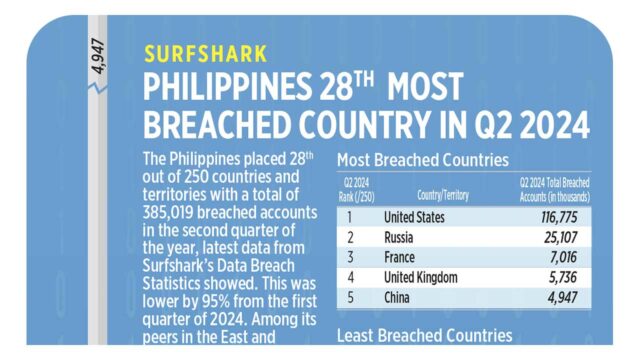
Surfshark: Philippines 28th most breached country in Q2 2024

The Philippines placed 28th out of 250 countries and territories with a total of 385,019 breached accounts in the second quarter of the year, latest data from Surfshark’s Data Breach Statistics showed. This was lower by 95% from the first quarter of 2024. Among its peers in the East and Southeast Asian region, the Philippines was the eighth-most breached country/territory during the period.

Surfshark: Philippines 28<sup>th</sup> most breached country in Q2 2024

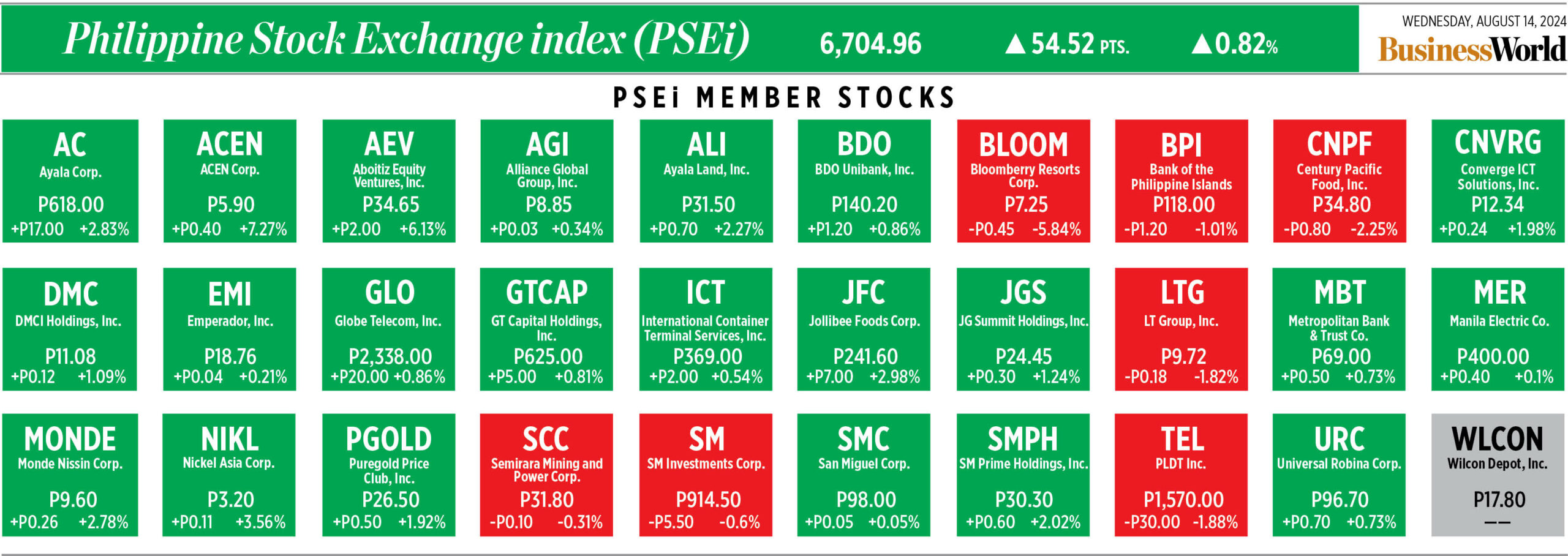
How PSEi member stocks performed — August 14, 2024

Here’s a quick glance at how PSEi stocks fared on Wednesday, August 14, 2024.


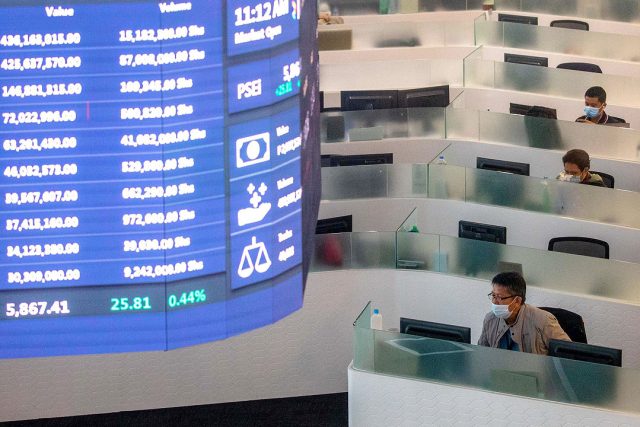
PSEi back above 6,700 as mart awaits BSP move

REUTERS

THE MAIN INDEX climbed to the 6,700 level on Wednesday, propped up by bargain hunting before the policy meeting of the Bangko Sentral ng Pilipinas (BSP), a strong peso, and positive spillovers from Wall Street overnight.

The bellwether Philippine Stock Exchange index (PSEi) rose by 0.82% or 54.52 points to end at 6,704.96 on Wednesday, while the broader all shares index climbed by 0.53% or 19.30 points to close at 3,629.30. This was the PSEi’s best close in almost three weeks or since it finished at 6,726.01 on July 26.

“Investors continued to bargain hunt ahead of the BSP meeting [on Thursday], while more economic data and corporate earnings continue to underscore that the economy continues to perform remarkably well,” Regina Capital Development Corp. Head of Sales Luis A. Limlingan said in a Viber message.

A BusinessWorld poll showed that nine out of 16 analysts surveyed expect the Monetary Board to deliver a 25-basis-point (bp) rate cut at Thursday’s policy meeting, bringing the target reverse repurchase rate to 6.25% from the current over 17-year high of 6.5%, where it has been since October 2023.

On the other hand, seven others expect the BSP to keep rates steady. The Monetary Board last reduced rates in November 2020, when it delivered a 25-bp cut and brought the key rate to 2% to support economic recovery amid the coronavirus pandemic.

“The local market extended its rise this Wednesday, gaining 0.82%. The positive spillovers from Wall Street’s overnight rally driven by the US’ below-expected producer price index numbers gave a boost in [Wednesday’s] session,” Philstocks Financial, Inc. Senior Research Analyst Japhet Louis O. Tantiangco said in a Viber message.

“The local currency’s recent strengthening against the US dollar also helped in sustaining the market’s upward movement,” Mr. Tantiangco added.

The peso inched up to P56.955 per dollar on Wednesday from P56.96 on Tuesday, according to Bankers Association of the Philippines data.

This was a new near four-month high for the local unit as it was its best finish since closing at P56.808 on April 15.

All sectoral indices closed higher on Wednesday. Property rose by 1.68% or 44.75 points to 2,693.91; mining and oil increased by 1.44% or 116.87 points to 8,219.39; industrials went up by 1.32% or 120.18 points to 9,166.15; holding firms jumped by 0.79% or 45.70 points to 5,788.74; services improved by 0.06% or 1.27 points to 2,088.22; and financials inched up by 0.02% or 0.44 point to 1,984.65.

Value turnover went up to P6.96 billion on Wednesday with 670.22 million issues changing hands from P4.98 billion with 607.05 million shares traded on Tuesday.

Decliners outnumbered advancers, 105 versus 98, while 54 issues were unchanged.

Net foreign buying rose to P457.52 million on Wednesday from P121.63 million on Tuesday. — R.M.D. Ochave

Peso inches up before key US inflation report

ANGIE REYES-PEXELS

THE PESO rose further against the dollar on Wednesday as the market awaits the July US consumer price index (CPI) report, which could cement expectations of a September rate cut by the US Federal Reserve.

The local unit closed at P56.955 per dollar on Wednesday, inching up by half a centavo from its P56.96 finish on Tuesday, Bankers Association of the Philippines data showed.

This was the peso’s strongest showing in almost four months or since its P56.808-a-dollar close on April 15.

The peso opened Tuesday’s session stronger at P56.90 against the dollar. Its weakest showing was at P57.12, while its intraday best was at P56.835 versus the greenback.

Dollars exchanged went down to $1.34 billion on Wednesday from $1.799 billion on Tuesday.

“The peso-dollar moved sideways ahead of the figures of US inflation later. The market is expecting higher US CPI. We saw some slight buying earlier in the session due to bets of higher-than-expected CPI data,” a trader said by phone.

The peso appreciated slightly amid the dollar’s decline after the release of US producer price index (PPI) data overnight, Rizal Commercial Banking Corp. Chief Economist Michael L. Ricafort said in a Viber message.

The dollar hovered near a one-week low on Wednesday as traders bet US consumer price data later in the day will keep the Fed on course to cut rates next month, Reuters reported.

Traders were largely cautious ahead of US inflation data at 1230 GMT (8:30 a.m. ET), which is expected to show consumer prices increased 0.2% in July, on a month-on-month basis, following a 0.1% decline a month ago.

The dollar index — which measures the greenback against other major currencies — dipped 0.1% to 102.52, after slumping 0.5% on Tuesday when a slower-than-expected rise in producer prices reinforced hopes of a US rate cut next month.

Traders had been widely expecting a rate cut in September before the producer price data and ramped up bets for a super-sized 50-basis-point cut after the release to 52.5% from 50% a day earlier, according to CME’s FedWatch Tool.

For Thursday, the trader said the peso’s movement against the dollar would depend on the Philippine central bank’s policy decision.

The trader expects the peso to move between P56.80 and P57.20 per dollar, while Mr. Ricafort sees it ranging from P56.85 to P57.05. — A.M.C. Sy with Reuters

Vind Energy wins green-lane privileges for two wind farms

STOCK PHOTO | Image by Nicholas Doherty from Unsplash

THE Board of Investments (BoI) said on Wednesday that it awarded green lane certifications to Vind Energy Corp. for its combined P331 billion worth of offshore wind projects in Cavite and Guimaras.

In a statement, the BoI said that it awarded the certificates to Alma Roxas-Aguila, development director of Corio Generation, a shareholder of Vind Energy and a company in Macquarie Asset Management’s portfolio.

“We greatly appreciate the government’s support for renewable energy, particularly offshore wind. These green lane certifications are crucial for our project development and efforts in helping the country reach its decarbonization targets,” Ms. Roxas-Aguila said.

The projects in Cavite and Guimaras have a potential maximum capacity of 994 megawatts (MW) and 728 MW, respectively, and are expected to start operations in 2030.

“In particular, the projects will utilize a fixed-bottom offshore wind technology with a combined project cost of more than P331 billion,” the BoI said.

Corio’s portfolio includes floating and fixed-foundation projects across established and emerging markets. In the Asia-Pacific, it also has projects in Australia, South Korea, Taiwan, and Vietnam.

The government, through Executive Order (EO) No. 18, established green lanes in all government agencies to speed up the approval and registration process for priority or strategic investments.

There are 102 projects with investments worth P3 trillion endorsed by the BoI’s One-Stop Action Center for Strategic Investments, the majority of which are renewable energy (RE) projects.

The government has taken in increased investment in RE projects after it allowed full foreign ownership in the industry, which was previously limited to 40%.

According to Corio, EO 18 and EO 21, which directed the establishment of the framework for offshore wind development, will help in the seamless implementation of the company’s five projects in the Philippines. — Justine Irish D. Tabile

Fish production declines 6% in second quarter

PHOTOGRAPH © ALO LANTIN/WWF-PHILIPPINES/ WWF.ORG.PH

FISHERIES output fell 6% in the second quarter led by the marine municipal fisheries, inland municipal fisheries, and aquaculture segments, according to the Philippine Statistics Authority (PSA).

In its fisheries report, the PSA said production was 1.02 million metric tons (MMT) in the second quarter.

The commercial fishery segment reported a 21.9% year-on-year gain for the quarter to 286,602 MT.

Marine municipal fisheries, which accounted for 25.5% of overall output, declined 6.1% year on year to 259,465 MT.

Inland municipal fisheries production declined 21.9% to 30,100 MT. Its output was equivalent to 3% of overall fisheries production.

The PSA added that aquaculture production for the three months to June period fell 17.7% to 471,400 MT, accounting for 46.3% of total output.

Of the 20 major species, declines were posted by tiger prawns or sugpo (40.3%), grouper or lapu-lapu (34.8%), and seaweed (25.8%).

Production gains were reported for skipjack (141.2%), bigeye tuna (94.1%), and yellowfin tuna (43.2%).

The Department of Agriculture said it is looking to improve conservation and management of tuna species to maintain the population and long-term industry viability.

It made the statement at the 20th regular meeting of the Scientific Committee of the Western and Central Pacific Fisheries Commission.

“For the Philippines, the outcomes of this session are of particular significance. The tuna industry is a major catalyst of economic growth and food security in our nation,” Agriculture Undersecretary for Fisheries Drusila Esther E. Bayate said.

“As such, we are deeply interested in ensuring fair and equitable access to tuna resources,” she added. — Adrian H. Halili

DTI’s inflation-containment role seen limited to regulating prices of basic commodities

PHILIPPINE STAR/MIGUEL DE GUZMAN

THE Department of Trade and Industry (DTI) said it can play only a limited role in easing inflation, with authority only over the prices of basic goods.

Undersecretary Amanda Marie F. Nograles said during the DTI’s budget briefing at the House of Representatives that the department is focusing on controlling price instability, including the suspension of road tolls for goods shipments and encouraging manufacturers to voluntarily hold the line on commodity prices.

“The DTI’s mandate covers basic necessities and prime commodities, which have an impact of only about 0.89% on consumer pricing,” she told legislators.

“Therefore, the DTI’s (authority) regarding the increase in the prices of goods reported in inflation is not very significant,” she added.

Inflation accelerated to 4.4% in July from 3.7% in June, according to the Philippine Statistics Authority.

July’s inflation reading represented a nine-month high, following the 4.9% posted in October 2023.

The DTI’s other main concern is monitoring the supply of goods throughout the country, Ms. Nograles said. “Based on reports from our (price) monitors, the supply of goods in Luzon, the Visayas, and Mindanao is adequate.”

Party-list Rep. Arlene D. Brosas said at the hearing that the government should look into boosting the budget of a program meant to provide support to small businesses, which could lead to the creation of more jobs.

The proposed MSME (micro, small and medium enterprises) development fund for next year was slashed 71% to P780 million, against the DTI’s request of P2.47 billion, according to Acting Trade Secretary Cristina A. Roque.

“Considering that (MSMEs are) 99.5% of the business sector, the budget is not enough,” Mr. Roque said in response to a query on the adequacy of the program’s funding.

“We should actually get more so we can push this large part of the business sector,” she added.

Congress should restore the budget to “some of the more important priority programs” of DTI to support further economic development, Cagayan de Oro Rep. Rufus B. Rodriguez said, after the government cut P12 billion from the DTI’s budget proposal for next year.

“Only P6 billion (was retained), P12 billion was scratched” he said.

“We cannot allow that in Congress because we are here to support trade and industry, an important cog in the development of our country,” he added. — Kenneth Christiane L. Basilio

PCCI backs curbs on number of holidays

PARTICIPANTS in the streetdance competition — BW FILE PHOTO

THE Philippine Chamber of Commerce and Industry (PCCI) said on Wednesday that the Philippines celebrates “too many holidays,” which is affecting its productivity and attractiveness as an investment destination.

In a statement, PCCI President Enunina V. Mangio said: “We have too many holidays compared to the others in the region. We have to reduce its negative impact on the productivity of our workforce and the state of our economy.”

On average, the PCCI tallied 27 holidays a year, including special holidays declared by the Palace every year, not counting the calamity-related days off work and hundreds of provincial and municipal holidays.

In October, President Ferdinand R. Marcos, Jr. through Proclamation No. 368, listed 10 regular holidays for 2024.

These are New Year’s Day (Jan. 1), Maundy Thursday (March 28), Good Friday (March 29), Araw ng Kagitingan (April 9), Labor Day (May 1), Independence Day (June 12), National Heroes Day (Aug. 26), Bonifacio Day (Nov. 30), Christmas (Dec. 25), and Rizal Day (Dec. 30.).

Four special non-working days were also declared — Ninoy Aquino Day (Aug. 21), All Saints’ Day (Nov. 1), the Feast of the Immaculate Conception of Mary (Dec. 8), and the last day of the year (Dec. 31).

Additional special non-working days were also declared, which included Chinese New Year (Feb. 10), Black Saturday (March 30), All Souls’ Day (Nov. 2), and Christmas Eve (Dec. 24).

The President also declared, through separate proclamations, April 10 and June 14 as regular holidays for the observance of Eidul Fitr and Eidul Adha.

“Having too many holidays is unhealthy for business and the economy. It increases the labor costs that actually burden small businesses in particular,” Ms. Mangio said.

“Let us focus and work on our productivity and competitiveness, and make sure we attract more investors,” she added.

Senate President Francis Joseph G. Escudero said over the weekend that the chamber is not considering reducing the number of holidays but ruled out adding more holidays on top of the fixed regular and special non-working holidays. — Justine Irish D. Tabile

Danish firm signs on to prepare Clark decarbonization strategy

New Clark City

THE Bases Conversion and Development Authority (BCDA) said that it received commitments from a Danish company and the Royal Danish Embassy in Manila to help prepare a so-called “green map” that will guide New Clark City’s decarbonization efforts.

In a statement on Wednesday, the BCDA said it has been in talks with Danfoss, Inc. on the energy efficiency and decarbonization plan for New Clark City, which touts itself as a smart and green urban space.

Danfoss provides technology and solutions aimed at driving the green transition through energy efficiency, machine productivity, lower emissions, and electrification, the BCDA said.

It added that it received a commitment from Danish Ambassador Franz-Michael Mellbin for the assistance of the Danish government in “optimizing the New Clark City for energy efficiency” through sharing Danish expertise in green solutions and innovation.

BCDA Chairman Delfin N. Lorenzana said sustainability is built into the development and investment plans of New Clark City. 

“These initiatives include the development of renewable energy, the use of low-carbon district cooling technologies, smart governance of mass transportation, and the establishment of a solid waste-to-energy system and facilities,” Mr. Lorenzana said.

BCDA’s projects also include the development and expansion of industrial spaces, greenbelts and river parks, eco-tourism and hospitality facilities, and universities, among others.

BCDA President and Chief Executive Officer Joshua M. Bingcang said: “We are not only mindful of the commercial arrangement. We want sustainability to be a key factor in our development. We are always into ‘future-proofing’, especially on the sustainability aspect of development.” — Justine Irish D. Tabile

Industrialization seen critical in reining in growing trade deficit

REUTERS

THE Department of Trade and Industry (DTI) said industrialization is the path to take in containing the growing trade deficit, which has been preventing the country’s development.

At a budget hearing on Wednesday, Trade Undersecretary and Board of Investments Managing Head Ceferino S. Rodolfo said that the trade deficit grew sharply to $52.59 billion in 2023 from $3.3 billion in 2014.

“That is why we are saying that we have to industrialize our way out of the trade deficit; we cannot just export our way out of the trade deficit because we are really importing a lot of products that we could very well produce,” he added.

“If you look at the primary contributors (to the deficit), these would be automotive, steel, petrochemicals, cement, and, of course, petroleum and rice, which are high on the list, but we cannot do anything about them in the short term,” he said.

According to Mr. Rodolfo, the Philippines needs heavy industry and manufacturing to get on a firm development path. 

He said steps have already been taken, noting that steel rebar producer SteelAsia Manufacturing Corp. recently inaugurated a factory in Cebu.

This brings SteelAsia’s rebar capacity to the largest in Southeast Asia, according to Mr. Rodolfo.

“In addition to this, on the topic of integrated steel facilities, we are also looking at a potential foreign investor, (which is) the largest steel-making company in Southeast Asia,” he said.

“We are hoping that they will come; in fact, we are already in advanced stages of discussions with them,” he added.

According to the DTI’s presentation to the House of Representatives, the trading relationships that were the source of the largest deficits were China, Indonesia, South Korea, Thailand, Malaysia, Singapore, Australia, Vietnam, Saudi Arabia, and Taiwan.

The Philippine trade-in-goods deficit widened by 9.3% to $4.3 billion in June, the Philippine Statistics Authority said.

However, the trade deficit in the first six months narrowed 9.5% to $25 billion.

The balance of trade in goods has been in deficit for 109 straight months, or since the $64.95-million surplus posted in May 2015.

Mr. Rodolfo said that despite increasing exports, the trade deficit is still not narrowing due to imports.

“Even if we are the fastest-growing economy in the region, much of the growth is being met by imports,” he said.

He added that the top opportunities for growth are mining and processing of minerals, semiconductors and electronics, information technology and business process management, and non-meat agricultural products.

“Mining currently accounts for less than 1% of gross domestic product; imagine if we could increase that to 1% in the succeeding years, to 2%, 3%, and so on,” he said.

“Second are semiconductors and electronics, particularly because of supply chain issues. We have been getting a lot of attention from other countries on this,” he added. — Justine Irish D. Tabile


Budget release rate hits 94.2% at end of July

BW FILE PHOTO

THE Department of Budget and Management (DBM) said it had released 94.2% of the 2024 national budget by the end of July.

According to the DBM Status of Allotment Release report, the releases amounted to P5.43 trillion out of a budget of P5.768 trillion, leaving P333.57 billion undistributed.

The release rate at the end of last month was running ahead of the year-earlier pace of 92.8%.

Releases to government agencies and departments amounted to P3.42 trillion, equivalent to 97.8% of their allocations.

Special Purpose funds released by the end of the month stood at P348.95 billion, representing 68.8% of the funds allocated.

Meanwhile, Automatic Appropriation releases were at 82.1% or P1.44 trillion.

These include P916.91 million for the retirement and life insurance premiums of various National Government agencies and P10 billion for the Rice Competitiveness Enhancement Fund.

This year’s budget is 9.5% higher than last year’s and is equivalent to 21.7% of gross domestic product. — Beatriz Marie D. Cruz