Home Blog Page 2361

Peso may move sideways after guarded Federal Reserve signals

ANGIE REYES-PEXELS

THE PESO is expected to move sideways against the dollar this week after US Federal Reserve Chairman Jerome H. Powell said there was no need to rush the US central bank’s easing cycle.

“The dollar-peso closed lower following Powell’s comments on the recent performance of the US economy, giving the Fed room to lower interest rates cautiously,” a trader said by phone.

The peso closed at P58.732 a dollar on Friday, strengthening by 4.5 centavos from its P58.777 finish on Tuesday, according to data posted by the Bankers Association of the Philippines on its website. Week on week it weakened by 47.2 centavos.

The Federal Reserve does not need to rush to lower interest rates given a strong US economy, a solid job market and inflation above its 2% target, Mr. Powell said on Thursday in remarks that could point to borrowing costs remaining higher for longer, according to Reuters.

He said he and his fellow policy makers considered inflation to be “on a sustainable path to 2%” that would allow the Fed to move monetary policy to a more neutral setting without slowing the economy.

The US central bank’s next policy meeting is scheduled for Dec. 17-18.

Faster October US producer price index (PPI) also resulted in a generally weaker dollar on Friday, Michael L. Ricafort, chief economist at Rizal Commercial Banking Corp., said in a Viber message.

US producer prices picked up in October, lifted by higher costs for services such as portfolio management and airline fares, another sign that progress toward lower inflation was stalling, Reuters reported.

The PPI for final demand rose 0.2% last month after a 0.1% gain in September, the Labor department’s Bureau of Labor Statistics said. The increase in the PPI was in line with economists’ expectations. The PPI was reported to have been unchanged in September.

In the 12 months through October, the PPI increased 2.4% after advancing 1.9% in September.

The trader expects the market this week to look for further signals on the Fed’s December policy meeting.

The foreign exchange market will also await US President-elect Donald J. Trump’s trade policies and appointment of his officials, the trader added.

The trader expects the peso to move from P58.50 to P58.95 a dollar this week, while Mr. Ricafort expects it to range from P58.40 to P58.90. — Aaron Michael C. Sy

Austin’s visit seen as last-ditch effort to reaffirm Philippine-US defense ties

US DEFENSE SECRETARY Lloyd Austin III — PCO.GOV.PH

By John Victor D. Ordoñez, Reporter

US DEFENSE chief Lloyd Austin III visit to Manila this week is the outgoing Biden administration’s last-ditch effort to reinforce their security commitments to the Philippines as Washington is headed into another Trump presidency, security analysts said at the weekend.

“I think he will reassure his hosts that the US commitment to the Philippines remained strong throughout the first Trump administration, and he has no reason to think it will change in a Trump 2.0,”  Raymond M. Powell, a fellow at the Stanford University’s Gordian Knot Center for National Security Innovation, said in an X message.

He described the outgoing Defense secretary a “lame duck” as he only has two months left before President-elect Donald J. Trump takes office.

“That does not make him powerless, but it does limit what he can accomplish with two months left on the job,” Mr. Powell said.

The US Defense Department said last week that Mr. Austin’s visit to Manila aims to explore deeper security ties and ensure peace and stability in the Indo-Pacific region.

He will meet with his Philippine counterparts to “advance security objectives with Philippine leaders,” the agency said in a statement.

Philippine President Ferdinand R. Marcos, Jr. told reporters last week that ties between both countries would not change under a Trump presidency

The US is the Philippines’ major security partner, with a 1951 Mutual Defense Treaty compelling both nations to defend each other in case of an armed attack.

Under President Joseph R. Biden, Washington reiterated that the treaty covers any attacks on Philippine vessels, personnel and other assets in the South China Sea and anywhere in the Pacific.

In April, Republican Senator Bill Hagerty and Democrat Senator Tim Kaine pushed a bill that increased US military aid to the Philippines to $500 million from $40 million over five fiscal years through 2029.

“This is a last minute attempt by the Biden administration to see to it that all the security agreements signed and talked about between the US and the Philippines will continue their attempt that before a new administration takes over things will continue to be in place,” Aaron Jed Rabena, who specializes in geopolitics and foreign policy at the University of the Philippines Asian Center, said in a Facebook Messenger chat.

Last year, the Philippines gave the US access to four more military bases under their 2014 Enhanced Defense Cooperation Agreement.

Philippine Defense Secretary Gilberto Eduardo Gerardo “Gibo” C. Teodoro, Jr. on Tuesday said China is putting greater pressure on the Philippines to cede its sovereign rights in the South China Sea.

China and the Philippines have sparred repeatedly this year over disputed areas of the South China Sea, including the Scarborough Shoal, one of Asia’s most contested features.

China claims almost the entire South China Sea, a conduit for more than $3 trillion of annual ship-borne commerce. The Permanent Court of Arbitration in 2016 said China’s claims had no legal basis, a ruling Beijing rejects.

In a separate development, Philippine Foreign Affairs Undersecretary Ma. Theresa P. Lazaro has urged Poland to support Manila’s efforts to ensure international law is upheld amid maritime disputes with China in the South China Sea after she met with international relations experts in Warsaw, according to the Department of Foreign Affairs (DFA).

“She invited Poland to consider joining the chorus of like-minded countries that have publicly expressed support for Philippine efforts to uphold the rule of law in the South China Sea, including calling on all parties to abide by the final and legally-binding 2016 Arbitral Award,” the agency said in a statement, citing her roundtable discussion on global issues at the Polish Institute of International Affairs or the Polski Instytut Spraw Międzynarodowych (PISM)  in Warsaw, Poland on Nov. 15.

At the roundtable meeting, Ms. Lazaro also spoke with PISM international affairs analysts and researchers on global issues, particularly those in the Asia-Pacific region and the current world order.

“Undersecretary Lazaro underscored that the Philippines shares the common values of human rights, rule of law and the rules-based international order with the European Union and its Member States,” according to the DFA.

Jarosław Szczepankiewicz, chargé d’affaires at the Embassy of Poland in Manila, earlier said that Poland is open to participating and observing joint military exercises with the Philippines and its allies in the South China Sea amid China’s growing assertiveness in the waterway.

Poland Foreign Minister Radoslaw Sikorski and deputy ministers in September met with their Philippine counterparts to explore deeper bilateral ties.

Super Typhoon Man-Yi makes second landfall over Aurora province

PAGASA.DOST.GOV.PH

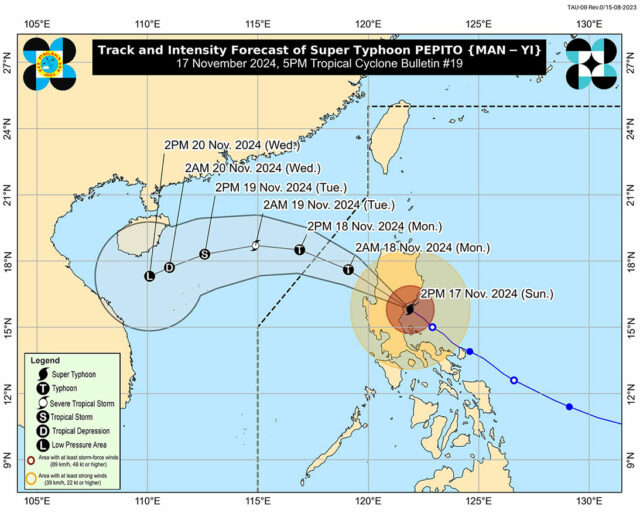
THE state weather bureau on Sunday said that Super Typhoon Man-Yi, locally named Pepito, is expected to exit Luzon after making a second landfall over Aurora.

In a 5 p.m. bulletin, the Philippine Atmospheric, Geophysical and Astronomical Services Administration (PAGASA) reported that Man-Yi made a second landfall in the vicinity of Dipaculao, Aurora at 3:20 p.m. It is forecast to exit the landmass of Luzon tonight or early Monday morning.

“During this period, Pepito will significantly weaken due to land interaction,” PAGASA noted.

As of 5 p.m., Man-Yi was last seen over Nagtipunan, Quirino, moving northwestward at 25 kilometers per hour (kph).

Man-Yi was packing maximum sustained winds of up to 185 kph near the center, and gustiness of up to 230 kph.

PAGASA has raised Tropical Wind Signal No. 5 over the central portion of Aurora, the southern portion of Quirino (Nagtipunan), and the southern portion of Nueva Vizcaya.

The rest of Aurora, the rest of Nueva Vizcaya, the rest of Quirino, the southern portion of Ifugao, Benguet, the southern portion of Ilocos Sur, La Union, the eastern portion of Pangasinan, and the northern portion of Nueva Ecija were placed under Signal No. 4.

Under Signal No. 3 are the southern portion of Isabela, the rest of Ifugao, Mountain Province, the southern portion of Kalinga, the southe000rn portion of Abra, the rest of Ilocos Sur, the rest of Pangasinan, the northern and eastern portions of Tarlac, the rest of Nueva Ecija, the northern portion of Bulacan, and the northern portion of Quezon including the rest of Polillo Islands.

The rest of Isabela, the southwestern portion of mainland Cagayan, the rest of Kalinga, the southern portion of Apayao, the rest of Abra, Ilocos Norte, Zambales, the rest of Tarlac, the northern portion of Bataan, Pampanga, the rest of Bulacan, Metro Manila, Rizal, the northeastern portion of Laguna, and the central portion of Quezon were all under Signal No. 2.

Signal No. 1 was hoisted over the rest of mainland Cagayan, the rest of Apayao, the rest of Bataan, Cavite, the rest of Laguna, Batangas, the rest of Quezon, the northern portion of Occidental Mindoro including Lubang Islands, the northern portion of Oriental Mindoro, Marinduque, Camarines Norte, and the northern portion of Camarines Sur.

The Presidential Communications Office also announced on Sunday that local chief executives may cancel classes and/or suspend government work.

Data from the National Disaster Risk Reduction and Management Council (NDRRMC) showed 238,982 families or 852,475 people had been affected by Super Typhoon Man-Yi, Typhoon Toraji (Nika), and Super Typhoon Usagi (Ofel). 

NDRRMC said 24,421 families or 75,581 people had stayed in 566 evacuation centers.

It said a total of 7,838 damaged houses were reported in Cagayan Region, Ilocos Region, Central Luzon, and the Cordillera Administrative region, 437 of which were totally destroyed.

No deaths had been reported but NDRRMC said at least two people have been injured.

ECONOMIC COST
The Philippine government has been counting the economic costs of recent storms that have resulted in agriculture damage worth billions of peso, its economic planning agency said, as the country braced for Super Typhoon Man-Yi.

National Economic Development Authority (NEDA) Secretary Arsenio M. Balisacan said the government expects the agriculture sector to be among the hardest-hit sectors in the face of storms.

“Agriculture, in the third quarter, declined by 2.8%. For the whole year, it’s likely negative for agriculture. So that’s the immediate effect,” he told BusinessWorld on the sidelines of an event on Friday.

When asked to clarify whether the impacts of previous tropical cyclones had already been taken into account in growth projections for 2024, Mr. Balisacan said: “Well, part of it showed up in the third quarter already. But I would expect the fourth quarter will show also the effects.”

Before Man-Yi, the Philippines was hit by Tropical Storm Trami (Kristine), which left over P3 billion in agricultural damage based on latest estimates from the Department of Agriculture (DA).

DA estimated the volume of production losses at 160,107 metric tons (MT) in 11 regions, covering 72,329 hectares of land.

Due largely to the impacts of weather disturbances and reduced government spending, the Philippine economy grew by 5.2% in the third quarter, lower than the revised 6.4% growth in the second quarter and the government’s 5.7% forecast.

The agriculture sector saw a 2.8% decline year-on-year, which NEDA linked to the El Niño and seven typhoons including Trami that resulted in an estimated P15.8-billion agricultural damage.

The successive storms disrupted supply chains and delayed harvests, he noted.

A Nov. 6 report by the Philippine Statistics Agency showed agricultural production experienced the steepest decline in nearly four years.

Before Man-yi’s landfall, the agriculture province of Cagayan in northern Luzon posted an initial P1.4 billion damage in agriculture largely covering crops like rice, corn, coconut, and bananas after Typhoon Krathon (Julian), Trami, Super Typhoon Kong-rey (Leon), and Typhoon Yinxing (Marce) hit northern Philippines since the last week of September.

President Ferdinand R. Marcos, Jr. earlier this month said typhoons experienced by his country have been increasingly unpredictable due to the changing climate, and that his government doesn’t have a “template to follow” in terms of response.   

“It is climate change, and it is the new reality that we are having to face,” he told reporters.

The President held a disaster briefing on Friday in anticipation of Man-Yi’s impacts.

On Sunday, the presidential palace said the Philippine leader had directed authorities to implement preemptive measures amid Man-Yi’s devastation.   

Meanwhile, a political group on Sunday urged the government to use seized illegal online casino hubs as evacuation centers as Super Typhoon Man-Yi battered the country.

“We have numerous POGO (Philippine Offshore Gaming Operator) facilities in areas like Bamban, Porac, Bataan, Bulacan, and Cagayan that can serve as spacious, well-equipped evacuation centers,” Neri J. Colmenares, one of Bayan Muna party-list’s nominees in the midterm elections next year, said in a statement.

Philippine authorities earlier this year began cracking down on illegal online casinos due to crimes linked to it, such as human trafficking, financial scams, and torture. POGOs also raised national security concerns because of some hubs’ proximity to military facilities.

Mr. Colmenares said the POGO sites are spacious and already equipped with medical facilities, making them suitable disaster shelters. — Adrian H. Halili, Kyle Aristophere T. Atienza, and Kenneth Christiane L. Basilio


Delay in release of CoA reports hampers public scrutiny — analysts

PHILIPPINE STAR/ MICHAEL VARCAS

By Kenneth Christiane L. Basilio, Reporter

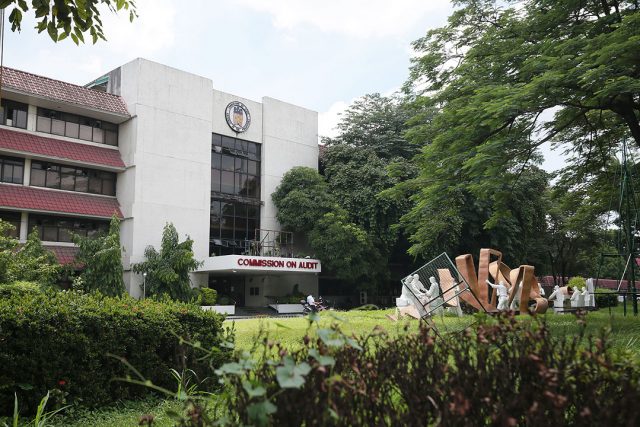
THE DELAY in the public release of the Commission on Audit’s (CoA) annual reports to December could affect the public’s ability to scrutinize spending issues within government agencies, political analysts said over the weekend as deliberations for next year’s proposed national budget advances in Congress.

State auditors have moved the release of its audit reports to December in compliance with a General Appropriations Act provision, CoA Assistant Commissioner Alexander B. Juliano told congressmen in August. Audit reports were previously released in June.

Section 99 provided that concerned agencies are given 60 days upon the receipt of the audit reports to submit to CoA a status report on the actions taken regarding observations and recommendations of the Commission. It also noted that CoA’s web administrator should ensure that the audit reports are published on the website with the corresponding status report.

This led to the delay, which analysts said, could affect how the public perceives government spending and the Marcos administration’s transparency efforts.

“The General Appropriations Bill (GAB) that becomes the national budget tends to be fast-tracked by Congress. Moving the release of CoA audit reports means… we can no longer pursue them because their budgets were already approved,” Hansley A. Juliano, who teaches politics at the Ateneo de Manila University, said in a Facebook Messenger chat.

The Philippine Congress is expected to ratify the proposed P6.352-trillion national spending plan for 2025 before lawmakers go on break in mid-December, House of Representatives Majority Leader and Zamboanga City Rep. Manuel Jose M. Dalipe said in a statement earlier this month.

The House has already approved its version of the GAB in September, while senators are still discussing their budget bill in plenary.

The Commission is an independent constitutional body responsible for auditing all expenses and revenues of departments and agencies by conducting comprehensive reports of their operations, ensuring accountability and transparency in the use of public funds.

CoA’s Mr. Juliano explained that audited departments and oversight agencies are given access to the annual audit reports in June, while the publicly available report was not published until December “So, the publication on the website was delayed because we need to validate the actions taken by the agency on the audit observations,” he said in Filipino.

“This limits timely public access to critical information about how government funds are utilized. Without them, it becomes more challenging for advocates and the general public to hold public officials accountable,” Aljon Patrick C. Acupan, convener of transparency group FOI Youth Initiative, said in a Facebook chat.

He added that the delay “undermines” the Marcos administration’s commitment to a transparent government.

The delay in the release of audit reports also reflects poorly on the state auditing agency, Ateneo’s Mr. Juliano said.

“The impact on credibility isn’t just on the lawmakers and our line offices, it’s also on CoA. It either gives the impression that CoA is not staffed enough to timely pursue and review all budget spending, or that CoA is compromised.”

“Transparency in relation to public trust is not only a matter of publicizing reports. It is also a matter of making ordinary citizens value transparency and enabling them to utilize such reports in their political decision-making,” Anthony Lawrence A. Borja, a political science professor at De La Salle University, said in a Facebook chat.

Gen Zs seek meaningful work, financial security, study finds

AKSON-UNSPLASH

By Chloe Mari A. Hufana, Reporter

GEN Zs, or those born between 1995 and 2012, are reshaping workplace expectations as they value meaningful and fulfilling work, while also prioritizing financial security, a new study from the Ateneo de Manila University (ADMU) found.

The study, “Motivating Filipino Generation Z employees at work: enablers and outcomes,” noted that Gen Z workers are motivated by familial responsibilities, particularly the need to provide financial support.

This is an intrinsic motivator in the Filipino culture, which drives these workers to look for competitive salaries and benefits to support themselves and their loved ones, it added.

“Family is a significant motivator for their work, as they strive to provide a good life for their loved ones. Some participants (of the study) who are the eldest child also reported feeling a greater sense of responsibility to provide for their family,” a portion of the study, published by Mikee C. Talamayan, Mendiola Teng-Calleja and Jaimee Felice Caringal-Go of the ADMU Department of Psychology and the Ateneo Center for Organization Research and Development in October 2024, read.

Unlike older generations such as Generation X (born in either 1961 or 1965, up to 1979) and Baby Boomers (born after World War II, in 1946 to 1960/1964), who prioritize job security and organizational loyalty, Gen Z workers place a premium on career advancement and skill development, it said.

They also value autonomy, with many preferring hybrid or flexible work arrangements over rigid office settings.

“Compared to Millennials (or Gen Y, born between 1980 and 1994), who put more value on interesting work and collegial work environments, Gen Zs tend to focus on securing their future through savings and investments,” the study found.

Gen Z’s emphasis on meaningful work is further influenced by growing up in a digitally connected world, where social issues and value-driven missions are increasingly visible.

According to the study, employers must focus on fostering career growth, aligning organizational values with broader social impact and providing robust financial benefits for immediate and long-term security to retain the youngest cohort of employees.

Federation of Free Workers (FFW) President Jose Sonny G. Matula said firms must enhance support systems to create a supportive and adaptable work environment that meets Gen Z’s evolving needs while ensuring organizational resilience.

“Provide comprehensive benefits that include mental health support, financial assistance, and career development opportunities to address immediate and long-term concerns,” he told BusinessWorld in a Viber message.

He added that firms must offer not only minimum wages but also living wages, comprehensive benefits, flexible work options (e.g. hybrid), and financial education programs.

He said that strengthened communication can also foster a conducive work environment for Gen Zs.

“Maintain transparent and consistent communication during crises to foster trust and reduce uncertainty among employees.”

Childhood Cancer Helpline set up

ELENA KOYCHEVA-UNSPLASH

THE Childhood Cancer Helpline, set to be presented by the I Want to Share Foundation (IWTS) to Health secretary Dr. Teodoro “Ted” J. Herbosa, will help navigate families to essential medical support for pediatric cancer care, the IWTS founder said.

“With this, we hope it will address the gaps in the cancer burden. This childhood cancer helpline will support early cancer detection, reduce instances of misdiagnosis, and decrease treatment abandonment due to the economic difficulties faced by our patients,” Sheila Marie B. Romero, founder of IWTS, said during her opening statement at the IWTS and Manila Hearing Aid event.

Ms. Romero told BusinessWorld that she has heard stories of pediatric patients being misdiagnosed or sent to the wrong doctors. She also noted the struggles of patients from distant provinces who travel to the Philippine General Hospital (PGH) for much-needed checkups and treatments, only to be turned away due to long queues.

With the implementation of the Childhood Cancer Helpline, IWTS hopes to ease the burden on patients and families and reduce misdiagnoses by answering parents’ questions about where to seek medical diagnosis and treatment, as well as institutions to seek financial support.

Parents can also schedule appointments in PGH, avoiding the hassle caused by cutoff times.

In the secondary phase of its implementation, Ms. Romero noted that they will collaborate with city and barangay health centers, where patients can receive initial face-to-face screenings to determine if they may have cancer. From there, they will coordinate with PGH to ensure patients are referred to the appropriate doctors for further diagnosis and treatment.

Ms. Romero emphasized that this initiative underscores the United Nations’ goal of increasing the survival rate for children with cancer in the Philippines by 2030.

“We believe that through this, I Want to Share Foundation can help improve the five-year overall survival rate of children with cancer from 25% to 50%,” Mr. Romero said.

If they receive approval from the Department of Health (DOH), IWTS will pilot the Childhood Cancer Helpline in Sta. Rosa, Laguna, and Bacoor, Cavite, areas with a high number of pediatric cancer patients from PGH, Ms. Romero said.

“So, we lay the groundworks with PGH. We’ve submitted the letter to DOH. The technical working group of DOH are already aware. It’s just more of an approval from the DOH to roll out the helpline smoothly,” Mr. Romero said in mixed English and Filipino.

Meanwhile, IWTS also announced its other future endeavors for PGH, such as the construction of a Bone Marrow Cancer Wing in January 2025, aimed at providing leukemia patients with access to free or more affordable bone marrow transplants.

Also, the proceeds from the IWTS Gala happening in September 2025 will be allocated to the renovation of the PGH Halfway House, offering pediatric patients a temporary shelter if they do not reach the cutoff queue for their treatments and checkups. — Edg Adrian A. Eva

$2.8M needed for humanitarian aid

REUTERS

THE United Nations Children’s Fund (UNICEF) said it needs $2.87 million to provide humanitarian services to over 47,000 people, including 20,670 children.

“These figures are part of the larger appeal of the Humanitarian Country Team, which seeks to raise US$29.8 million to reach 210,000 people,” Humanitarian Situation Report No. 1 of UNICEF showed.

As of Nov. 13, 13,275 individuals from 2,950 households have been reached with life-saving Water, Sanitation, and Hygiene (WASH) interventions, UNICEF said, adding it set to support learning continuity for 14,594 learners.

Meanwhile, Severe Tropical Storm Trami (Kristine) has hit the country as the third consecutive tropical cyclone to affect the country.

A combined impact of these storms left an estimate of almost 893,000 people in need of humanitarian interventions, according to the Humanitarian Country Team

“UNICEF and its partners are concentrating response efforts in the hardest hit provinces of Camarines Sur — which experienced record levels of flooding due to STS Trami — and Albay,” it said. Aubrey Rose A. Inosante

CHED pursuing more int’l partners

COMMISSION ON HIGHER EDUCATION FACEBOOK PAGE

THE Commission on Higher Education (CHED) claims to be “aggressive” in partnering with international universities to open opportunities for higher education institutions (HEIs) students abroad.

“Our office is very aggressive in connecting with universities abroad so the Philippine higher education institutions will have more opportunities to have more partnerships and participate in mobility programs,” Mabel A. Gutierrez, representative of CHED International Affairs Service (IAS), told BusinessWorld on Thursday.

CHED has educational partnerships currently with Cambodia, China, Japan, the United States of America (USA), Canada, Hungary, Poland, France, the United Kingdom, the European Union, and Israel.

“After the partnership, the opportunities for students are very wide,” Ms. Gutierrez said. “After their schooling, this can help with their career and their employment.” 

In one of the testimonies shared at the 2024 European Higher Education Fair Press Conference, Jerald Montaner Apac, a scholar of the 2021 Philippine-France Fellowship Program, said that his master’s degree in Nuclear Engineering at the Université Paris-Saclay, France, helped his career flourish both locally and internationally.

After studying in France, which Mr. Apac described as “life changing,” he returned to the Philippines and helped develop the instrumentation and control manual of the only nuclear facility in the Philippines, the Bataan Nuclear Power Plant (BNPP). In addition, he works as an executive assistant in a French company.

“I had a lot of opportunities, especially in the French community here in the Philippines,” he added.

Ms. Gutierrez said the department aims to provide information and global opportunities not only for students but also for academic staff to be on par with international institutions. — Almira Louise S. Martinez

CHR backs barangay worker bill

PHILIPPINE STAR/ MICHAEL VARCAS

THE Commission on Human Rights (CHR) endorsed Senate Bill (SB) No. 2838, the Magna Carta of Barangay Health Workers (BHWs), highlighting its significance in recognizing the critical contributions of BHWs to primary healthcare across the Philippines.

“It is crucial to recognize that BHWs were frontline workers during the COVID-19 pandemic, helping to assist and monitor affected individuals within their communities,” it said in a statement. “This underscores their essential role in promoting health and wellness in their respective areas.”

The bill seeks to provide just compensation and benefits to BHWs to protect their welfare and well-being, it added.

It proposes incentives including monthly honoraria, transportation allowance, hazard allowance, insurance coverage, health emergency allowance during public health emergencies, and opportunities for further education and career advancement.

“The Commission views this bill positively as a key factor to further recognize the invaluable contributions made by BHWs.” — Chloe Mari A. Hufana

P9-M cannabis plantation torched

CRYSTALWEED CANNABIS-UNSPLASH

BAGUIO CITY — The Philippine Drug Enforcement Agency (PDEA) in Mountain Province, aided by local policemen and police commandos, swooped down on a 1,800-square meter marijuana plantation in Barangay Saclit, Sadanga town on Saturday.

This led to the seizure of 45,000 pieces of marijuana shrubs, pegged to reach P9 million.

Roselle Sarmiento, PDEA-Cordillera spokesperson said all the seized marijuana was planted in a single location.

No cultivators, however, were caught nor care takers immediately identified by authorities. — Artemio A. Dumlao

PPP eyed for Mindanao rail after China pullout

JOHANNES PLENIO-UNSPLASH

By Ashley Erika O. Jose, Reporter

THE Department of Transportation (DoTr) is considering enlisting the private sector for the Mindanao railway project as the government scrambles to put together funding after China bowed out of the project.

“We are also reviewing the feasibility study and the alignment of the rail line. We are talking to many (possible sources of funding) but we are not at liberty to divulge their identity yet. We need to do this project; that is why we are looking for other sources of funds. In fact, this project is also a possible PPP (Public-Private Partnership),” Transportation Secretary Jaime J. Bautista told reporters on the sidelines of the Transport Con 2024 last week.

Mr. Bautista said the government is still considering official development assistance (ODA) for the project, but it is now leaning towards a PPP arrangement.

“We are still open for ODA but if there’s PPP we will do that,” he said, noting the potential for private partners to move faster. He added that the DoTr is drafting the terms of reference for possible PPP.

The Philippines’ dropped China as funding source for the Mindanao Railway project and two more railway projects such as the South Long-Haul railway, and the Subic-Clark Railway project, due to lack of progress on a financing decision in Beijing.

Earlier this year, the Transportation department said that it is finalizing the feasibility study to overhaul the Mindanao Railway’s original study to make it more modern and environment-friendly.

“The feasibility study is ongoing now. We are not in a hurry, we need investor confidence. Investors need to know that their investments will be profitable and have a reasonable rate of return,” Mr. Bautista said.

“Government should be reminded that the Mindanao railway project is first and foremost a massive development undertaking, which seeks to improve regional economic outcomes and reduce poverty in the countryside,” Terry L. Ridon, a public investment analyst and convenor of think-tank InfraWatch PH, said in a Viber message.

Mr. Ridon said the objectives of the Mindanao railway project typically require ODA funding as the commercial case for these projects is not enticing to the private sector.

“In order for the government to have actual proponents, it should first make the commercial case as to why the private sector should take on the Mindanao railway project,” Mr. Ridon said.

Nigel Paul C. Villarete, senior adviser on PPP at the technical advisory group Libra Konsult, Inc., said the government needs to assess and understand the private sector’s appetite for PPPs. 

“Private proponents are after financial returns and they won’t enter into anything which is not profitable,” Mr. Villarete said.

The viability of adopting a PPP scheme for this project would depend on the project’s profitability and economic viability, he added.

Rene S. Santiago, former president of the Transportation Science Society of the Philippines, said PPP would be a solid option for railway projects, especially the operations and maintenance components.

“But it won’t address the fundamental deficiencies of the Mindanao railway: it is neither economically or financially viable. To be acceptable for PPP, huge subsidies in construction and operations are needed,” Mr. Santiago said. 

Libra Konsult’s Mr. Villarete said if the government is really leaning towards PPP for a project as massive as the Mindanao Railway, then the government should offer it as a solicited project.

“A railway requires right-of-way (RoW) over its entire length and stations will involve hundreds of small lots along its route,” he said.

“The possibility of delays due to RoW acquisition is much higher; these are responsibilities that can only be taken on by the government. Thus, it’s better that government to tender this in solicited mode, rather than wait for the private sector to submit proposals, which will entail substantial negotiation on RoW acquisition responsibilities later,” Mr. Villarete said.

The first phase of the Mindanao Railway project is valued at P83 billion. It will run from Tagum, Davao del Norte to Digos City, Davao del Sur. It is expected to carry 122,000 passengers per day and cut travel time between Tagum and Digos from three hours to one.

Constraints on PHL consumption growth seen loosened as inflation, rates recede

HOUSEHOLD consumption in the Philippines will rebound due to easing inflation and loosening monetary policy, Bank of America (BofA) Global Research said.

“Consumption growth in the Philippines has lagged overall growth in domestic product (GDP) due to elevated inflation, unemployment, and lagging wages,” it said in a report.

“However, these issues are slowly easing, and we think consumption growth has bottomed as inflation recedes, wages and employment catch up.”

The economy grew 5.2% in the third quarter, the weakest level in five quarters or since the 4.3% expansion in the second quarter of 2023.

However, household consumption rose 5.1%, improving from 4.7% in the second quarter. Consumption accounts for over 70% of the economy.

“Consumption is most sensitive to income, employment, consumer confidence, and remittances from overseas. Its growth has also been occasionally boosted by tax cuts (2023) and mandated wage adjustments (2022, 2023 and 2024),” the bank said.

BofA expects Philippine GDP to “stay shy” of 6% for this year and the next, below the government’s 6-7% and 6.5-7.5% targets, respectively.

However, it sees stronger private consumption at 5.5% for the fourth quarter. It estimates household spending to accelerate to 5.4% in 2025 from 5% this year.

“Some of the anticipated consumption growth drivers have already begun to take root in the third quarter, starting with a sharp slowdown in inflation.”

Headline inflation picked up to 2.3% in October, bringing the 10-month average to 3.3%. This was still within the central bank’s 2-4% target range.

The Bangko Sentral ng Pilipinas (BSP) expects inflation to settle at 3.1% this year, 3.2% in 2025 and 3.4% in 2026.

Inflation is also expected to ease further after an executive order slashed tariffs on rice imports to 15%, which took effect in July.

“The government also stepped in in the third quarter to cut tariffs on rice imports — the effects of which should be apparent on domestic rice prices by the first quarter of 2025, during which we expect inflation to bottom out.”

The Philippine Statistics Authority reported that the average price of regular-milled rice dropped to P50.22 per kilo in October from P50.47 in September, while well-milled rice declined to P55.28 per kilo from P55.51.

“The decline of inflation is also expected to be accompanied by easing monetary policy,” BofA said.

BofA expects the BSP to cut rates by a total of 75 basis points (bps) this year. This would bring the policy rate to 5.75% by year’s end.

This year so far, the central bank has reduced interest rates by a total of 50 bps since August, when the BSP kicked off its easing cycle.

The Monetary Board has scheduled its last rate-setting review for the year for Dec. 19.

BSP Governor Eli M. Remolona, Jr. has said it is possible to deliver a 25-bp rate cut at the meeting.

BofA also forecasts four 25 bps worth of cuts next year, “roughly at a quarterly pace.”

“Unclear if the rate path of the BSP will inflect should the election outcome in the US eventually result in a much stronger dollar as to ultimately alter the domestic inflation outlook,” it added.

In a separate report, BofA noted that the Philippine central bank will “ease policy rates in a gradual but consistent manner in the next few quarters, broadly following the Fed.”

It also noted that the inflation outlook gives the country “ample space” to continue lowering policy rates.

“For the Philippines, the focus is more exclusively on inflation, which will dictate pace and quantum of rate cuts, while keeping an eye on the exchange rate. BSP could complement rate cuts with RRR cuts,” it added.

The BSP reduced the reserve requirement ratio (RRR) for universal and commercial banks and nonbank financial institutions with quasi-banking functions by 250 bps to 7% from 9.5%, effective on Oct. 25.

Mr. Remolona has said the RRR could be brought down to as low as zero before his term ends in 2029. — Luisa Maria Jacinta C. Jocson