Home Blog Page 2186

Philippines’ zero-waste bid relies on informal workers

Workers clean and segregate assorted plastic bottles inside a junk shop along Mel Lopez Boulevard in Tondo, Manila. -- Photo by Ryan Baldemor, The Philippine Star

MANILA – Plagued with discarded face masks, plastic bottles and other trash during the COVID-19 pandemic, a small riverside community in Manila created its own waste management service, giving its workers, mostly women, a chance to boost their livelihoods.

The Tagumpay 83Zero Waste Association’s network of street sweepers, drivers and creek rangers clean up waterways and collect recyclable waste from the community’s 5,700 residents as well as 24 nearby villages and five schools.

They also run a junkshop where they earn money by selling collected trash, such as single-use plastic bottles and hard plastics, to recycling facilities.

“Aside from reducing plastic waste in our community, we also help our members earn extra income for their family,” Catherine Gabriel, president of the association of informal waste workers in the district of Barangay 830, told the Thomson Reuters Foundation.

The association is one of two community groups in Manila chosen by the United Nations Human Settlements Programme, or UN-Habitat, to receive training on waste management and funding to expand their operations.

Most communities struggle to collect and repurpose waste in a country that devotes insufficient resources to tackle the mountain of trash it produces every year.

The Philippines is among the top waste generators in Southeast Asia, with 18.05 million tons of garbage in 2020 that is projected to reach 23.61 million tons in 2025, according to the National Solid Waste Management Commission.

Local administrations in villages and barangays, or neighborhoods, are tasked with garbage removal but often lack the money, skilled labour and infrastructure to support such operations.

Community organizations often fill the gaps, but their workers earn low pay and lack job protection.

The waste association of Barangay 830 began with no funding but has since received millions of pesos from nongovernmental organizations, as well as UN-Habitat, to purchase equipment and operate facilities.

“If we only depended on the association’s income, we will not be able to purchase delivery trucks or to put up an office to sustain our system,” said Gabriel.

The Philippines marks Zero Waste Month this January to promote sustainable production and consumption practices, part of its bid to keep industrial and post-consumer packaging waste out of nature by 2030.

A government poster for the campaign touts its theme of “integrating sustainability and circularity into the informal waste sector.”

It remains unclear, however, how informal waste workers, the backbone of the country’s current recycling efforts, will be a part of the shift.

WASTE MANAGEMENT GAPS

The Philippines requires 42,000 barangays and villages to set up their own materials recovery facility and door-to-door collection of segregated waste.

But only 39% of villages have such facilities, according to the Commission on Audit.

The task of managing local waste is often delegated to more than 100,000 informal waste workers in the country. Some of them earn less than a dollar a day.

The Department of Environment and Natural Resources has said it wants to to do more to protect waste collectors’ rights and “transform the collection and sorting facilities into formal activities and establishments.”

In Dumaguete, a city on Negros Island in southern Philippines, Aloja Santos and other waste pickers were trained in 2018 by the Mother Earth Foundation, an NGO working to reduce waste and pollution.

The idea was that after a year of NGO support, the local administration would adopt the practices.

“But the barangay could not shoulder our expenses. So we provide our own sacks, gloves, boots and other materials. We use only bicycles to collect heavy waste from households,” said Santos.

Santos and other female waste workers formed a group that services 400 households a day to collect and sort biodegradable and plastic waste, often without enough protective equipment.

The group charges each household 50 pesos, or less than a dollar, a month.

Because its operations are independent from the local authorities, the workers have to pay the government 3 pesos per sack of waste. Philippines law bars the “unauthorized removal of recyclable material” intended for formal collection.

“We are part of the solution in reducing plastic waste in landfills, but we want proper compensation. We are literally doing the dirty work for manufacturers, and we want to be part of the talks on how to better handle our waste,” said Santos, who is an advocate for workers’ rights.

She said informal waste workers were excluded from discussions on the Philippines’ extended producer responsibility (EPR) rules. The government passed a law in 2022 that holds plastic packaging makers and brands financially responsible for the collection and recycling of their products.

“For instance, we don’t know the actual value of our collected waste that’s being sold to plastic credit markets,” she said.

WORKERS’ RIGHTS

Enterprising informal waste workers provide an affordable solution for communities in the Philippines that struggle with basic waste segregation, studies show.

But they are exposed to health and safety risks.

In February, a coalition of 12 waste worker organizations representing more than 1,000 members formed a nationwide alliance to push for legal protections.

The Philippine National Waste Workers Alliance, headed by Santos, is calling for labour safeguards such as hazard pay, health insurance and job security as well as training and participation in policymaking.

Last April, a senator filed the Magna Carta for Waste Workers bill, containing demands from informal waste workers.

Environmentalists want a global treaty to reduce plastic and have called for informal workers to be included in the framework. But a U.N.-backed effort to forge such an agreement late last year fell short.

The delay in crafting the treaty means waste workers are still unprotected, working in dangerous conditions and exposed to toxic fumes from burning plastics, said Marian Ledesma, zero waste campaigner for Greenpeace Southeast Asia.

“Waste workers are often discriminated against and left behind by society,” said Ledesma.

“We must ensure that they … have a say in planning and implementation, and they have access to decent work opportunities as we end the age of plastic.” – Thomson Reuters Foundation

ABS-CBN Corporation to hold Special Stockholders’ Meeting on Feb. 11


Spotlight is BusinessWorld’s sponsored section that allows advertisers to amplify their brand and connect with BusinessWorld’s audience by publishing their stories on the BusinessWorld Web site. For more information, send an email to online@bworldonline.com.

Join us on Viber at https://bit.ly/3hv6bLA to get more updates and subscribe to BusinessWorld’s titles and get exclusive content through www.bworld-x.com.

2024 car sales rise but miss target

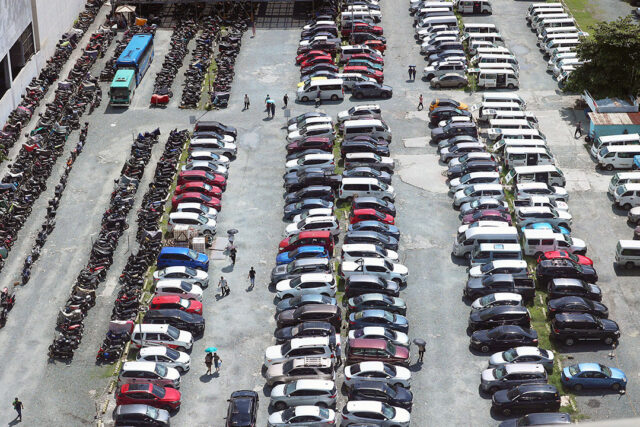
A parking lot is full of vehicles in Mandaluyong City, June 30, 2024. — PHILIPPINE STAR /MIGUEL DE GUZMAN

NEW VEHICLE SALES in the Philippines hit a record-high 467,252 in 2024, but fell short of the full-year target, according to an industry group.

A joint report by the Chamber of Automotive Manufacturers of the Philippines, Inc. (CAMPI) and the Truck Manufacturers Association (TMA) showed total vehicle sales last year jumped by 8.7% from 429,807 units in 2023.

It missed the industry’s 468,300 sales target by 0.2% last year.

Auto Sales (December 2024)For the January-to-December period, commercial vehicle sales increased by 8.1% to 346,482 units, while passenger car sales rose by 10.5% to 120,770 units.

Sales of commercial vehicles, which accounted for 74.15% of the total, were driven by Asian utility vehicles (AUV) and light commercial vehicles.

AUV sales jumped by 33.7% to 81,818 units, while sales of light commercial vehicles rose by 2.1% to 253,412 units.

Sales of light-duty trucks went up by 1.7% to 6,545 units, while those of medium-duty trucks grew by 5.8% to 3,970 units.

On the other hand, sales of heavy-duty trucks dropped by 27.3% to 737 units.

Toby Allan C. Arce, head of sales trading at Globalinks Securities and Stocks, Inc., said vehicle sales would continue to grow this year.

“Philippine car sales in 2025 are likely to grow by 6-8%, driven by demand for passenger cars and commercial vehicles, especially AUVs and light commercial vehicles,” he said in a Viber message.

Rizal Commercial Banking Corp. Chief Economist Michael L. Ricafort said the electric vehicle (EV) segment would be another sales growth driver.

“The Philippines has yet to catch up with other countries in increasing the demand for EVs and hybrid vehicles, given increased competition in terms of lower prices from China, Vietnam and other countries,” he said in a Viber message.

The Board of Investments had projected EV adoption in the country to have reached 5% by the end of 2024, based on the projections of the Accelerating the Adoption and Scale-up Electric Mobility for Low-Carbon City Development in the Philippines project.

CAMPI President Rommel R. Gutierrez said in August he expected EV sales to account for fewer than 10% of the total industry sales.

DECEMBER SALES
Meanwhile, CAMPI-TMA data showed a 7.4% increase in sales in December to 42,044 from 39,153 units in December 2023.

“In December 2024 alone, the industry recorded 42,044 units sold, a 2.8% [increase] month over month,” said Mr. Gutierrez.

“The positive results in December reflect the continued strength of the industry, with strong growth in both passenger cars and key commercial vehicle segments. The overall market remains on track to sustain growth into 2025,” he added.

Passenger car sales rose by an annual 5.5% to 10,125 in December. Month on month, passenger vehicle sales were up by 2.94%.

However, the bulk came from sales of commercial vehicles that grew by 8% to 31,919 in December. Month on month, commercial vehicle sales were up 2.8%.

Sales of AUVs grew by 4.1% year on year to 6,829 units in December. However, month on month sales fell by 13.4%.

Sales of light commercial vehicles went up by 9% to 24,099, while those of light trucks jumped by 11.2% to 616 units.

Heavy truck sales surged by 83.3% to 99 units, while sales of medium trucks dropped 3.5% to 276.

MARKET LEADERS
In 2024, Toyota Motor Philippines Corp. remained the market leader with a 46.66% share. Toyota’s full-year sales rose by 9% to 218,019 units.

Mitsubishi Motors Philippines Corp. came in second with a 13.7% increase in sales to 89,124 units.

In third spot is Ford Motor Co. Phils., Inc. whose sales dropped by 10.6% to 27,997 units.

Rounding out the top five were Nissan Philippines, Inc., which saw a 1.3% decline in sales to 26,774 units, and Suzuki Phils., Inc. whose sales jumped 10.4% to 20,371 units.

“Manufacturers with diverse product lines and strong dealership networks will have an edge,” said Mr. Arce.

He said Toyota would likely remain the market leader this year.

“Toyota is expected to maintain dominance, while competitors like Mitsubishi and Suzuki will likely leverage the growing AUV and light commercial vehicle markets,” he added.

However, Mr. Arce said there are risks to sustained car sales growth in 2025, which include “economic headwinds, potential interest rate hikes and supply chain issues.”

CAMPI earlier set an “aspirational” sales target of 500,000 for 2024. However, Mr. Gutierrez said late last year that if the industry fails to breach the 500,000 level in 2024, it would likely reach it in 2025. — Justine Irish D. Tabile

Penalties for motorists without RFID to be implemented by March

VEHICLES pass through toll gates at the South Luzon Expressway. — PHILIPPINE STAR/RUSSELL PALMA

By Ashley Erika O. Jose, Reporter

MOTORISTS passing through expressways without electronic toll collection (ETC) devices or radio frequency identification (RFID) tags would be fined starting March, the Toll Regulatory Board (TRB) said.

The new tollway guidelines, which were supposed to be enforced last year, are tentatively scheduled to be implemented by March 1, TRB Executive Director Alvin A. Carullo told BusinessWorld on Tuesday.

Mr. Carullo said the government is only targeting to fine motorists without RFID tags first. Fines on motorists with insufficient wallet balance will not yet be implemented, he added.

“Fines for no valid ETC device will be implemented, but fines for (motorists with) no sufficient load balance will not yet be implemented,” Mr. Carullo said in a Viber message.

The tollway guidelines under Joint Memorandum Circular (JMC) No. 2024-001 were supposed to be enforced starting Oct. 1 last year.

However, the Department of Transportation (DoTr) deferred the implementation to 2025 to give tollway operators and concerned agencies time to fine-tune their operations.

All motorists entering an access highway without an ETC device will face a fine of P1,000 for the first offense, P2,000 for the second offense and P5,000 for subsequent offenses, according to the memo issued last year.

The circular also stated that motorists exiting toll expressways with insufficient account balance will be fined P500 for the first offense, P1,000 for the second offense and P2,500 for subsequent offenses.

Rene S. Santiago, former president of the Transportation Science Society of the Philippine, said imposing penalties for motorists without RFID tags is a bad policy due to defective RFID readers and delayed gates at expressways.

“It would be fair if TRB also penalizes tollway operators for malfunctioning systems and deficient interoperability,” Mr. Santiago said in a Viber message.

SMC Infrastructure, which operates San Miguel Corp.’s (SMC) toll road network, said the company is prepared to implement a cashless toll payment and that all of its toll roads are equipped to support its implementation.

The company also said the transition to cashless toll payment would also help ease traffic congestion.

SMC Infrastructure has been ready for cashless toll payments since last year, with all our toll roads equipped to support it,” it said, noting that its teams are also on standby to install RFID tags for motorists who do not have it yet.

BusinessWorld also sought comments from toll road operator Metro Pacific Tollways Corp. (MPTC) but had not received a response as of the deadline.

The implementation of a cashless toll collection is needed for the planned electronic toll collection interoperability, the TRB said.

The TRB also plans to introduce a unified RFID wallet system that can be used in various tollways.

Mr. Carullo said previously the TRB and tollway operators were just ironing out the implementation of the planned interoperability.

He said they are doing some tests to fix some technical glitches to ensure its seamless implementation.

Easytrip is used on MPTC’s North Luzon Expressway, Subic–Clark–Tarlac Expressway, Manila-Cavite Expressway and Cavite-Laguna Expressway.

Meanwhile, Autosweep is used on the San Miguel group’s Skyway, South Luzon Expressway, NAIA Expressway, Southern Tagalog Arterial Road Tollway and Tarlac-Pangasinan-La Union Expressway.

MPTC is the tollway unit of Metro Pacific Investments Corp., one of three key Philippine units of Hong Kong-based First Pacific Co. Ltd., the others being Philex Mining Corp. and PLDT Inc.

Hastings Holdings, Inc., a unit of PLDT Beneficial Trust Fund subsidiary MediaQuest Holdings, Inc., has a majority stake in BusinessWorld through the Philippine Star Group, which it controls.

BIR says it exceeded 2024 collection goal

TAXPAYERS line up to file their income tax returns at the Bureau of Internal Revenue office in Manila. — PHILIPPINE STAR/EDD GUMBAN

THE Bureau of Internal Revenue (BIR) on Tuesday said it exceeded its revised P2.85-trillion collection goal in 2024, mainly driven by value-added tax (VAT) collection.

“Although the numbers are still being finalized, the BIR confirmed that they have definitely reached the P2.848-trillion mark for 2024,” BIR Commissioner Romeo D. Lumagui, Jr. said in a press release.

The BIR’s collection target for 2024 was 22% higher than the P2.34-trillion collection in 2023, when revenue rose by 8% annually but missed its P2.64-trillion target.

“The exact figures will be finalized by around mid-February, and by then, the collection figures will only increase past the DBCC (Development Budget Coordination Committee) target,” he added.

The BIR said 2024 would mark the first time the agency surpassed its collection target in two decades, excluding 2020 when the target was significantly lowered due to the pandemic.

Last year’s target was lowered from the original P3.05-trillion goal.

The BIR said revenues were mainly driven by VAT collections, as it failed to hit the goal for other tax types.

“Moreover, this was accomplished despite the country’s gross domestic product (GDP) growing by a weaker-than-expected 5.2% in the third quarter,” the BIR said.

In the first 11 months of 2024, BIR revenue collections increased by 13.88% to P2.67 trillion, which already accounted for 93.64% of the full-year program.

Last year, the BIR implemented a 1% withholding tax on online sellers to address tax leakages in the digital economy. It also created a task force to go after taxpayers using “fake transactions” and “ghost receipts” to avoid the payment of income tax and VAT liabilities.

“Our dedication to good governance reforms, manifested by our shift to a taxpayer-oriented agency, has increased the voluntary compliance of taxpayers. This goes to show that if government agencies improve their services, processes and programs, our countrymen will do the right thing and pay their proper share of taxes,” Mr. Lumagui said.

Last week, the BIR told a Senate hearing its tobacco excise tax collections reached P134 billion in 2024, falling short of its P185.3-billion target by 28%.

The BIR attributed the lower excise tax collection to the illicit tobacco trade and consumer preference for vape products. Aubrey Rose A. Inosante

BMI forecasts 6.3% growth for PHL this year

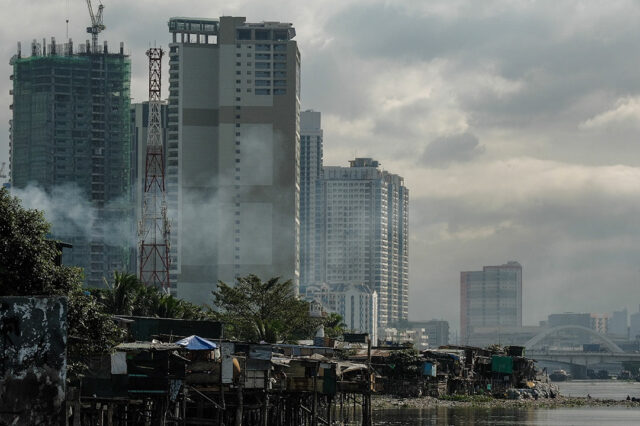
High-rise buildings tower over shanties in Parola, Tondo, Manila, Jan. 11, 2025. — PHILIPPINE STAR/RYAN BALDEMOR

By Luisa Maria Jacinta C. Jocson, Reporter

FURTHER monetary easing is seen to prop up gross domestic product (GDP) growth in the Philippines, Fitch Solutions’ unit BMI said, as this would provide much-needed support to domestic demand.

“For the Philippines, we are expecting growth to accelerate from 5.8% in 2024 to 6.3% in 2025. The main driver is monetary policy loosening,” BMI Asia Country Risk Analyst Shi Cheng Low said in a webinar on Tuesday.

The government is targeting 6-8% GDP growth this year.

For the first nine months of 2024, growth averaged 5.8%. Preliminary fourth-quarter and full-year GDP data will be released on Jan. 30.

“Keep in mind that investment has been quite weak in the first quarter and third quarter. So about 150 basis points (bps) of cuts by the end of 2025 should help boost the Philippine economy going forward,” he added.

The Bangko Sentral ng Pilipinas (BSP) began its easing cycle in August last year, delivering 75 bps worth of cuts for 2024.

The central bank has signaled further easing this year as the current policy rate at 5.75% is still in “restrictive territory,” BSP Governor Eli M. Remolona, Jr. said.

Mr. Low said another growth driver is the rebound in private consumption as inflation continues to ease.

Headline inflation averaged 3.2% in 2024, within the 2-4% central bank target.

“We expect inflation to stay within the target for the rest of the year, obviously barring external shocks and also because the labor market has actually been improving,” he said.

This year, the BSP expects inflation to average 3.3%.

However, Mr. Low said their growth forecast for this year hinges on the expectation that US President-elect Donald J. Trump would not be aggressive in the implementation of his tariff proposals.   

“If that’s the case, we are going to lower our projections downwards. And I think that’s the biggest risk for the Philippines because the US is one of [its] biggest trading partners,” he said.

Mr. Trump, who is set to assume the presidency on Jan. 20, has pledged to impose import tariffs of up to 10% across the globe and 60% for Chinese goods.

“In sum, we expect the growth outlook to improve at least for the Philippines over the coming quarters,” Mr. Low added.

SERVICE BOOST
Meanwhile, HSBC in a separate commentary said the Philippines is expected to be one of the fastest-growing economies in Southeast Asia, mainly driven by a boost in services.

HSBC Global Private Banking and Wealth Chief Investment Officer for Southeast Asia and India James Cheo said the Philippine economy is “expected to deliver one of the strongest growths in the region this year.”

HSBC expects the Philippines’ GDP to expand by 6.3% this year and 6.7% in 2026.

“Philippine economic growth in 2025 will be driven by robust domestic consumption, a thriving business process outsourcing (BPO) sector, and increasing investments in digital services.”

“The country’s unique strength in service exports, including IT and BPO services, provides a buffer against global trade uncertainties and tariff risks.”

Data from the BSP showed the Philippines booked $37.4 billion worth of services exports in the first nine months, up 6.25% from a year earlier.

“Service exports and overseas remittances, which remain key economic pillars, will continue to contribute significantly to economic resilience and stability in the Philippines,” Mr. Cheo said.

He also said the country’s monetary and fiscal policies are “aligned to support growth while managing risks.”

Mr. Cheo said the central bank would likely deliver further rate cuts this year.

“We forecast the BSP to cut the policy rate to 5% in the third quarter of 2025, as it cautiously navigates external risks like potential volatility in the peso and the US Federal Reserve’s easing cycle.”

“On the fiscal side, the government’s infrastructure agenda remains a key growth driver, supported by revenue-enhancing measures,” he added.

Meanwhile, HSBC expects the peso to “face volatility from a stronger dollar but its high carry will be a buffer.”

“We are bullish on the peso and expect it to stay resilient at P59.8 against the US dollar by end-2025.”

The peso closed at P58.62 a dollar on Tuesday, strengthening by eight centavos from its P58.70 finish on Monday. Last year, the peso fell to a record-low P59-a-dollar level thrice.

MONETARY POLICY BUFFER
Meanwhile, Bank of America (BofA) Global Research in a separate report said economies in Southeast Asia might need to deploy varying policies to cushion the spillovers from Mr. Trump’s tariff plans.

“If trade shocks materialize, we reckon that the fiscal-monetary policy mix to cushion any softening of external demand may differ across countries,” it said.

“We think that policy mix may be more balanced in the case of Malaysia and Singapore, more skewed towards fiscal policies for Indonesia and Vietnam, and more skewed towards monetary policies for the Philippines and Thailand.”

For the Philippines, BofA said monetary policy “may have to play a greater role.”

“Inflation is at more manageable levels after the reduction of rice import duties in mid-2024, and BSP is less sensitive to FX (foreign exchange) movements compared with Bank Indonesia,” it said.

“As such, BSP could pursue deeper policy rate and RRR cuts. On the other hand, the government has less scope to raise spending significantly, with the fiscal deficit target for 2025 already above 5% of GDP and government debt at record high levels.”

Abstract dimensions

MECHANICAL KOMOREBI by Walther Ocampo

ABSTRACTION challenges people to examine and imagine, with the varying perceptions of shapes, colors, and forms in a painting reflecting the viewer’s inner thoughts. This interplay of ideas sets abstract works apart from the representational.

Conrad Manila’s first exhibit in its regular “Of Art and Wine” series this year features the works of The Authenticity Zero Collective (TAZC), a Filipino architect-artist-educator group focused on abstraction.

Titled Machine of Thoughts, the exhibit aims to transport viewers to different dimensions through the abstract works on display. Before this exhibit, the collective mainly showed their works at art fairs and galleries including Art Fair Philippines, Gateway Gallery, The Grey Space, and the Manila Bang Show.

The group’s five members — Cocoi Base, Gab Brioso, Almi Domingo, Walther Ocampo, and Robin Ravago — each contributed pieces to Machine of Thoughts. The show invites visitors to interact with the material and the immaterial present in their works.

There are 53 works on view at Conrad Manila’s Gallery C.

The Tiny Dwellings collection of acrylic-on-canvas paintings are by Cocoi Base. His use of lines and dots orient the viewer amid splashes of colors and shapes, evoking a kind of organized chaos. Then there’s the Hyper Proun series by Gab Brioso, utilizing acrylic on 3D-printed polyester and plaster, an interesting intersection of a digital process and a tactile, amorphous output.

Almi Domingo provided three acrylic panel etchings that explore geometric compositions, while the series of painted “constructionals” by Robin Ravago dives into the formal qualities of the wooden material.

Walther Ocampo’s Mechanical Komorebi collection of paintings is multi-dimensional in its elements. At the exhibition opening, he said that everyone in TAZC is curious about where abstraction can take them.

“For me, my interest lies in anything with contrast, for example absence and presence,” Mr. Ocampo told members of the press at the exhibit’s launch on Jan. 7.

“I see the dimensions in the contrasting colors and elements in each work. It’s exciting for us as artists,” he said.

Nestor O. Jardin, the hotel’s resident exhibition curator, added that he had set out to look for an abstract artist to feature in the “Of Art and Wine” series. Thanks to TAZC, he ended up with five.

Mr. Base told BusinessWorld that their group usually shows in art fairs and art galleries. However, in hotels, there is a “well-established art market” that they’re able to penetrate.

“We venture into all kinds of platforms. This year you can also find us at the Xavier Art Fair, in February,” he said.

Of Art and Wine: Machine of Thoughts at Conrad Manila’s Gallery C runs until March 8. — Brontë H. Lacsamana

The best nonfiction books of 2024

By Stephen L. Carter

THE past year was a marvelous one for those who read serious nonfiction. As has been my tradition, I present (in random order) a baker’s dozen of the best nonfiction of 2024, with an emphasis on books that have taught me things I didn’t know. I end with my pick for the best book of the year.

The Invention of Prehistory: Empire, Violence, and Our Obsession with Human Origins by Stefanos Geroulanos

Was the excitement over prehistory and the “savage” just a cloak for colonialist oppression? This was, here and there, a bit polemical for my taste, but it was highly engaging and, for the most part, persuasive.

Combee: Harriet Tubman, The Combahee River Raid, and Black Freedom During the Civil War by Edda L. Fields-Black

Although Tubman has become an icon of the American narrative, we pay insufficient attention to her remarkable skill as a military leader and strategist. This book helps remedy that deficit.

The Right to Oblivion: Privacy and the Good Life by Lowry Pressly

Perhaps instead of our right to be left alone, we should conceptualize privacy as our right to be unobserved, unseen, untracked, exposing to the world only that which we choose to expose; we should be free, in short, to live in oblivion, a kind of hiding, where the world does not come questioning, pursuing, demanding, recording. (Pressly isn’t sure how to fix it, but a good start might be getting rid of those traffic cameras!)

Silk: A World History by Aarathi Prasad

I’m a bit surprised that this delightful tour through history, geography, archaeology, and entomology hasn’t received more attention. It even includes some chills, such as when the silk gown worn by a mummy sealed up for two millennia, upon contact with the air when her tomb is opened, immediately unravels and disappears.

Naples 1925: Adorno, Benjamin, and the Summer That Made Critical Theory by Martin Mittelmeier (translated by Shelley Frisch)

Perhaps a little forced in places, for the Frankfurt School or its equivalent was bound to come into existence one way or another. But this bright, clever portrait of a handful of young theorists meeting in one remarkable summer in one remarkable city taught me a great deal about how it did come into existence.

Life as No One Knows It: The Physics of Life’s Emergence by Sara Imari Walker

Imagine that the vast calculating machine we call the universe constantly assembles “objects” of various levels of complexity, all full of information.  Might what we call life be simply a label for an object created by a sufficient number of steps? For the past few years, scientists interested in the origins of life have been arguing vehemently over “assembly” theory. Walker, a physicist and astrobiologist, and one of the field’s founders, has crafted a provocative and informative defense.

Four Points of the Compass: The Unexpected History of Direction by Jerry Brotton

A fine compendium of just what the title promises, from the Mesoamericans who measured direction along three axes rather than two, to the European elites who seized upon east, west, north, and south to designate who was civilized and who not, to NASA’s panicked inversion of the “Blue Marble” photograph prior to release (the original image had the South Pole at the top). An intriguing account, too, of Mercator’s projection, which, apparently, was not related to assumptions about white supremacy.

The Notebook: A History of Thinking on Paper by Roland Allen

As this eclectic account reminds us, the story of the human race has been marked by the physical act of writing. Language and religion, war and peace, arts and sciences, all have been influenced by the process of making notes. If we change that, Allen worries, we change ourselves – and not necessarily for the better.

Why Machines Learn: The Elegant Math Behind Modern AI by Anil Ananthaswamy

Yes, much of the math is hard, and my undergraduate training in differential equations and linear algebra was too long ago to be much help. Yet the volume fascinates, both because of the many startling images (a penguin as a point in five-dimensional space!) and because of the way the author combines history and math, by showing us how one seemingly small discovery led to the next, until we reach today, when a neural net trained on images of wooden chairs quickly figures out that “wood” has nothing to do with “chair.” (John Hopfield, who just won the Nobel Prize in physics for his indispensable contributions to AI, figures prominently.)

The Rebel’s Clinic: The Revolutionary Lives of Frantz Fanon by Adam Shatz

One cannot understand the attraction of today’s intellectual to liberation movements without understanding the strange genius of Fanon, whose incisive studies of the colonized mind continue to influence scholars and revolutionaries alike. I’m long over my youthful love affair with Fanonist thought, but my awe for his oeuvre is no less. As fine a one-volume introduction to his remarkable life and work as we’re likely to find.

Savings and Trust: The Rise and Betrayal of the Freedman’s Bank by Justene Hill Edwards

Recent years have seen surging scholarly interest in the 1874 collapse of the Freedman’s Bank, an event that cost many of those liberated from enslavement their savings. Edwards neatly and persuasively summarizes the evidence for the proposition that the principal cause was the determination of the board to make the bank “a lending powerhouse,” together with self-dealing by directors who found the pot of money irresistible.

The Roads to Rome: A History of Imperial Expansion by Catherine Fletcher

The Roman Empire, the author tells us, built 100,000 kilometers of their famous roads — for trade, for the carrying of messages, and of course for the rapid movement of the ubiquitous legions. Ever since, the roads have excited explorers, archaeologists, and, intriguingly, dictators, who have cast their eyes at imperial Rome and decided that rapid construction of roads is crucial to staying in power.

Cosmic Connections: Poetry in the Age of Disenchantment by Charles Taylor

The great philosopher proposes that our uncommon divisions might be overcome by learning to experience poetry (particularly the Romantics) in the “interspace” between ourselves and the world. Beautifully written, as Taylor’s work always is, but tinged with a wistful quality that suggests he thinks liberal democracy may be over.

Finally, the best nonfiction book of 2024, and one of the most important I’ve read in many years:

Nuclear War: A Scenario by Annie Jacobsen

A forceful, sobering reminder of the existential risk hanging over our heads. Anyone in public life who isn’t thinking seriously about the six minutes the American president has to decide to launch upon learning that someone else appears to have launched… isn’t thinking seriously. In between history and the long-standing concerns of experts, Jacobsen embeds her warning in what she calls a “scenario” — essentially a chilling pre-apocalyptic novel of a possible near future.

Might I wish you peace, joy, and love in the new year — and lots of happy reading!

BLOOMBERG OPINION

Semirara Mining says coal shipments up 4.4%

REUTERS

SEMIRARA Mining and Power Corp. (SMPC) reported 16.5 million metric tons (MT) in coal shipments for 2024, a 4.4% increase from the previous year, driven by stronger demand from China and domestic markets.

Broken down, foreign shipments rose by 4% to 8.4 million MT, with exports to China increasing by 46% to 7.6 million MT, the company said in a statement on Tuesday.

SMPC shipped 8 million MT of coal within the Philippines, higher by 4% from the previous year, on the back of increased sales to local cement producers and Calaca power plants.

The company supplies the coal requirements of cement companies. Coal is used to fire the preheater cyclone and rotary kiln, which heat raw materials in the pyro-processing stage of cement production.

The company said that 20% of the 1.3 million MT sold to cement plants were supplied to associate company Cemex Holdings Philippines, Inc.

SMPC President and Chief Operating Officer Maria Cristina C. Gotianun said the company also hit its maximum coal production of 16 million MT under its existing environmental compliance certificate for the third consecutive year.

“This milestone underscores the SMPC team’s dedication and commitment to meeting rising local and global energy demand,” she said.

For the third quarter, SMPC saw its earnings drop by 8% to P3.1 billion due to reduced contribution from the coal segment amid stabilizing market indices.

Revenues grew by 12.5% to P13.08 billion from P11.63 billion in the previous year.

“While we anticipate market prices to further normalize in 2025, we remain focused on strengthening our customer network and enhancing operational efficiencies to effectively support national energy security and meet the growing demand from the industrial and cement sectors,” Ms. Gotianun said.

At the local bourse on Tuesday, shares in SMPC fell 0.86% to close at P34.70 apiece. — Sheldeen Joy Talavera

MVP Group companies partner with performer Dylan Menor

REVIN MIKHAEL D. OCHAVE

VARIOUS companies under the MVP Group have partnered with singer and actor Dylan Menor for several projects and endorsements this year.

Mr. Menor and his representative, Stages Talent Agency, signed partnership agreements with Pangilinan-led companies such as MediaQuest Holdings, Inc., Cignal TV, Inc., MQuest Ventures, Smart Communications Inc., MWell, and Kayana Solutions Inc. during an event in Mandaluyong City on Monday.

The event was also attended by key executives from the MVP-led companies as well as the Stages Talent Agency.

Mr. Menor previously signed partnership agreements with record label Universal Records Philippines, Inc. and fragrance company Blackwater Philippines.

Some of Mr. Menor’s previous projects include the 2024 Metro Manila Film Festival film The Kingdom, GMA Network’s youth-oriented show Maka, and the crime drama television show Almost Paradise.

Hastings Holdings, Inc., a unit of the PLDT Beneficial Trust Fund subsidiary MediaQuest, has a majority stake in BusinessWorld through the Philippine Star Group, which it controls. — Revin Mikhael D. Ochave

D&L in talks for sustainable technology

DNL.COM.PH

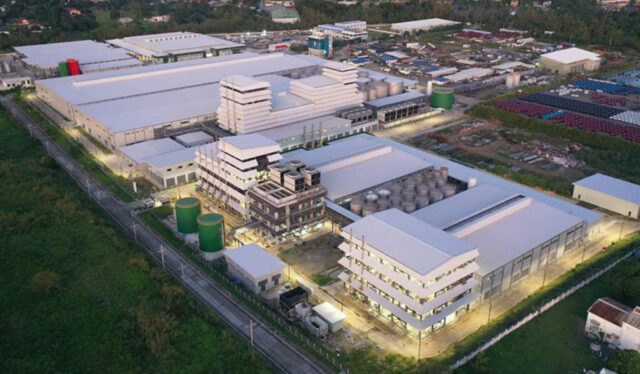
LISTED D&L Industries, Inc. said it is in talks with several potential partners for the application of a new plant fiber-plastic technology that provides a sustainable alternative to plastics.

The technology, developed by D&L through its subsidiary D&L Polymer & Colours, Inc. (DLPC), will have a wide range of uses, from consumer durables to industrial applications in the construction and automotive industries, the company said.

DLPC is in talks with potential partners that are keen on using the technology to make their plastic products more sustainable.

While the company will initially use abaca fiber as the base material, the technology was also tested to use other locally available fibers such as pineapple, spider-lily or bakong, and vetiver.

“The Philippines has an endless supply of natural fibers that are mostly deemed as waste. About 25 years ago, even before the term sustainability became mainstream, we had already started exploring the possibilities of harnessing the potential of abaca fiber as an environmentally friendly complementary material or alternative to plastics,” DLPC President and Chief Executive Officer Lester A. Lao said in a statement on Tuesday.

“What we have developed is a totally new material that is arguably breaking the boundaries of polymer science. With its unique characteristics and sustainable aspects, we are convinced that it has the potential to revolutionize the plastics industry,” he added.

DLPC is currently in the sampling stage of the new plant fiber-plastics technology. Some of the sample finished products include vetiver and bakong chairs, vetiver crates, abaca floor mats, and abaca bins.

The fibers can help reduce plastic usage as they replace up to 40% of polymers in the formulation of different consumer and industrial products that are made of plastics.

Meanwhile, Mr. Lao said that DLPC is currently engaged in groundwork to make the technology available and used at scale.

“With the majority of the people in the industry not yet familiar with the technology and its potential applications, we believe that we are exploring uncharted territory with endless opportunities for innovators and pioneers like us. At this point, we believe that we are merely scratching the surface for a multitude of industries,” Mr. Lao said.

D&L has business interests in product customization and specialization for the food, chemicals, plastics, and consumer products original design manufacturer industries.

It is engaged in the manufacturing of customized food ingredients, specialty raw materials for plastics, and oleochemicals for personal and home care use.

D&L shares rose by 0.5% or three centavos to P6 apiece on Tuesday. — Revin Mikhael D. Ochave

Arts & Culture (01/15/25)


Ayala Museum holds talk on ancestral home book

THE Ayala Museum will be hosting a book talk with Gina Consing McAdam about the book Houses that Sugar Built: An Intimate Portrait of Philippine Ancestral Homes which features award-winning images by Siobhán Doran. It will be held on Jan. 25 (Saturday) from 2-4 p.m. In the book, London-based writer Gina Consing McAdam explored the sense of home and identity manifested by the grand domestic architecture and interiors built by the sugar planters of Iloilo, Negros, and Pampanga during the sugar industry’s peak in the early 20th century. Drawing on the narratives shared by their owners and heirs and her own family history, McAdam will delve into how these homes, blending Art Deco, Neoclassical, and Modernist styles, served as expressions of personal, cultural and economic aspirations. The event will also showcase a selection of her co-author Siobhán Doran’s photographs from the book, including the “Sala Mayor” series that won first prize in the Professional Architecture & Design category of the 2024 Sony World Photography Awards. Limited slots to the talk are available. Tickets are P300 (regular price), with discounts for Seniors, PWDs, students, Ayala Group employees, Museum and Library members, and cultural workers with valid IDs. The ticket includes free one-day access to Filipinas Heritage Library valid until Feb. 25. Interested parties may register now: https://bit.ly/fhl-ginamcadam.


Into the Woods, A Chorus Line staged in the Philippines

THE producers of the wordless play Request sa Radyo which saw success in the Philippines last year have formed Theatre Group Asia and are set to stage several musicals soon. Clint Ramos and co-producers John and Joanna Echauz, together with venue host Samsung Performing Arts Theater, represented by its executive director Christopher Mohnani, have announced that they are bringing in two iconic musicals: Into The Woods and A Chorus Line. The former will be staged in August while the latter will be staged in March 2026. More details will be revealed soon.


Pinoy artists to show at Singapore’s Gajah Gallery

GAJAH Gallery will be presenting two exhibits this January — one at their Singapore space and another at the Art SG 2025 fair — both opening on Jan. 17. On their home turf, the exhibit Big Bang: A Myth of Origins features works by Agnes Arellano, I Gusti Ayu Kadek Murniasih, Jane Lee, Jitish Kallat, Jose John Santos III, Mahalakshmi Kannappan, Mark Justiniani, Miguel Aquilizan, Prajakta Potnis, Pam Yan-Santos, Susie Lingham, and Yunizar. The show delves into the mysteries of beginnings, beings, and becoming. Meanwhile, artists from Indonesia, Singapore, and the Philippines will be the focus in the gallery’s booth at Art SG, offering visitors perspectives on materiality and urban life. Participating artists include Jemana Murti, Marina Cruz, Mark Justiniani, and Yunizar, alongside pieces by Philippine National Artist Benedicto “BenCab” Cabrera.


Iligan’s IPAG reveals lineup

MINDANAO State University’s Integrated Performing Arts Guild in Iligan City has unveiled its calendar of productions for 2025. The first production is Sita: The Ramayana Revisited, a Philippine version of the classic Sanskrit epic which will have national and international tours. There is also the play MarLen and the dance-theater productions Tales from Mindanao and Tatlo sa Isa, also set to tour this year. For National Literature Month in April, the guild will be staging the poetry-theater production sugaTula.


CCP’s Pasinaya expands program nationwide

THE Philippines’ largest multi-arts event, the Cultural Center of the Philippines’ (CCP) Pasinaya Open House Festival, returns this year with performances to be held nationwide. The 19th edition of the festival will take place on Feb. 1 and 2 at various venues around the country under the theme “CCP Pasinaya 2025 Open House Festival: Para sa Lahat!” Its regional partner sites include Clark in Pampanga, Batangas Province, Himamaylan in Negros Occidental, and Sorsogon City in Bicol. Pasinaya will also return to Tagum City in Davao del Norte and Iloilo City. In Metro Manila, the festival will unfold across multiple venues such as Circuit Makati, The Metropolitan Theater, Intramuros, Aliw Theater, and various partner museums and galleries. More details will be announced soon.

ADVERTISEMENT
ADVERTISEMENT