Home Blog Page 2163

PSE index ends lower on last-minute profit taking

BW FILE PHOTO

THE MAIN INDEX slipped on Thursday as investors booked profits amid the escalating conflict in the Middle East and ahead of the release of September Philippine inflation data.

The benchmark Philippine Stock Exchange index (PSEi) dropped by 0.18% or 13.89 points to 7,388.92 on Thursday, while the broader all shares index rose by 0.29% or 11.80 points to 3,982.66.

“The local market closed lower this Thursday. The bourse was in positive territory for the most part of the day but was dragged by last-minute profit taking,” Philstocks Financial, Inc. Senior Research Analyst Japhet Louis O. Tantiangco said in a Viber message.

The PSEi opened at 7,406.79 and reached a high of 7,470.39 before succumbing to profit taking.

“Philippine shares ended slightly lower on rising Middle East tensions, following Iran’s missile attack on Israel. Investors are bracing for more uncertainty as Israel starts a ground operation in Lebanon and tensions escalate with Hezbollah,” Regina Capital Development Corp. Head of Sales Luis A. Limlingan said in a Viber message.

Israel bombed Beirut early on Thursday, killing at least six people, after its forces suffered their deadliest day on the Lebanese front in a year of clashes with Iran-backed Hezbollah, Reuters reported.

Israel said it had conducted a precise air strike on the Lebanese capital. Reuters witnesses reported hearing a massive blast, and a security source said it targeted a building in the district of Bachoura near parliament, the closest an Israeli strike has come to the central downtown district of Beirut.

“Locally, easing inflation expectations and strong manufacturing growth kept the market from drifting lower,” Mr. Limlingan added.

A BusinessWorld poll of 15 analysts yielded a median estimate of 2.5% for the September headline inflation.

If realized, this would be the slowest print in nearly four years or since 2.3% in October 2020. This would also be slower than 3.3% in August and 6.1% in the same month a year ago.

September consumer price index data will be released on Friday (Oct. 4).

Sectoral indices closed mixed on Thursday. Services dropped by 0.34% or 7.82 points to 2,274.57; holding firms went down by 0.24% or 15.03 points to 6,256.11; and property slipped by 0.02% or 0.62 point to 2,995.66.

On the other hand, mining and oil surged by 2.57% or 229.50 points to 9,146.91; industrials climbed by 0.38% or 37 points to 9,744.87; and financials rose by 0.23% or 5.57 points to 2,358.49.

Value turnover went up to P7.38 billion on Thursday with 1.01 billion shares traded from the P4.33 billion with 1.16 billion issues changing hands on Wednesday.

Advancers outnumbered decliners, 124 versus 83, while 49 names were unchanged.

Net foreign buying went down to P287.5 million on Thursday from P540.05 million on Wednesday. — R.M.D. Ochave with Reuters

Peso sinks to three-week low vs dollar

BW FILE PHOTO

THE PESO slumped to a three-week low against the dollar as the conflict in the Middle East continued and following dovish signals from the Bank of Japan (BoJ).

The local unit closed at P56.37 per dollar on Thursday, weakening by 19.2 centavos from its P56.178 finish on Wednesday, Bankers Association of the Philippines data showed.

This was the peso’s worst finish since its P56.385-per-dollar close on Sept. 10.

The peso opened Thursday’s session weaker at P56.30 against the dollar. Its intraday best was at P56.17, while its worst showing was at P56.40 versus the greenback.

Dollars exchanged went down to $1.73 billion on Thursday from $1.95 billion on Wednesday.

“The dollar-peso was well bid today on market risk aversion amid escalating tensions in the Middle East,” a trader said by phone on Thursday.

The dollar rose against the yen on Thursday amid cautious signals from the BoJ, which likewise caused the peso to weaken versus the greenback, Rizal Commercial Banking Corp. Chief Economist Michael L. Ricafort said in a Viber message.

The dollar scaled a more than six-week high versus the yen on Thursday as robustness in the US jobs market reinforced bets the Federal Reserve will not rush to cut interest rates, Reuters reported.

The yen has come under selling pressure since Japan’s new prime minister said on Wednesday, following a meeting with the central bank governor, that the country is not ready for additional rate hikes.

The safe-haven US currency saw additional demand as tensions simmered in the Middle East following Iran’s ballistic missile attack on Israel, which spurred a vow of revenge.

The dollar index, which measures the currency against the euro, yen and four other top rivals, added 0.22% to 101.88 as of 0540 GMT, a three-week peak.

The dollar added 0.14% to 146.66 yen after earlier reaching 147.25 for the first time since Aug. 20.

Dovish Bank of Japan policy maker Asahi Noguchi, who dissented against the rate hike in July, said the central bank must be patient in normalizing policy in a speech in Nagasaki.

On Wednesday, Japanese Prime Minister Shigeru Ishiba completed his backflip from perceived monetary hawk to dove, saying: “I do not believe that we are in an environment that would require us to raise interest rates further.”

For Friday, the trader sees the peso moving between P56.10 and P56.50 per dollar, while Mr. Ricafort expects it to range from P56.25 to P56.45 — AMCS with Reuters

SMB clashes with Converge in Game 4 of PBA quarterfinals

SAN MIGUEL BEERMEN — PBA.PH

Game on Friday
(Ninoy Aquino Stadium)
7:30 p.m. – Converge vs San Miguel Beer (Quarterfinals Game 4)*
*SMB leads best-of-five series, 2-1

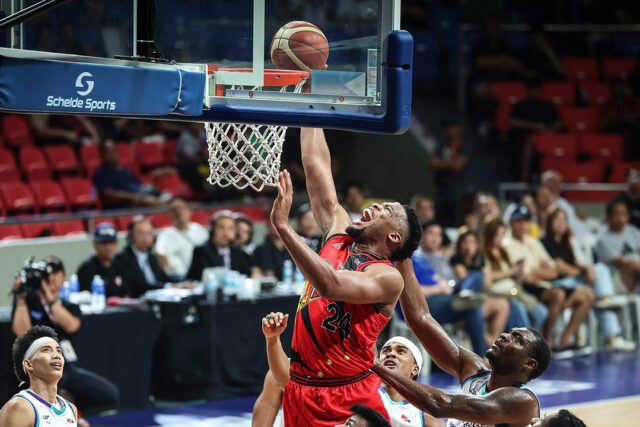
THE CONVERGE FiberXers will be an emboldened lot following their epic Game 3 steal. The San Miguel Beermen (SMB) will be like an awakened dragon.

With fierce determination, the upset-conscious underdogs and favored heavyweights duke it out again on Friday in Game 4 of the PBA Governors’ Cup quarterfinal series at the Ninoy Aquino Stadium.

The FiberXers hope momentum is now on their side after fighting back from 25 points down to wrest a gritty 114-112 series-extending victory from SMB on Monday.

In between the third and fourth matches, the Beermen absorbed an 81-87 loss to Korea club Suwon KT Sonicboom in the East Asia Super League (EASL) opener on Wednesday, giving them a double-whammy heading to the 7:30 p.m. tiff with Converge.

“It’s still far,” cautioned Converge coach Franco Atienza amid the euphoria of stopping SMB’s sweep bid in the best-of-five contest and posting the franchise’s first victory in the PBA playoffs ever.

“It’s only one. It’s one of the three (wins needed to win the series). It’s hard to beat that team three straight (games). But we will take it one game at a time,” he added.

After taking care of business in the first two games, 102-95 and 107-100, the Beermen seemed on their way to cruising to a 3-0 blanking of Converge and setting up an awaited best-of-seven Final Four versus Barangay Ginebra before disaster struck. Riding on a 48-25 fourth-quarter storm capped by Alec Stockton’s winning jumper, the FiberXers spoiled SMB’s grand plans and lived to fight another day.

The seasoned bunch that they are, coach Jorge Gallent’s troops are quick to move on from the Game 3 slip-up.

“Life is like basketball. At your lowest point, you bounce right back up. As long as you go out to compete, play hard, play together as a team, you’ve got a chance,” said SMB import EJ Anosike.

“I could live with the result (Game 3 setback) and at the end of the day, you know it’s just a basketball game, we got another on Friday to get the job done,” he added.

While San Miguel and Converge settle their dispute, the Justin Brownlee-led Gin Kings are sitting pretty in the Final Four after sweeping Meralco in their side of the Last-8 on Monday.

Defending champion TNT is also through after disposing of NLEX in four matches and awaits the winner of the Game 5 rubbermatch between Rain or Shine and Magnolia slated on Saturday in Antipolo. — Olmin Leyba

Meralco starts EASL campaign with Black Bears win

CHRIS NEWSOME — PBA.PH

BOOTED out of the PBA Governors’ Cup title run, Meralco is challenging all its energy into its campaign in the East Asia Super League (EASL) Season 2 for now.

Just days after absorbing a bitter 0-3 sweep from Barangay Ginebra in the quarterfinal series, the Bolts returned to action for the EASL tipoff and took care of business against the Macau Black Bears, 97-85, on Wednesday at the MOA Arena.

The opening win in Group B enabled the reigning PBA Philippine Cup titlists to already match its total win in the previous season of the international league. As a group, the win worked as a balm for the pride bruised by the shutout defeat to old rival Ginebra.

“It’s a blessing for us to have the opportunity to bounce back not even three days later from the quarterfinal loss,” said Meralco ace Chris Newsome after venting their ire on the EASL expansion team.

“It’s definitely something that we needed as an organization, as a team, to kind of find our rhythm again and kind of have that fresh start. We were definitely able to get that win that we needed after losing three straight and I think that can do a lot for our confidence,” he added.

After Macau, the Bolts will go on the road on Oct. 16 to face Japan’s Ryukyu Golden Kings in Okinawa then host Korea’s Busan KCC Egis on Nov. 13 before returning to the PBA for the mid-season Commissioner’s Cup late November.

Against the Bears, Mr. Newsome fired 18 points and grabbed six rebounds while import Allen Durham posted a double-double of 17 markers and 11 boards for the Bolts, who pulled away in the second half and led by as many as 19 points.

Also delivering for Meralco were its second reinforcement, DJ Kennedy, who dished a 17-9-8 statline, Chris Banchero, who scored 14, and naturalized player Ange Kouame, who logged 9-9.

“It’s nice to win our first game here. We played with a lot of pride, although we didn’t play our best game,” said coach Luigi Trillo, whose charges finished with 1-5 last time, their lone victory posted in home-away-from-home Macau at the expense of Ryukyu. “At least we got one over here on our home turf.” — Olmin Leyba


The scores

Meralco Bolts 97 – Newsome 18, Durham 17, Kennedy 17, Banchero 14, Kouame 9, Almazan 7, Quinto 7, Hodge 4, Caram 2, Bates 2.

Macau Black Bears 85 – Cylla 23, Artino 23, Chongqui 21, Leung 10, Deguara 8, Chao 0, Li 0, Zeng 0, Lao 0, Chan 0.

Quarter scores: 24-17; 43-39; 73-64; 97-85.

College of St. Benilde clashes with unpredictable Arellano

COLLEGE OF ST. BENILDE — FACEBOOK.COM/NCAA.ORG.PH

Games on Friday
(Filoil EcoOil Arena)
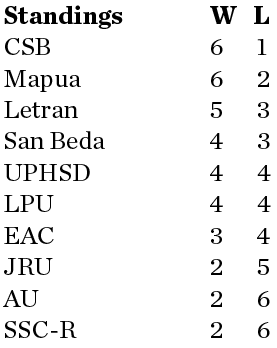
12 nn. – AU vs CSB
2:30 p.m. – JRU vs EAC

ON THE OUTSIDE, College of St. Benilde (CSB) looked like the victor with an NCAA Season 100 best 6-1 record.

On the inside, the Blazers carry the feelings of a vanquished.

“I’m looking for an explanation, an excuse for us on why this happened,” said CSB coach Charles Tiu, whose wards clash with unpredictable Arellano University on Friday at the Filoil EcoOil Arena at 12 noon.

Mr. Tiu remained livid after the Blazers nearly blew a 26-point lead before surviving the San Sebastian College-Recoletos Stags in a 96-94 overtime squeaker Tuesday that betrayed people’s expectation on them as a legitimate title contender.

“It’s one of the worst games I’ve been a part of this kind of team. We’re a Final Four team at the very least. I think for us to play like this, it’s like high school, or grade school the way we play,” said Mr. Tiu.

“We really have to do a better job,” he added.

Mr. Tiu said he will not be surprised if they lose to AU playing the same way they did the last time out.

“To me, they easily should be contending in the Final Four,” said Mr. Tiu referring to AU, which owns a 2-6 mark but most of its losses were nail-biting cliffhangers. “If we play like this, Arellano will beat us easily.”

Like AU, Emilio Aguinaldo College (3-4) and Jose Rizal University  (2-5) will try to bolster their Final Four bids as they collide at 2:30 p.m. — Joey Villar

Padres ride 5-run inning to victory, eliminate Braves

KYLE HIGASHIOKA homered and Manny Machado and Jackson Merrill added two RBIs apiece during a five-run second inning to help the San Diego Padres clinch their National League wild-card series with a 5-4 victory over the visiting Atlanta Braves on Wednesday night.

Fernando Tatis Jr. reached base four times on three hits and a walk for fourth-seeded San Diego, which wrapped up the best-of-three series in two games. Luis Arraez and Merrill had two hits for the Padres.

Michael Harris II had three hits, including a two-run homer, for the fifth-seeded Braves.

The Padres will open the NL Division Series on Saturday against the top-seeded Dodgers in Los Angeles.

Atlanta moved within 5-4 in the eighth when Orlando Arcia led off with a single against Jason Adam and Harris homered to center on the next pitch.

But Adam got the next three batters out and Robert Suarez retired the Braves in order in the ninth.

Padres right-hander Joe Musgrove departed after 3 2/3 innings with right elbow tightness.

San Diego held a 5-1 advantage when Musgrove exited. He struck out four, walked none, and gave up one run and one hit.

Bryan Hoeing finished the at-bat to Matt Olson after Musgrove left to end the fourth inning and pitched 1 1/3 innings to get the victory. Hoeing gave up a homer to Jorge Soler in the fifth.

Atlanta’s Max Fried was torched for five runs and eight hits over two innings. He struck out two and walked none.

Fried got hit in the hip by a liner in the first inning. Braves manager Brian Snitker said during an in-game interview that Fried was bothered by the injury.

After being shut out in Game 1, the Braves scored in the first inning when Harris led off the game with a double, moved to third on Ozzie Albies’ groundout and scored on Marcell Ozuna’s sacrifice fly.

But with two outs in the second, the Padres strung together six straight hits while scoring five runs off Fried.

Higashioka got the outburst started by slamming a 1-2 fastball over the wall in left-center. He also homered in Tuesday’s 4-0 victory.

Arraez followed with a single and Tatis and Profar each reached on infield singles to load the bases.

Machado was up next. He had fallen to 1-for-17 all-time against Fried after striking out with two on in the first inning. This time, however, he lined a two-run double to left to give the Padres a 3-1 lead.

Merrill followed with a two-run triple that short-hopped the fence in center.

Soler led off the fifth with a homer to center to cut Atlanta’s deficit to 5-2. — Reuters

Lionel Messi nets pair as Inter Miami edges Crew

LIONEL MESSI scored twice and Drake Callender made a late penalty kick save when Inter Miami held on for a 3-2 victory over the host Columbus Crew to clinch the Supporters’ Shield in a battle of heavyweights on Wednesday.

Callender dove to his right to stop Cucho Hernandez from tying it 3-3 in the 84th minute after Hernandez had beaten him earlier in the match from the spot.

Messi stunned the sellout crowd with goals in the 45th minute and fifth minute of first-half stoppage time to give Miami (20-4-8, 68 points) what seemed like a comfortable lead.

But the Crew (16-6-9, 57 points) got a goal from Diego Rossi in the 46th minute before a defensive blunder gifted Miami’s Luis Suarez his 18th goal to make it 3-1 in the matchup of the top teams in the Eastern Conference.

Hernandez converted a penalty in the 61st to cut the deficit to 3-2 but just two minutes later, Crew defender Rudy Camacho was sent off after his second yellow.

With the win, Miami is still on track to set the MLS record for points in a season set by the New England Revolution in 2021 with 73. Miami needs to beat Toronto FC and New England to end the season.

The Herons extended their unbeaten streak to nine matches. They entered with three ties after five consecutive victories.

Messi, playing against Columbus for the first time, broke the scoreless deadlock with a short chip past Patrick Schulte. Reuters

NCFP unveils amateur chess tilt

THE SEARCH for a new Filipino Grandmaster is on as the National Chess Federation of the Philippines (NCFP) stages the Philippine Amateur Chess Championships unfurling on Friday until Sunday at the Robinsons Mall Metro East in Pasig City.

Open to all Filipino chessers with a FIDE rating of 2000 and below, the meet, backed by NCFP chief Butch Pichay, offers P25,000 to the champion and P20,000 and P15,000 to the second and third placers, respectively, with several category prizes to be given away apart from free shirts to given to all participants. — Joey Villar

Father and son

LeBron James was having fun — make that a lot of fun — on Media Day. In concept, it was just about the same as any other that he had previously gone through since being taken with the first overall pick in the 2003 draft: lots of photo opportunities, queries (a number of which may have even been about hoops) from scribes, good-natured clowning with teammates. In short, it was the typical calm before the storm of the regular season. There was, however, one significant difference: He was experiencing it with son Bronny James, and he looked to be having the proverbial time of his life.

Indeed, James has been there and done that. As the National Basketball Association’s oldest player (a distinction he will hold until he hangs up his jersey for good), there is nothing he hasn’t yet seen. There is also nothing left for him to prove as he gears up for his 22nd season; as he noted in response to a query on the matter, “Everything else is extra credit. I’ll take it though. I love it. I love what I do.” And, no doubt, the joy he feels in continuing to be the face of the pro league will be more pronounced with his son on the Lakers roster.

James has already been making the most of his time with Bronny on the court. News of him talking trash to his son — in an otherwise nondescript scrimmage — made headlines. Off the floor, he was no less playful; among other things, he made jokes at Junior’s expense when they were interviewed together. And, needless to say, the first time they burn rubber in live action alongside each other will be a spectacle — so much so that head coach JJ Redick has already been planning for it with his staff.

Make no mistake, though. As much as James can appear childlike in his appreciation of the sport, and childish in his actuations around it, he will be uncompromising in his pursuit of the hardware. Even as he is already pushing 40, he firmly believes he can keep brandishing with consistency the tools he requires to win. And who’s to disabuse him of the conviction? After all, he is fresh off a successful Olympics run in which he emerged as the Most Valuable Player.

Perhaps James is more delusional than realistic. Not a few projections have the Lakers missing the playoffs amid strong competition in the West. All the same, he is who he is. Bronny or no Bronny, his ultimate objective has stayed the same; it’s championship or bust unless and until he exits stage left.


Anthony L. Cuaycong has been writing Courtside since BusinessWorld introduced a Sports section in 1994. He is a consultant on strategic planning, operations and human resources management, corporate communications, and business development.

Fears rise Israel could target Iran’s oil industry

MODELS of oil barrels and a pump jack are displayed in this illustration photo taken on Feb. 24, 2022. — REUTERS

LONDON — The Organization of the Petroleum Exporting Countries (OPEC) has enough spare oil capacity to compensate for a full loss of Iranian supply if Israel knocks out that country’s facilities but the producer group would struggle if Iran retaliates by hitting installations of its Gulf neighbors.

Iran fired hundreds of missiles at Israel on Tuesday in response to Israeli airstrikes and attacks. Israel’s Prime Minister Benjamin Netanyahu said Iran made a big mistake and would pay for it, and Iran threatened a crushing response if Israel retaliated.

Israel’s options include targeting Iranian oil production facilities among other strategic sites, US news website Axios reported on Wednesday citing Israeli officials. Iran is an OPEC member with production of around 3.2 million barrels per day (bpd) or 3% of global output.

Iranian oil exports have climbed this year to near multi-year highs of 1.7 million bpd despite US sanctions. Chinese refiners buy most of its supply. Beijing says it doesn’t recognize unilateral US sanctions.

“In theory, if we lost all Iranian production — which is not our base case — OPEC+ has enough spare capacity to make up for the shock,” said Amrita Sen, co-founder of Energy Aspects.

OPEC+, which includes OPEC and allies like Russia and Kazakhstan, has been cutting production in recent years to support prices amid weak global demand. So the group is sitting on millions of barrels of spare capacity.

Cuts by OPEC+ producers currently total 5.86 million bpd. Analysts estimated Saudi Arabia is able to raise output by 3 million bpd and the United Arab Emirates by 1.4 million.

OPEC+ met on Wednesday to discuss compliance with cuts. The group did not discuss the Israeli-Iranian conflict, OPEC+ sources said.

“The only thing mentioned about the geopolitical situation and the conflict was the hope for non-escalation,” said an OPEC+ source familiar with the discussions.

While OPEC has enough spare capacity to compensate for the loss of Iranian supplies, much of that capacity is in the Middle East Gulf region and potentially vulnerable should the conflict escalate further, said Giovanni Staunovo, analyst at UBS.

“The effectively available spare capacity might be much lower if renewed attacks on energy infrastructure on countries in the region happen,” he said, adding the West might have to tap strategic reserves if there were severe disruptions.

Israel has so far refrained from attacking Iranian oil facilities. Oil analysts and security experts have said Israel could target Iran’s oil refining sites and the Kharg Island oil port, which handles around 90% of the country’s crude exports.

During the Iran-Iraq War in the 1980s, Baghdad regularly attacked tankers around Kharg Island and threatened to destroy the oil terminal.

“Iran and its proxies could potentially target energy operations in other parts of the region in order to internationalize the cost if the current crisis devolves into an all-out war,” said Helima Croft from RBC Capital Markets.

In 2019, a drone attack by Iranian proxies on Saudi oil processing facilities briefly knocked out 50% of the kingdom’s crude production.

“In case of an escalation Iran’s proxies might launch attacks on Middle East oil producers, namely Saudi Arabia,” said Tamas Varga from PVM.

Riyadh and Tehran have had a political rapprochement since 2019, which helped ease regional tensions, but relations remain difficult.

Oil prices have traded in a narrow range of $70-90 per barrel over the past years despite the war between Russia and Ukraine and conflict in the Middle East.

A rise in US production has helped ease the fear premium in oil markets, said Rhett Bennett, chief executive at Black Mountain, which has operations in the US Permian basin.

The US produces 13% of global crude and almost 20% of global oil liquid production compared to OPEC’s 25% global crude production share and some 40% by OPEC+.

“This diversity of supply from US domestic sources, combined with healthy spare capacity within OPEC, is translating into the market feeling insulated from a dramatic supply shock — regardless of perpetual Middle East flare ups,” Mr. Bennett said.

A broad conflict in the Middle East, however, with a major impact on production would inevitably push oil prices up.

That would drive up fuel costs. A related rally in gasoline prices could hurt US Vice-President Kamala Harris in her campaign to win the Nov. 5 presidential election against Republican candidate Donald Trump.

“The United States will likely try to push Israel for a more modest response, wanting to avoid a significant escalation in tensions,” said Warren Patterson from ING. — Reuters

Tokyo expands underground ‘cathedral’ complex to counter climate change rains

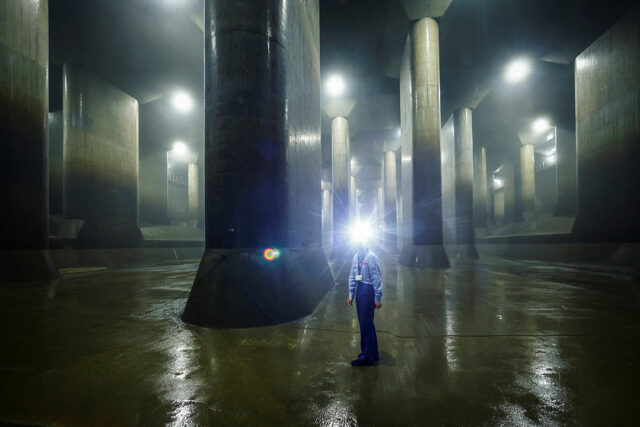
A STAFF MEMBER of Metropolitan Outer Floodway Management Office demonstrates how to perform checkups inside a pressure-adjusting water tank, part of a complex of underground water discharge tunnels constructed to protect Tokyo and its suburbs against floods during heavy rain and typhoon seasons, at the Metropolitan Outer Area Underground Discharge Channel in Kasukabe, Japan, July 4, 2024. — REUTERS

KASUKABE, Japan — Just after 5 a.m. on Aug. 30, water began flooding a vast underground chamber called the “cathedral” just north of Tokyo. The gushing water, captured by security cameras, was the rain that was drenching the capital region as Typhoon Shanshan lashed southwest Japan, 600 kilometers (kms) or 373 miles away.

The cathedral and its vast network of tunnels did their job: they prevented a vulnerable river basin in the metropolis from flooding. But as global warming causes more severe weather, authorities are having to give the system a major upgrade.

“As the temperature rises, the amount of water vapor in the atmosphere increases, resulting in relatively larger quantities of rainfall,” said University of Tokyo professor Seita Emori, who is a member of a climate science group that won a Nobel Prize in 2007.

“We anticipate that previously unseen amounts of rain will fall as the temperature rises in the future,” he added.

Japan is prone to numerous natural disasters, from earthquakes and volcanic eruptions to typhoons and landslides. And like much of the world, the nation is dealing with unprecedented weather due to global warming.

This summer was the hottest ever since records began in 1898, while record rainfall in northern regions resulted in disastrous flooding in July, according to the weather agency. In Tokyo, sudden, violent storms known as “guerrilla” showers have become increasingly common.

The cathedral complex, officially called the Metropolitan Outer Area Underground Discharge Channel, took 13 years and 230 billion yen ($1.63 billion) to build. Since coming online in 2006, it has already prevented more than 150 billion yen in flood damage, the land ministry estimates.

In addition to its engineering ingenuity, the complex is a popular tourist spot and filming location. The cavernous expanse has the capacity to hold the water in almost 100 Olympic-sized swimming pools.

Inside are 59 massive pillars, each weighing 500 tons (551 tons) and stretching 18 meters (59 ft) tall. When nearby rivers flood, the overflow courses through 6.3 km of massive underground tunnels before collecting in the reservoir.

Descending about six floors to the bottom of the chamber is an otherworldly experience. It has its own microclimate, much cooler than the surface in the summer and warmer in the winter. Clouds of mist obscure the top of the pillars.

The dim interior, punctuated by spears of natural light from apertures in the ceiling, and towering pillars evoke an ancient religious structure, giving rise to names such as “the cathedral”, “the shrine” or “the temple.”

The drop of the No. 1 shaft is deep and wide enough to comfortably hold the Statue of Liberty.

The system kicked in four times in June, more than all of last year. During Typhoon Shanshan, it captured enough water to fill the Tokyo Dome baseball stadium almost four times, before pumping it safely into the Edogawa River and out to sea.

“Compared to years past, there’s a tendency for a great deal of rain to come down all at once in what we call guerrilla downpours,” said Yoshio Miyazaki, the land ministry official in charge of the complex.

“If this facility didn’t exist, the water levels of the main Nakagawa River and its tributaries could rise much higher, leading to flooding of homes and even deaths,” he said.

Even so, the system couldn’t stop the inundation of more than 4,000 homes in the river basin from heavy typhoon rains in June 2023. Those floods prompted authorities to embark on a seven-year, 37.3 billion yen project to bolster levees and water drainage in the area.

And closer to the center of Tokyo, another major project is underway to link channels that take in overflow from the Shirako and Kanda rivers. When completed in 2027, it will carry floodwater about 13 kms underground out to Tokyo Bay.

Tokyo’s sewer network is designed to handle rainfall of up to 75 mm per hour, but increasingly there are localized storms bringing down as much as 100 mm, overtaxing the system, said Shun Otomo, a construction site manager for the project.

“For example, if there is a temporary downpour in the Kanda River basin, we can tap the watershed capacity in basin areas where it isn’t raining,” Otomo said. “We believe that will be effective against these guerrilla rains.” — Reuters

Ship queue grows at US ports as dockworker strike enters third day

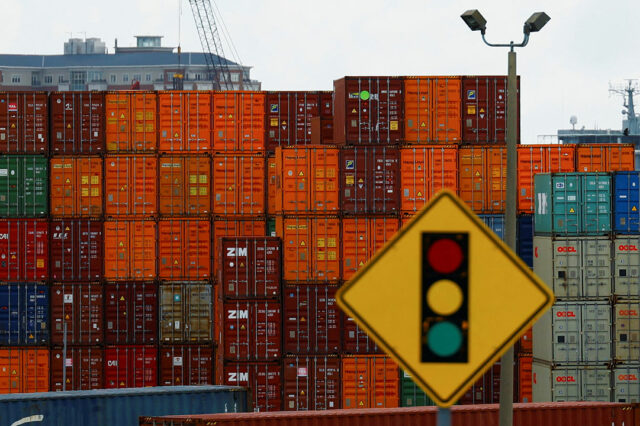
CONTAINERS are stacked at the Portsmouth Marine Terminal (PMT), as port workers from the International Longshoremen’s Association (ILA) participate in a strike in Portsmouth, Virginia, US, Oct. 2, 2024. — REUTERS

NEW YORK — Long lines of container ships queued up outside major US ports on Thursday as the biggest dockworker strike in nearly half a century entered its third day preventing unloading and threatening shortages of everything from bananas to auto parts.

No negotiations were scheduled between the International Longshoremen’s Association (ILA) and employers, but the port owners, under pressure from the White House to hike their pay offer to land a deal, signaled late on Wednesday they were open to new talks.

At least 45 container vessels that have been unable to unload had anchored up outside the strike-stricken East Coast and Gulf Coast ports by Wednesday, up from just three before the strike began on Sunday, according to Everstream Analytics.

“Many seem to have decided to wait it out, possibly in hopes of a prompt resolution to the strike action, rather than taking the proactive decision to divert,” said Everstream’s Jena Santoro in a video presentation seen by Reuters.

She said the vessel backlog could double by the end of the week, and that the resulting congestion could take weeks, if not months, to clear.

One alternative would be to sail to West Coast ports on the other side of the country, likely using the Panama Canal, a journey of thousands of miles that would hike costs and add weeks to delivery times.

The ILA launched its strike by 45,000 port workers from Maine to Texas, its first major stoppage since 1977, on Tuesday after talks for a new six-year contract with the United States Maritime Alliance (USMX) employer group broke down.

The ILA is seeking a big pay raise along with commitments to halt port automation projects it fears will kill jobs. The USMX had offered a 50% pay bump, but the ILA said it was insufficient to address its concerns.

“Reaching an agreement will require negotiating,” USMX said late on Wednesday. “We cannot agree to preconditions to return to bargaining, but we remain committed to bargaining in good faith to address the ILA’s demands and USMX’s concerns,” it said.

President Joseph R. Biden’s administration has sided with the union, heaping pressure on the port employers to raise their offer to secure a deal and citing the shipping industry’s bumper profits since the COVID-19 pandemic.

Economists say the port closures will not initially raise consumer prices as companies accelerated shipments in recent months for key goods. However, a prolonged stoppage will eventually filter through, with food prices likely to react first, according to Morgan Stanley economists.

The strike affects 36 ports – including New York, Baltimore and Houston — that handle a range of containerized goods.

The National Retail Federation on Wednesday, along with 272 other trade associations, called on Mr. Biden’s administration to use its federal authority to halt the strike, saying the walkout could have “devastating consequences” for the economy.

Mr. Biden’s administration has repeatedly said it will not use federal powers to halt the strike. — Reuters