Home Blog Page 2105

DoF says Semirara mining shares among assets set for privatization

THE PHILIPPINE government is looking to sell its mining shares in Semirara Mining and Power Corp. by next year, an official from the Department of Finance (DoF) said on Wednesday.

“We’re still reviewing it but that’s up for privatization already,” Finance Undersecretary and Chief Economist Domini S. Velasquez told reporters on the sidelines of a forum.

“The timeline should be anytime soon. I think that’s being discussed. Should be within the next year,” she added.

The Philippine government has over 145 million worth of shares in Semirara.

To narrow its budget deficit, the government intends to generate revenues from privatizing its assets to lessen the need to impose new taxes. It plans to raise P42 billion and P101.02 billion in 2024 and 2025 from privatization.

“Part of what we’re doing in the government is to increase or beef up our nontax revenues, and this is through the sale of some of the idle assets that we do have in the government,” Ms. Velasquez told the forum.

“These idle assets not only will generate revenues for the government but will also increase the value of these assets that have been lying around in Metro Manila,” she added.

The government is also keen on privatizing its Star City property, which had a zonal value of P14 billion as of September last year.

It also seeks to privatize its shares of stock in United Coconut Chemicals, Inc., the Elorde Sports & Tourism Development Corp., and condominium units in Atrium, Makati City.

In a list sent to reporters, the government aims to privatize 19 assets next year. These include the Food Terminal, Inc. in Taguig City, the Financial Center Area in Pasay City, the Ecology Villages (I, II, III) and the Mile Long Complex in Makati City, its National Housing Authority property in Caloocan City, and the Pioneer Glass Manufacturing Corp. in Rosario, Cavite.

In Quezon City, three government assets are up for privatization: the Fil-Eastern Woods Industries, Inc., the Mindanao Progress Corp., and the Al-Almanah Islamic Investment Bank of the Philippines.

It also aims to dispose of assets in Central Bank-Board of Liquidators in Iloilo City, its Technology Resources Corp. offices in South Cotabato, Pampanga, Rizal, and Bataan, and Office of the Ombudsman properties in Baguio, Batangas, and Laguna.

The government also plans to privatize the Sta. Clara Lumber Co., Inc. in Davao del Norte, the Anti-Money Laundering Council office in Cavite, and the Peninsula Development Bank in Quezon Province.

Earlier this year, the government raised P3.3 billion after divesting its 3.46% stake in NLEX Corp.

The government aims to narrow its deficit to P1.48 trillion this year and P1.54 trillion next year. — Beatriz Marie D. Cruz

Steak deflation hits New York City restaurants with $35 beef menus

TAOGROUP.COM

LAST NOVEMBER, when Tao Group began offering unlimited ribeye steak with French fries and salad for $45 at Legasea Bar & Grill in Herald Square, the response was initially tepid. But then a popular influencer’s Instagram video touted it as the “best all-you-can-eat steak deal in New York City.” Almost overnight, the seven-year-old restaurant doubled its nightly bookings and became one of the hottest dinner destinations in town.

The company expected business to slow down after the holidays; instead, because of the ribeye promotion, sales climbed. According to Matt Strauss, who oversees Tao Group’s New York hotel food and beverage operations, the restaurant increased its monthly covers 55% year over year in February, with revenue rising by 178%. “We were busy before the viral video,” says Mr. Strauss, “but after it came out, our sales went parabolic.”

As the cost of dining out in New York becomes increasingly prohibitive and restaurant sales show signs of softening, city residents are finding value in an unexpected place: steak restaurants. The city’s clubby chophouses, such as the Major Food Group’s The Grill and 4 Charles Prime Rib, are still routinely packed with customers looking for trophy cuts and three-figure côtes de boeuf. But with a wave of recent openings, including the new Washington, DC, import Medium Rare, affordable steak deals are more and more common.

But even while customers are still clamoring for the $154 Chateaubriand steak for two at Keens Steakhouse, enterprising operators see the appeal of a steak dinner that’s more approachable, and affordable, for everyday dining. Medium Rare, which opened over Labor Day weekend in Manhattan’s Kips Bay, is the latest to offer what seems like an impossible steak deal. For $35 per person, the restaurant serves a six-ounce serving of sliced Culotte steak (top sirloin cap) followed by an offer for seconds, with a “secret sauce” (a creamy accompaniment reminiscent of au poivre), a simple green salad, and unlimited French fries. According to Mark Bucher, who co-founded the restaurant’s original DC location in 2011, the New York restaurant doubled the company’s initial sales projections in its first three weeks. (He declined to cite actual figures.)

It’s hardly surprising that New Yorkers are excited about the recent steak deflation trend. For about the same price as one 32-ounce tomahawk steak at Del Frisco’s ($135 without sides or salads) in Midtown Manhattan, four people can enjoy a meal at Medium Rare. Affordably priced set menus, says Mr. Bucher, also attract more repeat customers, who are looking for a streamlined dining experience that simplifies the decision-making process. According to Mr. Bucher, 86% of Medium Rare customers in Washington dine there at least once a week.

But the value proposition is increasingly challenging to sustain with US beef prices rising by more than 40% since the pandemic began. At Skirt Steak, which opened near Penn Station in Chelsea in 2021, chef Laurent Tourondel offers a $45 set menu that includes an eight-ounce prime skirt steak with peppercorn bearnaise sauce, market salad, and fresh-cut fries. Three years in, business is still booming but controlling prices hasn’t been easy. “It’s been challenging from Day 1,” says Mr. Tourondel. “We’ve had to raise the price three times since we opened, but I refuse to sacrifice quality.” (The menu was originally priced at $27.)

Mr. Bucher says his company controls costs by locking in annual contracts with vendors when beef prices are traditionally lowest, such as around Easter, when meats like lamb are more popular. “Because we buy one cut of steak and do massive volume, our raw material prices go down every time we open a new unit,” he says.

Managing a menu with limited choices brings other built-in operational advantages. At Medium Rare, less than 10% of the restaurant is dedicated to kitchen space, which allows Mr. Bucher to allocate more square footage to customer seating. Skirt Steak has been able to boost check averages with upsells, such as offering to upgrade the steak to wagyu beef ($25), a la carte side dishes such as stuffed mushrooms ($12) and a roving, glass-enclosed dessert cart that tempts guests with an array of desserts ($12) including a homemade peach and raspberry tart and New York-style cheesecake.

Meanwhile, local stalwarts such as Le Relais de Venise, the Parisian import that opened in Midtown in 2009, survive by hewing closely to tradition. After shuttering its original location on Lexington Avenue during the pandemic, the restaurant reopened this past winter in a new space on East 54th Street and was immediately greeted with lines out the door for its $38 prix fixe — a thinly sliced six-ounce sirloin bathed in its signature butter sauce (allegedly laced with chicken livers), a mustardy green salad with walnuts, and French fries. “We don’t want to be trendy,” says Darin Nathan, one of the partners in the New York restaurant. “We cater to the masses, not the classes.” Even though the new location has 48 fewer seats, Nathan says sales haven’t suffered.

In early July, Legasea scaled back the unlimited ribeye deal to offer it exclusively on Sundays and Mondays. “Guests were exceeding our projections on how much they could eat,” says Tao Group’s Strauss. “Revenues were up, but our food and labor costs were higher than any venue in our company.” To account for higher costs, the restaurant raised the price of the all-you-can-eat offer to $49 and added a more affordable 14-ounce ribeye with fries to its a la carte menu for $39. “The venue has remained popular, but of course Sundays and Mondays are now our most popular nights of the week,” Strauss says. — Bloomberg

BSP revises rediscounting facility

BW FILE PHOTO

THE BANGKO SENTRAL ng Pilipinas (BSP) has launched an “enhanced” rediscounting facility that would let banks directly offer central bank securities in exchange for advances.

The Discount Window Facility will replace the old rediscounting facility, it said in a statement late on Tuesday.

“The BSP will enhance its rediscounting facility, adding advances against government and BSP securities, helping align its credit operations with global best practices,” the BSP said.

It will take effect in November, it added.

BSP only rediscounts loans, accepting government securities as additional collateral. Under the new facility, banks can directly offer state debt and BSP securities in exchange for advances, it said.

“This gives the BSP an additional mode to influence credit volume, consistent with its objectives of maintaining price and financial stability,” it added.

Banks can tap approved Discount Window Facility lines by rediscounting loans or by offering their government or BSP securities for advances.

“Banks can tap existing rediscounting lines until these lines expire a year after their effectivity, but only for rediscounting loans,” it added.

Credit instruments that are eligible for rediscounting include interbank, extended and restructured, past due, unsecured and personal consumption loans. It also covers loans to nonbank financial institutions and those funded by other borrowings.

Meanwhile, the BSP said it would accept unencumbered marketable debt instruments issued by the National Government or BSP as eligible collaterals for advances.

“Banks shall execute a security agreement and register any notice or take any action necessary to perfect the Bangko Sentral’s security interest over their eligible collaterals and make it binding against third parties prior to any availments,” it added. — Luisa Maria Jacinta C. Jocson

Digital solutions, AI seen to boost PHL education sector

STOCK PHOTO | Image by DC Studio from Freepik/THIS RESOURCE WAS GENERATED WITH AI

EDUCATIONAL TECHNOLOGY (edtech) and artificial intelligence (AI) can help improve efficiency among learners and educators in the Philippines, experts said.

“I do think if the Philippines doesn’t embrace hybrid learning and technology in face-to-face ways, it could easily slip behind in its competitiveness,” Martin Bean, chief executive officer of The Bean Centre and professor at the University of New South Wales, told BusinessWorld at the sidelines of an event this month.

The Bean Centre partners with education experts, technology companies, and education providers.

Ryan Lufkin, vice-president of Global Academic Strategy at Instructure Holdings, Inc., said AI can boost learning efficiency among both educators and students.

“AI literacy training is key to really upping that skill level for educators and students across the Philippines,” Mr. Lufkin said.

Instructure is the maker of learning management system Canvas, which is used in many  Philippine educational institutions. Canvas recently rolled out AI-powered tools like automated discussion summaries, content translation, and a Smart Search API feature.

“Discussion summaries seem simple, right? But if you’ve got a large class with 100 students, those discussions get very large very quickly. [By using Canvas’] discussion summary, we can hit a button and understand exactly what conversation is being had without having to go through hundreds of posts,” Mr. Lufkin said.

Mr. Bean said some uses of generative AI for student services include personalized course advice, interactive career development, sentiment analysis, and smart campus navigation, among others.

For learning and teaching, it can help with grading support, plagiarism detection, assessments, personalization of course materials, and content summarization, he added.

Both Mr. Bean and Mr. Lufkin said that educators should be given ample time for AI training to fully reap the technology’s benefits, as its use also comes with various risks and challenges.

“We need to make sure that the models we’re using aren’t skewing towards those biased feedback in the content that they generate,” Mr. Lufkin said.

According to the Digital Education Council Global AI Student Survey 2024, 58% of students feel they do not have sufficient AI knowledge and skills.

Meanwhile, 72% agree that universities should provide training for students on AI and expect faculty to be prepared for AI integration.

Mr. Bean added that edtech companies should also invest in offline and mobile-first technologies to support educations in countries that lack digital infrastructure.

“Instructors’ desire to double down on offline experiences for their technologies is a classic example of not running away from the challenge, but actually being prepared to invest in the technologies to meet the challenge,” he said. — A.R.A. Inosante

NAIA: Now comes the hard part

BW FILE PHOTO

The Bureau of the Treasury was reported to have recently received P30 billion in upfront payment from San Miguel Corp. (SMC) as its New NAIA Infrastructure Corp. (NNIC) took over from the government the operations of the Ninoy Aquino International Airport (NAIA) complex consisting of four terminals and two runways.

In March, SMC won the bid to rehabilitate and modernize NAIA. Last week was the official turnover of NAIA’s operations and maintenance to NNIC, in line with its 15-year modernization program to improve the gateway. The government expects to receive around P900 billion during the 15-year concession period through yearly payments plus a share in airport revenues.

If NNIC does well, its concession to operate NAIA can be extended by 10 years. Its target is to increase airport capacity to 62 million from 35 million passengers annually, and to raise flights to 48 from 40 per hour. One can only hope that the Marcos II Administration, through NNIC, will succeed where many other administrations have failed: making NAIA efficient.

If memory serves me, one of the more famous examples of airport privatization was London’s Heathrow, which was turned over to private operators in 1987. Heathrow is said to be the first ever privatized airport, following the sale of the British Airports Authority (BAA). Heathrow Airport Holdings successfully improved airport capacity, efficiency, and passenger services.

In 2001, Lima, Peru’s Jorge Chavez International Airport was also privatized. It is now one of the busiest hubs in South America. Sydney Airport in Australia followed in 2002, then Mumbai International Airport in India in 2006. In Germany, Frankfurt Airport is only partially privatized with the involvement of privately owned Fraport AG. Many other airports were privatized after.

Over here, NNIC’s payment of P30 billion is just the start. What comes after is the hard part. Obviously, NAIA’s rehabilitation will not happen overnight. Meantime, as the airport complex undergoes modernization, there will be plenty of birth pains to experience. On average, airport privatization typically begins to show positive results after three to five years.

For sure, there will be plenty of confusion during the transition of airport management to NNIC. Moreover, as NNIC undertakes infrastructure development, parts of the airport complex will have to be closed for renovation. While management change can result in operational improvements, significant operational efficiencies such as faster processing times and improved passenger experience can be expected only after the development phase.

The goal is for NAIA to accommodate more passengers and aircraft. But even with increased volumes, there should be reduced passenger processing times and better utilization of airport resources, and higher standards of customer service and user satisfaction. It is only after this that the airport operator can expect better profitability from aeronautical revenues (fees from airlines) and non-aeronautical revenues (retail, parking, real estate, etc.).

This is not to say that privatization is the only solution. In fact, among the world’s best airports are several which are government-operated such as Singapore’s Changi, Tokyo’s Haneda and Narita, Doha’s Hamad, Seoul’s Incheon, Paris’ Charles De Gaulle, Hong Kong’s International Airport, and Germany’s Munich airport.

The Changi Airport Group is under the Singapore government. Haneda is run by Japan Airport Terminal Co., Ltd. and the Japanese government, while Narita is run by the government-owned Narita International Airport Corp. Doha Hamad is operated by Qatar Airways, which is a state-owned enterprise, while Incheon International Airport Corp. is also state-run.

Charles de Gaulle is managed by the partly privatized Groupe Aéroports de Paris, while Munich Airport is operated by Flughafen München GmbH, which is majority-owned by the German government. Hong Kong International Airport is managed by the Airport Authority Hong Kong, a statutory body.

In the case of NAIA, I believe SMC is utilizing the expertise of the Incheon International Airport Corp. (IIAC). But considering that IIAC is 100% owned by Korea’s Ministry of Land, Infrastructure, and Transport, does this mean that a foreign government agency is going to be part of the consortium that would now run the Philippines’ main international airport?

Bottomline, NAIA is in dire need of rehabilitation. Its Runway 06/24 and taxiways are 70 years old, while its Terminal 1 is 43 years old. The control tower is also around 61 years old. Terminal 3, the newest terminal, was opened 16 years ago. Runway 13/31 is even older than 06/24, having been part of Nichols Airfield since World War II.

The Manila airport started operations in 1935 in Grace Park, Caloocan. In 1937, Nielson Airport opened in Makati, with what is now Ayala Avenue and Paseo De Roxas as parts of its runways. Nielson was closed in 1948, after the war, and airport operations were moved to its present site adjacent to Nichols Air Base (now Villamor) and made use of the base runway (13/31).

A longer international runway (06/24) was built in 1954, while the construction of a control tower and international terminal did not start until 1956. The international terminal was opened in 1961, but was closed after a fire in 1972. A smaller terminal was built beside it and this was used until Terminal 1 was opened in 1981. Terminal 2 was built in the 1990s. Terminal 3 partially opened in 2008.

As I have written before, it is obvious that NAIA is operating beyond capacity and is in desperate need of expansion and modernization. I used to think that rehabilitation would do little to improve capacity unless new runways were added. But I have been recently made to believe that even with just two runways, NAIA can still be made more efficient and more comfortable.

To airline passengers and other airport users, I doubt very much if it matters whether an airport is managed and operated by the government or a private corporation. After all, what counts is how service is delivered, and not necessarily who delivers it. As for ownership, being strategic public assets, I believe that airports should remain state-owned.

In NAIA’s case, it will remain state-owned. Only operations were privatized. The Cebu and Clark airports are also owned by the government. But the Mactan-Cebu International Airport is now operated by GMR Megawide Cebu Airport Corp. while Clark International Airport is run by Luzon International Premier Airport Development Corp. Cebu and Clark are seemingly better run than NAIA to date. So, with the privatization, there is still hope for NAIA.


Marvin Tort is a former managing editor of BusinessWorld, and a former chairman of the Philippine Press Council

matort@yahoo.com

FLI to do P1.87-B voluntary tender offer via share swap for FILRT stocks

FILINVEST Land, Inc. (FLI) plans to make room for potential asset infusions into its real estate investment trust (REIT) company as the property developer’s board approved a P1.87-billion capped voluntary tender offer via a share-swap deal in exchange for Filinvest REIT Corp. (FILRT) stocks.

The tender offer aims to purchase or reacquire up to 1.866 billion FLI common shares, equivalent to 7.69% ownership, in exchange for FILRT shares owned by the property developer, FLI said in a statement to the stock exchange on Wednesday.

FLI shares will be exchanged at P1, which FLI said is “a 56% premium” to its 10-day and 30-day volume-weighted average prices (VWAP), both at 64 centavos. FILRT has a 10-day VWAP of P3.11 and a 30-day VWAP of P3.08.

The company will exchange 0.32 FILRT share for every one FLI share tendered.

Once the share swap is completed, FILRT’s public ownership will reach 46.75%, higher than the current 34.48% as well as the 33.33% minimum public ownership threshold set by the local bourse operator for REITs.

FLI President and Chief Executive Officer Tristaneil D. Las Marias said the share swap provides room for a “potential dividend-accretive asset infusion by FLI into FILRT.”

“Despite current share price challenges, we continue to believe in the intrinsic value of FLI, as we enter a more positive macroeconomic environment that favors our business. The share buyback allows existing FLI shareholders to unlock value,” Mr. Las Marias said.

“Not only does the offering value their shares higher than the current FLI market price, but they are also getting higher-yielding FILRT shares in return. With this offering, we intend to safeguard our investors from market volatility to allow them to maximize value from our shares,” he added.

FLI tapped FTI Consulting to issue a valuation and fairness opinion to determine the reasonable and fair range of prices for both shares and the exchange ratio between FLI and FILRT shares.

Meanwhile, FLI said the tender offer provides an opportunity for FLI shareholders to participate in REITs and to gain exposure to “income-generating properties with the potential for capital appreciation.”

“FLI shall submit its reinvestment plan on settlement date of the voluntary tender offer for the total value of FILRT shares that will be exchanged pursuant to such tender offer. The cash equivalent of the total value of FILRT shares shall be allotted by FLI for reinvestment for real estate projects in the Philippines,” the property developer said.

FLI improved its first-half attributable net income to P1.54 billion as consolidated revenue jumped by 15.8% to P11.49 billion, led by the growth of its residential and co-living segments.

FILRT saw a 7% increase in its net income for the first semester to P601 million. Despite the higher net income, the company recorded an 11% drop in revenue to P1.4 billion, which was offset by 3.1% reduction in costs and expenses to P643 million on “prudent” management of company resources.

The REIT company has a portfolio consisting of 17 office buildings spanning over 300,000 square meters of gross leasable area, of which 16 are located in Filinvest City, Alabang and another building in Cebu City. It also has a 2.9-hectare land leased to the owner and operator of Crimson Resort & Spa Boracay.

On Wednesday, FLI shares rose by 22.06% or 15 centavos to 83 centavos each while FILRT stocks gained by 1.63% or five centavos to P3.11 per share. — Revin Mikhael D. Ochave

Hong Kong plans to cut tax on liquor in bid to revive nightlife

CHI LOK TSANG-UNSPLASH

HONG KONG is planning to lower the amount of tax it levies on spirits, according to people familiar with the matter, as the Asian financial center seeks to regain its edge as a premier destination for nightlife, dining, and shopping.

The reduction is expected to be one highlight of Hong Kong Chief Executive John Lee’s policy address in mid-October, the people said, asking not to be identified because the deliberations are private. Liquor that has an alcohol content of more than 30% currently attracts a duty equivalent to 100% of its value in Hong Kong — among the highest anywhere in the world.

One approach the government is considering is a tiered system whereby more expensive spirits would be taxed less, one of the people said. It’s thought that could boost spending on premium liquor among a higher value type of clientele while discouraging consumers to stock up on cheap drink in a bid to also limit health risks, the person said.

Discussions around the spirits tax aren’t final and may still change, the people said.

Representatives for Mr. Lee’s office didn’t respond to a request for comment.

If implemented, the move would mark Hong Kong’s latest effort to rekindle sales for restaurants, bars, and retailers, all of which have been struggling with fewer tourists post COVID. There’s also been a slowdown in domestic spending amid lackluster property and financial markets.

At the same time, the city is under increasing pressure to regain its relevance as a travel and shopping hub as it faces rising competition from metropolises in mainland China, as well as Singapore and Japan, where there is a travel boom thanks to the weak yen.

Retail sales in Hong Kong fell 12% in July from the year prior and are still 25% down on 2018 levels, before Hong Kong’s economy was battered by years of political unrest and pandemic isolation. While restaurant receipts for the second quarter weren’t so far below 2018 levels, sales for bars were down almost 30%, making those types of establishments the worst hit.

The planned tax cut also reflects Hong Kong’s ambition to become a center for spirits trade, capturing a bigger share of an industry that’s estimated to have contributed $730 billion to the global economy in 2022, including $390 billion in tax revenue, according to a July report by the World Spirits Alliance.

Hong Kong in 2008 removed all duties on non-spirits-based alcohol drinks and saw strong growth in the wine trade the following year, with imports jumping 80% to HK$3.2 billion ($411 million), government data show.

More than 800 businesses related to wine sprung up in the following two years, including traders, retailers, restaurants, bars, and logistics firms. Total industry revenue meanwhile grew 30% over two years to HK$5.5 billion.

Tax on spirits accounts for a relatively small amount of Hong Kong’s overall revenue from duties, estimated to be about HK$717 million this financial year, or 5.6% of the total, according to government data. — Bloomberg

BSP coin deposit machines yield P950M as of Sept. 15

PHILSTAR FILE PHOTO

THE PHILIPPINE central bank’s coin deposit machines have collected P950.36 million worth of coins as of Sept. 15 this year, it said in a social media post on Wednesday.

This was a 6.9% increase from the P888.7 million collected a month ago. There were 228,482 transactions covering 250 million coins deposited in the machines, BSP data showed.

The BSP and its retail partners launched the deposit machines in June 2023 to help promote efficient coin recirculation.

It aims to address artificial coin shortage in the financial system and help ensure that the public uses only fit and legal tender.

All denominations of the BSP Coin Series and New Generation Currency Coins Series are accepted by the machines. Unfit and demonetized coins, foreign currency and foreign objects get rejected.

The value of coins deposited in the machines may be credited to a person’s e-wallet account or converted into shopping vouchers.

In February, BSP Deputy Governor Bernadette Romulo-Puyat said the central bank wanted to roll out another 25 deposit machines this year.

There are 25 deposit machines available in the Greater Manila Area. They can be found in select retail establishments of the SM Store, Robinsons Supermarket and Festival Mall. — Luisa Maria Jacinta C. Jocson

Lenovo set to launch new Legion Go accessories in the Philippines

LENOVO PHILIPPINES is set to launch within the year its latest Legion Go accessories targeted towards online gamers.

“As the Lenovo Legion gaming ecosystem continues to grow, players will have more options to customize their builds, ensuring great battles and enjoyable plays,” the company said in a statement this week.

“Whether you’re looking to elevate your gaming experience or customize your setup, the Lenovo Legion ecosystem is set to deliver cutting-edge solutions that will transform how you play,” it added.

Lenovo said local pricing and availability details will come out soon.

The new accessories include the Lenovo Legion Go USB-C dock, which will give gamers a base station for their device. It has a USB-C Power port, 1G RJ45 port, full-function Type-C port, two USB-A 3.0 ports, and an HDMI 2.0 port that supports up to 4K at 60Hz. It also has a 230mm integrated Type-C cable.

Meanwhile, the Lenovo Legion Go Charging Connector, which is rechargeable via a Type-C port, turns the Lenovo Legion Go’s detachable TrueStrike controllers into a single, chargeable controller. Its onboard battery also provides a full charge for both the left and right detachable TrueStrike controllers.

Lenovo is also set to launch in the country the hard shell Legion Go Carry Case, which has a clapboard to protect the device’s screen and an internal zip pocket to hold other accessories, as well as the Legion Go Joystick Pro, which is made of textured material to offer better control when playing games.

Lastly, the Lenovo Multi-Device Bluetooth Mini Keyboard, which weighs just 180 grams, has a 75% layout and can switch between up to three devices. It supports Microsoft Windows, Android, and iPadOS.

“Gamers who want to get the most out of their new Lenovo Legion accessories and devices can upgrade to Legion Ultimate Support and gain access to expert gaming techs available 24/7/365 via chat, e-mail, or phone,” Lenovo added. — BVR

Philippines climbs to 73rd spot in UN E-Government Development Index

The Philippines rose 16 places to 73rd out of 193 United Nations (UN) member states in the 2024 edition of the biennial  E-Government Development Index (EGDI) of the latest E-Government Survey. It was the Philippines’ best performance in the index since 2016. The index measures the readiness and capacity of national institutions to use information and communications technologies (ICTs) to deliver public services. With an index score of 0.7621 out of possible high score of 1, the Philippines finished better than the global average of 0.6382 and the regional average of 0.6990 in Asia.

Philippines climbs to 73<sup>rd</sup> spot in UN E-Government Development Index

Coal’s economic contribution, the new ERC Chair

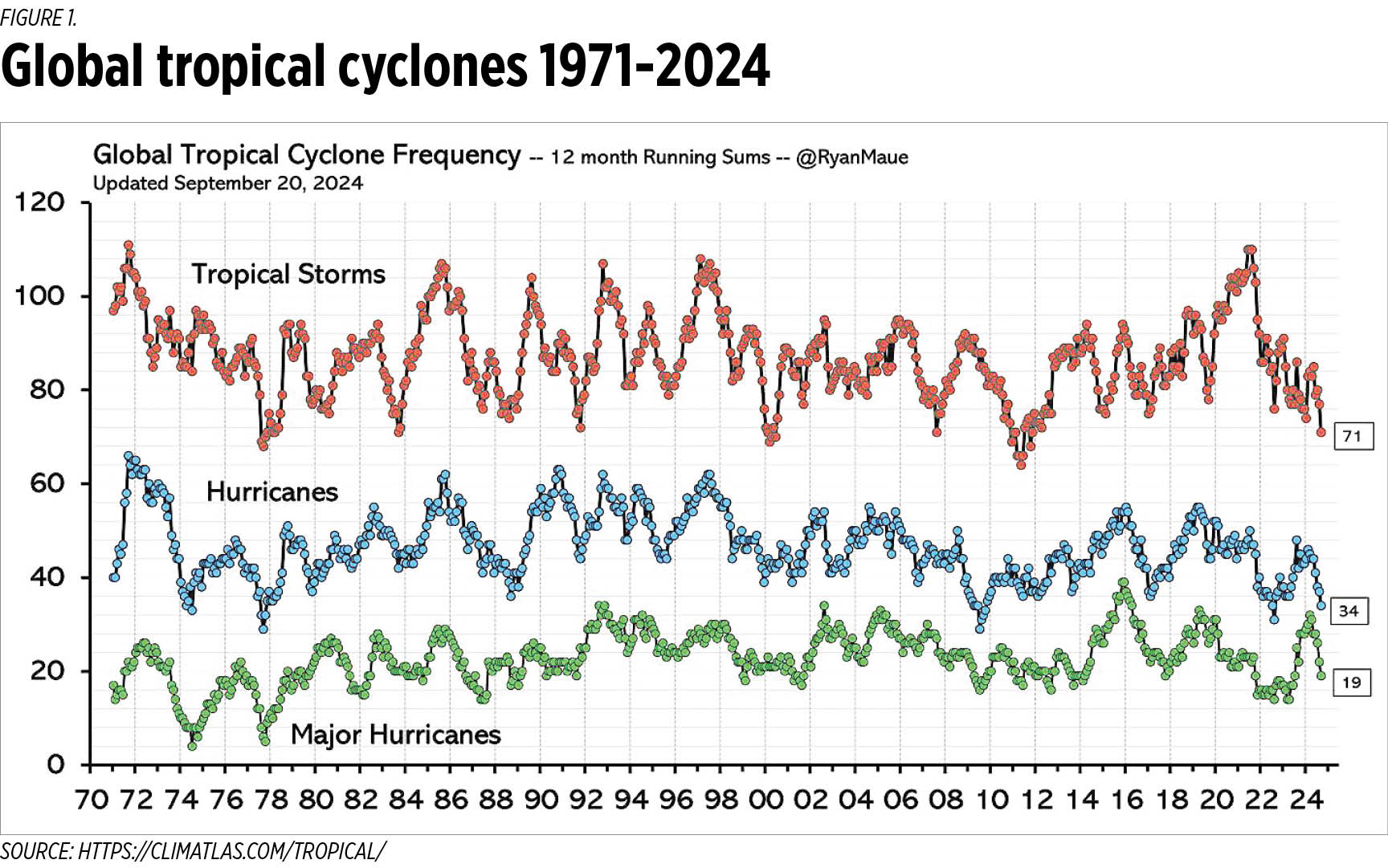
A quick update on the number of global tropical storms was made by Dr. Ryan Maue. One narrative about “man-made” climate change is that there are now more frequent storms and stronger storms than in the past. The data says there is no truth to the former claim (see Figure 1).

The claim that storms are getting stronger is also not true. The accumulated cyclone energy (ACE) just shows the natural cycle of high-low ACE, like the period 2021-2024 has low ACE.

The pattern of ice growth and melting in both the Arctic and Antarctica remains the same. Data from 1978-2024 can be viewed here, https://wattsupwiththat.com/reference-pages/sea-ice-page/.

There is no climate crisis to justify the continued demonization of coal, oil, gas, and nuclear, and the continued push for intermittent solar and wind power. We need the “business as usual” power sources to sustain the growth path of developing countries like the Philippines.

Developed Western countries like the US, the UK, Germany, and Spain have greatly moved away from coal power. In the process, their average economic growth has been declining while their average inflation rate has been rising. The opposite trend is shown in coal-heavy Asian nations like China, India, Indonesia, and Vietnam (see Figure 2).

Related to this, the Coaltrans Asia 2024 forum was held in Bali, Indonesia on Sept. 10. According to a press release, Aboitiz Power Corp. Chief Operating Officer for Thermal Operated Assets Ronaldo Ramos was one of the speakers, and he said that “We need reliable and reasonably priced baseload power to address the inherent intermittency of renewable energy and the geographical challenges of injecting these intermittent capacities to our present grid.”

This was reported also in BusinessWorld, “AboitizPower: Renewables need baseload for reliability” (Sept. 25). Mr. Ramos’ statement is corroborated by the numbers. Developing countries cannot just dump cheap and stable energy and expect growth to remain high. It did not happen and will not happen.

A coal plant that is visible from the house of my parents-in-law in Lapaz, Iloilo City, is that of the Panay Energy Development Corp. (unit 1 is 167 MW, unit 2 is 150 MW), owned by Meralco PowerGen Corp. Day or night, I did not see the black smoke that we often see in photos and campaign materials of the climate activists. Some BBQ stands nearby produce more visible smoke than that coal plant.

Panay island is composed of four provinces (Iloilo, Capiz, Aklan, Antique) and is growing fast — they need adequate, reliable, and cost-efficient energy. Meralco spokesman Joe Zaldariaga went there this week and he said that “The power plant is beside a residential area and the lush greeneries and mangrove areas nearby complement the sustainability in the place and is proof that high performance clean coal stations can co-exist with urban residents.”

THE NEW ERC CHAIRPERSON
The newly appointed OIC of the Energy Regulatory Commission (ERC), former Justice Undersecretary Jesse T. Andres, is my batchmate from UP School of Economics (1984). I learned about this when he joined our batch’s Viber group. I have communicated with him some of my observations about the country’s energy regulation system.

I think these issues need to be addressed and prioritized by the ERC.

1. Power Supply Agreement, (PSA) and Ancillary Services Procurement Agreement, (ASPA) should get the ERC nod if these have gone through the mandatory competitive selection process (CSP) that ERC itself oversees.

2. Barriers to the entry of new generation companies (gencos) should be reduced. ERC processes in Energy Virtual One-Stop Shop (EVOSS) system should be included and timelines should be observed and met.

3. The recent ERC limitations on retail electricity supply (RES) of up to a 50% limit on affiliate gencos should be reviewed if not removed.

4. The price control at the Wholesale Electricity Spot Market (WESM) via secondary price cap (only P6.25/kWh, which was imposed by the ERC around 2014, a decade ago) should be removed. If the price is capped, the supply curve shifts to the left while the demand curve remains the same. This largely explains the frequent yellow-red alerts that we experience yearly. Peaking plants to supply peak demand are not there as they are discouraged by price controls.

5. The performance-based regulation process for distribution utilities and electric cooperatives should proceed for their upcoming regulatory periods.

6. The “cost-based evaluation” for genco applications should be removed because the generation sector is supposed to be competitive. This should force the gencos to make their operations more efficient to make them profitable. High efficiency means a high probability of winning CSPs with low prices for the consumers.

For regulated entities (distribution utilities and transmission), performance-based regulation (PBR) was introduced in the early 2000s as an alternative design to regulation. PBR will push the monopoly to act as if it is under a competitive regime, increasing its efficiencies while meeting its performance targets thereby substantially reducing the “deadweight loss” to society from a monopolistic market. PBR uses forecasts instead of historic values. The monopoly is allowed to keep efficiency gains and the focus should be on the performance of the utility. PBR is an economic concept but recently it has become an accounting exercise when it should be an economics exercise.

Regulators’ biggest service to the public is to expand consumer choice. Let them choose and decide whether to consume 1,000 kWh, or 500 kWh, or just 200 kWh per month, provided that the electricity is there when they need it. Their choice should not be limited to using candles or kerosene torches or diesel gensets due to frequent blackouts.


Bienvenido S. Oplas, Jr. is the president of Bienvenido S. Oplas, Jr. Research Consultancy Services, and Minimal Government Thinkers. He is an international fellow of the Tholos Foundation.

minimalgovernment@gmail.com

Sustainability key to resilient economy, says SEC commissioner

THE SECURITIES and Exchange Commission (SEC) is advocating for broader adoption of sustainable practices among businesses in the Philippines.

“The sustainability landscape is continually evolving, and with it, so are the expectations placed upon businesses,” SEC Commissioner Javey Paul D. Francisco said during his keynote speech at a forum in Quezon City on Wednesday.

“By integrating sustainable practices into your core strategies, you not only safeguard the future of your organizations, but also contribute to building a resilient and inclusive economy for all Filipinos,” he added.

Mr. Francisco said the SEC is aiming to further push sustainable projects and activities in the country, as well as to make the Philippines a leader in sustainable capital market development in the region.

“Through our policies, we are not only empowering individuals, but also strengthening the very foundation of our economy. True sustainability encompasses both environmental and social dimensions, and only by addressing these together can we create resilient and inclusive societies,” he said.

“It is up to us as leaders in the corporate sector, to work towards the universal sustainable agenda and to lead by example for others to follow,” he added.

Meanwhile, the United States Agency for International Development Investing in Sustainability and Partnerships for Inclusive Growth and Regenerative Ecosystems project (USAID INSPIRE) and the Institute of Corporate Directors (ICD) have strengthened the fight against climate change and its impacts by sounding a call to action to address environmental degradation.

The two groups also pushed for inclusive development through shared initiatives as well as increased accountability in sustainability reporting.

These happened as USAID INSPIRE and ICD held the Sustainability Nexus: Inspiring Ideas for a Sustainable Philippines forum in Quezon City on Wednesday. The forum discussed the status of environmental governance in the country; shared best practices of sustainability models belonging to the private sector and civil society organizations; and explored opportunities for cooperation.

“We need to work harder, better, and faster. There are six years left until 2030 and only 17% of global development goals are on track. We are facing threats to our natural ecosystems, our businesses, our way of life,” INSPIRE Project Chief of Party Rebecca R. Paz said.

“Let us use this opportunity to decide how we can work together and make a truly meaningful impact,” she added. — Revin Mikhael D. Ochave