Home Blog Page 2087

Penalize PR firms, advertisers engaged in online disinformation, lawmakers told

FREEPIK

PHILIPPINE lawmakers should consider crafting laws that would penalize public relations  and advertising agencies engaged in peddling disinformation, rather than individuals engaged in troll farms, experts said on Tuesday.

“[We should] penalize masterminds, especially black PR (public relations) firms engaged in disinformation. There has to be a way to penalize the masterminds rather than individual trolls,” Rachel E. Khan, a journalism professor at the University of the Philippines, told lawmakers during a House of Representatives hearing.

“We won’t achieve anything if we go after individuals rather than those who brought them or those who pay them,” she added in Filipino.

Ms. Khan was speaking before the House joint committee on public safety, public information and communications technology, which launched an inquiry into the prevalence of disinformation in social media platforms, described as a “national security threat.”

“Our goal is to develop a code of conduct for content creators, ensuring accountability and ethical responsibility in this rapidly evolving digital space,” Surigao del Norte Rep. Robert Ace S. Barbers said in the same hearing, according to a statement.

“We need to hold accountable the people at the top, the elites in the advertising and PR industries…. we should not only go after the low-level workers,” said Jonathan Corpus Ong, professor of global digital media at the University of Massachusetts Amherst.

“We should also focus on ‘big tech’ corporations,” he added.

Lawmakers should also consider “different kinds of legislation,” focusing not only on penalizing social media users who spread false information.

A proposal against online disinformation should include “compliance measures” for social media platforms to participate in transparency mechanisms with researchers.

“If the law is not specific and not transparent, a ‘top-down’ regulation can actually do more harm than good,” said Mr. Ong.

Ms. Khan said congressmen should consider legislating a mechanism allowing fact-checkers to counter disinformation through a “rapid response mechanism,” just like in Taiwan.

“This approach has been effective in addressing false information quickly. We can replicate it if there is collaboration among and support from fact-checking organizations,” she said in Filipino. — Kenneth Christiane L. Basilio

Meralco franchise bill up for signing after House adopts Senate changes 

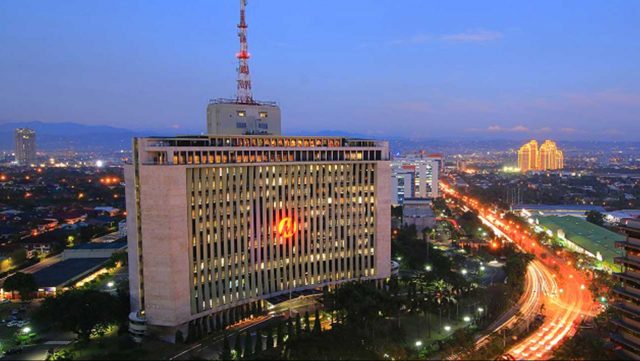
MERALCO.COM.PH

THE House of Representatives on Tuesday evening adopted the Senate’s changes to a bill, extending Manila Electric Co.’s (Meralco) franchise for another 25 years, allowing the chamber to send it straight to Malacaсang for President Ferdinand R. Marcos, Jr.’s signature. 

Senators on Monday approved on final reading House Bill No. 10926, which seeks to grant Meralco the franchise to construct, operate, and maintain its electric distribution systems in the greater Metro Manila area, including Bulacan, Cavite, Rizal, and parts of Batangas, Quezon, Laguna, and Pampanga. 

Meralco is the main power distributor for the National Capital Region and nearby areas, covering 39 cities and 72 municipalities, delivering electricity to at least 7.6 million Filipinos. It provides power to a region responsible for half of the country’s gross domestic product output. 

“The Senate passed with amendments House Bill No. 10926, renewing for another 25 years the franchise granted to Meralco,” Cagayan Rep. Ramon C. Nolasco, Jr. told the House floor.  

“We have been informed that the committee on legislative franchises, which sponsored the aforementioned bill, as well as the authors, has no objections with the Senate to the said measure,” he added.  

Bills seeking to provide a legislative franchise to companies first originate at the House, undergoing the same legislative process as regular bills, according to the Energy department.  

Congressmen gave their final nod to the bill in November, approving it four years ahead of its initial concession’s expiry.  

Meralco’s controlling stakeholder, Beacon Electric Asset Holdings, Inc., is partly owned by PLDT, Inc. Hastings Holdings, Inc., a unit of PLDT Beneficial Trust Fund subsidiary MediaQuest Holdings, Inc., has an interest in BusinessWorld through the Philippine Star Group, which it controls. — Kenneth Christiane L. Basilio  

Gov’t told to explain 2025 budget

PHOTO BY MIKE GONZALEZ

THE Supreme Court (SC) on Tuesday ordered the Philippine government to comment on a lawsuit filed by a former presidential spokesman challenging the 2025 national budget.

The high court en banc directed both houses of Congress and Executive Secretary Lucas P. Bersamin to comment on the petition filed by Victor D. Rodriguez last week within a non-extendible period of ten days from receipt of notice.

On Jan. 27, Mr. Rodriguez asked the high court to declare the General Appropriations Act (GAA) illegal for failing to include mandatory funding for the Philippine Health Insurance Corp. (PhilHealth), illegally increasing appropriations over the President’s recommendations, and giving the most budget to infrastructure over education.

The petition added the 2025 national budget is illegal as the Bicameral Committee Report on the General Appropriations Bill had blank items.

“You don’t pass an unenrolled bill blank,” he said, claiming that the 2025 GAA “violated Article VI, Section 27 of the 1987 Constitution of the Philippines when the members of the Bicameral Conference Committee signed and submitted a Report on the 2025 General Appropriations Bill with blanks.” — Chloe Mari A. Hufana

House carbon pricing framework bill approved on 2nd reading

FREEPIK

THE House of Representatives on Tuesday approved on second reading a bill establishing a carbon pricing framework for Philippine companies in a bid to meet the country’s climate targets amid climate change concerns.

In a voice vote, lawmakers approved House Bill No. 11375, which mandates Philippine enterprises to offset its operational carbon footprint by reducing its carbon emissions, investing in low-carbon ventures or through carbon credits.

“The measure creates a carbon pricing framework that requires companies exceeding government-set emission targets to spend or invest in environmental sustainability projects to offset their carbon footprint,” Bohol Rep. Edgar M. Chatto, who heads the House climate change committee, told the House floor.

The Philippines ratified in 2017 a United Nations agreement to keep global temperatures rise below 2°C this century.

Medium and large-sized enterprises would be required to partake in the government’s decarbonization efforts, complying with a carbon threshold to be set by the Climate Change Commission.

Covered companies are required to submit a yearly compliance report to the Environment department’s, which should contain greenhouse gases emission levels and its “reduction activities” to lessen their carbon footprint. — Kenneth Christiane L. Basilio

Phase 2 of SkillsUpNet launched

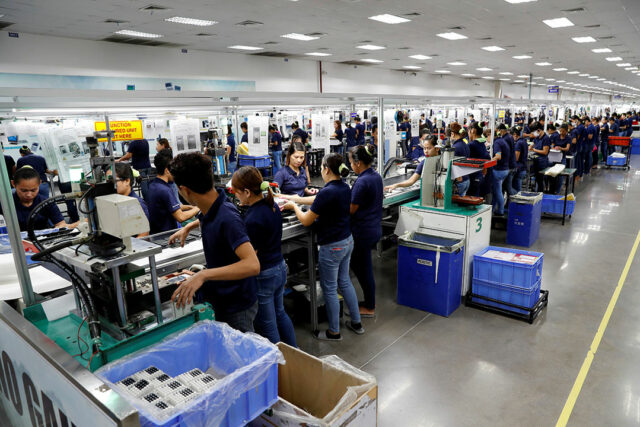
Women work at the assembly line of an electronics factory in Malvar, Batangas, Aug. 10, 2018. — REUTERS

THE Asian Development Bank (ADB) and the Philippine government have launched the second phase of SkillsUpNet Philippines, which offers grants to employers to train their workers.

The ADB, Department of Trade and Industry and Technical Education and Skills Development Authority on Tuesday signed a memorandum of agreement (MoA) for the second phase of SkillsUpNet Philippines.

The project will be allocated $1 million, the ADB said.

SkillsUpNet is an “employer-led skills development funding scheme that offers competitive grants to networks of employers for skills training of workers.”

“This MoA strengthens the partnership between the government and ADB, and it will drive meaningful reforms and help ensure that the Philippines remains competitive in what we know to be an increasingly skills-driven global economy,” ADB Director of the Human and Social Development Sector Office Karin Schelzig said.

The project seeks to address skills mismatch through short-term training, improve skills competencies of employees, raise performance and productivity and broaden income opportunities.

“We want to further evaluate the training impact on workers and enterprises for a potential national rollout later, and we’re looking to promote inclusive skills development for women, youth, and informal workers,” Ms. Schelzig said.

“By aligning training investments with industry needs, we enhance employability, we support business growth, we boost productivity and ultimately drive national economic resilience.”

The second phase will take place from February this year to November 2026. The first phase of the project was from January 2022 to December 2023.

Under the first phase, sectors covered include IT animation, tourism, construction, agribusiness and women-led enterprises.

It also disbursed $310,000 in grants and was able to train a total of 671 workers.

The second phase plans to extend the regions covered and as well as sectors, now including renewable energy and logistics and supply chains.

Probe of child exploitation sought

STOCK IMAGE | Image by Gerd Altmann from Pixabay

A PHILIPPINE senator has filed a resolution that seeks to probe the spike in cases of online sexual abuse and exploitation of children and the use of chat platforms and electronic wallets in soliciting these illegal services.

Senate Resolution No. 1307, which Senator Ana Theresia N. Hontiveros filed on Feb. 3, urges the committee on women, children, family relations and gender equality to look into the use of digital financial systems for transactions linked to online sexual abuse of children.

Citing a 2022 study by the International Justice Mission, nearly half a million Filipino children were trafficked to produce child sexual exploitation material for profit.

“The rise of end-to-end encryption, while providing privacy and security to regular conversations, has led to the impunity of sexual predators, whose illegal activities can fly under the radar and below law enforcement security,” based on a copy of the resolution.

In a separate 2022 study, the United Nations Children’s Fund (UNICEF) said about 20% of children aged 12-17 were prone to online sexual abuse and exploitation, with 23% of children not telling anyone of the harm they experienced.

The Anti-Online Sexual Abuse and Exploitation of Children Act, which established the National Coordination Center against Online Sexual Abuse Against Children, lapsed into law in July 2022. 

Its implementing rules and regulations were released in May 2023, which mandates the creation of an online sexual offenders registry for foreigners and Filipinos.

“While the passage of the law has provided many additional policy tools for law enforcement agencies to investigate online sexual abuse of children related offenses the advent of emerging technologies… has proven challenging for even the most committed law enforcer,” Ms. Hontiveros said. — John Victor D. Ordoñez

Marcos names new PDEA chief

MAJ. GEN ISAGANI NEREZ — PCO.GOV.PH

PHILIPPINE President Ferdinand R. Marcos, Jr. on Tuesday named retired major general Isagani Nerez as director general of the Philippine Drug Enforcement Agency (PDEA), according to the Presidential Communications Office.

In a statement, the agency said the retired general will replace former Special Actions Forces chief Moro Virgilio Lazo, who served in his post since Oct. 2022.

Mr. Nerez took his oath before Executive Secretary Lucas P. Bersamin on Tuesday.

The new PDEA chief is a lawyer and law enforcer who previously served as Baguio City police chief and a member of the Presidential Anti-Organized Crime Task Force and Philippine National Police Anti-Kidnapping Group.

The government estimates that at least 6,117 people were killed in the previous administration’s deadly drug war between July 1, 2016, and May 31, 2022, but human rights groups say the death toll could be as high as 30,000. — John Victor D. Ordoñez

New Sandiganbayan justice takes oath

PHILSTAR FILE PHOTO

THE Philippine Chief Justice swore in a newly appointed justice in the anti-graft court on Feb. 3, 2025, the top court said on Tuesday.

Chief Justice Alexander G. Gesmundo has sworn in newly appointed Sandiganbayan Justice Lord A. Villanueva in a formal ceremony held at the Supreme Court Dignitaries’ Lounge last Monday, replacing Justice Rafael R. Lagos, Chairperson of the Fifth Division, who retired last Dec. 22, 2024.

Mr. Villanueva brings experience in private legal practice and government service. Before his appointment to the anti-graft court, he served as Undersecretary for Operations at the Department of the Interior and Local Government (DILG).

Before that, he worked as the Assistant City Administrator for General Affairs in Quezon City, following 16 years in private law practice.

An alumnus of the University of the Philippines (UP) College of Law, Mr. Villanueva was awarded the UP Law Dean’s Medal for Academic Excellence and was a member of the Order of the Purple Feather Honor Society.

The Sandiganbayan, a special appellate collegial court, is responsible for handling corruption cases involving public officials. — Chloe Mari A. Hufana

Bill extending PWD ID validity to 10 years hurdles House panel

BW FILE PHOTO

A House of Representatives committee on Tuesday approved an unnumbered substitute bill extending the validity of IDs for Filipinos with permanent disabilities to 10 years from five, easing the burden of reapplication for new identification cards.

“Many find the frequent need to renew their ID inconvenient and unnecessary, especially for individuals whose disability status is not likely to change over some short periods,” San Juan City Rep. Ysabel Maria J. Zamora told lawmakers before the House persons with disabilities (PWD) panel approved the proposal.

“The unnumbered substitute bill seeks to address these concerns by extending the validity periods of the ID cards and making corresponding adjustments to provisions concerning penalties and the issuance process,” she added.

Persons with temporary disabilities would be given an ID with a two-year validity, which could only be renewed “only after reassessment… by an appropriate medical practitioner,” according to a copy of the bill obtained by BusinessWorld.

Anyone caught faking their disability or using fake IDs could face up to two years in prison and fines of up to P100,000. – Kenneth Christiane L. Basilio

Fake PWD cards cause up to P100,000 monthly losses

PHILSTAR FILE PHOTO

USE of fake persons with disabilities (PWD) cards has led to up to P100,000 monthly loss for restaurants, said industry advocate Restoph.

“The PWD discount was designed to help those who truly need it, but the misuse of fake cards is now threatening the survival of many restaurants,” said David Sison, president of Restoph.

“What many don’t realize is that the 20% discount isn’t subsidized by the government—it comes directly from the pockets of business owners. Every fraudulent claim is a direct hit to our already struggling industry,” he added.

Restoph said that restaurants lose P50,000 to P100,000 per month due to fraudulent discounts.

“For small, family-run establishments, these losses can be devastating. In some cases, multiple fake PWD cards are used at a single table, compounding the financial burden and pushing businesses to the brink of closure,” it added.

The use of fake IDs not only causes lost revenue but also affects the restaurants’ ability to pay their employees, maintain food quality, and keep prices affordable.

“We’re asking for fairness,” Mr. Sison said. “The PWD discount should serve its intended purpose — to help those who genuinely need it — not be exploited as a loophole for personal gain.”

To address the issues, the group proposed “stronger enforcement measures, including stricter verification processes for PWD card issuance and increased penalties for those caught using or producing fraudulent cards.”

“The organization believes collaboration between the government, businesses, and the public is essential to curb this growing problem,” it added. — Justine Irish D. Tabile

PSEi back above 6,000 as Trump pauses tariffs

REUTERS

PHILIPPINE SHARES rallied to return above the 6,000 mark on Tuesday after US President Donald J. Trump suspended the implementation of import tariffs on Canada and Mexico.

The Philippine Stock Exchange index (PSEi) surged by 3.50% or 206.02 points to close at 6,089.06, while the broader all shares index increased by 2.35% or 83.32 points to 3,617.93.

“The local market rallied as US President Donald Trump decided to pause the planned tariffs against Canada and Mexico for 30 days,” Philstocks Financial, Inc. Senior Research Analyst Japhet Louis O. Tantiangco said in a Viber message.

“Philippine shares finally made a furious rebound after successive sessions of selling, as the main barometer climbed back above 6,000,” Regina Capital Development Corp. Head of Sales Luis A. Limlingan said in a Viber message. “US equities dropped on Monday as markets responded to new tariffs on imports, sparking a global sell-off. However, investor sentiment rebounded after reports of a temporary agreement between US and Mexican leaders.”

Mr. Trump on Monday suspended his threat of 25% tariffs on Mexico and Canada at the last minute, agreeing to a 30-day pause in return for concessions on border and crime enforcement with the two neighboring countries, Reuters reported.

Meanwhile, China on Tuesday imposed tariffs on some US imports in a swift response to new US duties on Chinese goods.

An additional 10% tariff across all Chinese imports into the US came into effect at 12:01 a.m. ET on Tuesday (0501 GMT) after Mr. Trump repeatedly warned Beijing it was not doing enough to halt the flow of illicit drugs into the United States.

Within minutes, China’s Finance Ministry said it would impose levies of 15% for US coal and liquefied natural gas and 10% for crude oil, farm equipment and a small number of trucks as well as big-engine sedans shipped to China from the United States.

China’s new tariffs on the targeted US exports will start on Feb. 10, giving Washington and Beijing some time to try and reach a deal that Chinese policymakers have indicated they hope to strike with Mr. Trump.

Foreign buying also boosted the market, Mr. Tantiangco said. Net foreign buying went down to P47.6 million on Tuesday from P695.09 million on Monday.

All sectoral indices closed in the green on Tuesday. Services jumped by 4.75% or 91.54 points to 2,014.96; financials went up by 3.93% or 85.87 points to 2,266.67; mining and oil surged by 3.41% or 236.35 points to 7,157.03; industrials rose by 2.95% or 242.35 points to 8,453.19; property climbed by 2.32% or 52.14 points to 2,295.44; and holding firms increased by 1.95% or 96.16 points to 5,011.58.

Value turnover went down to P7.35 billion on Tuesday with 700.47 million shares changing hands from the P11.37 billion with 1.26 billion issues traded on Monday.

Advancers outnumbered decliners, 124 versus 61, while 60 names were unchanged. — Revin Mikhael D. Ochave with Reuters

Peso up as US halts Canada, Mexico tariffs

BW FILE PHOTO

THE PESO rebounded versus the dollar on Tuesday after US President Donald J. Trump suspended the implementation of tariffs on goods from Canada and Mexico.

The local unit closed at P58.34 against the greenback on Tuesday, strengthening by 32 centavos from its P58.66 finish on Monday, Bankers Association of the Philippines data showed.

The peso opened Tuesday’s trading session stronger at P58.45 against the dollar. It climbed to as high as P58.28, while its intraday low was at P58.555 versus the greenback.

Dollars traded ballooned to $2.13 billion on Tuesday from $1.27 billion on Monday.

The dollar was generally weaker early on Tuesday after Mr. Trump paused his planned import tariffs on Canada and Mexico, Rizal Commercial Banking Corp. Chief Economist Michael L. Ricafort said in a Viber message.

“The peso managed to recover after the US and Canada agreed to defer the implementation of tariffs by March and Mexico opening negotiations with President Trump,” a trader likewise said in an e-mail.

Meanwhile, a second trader said that client flows likely led to the huge trading volume on Tuesday.

For Wednesday, the first trader said the peso could move between P58.20 and P58.45 amid the release of January Philippine inflation data. The second trader expects the peso to range from P58.20 to P58.50 per dollar, while Mr. Ricafort said it could move from P58.25 to P58.45.

Currency markets had some of the wildest swings for years after the US paused planned tariffs on Canada and Mexico at the 11th hour, Reuters reported.

The dollar had reversed gains on Mexico’s peso and the Canadian dollar after the leaders of Canada and Mexico agreed to bolster border enforcement in calls with Mr. Trump, who had tied the tariffs to the flow of drugs and migrants and suspended them for a month in response.

However, the dollar strengthened in the Asian session on Tuesday after US tariffs on Chinese goods came into effect, triggering swift retaliation from Beijing and prompting a sell-off in the Chinese yuan and the Australian dollar.

The Canadian dollar and Mexican peso also weakened after rising the day before as those countries won a reprieve on their own US tariffs. The euro declined, with Washington threatening the European Union may be next in line for trade levies.

Mr. Trump’s administration imposed additional 10% tariffs on imports from China from 12:01 a.m. ET on Tuesday (0501 GMT).

The US dollar index — a measure of the value of the greenback relative to a weighted basket of six major foreign currencies — rose 0.15% to 108.6.

China on Tuesday placed tariffs on US imports, renewing a trade war between the world’s top two economies as Mr. Trump claimed China was not doing enough to halt the flow of illicit drugs into the United States.

The Chinese yuan edged down about 0.35% to 7.3207 per dollar in offshore trading, although that was well back from the record trough reached on Monday of 7.3631 yuan. There is no official yuan trading until Wednesday, with mainland markets still closed for the week-long Lunar New Year holidays. — A.M.C. Sy with Reuters

ADVERTISEMENT
ADVERTISEMENT