Home Blog Page 2081

Responding to defenses of the PhilHealth fund transfer

The third tranche of the controversial P89.9 billion in Philippine Health Insurance Corp. (PhilHealth) “unused” funds, worth P30 billion, is set to be transferred from PhilHealth to the National Treasury on Oct. 16. The last tranche worth P29.9 billion, is scheduled to be transferred in November.

In the Aug. 27 Senate hearing for the 2025 budget of the Department of Finance (DoF), Finance Secretary Ralph Recto noted that these next tranches could be transferred earlier than scheduled, depending on the cash flow of PhilHealth.

Despite the impending fund transfers, the Supreme Court scheduled oral arguments for the petition filed by Senator Koko Pimentel, the Philippine Medical Association, and other groups, seeking a Temporary Restraining Order (TRO) and a status quo ante order for the transfer to Jan. 14, 2025, by which time it may be too late to recover the money of PhilHealth members.

Over the past few months, a broad segment of society has opposed the transfer of unused PhilHealth funds to the National Treasury to fund unprogrammed appropriations, asserting that PhilHealth’s funds rightfully belong to their members: the Filipino people.

Healthcare workers were among the first to mobilize against the transfer of funds. In an open letter to President Ferdinand “Bongbong” Marcos, Jr. dated July 25, 83 medical societies and healthcare worker organizations (including the Philippine Medical Association and the professional organizations of nurses, pharmacists, physical therapists, occupational therapists, and midwives in the Philippines) called for the P89.9 billion to remain within PhilHealth, an immediate increase in the scope and coverage of PhilHealth benefits, and reforms to enhance PhilHealth’s benefit development capacity.

“The government cannot take back subsidies it used to pay for premiums of disadvantaged populations. Doing so will inadvertently lay the burden of healthcare entirely on the shoulders of formal payors, many of whom are in need of help themselves,” the healthcare workers’ letter reads. The President has yet to respond to their call.

Six former Secretaries of Health — Dr. Jaime Galvez-Tan, Dr. Manuel Dayrit, Dr. Francisco Duque, Dr. Esperanza Cabral, Dr. Enrique Ona, and Dr. Paulyn Ubial — joined the doctors and healthcare professionals in their call to stop the transfer of PhilHealth funds.

Lawmakers have also staunchly opposed the transfer of PhilHealth funds — in the Senate, Senators Koko Pimentel, Bong Go, JV Ejercito, Pia Cayetano, and Risa Hontiveros made statements calling on the DoF to stop the PhilHealth fund transfer. Meanwhile in Congress, Representatives Rufus Rodriguez, Wilbert Lee, France Castro, and Arlene Brosas denounced the unjust and immoral transfer.

Caritas, the Catholic Church’s development and advocacy arm in the Philippines, also opposed the PhilHealth fund transfer and supported the Supreme Court petition filed by Senator Pimentel’s group (“Caritas PH backs petition against PhilHealth funds transfer,” CBCP News, Aug. 19). “We appeal to the honorable justices of our Supreme Court to uphold the principles of the 2019 Universal Healthcare Law and protect every Filipino’s right to health by deciding in favor of the petition,” said Bishop Colin Jose Bagaforo in the statement.

Groups representing labor, business, senior citizens, persons with disability (PWD), and women have also joined the call to stop the transfers.

The DoF and its Secretary Ralph Recto, however, maintain that the fund transfer is sound and justifiable.

Secretary Recto argues that tapping PhilHealth’s funds will not impact its plan to expand benefit packages and that PhilHealth still has plenty of funds with which it can perform its mandate.

But PhilHealth’s remaining reserve chest does not justify the raiding of P89.9 billion worth of funds which should have otherwise been used for the healthcare of its members. Further, we cannot underestimate the huge and ever-increasing costs to implement Universal Healthcare, and even if no member’s benefits will be reduced due to the transfer of P89.9 billion, diverting funds will only take us further from our aspiration of reduced out-of-pocket payments and affordable, accessible, and quality healthcare for all Filipinos.

Seven former Finance Secretaries in a joint statement posited that mobilizing PhilHealth’s funds for public projects is more efficient than imposing additional taxes or increasing public debt. “Responsible public financing requires considering opportunity costs. If unused funds are left dormant, the potential benefits are lost. Every unused peso represents development denied for Filipinos,” the former Finance Secretaries said.

But to quote the latest statement opposing the PhilHealth fund transfer issued by 16 former government officials including former National Economic and Development Authority (NEDA) Secretaries Cielito Habito and Ernesto Pernia, it is “beyond reason to establish a trade-off between economic growth through infrastructure and social programs and public health.” The COVID-19 pandemic taught us that the health of our economy is contingent on the health of our people.

Another point that our Finance Secretary and our economic managers have yet to acknowledge is that our economic managers are doing a cash sweep of government-owned and -controlled corporations (GOCCs) like PhilHealth because Congress inserted massive pork barrel allocations in the 2024 General Appropriations Act (GAA), displacing essential priority projects which were then transferred to the unprogrammed appropriations. PhilHealth members should not have to bear the brunt of irresponsible fiscal decisions made by our Congress and approved by our economic managers.

Our economic managers are deferring to the Supreme Court to make the call as to whether PhilHealth’s funds should be returned, noting that they will follow the Court’s directives. While we pray that the Supreme Court issue a TRO before the scheduled October transfers, the DoF should make the prudent decision to immediately stop the next transfers.


Pia Rodrigo is strategic communications officer at Action for Economic Reforms.

New Cebu Int’l Container Port on track for construction this year — DoTr

THE TRANSPORTATION department said it plans to award the New Cebu International Container Port contract by October to Hanjin Heavy Industries & Construction.

“It will be awarded to the only bidder; it will be awarded to Hanjin for the civil works,” Transportation Undersecretary Elmer U. Sarmiento said on the sidelines of an event last week.

The Department of Transportation (DoTr) said previously that it was targeting to start the construction of the New Cebu Container Port within the year.

The container port, located in Tayud, Consolacion, Cebu, has a capacity of 2,500 twenty-foot equivalent units and will be equipped with four quay cranes.

Of the budget allotted for port upgrades and development, the majority will be allotted for the New Cebu International Container Port, he said, adding that the special allotment release order (SARO) has been secured by the department.

“We already got the SARO maybe two weeks ago. So, we are planning to award the contract for this by early October, hopefully,” he said.

The DoTr said that the construction of the New Cebu International Container Port is targeted for completion by 2028.

In 2018, the Department of Finance signed a $172.64-million loan agreement with the Export-Import Bank of Korea for the project.

The government will provide P1.4 billion or $26.09 million for the port project, which seeks to free up the existing seaport in Cebu province and to provide efficient and reliable transport infrastructure for the seamless flow of goods and services in the region.

Further, Mr. Sarmiento said the DoTr has proposed 126 ports valued at P9 billion for development next year, which is on top of the port development projects by the Philippine Ports Authority.

However, of the 126 ports the DoTr has proposed, only three have been approved, he said, attributing this to “tight fiscal space.” — Ashley Erika O. Jose

PHL losing share in key banana markets due to pests, diseases

ANFLOCOR.COM/TADECO

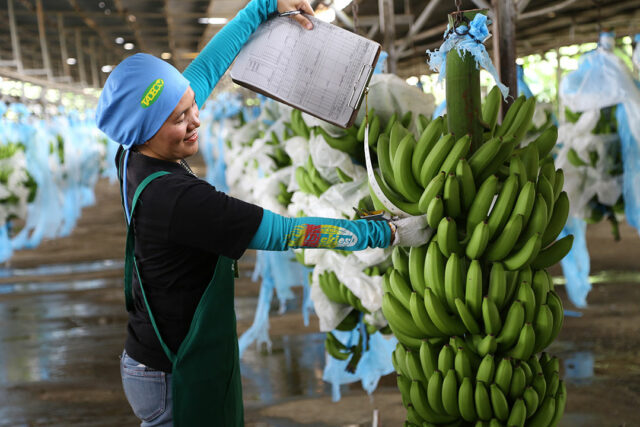
DAVAO CITY — Pilipino Banana Growers and Exporters Association (PBGEA) Executive Director Stephen Antig said the Philippines is losing key markets for bananas due to weak production as a result of pests and diseases, specifically fusarium wilt or Panama disease. 

Mr. Antig said Philippine market share for fresh banana has fallen steadily since 2012. In Japan, the Philippines used to have a 94% share of the market share; in 2023, it was 79%.

The industry’s main market, China, was at 40% market share last year, from 82% in 2012. South Korean market share was 69% in 2023 from 98% previously. Market share in the United Arab Emirates was down to 8% in 2023 from 83% in 2012.

“We simply don’t have the volume due to devastation brought about by pests and diseases,” he said during the Business Matters media briefing at Hukad, Ayala Malls Abreeza.

According to Mr. Antig, it’s not easy to replace areas with banana plantations affected by fusarium wilt or expand acreage because of the Agrarian Reform Law, which limits landowners to five hectares. 

“It’s not a demand problem but a supply problem because we have been infested with fusarium diseases and climate change and the problem of getting additional hectarage for expansion purposes and to replace those areas affected by pests and diseases,” he said.

He said in Cambodia, a single banana plantation can be as large as 20,000 hectares.

He also said Mindanao land planted to banana is down to 51,000 hectares from 89,000 hectares before the disease hit.

Mr. Antig said PBGEA has been lobbying the Department of Agrarian Reform to amend the Agrarian Reform Law because the five hectare limits is not suitable for efficient growing.

“Unfortunately, we have not gotten any feedback as to whether the amendments are happening or not. We will continue to lobby otherwise there will come a time when Mindanao will no longer be known as the banana republic,” he said.

Mr. Antig said banana growers must content themselves with rehabilitating the areas affected by pests and diseases.

“But we cannot do that as fast as we want to because it will take from nine months to one year for bananas to bear fruit. The spread of fusarium wilt is faster,” he said.

He said the industry is trying to develop a new variety of banana that is resistant to most pests and diseases.

“We are racing against time because if we do not identify a new variety, it is possible that the remaining 51,000 hectares will also be affected, and what will happen to individuals dependent on this industry?… the banana industry contributed not only to the economic development of Mindanao, but to improving peace and order by providing employment,” he said.

Mr. Antig said PBGEA is drafting a bill on the revitalization of the banana industry, which it hopes to pass on to a legislator to sponsor in Congress.

“One of the stipulations of the bill is to establish a world-class research facility that will not only serve the Cavendish industry but the entire agriculture sector. We are not giving up hope as a lot of people are dependent on the industry,” he said. — Maya M. Padillo

Power play

Posing with the just-unveiled BAIC B30e Dune at the BAIC Base Camp in SM Mall of Asia are (from left) United Asia Automotive Group, Inc. (UAAGI) Vice-Chairman Kenneth Sytin; UAAGI Chief Marketing Executive and Senior Vice-President Lyn Buena; UAAGI Chairman Rommel Sytin; UAAGI Marketing Manager Tim Sytin; and BAIC Brand Head and General Manager Chris Yu. — PHOTO BY KAP MACEDA AGUILA

The BAIC B30e Dune combines gas and electric mills, on- and off-road capabilities

By Dylan Afuang

IN THE BAIC B30e Dune, the SUV’s hybridity is evident in two ways: Its use of gasoline-electric power, and the duality of purposes for which the China-headquartered, crossover and SUV-focused brand designed the vehicle.

“United Asia Automotive Group, Inc. (UAAGI), the official distributor of the BAIC brand of SUVs and crossovers, (introduces) the BAIC B30e Dune, (which is) designed for both city drives and off-road adventures,” the distributor announced in its release.

Recently launched in two- and all-wheel-drive variants — with an introductory starting price of P1.488 million (lopping off P100,000 until today) — the B30e Dune is a hybrid-electric vehicle (HEV), the company’s first entry into “one of the fastest-growing segments in the automotive industry,” UAAGI continued.

Conversely, “we (are pitching it) to families and to those who want to go off-roading,” BAIC Sales and Training Manager Matthew Hildawa explained to “Velocity” during an exclusive media preview of the vehicle prior to its public launch.

Mr. Hildawa added that the B30e uses a parallel-hybrid system, which “seamlessly switches among its six energy management modes” for better fuel efficiency.

In such hybrid setups, power is provided solely by one or more electric motors, or by an internal combustion engine (ICE) together with the said motors. Many parallel-hybrid systems automatically choose whether power comes purely electric, from the ICE, or from both. Instead of being charged from the grid, the battery in this system is charged by the ICE.

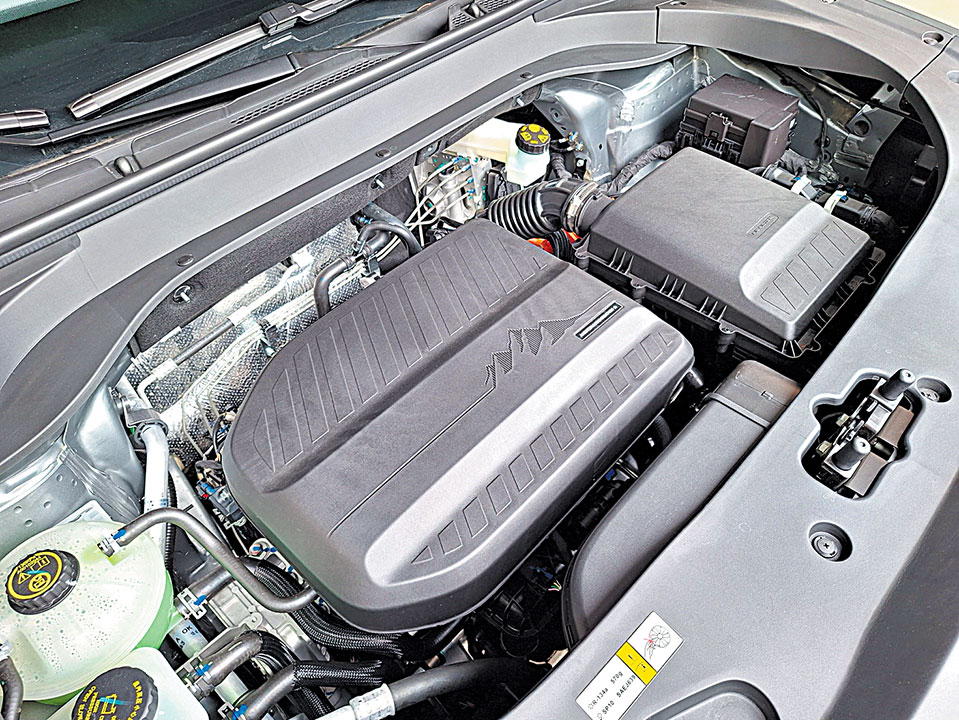
In B30e Dune 4×4, this version’s 1.5-liter turbo gasoline engine — and electric motors mounted on its front and rear axles, with one powering the rear wheels only when needed — produces a combined output of 403hp and 685Nm of torque. The B30e Dune 4×2 draws 329hp and 550Nm from the same 1.5-liter and front-axle-mounted electric motor.

Front- and all-wheel-drive (AWD) versions share a two-speed dedicated hybrid transmission. While the BAIC official said that the distributor has yet to rate the SUV’s fuel consumption, UAAGI did claim that the B30e 4×4 can “accelerate from zero to 100kph in just 6.9 seconds.”

The B30e AWD features the following seven drive modes to suit one’s driving style and the kind of terrain the vehicle has encountered: Comfort, Sport, Economy, Snow, Sand, Muddy Road, and Wading. The front-wheel-driven counterpart features only the first four modes.

Standard on the SUV are 19-inch alloy wheels and, to better clear the ground, an approach angle of 24.5 degrees, departure angle of 30 degrees, and wading depth of 450mm.

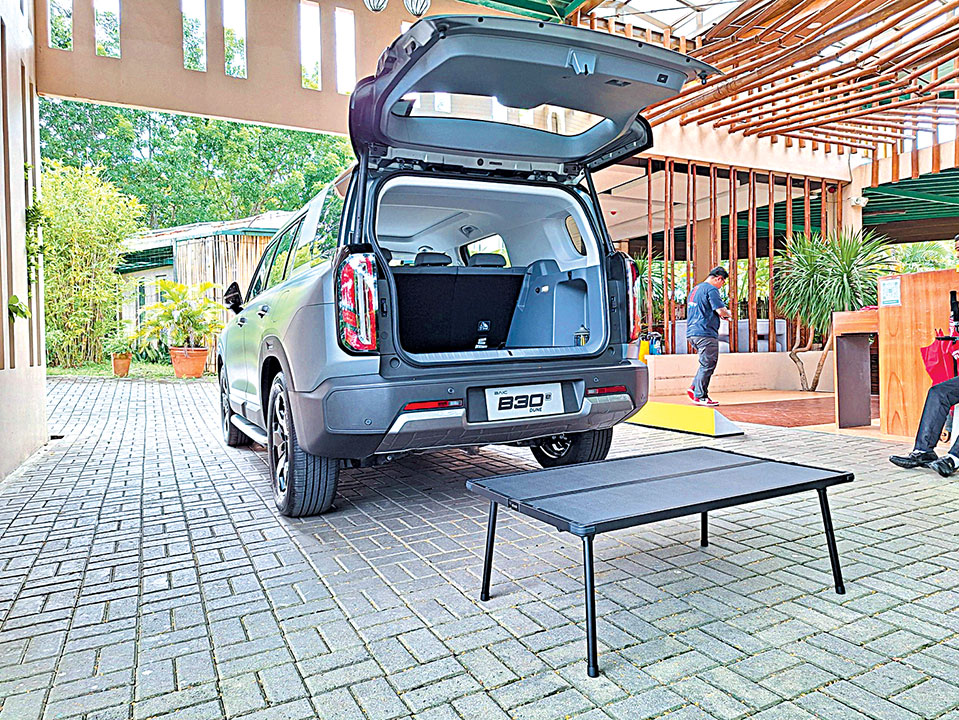
To “ensure (your enjoyment of) a roadside meal or setting up a campsite,” the company boasted, the B30e Dune’s cargo cover can be detached from its mounting to fold into a picnic table. Folding the second-row seats, meanwhile, frees up 1,496 liters of cargo space.

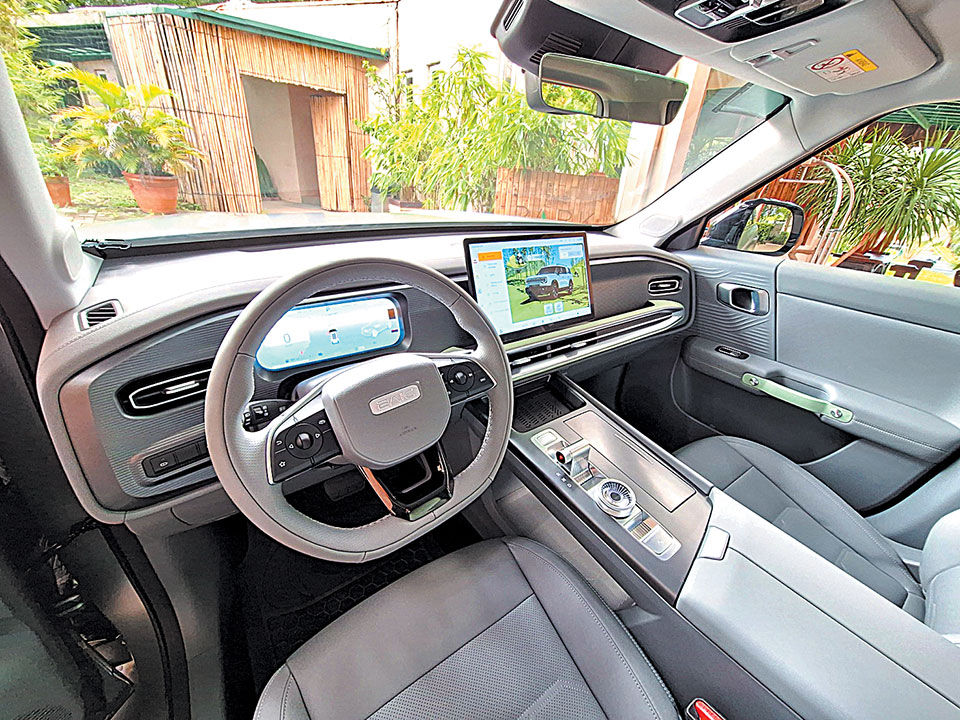
Notable features include a panoramic sunroof, heated and cooled front seats, a 10.25-inch digital driver display, and a 14.6-inch infotainment screen. Safety features are bundled with the Level 2 advanced driver assistance systems suite, and include a 360-degree camera.

UAAGI announced that the B30e and BAIC lineup are available at the brand dealerships in the following locations: Alabang; Marilao, Bulacan; North EDSA; Bacolor, Pampanga; Iloilo; Cagayan de Oro; Zamboanga; and Davao.

Italian designer Alberta Ferretti stepping down as creative director of her brand

MILAN — Italian designer Alberta Ferretti is stepping down as creative director of her eponymous brand after 43 years, fashion group Aeffe  said last week.

The new creative director for the Alberta Ferretti brand will be announced in the next few months, the group said, adding that Ms. Ferretti will retain her role as vice-president of Aeffe.

“I believe that at this point of my career it is a right and conscious choice to pave the way for a new creative chapter for the brand I founded, and which will continue to bear my name,” Ms. Ferretti said in a statement.

The spring summer collection that the brand presented last week during the Milan fashion week was the last one carrying her signature.

In the first half of the year, the Alberta Ferretti brand accounted for roughly 7% of total revenues of the group.

Aeffe, which also owns brands Philosophy di Lorenzo Serafini, Moschino, and Pollini, is struggling to revive its sales and profitability.

The family-owned group posted a net loss of 20 million ($22.27 million) in the first six months of the year and its revenues were down 15% year on year.

“Aeffe will proceed with a careful and in-depth analysis of the roles and functions of the various departments, with the aim of internally reorganizing its human resources in order to guarantee ever greater efficiency,” the group added. — Reuters

Debt yields dip after Q4 borrowing plan

YIELDS on government securities traded in the secondary market mostly fell last week after the Philippines’ Bureau of the Treasury (BTr) announced a P310-billion local borrowing plan for the last quarter.

Debt yields, which move opposite prices, dropped by 11.86 basis points (bps) week on week on average on Friday, based on PHP Bloomberg Valuation Service Reference Rates data posted on the Philippine Dealing System website.

The rate of the 91-, 182- and 364-day Treasury bills (T-bills) fell, while yields on the two-, three-, four- and five-year Treasury bonds dipped.

On the other hand, the rates of the seven-year T-bond, 10-, 20- and 25-year debt rose.

Volume fell to P47.88 billion on Friday from P113.58 billion on Sept. 20.

A bond trader said yields on seven-year T-bonds and 10- to 25-year debt increased due to some profit taking before the borrowing plan was announced.

Last week, the Treasury bureau said it would borrow P310 billion from the domestic market in the fourth quarter — P220 billion from T-bills and P90 billion via T-bonds.

This is amid expectations of further interest rate cuts that could drive yields lower. The borrowing is less than the P672.5 billion that was raised this quarter.

“The P310-billion borrowing plan is significantly less than the P630-billion auction size in the third quarter,” Dino Angelo C. Aquino, vice-president and head of fixed income at Security Bank Corp., said in a Viber message. “The market will likely see further buying momentum given less supply of bonds in the fourth quarter.”

He added that inflation data for September due this week would likely influence bond movements.

“Expect yields to trend lower especially with the outlook for reverse repurchase, and the announced reserve requirement ratio cut,” a bond trader said in a Viber message.

Last week, Finance Secretary Ralph G. Recto said inflation is slowing, and it would likely ease to 2.5% this month from 3.3% last month.

He added that the government remained cautious since global oil prices could go up due to worsening conflict in the Middle East.

Mr. Recto also said the Philippine central bank could match the 50-bp rate cut by the US Federal Reserve to boost growth.

The central bank in August cut the key rate by 25 bps to 6.25% from the over 17-year high of 6.5% amid an improving inflation outlook.

On Sept. 20 it said reserve requirements for universal and commercial banks would be cut by 250 bps to 7% of deposits from 9.5% on Oct. 25 to promote better pricing for financial services and intermediation costs. — Charles Worren E. Laureta

Post-election violence is possible in US, political scientist says — and it could be worse than Jan. 6

FREEPIK

Should Americans be bracing for bloodshed if Donald Trump loses the 2024 presidential election?

As a political scientist who studies American politics, I can easily imagine a repeat of the Jan. 6, 2021, Capitol insurrection — or worse — following this November’s presidential election.

FLASHBACK TO 2020
Four years ago, in an attempt to overturn his loss in the 2020 presidential election, then-President Donald Trump and his surrogates furiously challenged its results. Lodging 63 lawsuits, Trump and his surrogates tried to discredit or override vote counting, election processes and certification standards in nine states.

None of these attempts was successful. Many were dismissed as baseless — often by Trump-appointed judges — before they even saw trial. Simply put, there is no evidence of widespread fraud. Even a voter data expert hired by Trump concluded that the 2020 election was not stolen.

The US legal system agreed, demonstrating that courts remain an important bulwark protecting American democracy. Yet the legal system cannot prevent political violence wrought by election denialism, as the country soon learned.

On Jan. 6, 2021, over 2,000 people stormed the United States Capitol to forcibly prevent Congress from certifying the 2020 presidential election. Four people died and 138 police officers were injured during the riot, which inflicted nearly $3 million of damage. Four officers who responded to the riot would later kill themselves.

The mob was spurred, at least in part, by Trump’s rousing speech at a rally in Washington, DC, earlier that day. There, he reiterated his claims that the 2020 election had been “stolen by emboldened radical-left Democrats” and warned the crowd of approximately 53,000 that “if you don’t fight like hell, you’re not going to have a country anymore.”

Many legal scholars considered this to be incitement.

“He clearly knew there were people in that crowd who were ready to and intended to be violent,” legal scholar Garrett Epps told the BBC. “He not only did nothing to discourage it, he strongly hinted it should happen.”

TRUMP: A SORE LOSER … AND WINNER
Trump has a long history of denying the results of any contest whose outcome he does not like.

Before entering the political arena, Trump called the 2012 Emmys “dishonest” because his show, The Apprentice, did not win. In 2012, he dismissed then-President Barack Obama’s reelection as a “total sham” and questioned the accuracy of vote tallies and voting machines. Unleashing a barrage of tweets, Trump urged citizens to “fight like hell” against a “disgusting injustice.”

As a presidential candidate in 2016, Trump called the Republican primaries fraudulent after his competitor Sen. Ted Cruz won in Iowa, tweeting that the Texan “stole it.”

Ultimately, Trump won the Republican primaries and the national presidential campaign against Hillary Clinton in 2016. Nonetheless, he falsely claimed that he only lost the popular vote —Trump fell 2 million short of Clinton’s 65.8 million votes — due to massive voting among illegal immigrants.

ATTACKING THE 2024 ELECTION
Trump has doubled down on his election denial this election cycle. By May 2024, The New York Times had documented 550 such statements, up from roughly 100 in the entire 2020 campaign.

Continuing to insist that the 2020 election was “rigged,” Trump predicts a repeat in 2024.

This narrative of pervasive victimization has been bolstered by a flurry of lawsuits and criminal investigations brought against the former president. Since 2020, state and federal prosecutors have charged Trump with 94 crimes, including business fraud, mishandling classified documents and interfering with the federal election.

In New York, he was convicted of 34 counts of corporate fraud and found liable for sexual abuse in a civil case filed by author E. Jean Carroll.

Trump has cast these legal challenges as a deliberate attempt by President Joe Biden to interfere with the 2024 election over 350 times.

“My legal issues, every one of them, civil and the criminal ones, are all set up by Joe Biden,” Trump told a New York City crowd in January 2024. “They’re doing it for election interference.”

His surrogates amplify this message. For instance, Mike Howell, director of the right-leaning Heritage Foundation’s Oversight Project, proclaimed on June 6, 2024, at a public Washington event that there is a “0% chance of a free and fair election.”

FROM DENIALISM TO VIOLENCE: WARNING SIGNS

Lying about election results is no mere tantrum. It is a cornerstone of Trump’s strategy to paint himself as the victim of an elitist deep state — an image that appeals to his base, particularly among white working-class voters, some of whom feel that they are victims themselves of globalization and shadowy elites.

This strategy is working.

A September 2023 survey by the independent pollster PRRI showed that 32% of Americans believe that the 2020 election was stolen. Even though the question has been comprehensively litigated and dismissed in the courts, many American citizens simply do not believe, under any circumstances, that Trump can lose in a fair election.

That fact, combined with other statistics from the same poll, explains why I believe another Jan. 6 is possible.

About 23% of Americans and 33% of Republicans believe that “true American patriots may have to resort to violence in order to save our country” — a 5% increase among Republicans and 8% among the general public since 2021.

Meanwhile, 75% of Americans believe that American democracy is at risk in the 2024 election. That, too, may be something worth fighting for — especially when 39% of Trump supporters and 42% of Biden supporters report having no friends who support the opposing candidate. When people do not trust or socialize with people unlike them, violence between groups is more likely.

I fear little can be done to prevent such violence.

In 2022, Congress, acting in rare bipartisan fashion, approved the Electoral Count Reform and Transition Improvement Act of 2022, which closed many doors that President Trump attempted to use to thwart the 2020 election. Yet, as history shows, rule of law is not a certain brace against violence.

Given the perceived stakes of the election for most Americans, along with Trump’s ever-sharpening incendiary rhetoric, it is hard to imagine that Jan. 6, 2021, was an isolated chapter in American history.

Indeed, it may have been just a prelude.

THE CONVERSATION VIA REUTERS CONNECT


Alexander Cohen is an assistant professor of Political Science at Clarkson University.

FedEx Identifies PHL as key growth market

REUTERS

LOGISTICS provider Federal Express Corp. (FedEx), an American multinational conglomerate focused on transportation, e-commerce, and business services, said the Philippines is one of its growing markets in the Asia-Pacific region, alongside Vietnam and Indonesia.

On the sidelines of a facility tour at Clark International Airport in Pampanga on Friday, FedEx Managing Director for the Philippines Maribeth E. Espinosa said that the company makes strategic investments based on the trends they monitor.

“The fact that we will expand to a bigger facility shows that we have full trust in the Philippines,” Ms. Espinosa said.

“The Philippines is strategically located. Geographically, it has access points to the different ASEAN regions. That is one, and we also look at the talent pool when we invest in a certain market,” she added.

She said the country’s English-speaking population and dedicated workforce are why the company trusts its over 1,000 Filipino employees.

In July, FedEx announced plans to more than double the size of its Clark facility by signing a lease agreement with Luzon International Premiere Airport Development Corporation (LIPAD).

“We signed a lease agreement with LIPAD to expand this facility because we want to ensure that we answer the needs of our customers and anticipate their needs because we want to help the Philippine business community to really connect to the world,” she said.

The company’s hub in Clark is among its three gateway facilities, with the others located in Singapore and Japan. Its main hub is in China.

FedEx’s 17,000-square-meter facility at Clark International Airport can sort 9,000 parcels per hour. — Justine Irish D. Tabile

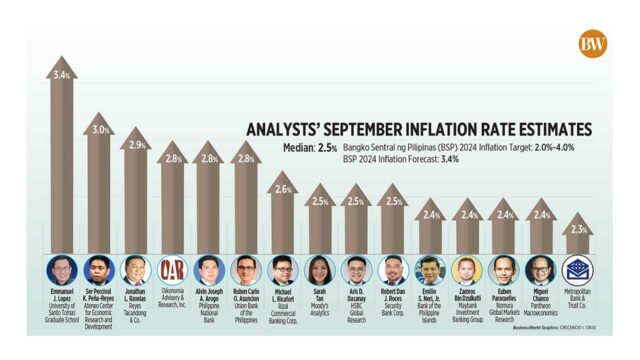
Analysts’ September inflation rate estimates

HEADLINE INFLATION likely slowed to a near four-year low in September amid falling prices of rice and fuel, giving the Bangko Sentral ng Pilipinas (BSP) room to cut benchmark interest rates further, analysts said. Read the full story.

Analysts’ September inflation rate estimates

Poultry imports from France banned after bird flu outbreak

REUTERS

THE Department of Agriculture (DA) said it banned  imports of poultry and wild birds from France after an outbreak of Highly Pathogenic Avian Influenza (HPAI) or bird flu.

In Memorandum Order no. 40, the DA said shipments of domestic and wild birds, poultry meat, day-old chicks, eggs, and semen from France were suspended.

“There is a need to prevent the entry of the HPAI virus to protect the health of Philippine poultry,” it added.

According to the Bureau of Animal Industry, avian flu cases in the Philippines have been detected in 53 municipalities across nine provinces as of Sept. 20.

The French authorities had submitted a report to the World Organization for Animal Health regarding an outbreak of H5 (N untyped) HPAI cases there.

A case was reported in Saint-Malo in Brittany on Aug. 7, according to an official report submitted by the French authorities on Aug. 12.

It added that all shipments coming from France that are already in transit, loaded, or accepted into port would be allowed provided that the products were slaughtered or produced before July 25.

In April, the DA had lifted the import ban of domestic and wild birds from France after cases of HPAI were resolved. — Adrian H. Halili

DFSK enters market with 3 electrified offerings

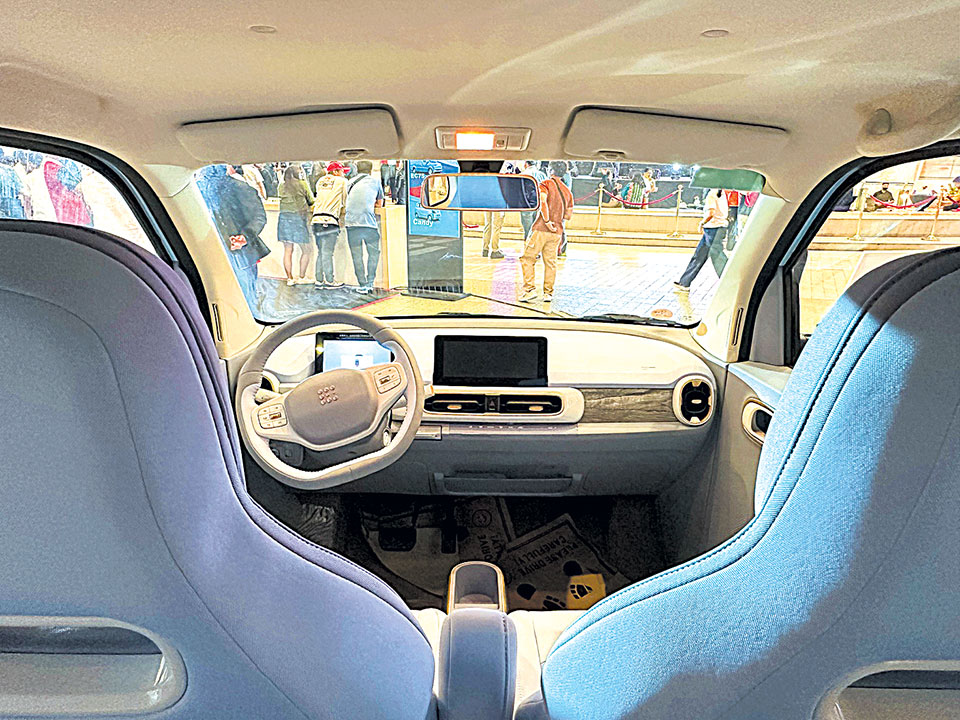
The DFSK Candy Mini EV is priced at P658,000. — PHOTO BY JOYCE REYES-AGUILA

The Seres Group brand is now here

CHINESE AUTOMOBILE brand DFSK (Dongfeng Sokon Automobile) recently made its entry in the Philippine market official. Three electric vehicle (EV) offerings were unveiled to the public at the TriNoma Mall in Quezon City: the DFSK Candy Mini EV, the DFSK E5 PHEV (plug-in hybrid electric vehicle), and the DFSK EC75 commercial van. The Chinese brand is a wholly owned subsidiary of the Seres Group, which has maintained a partnership locally with QSJ Motors since 2018.

“This an exciting time as we unveil the latest models of our electric vehicles,” QSJ Motors Junior Business Manager Kenneth Chang told guests which included bank partners, members of the media, and key opinion leaders. “It marks a significant milestone for our company as we introduce DFSK vehicles. These vehicles are not just a culmination of our dedicated efforts but also our commitment to pushing the boundaries of automotive excellence.”

The compact Candy Mini EV is said to be a cost-effective alternative to traditional vehicles, according to DFSK. The four-seater boasts up to 220 kilometers of pure battery range on a single charge, and has a 16.8-kWh battery capacity. Technology offerings include an advanced infotainment system, parking radar, and cruise control. The Candy Mini EV is priced at P658,000 and is recommended by the brand for short trips, such as running errands or going to and from the office.

Meanwhile, with the E5 PHEV, the company targets those who are looking for a PHEV for the urban commute and weekend drives. The mid-sized sport utility vehicle seats seven and has a combined range of 1,150 kilometers, with the pure electric range pegged at 100 kilometers. Available in the E5 are a dual-screen infotainment system, seat ventilation, advanced driver assistance systems (ADAS), in addition to hill start assist, traction control, and hill descent assist. The vehicle has a panoramic sunroof and a surround sound system with four speakers for the M1 variant and 12 speakers for the M2 variant. Other features in the M2 are front and rear parking radar, automatic air-conditioner control, and an intelligent air purification system. Both variants come in black, and white plus gray colors, while the M2 can also be purchased in brown. Pricing starts at P1.58 million.

Finally, the EC75 commercial van, also referred to as the “E-Negosyo Van” by DFSK in the Philippines, is fully electric. The vehicle can accommodate two and offers a seven-cubic-meter cargo space. Fully charging the 50.38-kWh battery can take as little as 45 minutes, providing the van with up to 310 kilometers of electric range. Its smart features include ADAS and real-time tracking and fleet management systems. This vehicle is priced at P1.45 million.

In a statement, DFSK says that the introduction of its vehicle lineup is designed to meet the growing demand for sustainable transportation, and contribute to efforts to combat climate change. For more information, visit www.dfsk.com.ph. — Joyce Reyes-Aguila

H&M bets on lower prices, trendy clothing to boost holiday sales

STOCKHOLM — Swedish fashion retailer H&M is banking on lower prices and a wider range of trendy clothing compared to basics to drive sales among cautious consumers in the crucial shopping months leading up to the end of the year.

Shoppers are already starting to browse for holiday items and H&M recently launched its homeware collection for the holiday season, CEO Daniel Erver said, adding that value for money will be critical as households are still under financial pressure.

H&M is the first global retailer to offer insights into its outlook for the upcoming holiday shopping season, a critical sales driver for the sector.

“We see a high search interest, actually, in holiday (products) already now,” Mr. Erver told Reuters in an interview, referring to online search trends.

He was speaking after the retailer ditched its hope for a 10% operating margin this year and reported weaker than expected third-quarter profit, but said it sees sales for September — the first month of its fourth quarter — jumping 11% compared to a year ago.

While H&M sells many cheap evergreen basics like $19.99 jeans and $7.99 T-shirts, Mr. Erver said it is shifting to a bigger share of trendy pieces that people will buy no matter the weather.

“Where we are shifting and doing the biggest leap is updating the assortment to make it more relevant, to make it in current fashion, updated aesthetics, that’s where were performing the best and that’s also the least weather-dependent,” he said.

CELEBRITY APPEAL
Shiny leather dresses with silver studs, knee-high boots, and mohair tops and skirts embellished with rhinestones all featured prominently in H&M’s autumn/winter collection modelled by pop star Charli XCX, who performed at H&M’s London Fashion Week launch two weeks ago, and supermodel Kate Moss’ daughter Lila Moss, among other celebrities.

A fluffy leopard print coat worn by Charli XCX in the advertising campaigns sold out in minutes, Mr. Erver told Reuters. He is betting that star power will boost H&M’s brand and justify the marketing splurge that is part of his turnaround strategy.

“The focus on fashionability, brand heat and activating collections with collaborations has always been probably the strongest piece of H&M’s business, and basics have just become more and more competitive,” said Deutsche Bank Research analyst Adam Cochrane.

Increasing marketing spending is “100% the right thing to do to reignite the H&M brand,” Mr. Cochrane added.

H&M will still have to use discounts to lure cash-strapped shoppers, though, and on H&M’s US website many of the items in the autumn/winter collection were marked down between 15% and 42%. A burgundy synthetic leather skirt, slashed to $10.49 from $17.99, showed as sold out.

Overall US retail sales growth is expected to be muted during the holidays as prudent shoppers hold out for the best bargains, industry experts predict.

North America is a “more challenged” region for consumer demand, Mr. Erver said. — Reuters