Home Blog Page 2045

Converge tapped to connect 600-ha industrial park in Batangas

FIRST PHILIPPINE Industrial Park is a joint venture between the local conglomerate First Philippine Holdings and the Japanese conglomerate Sumitomo Corp. — FPIP.COM

LOPEZ-LED First Philippine Holdings Corp. has tapped Converge ICT Solutions, Inc. to provide connectivity solutions for First Philippine Industrial Park’s (FPIP) 600-hectare (ha) industrial park hub in Batangas.

In a joint statement, the two parties said the collaboration would allow Converge to take advantage of FPIP’s dark fiber, enabling fiber connectivity to over 150 locators of FPIP’s industrial park.

They said the commercial agreement between FPIP and Converge would also allow FPIP to adapt to technologies like cloud services, cybersecurity solutions, and digital collaboration tools.

Converge Chief Executive Officer Dennis Anthony H. Uy said it is necessary to deliver connectivity solutions to industrial parks like FPIP because they are the driver of economic growth and critical in bringing foreign investments.

First Philippine Holdings, together with Japan’s Sumitomo Corp., established FPIP as a location for manufacturers and traders, as well as a platform for creating jobs and generating tax revenues for the government.

FPIP has established a shared infrastructure through investments in dark fiber facilities. This has allowed FPIP to maximize its existing underground infrastructure and facilitate deployment of fiber internet services for their locators.

At the local bourse on Tuesday, shares in First Philippine Holdings closed unchanged at P60.70 each, while shares in Converge went up by 68 centavos, or 4.13%, to end at P17.16 apiece. — Ashley Erika O. Jose

Airlines see early holiday booking surge

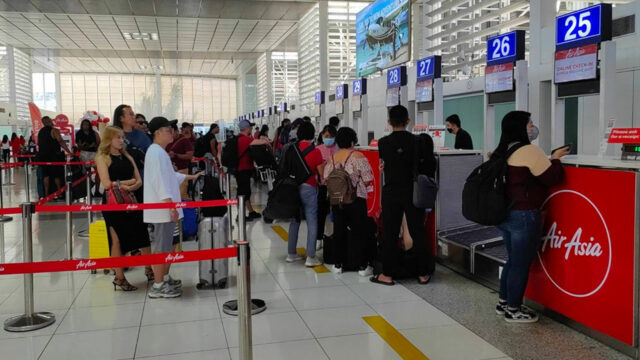
GUESTS IN QUEUE at the AirAsia check-in counters at NAIA Terminal 2. — NEWSROOM.AIRASIA.COM

By Ashley Erika O. Jose, Reporter

PHILIPPINE CARRIERS are gearing up for a surge in flight bookings as the holiday season approaches, driven by early travel planning and cost-saving measures by passengers.

“This increase is attributed to guests planning ahead and securing their travel early to save more and avoid any last-minute hassles,” AirAsia Philippines said in a statement on Tuesday.

Philippines AirAsia, Inc. (AirAsia Philippines) said it sees an increase in bookings for both domestic and international flights.

The low-cost carrier said it had logged more than 50,000 seats sold for the upcoming All Souls’ Day and All Saints’ Day, falling within the travel period of Oct. 30 to Nov. 3.

AirAsia said these numbers are also anticipated to further increase in the coming weeks.

For Christmas and New Year’s Day, AirAsia Philippines reported over half-a-million bookings, totaling 528,031 passengers. Of these, 367,455 are for domestic travel, while 160,576 are for international destinations.

“To accommodate the influx of holiday travelers, we have also increased our manpower at NAIA Terminals 2 and 3. We will always be committed to fulfilling our brand promise of reaching guests safely and on time,” said AirAsia Philippines Communications and Public Affairs Head Steve F. Dailisan.

To date, AirAsia Philippines said it has flown a total of 5.49 million passengers, about 68.5% of its eight million passenger volume target for 2024.

Meanwhile, budget carrier Cebu Pacific, operated by Cebu Air, Inc., said it is anticipating one million passengers for the upcoming All Souls’ Day and All Saints’ Day alone.

“With the addition of new routes and enhanced capacity, we expect a significant increase in passenger numbers this year,” Cebu Pacific said.

The company is also projecting growth in travel demand for the upcoming holidays, driven by its increased capacity from the newly added routes.

Cebu Pacific said earlier that the company is looking at exploring fresh destinations for Filipino travelers for both international and domestic routes.

In October, Cebu Pacific finalized its P1.4-trillion aircraft order with Airbus SE, consisting of 102 A321 new engine option (NEO) and 50 A320neo family.

For the year, the company has initially set a target of 24 million passengers, significantly higher than its 2023 passenger volume.

In the second quarter alone, Cebu Pacific carried a total of six million passengers, its highest quarterly passenger count in its history, the airline said.

The airline currently serves 35 domestic and 26 international destinations across Asia, Australia, and the Middle East.

Philippine Airlines did not respond to BusinessWorld’s request for comment by the deadline.

DMCI stockholders OK share issuance for Cemex purchase

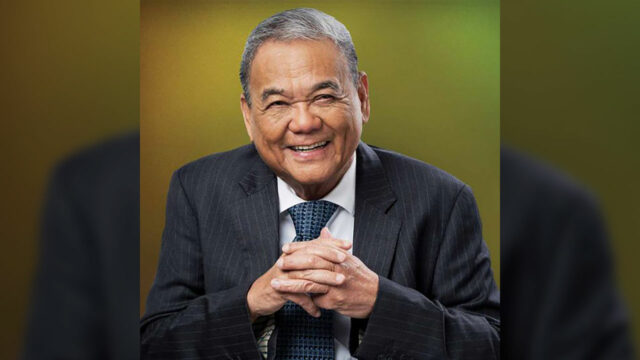
DMCI HOLDINGS Chairman and President Isidro A. Consunji — DMCIHOLDINGS.COM

DMCI HOLDINGS, Inc. has secured stockholders’ approval to issue P10 billion in preferred shares to Dacon Corp., the Consunji group’s private holding company, for the acquisition of Cemex Holdings Philippines, Inc. (CHP).

The issuance involves 10 million Class B preferred shares at P1,000 each, via private placement.

The move was approved during a special stockholders’ meeting on Tuesday.

“The reason for the financing is for us to be able to raise P10 billion for the 56.75% acquisition of Cemex Asian South East Corp. (CASEC). It does not intend to dilute the voting rights of the common shareholders. It will strengthen the balance sheet as it is treated as equity capital,” DMCI Holdings Chairman and President Isidro A. Consunji said during the meeting.

“Furthermore, the convertibility option provides the flexibility in managing the capital structure and optimizes the cost of capital,” he added.

Mr. Consunji said that DMCI remains committed to its dividend policy of at least 25% of the company’s previous year’s core net income amid the share issuance.

“The primary consideration for funding the acquisition is to optimize the financing costs and limit the impact on common shareholders’ dividends while providing mutual benefits for the investors and the company. With fixed interest rates, the annual dividend rate is at 4%,” Mr. Consunji said.

Last month, DMCI, through Dacon Corp., announced a P1.94-billion mandatory tender offer to acquire the remaining 10.14% of CHP.

The tender offer plans to buy up to 1.37 billion publicly owned CHP common shares at P1.42 apiece, equivalent to 10.14% ownership. The offer period will be from the morning of Oct. 23 up to noon of Nov. 21.

Under the planned acquisition, Dacon has been appointed as the bidder for the mandatory tender offer to acquire the remaining 10.14% of CHP’s total issued and outstanding capital stock.

In April, DMCI, Semirara Mining and Power Corp. (SMPC), and Dacon Corp. announced the acquisition of CHP for $305.6 million via a share purchase agreement.

DMCI will buy the entire share of Cemex Asia B.V. in CASEC, the majority owner of CHP with an 89.96% equity interest. DMCI will acquire a 56.75% stake in CASEC, Dacon will secure 32.12%, and SMPC will purchase the remaining 11.13%.

On Tuesday, DMCI shares dropped by 1.01% or 12 centavos to P11.72 per share. — Revin Mikhael D. Ochave

Ayala Corp. scaling new ventures

CEZAR P. CONSING — GLOBE.COM.PH

AYALA Corp. is scaling its newer businesses in healthcare, logistics, infrastructure, education, financial technology, and electric mobility, leveraging its fundraising ability, according to its president.

“Perhaps as important are our newer, less well-known businesses in healthcare, logistics, infrastructure, education, financial technology, and electric mobility. These too will benefit from our ability to raise funding,” Ayala Corp. President and Chief Executive Officer Cezar P. Consing said during a listing ceremony on Tuesday.

“Our objective is to grow these to scale so that even these relatively newer businesses can have a positive impact on the lives of a significant number of our countrymen,” he added.

Mr. Consing said this as Ayala Corp. listed its P15-billion preferred Class B shares at the Philippine Stock Exchange on Tuesday.

Under the issuance, Ayala Corp. sold 7.5 million shares, including a base offer of five million shares and an oversubscription of 2.5 million shares.

The preferred shares were issued at P2,000 per share and are payable quarterly with an initial dividend rate of 6.0538% per annum.

“This issuance provides us with the flexibility to redeem the outstanding preferred shares issued in 2019, and allows us to maintain competitiveness in our cost of capital,” Ayala Corp. Chief Finance Officer Alberto M. de Larrazabal said.

Meanwhile, Mr. Consing said the P15 billion preferred shares will help the conglomerate build businesses that “enable people to thrive.”

“Our bigger and better-known businesses, real estate, banking, telecommunications, and renewable energy, have been beneficiaries of our ability to raise funding at the holding company level,” he said.

On Tuesday, Ayala Corp. shares rose by 1.39% or P10 to 730 per share. — Revin Mikhael D. Ochave

Contemporary Philippine artists in Art Jakarta

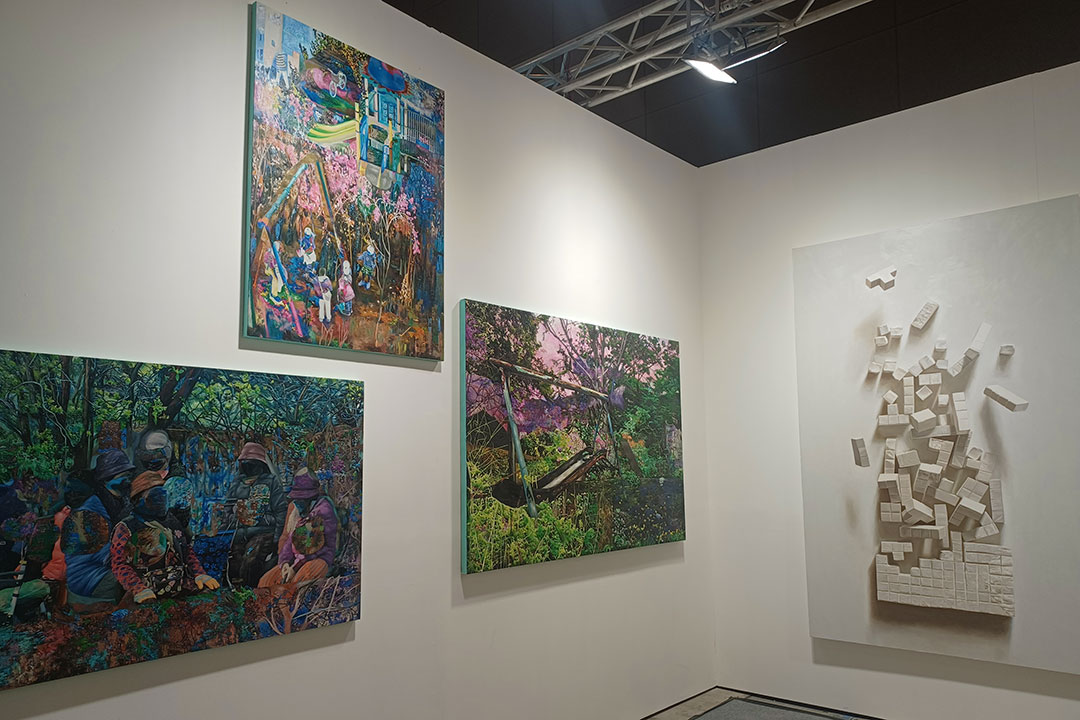
VIOLET WOMEN, Lilac Girls, and Tropical RGB by Kitty Kaburo; Stronghold 2 by Chelsea Theodossis — BRONTË H. LACSAMANA

TWO Philippine galleries participated in the recently held Art Jakarta art fair — The Drawing Room and Vinyl on Vinyl — attracting bigger crowds this year than last.

Speaking about the various Asian galleries that attended, Art Jakarta’s fair director Tom Tandio told the press that “stable regional art markets are rife with opportunities for international collaborations. By bringing together all the key players of this larger art market, we’re able to offer artists and creative minds a platform to hone their creations. It is a show of force of our countries’ importance in the global art world,” he said.

When BusinessWorld visited the two Philippine galleries during the fair’s run early in October, they were swarmed by passersby attracted by the art. Both reported that the foot traffic seemed heavier than last year (an impression later corroborated by Art Jakarta’s official count: 38,368 visitors in 2024, compared to 35,578 visitors in 2023).

THE DRAWING ROOM
At The Drawing Room’s booths hung paintings showing three women’s unique reflections on the world around them.

Nicole Decapia, the gallery’s strategies consultant, said that the goal was to bring in “striking works that might resonate in Jakarta” and that featuring all female artists wasn’t intentional.

One of the artists was Kitty Kaburo, whose colorful paintings are a great example of the kind of striking works the gallery was going for. Her paintings simulate transformations over time by depicting human activity in natural settings. The three pieces she contributed depict a playground in South Korea, its people and surroundings lit up in vibrant colors.

“As a Korean-Filipino artist, she talks about how Korea is slowly becoming a tropical climate due to changes in the environment, leading to a blurring of what is Korean and what is Filipino,” said Ms. Decapia.

Meanwhile, Victoria Montinola’s landscapes show off a classical painterly technique in the portrayal of trees. Her three works achieve both a mundane yet fantastical look due to the subtle use of color and texture.

Placed in a fair which highlights both similarities and resonances among different art practices across Asia, both artists’ works are a mark of “everything blending together in a clear display of talent.”

“The Philippines, Indonesia, and other Asian countries have similar histories, experiences, and stories, from the diaspora to the post-colonial. These connections make this fair very strong,” Ms. Decapia said.

A major draw to The Drawing Room’s booth were two paintings by Chelsea Theodossis. In them, levitating Tetris block-like objects stand out in gravity-defying compositions, creating a surreal still life.

Ms. Theodossis told BusinessWorld that it was common for people to approach her works to try and figure out if it was a mixed-media or installation work, only to find that it was a realistic painting.

“The energy here is high-level,” she said of the art fair. “It’s my first time to come along with my works because I usually just send them over. The first thing I have to say is that I’m Filipino, because we Filipinos look Indonesian!” she said.

She then talked about her art, particularly the importance of giving life to the seemingly ordinary objects that she paints. “I feel that it’s good to live as an artist now because there’s a lot of understanding for different points of view. It’s very joyful,” said Ms. Theodossis.

VINYL ON VINYL
The diverse eye-catching works of five artists who have done well internationally filled the booth of Vinyl on Vinyl.

On its outer wall facing one of the central hallways hung Iyan De Jesus’ dreamlike painting of female faces amid lotus pods and swans, composed of graceful lines and circles.

Inside, pieces by Teo Esguerra displayed a peculiar combination of aerosol paint, acrylic, and cutouts on canvas, achieving a vivid memory-like collage. These were contrasted by Dennis Bato’s striking, monochrome abstraction.

Two returning artists were part of the fun, too.

TRNZ (real name: Terence Eduarte) was the gallery’s sole artist in Art Jakarta last year, and featured animated depictions of warm, childlike scenes — not unlike his two paintings shown in this year’s edition.

Back in 2022, the first year that Vinyl on Vinyl participated in the fair, they featured a Reen Barrera solo show. This time, his return is marked by a large, colorful painting of a patchwork-faced character, with wood-and-resin figurines adding spunk to the booth.

Pia Reyes, one of the gallery’s co-founders, told BusinessWorld that it was the first time they did a group show at Art Jakarta.

“There’s no formula as to what artist will connect [with the fair’s visitors], because all of them have the potential to do so. Dennis Bato’s work is abstract-conceptual while Reen Barrera’s is more figurative, and they’re both a hit here,” she said.

“You never really know, so it’s nice to provide diversity.”

For Vinyl on Vinyl co-director Gaby dela Merced, the bond between Indonesian and Filipino artists and collectors helps a great deal.

“From the start of our gallery, we’d already been exhibiting Indonesian artists, so we enjoy bringing our Filipino artists here for a change,” she said. “If you go to fairs like Hong Kong, Singapore, or Korea, it’s more international because there’s a lot [of art] from the West. Our advantage here is the homegrown feeling, the unique flavor that comes from us relating with each other.” — Brontë H. Lacsamana


Gov’t fully awards bonds amid strong demand

STOCK PHOTO | Image by RJ Joquico from Unsplash

THE GOVERNMENT made a full award of the Treasury bonds (T-bonds) it offered on Tuesday amid robust demand and as rates were in line with secondary market levels amid expectations that the Bangko Sentral ng Pilipinas (BSP) will cut borrowing rates further at its meeting this week.

The Bureau of the Treasury (BTr) raised P15 billion as planned via the reissued 10-year bonds it auctioned off on Tuesday as total bids reached P40.876 billion, or almost three times the amount on offer.

This brought the total outstanding volume for the series to P205 billion, the Treasury said in a statement.

The bonds, which have a remaining life of six years and nine months, were awarded at an average rate of 5.69%. Accepted yields ranged from 5.65% to 5.7%.

The average rate of the reissued papers was 55 basis points (bps) higher than the 5.13% fetched for the bonds when they were last awarded on Nov. 9, 2021. This was also 169 bps above the 4% coupon rate for the issue.

Still, this was 1.4 bps lower than the 5.704% fetched for the seven-year bond, the tenor closest to the remaining life of the T-bonds on offer, and 5.53 bps below the 5.7453% quoted for the same bond series at the secondary market before Tuesday’s auction, based on PHP Bloomberg Valuation Service Reference Rates data provided by the BTr.

The government made a full award of its T-bond offer as the average yield fetched for the issue was aligned with prevailing secondary market rates, the Treasury said.

The BTr’s offer was met with strong demand as expected as the bond on offer is “relatively illiquid,” a trader said in a text message.

The Treasury fully awarded its offering as rates were slightly below comparable secondary market levels as the market expects the BSP to reduce borrowing costs at its policy meeting on Wednesday following slower-than-expected headline inflation last month, Rizal Commercial Banking Corp. Chief Economist Michael L. Ricafort said in a Viber message.

The BSP will likely cut benchmark interest rates by 25 bps for a second straight meeting on Wednesday to continue its easing cycle amid an improving inflation outlook, analysts said.

A BusinessWorld poll conducted last week showed that 16 out of 19 analysts expect the Monetary Board to reduce borrowing costs by 25 bps at its policy meeting on Oct. 16 to bring the target reverse repurchase rate to 6%.

On the other hand, two analysts expect the BSP to cut by a bigger 50 bps this week, while one sees the Monetary Board keeping rates unchanged.

The BSP kicked off its easing cycle with a 25-bp cut in August, marking the first time it reduced borrowing costs in nearly four years.

BSP Governor Eli M. Remolona, Jr. earlier said they could deliver a 25-bp rate cut at each of their October and December meetings, which would bring the policy rate to 5.75% by yearend.

Philippine headline inflation sharply slowed to 1.9% year on year in September from 3.3% in August and 6.1% a year ago.

This was below the central bank’s 2%-2.8% forecast for the month and was also the slowest print in over four years or since the 1.6% in May 2020.

For the first nine months, inflation averaged 3.4%, matching the central bank’s full-year forecast and also falling within its 2-4% annual target.

The BTr is looking to raise P145 billion from the domestic market this month, or P100 billion via Treasury bills and P45 billion through T-bonds.

The government borrows from local and foreign sources to help fund its budget deficit, which is capped at P1.48 trillion or 5.6% of gross domestic product this year. — A.M.C. Sy

Bloomberry refinances P72-B loan

BLOOMBERRY.PH

RAZON-LED Bloomberry Resorts Corp. has refinanced a P72-billion loan to enhance financial stability and preserve cash.

Bloomberry subsidiaries Bloomberry Resorts and Hotels, Inc. (BRHI), as borrower, and Sureste Properties, Inc. (SPI), as surety and third-party security provider, signed a P72-billion syndicated refinancing facility with a group of banks on Tuesday, the listed integrated resort operator said in an e-mailed statement.

The new loan facility replaces the existing P73.5-billion syndicated term loan facility obtained in 2018 and the P20-billion additional term loan facility that BRHI obtained in December 2020.

“We view this refinancing as a positive development that will allow the company to lighten its debt service and preserve cash as Solaire Resort North ramps up, improve the company’s bottom line, and ultimately ensure the consistent return of capital to our shareholders in the coming years,” Bloomberry Chairman and Chief Executive Officer Enrique K. Razon, Jr. said.

Bloomberry’s updated loan is priced at a spread that is 75 basis points lower than the previous facilities and gives the option to fix the interest rate within the next 12 months.

The feature will allow the company to benefit from further interest rate cuts that are expected to be implemented in the coming months.

The banks involved in the refinancing loan include BDO Unibank, Inc., Bank of the Philippine Islands, China Banking Corp., and Philippine National Bank.

BDO Capital served as lead arranger and sole bookrunner, while BDO Unibank, Inc. – Trust and Investments Group is the security trustee, facility agent, and paying agent.

Bloomberry’s integrated resort portfolio includes Solaire Resort Entertainment City, Solaire Resort North in Quezon City, and Jeju Sun Hotel & Casino (Jeju City) in Korea.

On Tuesday, Bloomberry shares fell by 0.88% or seven centavos to P7.89 apiece. — Revin Mikhael D. Ochave

Tiny Beautiful Things premiers this November

INSTAGRAM.COM/THESANDBOXCO

“BRING a box of tissues,” an audience member quipped after watching an excerpt of Tiny Beautiful Things: A Play About Life — In Letters.

Presented by The Sandbox Collective, the straight play is set to make its Philippine premiere this November, starring acclaimed actress Iza Calzado in the lead role. Describing the play as a “roller coaster of emotions,” during its press launch, Ms. Calzado promised that it will make audiences laugh, cry, and feel comforted, as the story explores the common threads of human experience through real letters from real people sent to an advice columnist who she plays.

Tiny Beautiful Things is based on the book — which was turned into a play, then turned into a limited TV series — written by Cheryl Strayed (the New York Times bestselling author of Wild) and adapted for the stage by Nia Vardalos (of My Big Fat Greek Wedding fame).

Gawad Buhay awardee Jenny Jamora directs Tiny Beautiful Things. She described the play as a “non-prescriptive map for life.” She told BusinessWorld that audiences will find themselves resonating with the letters, which are brought to life by the characters during the show.

“It allows us to come together in one space — the theater. We come from different places, whether from stressful lives or retirement. We are a community in this one space. Hopefully, we can see one of our stories on stage,” Ms. Jamora said during the press conference last Thursday.

Tiny Beautiful Things will run from Nov. 16 to Dec. 8 at the Power Mac Center Spotlight Black Box Theater in Circuit Makati. Performances are scheduled for Fridays at 8 p.m., and Saturdays and Sundays at 2:30 and 7:30 p.m.

This production also marks the culmination of The Sandbox Collective’s 10th anniversary season, which included productions of The 25th Annual Putnam County Spelling Bee and Little Shop of Horrors.

LETTERS AND ADVICE
Ms. Calzado plays an advice columnist known by the pen name Sugar, who receives letters from various senders seeking advice on their lives.

The letter writers are portrayed by Gabby Padilla, a theater, film, and TV actress last seen in I Love You, You’re Perfect, Now Change; Ketchup Eusebio, making a comeback to the stage after appearing in the Ang Tanging Ina films, the Maalaala Mo Kaya anthologies, Heneral Luna (2016), and Un/Happy For You; Brian Sy, known for his role in Mula sa Buwan; and Regina De Vera, who made her theatrical debut in the US with The Underpants.

“I don’t know if my unorthodox approach is right or wrong. Advice columnists are supposed to position themselves as ‘the ones who know,’ but I am not that person; I am the one who is wrong… but this is who I am,” Iza Calzado said in her portrayal of Sugar during the showcase performance.

Eventually, Sugar and the letter writers will converge in a unified metaphorical space. — Edg Adrian Eva

Central banks remain keen buyers of gold, officials tell bullion conference

BW FILE PHOTO

MIAMI — Central banks remain keen buyers of gold to diversify their reserves for financial or strategic reasons, representatives of three central banks told the London Bullion Market Association’s annual conference in Miami on Monday.

Elevated demand for gold from central banks underpinned the price of the non-yielding gold when the global interest rates were high in 2022-2023 and then slowed down with this year’s 28% spot gold price rally. China’s central bank held back on buying gold for a fifth straight month in September.

Despite the gold rally, representatives of central banks of the Czech Republic, Mongolia and Mexico told the conference that having gold in reserves still matters to them, even though each one of them has their own reasoning.

The importance of gold as a secure asset is increasing for Mongolian reserves, Enkhjin Atarbaatar, head of the financial markets department at the Central Bank of Mongolia, told the conference.

For the Czech National Bank (CNB), gold is viewed as a pure diversifier of reserves, Marek Sestak, deputy executive director of the risk management department at the CNB, said.

All three said that they were not currently active in gold derivatives and that London remained the main storage location for their gold as a trading hub, while only Mongolia had limited appetite for repatriation of gold to store it at home.

Global central banks increased purchases for their reserves by 6% to 183 tons in the second quarter, according to the World Gold Council, and are on track to slow buying in full 2024 by 150 tons from 2023. — Reuters

Laguna hydro plant privatization on track for 2025 — PSALM

CBKPOWER.COM

STATE-RUN Power Sector Assets and Liabilities Management Corp. (PSALM) is on track for the privatization and turnover of the 796.64-megawatt (MW) Caliraya-Botocan-Kalayaan (CBK) hydroelectric power plant (HEPP) complex in Laguna next year, its president said.

“We’re undergoing a privatization process this year. We hope to have a successful bidding next year,” PSALM President and Chief Executive Officer Dennis Edward A. Dela Serna said during a Senate budget hearing on Tuesday.

Mr. Dela Serna said that the company is targeting to determine the indicative price for the CBK hydropower complex one to two months prior to the bidding.

The CBK hydro facilities are currently under a 25-year build-rehabilitate-operate-transfer and power purchase agreement between independent power producer CBK Power Co. Ltd. and National Power Corp. (NPC), which will expire in 2026.

These facilities include the 39.37-MW Caliraya HEPP in Lumban, the 22.91-MW Botocan HEPP in Majayjay, and the 366-MW Kalayaan I and 368.36-MW Kalayaan II pumped storage power plants in Laguna.

Currently, PSALM has identified six qualified bidders.

As of June, the company has privatized at least 82% of the generation assets, equivalent to 9,026 megawatts.

The remaining assets under PSALM include the CBK hydroelectric complex, the Agus-Pulangi hydroelectric complex, and a coal-fired power plant in Mindanao.

Mr. Dela Serna noted that the Agus-Pulangi facilities are up for rehabilitation. He said that PSALM has received numerous comments on the modality as there are concerns that it may lead to higher rates.

“In this case, the main concern really is the cost of power… We currently give the lowest rates in Mindanao. We can enter into long-term contracts with cooperatives and distribution utilities and assign it to the concessionaire,” he said.

The Agus-Pulangi hydropower complex consists of seven run-of-river hydroelectric power plants located in southern and central Mindanao with a combined installed capacity of 1,001.1 MW.

PSALM was created under Republic Act No. 9136, or the Electric Power Industry Reform Act of 2001, to lead the privatization of generation and transmission assets of the NPC and the National Transmission Corp.

It is also tasked to liquidate the financial obligations and administer the Universal Charge for Missionary Electrification (UCME).

“We have reduced the total financial obligations by 78% from P1.2 trillion in 2023 to P277 billion in June of 2024,” Mr. Dela Serna said.

PSALM’s corporate life is set to expire in June 2026, or 25 years after the effectivity of EPIRA. Should PSALM be dissolved, all its assets and liabilities will revert to the National Government. — Sheldeen Joy Talavera

Another epic adaptation hits the stage

Ballet Manila breathes life into Florante at Laura

By Brontë H. Lacsamana, Reporter

Ballet Review
Florante at Laura
Ballet Manila

MASTERS of dance, music, literature, and stage production are coming together to stage the first-ever ballet adaptation of the 1838 Filipino literary classic Florante at Laura by Francisco “Balagtas” Baltazar.

Helmed by Ballet Manila’s co-artistic associate and Ibong Adarna choreographer Gerardo Francisco, in collaboration with British choreographer Martin Lawrance, the show was already conceptualized before the pandemic. Its world premiere, which finally hit the Aliw Theater stage on Oct. 12, was a joyous celebration of the meeting of creative minds.

Aside from the two dance auteurs, renowned writer and balagtasan expert Professor Michael Coroza came on board to create a libretto, while Pinoy music pioneer and National Artist for Music Ryan Cayabyab took on the challenge of creating the music. His original compositions will be performed live by the Orchestra of the Filipino Youth (OFY) under the baton of his son, Toma Cayabyab.

“Something magical happens when artists come together,” said Lisa Macuja-Elizalde, Ballet Manila’s creative director, before the show on Oct. 12. The production’s premiere coincided with her birthday celebration.

She shared how ecstatic she was when all the artistic virtuosos she invited said yes to the project. Mr. Cayabyab, in particular, last worked with Ballet Manila in 2004 for Mga Kwento ni Lola Basyang, making his comeback composing music with the company all the more memorable.

Ms. Macuja-Elizalde likened him to “a Filipino Tchaikovsky — sweeping, dramatic, powerful, and romantic.”

For Mr. Cayabyab, the project was a daunting one. “It had been quite some time since I wrote a large musical work,” he told the press before the show. “I challenged myself into accepting this, and I hope that it becomes an important legacy for all of us involved in it.”

SHORT REVIEW
BusinessWorld caught the Oct. 13 show, which was attended by a variety of families, friends, ballet and music enthusiasts, and audiences both young and old. Coming from the success of Ballet Manila’s Ibong Adarna adaptation, expectations were high for another renowned Filipino literary adventure.

From the grand overture that OFY played before the curtains lifted, right up to the ending when the audience erupted in applause, the production lived up to the hype. The live music elevated the action-packed narrative, which featured the most important beats found in the old novel. The few children that were in the audience curiously peeked into the orchestra pit before and after the show, entranced by where the music was coming from.

Florante at Laura is a large-scale story, following the duke Florante who is held captive and enslaved by the Turks and how he escapes, with the help of Aladin, to return to his country, Albania. His faceoff with the usurper, Count Adolfo, and reunion with his beloved Laura drive home powerful themes of love and friendship.

Principal dancers Joshua Enciso and Abigail Oliveiro portray the titular Florante and Laura with much emotion and grace, their experience as lead dancers shining in their drama-filled roles. The choreography is striking, the audience able to feel every moment of action, romance, or quiet. The large dance pieces, in particular, manage to consolidate the strong energy of the Ballet Manila’s ensemble of dancers.

The stage was transformed into a unique representation of the Kingdom of Albania thanks to set designer Mio Infante. The geometric set pieces, ranging from castle interiors to dense forests, moved smoothly and evoked both physical spaces as well as the internal conflicts of the characters amid war.

Costumes by Make It Happen, led by Otto Hernandez and Therese Arroyo Hernandez, added to the grand visual aesthetics. Color-coded clothes defined the characters, the Albanian kingdom in blue, the Turks in red, and the usurper’s faction in green. Lighting director John Batalla also did a wonderful job using colors to differentiate moods in the play.

Overall, those who are vaguely familiar with Florante at Laura as a high school requirement will have a newfound appreciation for it. It is fast paced yet elaborate in its beautiful details and emotional beats, making it fairly easy to follow. Mr. Cayabyab’s music stays with the audience, the recurring musical motifs in the show remaining in one’s head even after having left the theater.

A true product of collaboration, it goes to show how putting great creative minds together — be it from music, dance, literature, or stage production — can bring classic material to new audiences.

The final performance on Oct. 19 will be staged at the Aliw Theater, CCP Complex, Pasay City. For tickets, visit ticketworld.com.ph.

CBS on track to reach 2024 earnings target

BW FILE PHOTO

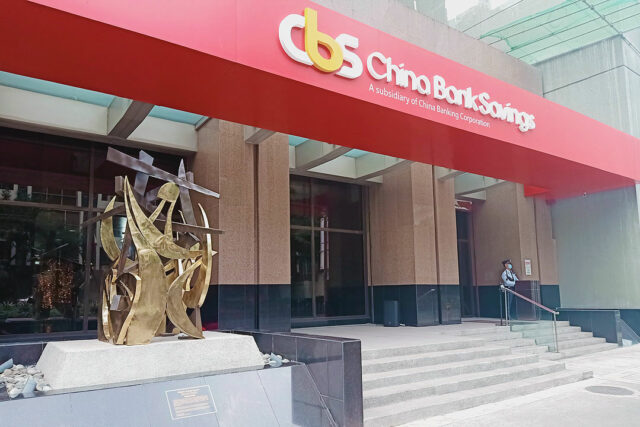
CHINABANK Savings, Inc. (CBS), the thrift banking arm of listed China Banking Corp. (Chinabank), has surpassed its loan growth target for the year and expects further expansion amid declining interest rates, which would put it on track to reach its 2024 income goal, its top official said.

“In terms of growth, we’ve actually already hit our year-end target in loans as of October,” CBS President James Christian T. Dee told BusinessWorld on the sidelines of an event on Friday.

Mr. Dee previously said CBS wants its loan portfolio to reach P130 billion by end-2024.

As of end-June, the thrift bank’s net loans grew by 9.39% year on year to P127.28 billion, latest data from the Bangko Sentral ng Pilipinas (BSP) showed.

The growth in its loan book puts the bank on track to reach its P2.15-billion net income target for this year, Mr. Dee said.

“Actually for net income, we’re just right on target. We’re looking forward to some easing in rates to support our final year-end target,” he said.

“Looking toward the next year, we’re generally optimistic because hopefully, with rates stabilizing or easing, we’re looking at even better numbers for 2025,” Mr. Dee added.

CBS booked a net income of P1.001 billion in the first semester, rising by 14.4% from P875 million in the comparable year-ago period, according to its listed parent’s quarterly report.

In 2023, the thrift lender posted a net profit of P1.828 billion.

Mr. Dee earlier said the thrift bank targets to grow its loan portfolio to P151 billion in 2025, backed by expectations of growth in its retail banking segment.

The BSP in August cut benchmark interest rates for the first time in nearly four years, slashing its policy rate by 25 basis points (bps) to 6.25%.

A BusinessWorld poll conducted last week showed that 16 out of 19 analysts expect the Monetary Board to reduce borrowing costs by another 25 bps at its policy meeting on Wednesday (Oct. 16) to bring the target reverse repurchase rate to 6%.

On the other hand, two analysts expect the central bank to cut by a bigger 50 bps this week, while one said the Monetary Board could leave rates unchanged.

BSP Governor Eli M. Remolona, Jr. earlier said they could deliver a 25-bp rate cut at each of their October and December meetings, which would bring the policy rate to 5.75% by yearend.

CBS’ listed parent Chinabank booked an attributable net income of P5.53 billion in the second quarter, down by 4.75% year on year as trading losses multiplied by nearly six times. This brought its net profit for the first semester to P11.44 billion, up by 5.65% year on year.

Chinabank shares went up by P1.80 or 3.02% to end at P61.40 apiece on Tuesday. — Aaron Michael C. Sy