
How PSEi member stocks performed — November 5, 2024

Here’s a quick glance at how PSEi stocks fared on Tuesday, November 5, 2024.


Here’s a quick glance at how PSEi stocks fared on Tuesday, November 5, 2024.
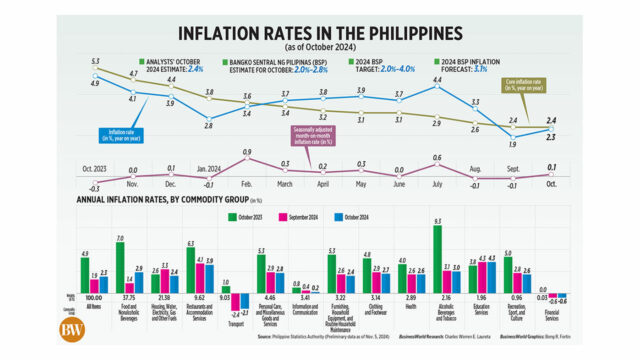
HEADLINE INFLATION picked up to 2.3% in October amid higher food prices, particularly rice, the Philippine Statistics Authority (PSA) reported on Tuesday. Read the full story.

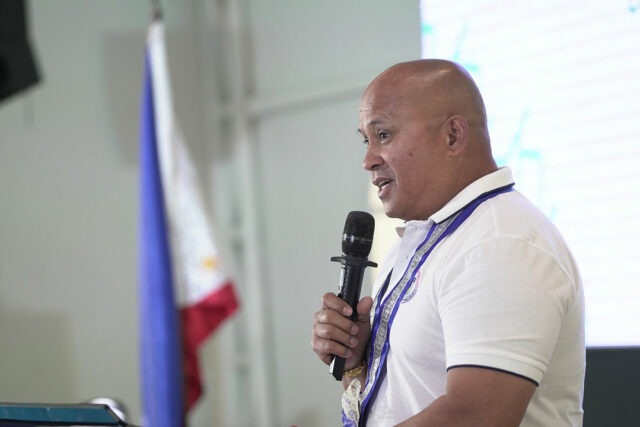
A SENATOR who enforced ex-President Rodrigo R. Duterte’s deadly drug war as his national police chief on Tuesday rejected a plan to hand over the transcript of the Philippine Senate’s investigation of the crackdown to the International Criminal Court (ICC), saying this would mean recognizing the tribunal’s jurisdiction to probe crimes against humanity allegedly committed by the government.
“Giving in to their request is tantamount to recognizing their jurisdiction over us,” Senator Ronald M. dela Rosa told a news briefing. “And our government is very consistent in declaring that the ICC has no jurisdiction over us, so I hope as a co-equal branch with the Executive, that we follow the same line.”
The Hague-based tribunal is looking into alleged crimes against humanity committed during the drug war, where thousands of suspects died.
The government estimates that at least 6,117 people died in Mr. Duterte’s drug war between July 1, 2016 and May 31, 2022, but human rights groups say the death toll could be as high as 30,000.
Senate President Francis “Chiz” G. Escudero earlier said that the Senate would be willing to submit to the ICC an official transcript the recent blue ribbon subcommittee hearing where Mr. Duterte gave “no apologies, no excuses” for his war on drugs.
The tough-talking former President admitted having ordered police officers in his hometown of Davao City when he was its mayor to goad criminals to fight back during anti-illegal drug raids so cops will have a reason to retaliate, adding that he had a hit-squad tasked to eradicate crimes.
He also said his ex-police chiefs were “commanders of death squads” since they took care of criminal syndicates, but denied ordering them to kill innocent people.
“We also have to ask for what purpose do we need to hand over a certified true copy of the transcript?” Mr. Dela Rosa asked.
The former police chief earlier said he is not worried about the ICC amid the Senate probe of the crackdown, adding that he would not inhibit himself from the investigation.
Withdrawing from the investigation would be a “disservice to the Filipino people,” he said, citing the need to debunk lies and paint a truthful picture of the anti-illegal drug campaign.
The Philippines under Mr. Duterte withdrew from the ICC in March 2018 amid criticisms that his government had systemically murdered drug suspects in police raids. It took effect a year later.
Philippine President Ferdinand R. Marcos, Jr. has ruled out working with the ICC, citing the country’s working justice system.
“I am not worried [about the ICC],” Mr. Dela Rosa said. “If Malacañang says that we do not recognize the ICC’s jurisdiction, then we should not recognize it as a country.”
Also on Tuesday, congressmen said Mr. Duterte should keep his promise and attend a separate House of Representatives probe of his anti-narcotics campaign.
Mr. Duterte had assured the House that he was willing to attend the House quad committee’s hearing on alleged extrajudicial killings during his administration, according to a letter sent by his lawyer last month to Surigao del Norte Rep. Robert Ace S. Barbers, who heads the panel.
The House quad committee will meet again on Thursday to continue its probe.
“It would demonstrate that he’s not afraid of accountability, just as he showed in the Senate probe, where he took responsibility and advocated for the victims of extrajudicial killings during his administration,” Lanao del Sur Rep. Zia Alonto Adiong said in a statement.
Mr. Duterte should attend the committee hearing because there has been a “repeated demand for public accountability” over his drug war policy, Zambales Rep. Jefferson F. Khonghun said in a separate statement. “Innocent lives have been lost in the name of the purported war against illegal drugs.”
Mr. Duterte’s lawyers might advise him to skip the House hearing to avoid incriminating himself further, La Union Rep. Francisco Paolo P. Ortega V said in a separate statement.
“I believe his legal team might pursue a ‘play it safe’ strategy of ‘less talk, fewer mistakes,’ and they can best achieve this by advising Duterte not to attend the quad committee hearing,” he said. “They’ll only dig themselves deeper if the former President speaks.”
Mr. Duterte told the Senate he takes “full legal and moral responsibility” for his anti-drug campaign’s “mistakes and crimes.” — John Victor D. Ordoñez and Kenneth Christiane L. Basilio

A HOUSE of Representatives committee on Tuesday approved a bill that seeks to extend foreign investors’ land lease limits to 99 years from 75 years as part of government efforts to attract foreign investments.
House Bill No. 10755, filed by several congressmen led by Speaker and Leyte Rep. Ferdinand Martin G. Romualdez, wants to reduce investment risk and uncertainties facing foreign investors by stretching land lease limits.
“It’s high time to amend this law,” Board of Investments Governor Marjorie O. Ramos-Samaniego told congressmen at a House Trade and Industry Committee hearing, referring to the 31-year-old Investors’ Lease Act.
The measure is a legislative priority of President Ferdinand R. Marcos, Jr.’s government.
The committee introduced changes to the measure, including the removal of a requirement for foreign investors to have a registered investment certified by an investment promotion agency under the Corporate Recovery and Tax Incentives for Enterprises (CREATE) Act to rent land.
Export processing zones and free port authorities are empowered to be a registration agency for foreign investors, Leyte Rep. Anna Victoria Veloso-Tuazon said.
Criminal liabilities for corporate officers of foreign companies with a land lease contract were also removed under the amended version of the bill. The House body also made optional a provision that originally required lease contracts to be registered with the Registry of Deeds.
Allowing foreign investors to lease Philippine land for as long as 99 years could improve the country’s prospect as an investment destination, matching its regional neighbors, National Economic and Development Authority Assistant Director Bien A. Ganapin told the committee hearing.
“By providing long lease periods, the Philippines will effectively be on par with regional peers that offer comparable investment incentives,” he said.
“Extending the lease of private lands will further liberalize foreign property rights ownership, [which] may encourage more foreign investors in addition to current incentives already provided by existing economic liberalization laws,” he added, referring to the Public Services and Foreign Investment laws.
Extending the land lease limits could enhance the country’s investment climate, Ms. Samaniego said, adding that it would make the iron, steel and shipbuilding sectors and other industries more attractive to foreign investors since they will have more time to recover initial investments.
It would also provide foreign investors “the confidence to undertake long-term projects,” helping them make strategic business decisions with a sense of security, Nueva Ecija Rep. Rosanna V. Vergara said.
The committee also approved a bill institutionalizing Mr. Marcos’s executive order (EO) creating green lanes for strategic investments.
Filed by Bukidnon Rep. Jose Manuel F. Alba, House Bill 8039 seeks to codify into law EO No. 18, which the President issued last year.
“His executive order was issued to promote the Philippines as a top investment destination, and to encourage investors to engage in strategic investments by ensuring that the country’s regulatory environment is conducive to business operations,” according to the bill’s explanatory note.
“It’s our aim to have this institutionalized because we see that it is a very effective mechanism in facilitating the permits and licenses… for strategic investments,” Ms. Samaniego said. — Kenneth Christiane L. Basilio

THE National Economic Development Authority (NEDA) Board has revised the implementation period and approved changes in the scope of work of two major flood-control projects in the capital region and nearby provinces, resulting in cost increases.
The Board, which met at the presidential palace on Tuesday, approved a 65-month extension for the implementation period of the Cavite Industrial Area-Flood Risk Management Project, which was initially set to be implemented from October 2019 to April 2024.
This more than doubled the project cost to P22.04 billion from P9.9 billion, the Presidential Communications Office (PCO) said in a statement.
The project aims to “mitigate flood damage in the lower reach of San Juan River Basin and its adjacent Maalimango Creek Drainage Area in Cavite.”
The Board also approved a 63-month extension for the implementation of the Pasig-Marikina River Channel Improvement Project-Phase IV, which was expected to be implemented by December this year.
The scope of work for the project was also revised, including the widening of diversion channels and adding drainage channels, the PCO said.
“Another adjustment was a loan reallocation worth 1.04 billion yen from consulting services (384 million yen) and contingencies,” it added.
It said that as of Sept. 30, the project had an overall physical accomplishment of 44.21% “with a negative slippage of 55.79%.” It has a fund use rate of 35.42% or P3.5 billion already disbursed, according to the palace.
The Board also approved a 63-month extension for the implementation of the Pasig-Marikina River Channel Improvement Project – Phase IV, which was expected to be implemented by December.
This increases the total cost by 74.32% or P24,599.29 million to P57,696.87 million from P33,097.58 million.
There will also be changes in scope of work such as the design of the Middle Marikina River, modifications in drainage facilities, and additional work, the PCO said.
“A loan reallocation totaling 3.37 billion yen from consulting services (1.73 billion yen) and contingencies (1.65 billion yen) to the civil works component was also approved by the Board, including a supplemental loan of 45.76 billion yen,” it added.
Set to benefit residents of the cities of Pasig, Marikina and Quezon City in Metro Manila, and the municipalities of Taytay and Cainta in Rizal, the Pasig-Marikina River Channel Improvement Project aims to mitigate flood damage in the capital region caused by channel overflow of the Pasig-Marikina River.
Meanwhile, the PCO said the NEDA Board had also approved the implementation of the locally financed Philippine International Exhibition Center project and the acquisition of 40 units of fast patrol craft to be funded through official development assistance. — Kyle Aristophere T. Atienza

THE Philippine Senate on Tuesday night approved on second reading a bill that seeks to promote the production of indigenous natural gas and liquefied natural gas, which the government sees as a transition fuel toward renewable energy.
Under Senate Bill No. 2793 or the proposed Philippine Natural Gas Industry Development Act, the Department of Energy will oversee strategies to develop the downstream natural gas industry.
The Philippines is hard-pressed to find other sources of indigenous energy as the Malampaya gas field, which supplies a fifth of the country’s power requirements, nears depletion. The gas field is expected to run out of easily recoverable gas by 2027.
The Philippines plans to raise the share of renewable energy in the country’s energy mix to 35% by 2030 and to 50% by 2040 from 22% now.
Under the bill, the Energy Regulatory Commission (ERC) will keep track of the government’s share and other revenues related to the production of indigenous natural gas sold to power plants.
LNG storage and regasification terminals will not be considered as a public utility operation under the measure.
Downstream natural gas industry projects, as certified by the Department of Energy, will also be entitled to a value added tax (VAT) exemption in the purchase and sale of indigenous gas attributed to aggregated fuel as authorized by the ERC.
Facilities used for the production of downstream natural gas are also entitled to zero-rated VAT for the local supply of goods and services needed for their operations. — John Victor D. Ordonez

By Chloe Mari A. Hufana, Reporter
THE National Solid Waste Management Commission (NSWMC) urged local government units (LGUs) to provide access to waste resources to help implement the Extended Producers’ Responsibility (EPR) Act, which requires private firms to recover the plastic and packaging waste they produce and distribute.
“The biggest challenge [in implementing this law] is that even if the industry wants to recover [waste], unless we get the support of the general citizenry [and] the LGUs to give us access to the actual waste in a condition that we need it so that we can valorize it, we’re going to have a very difficult time,” NSWMC Commissioner and Vice Chairman Crispian N. Lao told BusinessWorld on the sidelines of the Road to Zero Waste Summit in Mandaluyong City on Tuesday.
The Extended Producers’ Responsibility Act, under Republic Act (RA) No. 11898, identifies plastic waste as a recovery requirement for enterprises, which means any packaging made from synthetic material should be collected and properly handled by manufacturers.
“The government is starting with plastics because it’s a bigger problem and other [materials] will follow,” Mr. Lao added.
He urged private companies to support compliance with the law and to “do what needs to be done so that we can be responsible for the packaging that we put in the market.”
Mr. Lao said legislations such as RA 11898 and the Ecological Solid Waste Act, RA No. 9003, “are enough” but implementing such laws is lacking.
This comes after the Metropolitan Manila Development Authority (MMDA) launched its 10-Year to Zero Waste Program on Tuesday to promote practices that support a “sustainable and circular economy” to address solid waste management issues in the capital region.
Speaking at the event, MMDA General Manager Procopio G. Lipana said the summit is a commitment to solid waste disposal and management, protecting landfills, and proactive adherence to RA 9003 and RA 11898.
In a statement on the same day, MMDA cited its 2023 study on Waste Analysis and Characterization in Metro Manila, which found that 21.44% of household waste could be recycled.
While a report from the Department of Environment and Natural Resources Environmental Management Bureau estimated that 85% of waste generated could be composed, it added.
“If left unattended, they will continue to degrade our environment, pollute our waterways, contribute increasingly to flooding, and hinder our economic growth, ultimately impacting our economy and overall public health,” MMDA Chairman Romando S. Artes said in his welcome remark.

Greenpeace Philippines on Monday urged the country’s corporate regulator to enforce stronger climate accountability on companies, after the soon-to-be host of the world’s Loss and Damage Fund was hit by strong storms killed at least 150 people.
In a statement, the environmental group said guidelines on sustainability reporting and climate disclosures operate under a “comply or explain” approach, limiting accountability in terms of corporate greenhouse gas emissions.
“If a company does not comply with the guidelines or fails to meet disclosure requirements, they can provide an explanation “for items where they still have no available data,” it said.
On Tuesday, community representatives including farmers and fisherfolk from a central Philippine province that was hit by Super Typhoon Haiyan (Yolanda) in 2013 hand-delivered a letter to the Securities and Exchange Commission asking it to enforce sustainability reporting and climate-related financial disclosures for publicly listed companies.
The lack of comprehensive transparency “undermines the principle of disclosure, which is an essential component of holding companies accountable if their operations or activities contribute to the worsening of the climate crisis,” they said in a letter to SEC Chairman Emilio B. Aquino.
In an email, Ryan Jay Roset, senior legal fellow at the Legal Rights and Natural Resources Center, which provides legal support to victims of Haiyan in Eastern Samar, said the SEC is “mandated to establish a socially conscious free market, and as such should ensure businesses are accountable not only to their shareholders but to the broader public as well.”
“In the context of the climate crisis, this duty includes ensuring that corporations, most especially those in environmentally critical or carbon intensive industries such as energy, oil, gas, and mining, comply with stringent requirements on climate-related financial disclosures,” he added.
Greenpeace campaigner Virginia Benosa-Llorin, who accompanied the typhoon victims to SEC office, said the government “must concretize the responsibility of businesses in the context of the climate crisis.” — Kyle Aristophere T. Atienza

THE Department of Labor and Employment (DoLE) on Tuesday said it distributed over P30.83 million in wages from Oct. 28 to Nov. 5 to the citizens of the Bicol Region affected by severe tropical storm Trami (Local name: Kristine) as part of its cash-for-work initiative.
The department aided over 7,000 workers in the region composing the provinces of Albay, Camarines Sur, Masbate, Sorsogon, and Catanduanes, it said in a statement.
According to DoLE Region 5, each beneficiary provided various community services, such as clean-up drives, community-based farming initiatives, planting of disaster-resilient crops, and repacking relief goods.
They received a daily wage of P395, depending on the number of workdays they rendered, it added.
The initiative is under the Tulong Panghanapbuhay sa Ating Disadvantaged Workers (TUPAD) program, where temporary jobs are provided for workers in 10 to 30 days in community-related tasks, especially during times of disasters and calamities.
Greenpeace Philippines dubbed Trami as the “third-[most] highly devastating weather event to batter the country this year.” — Chloe Mari A. Hufana

THE Marcos government has suspended an anti-crime task force official following a supposed mistreatment of a Filipino as authorities served an arrest warrant in an alleged scam hub in Bataan province.
The Office of the President ordered Presidential Anti-Organized Crime Commission (PAOCC) spokesman Winston John R. Casio to submit a written explanation after his “alleged involvement in the incident involving the mistreatment of a Filipino national on October 31, 2024 at CENTRAL ONE in Bagac, Bataan.”
“This incident occurred following the execution of a search warrant at the location is reported to have been documented, with the footage now circulating on social media platforms.
In the footage, Mr. Casio was seen slapping a worker of a Philippine offshore gaming operators (POGO) during the Oct. 31 raid.
The palace said Mr. Casio has been “relieved” of his responsibilities as PAOCC spokesman “until the completion” of its investigation.
In a statement, Mr. Casio admitted his act and said he “should have simply filed the necessary charges against the person who flashed the dirty finger at us and insulted our office with vitriol.”
“Then again, my temper got the better of me.”
Mr. Casio said the public should never associate his actions with the entire PAOCC.
“As I embark on a period of reflection during this most humbling time, I subject myself to whatever administrative measures that the Commission will impose. No matter where this episode will lead me, I will continue to serve the Filipino people in whatever capacity.”
Mr. Casio has been the face of the PAOCC as the Marcos government wages a crackdown on POGOs, which have been linked to Chinese syndicates and transnational crimes.
POGOs, which mainly cater to Chinese markets and had been widely embraced by the previous administration, have been a major headache for the Philippine government, so much so that Mr. Marcos ordered a ban in July. — Kyle Aristophere T. Atienza

AIR CANADA is seeking additional direct flights between Canada and the Philippines as part of its Asia-Pacific route expansion plans, the Department of Transportation (DoTr) said.
“We are ramping up linkages with other international destinations. Our aim is to launch and expand new routes of flight networks in various parts of the world,” Transportation Secretary Jaime J. Bautista said in a media release on Tuesday.
Mr. Bautista said that the additional flights between the two countries will spur economic growth for the Philippines.
“It will contribute not only to our economic growth but also to the growth of both of our societies,” Mr. Bautista said.
Canadian Ambassador to the Philippines David Hartman has also expressed his optimism that the flight expansion will help capture the growing demand in the North American region.
To recall, the DoTr said previously that it is targeting to introduce new routes and expand flights frequencies from the Philippines to US, United Kingdom, Australia, and other countries in Asia to boost the country’s link to other destinations.
In September, the DoTr announced that Air France-KLM Group would start non-stop direct flights from Manila to Paris starting Dec. 8 to boost tourism in the two countries. — Ashley Erika O. Jose
DAVAO CITY — An official of the National Labor Relations Commission – Regional Arbitration Branch 11 (NLRC-RAB 11) reported on Monday that NLRC 11 exceeded its 84% target for a nine-month process cycle time in case disposal from 2020 to 2024.
NLRC-RAB 11 Executive Labor Arbiter lawyer Nelia Tancio-Sedillo said that NLRC 11 has consistently met and exceeded the nine-month process cycle time.
“We have process cycle time, which is the period in which the labor arbiters were given time to resolve the cases pending before them. The maximum is nine months… because we have to acquire jurisdiction over the respondent of services of summons that it entails time to serve the summons. Mostly we serve summons by way of personal service or by mail,” Ms. Sedillo explained in mixed Filipino and English during the Kapehan sa Dabaw at SM City Davao.
Ms. Sedillo said in 2020, NLRC was able to resolve 93% of cases; 93% in 2021; 94% in 2022; 98% in 2023; and 90% as of July 2024.
For 2024, according to Ms. Sedillo, as of August 31, NLRC 11 has a total of 1,277 cases handled. Of this number, 860 were disposed of, while 417 cases are pending.
“Of course, all cases go through conciliation and mediation, whether settled or not, there are instances where the complainant will not file a position paper, because we will require the parties of a position paper in case there is no settlement during the conciliation and mediation,” she said.
Ms. Sedillo said the majority of the cases handled by NLRC 11 involves industries that include security and manpower agencies. Ms. Sedillo also said that 80% of cases lodged to NLRC 11 are illegal dismissal. — Maya M. Padillo
