Home Blog Page 1982

DMCI Homes eyes P30B from Kalea, plans more Cebu projects

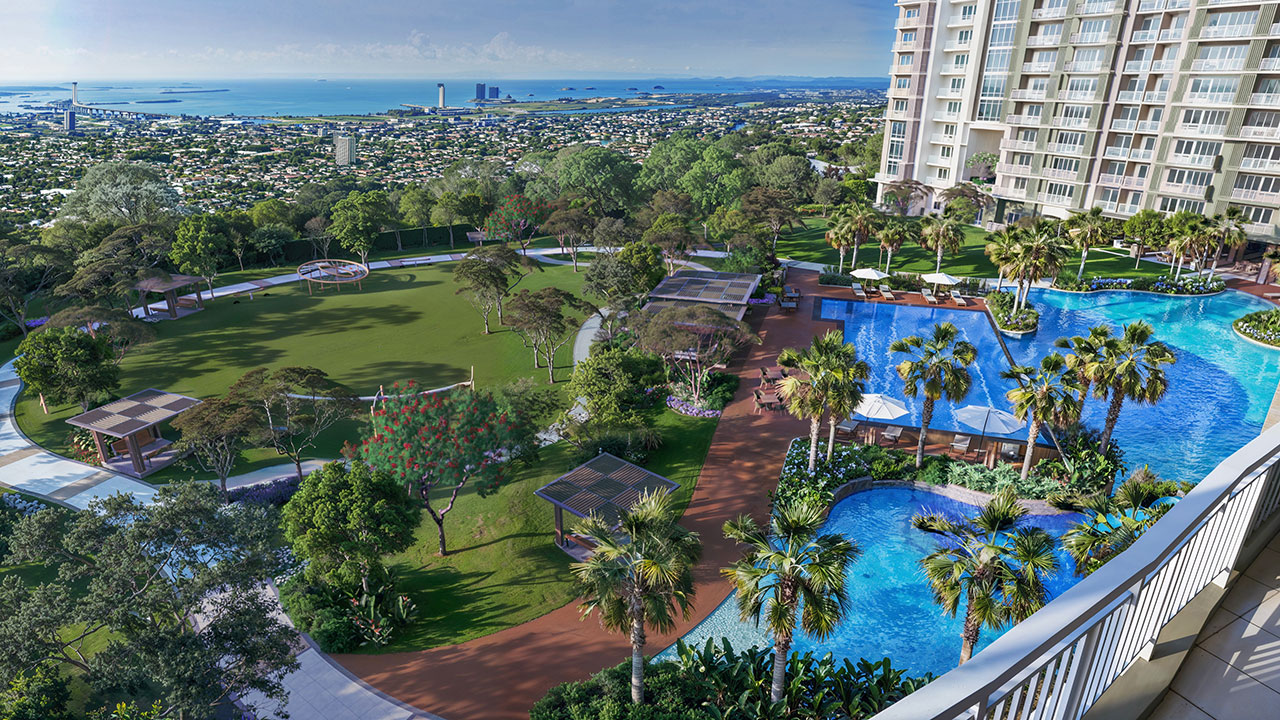
KALEA HEIGHTS is DMCI Homes’ first venture into Cebu’s real estate market.

By Beatriz Marie D. Cruz, Reporter

DMCI Homes, Inc. expects its four-tower project, Kalea Heights, in Cebu City to generate around P30 billion in revenue, the Consunji-led developer said.

“Here in Cebu, we’ve observed that other developments’ approach to solving urban lifestyle issues is different from ours,” DMCI Group Chairman Isidro A. Consunji said in a media briefing last week.

“I think our approach is superior in terms of value, features, open space, and so forth.”

Kalea Heights, located along Good Shepherd Road in Barangay Guadalupe, is a 4.6-hectare residential condominium project.

This project is DMCI Homes’ first venture into Cebu’s real estate market.

The total investment for the project is around P24 billion, according to the real property developer.

In its first phase, DMCI Homes plans to launch 600 units. The units will likely be turned over starting December 2029, according to the company.

The first phase will launch the Leia Building, a 41-storey tower with one-, two-, and three-bedroom units ranging from 29.5 square meters (sq.m.) to 88.5 sq.m.

The property offers a refined, laid-back lifestyle that balances urban convenience with nature-inspired tranquility, DMCI Homes said.

The site will be divided into four districts — Dawn, Dusk, Summit, and Azure.

The price range for the units is around P5.7 million to P13.4 million, the company said.

The property features 3.6 hectares of open space, the largest among Cebu’s condominium complexes and all DMCI Homes properties, according to the company.

Residents will also have access to amenities such as swimming pools, jogging and bike trails, a pet park, an amphitheater, playing courts, open lounges, and a central plaza. A laundry station and convenience store are also available on-site.

A four-meter-wide sky bridge connects the towers and provides access to the 1.5-hectare sky parks on the roof decks, offering 360-degree views.

The sky parks feature lush landscapes and panoramic vistas, including mountain and sea views.

The company also said the property will include eco-friendly features like a water reuse facility and a ride-share carpool program.

Kalea Heights is an ideal location due to its proximity to Cebu’s business hubs, namely 8 Banawa Centrale, Paseo Arcenas, Cebu IT Park, and nearby shopping centers like One Pavilion Mall, Ayala Malls Center Cebu, and SM Seaside City Cebu, according to the company. It has access to essential services like schools and hospitals.

“For investors, Kalea Heights’ central location translates to high rental demand,” DMCI Homes said.

The growing housing demand in Cebu, coupled with its robust economy, makes the province an ideal location for DMCI Homes’ expansion, it added.

“We have acquired at least one other location in Cebu City, and we’re also studying a few others. We hope to stay here for a long, long time, doing projects continuously within Cebu,” DMCI Homes President Alfredo R. Austria told BusinessWorld in an e-mail.

Like Manila’s real estate market, the Cebu market has been in a slow recovery from the pandemic, said DMCI Homes Vice-President for Marketing Jan O. Venturanza.

“The trend is developers are selling more developments in the upscale category rather than the affordable and mid-income segments. So, I think that will hold for maybe a few more years,” he told BusinessWorld.

Shooter shot himself in the foot

PHILIPPINE STAR/JESSE BUSTOS

Shooting oneself in the foot is an idiomatic expression that means foolishly putting oneself in trouble. Then presidential candidate Rodrigo Duterte said at a rally in April 2016, “I’m used to shooting people.” But he shot himself in the foot during the House of Representatives Quad committee hearing last Wednesday.

Former senator Antonio Trillanes was testifying that money generated in drug trade was deposited multiple times in the Bank of the Philippine Islands account of Duterte and his daughter Sara.

Duterte butted in, “If it is true, even if only one (referring to any deposit), I will sign a waiver. All banks.” The bank secrecy law prohibits the disclosure of or inquiry into deposits with any banking institution. A bank waiver lifts the prohibition.

Deputy Speaker David Suarez, who was presiding at that point, asked Duterte if he was willing to sign a bank waiver.

“Just so that we could put to rest the issue of waivers, because it’s been going back and forth, will the former president be okay that if we draft the waiver now that it will be signed today instead of tomorrow? Will you be fine with that, Mr. President?” Suarez said.

“In exchange for what, sir, I will slap him in public?” responded Duterte. “There is no such thing, sir,” Suarez replied, suspending the hearing immediately after saying that.

The impression the incident left was that Duterte was bluffing about a bank waiver. His bluff in turn left the impression that Trillanes’ allegation is true.

It is not the first time the issue has been raised. During the presidential campaign in 2016, Trillanes alleged that then-presidential candidate Duterte had unexplained wealth. In February 2017, by which time Duterte was already president, Trillanes pressed him to publicly release details of his bank accounts to disprove allegations that he had large sums of undeclared money.

Trillanes dared Duterte in April that year to meet him at the Bank of the Philippine Islands branch on Julia Vargas, Pasig City where he was alleged to have a large sum of money, but it was lawyer Salvador Panelo who showed up with a special power of attorney from Duterte. Panelo said bank officials told him it would take seven days to study the request. Trillanes said the account was never opened to scrutiny.

In May, Trillanes distributed to journalists copies of documents he said were given to him by a “concerned citizen.”  The documents supposedly showed lists of bank accounts owned by the Duterte children — Paolo, Sebastian, and Sara — and Duterte’s common-law wife, Honeylet Avanceña. The documents supposedly showed that a total of P2.4 billion flowed into the Dutertes’ various bank accounts from 2006 to 2015, representing alleged unexplained wealth.

Duterte refused to sign a waiver that would allow the scrutiny of his alleged bank accounts. He said that he had already signed a waiver when the allegation that he had a large amount of money kept in the Bank of Philippine Islands (BPI) branch in Julia Vargas first surfaced. It was not a waiver he signed, it was the power of attorney to Panelo.

So, when he offered to sign a bank waiver last Wednesday, he shot himself in the foot. He didn’t expect his bluff to be called. He must have assumed he would be accorded the same reverence and indulgence the members of the Senate Blue Ribbon Committee rendered him. But he was forewarned.

In his opening statement, Rep. Benny Abante, chairman of the House Committee on Human Rights, said:

“We are not here to give you obeisance, we are not here to submit to you. We are here as equal members of this House, Mr. Former President. You are now a private citizen. And I hope and pray that you will give equal respect as we give you equal respect today.”

I discerned from Abante’s use of the word “obeisance” the subtle message to Duterte that the members of the Quad committees would not sit meekly as he dresses them down like what happened when Duterte appeared before the Senate Blue Ribbon Committee. And in sharp contrast to the Senate Blue Ribbon Committee proceedings, which was more of a Duterte seminar on governance, the horrific consequence of the illegal drug trade, and the role of the police force in the war on drugs, the Quad hearing was more of an inquiry into extra-judicial killings.

And what the Senate Blue Ribbon Committee neglected to do, the Quad committees did to a large extent last Wednesday.  They picked up where the senators left off.

The first to question Duterte was Rep. Arlene Brosas. She opened her interpellation by quoting what Duterte said before the senators, that he takes full legal responsibility for what the police did. Then she asked, “Can the former president looked them (families of innocent victims of extra-judicial killings present in the hearing) in the eye and say once more ‘I take full, legal responsibility for the death of their love ones’?”

Duterte answered, “Correct, very correct. When I was president, there was, there still is, a drug problem. I had to issue or make a policy statement about drugs. All that happened pursuant to my order to stop the drug problem in this country is mine, all mine. I was the one who gave the order. What they did, legal or illegal, that is mine.” Former president Duterte’s executive secretary Salvador Medialdea, who was seated right behind Duterte, jerked forward upon hearing the word “illegal.” Duterte just shot himself in the foot — the first time that day.

When Brosas also asked if he is willing to cooperate with the International Criminal Court (ICC), Duterte said, “I am asking the ICC to hurry up, and if possible they can come to start their investigation tomorrow and if I am found guilty I will go to prison and rot there for all time.”

Next to question him was Rep. Dan Fernandez, chairman of the Committee on Public Order and Safety. He got Duterte to admit that many of those killed in the drug war were collateral damage, that reward money was given to policemen who killed drug pushers. He asked Duterte if it is true what he (Duterte) said in an interview in 2016 that he planted evidence during his time as a fiscal. Duterte denied it repeatedly. Then Fernandez played the video of the interview that showed Duterte saying, “We planted evidence, we arrested persons but we released them,” Duterte said, “That’s true.”

To Rep. Jeffrey Khonghun’s question if he takes responsibility for the collateral death of 21 children, Duterte answered, “Yes, I take full responsibility.”

In answer to Rep. Raoul Manuel’s question if it is okay with him for the ICC to investigate, Duterte said, “The ICC does not scare me a bit. They can come anytime. I will welcome them… Whatever I did I did it for my country… No excuse, no apology.”

Rep. Gerville Luistro said that Duterte’s war on drugs never complied with the requirements of due process. She suggested that the Quad committees recommend the filing of the necessary action in court for crimes against humanity or at least murder charges against Duterte.  Asked if he is willing to submit to the ICC if his trip to The Hague is sponsored, Duterte said, “Yes, I will slap them. If they come here, I will slap them as well.”

Rodrigo Duterte is not only used to shooting people, he is inclined to slapping people.  The Nov. 13 hearing of the Quad committees ended with Duterte’s rude offer to sign a bank waiver in exchange for slapping Trillanes.

All throughout the 13-hour session, the former president tried to intimidate the Quad people. He barked at Brosas for asking questions like an investigator. “But this is an investigation,” asserted Brosas. He raised his voice when answering Fernandez’ question. Fernandez told him to tone down his voice. When he kept on interrupting Fernandez, Stephen Paduano, co-chairman of the Quad committees, ruled Duterte out of order. By the way, Fernandez and Paduano were among the many congressmen who acceded to then President Duterte’s prompting to deny the renewal of ABS-CBN’s franchise.   

Rep. Ace Barber, overall chairman of the Quad committees was too lenient to the disrespectful conduct of ordinary citizen Duterte.


Oscar P. Lagman, Jr. has been a keen observer of Philippine politics since the late 1950s.

BDO CEO expects to sustain net income growth next year

NESTOR TAN — BDO.COM.PH

BDO UNIBANK, Inc. expects to sustain its profit growth in 2025 on continued core business expansion amid expectations of rate cuts from the Philippine central bank.

“We’re hoping to sustain our net income growth because our earnings come more from our core businesses, no extraordinary items, so that should be sustainable,” BDO President and Chief Executive Officer (CEO) Nestor V. Tan told BusinessWorld on the sidelines of a BDO event on Friday.

The Sy-led bank’s net income grew by 13.26% year on year to P21.18 billion in the third quarter, driven by the continued growth of its core businesses. This brought BDO’s nine-month net income to P60.62 billion, climbing by 12.47% from a year ago.

“We see slow and steady growth. We expect to have a good economic environment,” Mr. Tan added.

The Monetary Board will hold its last policy review of the year on Dec. 19. Bangko Sentral ng Pilipinas (BSP) Governor Eli M. Remolona, Jr. has said it is possible to deliver a 25-basis-point (bp) rate cut at the meeting.

The central bank has cut the policy rate by 50 bps since it started its easing cycle in August, bringing its key interest rate to 6%.

Meanwhile, BDO on Friday held a time capsule-laying ceremony to mark the start of construction of its BDO Corporate Center in Makati City.

The financing for the twin-building will come from the bank’s working capital, Mr. Tan said. “It’s our office so whatever we pour into here will be savings on rent and similar things. It’s planning for our expansion.”

The complex will be one of BDO’s three main offices, alongside the existing BDO Corporate Center Ortigas and the still to be completed BDO Corporate Center Cebu. — Aaron Michael C. Sy

Filinvest Development names Ven Guce as new CFO

FILINVESTGROUP.COM

GOTIANUN-LED Filinvest Development Corp. (FDC) has named Ven Christian S. Guce as its new chief finance officer (CFO) effective Dec. 1.

Mr. Guce will replace outgoing CFO Brian T. Lim, who will step down on Nov. 30 to “pursue other career interests,” FDC said in a stock exchange disclosure on Monday.

The conglomerate also appointed Mr. Guce as its treasurer and compliance officer.

Mr. Guce is currently the senior vice-president of group strategy, strategic finance, and special projects at FDC.

For the first nine months, FDC saw a 59% jump in its attributable net income to P9.45 billion from P5.93 billion last year.

Total revenues and other income increased by 34.4% to P86.84 billion from the previous year’s P64.6 billion.

FDC has business interests in banking, real estate, power, hospitality, sugar, and infrastructure.

On Monday, FDC shares rose by 0.19% or one centavo to P5.41 per share. — Revin Mikhael D. Ochave

And the next Oscars host will be … Conan O’Brien

LOS ANGELES — Comedian, writer and former late-night host Conan O’Brien will be the host of the 97th Oscars, the Academy of Motion Picture Arts and Sciences said on Friday.

It will be the Emmy-winner’s first time hosting the ceremony, which will air live from the Dolby Theater in Los Angeles on ABC on Sunday, March 2, 2025.

“He is the perfect person to help lead our global celebration of film with his brilliant humor, his love of movies, and his live TV expertise,” Academy Chief Executive Officer Bill Kramer and President Janet Yang said in a statement.

“His remarkable ability to connect with audiences will bring viewers together to do what the Oscars do best — honor the spectacular films and filmmakers of this year.” — Reuters

Damosa Land, Inc.’s first agri-residence project in Davao seen ready by 2027

A RENDERED IMAGE of the vegetable garden at Kahi Estates, designed to promote urban farming and food security — Damosa Land, Inc.

DAMOSA Land, Inc. (DLI) targets to complete its inaugural agri-residential project Kahi Estates in Davao City by 2027, the real estate and agro-industrial developer said.

“Set for completion in October 2027, Kahi Estates will cover five hectares with 48 lots available to the public,” DLI said in an e-mailed statement last week.

The project features an open-lot subdivision, with areas ranging from 550 square meters (sq.m.) to 600 sq.m.

The name for the project was derived from the Cebuano word kahilom, which means peace and tranquility, according to the company. This reflects the real estate developer’s goal to promote wellness and a deeper connection with the environment, it said.

“Designed in partnership with Palafox Associates, led by renowned architect and urban planner Architect Felino “Jun” A. Palafox, Jr., Kahi Estates takes inspiration from the concept of ‘Ecopolis,’ or a harmonious blend of the environment within a city,” DLI said.

The property will incorporate sustainable design elements, namely eco-friendly homes, urban gardens supporting farm-to-table living, and rainwater harvesting systems via butterfly roofs to efficiently collect water for gardening uses, according to the company.

It will also feature amenities like a clubhouse and linear park where residents can enjoy quality time.

The project also aims to promote smart living by cutting energy consumption and incorporating “green” infrastructure.

To showcase environment-friendly designs, the property will retain its fruit-bearing trees, enhance open spaces, incorporate tree-lined and shaded streetscapes, ecological restoration, and provide access to community farms and vegetable gardens.

“In Kahi Estates, we envision creating a residence where people can embrace sustainable living and better appreciate agriculture and the environment,” DLI President Ricardo F. Lagdameo said during its groundbreaking ceremony on Oct. 15.

“We want this new project to serve as a model not only for our future developments but also for other property developers aiming to adopt sustainable practices.” — Beatriz Marie D. Cruz

On the nuclear forum, and the link between nuclear energy and inflation

Last week I attended the “Philippine International Nuclear Supply Chain Forum 2024” at Solaire Resort North in Quezon City. It was organized by the Department of Energy (DoE) and ran from Nov. 13-15, but I attended only the last two days.

Held on Nov. 13 was the Opening Ceremony with Keynote speeches from DoE Secretary Raphael P.M. Lotilla, US Ambassador to the Philippines MaryKay L. Carlson, and Special Assistant to the President on Investment and Economy Affairs Secretary Frederick D. Go (who was represented by his Assistant Secretary Marvin Jason Bayang). Then there were discussions on the US experience in nuclear energy development.

Nov. 14 focused on the nuclear energy experience of Canada in the morning, and that of France in the afternoon. The host in the morning session was Guy Boileau, Counselor and Senior Trade Commissioner of the Canadian embassy in the Philippines. A Welcome Message was given by the Ambassador of Canada, David Hartman. Among the speakers were Todd Smith, Vice-President of AtkinsRéalis’ Candu Energy, Inc., and Dr. Sara Supa-Amornkul also of AtkinsRéalis, a Thai-Canadian scientist who talked about CANDU (Canada Deuterium Uranium) technology as the only unenriched uranium technology in the world.

(I was one of several media participants who went along during the Philippines’ nuclear trade mission to Canada last March in Toronto, led by DoE Undersecretary Sharon Garin and other government officials.  Mr. Boileau was with us and Todd Smith was the Energy Minster of Ontario at that time and we met him there. It was one of the most educational foreign trips I have ever attended.)

On the afternoon of Day 2, France’s Ambassador to the Philippines Marie Fontanel gave an overview of the two countries’ economic partnership and her country’s nuclear energy delegation. A talk on France’s extensive nuclear experience was delivered by Thomas Muisset, Nuclear Special Adviser of the French Government in Paris.

Nov. 15 focused on the nuclear energy experience of South Korea in the morning and of Japan in the afternoon. Opening remarks in the morning were given by Energy Regulatory Commission Monalisa Dimalanta. I like the discussion given by an official of Korea Hydro and Nuclear Power (KHNP) of KORI 2, a nuclear plant “twin” of our Philippine Nuclear Power Plant 1 (PNPP 1) in Bataan. Both were built by Westinghouse. Kori 2 produces 640 megawatts (MW) of power and was commissioned in 1983 while the PNPP 1 is capable of producing 620 MW and should have been commissioned in 1985 but was unlucky.

The afternoon of Day 3 had plenty of presentations from Japanese agencies, nuclear vendors, and energy companies — the Ministry of Economy, Trade and Industry (METI), Japan NUS Co. (JANUS) about their small modular reactors (SMR), from JGC, Hitachi-GE, and Japan Atomic Power Co. (JAPC).

When we were in Toronto last March, we saw the future site of Hitachi-GE’s SMR named BWRX 300 at the Ontario Power Generation (OPG) — it was small, about the size of one soccer field, and yet it can deliver 300 MW of 24/7 reliable and cheap electricity. That is beautiful.

Also that afternoon, Senator Sherwin Gatchalian came to the venue and I briefly chatted with him. I was happy when he told me that he regularly reads my column on energy, especially my discussion and critique of the LNG bill, but it has already been enacted into a law last week.

Congratulations to the DoE, especially Secretary Lotilla and Undersecretary Garin. Ms. Garin stayed all throughout the three-day event. I think it was very successful and gave the Philippine energy sector a wider perspective of these rich countries — the US, Canada, France, South Korea, and Japan — who have been industrialized for many decades now.

ON NUCLEAR ENERGY AND INFLATION
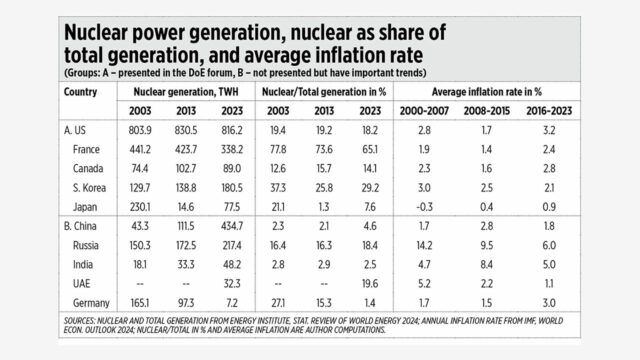
I checked again the nuclear power generation of these five countries, plus that of some other countries. I also compared their power generation with their consumer price stabilization. These are some interesting points I discovered:

1. Countries with rising nuclear power use experienced declining inflation rates — China, Russia, India, South Korea, and the United Arab Emirates (UAE).

2. Countries with declining nuclear power use experienced rising inflation rates — Germany, Japan, and France.

3. Countries with generally flat nuclear power use also experienced generally flat inflation rates — the US and Canada (see the table).

There are many factors why a country’s inflation rate rises, stays flat, or declines. But the cost of energy and electricity is one of the big contributors to inflation trends among countries. This should be one important incentive for the Philippines to go into nuclear power generation — to acquire many SMR units or quickly rehabilitate or refurbish BNPP 1 and proceed with BNPP 2 and other large nuclear plants.

I saw a press release from the Manila Electric Co. (Meralco) along with the Meralco Power Academy (MPA) about a recent visit to the Université Paris-Saclay (UPS) and top nuclear institutions in France. Meralco has a new initiative called nuclear energy strategic transition (NEST) and the visit to France was cool, exploring possible collaborations on capacity building and knowledge sharing.

Among the Meralco officials who went to France were Executive Vice-President and Chief Operating Officer Ronnie L. Aperocho, Senior Vice-President and Chief Human Resources Officer Edgardo V. Carasig, and First Vice-President and Head of Networks Froilan J. Savet.

UPS will be one of Meralco’s partner institutions for its Filipino Scholars and Interns on Nuclear Engineering (FISSION) program. The company sends young Filipinos abroad to cultivate the next generation of strong innovators and professionals in nuclear energy. Good move. Keep giving your consumers in the country stable, reliable, and competitively priced electricity.


Bienvenido S. Oplas, Jr. is the president of Bienvenido S. Oplas, Jr. Research Consultancy Services, and Minimal Government Thinkers. He is an international fellow of the Tholos Foundation.

minimalgovernment@gmail.com

House body OKs DBP capital hike

BW FILE PHOTO

By Kenneth Christiane L. Basilio, Reporter

A HOUSE of Representatives committee on Monday approved a substitute bill that seeks to increase Development Bank of the Philippines’ (DBP) capital stock to P300 billion from P35 billion under a new charter.

The state-owned lender is seeking to update its 26-year-old charter to better fulfill its mandate of funding infrastructure projects and loans for small businesses.

“We have to increase the capital so we can increase our lending [capacity],” DBP President and Chief Executive Officer Michael O. de Jesus told BusinessWorld in an interview after the House banks committee approved the measure.

The bill gives DBP an authorized capital stock of P300 billion, with the National Government being mandated to own 70% of the bank’s capital stock at all times, according to a copy of the bill obtained by BusinessWorld.

The bill also prescribes that 10.67% or P32 billion of the stock be subscribed to and paid from the state’s coffers.

“The bigger the bank… the more we can continue lending,” Mr. De Jesus said. “The more we build our capital, the more we have [the power] to fulfill our mandate, which is to finance industry.”

It also allows DBP to issue public stocks through an initial public offering, according to Mr. De Jesus. “Right now, the bank is 100% owned by the National Government… But the bank can sell up to 30% to the public or to other government corporations sometime in the future.”

Mr. de Jesus said the bank would likely list “within five to seven years,” citing the need to first increase the valuation of the bank.

The House bill also expands DBP’s mandate to include funding for government programs that seek to spur economic growth and increase productivity, a shift from its 1986 Charter, which focused on providing services to agricultural and industrial enterprises.

“The bank shall support the programs of the government… such as the development of both digital and physical infrastructure, expansion of business, especially micro, small and medium enterprises, and high-impact programs in education, healthcare, housing, other social services and those that support the protection of the government,” according to a copy of the bill.

ABCOMP and Tookitaki ink memo versus dirty money

THE ASSOCIATION of Bank Compliance Officers (ABCOMP) has signed a memorandum of understanding with Singapore-based anti-money laundering software provider Tookitaki Holding Pte. Ltd. to promote knowledge-sharing against dirty money.

“This collaboration is not only timely but aligns directly with our national agenda,” ABCOMP President Ma. Bernadette T. Ratcliffe said in a statement on Monday. “By partnering with Tookitaki, we are equipping our financial institutions with enhanced detection and prevention capabilities, which are critical for meeting FATF (Financial Action Task Force) requirements and restoring global confidence in the Philippines’ financial system.”

Under the partnership, the parties will set up a framework for knowledge-sharing sessions and collaborative initiatives.

ABCOMP members will gain access to Tookitaki’s library of anti-money laundering and fraud scenarios that is regularly updated to reflect the latest trends.

Tookitaki’s Anti-Financial Crime Ecosystem provides a platform that connects global financial experts and institutions, while ABCOMP offers knowledge of chief compliance officers within the Philippine banking sector.

“Our shared goal is to create a more robust and effective approach to financial crime prevention in the Philippines,” Tookitaki founder and Chief Executive Officer Abhishek Chatterjee said in the statement.

“By pooling our resources and expertise, we can make significant strides toward enhancing compliance and restoring confidence in the financial system,” he added.

Tookitaki will also support the development of a quarterly white paper to share insights with the financial community and regulators.

The partnership was made to help the Philippines get out of the FATF’s “gray list” by next year, ABCOMP said.

The FATF last month kept the Philippines on its list of jurisdictions under increased monitoring for dirty money risks. The country has been on the gray list since June 2021.

Still, it said the country has addressed the remaining deficiencies in its recommended actions.

The dirty money watchdog is set to conduct an onsite visit to verify the Philippines’ progress in its action plan and implementation of reforms. This will to take place between now and February 2025. — Aaron Michael C. Sy

Jeff Beck’s guitars and amps to go on sale in London

PRESS.CHRISTIES.COM

LONDON — More than 130 electric guitars, amps, and other pieces of musical equipment that belonged to English guitar legend Jeff Beck will go on sale in London next year, Christie’s auctioneers said on Friday.

Often described as a “guitarist’s guitarist,” Mr. Beck rose to fame with The Yardbirds, went on to pursue a solo career and was hailed as a great alongside the likes of Eric Clapton and Jimmy Page. He died last year aged 78.

The auction includes one of Mr. Beck’s most recognizable instruments: the coffee-colored 1954 “Oxblood” Gibson Les Paul depicted on the cover of his 1975 instrumental album Blow By Blow. Its value is estimated at £350,000-£500,000 ($444,000-$634,000), Christie’s said.

The “Tele-gib” — a guitar heard on the Stevie Wonder track “Cause We’ve Ended As Lovers,” from the same album — will also go on sale, with an estimated value of £100,000-£150,000.

“These guitars were his great love and after almost two years of his passing it’s time to part with them as Jeff wished,” Mr. Beck’s widow Sandra said. “It is a massive wrench to part with them but I know Jeff wanted for me to share this love.

“I hope the future guitarists who acquire these items are able to move closer to the genius who played them,” she said.

Highlights from the auction will go on show in Los Angeles from Dec. 4-6. The full collection will be displayed at Christie’s London headquarters from Jan. 15 until the auction on Jan. 22.

“His magic lay in the balance between the fluidity and aggression of his playing and his technical brilliance, which could swing from furious attack one moment to sheer ethereal beauty in the next,” Amelia Walker, Christie’s Specialist Head of Private & Iconic Collections, London, said. — Reuters

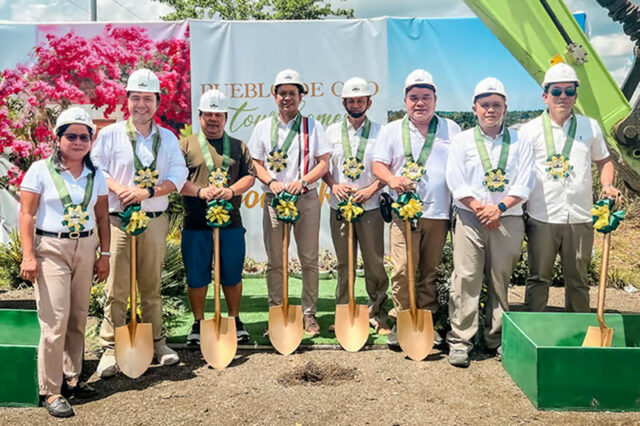
Pueblo de Oro invests P1.2B in Carcar City townhouse project

PHOTO COURTESY OF PUEBLO DE ORO

PUEBLO DE ORO Development Corp. (PDO) is allocating P1.2 billion to develop a 10-hectare (ha) townhouse project in Carcar City, Cebu, which is scheduled for completion by 2029.

The 900-unit townhouse development, named Pueblo de Oro Townhomes Carcar, will be located on a 10-ha property in Barangay Can-asujan in Carcar City, Cebu, PDO said in an e-mail to BusinessWorld.

“Pueblo de Oro, a member of the ICCP (Investment and Capital Corp. of the Philippines) Group, is investing P1.2 billion in Carcar City as part of its strategy to expand into promising regional markets,” it said.

The real estate developer held its groundbreaking ceremony for the new townhouse project on Sept. 26. It will be launched in the first quarter of 2025.

Pueblo de Oro Townhomes Carcar will feature a “modern Asian” architectural style, blending contemporary minimalism with references to Asian aesthetics, the company stated.

“We are highlighting contemporary minimalism through a focus on clean, functional lines meant to evoke simplicity and functionality,” PDO said, noting the use of combined textures to add contrast, depth, and visual interest.

Each housing unit includes a balcony, based on the homeowner’s preference, and ample windows.

The property also features a natural slope and terrain landscape that is 42 meters above sea level. It is nestled within the scenic landscape of the city, blending into its natural surroundings to offer comfort and serenity.

To ensure easy access, various developed and cemented access roads lead to the property. It is also near key establishments like schools, a church, hospitals, markets, and malls.

Its lot sizes are ideal for starting families and single-income earners, according to the real estate developer.

PDO said it plans to work with various government and private financial institutions like the Home Development Mutual Fund (Pag-IBIG Fund) to offer homebuyers lower interest rates. It will also allow for low staggered monthly equity payments.

Carcar City is just an hour’s drive from Cebu City, making it accessible by commute while providing a relaxed, suburban lifestyle, according to PDO.

The city is also known for its rich heritage and culture, as well as its scenic environment.

Pueblo De Oro Townhomes Carcar is the real estate developer’s latest project in Cebu, alongside its 30-ha residential project and retail hub in Lapu-Lapu City. — Beatriz Marie D. Cruz

World Wide Web inventor wants the internet back

FREEPIK

TIM BERNERS-LEE has a radical proposition. Instead of leaving our online data vulnerable to harvesting by large tech platforms and governments, we should control it. Our own little piece of the web or “personal cloud” should need permission to be accessed.

The idea sounds reasonable in theory, though in practice it’s a big ask. The internet today isn’t the vibrant, motley network that came into being after Berners-Lee first fashioned it in 1989, but a landscape dominated by huge companies like Alphabet, Inc.’s Google and Meta Platforms, Inc.’s Facebook. In many parts of the world, Facebook is the internet and the only experience that people have of the web. Most apps function as gatekeepers of our personal data.

Berners-Lee wants to flip that dynamic. Over the last decade or so, he’s watched the web’s evolution with mounting dismay as we’ve traded our data for greater conveniences, plugging into “ecosystems” from Apple, Inc. and Google so that we can seamlessly move our profiles — full of identifying details and interests — between e-mail clients and online browsers. The platforms insist they’re protecting all that information and respecting our privacy, but Berners-Lee believes that’s not enough. Our data is scattered across Big Tech’s servers and those of countless other companies, out of our control.

The idea for the World Wide Web came to Berners-Lee in 1989 when he was working at the European Organization for Nuclear Research (CERN). Initially aimed at helping scientists share data with one another, he released the source code for free to make the web an open platform for all, and it took on a life of its own. In the more than three decades since, he’s been trying to steer the web back to that free and democratic idea.

His answer is a digital wallet, a piece of the internet that stores everything from your medical records to your social media posts, your shopping history to your family photos. But unlike the siloed apps and services we use today, the wallets allow you to control exactly who sees what.

Berners-Lee has been working on this radical idea for five years through a startup called Inrupt. In an early trial, the Belgian region of Flanders is rolling out its system of personal data pods to 7 million citizens, using it as the foundation for delivering social services and sharing data more securely with businesses. Earlier this year, five Belgian hospitals began storing information about patient visits in the data pods, a process which Berners-Lee says can help aid compliance with Europe’s General Data Protection Regulation (GDPR).

But the initiative is swimming against a powerful tide as artificial intelligence assistants turn into our digital gatekeepers. Microsoft’s Copilot is being embedded into Windows and Office, Google is weaving Gemini through its ecosystem, and Apple Intelligence has been baked into the iPhone’s operating system. These assistants could increasingly shape our choices about what to buy, where to eat, and how to spend our time.

You would think that a web increasingly driven by AI and AI content will be less open and free, but Berners-Lee is optimistic. “This is completely within our control,” he tells me. “If you go home and write AI models and send out fake news and fill the world with junk, the world will become very bland. If you put out misinformation, it becomes untruthful.”

Instead he’d like to see more control of our data through decentralized systems like his and more public disclosures about where content comes from. That means more provenance labels on photos and videos to show they are AI-generated.

But the economics of AI development make this effort increasingly fraught. Training advanced AI models requires massive amounts of data — the kind of personal information that tech giants have spent more than a decade accumulating and exploiting for the benefit of their shareholders, and they won’t willingly give up that advantage.

Another challenge is how habituated humans have become to trading their personal information for convenience, an exchange that seems increasingly valuable with AI assistants. Scaling a model like Inrupt’s would require unprecedented cooperation between governments, corporations, and citizens.

None of that means personal data pods are doomed. The Flanders rollout could prove that government-backed systems deliver enough concrete benefits to overcome user inertia. Success with that trial might convince other regions to follow suit, particularly in areas like health care or social services.

But for most of the rest of us on the internet that Berners-Lee started, the future is clear: Our personal information will remain scattered across countless databases, increasingly processed by AI systems that serve the interests of large technology conglomerates. It’s not that better alternatives don’t exist, but the companies fashioning our AI futures have too much to lose by giving users control over their digital lives.

BLOOMBERG OPINION