
How PSEi member stocks performed — February 25, 2025
Here’s a quick glance at how PSEi stocks fared on Tuesday, February 25, 2025.
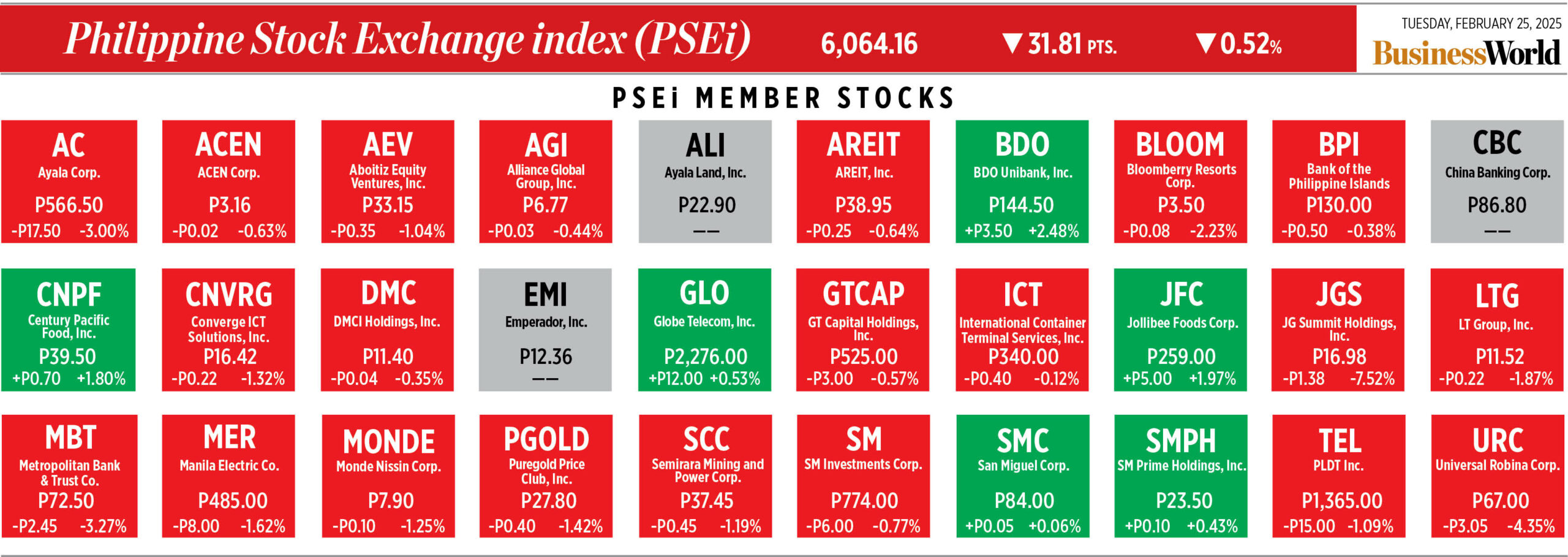

Here’s a quick glance at how PSEi stocks fared on Tuesday, February 25, 2025.

PHILIPPINE President Ferdinand R. Marcos, Jr. won’t call on the Senate to hold a special session for the impeachment trial of Vice-President (VP) Sara Duterte-Carpio, the Presidential Communications Office (PCO) said on Tuesday.
At news briefing, PCO Undersecretary Claire B. Castro said calling for the session would put the President in an “awkward position considering ongoing intrigues” surrounding his political rift with the Duterte clan.
“It is better for Senate to request from the President considering that even the President made this pronouncement, that if the Senate will ask him to call for the special session, he will do so,” she said.
The House of Representatives on Feb. 5 impeached the Vice-President for alleged abuse of power and constitutional violations stemming from her use of confidential funds, paving the way for her trial by the Senate.
The impeachment complaint against Ms. Duterte, daughter of former President Rodrigo R. Duterte, was filed and signed by 215 congressmen, more than the one-third legal requirement before it can be sent to the Senate, which will try her as an impeachment court. Under the 1987 Constitution, several congressmen will be serving as impeachment prosecutors.
The ouster charges consisted of seven articles of impeachment, including allegations of plotting the assassination of the President, misusing secret funds, amassing unexplained wealth and committing acts of destabilization.
Senate President Francis “Chiz” G. Escudero said on Tuesday the impeachment trial of Ms. Duterte may be over before the October recess.
“The trial will not last more than three months or two months, so by the time we recess in October 2025, it will be over and will be ready to be voted on,” Mr. Escudero said in livestreamed news briefing in Sorsogon.
He added that any action taken by the Senate must happen during an open session, like the reading of charges and the approval of trial rules and must await session resumption.
Congress went on a four-month break starting Feb. 5 for the 2025 midterm elections.
It reconvenes for a two-week session on June 2, during which the Senate will begin deliberation on the updates of impeachment rules and pre-trial preparations, he said.
“We debated that at length. Although we want to update the rules, we can’t do everything we want to do because there are already cases filed,” he said. “I don’t want the Senate to be accused of changing the rules in the middle of the game. The (Vice-President) might say that the rules were changed just for her.”
“Let’s not give anyone a reason to challenge this in court,” he added.
He said that the Senate would only “refine procedures for future impeachment complaints,” without affecting the ongoing cases against Ms. Duterte.
Mr. Escudero added that once the updated rules are approved, he would then authorize to issue summons to Vice-President.
Earlier, the Senate President said that the impeachment proceedings of Ms. Duterte is expected to start after the fourth State of the Nation Address of the President or when the 20th congress starts.
“First day would be July 29, where 12 new senators would be sworn in. We will be able to resume the impeachment court on July 29 or possibly July 30 for the reception of the presentation of evidence,” he said.
Mr. Escudero had previously said that there is no reason to call for a special session in congress as it does not meet the requirements of the 1987 constitution.
Congress can only hold a special session for the passing of urgent legislation, the voting of a new Vice-President in case of removal or incapacitation, or if the President becomes incapacitated by a majority vote of the Cabinet.
It can also hold special sessions to canvass the votes and proclaim the President and Vice-President after an election, or when martial law is declared, and the writ of habeas corpus is suspended.
NOT NEEDED
A House prosecutor on Tuesday asserted that a special session is not necessary for the Senate to convene as an impeachment court.
“We don’t need a special session because the Constitution is clear that trial shall forthwith proceed. For us, the Senate is already the impeachment court even if it is on recess,” San Juan Rep. Ysabel Maria J. Zamora, a member of the 11-man House prosecution panel, said in a statement.
She noted it is only “right” for the President not to intervene, citing the separation of powers among the branches of the government.
Also on Tuesday, the Supreme Court (SC) ordered both chambers of Congress to comment on a petition filed by Ms. Duterte, asking the tribunal to block her impeachment trial.
“The SC required respondents House of Representatives, its Secretary General Reginald S. Velasco, and the Senate to comment on the petition and prayer for TRO within a non-extendible period of 10 days from notice,” Spokesperson Camille Sue Mae L. Ting said in a news briefing on Tuesday.
The High Court acted on Ms. Duterte’s petition filed on Feb. 18, asking the tribunal to block her impending impeachment trial slated in June.
Ms. Duterte also asked the High Court for a temporary restraining order as she alleged Congress violated the One-Year Bar provision in the Constitution.
This provision states that no impeachment proceedings shall be initiated against the same official more than once within a period of one year.
House Assistant Majority Leader and Party-list Rep. Raul Angelo D. Bongalon said the House has not yet received a copy of the petition challenging the impeachment proceedings.
“We have not yet received a copy of the order, but definitely we will comply. We are confident that the Supreme Court will not intervene,” Mr. Bongalon, also a member of the House prosecution panel, said in a statement.
UNINTENDED BENEFICIARY
Meanwhile, law professor Howard M. Calleja said China is the “unintended beneficiary” of Mr. Escudero’s blockade of Ms. Duterte’s impeachment trial.
In a statement on Tuesday, Mr. Calleja said any delay in Ms. Duterte’s impeachment protects her and weakens the administration’s political position against the Duterte family.
The Marcos administration and the Duterte family, once a formidable alliance, have been at odds since Ms. Duterte allegedly threatened the lives of Mr. Marcos, the first lady, and House Speaker Ferdinand Martin G. Romualdez.
Mr. Calleja accused Mr. Escudero of having his own reasons “for risking too much, including driving a wedge between himself and the Marcos administration, which could cost him his post.”
“Escudero immediately adjourned the Senate an hour from receiving the complaint and although it still had up to Feb. 7 in its legislative calendar,” the law professor alleged. — John Victor D. Ordoñez, Adrian H. Halili, and Chloe Mari A. Hufana

By Kenneth Christiane L. Basilio, Reporter
THE PHILIPPINE military could escort civilian air patrol missions over the disputed waters of the South China Sea, its military official said on Wednesday.
The Philippine Air Force is “capable” of providing air support to aircraft in “danger or distress,” Air Force spokesperson Ma. Consuelo N. Castillo said in a media briefing, but noted the type of air assets that could escort during Manila’s so-called routine maritime domain awareness flights depends on the top brass.
“Whenever we are called upon to deploy our air assets to support other aircraft operating, be it civilian aircraft or another military aircraft, the air force is capable… if called upon,” she added.
“Our aircraft, our helicopters are capable of ship deck operations. So, if there’s an available ship where our aircraft can safely land… those operations are possible.”
A Chinese navy helicopter last week flew close to a Philippine government aircraft conducting surveillance over Scarborough Shoal, a move that resulted in Manila accusing China of “unprofessional and reckless” flight actions.
This prompted Manila to file a diplomatic protest against Beijing after the incident, according to Foreign Affairs Secretary Enrique A. Manalo.
The People’s Liberation Army (PLA) Navy helicopter flew as close as three meters to the aircraft, which the Philippine Coast Guard said was a “clear violation and blatant disregard” of aviation regulations.
Beijing disputed the Philippines’ account last week, saying its aircraft “illegally intruded” into China’s airspace and accused its Southeast Asian neighbor of “spreading false narratives.”
“The AFP (Armed Forces of the Philippines) will not go down to the level of illegal actions when confronted with actions that are illegal, that are coercive,” Philippine Navy Rear Admiral Roy Vincent T. Trinidad said in the same briefing.
Manila has accused China’s coast guard of aggression within its exclusive economic zone (EEZ), while Beijing is furious over what it calls repeated provocations and territorial incursions.
The Philippines and China have been at loggerheads over disputed features in the South China Sea, which Beijing claims almost in its entirety. A United Nations-backed tribunal based in The Hague in 2016 voided China’s claim for being illegal.
“The actions of the PLA Navy to endanger the life of the BFAR (Bureau of Fisheries and Aquatic Resources) personnel is unacceptable,” Mr. Trinidad added.
The Chinese Embassy in Manila did not immediately respond to a Viber message seeking comment.
The Philippine military could still respond to security issues in the South China Sea without the need to be within “close-quarter proximity,” Xerxes A. Trinidad, chief of the AFP’s Public Affairs Office, said in the same briefing.
“Our AFP assets need not be in close-quarter proximity for us to deliver our weapon system and neutralize any possible targets or enemy… We can respond, and we will respond accordingly.”
Navy’s Mr. Trinidad said they would provide an update on China’s presence in the country’s EEZ next week. “We’ll have that next Tuesday so that we could give the entire picture for the month of February.”
Deploying military aircrafts for air surveillance missions could increase tensions with China, according to Josue Raphael J. Cortez, who teaches diplomacy at the De La Salle College of St. Benilde.
“This proposition to escort civilian agencies in undertaking air surveillance missions will undoubtedly propel the tensions transpiring presently in the South China Sea,” he said in a Facebook chat. “China will view it as a way of our troops impeding on what they consider and claim as theirs.”
“This may be a security dilemma of sorts for China… and we can expect that it will also undertake such operations to counter and induce fear in our troops,” he added.
Also on Tuesday, the Navy official said the US’ exemption of defense assistance to the Philippines is a “very much welcome development,” saying it would help fund security programs and activities on the “sea, air and land,” including military support systems.
US President Donald J. Trump’s government would continue its $336-million security aid to the Philippines, according to the Department of Foreign Affairs.
Mr. Trump earlier ordered a 90-day pause on existing and new foreign development assistance packages pending review to ensure its alignment within his “America First” policy.
Navy’s Mr. Trinidad said the procurement pipeline for military hardware is not lodged under the multi-million security aid. “It’s a different platform when it comes to the equipment.”

THE PESO declined against the dollar on Tuesday after US President Donald J. Trump said the tariffs he plans to impose on Mexican and Canadian exports are on schedule for next month.
It closed at P57.93 a dollar, weakening by 12.2 centavos from its P57.808 finish on Monday, according to Bankers Association of the Philippines data posted on its website.
The peso opened at P57.90 against the dollar. Its worst showing was at P57.95, while its intraday best was at P57.87 against the greenback. Dollars exchanged rose to $1.38 billion from $1.17 billion on Monday.
“The dollar-peso ended higher on worsening sentiment after Trump said that the tariffs on Canada and Mexico will push through in March,” a trader said by telephone.
The dollar edged up slightly on Tuesday after falling to its lowest in more than two months at the start of the week, buoyed by safe-haven flows after US President Donald Trump said tariffs on Canadian and Mexican imports are “on time and on schedule” despite efforts by the countries to beef up border security and halt the flow of fentanyl to the US ahead of a March 4 deadline, Reuters reported.
The dollar index was generally stronger due to Mr. Trump’s comments, Michael L. Ricafort, chief economist at Rizal Commercial Banking Corp., said in a Viber message.
The dollar index steadied at 106.59, rebounding from a more than two-month trough of 106.12 hit in the previous session.
The trader expects the peso to trade from P57.80 and P58.10 a dollar on Wednesday, while Mr. Ricafort sees it ranging from P57.80 to P58. — Aaron Michael C. Sy
PHILIPPINE STOCKS extended their losses on Tuesday as investors preferred to stay on the sidelines amid the tariff development in the US and as they await earnings of large caps.
The benchmark Philippine Stock Exchange index (PSEi) shed 0.52% or 31.81 points to close at 6,064.16. The broader all-share index lost 0.39% or 14.55 points to 3,640.45.
“Trading on the local bourse remained lackluster as investors mostly stayed on sidelines ahead of key US data and local large-cap earnings releases later this week,” Alfred Benjamin R. Garcia, research head at AP Securities, Inc., said in a Viber message.
Astro C. Del Castillo, managing director at First Grade Finance, Inc., said the local market “remains in the road to calvary.” “Some positive news today was basically shrugged off by investors as the market continues to be hounded by uncertainties in the domestic front and international arena.”
Rastine Mackie Mercado, research director at China Bank Securities Corp., said investor sentiment “remained fragile given US tariff developments and the announcement of fresh US investment curbs on China.”
“This may have been a contributing factor to sustained net foreign fund outflows seen today,” he said in a Viber message.
Last week, US President Donald J. Trump said he wanted to impose 25% tariffs on imports of cars, pharmaceuticals and semiconductors, Reuters reported.
Back home, almost all sectoral indexes fell. Holding firms fell 1.57% or 80.82 points to 5,048.96; while mining and oil lost 0.89% or 73.64 points to 8,200.61. Services shed 0.38% or 7.5 points to 1,956.63, while the industrial index dropped 0.33% or 29.64 points to 8,718.81.
Properties added 0.08% or 1.98 points to 2,218.91, while financials gained 0.05% or 1.32 points to 2,287.48.
Value turnover rose to P5.17 billion involving 634.67 million shares, from P4.47 billion involving 1.38 billion stocks a day earlier.
Decliners outnumbered advancers 125 to 63, while 57 shares were unchanged. Net foreign selling fell to P563.8 million from P632.57 million on Monday.
Mr. Mercado expects the market to react to the release of US consumer confidence data later on Tuesday, Manila time, in which a further softening in optimism could cause investor concerns over growth. — Sheldeen Joy Talavera
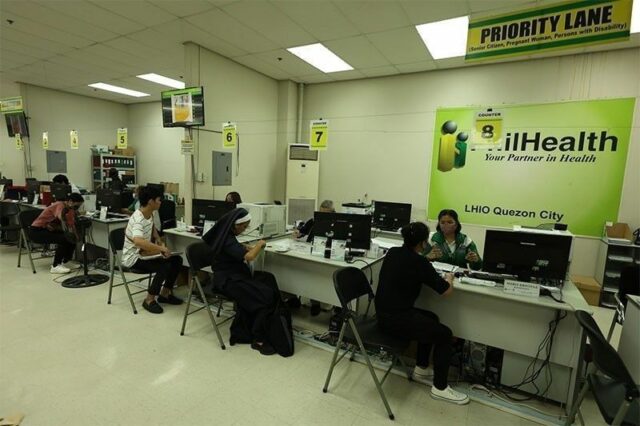
A HEALTH advocate questioned the zero subsidy for the Philippine Health Insurance Corp. (PhilHealth) under the 2025 General Appropriations Act (GAA) before the Supreme Court (SC) on Tuesday, citing violations in the provisions of the Universal Health Care (UHC) Act.
In a 45-page petition, former PhilHealth director Anthony C. Leachon said “the non-inclusion of PhilHealth in the national budget directly contravenes the mandates set forth in existing laws.”
He asked the tribunal to immediately issue a temporary restraining order (TRO) and/or writ of preliminary injunction to stop the implementation of the 2025 GAA “concerning the non-allocation of funds for PhilHealth, thereby preventing the deprivation of millions of Filipinos’ constitutionally guaranteed right to health pending the final resolution of this case.”
Mr. Leachon also sought to declare the omission of PhilHealth’s budget allocation illegal for violating provisions of the 1987 Constitution, particularly the government’s role to protect the right to health. He also alleged the move violated provisions of Republic Act No. 11223, UHC Act.
He also asked the top court to issue a writ of mandamus directing appropriate government bodies to immediately allocate and release the necessary funds to PhilHealth under the mandates of the UHC Act and the 1987 Constitution.
Lastly, he sought a writ of prohibition to completely enjoin and prohibit all concerned agencies, including the Budget department and any other bodies of government, from implementing budgetary measures that undermine the constitutional right to health by denying funding to PhilHealth.
He named Executive Secretary Lucas P. Bersamin and both chambers of Congress as respondents.
“The administration, the bicameral, and the Congress are simply showing that they do not prioritize the health of our nation. And yet, this is a basic right,” he told reporters in Filipino after filing his petition before the High Court.
He also noted the move decreasing the Department of Education’s (DepEd) 2025 budget, which should have the most out of all departments under the Constitution, showed the government’s lack of importance placed on health and education.
“So, health and education are not important. Instead, the funds were shifted to unstructured, disorganized TUPAD-AKAP, where you still need to request a guarantee letter,” he said, referring to the government’s social amelioration programs, Tulong Panghanapbuhay sa Ating Disadvantaged/Displaced Workers and Ayuda Para sa Kapos ang Kita.
“Whereas if it were allocated to PhilHealth, that money should have been properly organized.”
PHILHEALTH FUND TRANSFER
Also on Tuesday, the SC held the second round of oral arguments on petitions questioning the transfer of P89.9 billion in PhilHealth excess funds to the national coffers.
It was revealed that PhilHealth has not yet settled all monetary claims before remitting a total of P60 billion to the National Treasury.
Associate Justice Amy Lazaro-Javier asked PhilHealth Senior Vice-President Renato L. Limsiaco, Jr., if the state health insurer had settled all claims in 2024 before transferring billions into the National Treasury.
To which the PhilHealth executive replied in mixed English and Filipino: “On a certain cutoff date, we definitely cannot pay for everything… Not everything will be paid. The claims are still with the hospital.”
This is contrary to the claims of respondents, saying the unpaid claims of hospitals, doctors, and members have been recorded and recognized before transferring PhilHealth’s fund balance to the National Treasury, Ms. Lazaro-Javier said, citing the comment of the respondents (both chambers of Congress Senate, Executive Secretary Lucas P. Bersamin, Department of Finance, PhilHealth, et. al.) dated Sept. 2, 2024, filed by the Office of the Solicitor General.
Mr. Limsiaco said when the claim is in the course of settlement, it means PhilHealth has received the claims but is still in process and as such, they are not yet approved and not yet paid.
The oral arguments on Tuesday were a consolidation of three petitions filed by Senator Aquilino Martin L. Pimentel, Bayan Muna Chairperson Neri J. Colmenares, former Finance Undersecretary Cielo D. Magno, and others.
The plaintiffs assailed the intended transfer of P89.9 billion in PhilHealth excess funds to the national coffers, arguing it is against the Constitution as the provisions of the Universal Health Care Act have not been met yet.
They specifically questioned the legality of Section 1(d) of XLIII of the General Appropriations Act (GAA) 2024 and Department of Finance (DoF) Circular No. 003-2024.
In October 2024, the SC blocked the transfer of P29.9 billion — the last tranche of PhilHealth’s P89.9 billion in excess funds — to national coffers.
The excess PhilHealth funds would have been used to support unprogrammed appropriations worth P203.1 billion, which would support state health, infrastructure and social service programs, critics have said.
In the first oral arguments last Feb. 4, the government’s chief lawyer, Menardo I. Guevarra, said the move was only temporary to finance government projects.
Documents submitted by the Office of the Solicitor General enumerated some urgent national projects, which included routine maintenance of national roads, the Panay-Guimaras-Negros (PGN) Island Bridges and the payment of right of way.
Ms. Lazaro-Javier asked the government’s top lawyer if the transfer was urgent, considering some of the projects were already fully funded, such as the PGN Bridges Project.
“This is a matter really of delving into the wisdom of the legislature in allocating funds,” Mr. Guevarra said.
“If a project that has already been identified and sufficiently funded is considered to be non-implementable for the given fiscal year, then I think it is the decision of Congress in the exercise of its policy or wisdom, so to speak, to move it to the unprogrammed appropriations in the meantime,” he added.
The next oral arguments will be on March 4. — Chloe Mari A. Hufana

By Edg Adrian A. Eva, Reporter
TIKTOK, the Philippines’ third most popular social media platform, is promoting electoral integrity through its in-app Philippine Election Center and #ThinkTwice campaign ahead of 2025 midterm elections.
The platform earlier launched the Philippine Election Center to give users access to verified election information, including voting guidelines and election updates, Peachy A. Paderna, public policy manager of TikTok Philippines, told reporters in a site visit to TikTok’s Transparency and Accountability Center (TAC) in Singapore last Wednesday.
It also ran the #ThinkTwice campaign, a digital safety initiative that equips users with resources to identify misinformation during the election period.
 “We want people to be properly empowered so that they’re able to express themselves not just on the platform but also at the polling booths come election day. That’s why our initiatives are centered around providing them with access to reliable election information,” Ms. Paderna told BusinessWorld.
These are in partnership with the Commission on Elections (Comelec), the National Citizens’ Movement for Free Elections (NAMFREL), and the Legal Network for Truthful Elections (LENTE).
Ms. Paderna said TikTok is working with Comelec, LENTE, and NAMFREL to better understand the local context and identify policy-violating content, such as election-related misinformation.
Renowned Filipino lawyer Melencio S. Sta. Maria, Jr. found TikTok’s initiatives as important in ensuring people’s trust, especially among the youth, in the electoral process.
“The things that TikTok does in preserving integrity and preventing misinformation, along with the guidance they’re providing to users in making social media more honest and more acceptable to all in terms of the truth,” Mr. Sta Maria said.
Separately, Filipino lawyer and content creator Tony Roman told BusinessWorld that social media platforms taking steps to promote electoral integrity would help voters, especially the youth, make informed voting decisions.
“In the same way that I sort of impart and teach the law using social media, this is a good and effective way to reach the youth and voters, basically encouraging them to vote wisely,” Mr. Roman said.
Apart from the Philippine Election Center and #ThinkTwice, TikTok also plan to release a three-part podcast series with LENTE covering election-related topics.
During a site visit to TikTok’s TAC, the platform shared how its algorithms work, its content moderation practices, and its efforts to combat violations such as alcohol use, proliferation of misinformation, among others.
The company shared that it employs a content moderation system that combines automated detection with over 40,000 members of its trust and safety team to identify and remove content that violates the platform’s community guidelines.
TikTok said that it takes down an average of 1.6 million videos per day globally, or about 1% of the 160 million videos posted on the platform daily, due to violations.
In the Philippines alone, TikTok’s latest data revealed 4.5 million videos were taken down from July to October 2024, with 99.7% proactively removed by TikTok’s automation and 98% taken down within 24 hours after being reviewed by members of its trust and safety team.
TikTok said it has yet to release data on videos and fake accounts removed from November to February, covering the 2025 candidacy filing and campaign season kickoff.
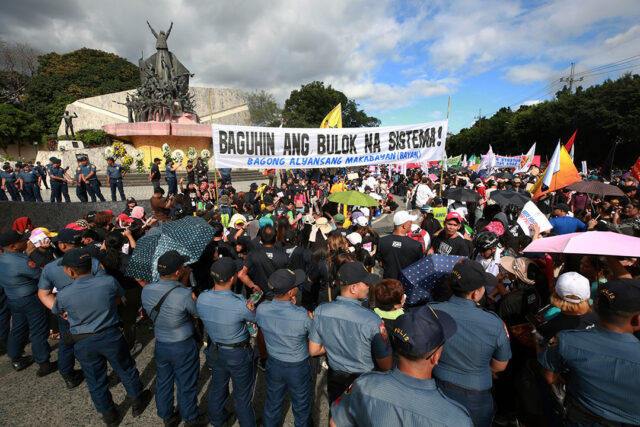
OPTING not to declare the EDSA People Power anniversary as regular holiday will not stop Filipinos from commemorating the revolution nearly four decades after the ouster of former President Ferdinand E. Marcos, Sr., a senator said on Tuesday.
“Even if Malacañang cancels (the) holiday, the spirit and message of People Power will remain alive — especially among the Filipino youth who stand up and speak out for freedom, justice, and collective empowerment,” Senator Ana Theresia N. Hontiveros-Baraquel said in a statement in Filipino.
Ms. Hontiveros lauded students, teachers, schools, universities and youth organizations for leading the commemoration of the event this year, even without the declaration of a state holiday.
In October, the Palace declared Feb. 25 as a special working holiday this year, diverging from past administrations’ practice of observing it as a special non-working holiday.
The day commemorates the popular street uprising that toppled the late Mr. Marcos, Sr. in 1986, the father and namesake of the current Philippine president.
Last year, Mr. Marcos moved the special nonworking holiday of the People Power Anniversary from Feb. 25 to Feb 24.
“We should take inspiration from the courage of our young kababayans (countrymen), and never be cowed into fear and inactivity,” she said. “We must speak truth to power, overcome disinformation and historical distortion, and continue to resist the corruption, violence, and lust for power of those who are supposed to serve the nation.”
Multiple schools have also declared that they have suspended classes on Feb. 25 or shifted to alternative learning modes.
Meanwhile, the Presidential Communications Office (PCO) on Tuesday dispelled accusations that President Ferdinand R. Marcos, Jr. is trying to halt the commemoration of the revolution by not making it a national holiday.
“When we say special working holiday, still there is encouragement to commemorate, to join any event and it will not hinder any activity to commemorate the People Power,” PCO Undersecretary Claire B. Castro said at a news briefing at the Palace.
“Since he became the President, we did not hear him stop activities to commemorate the said event.” — Adrian H. Halili and John Victor D. Ordoñez

THE PHILIPPINES’ anti-graft court has ordered the surrender of multi-million stocks from an insurance company tied to the coconut levy fund controversy.
In a 27-page decision released on Feb. 24, the Sandiganbayan Second Division ruled the 255 million shares of a now-defunct state bank in an insurance company should be surrendered to the government, citing a 2021 law creating a trust fund for coconut farmers.
In a ruling, penned by Associate Justice Edgardo M. Caldona, the insurance company was directed to cancel existing stock certificates and issue new certificates with the same number of shares in the name of the Republic of the Philippines.
Signed into law by ex-President Rodrigo R. Duterte, Republic Act No. 11524, the Coconut Farmers and Industry Trust Fund (CFITF) Act, cited that coco levy assets declared by the Supreme Court as belonging to the state should be given to the government.
“The shares of stock… are reconveyable coconut levy assets within the purview of the CFITF Act,” the ruling stated.
The petition stems from a complaint filed for the recovery of alleged ill-gotten wealth, in which the Philippine Commission on Good Government had claimed the insurance company was created or funded using coconut levy funds. — Kenneth Christiane L. Basilio
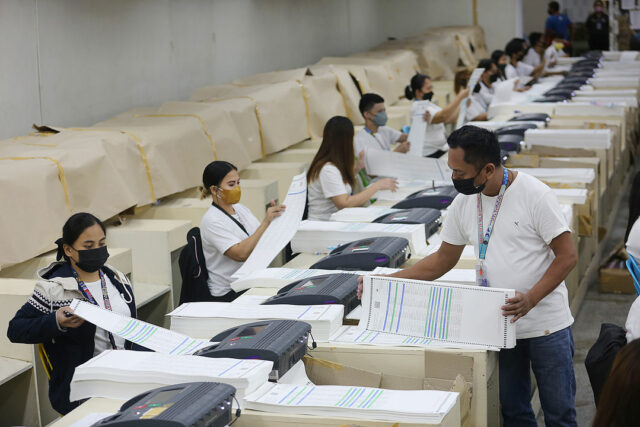
THE Commission on Elections (Comelec) has printed 45.65 million ballots — 63.32% of the required total — for the May 12 national and local elections, it said on Tuesday.
As of Feb. 24, the poll body still needs to print 26.45 million ballots, Chairman George Erwin M. Garcia told reporters in a Viber chat.
The poll body aims to finish the printing on March 9 to 10, ahead of the May 12 midterm elections, using printers of the National Printing Office and Comelec’s poll automation partner, Miru Systems Joint Venture.
He earlier said they are exceeding their daily targets, printing about 1.7 million ballots every day.
The campaign period for senatorial and party list candidates started on Feb. 11, while local bets will start their campaign on March 28.
Up for grabs in the May 12 elections are 317 congressional seats and thousands of local posts. The biggest battle will be for 12 spots in the 24-seat Senate, a chamber packed with political heavyweights and wielding outsized influence. — Chloe Mari A. Hufana
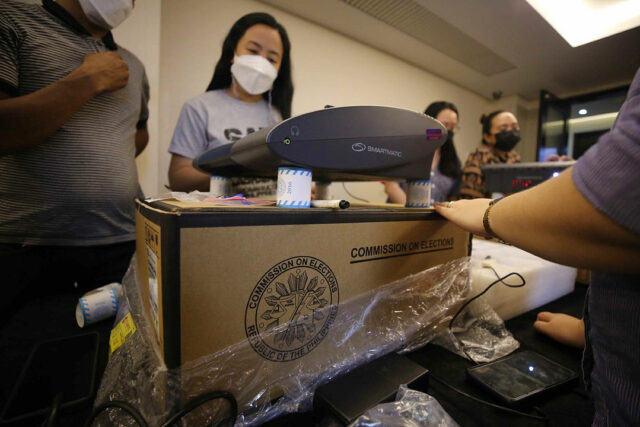
THE Commission on Elections (Comelec) approved a resolution increasing the service credits of all government personnel rendering election-related duties for the 2025 midterm elections to ten from five.
In a memorandum, dated Dec. 2, 2024, sent by Chairman George Erwin M. Garcia in a Viber chat group, the poll body adopted the resolution recommended by its Law Department which clarified concerns regarding leave privileges, particularly the computation and application of service credits for election services.
The recommendations included ensuring that all eligible government officials and employees, regardless of their specific roles, are granted service credits and addressing service credits’ non-commutative and non-cumulative nature under the Election Service Reform Act.
It clarified that extra credits should be in line with the guidelines on leave privileges as it recommended a meeting with the Civil Service Commission and the Department of Education.
Comelec earlier reported it is yet to train 186,000 teachers to work in the upcoming polls.
The training period is set from March 3 to 31. — Chloe Mari A. Hufana

 GOVERNMENT-OWNED and -controlled corp. (GOCCs) whistleblowers against illegal and unethical acts in the sector are now protected under a new policy of the Governance Commission for GOCCs (GCG).
In a memorandum circular No. 2025-01, the GCG said the Whistleblowing and Integrity Program (WHIP) for the GOCC Sector seeks to strengthen transparency, accountability, and integrity within the sector.
“The revised WHIP introduces important amendments to address emerging issues in the GOCC Sector,” the GCG said in a statement on Feb. 24.
“Among the most significant revisions is the inclusion of sexual harassment, illegal dismissal, and retaliatory acts against whistleblowers,” it added.
Additionally, the GCG, the monitoring body of the GOCC sector, said retaliation acts against whistleblowers “who submit reports in good faith shall not be tolerated by the Governance Commission, which shall extend all possible assistance to the whistleblower under the law and given circumstances.” — Aubrey Rose A. Inosante
