Home Blog Page 1928

Nintendo’s next console will play current Switch games

NINTENDO CO. said its next console will be compatible with current Switch games, allaying fears about the company’s ability to ride on the aging machine’s past success.

Backwards compatibility in the next-generation console is a key consideration for players trying to decide on further purchases of content in the waning months of the Switch. Nintendo’s next console will also support the company’s online gaming services, it said during a business strategy briefing.

Further information about the upcoming console will come at a later date, Nintendo said. Its stock rose 4.7% after the announcement Wednesday.

“Compatibility with the current Switch is good news for both investors and users,” Toyo Securities analyst Hideki Yasuda said. “Nintendo talking about its next console’s features and specifications suggests an announcement may be coming soon.”

Flagging momentum for the Switch, launched in 2017, forced the Kyoto-based company to cut its full-year profit and sales forecasts below estimates. The company logged its fifth straight quarter of profit declines earlier this week, hurt by weak sales of hardware and software.

Consumers have eagerly awaited an announcement on a successor to the Switch, which faces sleeker and more powerful updates from rivals Sony Group Corp. and Microsoft Corp.

On Tuesday, Nintendo slashed its operating profit outlook by 10% to ¥360 billion ($2.4 billion) and said it now expects to sell only 12.5 million units of the Switch this fiscal year, versus a previously forecast 13.5 million units. For the September quarter, Nintendo’s operating profit fell a bigger-than-expected 29% to ¥67 billion.

Nintendo’s been expanding into new areas to capitalize on its intellectual property and reduce the ups and downs of an industry hostage to gaming hits. That includes Alarmo, a $99 alarm clock featuring Nintendo’s game characters and music, as well as a Nintendo Music smartphone app for online service subscribers. Its affiliate Pokémon Co., meanwhile, released a smartphone app version of its highly popular trading card game.

The company’s also putting more resources behind a push into Hollywood. Encouraged by the blockbuster success of The Super Mario Bros. Movie last year, Nintendo’s working on another animated film based on the franchise, as well as a live-action film based on The Legend of Zelda. — Bloomberg

We need more married mothers

RAWPIXEL.COM

Amidst rising rates of unmarried childless women, someone needed to be blamed. And feminists, predictably, zeroed in on men as the dastardly culprits. Reviving an Independent article from 2019 (“Lack of ‘economically-attractive’ men to blame for decline in marriage rates, study suggests”), social media adjudged that “‘most women hope to marry but current shortages of marriageable men — men with a stable job and a good income — make this increasingly difficult, especially in the current gig economy of unstable low-paying service jobs,’ explains Dr Daniel Lichter, lead author of the study [‘Mismatches in the Marriage Market’; Lichter, et al., September 2019].”

Stunning and brave.

This, of course, goes against the Barbie-esque narrative of strong independent women that don’t need no man.

Furthermore, another study (“Why people face difficulties in attracting mates: An investigation of 17 probable predictors of involuntary singlehood”; Apostolou and Michaelidou, Science Direct, January 2024) points out that, “for women, we found that poor flirting capacity, poor sexual functioning, high choosiness, and low agreeableness were associated with higher probability to be involuntarily single than in a relationship or married. Moreover, shyness, agreeableness, sexual functioning, and choosiness had indirect effects. In addition, high choosiness was associated with more years being single.”

And indeed, emphasizing the “choosiness” angle, another study (“Do Men and Women Know What They Want? Sex Differences in Online Daters’ Educational Preferences”; Whyte, et al., Psychological Science, June 2018) confirmed that: “women were more likely than men to stipulate educational preferences at all ages. When members indifferent to educational level were excluded, however, the specificity of men’s and women’s preferences did differ for different age groups. That is, whereas women expressed more refined educational preferences during their years of maximum fertility, their demand specificity decreased with age. Men’s specificity, in contrast, remained stable until the 40s, when it was greater than that of postreproductive women, and then was higher during their peak years of career-earnings potential. Further, when individuals’ level of education was controlled for, women (compared with men) were more likely to state a higher minimum preference for educational level in a potential mate.”Unfortunately, the supposed hypergamous predisposition of women has been magnified by woke progressivism, such that their normal (even logical) choosiness has been exacerbated by the vastly increased options made available by social media, plus a culture promoting a “career first marry later” ethic and the media’s fascination with the ridiculously birdbrained DINK (Dual income, no kids) lifestyle.

This has led to unprecedentedly unfortunate consequences.

WHY IS THE OVERPOPULATION SCARE LIKE CLIMATE CHANGE?
As previously pointed out here (“Population collapse and the RH Law mistake,” March 2022; citing “Fertility, mortality, migration, and population scenarios for 195 countries and territories from 2017 to 2100,” The Lancet, July 2020), the world’s population is already shrinking to alarming levels.

Thus, “the global population was projected to peak in 2064 at 9.73 billion (8.84-10.9) people and decline to 8.79 billion (6.83-11.8) in 2100.” Total fertility rates (TFR) for several countries are expected to fall drastically: “By 2050, 151 countries were forecasted to have a TFR lower than the replacement level (TFR <2-1), and 183 were forecasted to have a TFR lower than replacement by 2100; 23 countries in the reference scenario, including Japan, Thailand, and Spain, were forecasted to have population declines greater than 50% from 2017 to 2100.” Even more disconcerting is the expected aging global population: “with 2.37 billion (1.91-2.87) individuals older than 65 years and 1.70 billion (1.11-2.81) individuals younger than 20 years, forecasted globally in 2100.”

The World Health Organization itself, not an organization known for enthusiasm in encouraging population growth, declared that: “By 2030, one in six people in the world will be aged 60 years or over. At this time the share of the population aged 60 years and over will increase from 1 billion in 2020 to 1.4 billion. By 2050, the world’s population of people aged 60 years and older will double (2.1 billion). The number of persons aged 80 years or older is expected to triple between 2020 and 2050 to reach 426 million.”

As for the Philippines, “the total fertility rate (TFR) of Filipino women aged 15 to 49 years dropped from 2.7 children per woman in 2017 to 1.9 children per woman in 2022, based on preliminary results of the National Demographic and Health Survey (NDHS) of the Philippine Statistics Authority (PSA). The PSA defines TFR as ‘the average number of children a woman would have by the end of her childbearing years if she bore children at the current age-specific fertility rates.’ With the lower TFR, the country is already below the replacement fertility rate of 2.1 children per woman.” (Philippine Congressional Policy and Budget Research Department)

Furthermore, “in the 2022 NDHS, women were asked whether they wanted more children and, if so, how long they would prefer to wait before the birth of the next child. About half (48.8%) of currently married women aged 15 to 49 years (including women who are sterilized or whose husbands are sterilized) want no more children. The percentage of women who want no more children increases with the number of living children, from 4.3% with no living children to 72% with six or more children. Around 13.9% of women want to have another child within the next two years and 17.4% want to wait at least two years before having another child. Moreover, less than one percent (0.2%) of women want another child but have not decided when, and 8.1% are undecided about having more children.” (Philippines Statistics Authority, Report November 2022) Bottomline? As The Lancet points out: “A sustained TFR lower than the replacement level in many countries, including China and India, would have economic, social, environmental, and geopolitical consequences.”

SUFFER THE CHILDREN
Disturbingly, a considerable number of women — to get around the self-accountability and responsibilities that marriage demands — are now resorting to getting pregnant but without the benefit of marriage. This leads to this present tragic statistic of 58.1% or 844,909 of new Filipino babies being born illegitimate.

Which points us to the reality that increased single-women households damage everyone, definitely society as a whole, but most unfortunately it damages the Filipino youth.

Consider that practically every school shooter in the US (for example) were bereft of fathers, “whether due to divorce, death, or imprisonment” (“When Will We Have the Guts to Link Fatherlessness to School Shootings,” Susan Goldberg, PJ Media, February 2018), as I pointed out in my column “The two parent advantage (or why a divorce law is a dumb idea)” in June this year.

As I wrote in my column, “Divorce is a deadly killer” in March 2018, “Then there’s this: ‘72% of adolescent murderers grew up without fathers; the same for 60% of all rapists, 70% of juveniles in state institutions grew up in single-or no-parent situations. The number of single-parent households is a good predictor of violent crime in a community, while poverty rate is not,’ (Terry Brennan, Co-Founder, Leading Women for Shared Parenting).”

As I wrote in “The two parent advantage (or why a divorce law is a dumb idea)”: “Gratifyingly, Melissa Kearney, the University of Maryland’s Neil Moskowitz Professor of Economics, recently came out with the highly relevant and quite commonsensical book The Two Parent Privilege. Here, she presents a data-driven defense of marriage and declares that to depreciate it leads to economic problems, fractures society, and badly hinders children’s development.

“Presenting no religious arguments and based on more than a decade of economic research, the Two Parent Privilege demonstrates that ‘marriage, for all its challenges and faults, may be our best path to a more equitable future’ and that when two adults marry, such immensely and comprehensively benefits not only the married couple but their children as well.“Indeed, ‘two parents combined have more resources than one. Two parents in a home bring in the earnings — or at least the earnings capacity — of two adults. And so, in a very straightforward way, we see that kids growing up in single-mother homes are five times more likely to live in poverty than kids growing up in married parent homes. (Kids in single-father homes are three times as likely to live in poverty).” See “Why Two Parents Are the Ultimate Privilege,” Bari Weiss interviewing Melissa Kearney, Free Press, December 2023.

BE FRUITFUL AND MULTIPLY
However, there are positive signs that the malignant influence of feminism is waning. CNN — of all media ironically — reported (March 2024) that “the number of marriages took a dive around the start of the pandemic, numbers show. For the past two decades, the number of marriages stayed around seven to eight per 1,000 people a year, according to new data released by the US Centers for Disease Control and Prevention’s National Center for Health Statistics.

But in 2020, the marriage rate was down to 5.1 per 1,000 people, the data showed. The rate started to climb the next year, and by 2022, the number of marriages had reached 6.2 per capita and over 2 million in a year, according to the report.”

And quite interestingly, “in 2022, the divorce rate was 2.4 per 1,000 people. Although that isn’t the lowest it has ever been — in 2021, it was 2.3 — it continues a downward trend, according to the data. By comparison, the rate of divorces in 2000 was four per 1,000, which means the current rate is a big decline from two decades earlier.

Indeed, the trope of the 50% divorce rate is influenced much by those in second, third, and subsequent marriages. Such marriages do have higher possibilities of ending in divorce. But recent first marriages are demonstrating much higher survival rates, with possible separations as low as 15-20%. For those couples considered part of the Traditional Catholic community, the rate can be as low as 5%.

Hopefully, this return of sanity and commonsense keeps on going. The last thing the world needs are more unhinged Kamala-clones shrilly trying to convince us on how happy they are.


Jemy Gatdula is the dean of UA&P Law, as well as a Philippine Judicial Academy law lecturer for constitutional philosophy and jurisprudence.

https://www.facebook.com/jigatdula/

Twitter  @jemygatdula

BPI launches virtual financial coach service

BW FILE PHOTO

BANK of the Philippine Islands (BPI) on Wednesday launched its virtual financial coach (VFC) service under NEXT by BPI Preferred.

“The main goal is really to prepare our next generation to manage their finances better, to empower them to do so… We believe that the next generation have the capability to be the emerging affluent and we have to prepare them to do that,” BPI Consumer Banking Head Maria Cristina L. Go told reporters at the launch event.

The VFC service aims to make financial consultations more convenient and is part of a series of virtual services the bank is rolling out.

“Convenience is one of the things that really drove us in thinking about the virtual financial coach. Fortunately, we have been piloting the theme of virtual stores, which we started late last 2022, and now we’re going full steam ahead. Virtual financial coaches is one of the units within the virtual stores. We have virtual loan advisors, virtual relationship managers, and virtual sales assistants,” she said.

Ms. Go said the bank currently has four VFCs.

The bank will also launch more offerings under NEXT by BPI Preferred in the coming months, including investment, loan, and deposit products, she added.

These will help BPI Wealth, the bank’s wealth management arm, grow its customer base, which is currently close to 15 million, Ms. Go said.

BPI’s net income grew by 29.4% year on year to a record P17.4 billion in the third quarter.

This brought its nine-month net earnings to P48 billion, 24.3% higher year on year, driven by robust revenue growth and sustained positive operating leverage.

BPI shares dropped by P3.80 or 2.64% to close at P140 each on Thursday. — A.M.C. Sy

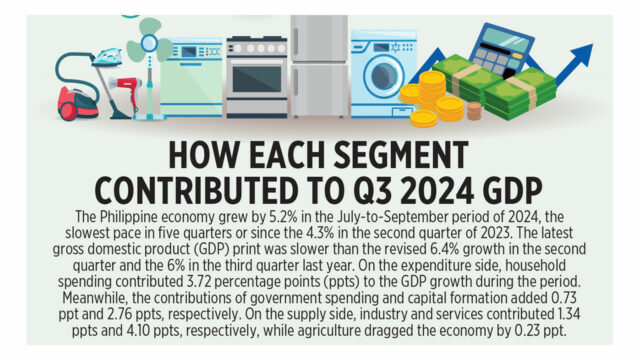
How each segment contributed to Q3 2024 GDP

THE PHILIPPINE economy expanded by a weaker-than-expected 5.2% in the third quarter, as bad weather hurt agricultural output and government spending, the statistics agency said on Thursday. Read the full story.

How each segment contributed to Q3 2024 GDP

How PSEi member stocks performed — November 7, 2024

Here’s a quick glance at how PSEi stocks fared on Thursday, November 7, 2024.


Philippine Coast Guard to add 49 new ships by 2028 amid China tensions

BRP SIERRA MADRE, a marooned transport ship which Philippine Marines live in as a military outpost, sits on the disputed Second Thomas Shoal, part of the Spratly Islands in the South China Sea. — REUTERS

THE Philippine Coast Guard on Thursday said it would have taken delivery of 49 new ships by 2028, 40 of which be funded by a French loan worth P25.8 billion and five from Japan, as it boosts patrols in the South China Sea amid growing tensions with China.

The rest will be built locally, PCG Commandant Admiral Ronnie Gil L. Gavan told a security forum on Thursday.

This will be the largest single purchase in the modernization of the Philippine Coast Guard (PCG) , Commandant he told a news briefing at the presidential palace.

The purchase, which was approved by the National Economic and Development Authority Board, would let them deploy two patrol boats in every Philippine district “fast enough to reach the edges of our exclusive economic zone,” he added.

The coast guard also seeks to add to its 30,000-strong manpower.

“This is a game changer for us because this will enable the coast guard to hold the position as the youngest fleet in Southeast Asia,” Mr. Gavan said. “In five years’ time we foresee that we will become the most respected and the most able coast guard.”

In a statement, the NEDA Board said the purchase, which will be funded through official development assistance from the French government, includes 40 fast patrol craft, 20 of which will be built locally.

“These patrol craft will enhance the country’s response capabilities in search and rescue operations, environmental protection, maritime law enforcement and disaster response,” it added.

The new boats will also “help deter smuggling and illegal activities while ensuring the enforcement of maritime sovereignty in critical marine areas.”

Mr. Gavan said the Philippine Coast Guard had also been given the go-signal to buy five 97-meter vessels from Japan. “Once delivered, we will have around eight large ships.”

The coast guard will start taking delivery of the ships in 2027 until 2028.

These purchases reflect the success of the PCG’s assertive transparency campaign, which has generated domestic and international support, said Raymond M. Powell, a fellow at the US-based Gordian Knot Center for National Security Innovation.

“The decision by international partners like France and Japan to assist the Philippines was motivated by the compelling visual evidence their governments saw after Manila showed it to the world,” he said in an X message.

Launched last year after the Chinese Coast Guard’s use of a military-grade laser to drive away a PCG vessel, the transparency campaign seeks to expose Chinese vessels’ aggression at sea.

China claims the South China Sea almost in its entirety, including waters that are within the Philippines’ exclusive economic zone.

“A decision by a democratically elected government to devote its national resources toward improving its external security requires the support of its people, and the Philippine people have been energized to support their government because it showed them the pictures of the outrage that are occurring within their waters,” Mr. Powell said.

Philippine President Ferdinand R. Marcos, Jr., who took office in 2022, has pursued closer defense ties with the US and other Indo-Pacific powers.

The PCG was under the Department of National Defense before it was transferred to the Office of the President on March 30, 1998 through an order issued by the late President Fidel V. Ramos.

Mr. Ramos later transferred the PCG to the Department of Transportation and Communications, which was split into two separate agencies in 2016 through a

law signed by the Late President Benigno S.C. Aquino III.

The PCG has since been under the Transportation department.

In his message at the South China Sea dialogue, Mr. Marcos said his government was pursuing “broad public diplomacy and awareness efforts” amid foreign intrusions into Philippine waters, as he denounced “aggressive actions” in the South China Sea.

“We seek to empower our citizens to become ambassadors for our cause.” — Kyle Aristophere T. Atienza

Marcos gov’t allots P2.7B for drug rehab facilities

BW FILE PHOTO

By Kenneth Christiane L. Basilio, Reporter

THE Philippine government has earmarked P2.7 billion in next year’s funding for state drug rehabilitation centers throughout the country to address overcrowding in treatment facilities, a congressman said on Thursday.

“The government will spend up to P2.7 billion in 2025 to sustain the operations and augment the beds of Drug Abuse Treatment and Rehabilitation Centers under the Department of Health,” Makati Rep. Luis N. Campos, Jr. said in a statement.

“The sum is P700 million higher than this year’s P2-billion allocation,” Mr. Campos, a vice-chairman of the House of Representatives appropriations committee, said.

The Health department operates 23 rehabilitation facilities across 15 regions. About P1.7 billion was allocated for their operations and P916 million more for construction and expansion, according to the 2025 National Expenditure Program.

Fifteen of them will receive almost P1 billion in infrastructure development funding, Mr. Campos said.

The drug rehabilitation facility for the Calabarzon region is set to receive the lion’s share of the health facility improvement fund at P350 million.

The Tagaytay City and Las Piñas City rehabilitation centers will get P101.5 million and P75 million, respectively.

Taguig City, Camarines Sur, Davao City and Zamboanga City will get P65 million, P63 million, P52 million and P50 million for their facilities.

Rehabilitation centers in Cebu province, such as the Cebu City and Argao municipality centers, will each receive P31 million. Albay province’s drug treatment facility in Malinao will get P30 million for its expansion.

Bataan and Mountain Province will get P15 million and P14.6 million for their centers.

The facilities in the Caraga region, San Fernando municipality of La Union Province and Malaybalay municipality in Bukidnon province will get P14 million, P8 million and P3.5 million in funding for infrastructure upgrades.

“We must keep under control the demand side by providing adequate treatment and rehabilitation services to drug dependents, while suppressing the supply side by putting traffickers and pushers behind bars,” Mr. Campos said.

The overzealousness of authorities to detain suspected drug users results overcrowding at rehabilitation centers, Hansley A. Juliano, who teaches politics at the Ateneo de Manila University, said in a Facebook Messenger chat.

He added that the government should look at motivating users to shun illegal drugs by reducing “punitive regulations,” and replacing it with “productive efforts.”

Authorities should also let their family members participate in the rehabilitation process to prevent users from backsliding to drug abuse.

“Usage is rooted in poverty, social isolation or alienation and socioeconomic insecurity,” Mr. Juliano said. “Addressing these issues will reduce, if not eliminate, the precarious population that drug markets rely on.”

Marcos to skip APEC summit after deadly storms

PPA-NOEL B. PABALATE

PHILIPPINE President Ferdinand R. Marcos, Jr. will not attend a key summit of Asia-Pacific leaders in Peru, since he would be busy with domestic concerns, the presidential palace said on Thursday.

He would skip the Asia-Pacific Economic Cooperation Leaders’ Summit — scheduled from Nov. 10-16 in Peru because he “prioritizes domestic concerns, including government responses to calamities,” Presidential Communications Secretary Cesar B. Chavez said in a Viber message.

Mr. Marcos as designated Trade Acting Secretary Cristina Aldeguer-Roque as the special envoy to the summit, the palace said.

In the summit, leaders, ministers and senior officials of the 21 APEC members, which account for half of global trade and 60% of world gross domestic product, will discuss trade and globalization policies.

The APEC members are the US, Australia, Brunei, Canada, Chile, China, Hong Kong, Indonesia, Japan, South Korea, Malaysia, Mexico, New Zealand, Papua New Guinea, Peru, the Philippines, Russia, Singapore, Taiwan, Thailand, and Vietnam. — Kyle Aristophere T. Atienza

Trump return may bode well for PHL, senators say

GAGE SKIDMORE-WIKIPEDIA

TOP LAWMAKERS welcomed Donald J. Trump’s return to the White House, with Senate President Francis Joseph G. Escudero saying the United States-Philippine relations were stable under his first presidency.

“I cannot foretell what President-elect Trump may or may not do,” Mr. Escudero said. “However, our country’s relations with the US were fairly well under his presidency before, so I am hopeful that his assumption would bode well for our country.”

Mr. Trump and Democrat Kamala Harris were almost tied in opinion polls, but official election results showed the Republican candidate securing 295 electoral votes against his opponent’s 226 electoral votes in the Nov. 5 polls.

Senate Majority Leader Francis N. Tolentino said Mr. Trump’s focus on the American economy “should extend to greater stability in global affairs, which should augur well for the Philippines.”

“Ultimately, what I hope to see under ‘Trump 2.0’ is the opening of a stronger and more dynamic chapter in the enduring relations between the US and the Philippines,” he said in a statement.

Senator Juan Miguel F. Zubiri said in a statement Americans have chosen to preserve their traditional institutions and values by electing the Republican candidate.

“We can see that the United States of America has once again leaned towards Conservatism, the protection of the Family and their respect for God and Country!” Mr. Zubiri said.

“When the other camp uses abortion as a key campaign slogan and heavily using a woke agenda, then the silent majority will awaken and say enough is enough.”

President Ferdinand R. Marcos, Jr. on Tuesday said he looks forward to working with Mr. Trump on a wide range of issues that “will yield mutual benefits to two nations with deep ties, shared beliefs, common vision, and a long history of working together.”

“I am hopeful that this unshakeable alliance, tested in war and peace, will be a force of good that will blaze a path of prosperity and amity, in the region, and on both sides of the Pacific,” he added.

  The US is the Philippines’ major security partner. Last year, Manila gave Washington access to four more military bases, on top of the existing 5, under the Enhanced Defense Cooperation Agreement.

In a statement, Foreign Affairs Secretary Enrique A. Manalo said he is committed to working with his counterparts to bring the Philippines-US “alliance to even greater heights under the administration of president-elect Donald Trump.” — Kyle Aristophere T. Atienza

Sandigan junks MRs on PDAF scam

PHILSTAR FILE PHOTO

THE Philippine anti-graft court has dismissed motions for reconsideration to overturn the guilty verdicts against those involved in the misuse of the Priority Development Assistance Fund (PDAF) between 2007 and 2009, citing the lack of merit.

In a 19-page resolution promulgated on Nov. 6, the Sandiganbayan Third Division resolved multiple motions filed separately by former public officials and private individuals who participated in the diversion of about P60 million in PDAF allocated to a congressman to bogus livelihood projects.

The convicted parties sought to overturn the anti-graft court’s ruling, arguing that state prosecutors failed to establish their role in the siphoning of public funds or show they conspired with other co-accused to divert the government money.

“After due consideration of the arguments raised by the accused- movants and the prosecution, as well as the assiduous review of the records, the Court finds no compelling reason to reverse their respective convictions,” read part of the resolution penned by Associate Justice Ronald B. Moreno.

“As defined by jurisprudence, “proof beyond reasonable doubt” does not mean such degree of proof as to exclude the possibility of error and produce absolute certainty,” it added. “Only moral certainty is required or that degree of proof which produces conviction in an unprejudiced mind.” — Kenneth Christiane L. Basilio

Civil forfeiture bill filed

PHILSTAR FILE PHOTO

A BILL seeking to provide the Philippine government the authority to seize real estate properties fraudulently acquired by foreigners has been filed at the House of Representatives on Thursday.

The filing of House Bill (HB) No. 11043 comes amid a House quad committee’s investigation into illegal online casinos.

The committee last month submitted to the Office of the Solicitor General (OSG) documents showing how a Chinese national allegedly connected to illegal Philippine Offshore Gaming Operators acquired a Filipino citizenship fraudulently, allowing him to own land and set up businesses in the country.

The committee urged the OSG to start building a legal case against the implicated Chinese national, citing national security concerns and violations of Philippine laws.

“The bill seeks to provide for a civil forfeiture in favor of the State any unlawfully acquired real estate properties by any foreign national,” according to the explanatory note of HB No. 11043, which were filed by several lawmakers led by Senior Deputy Speaker and Pampanga Rep. Aurelio D. Gonzales, Jr.

Foreigners are not allowed to own Philippine lands, according to the 1987 Constitution.

Foreigners were able to skirt the land ownership restriction through their acquisition of falsified Philippine documentation, such as birth certificates, passports and driver’s licenses through “corrupt public officers,” according to the bill.

Properties allegedly obtained by any foreign national are presumed to be illegally acquired, unless proven otherwise by authorities, under the proposed law.

HB No. 11043 noted that any taxpayer could file a complaint before their city or provincial prosecutor, who will be responsible for conducting a preliminary investigation to determine its merit.

It could then be elevated for OSG action should local prosecutors find “reasonable ground” that properties in question were illegally acquired.

“The respondent foreign national shall have a period of 15 days to answer the complaint… from the receipt thereof from the city or provincial or prosecutor or the regional trial court,” Sec. 7 of the measure stated.

Properties forfeited in favor of the government will be distributed to farmers, if the estate in question is an agricultural land. Non-agricultural lands should be used for “schools, hospitals, and other establishments for socialized services,” according to the bill. — Kenneth Christiane L. Basilio

Duterte ‘red tagging’ probe pushed

FORMER PRESIDENT Rodrigo R. Duterte — OFFICIAL FACEBOOK ACCOUNT OF THE SENATE OF THE PHILIPPINES

HOUSE QUAD committee hearings should also include in its investigation ex-President Rodrigo R. Duterte’s counter-insurgency campaign, a human rights group said on Thursday, citing gross violations against political activists.

“It is high time that the quad committee takes a serious look at Duterte’s accountability for other state-sponsored killings that were very likely perpetrated by the same death squads funded by government monies,” Karapatan Secretary-General Cristina E. Palabay said in a statement, referring to a House committee investigating alleged extra-judicial killings under Mr. Duterte’s administration.

The Philippine government estimates that more than 6,000 died under the campaign, according to a Facebook infographics published in June 2022 by RealNumbersPH, which is operated by the inter-agency Committee on Anti-Illegal Drugs. Human rights groups say the death toll could be as high as 30,000.

Hundreds of activists were slain during Mr. Duterte’s administration, said Ms. Palabay, highlighting the need to investigate human rights violations against them.

“Revelations at the quad comm hearings already point to the involvement of some of Duterte’s anti-drug henchmen in perpetrating human rights violations against activists and other human rights defenders,” she said.

She cited Oplan Sauron, an internal security program meant to address “lawless violence” in Negros and Samar islands and the Bicol Region under a 2018 memorandum.

“Oplan Sauron, a bloody counter-insurgency operation jointly conducted by the military and police that was centered on Negros Island was actually framed as a plan not just against rebel groups, but criminals and individuals involved in the illegal drug trade,” she said.

Ms. Palabay said that Oplan Sauron was a “coordinate military and police operation” that “brutalized” activists, with them being tagged as members of the armed communist movement to justify their killings. — Kenneth Christiane L. Basilio