Home Blog Page 1926

Japan revises Q3 GDP higher, keeps alive BOJ rate-hike expectations

STOCK PHOTO | Image by Josh Soto from Unsplash

 – Japan’s economy expanded in July-September at a faster pace than initially reported thanks to upward revisions in capital investment and exports, keeping alive market expectations for a near-term interest rate hike by the central bank.

But a downward revision on consumption underscores the fragile nature of the economic recovery, and leaves uncertainty on how soon the central bank could raise interest rates again, with a December hike not guaranteed either, some analysts say.

The data will be among factors the BOJ will scrutinize at its next policy meeting on Dec. 18-19, when some analysts expect a hike in short-term interest rates from the current 0.25%.

“It does support the case for a December rate hike, though the weakness in consumption is a concern,” said Takeshi Minami, chief economist at Norinchukin Research Institute.

Gross domestic product (GDP) rose an annualized 1.2% in the three months to September, the Cabinet Office’s revised data showed on Monday, higher than economists’ median forecast and the initial estimate of 0.9% growth.

The revised numbers translate into a quarter-on-quarter expansion of 0.3% in price-adjusted terms, compared with a 0.2% growth in preliminary data released on Nov. 15.

The upgrade was caused in part by a smaller-than-expected decline in capital expenditure, which fell 0.1% in the third quarter compared with a preliminary reading of a 0.2% drop. It compared with economists’ estimate for a 0.1% rise.

External demand, or exports minus imports, knocked 0.2 percentage point off growth, less than a 0.4 point drop in the preliminary reading, the revised GDP data showed.

Private consumption, which accounts for more than half of the Japanese economy, rose 0.7%, less than the preliminary reading of 0.9% growth.

“While the data isn’t something that gives a huge boost to rate hike expectations, it won’t be a hindrance to raising rates either,” said Uichiro Nozaki, an economist at Nomura Securities.

The upward revision still leaves third-quarter GDP growth much slower than an annualized 2.2% expansion in the April-June period, which was largely in reaction to a contraction in the first quarter caused by output disruptions in some auto plants.

The BOJ phased out a decade-long, radical stimulus in March and raised short-term interest rates to 0.25% in July on the view Japan was progressing towards sustainably achieving its 2% inflation target.

Governor Kazuo Ueda has signaled readiness to raise rates again if the BOJ becomes more convinced that inflation will durably stay around 2% backed by rising wages and robust domestic demand.

Nozaki at Nomura Securities expects consumption to have slowed in the current quarter, but to rebound in the January-March quarter on prospects of firm wage growth.

But others are less optimistic about Japan’s economy with overseas uncertainties, such as threats of higher tariffs by U.S. President-elect Donald Trump, clouding the outlook.

“While improvements in real wages will underpin consumption, the recovery in external demand will be muted as overseas growth stagnates,” said Masato Koike, senior economist at Sompo Institute Plus.

“Japan’s economy will continue recovering but the pace will be modest,” he added.

Many market players expect the BOJ to hike rates again by the March end of the current fiscal year, though they are divided on whether it would come in December or early next year.

The BOJ is staying guarded on the timing of the next rate hike with December hardly a done deal given soft consumption, its governor’s cautious decision-making style and anxiety over U.S. economic policy in a second Trump presidency, sources have told Reuters. – Reuters

Haiti gang massacres at least 110 people in Cite Soleil, rights group says

By Bruno Le Bansais - Own work, CC BY-SA 3.0, https://commons.wikimedia.org/w/index.php?curid=12865233

 – At least 110 people were killed over the weekend in Haiti’s Cite Soleil slum when a gang leader targeted elderly people he suspected of causing his child’s illness through witchcraft, the National Human Right Defense Network said on Sunday.

The gang leader, known as Monel “Mikano” Felix, along with his Viv Ansanm group, were responsible of the massacre.

RNDDH said that after Mr. Felix’s child became sick, he sought advice from a voudou priest who accused elderly people in the area of harming the child through witchcraft, triggering Felix to order the massacre.

Gang members killed at least 60 people on Friday and 50 on Saturday using machetes and knives, all of them aged over 60, it said.

Cite Soleil, a densely populated slum by the port of the capital Port-au-Prince, is among the poorest and most violent areas of Haiti.

Tight gang control, including the restriction of mobile phone use, limited residents’ ability to share information about the massacre.

Mr. Felix, who heads the Wharf Jeremie gang, was in 2022 banned from entering neighboring Dominican Republic. – Reuters

South Korea special forces officer says he had orders to block lawmakers

SOUTH KOREAN soldiers salute in front of a huge national flag in Pohang, South Korea, Sept. 30, 2021. — LEE JIN-MAN/POOL VIA REUTERS

 – The commander of South Korea’s special forces that stormed parliament last week after a martial law declaration said on Monday he was ordered to block lawmakers from entering the chamber to prevent a vote to lift the emergency measure.

Colonel Kim Hyun-tae, the commanding officer of the 707th Special Missions Group, told reporters he took all responsibility for his troops’ raid on parliament but said he was acting under orders from the defense minister.

South Korean President Yoon Suk Yeol, who is now a subject of a criminal investigation, declared martial law on Dec. 3 only to rescind the order within hours after parliament met in defiance of a security cordon to vote it invalid.

Mr. Yoon survived an impeachment vote in a opposition-led parliament on Saturday which plunged South Korea into a constitutional crisis.

Mr. Yoon said ahead of the vote he was entrusting his fate to the ruling party, but he did not offer to resign.

Mr. Kim said his unit landed on the grounds of parliament with orders to cordon off the main building to prevent lawmakers from entering but was met with legislative staff members inside who blocked their entrance.

“We were all victims who were used by the former defense minister, Kim Yong-hyun,” the commander told reporters outside the defense ministry in Seoul.

“The members of the Group are not guilty. Their only guilt is that they followed the orders of their commander,” he said, fighting back tears.

The former defense minister was arrested on Sunday over his role in declaring martial law and ordering the deployment of troops to parliament.

The leader of Yoon’s People Power Party, Han Dong-hoon, said on Sunday that Yoon would be excluded from foreign and other state affairs, and the party and Prime Minister Han Duck-soo would manage government affairs.

National Assembly speaker Woo Won-shik said it was unconstitutional to delegate presidential authority unless the president is impeached.

The main opposition Democratic Party, which led the failed impeachment motion on Saturday, said it would raise the motion again. – Reuters

Extreme heat puts garment factory workers at risk, study shows

RIO LECATOMPESSY-UNSPLASH

– Workers in some of the world’s biggest garment manufacturing hubs in Bangladesh, Vietnam, and Pakistan are increasingly exposed to extreme heat as climate change pushes temperatures up, a report found on Sunday, a problem multinational retailers and brands will have to help address.

New European Union regulations make retailers selling in the bloc, like Inditex, H&M and Nike, legally liable for conditions at their suppliers, putting pressure on them to help fund improvements to cool factories they source from.

In Dhaka, Hanoi, Ho Chi Minh City, Phnom Penh and Karachi, the number of days with “wet-bulb” temperatures – a measurement that accounts for air temperature as well as humidity – above 30.5 degrees Celsius jumped by 42% in 2020-2024 compared to 2005-2009, researchers at Cornell University’s Global Labor Institute found.

Above that threshold, the International Labor Organization recommends as much rest as work in any given hour to maintain safe core body temperature levels.

The report identified only three retailers – Nike, Levi’s, and VF Corp – which specifically include protocols to protect workers from heat exhaustion in their supplier codes of conduct.


COMPANIES WARNED

“We’ve been talking to brands for ages now about this issue, and they’re only now starting to turn their attention to it,” Jason Judd, executive director at Cornell University’s Global Labor Institute, told Reuters.

“If a brand or retailer knows that temperatures in a production area are excessively high or doing damage to worker health, then they’re obligated under this new set of rules to do something about it,” he added.

The EU Corporate Sustainability Due Diligence Directive came into force in July and will start applying to large companies from mid-2027.

Fixes to cool factories could include better ventilation and water evaporative cooling systems, instead of energy-intensive and expensive air conditioning that would increase manufacturers’ carbon emissions.

Some factory owners would likely be willing to make such investments themselves, given how heat stress significantly impacts productivity, Judd said, but the EU rules highlight brands’ responsibility to address the issue too.

The report also urged retailers and brands to invest in higher wages and health protections so that workers can manage the risk of missing work days due to heatwaves.

Extreme heat and flooding could erase $65 billion in apparel export earnings from Bangladesh, Cambodia, Pakistan and Vietnam by 2030, research from asset manager Schroders and the Global Labor Institute found last year. – Reuters

Dollar reserves slip 2% at end-Nov.

United States one-dollar bills are seen on a light table at the Bureau of Engraving and Printing in Washington in this Nov. 14, 2014 file photo. Dollar reserves stood at $108.5 billion as of end-November, the Philippine central bank said. — REUTERS

By Luisa Maria Jacinta C. Jocson, Reporter

THE PHILIPPINES’ gross international reserves (GIR) dipped at the end of November as the government settled some of its foreign currency-denominated debt, data from the Bangko Sentral ng Pilipinas (BSP) showed.

Preliminary data showed dollar reserves slipped by 2.4% to $108.5 billion at the end of November from $111.1 billion at the end of October.

Year on year, gross international reserves rose by 5.6% from $102.7 billion.

“The month-on-month decrease in the GIR level reflected mainly the National Government’s (NG) net foreign currency withdrawals from its deposits with the BSP to settle its foreign currency debt obligations and pay for its various expenditures,” the central bank said.

The level of dollar reserves was enough to cover about 4.3 times the country’s short-term external debt based on residual maturity.

The GIR as of end-November was also equivalent to 7.8 months’ worth of imports of goods and payments of services and primary income.

“By convention, GIR is viewed to be adequate if it can finance at least three months’ worth of the country’s imports of goods and payments of services and primary income,” the BSP said.

Ample foreign exchange buffers protect an economy from market volatility and ensure that a country can pay its debts in the event of an economic downturn.

Net foreign currency deposits dropped by 18% to $1.75 billion at end-November from $2.14 billion a month ago. It likewise fell by 8.1% from $1.91 billion a year ago.

The central bank also attributed the decline in dollar reserves to its “net foreign exchange operations and downward valuation adjustments in the BSP’s gold holdings due to the decrease in the price of gold in the international market.”

Reserves in the form of gold were valued at $11.03 billion, down by 2.9% from $11.35 billion at end-October. However, it was up by 1.9% from $10.82 billion in the same period a year earlier.

November saw gold’s first monthly price drop since June due to a post-US election sell-off driven by Donald J. Trump’s win, Reuters reported.

Spot prices for the precious metal are down 5% since hitting a record high of $2,790.15 an ounce on Oct. 31 but are still up 28% so far this year.

BSP data showed foreign investments stood at $91.2 billion as of end-November. This was 2% lower than $93.1 billion in the previous month but higher by 6.8% from $85.4 billion last year.

“Similarly, the net international reserves (NIR) declined by $2.6 billion to $108.4 billion as of end-November 2024 from the end-October 2024 level of $111 billion,” the BSP said.

Net international reserves are the difference between the BSP’s reserve assets or GIR and reserve liabilities, such as short-term foreign debt and credit and loans from the International Monetary Fund (IMF).

The country’s reserve position in the IMF dipped by 2.3% to $668.2 million from $683.9 million a month earlier. Year on year, it slumped by 15.1% from $787.2 million.

Special drawing rights — the amount the country can tap from the IMF — inched up month on month to $3.81 billion from $3.8 billion.

Rizal Commercial Banking Corp. Chief Economist Michael L. Ricafort said the lower GIR level was due to the net payment of the National Government’s foreign debt maturities and other US-denominated obligations.

He also cited the BSP’s net foreign exchange operations in view of the US dollar-peso volatility during the month.

In November, the peso fell to the P59-per-dollar level twice, hitting the record low on Nov. 21 and 26.

“For the coming months, the country’s GIR could still be supported by the continued growth in the country’s structural inflows from overseas Filipino worker (OFW) remittances, BPO (business process outsourcing) revenues, exports, relatively fast recovery in foreign tourism revenues,” Mr. Ricafort said.

Remittances typically see a boost in December as OFWs send more money for their families amid the holiday season.

Latest data from the BSP showed cash remittances rose by 3.3% to $3.01 billion in September. This brought the total to $25.23 billion in the January-September period, up by 3% year on year.

The central bank expects remittances to grow by 3% this year.

However, Mr. Ricafort also noted the government’s plan to reduce foreign borrowings to manage foreign exchange risks.

The government’s borrowing plan this year is set at a 75:25 mix, in favor of domestic sources.

For 2025 to 2027, the NG plans to source at least 80% of its borrowing program from domestic sources, and 20% from foreign lenders.

Finance Secretary Ralph G. Recto has said they are aiming to reduce the share of external borrowings in its borrowing program.

The BSP expects the country’s GIR to settle at $106 billion by end-2024.

Central bank likely to continue easing despite inflation uptick, say analysts

Inflation picked up to 2.5% in November, from 2.3% in October, as food prices rose. — PHILIPPINE STAR/EDD GUMBAN

THE BANGKO SENTRAL ng Pilipinas (BSP) will likely continue its rate-cutting cycle despite the slight uptick in November inflation, analysts said.

However, risks such as the weakening of the peso could prompt the central bank to be more cautious about further easing.

“Overall, the inflationary pressures were not broad-based, and the near-term outlook remains benign. Therefore, we think the BSP will lower its policy rate by 25 basis points (bps) at its next meeting in December,” ANZ Research said.

Headline inflation quickened to 2.5% year on year in November from 2.3% in October, mainly driven by higher food prices due to typhoon damage.

This brought average inflation to 3.2% in the 11-month period, well within the 2-4% target band.

Pantheon Macroeconomics Chief Emerging Asia Economist Miguel Chanco said that it is “all clear” for a third straight rate cut later this month.

“Crucially, the result was also well within the BSP’s forecast range, 2.2% to 3%, which means the bank will almost certainly make another 25-bp cut to the target reverse repo rate later this month, to 5.75%,” he said.

The Monetary Board is set to have its final policy-setting meeting for the year on Dec. 19.

The central bank could opt to pause its easing cycle or deliver another 25-bp rate cut later this month, BSP Governor Eli M. Remolona, Jr. earlier said.

He said inflationary pressures may prompt them to keep rates steady, while a cut is likely if economic growth remains weak.

Since August, the Monetary Board has delivered a total of 50 bps worth of rate cuts, bringing the key rate to 6%.

“The soft inflation print supports our view of a rate cut in the Dec. 19 meeting, on top of the third-quarter 2024 growth which surprised to the downside,” HSBC economist for ASEAN Aris D. Dacanay said.

Mr. Chanco noted the “disappointing” third-quarter gross domestic product (GDP) print, which would make room for more rate reductions.

The Philippine economy grew by a weaker-than-expected 5.2% in the July-to-September period, slower than the 6.4% growth in the second quarter and 6% a year ago.

This was also the weakest growth since the 4.3% expansion in the second quarter of 2023.

“The Board’s rate-cutting cycle is far from over though, despite the apparent global recalibration of policy rate expectations upwards since the US election,” Mr. Chanco said.

“The BSP, in its response to the latest inflation data, affirmed that it will ‘continue to maintain a measured approach in its easing cycle,’ echoing the same language used in October, when it last reduced rates, by 25 bps.”

Inflation is also seen to remain within the 2-4% target band moving forward.

“On balance, inflation should soon stabilize comfortably below the 3% midpoint of the BSP’s target range — barring any shocks — clearing the way for the 100 bps in further easing we expect next year,” Mr. Chanco said.

The BSP expects inflation to settle within the target band from this year until 2026. It projects inflation to average 3.1% this year, 3.2% in 2025 and 3.4% in 2026.

However, the central bank also warned that the balance of risks to the inflation outlook for next year until 2026 has shifted to the upside.

The BSP’s risk-adjusted forecasts see inflation at 3.3% next year and 3.7% in 2026.

“At the same time, the risks to our end-2025 benchmark rate baseline of 4.75% are skewed markedly to the downside, as policy will remain excessively tight in real terms, even after 125 bp in additional cuts,” Mr. Chanco said.

For 2025, ANZ Research expects a total 75 bps worth of cuts to “help bolster domestic demand.”

Mr. Remolona has signaled the possibility of up to 100 bps worth of rate cuts next year.

PESO WEAKNESS
Meanwhile, Mr. Dacanay said that the recent peso depreciation could pose a risk to the BSP’s easing cycle.

“The only upside risk to monetary policy is the currency. The USD-PHP (US dollar-Philippine peso) ranged between P58.5 and P59 over the course of November. It was even millimeters away from breaching its historic highs on Nov. 26.”

The peso fell to the all-time low of P59 against the dollar twice during the month — on Nov. 21 and Nov. 26.

“But things got better since then. The PHP has now appreciated to P58.23 against the USD and, according to HSBC FX, further support should come in due to the seasonality of remittances,” he added.

The peso has since strengthened after sinking to the record low last month. The local unit appreciated to P57.735 per dollar on Friday, up by 14.5 centavos from its P57.88 finish on Thursday.

Mr. Dacanay also said the tone of the US Federal Reserve “will be crucial.”

“However, it will be key to monitor the tone of the Fed in the next two weeks. Any shift to a more hawkish rhetoric may introduce volatility in the currency and prompt the BSP to pause its easing cycle,” he added.

Reuters reported US rate futures were pricing in roughly a 90% chance the Fed will lower interest rates by 25 basis points at its Dec. 17-18 policy meeting, according to LSEG calculations which previously saw just a 72% chance.

The Fed has lowered rates by 75 bps since September, when it launched its easing cycle. — Luisa Maria Jacinta C. Jocson

Big banks post double-digit growth in loans, assets in Q3

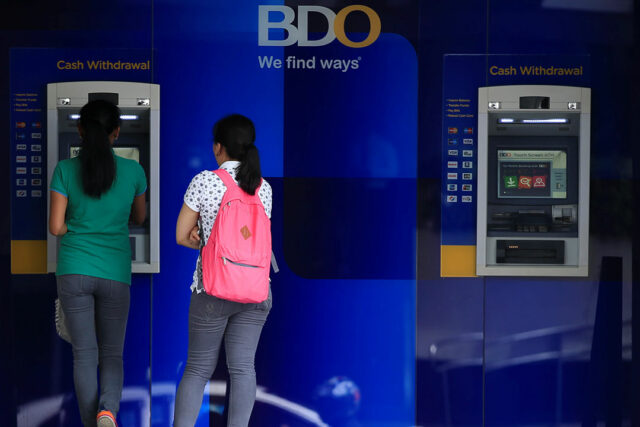
A woman withdraws money at the Automated Teller Machine (ATM) of the Banco de Oro (BDO) Unibank, Inc. building in Makati City, Metro Manila, Philippines, June 23, 2016. — REUTERS

THE COMBINED ASSETS and loans of the Philippines’ biggest banks rose by double digits in the third quarter, amid increased economic activity.

The latest edition of BusinessWorld’s quarterly banking report showed that the aggregate assets of 44 universal and commercial banks (U/KBs) grew by 11.17% year on year to P25.98 trillion in the July-to-September period from P23.37 trillion a year ago.

The third-quarter asset growth was faster than the 10.7% logged in the second quarter, and the 8.78% in the same period in 2023. It was also the quickest in six quarters or since the 11.25% in the first quarter of 2023.

Asset and loan growth of Philippines’ biggest banks surges in Q3

Meanwhile, total loans of these big banks surged by 15.07% to P13.16 trillion in the third quarter, faster than 7.01% a year ago.

In the July-to-September period, lending growth was the fastest in 23 quarters or since the 15.13% posted in the fourth quarter of 2018.

Heightened lending activity in the third quarter may have reflected improving credit demand as the central bank began its easing cycle in August.

At its Aug. 15 meeting, the Bangko Sentral ng Pilipinas (BSP) reduced policy rates by 25 basis points (bps), the first rate cut in nearly four years. This brought the benchmark rate to 6.25% from the over 17-year high of 6.5%.

The BSP followed it up with another 25-bp cut at its October meeting, bringing the key rate to 6%.

However, gross domestic product (GDP) growth slowed to 5.2% in the third quarter from 6.4% in the second quarter. This was the weakest growth in five quarters or since the 4.3% expansion in the second quarter of 2023.

Data also showed the share of bad loans to the total loan portfolio, also known as the nonperforming loan (NPL) ratio, rose to 3.28% from 3.25% in the previous quarter but fell from 3.62% a year ago.

Loans are considered nonperforming if any principal and/or interest are left unpaid for over 90 days from the contractual due date or accrued interests for more than 90 days have been capitalized, refinanced, or delayed by agreement. 

On the other hand, the net NPL ratio went up to 1.63% from 1.49% in the second quarter.

The banks’ median return on equity (RoE), which is an indicator of profitability, slipped to 8.15% in the third quarter from 9.42% in the same period a year ago.

The RoE, the ratio of net profit to average capital, measures the amount that shareholders make on every peso they invest in a company.

Additionally, the big banks’ median capital adequacy ratio (CAR) — which reflects their ability to absorb losses from risk-weighted assets — stood at 19.65% during the period. This was lower than the 21.54% a year earlier and the 18.8% in the second quarter.

The ratio remained well above the regulatory minimum of 10% set by the BSP as well as the international minimum standard of 8% under the Basel III framework.

The leverage ratio — which gauges the institution’s ability to absorb shocks by measuring the bank’s capital relative to total exposure — stood at a median of 11.53% during the period. This exceeded the central bank’s 5% guideline as well as the international standard of 3%.

Meanwhile, the net interest margin (NIM) of these big banks slipped to 3.91% from 3.62% in the previous quarter.

NIM is an indicator of banks’ investing efficiency by dividing annualized net interest income by average earning assets.

In the third quarter, the return of assets (RoA), which measures the profit generated per peso of an asset, grew to 1.69% from 1.46% in the second quarter.

BDO Unibank, Inc. (BDO) remained the largest bank in terms of total assets with P4.73 trillion as of the third quarter. It was followed by Land Bank of the Philippines (LANDBANK) with P3.43 trillion and Metropolitan Bank & Trust Co. (Metrobank) with P3.42 trillion.

The Sy-led bank also led the industry in lending with P3.06 trillion in loans issued, followed by Bank of the Philippine Islands (BPI) with P2.12 trillion and Metrobank with P1.68 trillion.

In terms of deposits, BDO topped the list with P3.74 trillion, followed by LANDBANK with P3.04 trillion and BPI with P2.49 trillion.

Among banks with at least P100 billion assets, Security Bank Corp., recorded the fastest year-on-year asset growth with 40.73%, followed by The Hongkong & Shanghai Banking Corp. Ltd. (26.63%) and Citibank NA (21.94%).

Meanwhile, Philippine Trust Co. was the most aggressive lender, with loan growth at 33.10%, followed by Maybank Philippines, Inc. with 30.57% and Security Bank Corp. with 27.20%.

BusinessWorld Research has been tracking the financial performance of the country’s large banks quarterly since the late 1980s using banks’ published statements. — Abigail Marie P. Yraola

Investment banks eye 2025 income boom as Trump drives deal rebound

The Wall Street sign is pictured at the New York Stock exchange (NYSE) in the Manhattan borough of New York City, March 9, 2020. — REUTERS/CARLO ALLEGRI/FILE PHOTO

LONDON President-elect Donald J. Trump’s return to the White House is seen fueling a dealmaking revival that could bolster investment banking income to $316 billion globally next year, a jump of about 5.7% on 2024, data seen by Reuters show.

Mergers and acquisitions (M&A) bankers are forecast to rake in about $27.6 billion in fees, according to previously unreported figures from analytics and insight provider Coalition Greenwich, in what could be their second-best year in at least two decades.

Global investment banking income has only topped $300 billion five times in the last 20 years, the data show, with earnings power in recent years stifled by the pandemic, inflation and global political unease.

Mr. Trump’s pro-business leanings should help an already thriving US economy, which could in turn encourage greater volumes of cross-border dealmaking and investment from European firms chasing growth, bankers said.

“I know it’s that time of year where bankers love to be bullish, but we actually do think that the current climate political clarity and macro stability will help drive M&A,” Richard King, head of corporate banking, EMEA, at Bank of America said.

“There’s a lot of pent-up demand that will likely come through in 2025,” he said, pointing to private equity as well as acquisitive trade buyers across a range of sectors including healthcare, tech and energy.

Mr. Trump’s administration could be particularly conducive to M&A because he is seen as likely to wave more deals through that had been blocked under the previous administration over competition or US strategic importance concerns, bankers said.

While rainmakers are getting busier, bankers managing debt sales for companies and governments could also see a jump in activity, bringing in as much as $49 billion, a new record, according to Coalition.

Revenue from the trading of securities the biggest contributor to investment bank income forecast at $220 billion for 2025 would be the highest since 2022.

Credit and emerging markets macro-related products are likely to see the biggest jump on 2024 figures next year, with a 6% increase each while trading in interest rate-related products could shrink as much as 3.5%.

“We have healthy corporate balance sheets, but we have a rate environment that has increased cost of capital… so businesses cannot be lazy,” said Taylor Wright, co-head of global banking at Barclays, predicting private equity firms will be active as both buyers and sellers of businesses.

“Geopolitical risk, in our view, is the wild card. It’s hard to plan for that but absent that, we see a lot of factors that suggest that the next 12 to 24 months should be very good for investment banking.”

RETURN OF THE FAT CATS?
With revenue on the increase, banker payouts look destined to follow suit, although bonuses will remain below bumper 2021 levels for now.

New York-based pay consultancy Johnson Associates said last month it expected banker salaries to rise in almost every business unit, with the exception of real estate investing.

Headhunters are also reporting new hiring mandates from some banks following Mr. Trump’s re-election, and a focus on adding staff in the first quarter, traditionally a time when most banks look to reduce headcount.

Hiring has increased across securities trading and from junior through to senior positions, said Natalie Nicolaou, senior manager, Distribution & Front Office, at Robert Walters UK. Reuters

Jonathan Esmerio takes reins of Loxon group of companies

The Loxon Group of Companies would like to announce that Jonathan A. Esmerio has been elected by the Board of Directors as its new President and Chief Operating Officer. He also steps up as President of Loxon Wandset, Inc. (LWI), a subsidiary that specializes in building envelop systems such as the design of aluminum glass for facade systems, engineering, testing, fabrication and installation of aluminum and glass systems, after being promoted from Vice President. Jon remains to be President of the other subsidiaries namely, Loxon Philippines, Inc. (LPI), which is a globally recognized specialty contractor of fully integrated building management systems for the protection of life and property; and ECE Prime Holdings, Inc., which has interests in the property sector. Jon also sits as a Director of the Group’s international logistics and procurement arm, Loxon Limited Hong Kong.

LPI and LWI have both achieved ISO-certification for their Risk Based Quality Management System and are Triple A-licensed specialty contractors as certified by the Philippine Contractors Accreditation Board (PCAB).

In both of his new roles, Jon replaced company founder Ed C. Esmerio who will continue to serve as Chairman of Loxon Group of Companies and the Chief Executive Officer of LWI. Jon has been tasked to oversee project management operations and business development while Ed will focus his energies on engineering and design, logistics, plant expansion and the forging of joint-venture partnerships for building facades with leading foreign companies.

“I would like to thank the Board for their vote of confidence and trust. I look forward to steering Loxon Group towards further growth and expansion by capitalizing on technological innovation and making sustainability a core part of our business strategy,” said Jonathan A. Esmerio, President and COO of Loxon Group of Companies.

Jon brings with him a wealth of experience having served in a variety of roles within the Group over the last 21 years. He has undergone extensive leadership and technical training here and abroad, and his track record of accomplishments has prepared him well for this new challenge. Jon graduated with a degree in BS Industrial Engineering from De La Salle University and completed the Corporate Finance Diploma Course in Ateneo de Manila Graduate School of Business and the Eliminate Obstacles to Growth by Recognizing and Overcoming Challenges Course of Harvard Business School.


Spotlight is BusinessWorld’s sponsored section that allows advertisers to amplify their brand and connect with BusinessWorld’s audience by publishing their stories on the BusinessWorld Web site. For more information, send an email to online@bworldonline.com.

Join us on Viber at https://bit.ly/3hv6bLA to get more updates and subscribe to BusinessWorld’s titles and get exclusive content through www.bworld-x.com.

First Gen eyes 50-MW solar facility in Batangas

FIRST GEN CORP. has a total of 3,668 megawatts of installed capacity coming from its portfolio of plants that run on geothermal, wind, hydro, solar energy, and natural gas. — FIRSTGEN.COM.PH

By Sheldeen Joy Talavera, Reporter

LOPEZ-LED First Gen Corp. plans to build a 50-megawatt (MW) solar power facility in Batangas, according to its president.

“Right now, we’re hoping that we can build our largest solar investment, which will be 50 megawatts, and that will be the springboard for more solar expansion of the First Gen Group moving ahead,” First Gen President and Chief Operating Officer Francis Giles B. Puno said in an interview with BusinessWorld.

The solar power project was allocated a portion of next year’s capital expenditure (capex) budget, amounting to approximately P35 billion.

If the company is to start the construction next year, Mr. Puno estimated it to invest around between P1 billion and P2 billion.

“This will take roughly about two years to build those facilities,” he said.

As the company is quite “coming from behind,” it is aiming to be “more aggressive” in investing in solar facilities.

“Hopefully, we can get attractive prices for our solar investment. But we’re very serious about expanding solar installation across the country,” Mr. Puno said.

The company is targeting a lower capex budget for 2025 amounting to P35 billion, of which 90% will be allocated for its renewable energy subsidiary Energy Development Corp.’s drilling activities and growth projects.

First Gen has a total of 3,668 MW of installed capacity coming from its portfolio of plants that run on geothermal, wind, hydro, solar energy, and natural gas.

AI in Philippine banking: Embracing innovation amid challenges

FREEPIK

By Abigail Marie P. Yraola, Deputy Research Head

AS THE COUNTRY embraces the digital revolution, the use of artificial intelligence (AI) in its banking operations shows significant advancements for the country.

AI, particularly generative AI (GenAI), redefines the operational and strategic landscapes of the banking sector and thus, has become a crucial factor in transformative change, Ernst & Young said in a report titled “How artificial intelligence is reshaping the financial services industry.”

The report highlighted that utilizing AI is driving a significant transformation in financial services by fostering innovation and streamlining operations.

Additionally, with its broad applications, AI enhances customer service, improves risk management, and reshapes capital markets.

The banking sector is adapting to a landscape sculpted by the six major trends: emerging technologies, ecosystem models, sustainability, digital assets, talent acquisition, and regulatory adjustments, Ernst & Young said in their report noting that these factors are driving the industry to move beyond traditional boundaries, impacting not only consumer banking but also transforming investment, corporate banking, and capital markets.

“By integrating AI technologies, banks are setting new benchmarks for operational efficiency, client engagement and sustainable growth,” it said.

The Bangko Sentral ng Pilipinas (BSP) recognizes that AI is continually evolving.

“AI has been identified as one of the crucial components of the fourth industrial revolution,” the BSP said in an e-mail.

The central bank added that AI can bridge the gap in financial inclusion through innovative solutions.

However, it also pointed out barriers that hinder financial inclusion which include (a) a lack of documentation required to open an account, (b) low awareness of the digital products and services available in the market, and (c) the high costs associated with the infrastructure needed for digitalization.

ADOPTING AI IN BANKING OPERATIONS
Currently, the central bank is guided by the definition provided by the Organisation for Economic Co-operation and Development (OECD), which describes an AI system as a “machine-based system that, for explicit or implicit objectives, infers how to generate outputs based on the input it receives.

These outputs, it said, can influence physical or virtual environments. Different AI systems vary in their levels of autonomy and adaptability after deployment.

This definition, the BSP said, aligns with the central bank’s goal of promoting the responsible use of technology to assist in inference and output generation that enhances decision-making processes.

“There has been a notable increase in the adoption and integration of AI solutions within the financial sector, particularly in enhancing decision-making, automating processes, and personalizing services,” BSP said.

It also added that recent advancements in technology have had a significant impact across various industries, particularly in BSP-supervised financial institutions (BSFIs) but noted that BSFIs can choose not to adopt AI if their existing processes are working efficiently.

The central bank further explained that when considering the adoption of AI systems, BSFIs should ensure that these technologies are integrated into their overall business plans, highlighting that it should align with its digital transformation goals.

“As with any emerging technology, there are benefits and risks associated in adopting AI,” the central bank said, acknowledging that there is “no one-size-fits-all approach for AI systems.”

However, it suggested that financial institutions can establish a policy statement outlining their approach towards AI adoption which could help prime the organization on its use.

Fintech Alliance.PH Founding Chairman and Rizal Commercial Banking Corp. Executive Vice-President and Chief Innovation and Inclusion Officer Angelito “Lito” M. Villanueva said that AI has played a crucial role in democratizing financial access, allowing for more efficient, secure, and personalized banking experiences.

He cautioned that alongside these advances, AI also brings complex challenges that demand careful attention to regulation and ethical boundaries before widespread adoption.

He further explained that AI is crucial for automating processes, enhancing predictive analytics, and enabling targeted decision-making, which helps banks accomplish data-driven tasks more efficiently and accurately.

“Central banks can leverage AI for regulatory compliance and fraud detection. In commercial banking, AI can personalize customer interactions, credit risk analysis, and cybersecurity measures,” Mr. Villanueva said in an e-mail interview.

He added that as AI evolves, concerns about job displacement, especially within low-skilled sectors, are growing. Under Philippine labor law, employers are permitted to terminate employees if labor-saving technologies, such as AI, lead to redundancies, provided that legal standards are followed.

“This presents a need for the government to focus not only on AI regulations but also on creating alternative job opportunities for displaced workers,” he said.

CONSIDERATIONS AND IMPLEMENTATION
When considering the adoption of AI or any emerging technology, financial institutions should start by evaluating their risk appetite.

“Depending on the risk-reward analysis, BSFIs could integrate AI into their systems with proper controls,” the BSP said.

The central bank expects that risk management measures for consumer protection, cybersecurity, and anti-money laundering/combating the financing of terrorism (AML/CFT) are established whenever an AI system is implemented.

“At the minimum, financial institutions should adhere to the principle of “Do no harm” regarding the use of AI, whether internally or externally,” BSP said.

For Mr. Villanueva, phased and purpose-driven AI implementation should be given priority to areas that improve customer experience, risk management, and boost cybersecurity.

Customer-facing applications, such as AI chatbots and virtual assistants, should be deployed initially to streamline basic customer interactions and make banking more accessible.

“At RCBC, we’re focusing on how AI could improve the accuracy of customer risk profiles and improve cybersecurity protocols. Through Fintech Alliance.Ph, we work to advocate for AI policies that promote both innovation and customer protection, a balance that helps financial institutions adopt AI responsibly,” he said.

Mr. Villanueva highlighted that traditional AI, such as predictive analytics and machine learning, can reinforce the foundational framework of Philippine banks, while GenAI can enhance customer engagement efforts.

EMERGING CHALLENGES
A report by McKinsey & Co. titled “Scaling Gen AI in banking: Choosing the best operating model” highlighted that banks and other financial institutions rapidly use AI technology, and challenges are emerging.

It further explained that AI, specifically Gen AI is transforming the banking industry as financial institutions leverage this technology to enhance customer-facing chatbots, detect fraud, and accelerate time-consuming tasks such as code development, creating pitch book drafts, and summarizing regulatory reports.

They suggested that banks and financial institutions can adopt varying approaches to structuring their GenAI operating models, ranging from highly centralized to highly decentralized.

The BSP is cognizant of its crucial role in promoting an enabling regulatory environment that promotes innovation and risk resilient financial systems.

When an institution intends to adopt artificial intelligence (AI), it should conduct risk-based assessments before development. These assessments should focus on key risk areas, including consumer protection, cybersecurity, and anti-money laundering (AML) and counter-terrorism financing (CFT). Additionally, continuous monitoring is essential to validate the AI system’s outputs over time.

For Mr. Villanueva, institutions can maximize the value of AI by prioritizing transparency, ethical practices, and strong data governance policies.

The proactive measures taken by the BSP in developing regulatory frameworks for AI are essential for establishing these standards, he highlighted.

“We need that distinction between goal-oriented AI and ethically guided AI. AI’s capabilities for automation and problem-solving raise questions about maintaining a balance between efficiency and ethics,” Mr. Villanueva emphasized.

“We must ensure that human judgment remains central, especially as AI advances to more autonomous roles, how AI systems are designed and used ultimately defines their impact, whether good or bad.”

For John Paolo R. Rivera, senior research fellow at Philippine Institute for Development Studies, he said that AI can be used by banks to detect fraud in transactions and forecast financial risks.

“As an advantage, generative AI can create customer outreach campaigns or designs tailored financial advice scripts using natural language generation,” he said in a Viber message.

He further explained that traditional and GenAI are complementary technologies that financial institutions can utilize to enhance operations, boost customer satisfaction, and ensure regulatory compliance.

“Banks should focus on adopting hybrid solutions — using traditional AI for precision and security, while exploring generative AI for innovation and customization.”

RISKS AND BENEFITS
Mr. Villanueva listed that harnessing AI offers numerous life-changing benefits, including improved decision-making, cost reduction, and more personalized customer experiences.

“In fraud prevention, AI systems can monitor transactions in real time, which is critical in addressing the Philippines’ higher-than-global fraud rates. There is promise in reducing fraudulent transactions and boosting security.”

However, he also cautioned that integrating AI posts risks such as data privacy concerns, potential biases, and high implementation costs.

For example, he said that if not carefully monitored, AI systems can inadvertently introduce biases into decision-making processes.

The central bank emphasized that financial institutions should also develop a workforce training plan to prepare employees for the adoption of AI technologies.

“Similarly, with the rise of AI-powered cyber-attacks, institutions should continuously monitor and strengthen their cybersecurity defenses,” the central bank said.

Mr. Villanueva emphasized that they are focused on implementing ethical AI adoption by working with regulators to establish standards that protect consumer data and mitigate bias risks.

He noted that reports from McKinsey and Goldman Sachs predict that AI will impact millions of jobs in industries such as manufacturing and marketing.

“This shift will require flexible regulatory frameworks that protect consumers without stifling innovation,” Mr. Villanueva said.

Utilizing AI in banking operations, he said, is not just black or white. It has dual sides benefits and risks, wins and losses.

It is undoubtedly a powerful tool that can either help us create a more inclusive and prosperous future or exacerbate the existing class and digital divide.


How First Circle aims to bridge the SME funding gap

FIRST CIRCLE Co-Founder and Chief Executive Officer Patrick Lynch

By Beatriz Marie D. Cruz, Reporter

FIRST CIRCLE, a local financial technology (fintech) lender, is looking to partner with four more banks next year to help bridge the lending gap between banks and small and medium enterprises (SMEs), according to its chief executive officer (CEO).

“We’ve got four credit relationships with banks, and we want to bring that to maybe seven or eight by next year,” First Circle Co-Founder and CEO Patrick Lynch said in an interview with BusinessWorld.

First Circle specializes in SME lending, as it offers flexible and collateral-free business and employee salary loans. It also provides online banking services to small businesses without transfer limits, transaction fees, and maintaining balance.

The fintech company borrows from banks and uses the money to lend to SMEs, Mr. Lynch said, noting that its affordable and flexible loan products help provide more small businesses with access to financing.

“Banks don’t have the technology and the operations to be able to serve and manage lots and lots of small customers, but we do because we’re a technology company, and the banks have the balance sheet.”

“The game is not about trying to compete in what’s there now; it’s about creating more access for businesses.”

Latest data from the Bangko Sentral ng Pilipinas (BSP) showed that Philippine banks had extended P488.13 billion in loans to micro, small- and medium-sized enterprises (MSMEs) as of the end of June. However, this fell below the 10% required quota, accounting for only 4.52% of their P10.08-trillion total loan portfolio.

Under Republic Act No. 9501, or the Magna Carta for MSMEs, banks are mandated to allot 10% of their loan portfolio for small businesses. Specifically, 8% must go to micro and small-sized businesses, while 2% must go to medium-sized enterprises.

MSMEs account for over 99.6% of all businesses in the Philippines and provide thousands of jobs, establishing their critical role as the backbone of the economy.

There was a total of 1.24 million MSMEs in the Philippines as of last year, with a majority (82.1%) of them operating in the provinces, according to the Asian Development Bank’s (ADB) latest SME Monitor.

However, banks would rather pay fines for non-compliance than undergo the risks of lending to small businesses. The banking industry’s gross non-performing loan ratio stood at 10.3% in 2023, nearly double the 2019 ratio, according to the ADB.

Small businesses’ access to bank loans also remains hindered by high-interest rates, tight collateral requirements, and the tedious loan application process. Other MSMEs resort to non-traditional sources of financing like pawnshops, the Manila-based lender said.

First Circle’s business loan offers up to P20 million without requesting collateral, compared to banks, which mostly require collateral for loan amounts beyond P2 million, it said.

The fintech company’s partnership with Philippine banks forms part of its strategy to improve Filipino SMEs’ access to financing next year, according to Mr. Lynch.

“Over the course of the next five to ten years, the whole game is about expanding our offering to support more of the needs of SMEs.”

TECH-BASED FINANCIAL INCLUSION
Mr. Lynch co-founded First Circle in 2016 with the idea of using technology to improve financing access among SMEs. He gained the backing of former BSP Governor Nestor A. Espenilla, who advocated for financial inclusion among consumers and businesses alike.

“He was very pro-financial inclusion, and he realized that the best way to include people was going to be through technology companies,” said Mr. Lynch, recalling the late banker’s full support.

To date, First Circle has extended P11 billion in loans to support SME growth, with its customers growing by 80% on average in over two years, Mr. Lynch said.

Since its founding, First Circle has supported up to 5,000 SMEs nationwide, with more than half of them being women-led firms, according to Mr. Lynch.

SMEs can open an account in one day and can loan up to P20 million with no collateral.

First Circle also boasts competitive interest rates, beginning at 0.99% per month, compared to most business loan providers, which charge between 2-10% interest per month, Mr. Lynch said.

It can also provide SME owners with a loan decision in a maximum of two days with minimal requirements. To limit unnecessary costs, business owners may only pay interest rates for the amount they borrow.

“It’s very easy to draw down; there are no hidden fees… if you want to repay early, we give you all your interest back,” Mr. Lynch said. “[If you] need to reschedule because your customers have paid you late, we reschedule very easily, and so that’s why we’re winning because we care about the customer.”

As part of its expansion plans, the tech company started using artificial intelligence (AI) in its underwriting earlier this year, which allows them to process documents more easily.

Beginning next year, First Circle is extending its loan period for its business loans, wherein borrowers can pay their loans for up to three years from the current 12 months, Mr. Lynch said.

“At the moment, we provide up to 12 months (repayment). We will soon be providing up to three years,” he said, which will be available as early as January.

For 2025, First Circle is also planning to launch its “express business loan,” which seeks to grant customers loan access on the day of their application.

Early next year, the fintech lender is also set to release three new financial products meant to help SMEs improve their operations, Mr. Lynch added, saying this has yet to be revealed.

With the BSP’s easing cycle still underway, Mr. Lynch is bullish that the company can provide even cheaper loans to small business owners.

The central bank has reduced borrowing costs by a total of 50 basis points (bps) since kicking off its easing cycle in August, bringing the key rate to 6%, BSP Governor Eli M. Remolona, Jr. said last month.

With the Philippine economy expected to grow over the next 20 to 30 years, SMEs need more credit access to utilize its growth potential, according to Mr. Lynch.

He added that the BSP’s push for financial inclusion plays a critical role in ensuring that more Filipinos, especially SMEs, are banked.

On what makes it worth investing in MSMEs, Mr. Lynch said: “It’s a huge market; it’s about half of GDP (gross domestic product). Number two, it’s a very big opportunity to use technology to drive change.”

“Number three, SMEs employ two-thirds of the labor force. And a strong SME sector is very important for wealth distribution in society.”