Home Blog Page 192

Regional flood risk elevated due to settlement of vulnerable areas — BMI

PHILIPPINE STAR/MIGUEL DE GUZMAN

SOUTHEAST ASIA is facing rapidly rising exposure to severe flooding as climate change accelerates, and populations expand in vulnerable areas, according to a study by BMI, a unit of Fitch Solutions.

BMI said the region is increasingly experiencing “compound disasters,” or extreme weather events that occur in close succession, which strain response systems.

BMI reported that Southeast Asia’s exposure to high-intensity flood risk remains among the highest globally.

About 20% of the population in Indonesia and Malaysia lives in areas that face significant flood threats. In the Philippines, Vietnam, Sri Lanka and Singapore, the percentage is between 14% and 15%. 

BMI reported that the share of Filipinos living in high-intensity flood-risk zones increased by almost two percentage points, equivalent to about one million people, between 2020 and 2024 compared with the previous decade.

According to BMI, transportation and agriculture are among the industries most severely affected by climate change in Southeast Asia.

“Many airports, roads, and railways lie in or near areas that are frequently flooded, leading to disruption. Croplands are also increasingly flooded, with the impact of floods, exacerbated by deforestation, which leads to soil erosion and landslides,” BMI said.

Meanwhile, BMI said disaster resilience of emerging Asian markets will continue to improve, but will not be keep pace with those of developed markets in the region.

Improvements also vary by country, with China, India, and Thailand seeing the biggest gains from 2023 to 2025. The Philippines’ resilience score in the same period remains largely unchanged at around 45 out of 100, with 100 representing the weakest resilience.

An earlier BMI report in September found that the Philippines’ flood mitigation measures remain inadequate. BMI said the country has been underspending on flood management, and recent revelations of rampant corruption suggest it has underspent more than previously thought.

“Climate change is increasing the frequency and severity of flooding and adverse weather events, and the inadequate flood control infrastructure in the Philippines will weigh on its long-term growth trajectory,” BMI said.

By comparison, complex, integrated flood defenses in countries like Japan and Singapore are expected to continue proving effective at preventing floods in the coming decades.

Citing a study by the Japan International Cooperation Agency, BMI said the Philippines will need to spend an average of $3.9 billion per year from 2016 to 2030 to meet demand for flood control infrastructure that would produce $12.6 billion in net benefits by 2030. — Vonn Andrei E. Villamiel


PHL, Canada eye cacao, coffee, dairy tie-ups

REUTERS

THE PHILIPPINES and Canada are looking into potential collaboration in cacao, coffee and dairy development, climate-resilient farming, and the monitoring of illegal, unreported and unregulated fishing, the Department of Agriculture (DA) said in a statement.

The DA said Agriculture Secretary Francisco P. Tiu Laurel, Jr. met with Canada’s Secretary of State for International Development Randeep Sarai in November to discuss ongoing programs and possible areas for expanded collaboration.

According to the DA, Canada is also committing to a 26-million Canadian-dollar investment package to support its global agricultural initiatives.

“Canada remains a vital partner in strengthening our agricultural sector. Our shared commitment to food security, value-adding, and technical cooperation positions both countries for long-term, mutually beneficial growth,” Mr. Laurel said.

The DA said the National Dairy Authority has expressed interest in Canadian dairy genetics, live animals and knowledge exchanges involving farm management and cow welfare.

The DA said it is constructing a new rice fortification plant and is seeking Canadian guidance on expanding fortification to other food products.

Agriculture Assistant Secretary Arnel V. de Mesa was quoted in the statement as saying the DA plans to submit year-end concept notes for Official Development Assistance projects in coffee, potatoes, cacao and dairy. — Vonn Andrei E. Villamiel
EU grants, guarantees to support green transition, Mindanao dev’t

STOCK PHOTO | Image from Freepik

THE Department of Finance (DoF) said new investments in green transition, circular economy, environmental protection and in Mindanao development will be backed by European Union (EU) grants and guarantees.

“New investments in key areas, like green transition, circular economy, environmental protection, Mindanao’s development, and prospective loan financing will be supported with EU grants (blended finance) and EU guarantees to de-risk upfront the investment,” the DoF said in a statement on Tuesday.

The announcement followed the fifth meeting of the EU–Philippines Sub-Committee on Development Cooperation in Brussels on Nov. 25, where both sides reaffirmed shared interests under their Partnership and Cooperation Agreement.

The sub-committee conducted a comprehensive review of key ongoing cooperation programs, primarily on the Mindanao peace process and good governance, and the green and digital economy.

“The roles of the European Investment Bank (EIB) and other European Development Finance Institutions (EDFIs) — in a Team Europe approach — will be crucial, alongside potential cooperation with multilateral development banks, in particular with the Asian Development Bank,” it said.

The DoF said the talks covered prospective future cooperation on the sustainable use of critical raw materials and green finance. — Aubrey Rose A. Inosante

Manufacturing PPI growth slows to 0.3% in Oct.

PHILIPPINE STAR/KRIZ JOHN ROSALES

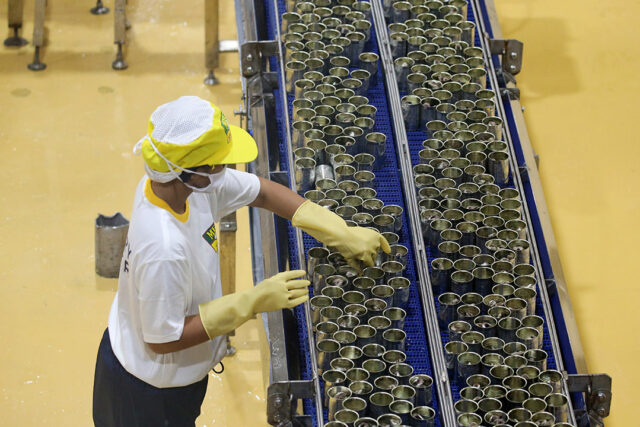
PRICE GROWTH at the factory gate slowed in October, with computer, electronic and optical products dragging down the overall index, the Philippine Statistics Authority (PSA) reported.

The PSA said the Producer Price Index (PPI) for manufacturing grew 0.3% year on year in October, decelerating from the 0.8% rate posted in September. The October growth represented a turnaround from the 0.4% decline posted a year earlier.

“The slower annual increase of PPI for the manufacturing section in October was primarily due to the annual decline in the PPI for the manufacture of computer, electronic and optical products industry division,” the PSA said in a statement on Tuesday.

The PPI for the manufacture of computers, electronics, and optical products industry division slipped 1% in October after having risen 0.6% in September.

“Among the 22 industry divisions for manufacturing, the manufacture of computer, electronic and optical products has the second-highest weight in the computation of PPI,” it added.

Other contributors to the decline were the price growth slowdowns in food products to 0.4% from 0.7% and in basic metals to 1.4% from 2.2%.

“Of the remaining 19 industry divisions, 12 exhibited annual increases, while seven industry divisions registered annual decreases during the period,” the PSA said.

Month on month, the PPI for manufacturing grew 0.4% in October, accelerating from 0.1% in September but slower than the 0.9% year-earlier rise.

“The top contributor to the faster monthly growth rate of PPI for manufacturing in October was the manufacture of coke and refined petroleum, which registered a monthly increment of 1% during the period from a 1.9% monthly decline in September,” it said.

Rizal Commercial Banking Corp. Chief Economist Michael L. Ricafort said the slower PPI increase could be attributed to better weather compared to previous months.

He said that the series of storms and earthquakes since July “partly led to a temporary increase in prices amid damage and reduction in the supply of some agricultural products.”

“For the coming months, prices could seasonally pick up during the Christmas holiday season,” he said via Viber.

He cited “higher demand/spending by consumers” though declines are expected “upon crossing the new year.”

Meanwhile, Reyes Tacandong & Co. Senior Adviser Jonathan L. Ravelas said slower price growth in October reflects easing cost pressures for manufacturers.

“Food prices cooled as supply improved, and global commodity prices — especially energy — stabilized after earlier spikes,” he said via Viber.

“Manufacturers are getting some breathing room, but risks remain from volatile electricity costs and imported raw materials. If oil or supply chain shocks return, PPI could climb again,” he added.

John Paolo R. Rivera, a senior research fellow at the Philippine Institute for Development Studies, said the moderation in PPI growth reflects stabilized global commodity prices, smoother supply chains, and softer domestic demand.

“Some industries are also adjusting from earlier high-cost periods and are now seeing more normal input prices,” he said via Viber.

“Overall, slower PPI growth reflects a cooling of cost-push pressures, consistent with the broader slowdown in manufacturing activity,” he added. — Justine Irish DP. Tabile

EDCOM 2: 85% of grades 1 to 3 students are struggling readers 

The Department of Education officials and EDCOM 2 Executive Director Karol Mark R. Yee (holding right of poster) at the launch of the Bayang Bumabasa Initiative. — ALMIRA LOUISE S. MARTINEZ

The Second Congressional Commission on Education (EDCOM 2) said on Tuesday that 85% of grades 1 to 3 students are “struggling readers”, further underscoring the literacy crisis nationwide. 

“Our data, at the beginning of the school year in July, found that the grade level students in our grades 1 to 3 are only 15%,” EDCOM 2 Executive Director Karol Mark R. Yee told reporters in Filipino at the sidelines of an event. 

“It means that 85% of grades 1 to 3 students are struggling readers,” he added. 

Data from the commission in November also echoed the same concern, revealing 24.8 million functionally illiterate Filipinos. 

According to Mr. Yee, challenges in literacy are mainly caused by a lack of learning resources, teacher training, and community mobilization, 

“Children need books because how can you improve literacy if you don’t have anything to read. Second, teacher training, and third, mobilizing the community,” he said. “Parents really need to play a role especially in Kinder to Grade 3, learning does not stop in school.” 

The EDCOM 2 executive director underscored that initiatives from the Education department, such as the newly launched Bayang Bumabasa Initiative, help schools address literacy gaps among students. 

Bayang Bumabasa Initiative aims to help schools with “higher literacy challenges” by providing grants of up to P1 million. 

“If they are facing challenges unique to their own school, they can access resources from DepEd and the support that they need to be able to address literacy challenges,” Mr. Yee said. 

“It will be dependent on the proposal of the school and they should justify how it will really support improved learner outcomes or literacy of students,” he added. 

Mr. Yee noted that the initiative aligns with the commission’s social media campaign Bayang Bumabasa: Mayors for Literacy which encourages local government units to champion literacy in their respective areas. 

“It’s important to involve the mayors because if they are not, it’s really going to be hard for DepEd,” he said. “They are the ones who know the child who dropped out, the child who is frequently absent.” 

“If the mayor and the barangay help, they can find these children, bring them back to school, and talk to their parents,” he added. 

About 20 mayors have participated in the social media campaign, including Pasig City Mayor Victor Ma. Regis “Vico” N. Sotto and Naga City Mayor Maria Leonor “Leni” G. Robredo. — Almira Louise S. Martinez

Bulldogs, Fighting Maroons eye quick finals date in UAAP S88

NATIONAL UNIVERSITY BULLDOGS — UAAP/JULIUS DOMONDON

Games on Wednesday
(Smart Araneta Coliseum)
(U16 Boys’ Stepladder Semis)
8:30 a.m. – FEU-D vs UST
(Women’s Stepladder Semis)
10:30 a.m. – ADMU vs NU
(Men’s Final Four)
1:30 p.m. – NU* vs DLSU
4:30 p.m. – UP* vs UST
*Twice-to-beat

TOP-RANKED National University (NU) and reigning champion University of the Philippines (UP) try to maximize their incentives to arrange a quick finals date in the UAAP Season 88 men’s basketball Final Four on Wednesday at the Smart Araneta Coliseum.

Armed with twice-to-beat bonuses, the NU Bulldogs and the UP Fighting Maroons could advance in the best-of-three finale in just one swing against the University of Santo Tomas Growling Tigers and the De La Salle University Green Archers, respectively.

NU battles fourth-ranked La Salle to snap its back-to-back finals appearance at 1:30 p.m. followed by UP’s fifth straight finals bid against the third-seeded Santo Tomas at 4:30 p.m.

Berths in the finals via stepladder semifinals are also up for grabs in the women’s and U16 divisions. Defending titlist and second place NU battles No.3 seed Ateneo de Manila University at 10:30 a.m. for a shot at unbeaten Santo Tomas in the women’s finals while No. 2 Santo Tomas clashes with No. 3 Far Eastern University-Diliman (FEU-D) at 8:30 a.m. for the right to challenge undefeated NU-Nazareth School in the U16 finale.

Ateneo and FEU-D advanced to the next stepladder after eliminating Adamson University, 66-56, and 90-76, respectively.

But all eyes are on the remaining four squads in the centerpiece men’s hoop wars with NU leading the way in an attempt to change the UAAP hoops order.

The Bulldogs licked the wounds of their seventh-place finish last year and dominated the two-round eliminations with an 11-3 slate, unseating the usual top seeds UP and La Salle.

That, however, doesn’t mean satisfaction and fulfillment already for NU with now a closer shot at returning to the finals after a decade as its ultimate goal.

“Stay focused, stay hungry, stay humble. Those three key words are very important for us,” said head coach Jeff Napa, warning against any complacency from his wards.

NU swept the crippled La Salle in two encounters this season but the semis is an entirely different arena, especially with the expected full-swing return of Mason Amos and Kean Baclaan for coach Topex Robinson’s troops following their MCL injuries. Mr. Amos has played limited minutes since while Mr. Baclaan for the first time was in uniform in La Salle’s last two wins against UP, 87-82, and Ateneo, 78-72, to catch the last semis bus behind Jacob Cortez and Elite Team member Mike Phillips.

NU will also welcome back Gelo Santiago from a five-game suspension following his unsportsmanlike foul on Ateneo’s Waki Espina early in the second round for an added coverage to Elite Team member Jake Figueroa, Omar John, Jolo Manansala, Mark Parks, Steve Nash Enriquez and Paul Francisco.

Then there’s the titleholder UP, which anticipates a dogfight with host Santo Tomas after splitting their season meetings in a bid to extend their finale streak to five under master tactician Goldwin Monteverde. The Fighting Maroons barely beat the Growling Tigers in the second round, 89-88, after a shellacking 87-67 defeat in the opener.

“Our mindset every time is consistency. It’s back to zero in the Final Four,” said Mr. Monteverde, tasking captain Gerry Abadiano, Harold Alarcon, Francis Nnoruka and Gani Stevens to steady the ship for Diliman.

Standing on their way is a streak of Growling Tigers led by super rookie and Elite Team members Collins Akowe and Nic Cabañero alongside Forthsky Padrigao, Gelo Crisostomo and Kyle Paranada as the wards of coach Pido Jarencio fight to live another day. — John Bryan Ulanday

POC names Eala, Bagunas as flag bearers in SEAG

BRYAN BAGUNAS — PNVF

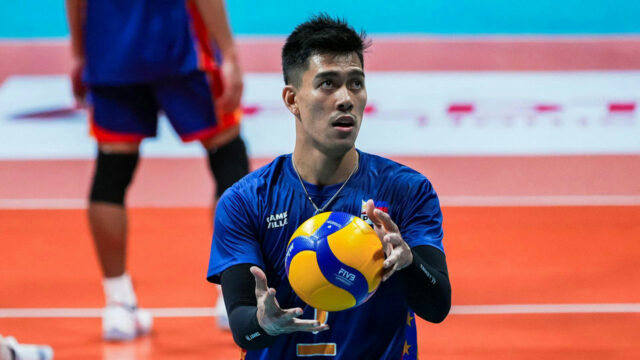
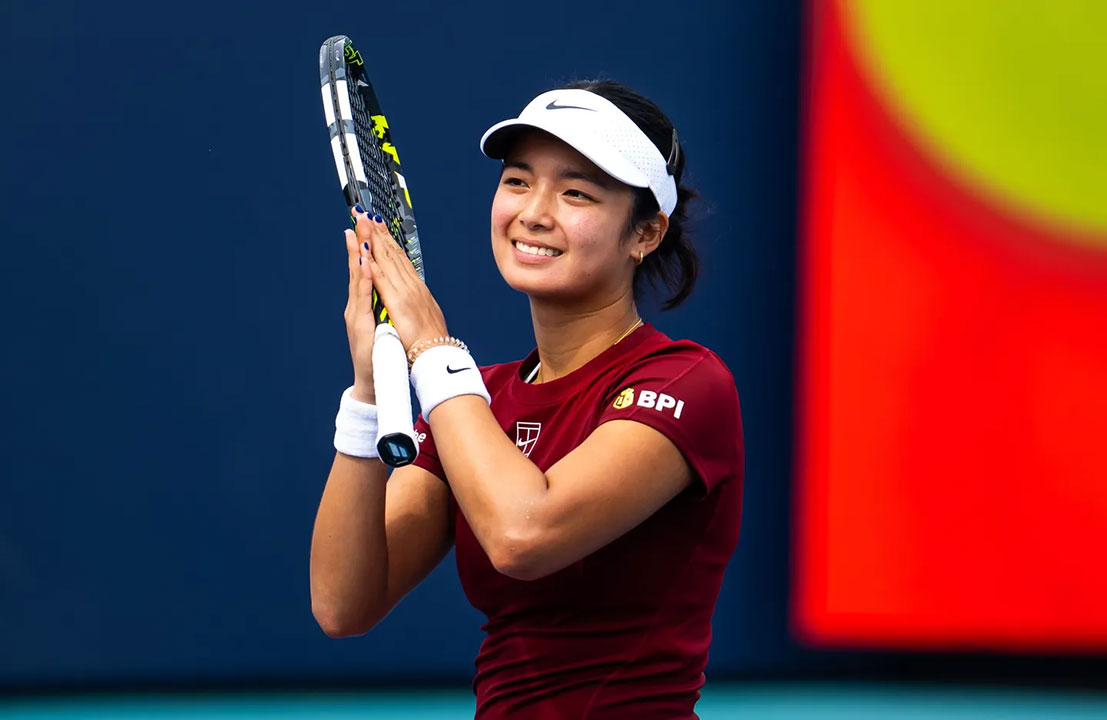
TENNIS supernova Alexandra “Alex” Eala and volleyball star Bryan Bagunas will be the Philippines’ flag bearers when it wades into battle in the 33rd Southeast Asian Games (SEAG) set Dec. 9 to 20 in Thailand.

“Popularity aside, Alex and Bryan have made impacts in the global sports community and that makes them the best choice to carry the flag in the SEA Games,” said Philippine Olympic Committee (POC) President Abraham Tolentino in a statement on Tuesday.

“It’s about the inspirational appeal, the motivation and hard work that reaps accomplishment that make an athlete or athletes the best choice for the chore,” he added.

Ms. Eala, of course, was an easy choice after her meteoric rise to prominence as she is now ranked 50th in the Women’s Tennis Association rankings — the highest place reached by a Filipina.

For Mr. Bagunas, he was the face of the Alas Pilipinas team that finished a historic 19th in the FIVB Men’s Volleyball World Championship the country hosted a few months ago.

The pair’s presence in the biennial meet should add to an already star-studded, 1,168-strong Philippine team eyeing to eclipse its 58-gold, fifth-place finish in Phnom Penh, Cambodia two years ago.

It included Tokyo Games weightlifting gold winner Hidilyn Diaz, Olympic medalists Nesthy Petecio, Aira Villegas and Eumir Felix Marcial of boxing and Kayla Sanchez of swimming, and Olympians EJ Obiena (pole vault), Hergie Bacyadan (boxing), Aleah Finnegan (artistic gymnastics), Joanie Delgaco (rowing), Eric Cray (athletics) and Elreen Ando (weightlifting).

Other stars in the fold are Gilas Pilipinas, Alas Pilipinas, and World Cup veterans from the national women’s football team.

Mr. Tolentino, meanwhile, said the country’s initial 300 slots in the opening parade at the Rajamangala National Stadium could possibly be trimmed to 200 due to the host Thais’ year-long mourning for their Queen Sirikit and the Songkhla flood disaster. — Joey Villar

After 2-decade stint with Gilas, Aguilar hangs up sneakers

JAPETH AGUILAR hung his sneakers with peace, comfort and confidence, knowing that he has left a very capable and youthful frontline for Gilas Pilipinas to bank on — more than just his lasting legacy.

Mr. Aguilar on Tuesday ended almost a two-decade stint with Gilas Pilipinas, the longest tenure for any national player in history, officially handing the keys to the likes of Kai Sotto, AJ Edu and Quentin Millora-Brown.

Mr. Aguilar, who started donning national colors as a pioneer member of the Smart Gilas Pilipinas program in 2009, started the game and played 10 minutes with three points, a rebound and a steal as head coach Tim Cone gave him a perfect swan song.

Following him in the later years was the nine-time PBA MVP June Mar Fajardo as they formed a formidable frontline tandem that led to Gilas’ three straight FIBA Basketball World Cup appearances from 2014.

That year, Gilas snapped a 36-year World Cup appearance by winning a silver medal in the 2013 FIBA Asia Championship prior.

Mr. Aguilar also had a hand in Gilas’ two SEABA and SEA Games championships on top of the gold medal in the 2023 Asian Games to end a 61-year thirst for the Philippines, which remains their greatest feat up to date.

Overall, Mr. Aguilar played 82 matches in FIBA competitions but his time was up, leaving Gilas in good hands with the triple tower combo of Messrs. Sotto, Edu and Millora-Brown as soon as Mr. Fajardo retired anytime soon, too.

What made it sweeter his having his No. 25 jersey retired during the game at a venue where it all started for him — the Blue Eagle Gym — as a former Ateneo player.

Mr. Aguilar may have retired from national team duties but for Mr. Cone, he can always come back, especially with still an active role for their mother club Ginebra in the PBA.

“He knows that if we call him, he could still come back. Who knows? His wife always tells my wife: ‘Can you please allow him to retire?’ I’ve said no for the last two to three years. But with Kai nearing his return, there was a chance for him to finally retire,” said Mr. Cone.

“But he’s still on call. If something happens with some of our bigs, we will still call him because he’s a freak of nature. He is gonna be like Muhammad Ali, maybe. Come back, retire, come back, then retire.” — John Bryan Ulanday

WNBA offers $1-M max base salary plus revenue sharing

STOCK PHOTO | Image by Markus Spiske from Unsplash

THE latest proposal made by the WNBA in collective bargaining negotiations with the players’ union would guarantee a $1-million base in salary for players on max deals, ESPN reported on Monday.

The total earnings for max players could exceed $1.2 million when factoring in revenue sharing, which would surpass the league’s previous proposal that had max salaries around $1.1 million between salary and a revenue-sharing piece.

The Women’s National Basketball Players Association rejected that proposal roughly two weeks ago, and the league and union agreed on Sunday to extend their deadline six weeks till Jan. 9, 2026. It was the second extension since the end of the 2025 season.

Per ESPN, the newest proposal would lead to a $5-million salary cap in 2026, and it would grow annually along with revenue growth throughout the length of the CBA. The minimum salary for 2026 would be $225,000.

Team salary caps were $1.5 million in 2025.

The players’ side has been asking for a cap that was tied to league revenue growth rather than staying flat throughout the length of the deal. The union has not yet responded publicly to the league’s latest proposal. — Reuters

Heat match team record with 24 treys, trounce Clippers

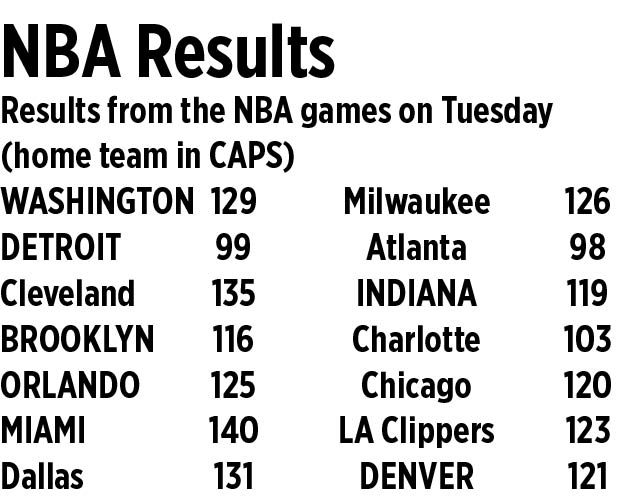
NORMAN POWELL sank six of the Heat’s franchise-record-tying 24 3-pointers as Miami blew out the visiting Los Angeles Clippers, 140-123, on Monday.

Powell put up 30 points and shot six-for-10 from long distance for the Heat, who won for the seventh time in eight games. Bam Adebayo set a career high with five treys while scoring 27 points and grabbing a season-high 14 rebounds.

Miami’s Andrew Wiggins and Tyler Herro each added 22 points, and Davion Mitchell scored 16 points, going four-for-four from 3-point range, and dished out 12 assists. Herro also sank four treys.

It was the fifth time this season that the Heat scored 140 points or more in a game. Miami completed a 3-1 homestand and improved to 10-2 at home.

Los Angeles’ Kawhi Leonard led all scorers with 36 points, 19 of them coming in the fourth quarter when the result was essentially settled. James Harden finished with 11 points in only 20 minutes, and Ivica Zubac contributed 16 points and 13 rebounds.

The Clippers took their fifth loss in a row and fell for the ninth time in 10 games. The Monday contest was the opener of a five-game road trip.

The game was tied before Miami closed out the first half on a 32-12 run to lead 76-56 at the break.

Miami went 14-for-21 from 3-point distance in the first half. The Clippers were 3-for-15 from beyond the arc.

The second half was more of the same for the Heat as Adebayo and Powell continued their barrage from distance. Miami went on a 12-0 run to open the half, featuring two 3-pointers from Adebayo and one apiece from Mitchell and Powell.

Following a Clippers timeout, Los Angeles coach Tyronn Lue chose to sit all five of his starters with 10:36 left in the third quarter. Harden never checked back into the game.

The Clippers outscored the Heat 41-26 in the fourth quarter and were able to cut the deficit as low as 12 points after trailing by 38 in the third.

The Heat wound up 24-for-46 (52.2%) on 3-point attempts, while the Clippers finished 9-for-29 (31%). — Reuters

Embiid’s iffy presence

Joel Embiid’s return to action the other day brought hope of a reset for the Sixers. If nothing else, it gave them a chance to reignite stability, reclaim lost ground, and, in the process (no pun intended), remind the National Basketball Association that former Most Valuable Player awardee remains central to their cause. Instead, what unfolded was the opposite, courtesy of a chaotic double-overtime setback to the Hawks that showed their rust in all the wrong places, and more.

First, the good news: Embiid managed to put up 18, four, two, one, and one in a season-high 30 minutes. And while he was held out in the second overtime, he insisted in the aftermath that his knee felt fine, and that he was “just happy I got to play.” Now, the bad news: The Sixers still lost despite the return of Embiid, and with Paul George and Tyrese Maxey also on the floor, a particularly telling outcome. Given the latter’s monster numbers (44, seven, and nine in 52 minutes of exposure).

That the Sixers failed to protect home court with the Big Three nominally intact underscores a deeper shift already under way in the City of Brotherly Love. As pundits have noted, the baton has effectively been passed from Embiid and George to Maxey and, yes, rookie VJ Edgecombe. The number three overall pick in the 2025 draft is off to a promising start, and, for the first time in a long while, the red, white, and blue aren’t simply waiting for their stars to heal. Their dynamic backcourt has allowed them to stay afloat even in the face of recurring injuries to their bigs.

That said, the loss to the Hawks reveals the limits of the Sixers’ evolution. Embiid’s mobility remains a question mark, and to a point where he needs to be used in spurts and can no longer be the focal point of the offense. In any case, paint protection will stay shaky given his physical frailties. Which is to say his iffy presence serves as a reminder that the future should be vastly different. Else, they will be treating themselves to the same old, same old.


Anthony L. Cuaycong has been writing Courtside since BusinessWorld introduced a Sports section in 1994. He is a consultant on strategic planning, operations and human resources management, corporate communications, and business development.

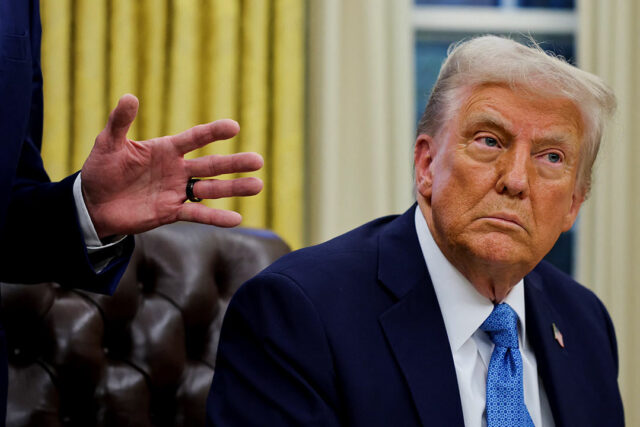
Trump’s push to end Ukraine war raises fears of ‘ugly deal’ for Europe

REUTERS

BRUSSELS — However US President Donald J. Trump’s latest push to end the war in Ukraine pans out, Europe fears the prospect of a deal — sooner or later — that will not punish or weaken Russia as its leaders had hoped, placing the continent’s security in greater jeopardy.

Europe may well even have to accept a growing economic partnership between Washington, its traditional protector in the North Atlantic Treaty Organization (NATO) alliance, and Moscow, which most European governments — and NATO itself — say is the greatest threat to European security.

Although Ukrainians and other Europeans managed to push back against parts of a 28-point US plan to end the fighting that was seen as heavily pro-Russian, any deal is still likely to carry major risks for the continent.

Yet Europe’s ability to influence a deal is limited, not least because it lacks the hard power to dictate terms.

It had no representatives at talks between US and Ukrainian officials in Florida over the weekend and will only watch from afar when US Special Envoy Steve Witkoff visits Russian President Vladimir Putin on Tuesday.

“I get the impression that, slowly, the awareness is sinking in that at some point there will be an ugly deal,” said Luuk van Middelaar, founding director of the Brussels Institute for Geopolitics think tank.

“Trump clearly wants a deal. What is very uncomfortable for the Europeans… is that he wants a deal according to great-power logic: ‘We’re the US, they are Russia, we are big powers.’”

RUBIO SEEKS TO REASSURE EUROPEANS
US Secretary of State Marco Rubio has said Europeans will be involved in discussions about the role of NATO and the European Union (EU) in any peace settlement.

But European diplomats take limited comfort from such reassurances. They say that just about every aspect of a deal would affect Europe — from potential territorial concessions to US-Russian economic cooperation.

The latest initiative has also triggered fresh European worries about the US commitment to NATO, which ranges from its nuclear umbrella through numerous weapons systems to tens of thousands of troops.

German Defense Minister Boris Pistorius said last week that Europeans no longer know “which alliances we will still be able to trust in future and which ones will be durable.”

Despite Mr. Trump’s previous criticism of NATO, he affirmed his commitment to the alliance and its Article 5 mutual defense clause in June in return for a pledge by Europeans to ramp up their defense spending.

But Mr. Rubio’s plans to skip a meeting of NATO foreign ministers in Brussels this week may only fan European jitters, amid fears that an eastern member of the alliance may be Moscow’s next target.

“Our intelligence services are telling us emphatically that Russia is at least keeping open the option of war against NATO. By 2029 at the latest,” German Foreign Minister Johann Wadephul said last week.

EUROPEANS FEAR TERRITORIAL CONCESSIONS WILL EMBOLDEN PUTIN
European officials say they see no sign that Mr. Putin wants to end his invasion of Ukraine. But if he does, they worry that any deal that does not respect Ukraine’s territorial integrity could embolden Russia to attack beyond its borders again.

Yet it now seems likely any peace accord would let Moscow at least keep control of Ukrainian land that it has taken by force, whether borders are formally changed or not.

The Trump administration has also not rejected out of hand Russian claims to the rest of the Donbas region that Moscow has been unable to capture after nearly four years of war.

Moreover, Mr. Trump and other US officials have made clear they see great opportunities for business deals with Moscow once the war is over.

European officials fear that ending Russia’s isolation from the Western economy will give Moscow billions of dollars to reconstitute its military.

“If Russia’s army is big, if their military budget is as big as it is right now, they will want to use it again,” EU Foreign Policy Chief Kaja Kallas told reporters on Monday.

EUROPE STRUGGLES TO EXERT LEVERAGE
But European leaders have struggled to exert a strong influence on any peace settlement, even though Europe has provided some €180 billion ($209.23 billion) in aid to Ukraine since Russia’s invasion in February 2022.

The EU has a big potential bargaining chip in the form of Russian assets frozen in the bloc. But EU leaders have so far failed to agree on a proposal to use the assets to fund a €140-billion loan to Ukraine that would keep Kyiv afloat and in the fight for the next two years.

To try to show they can bring hard power to bear, a “coalition of the willing” led by France and Britain has pledged to deploy a “reassurance force” as part of postwar security guarantees to Ukraine.

Russia has rejected such a force. But even if it did deploy, it would be modest in size, intended to bolster Kyiv’s forces rather than protect Ukraine on its own, and it could only work with US support.

“The Europeans now are paying the price for not having invested in military capabilities over the last years,” said Claudia Major, senior vice-president for transatlantic security at the German Marshall Fund of the United States think tank.

“The Europeans are not at the table. Because, to quote Trump, they don’t have the cards,” she said, referring to the US President’s put-down of Ukrainian President Volodymyr Zelensky in February. ($1 = 0.8603 euros). Reuters