The law finally caught up with Duterte and his death squads
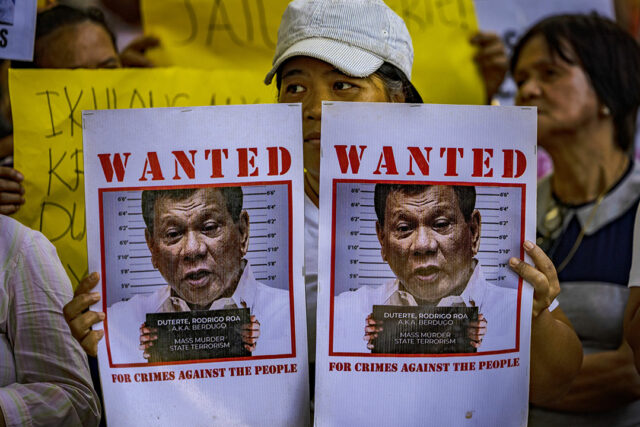
RODRIGO DUTERTE once famously said he “offered no apologies” for the deaths of thousands of Filipinos, who were killed as part of the former president’s brutal drug war. Those words will no doubt come to haunt him following his arrest Tuesday on an International Criminal Court warrant that accuses him of crimes against humanity. He is due to arrive in The Hague, where the court sits, on Wednesday.
Duterte’s detention is a win for a country where hundreds of families are still living with the scars of his anti-narcotics pogroms. Still, the move will plunge the archipelago into an extended period of political chaos. Powerful rival clans that dominate politics will hijack the national conversation again. Filipinos should brace for more upheaval ahead.
A reckoning for Duterte — the man they called “The Punisher” — is long overdue. During his presidency from 2016 until 2022, his campaign killed more than 6,000 people, according to government data. Human-rights groups say that number is at least double. Most were poor young men, shot dead after coming into contact with police, as well as children and others caught in the crossfire.
According to the New York Times, which has seen a copy of the ICC warrant, a three-judge panel said the killings Duterte ordered were both widespread and systematic. It added that “Mr. Duterte is individually responsible for the crime against humanity of murder.” Carlos H. Conde, a senior researcher with Human Rights Watch’s Asia Division, wrote on X that the drug war was the Philippines’ worst human-rights catastrophe, and so far, there had been no accountability.
Duterte defended himself in an inquiry into his administration’s deadly war on drugs. He denied authorizing police to gun down suspected suspects, but acknowledged he had maintained a “death squad” of gangsters to kill other criminals when he was mayor of Davao.
There was no room for anything but impunity during Duterte’s term in office. He unilaterally withdrew the Philippines from the ICC’s founding treaty in 2019 after it started looking into allegations of systematic extrajudicial killings. Under the administration of current President Ferdinand Marcos, Jr., the case has picked up pace. Although Marcos initially said he wouldn’t support the court’s investigation, he should be applauded for complying with the warrant.
This is a huge development in the work of the court, notes Professor Emily Crawford, an international law expert at the University of Sydney. The ICC hasn’t been successful in apprehending former and sitting heads of state, she told me. “The fact that there’s been an arrest by the Philippines shows a willingness of compliance by the government.”
Duterte would become Asia’s first former head of state to go on trial at the ICC. The court has issued warrants of arrest for Israeli Prime Minister Benjamin Netanyahu for crimes against humanity and war crimes in Israel’s military operation against Hamas in Gaza, and for Russian President Vladimir Putin over war crimes in Ukraine. Neither is likely to be arrested.
In Manila, political camps will be retreating to figure out what this means for the Duterte faction. The 79-year-old’s political career is likely over, and his departure could set off an even bigger political feud between the two dynasties, which is currently at boiling point. The families joined forces in the 2022 election with a winning ticket of Marcos Jr. and Sara Duterte — the former president’s daughter.
That marriage of political convenience didn’t last long. Sara announced her resignation from Marcos’ Cabinet last June, yet still held onto the vice presidency. She is currently facing an impeachment trial over accusations of corruption, betrayal of public trust, and issuing a death threat against Marcos, and could be removed from office. Sara denies the charges, and says she’s the victim of a political vendetta.
Both she and her father will no doubt see the court cases — either at home, or overseas — as a way to torpedo their careers, clearing the way for the Marcos family to preside unchallenged in the Philippines. The clan has its own checkered history. Marcos Jr. is the son of the former dictator Ferdinand Marcos, known for his deadly political repression who ruled for two decades before he was ousted in a popular uprising in 1986. His mother Imelda Marcos built up an enviable collection of shoes that was famous the world over — a small illustration of the rampant corruption that was a feature of their reign.
This chaotic domestic political picture shouldn’t get in the way of Duterte facing the consequences of his actions. It is right that Manila has facilitated his extradition to the Hague so quickly. This case is as much a test of the international system as it is an indictment of his alleged crimes. Petty Philippines politics can wait.
BLOOMBERG OPINION