Home Blog Page 1872

Globe secures double win at ACES Awards 2024 for industry leadership and workplace excellence

Nico Bambao (middle), Globe Vice President for People Experience, receives one of two awards on behalf of Globe at the ACES Awards 2024.

Globe has earned two prestigious recognitions at the Asia Corporate Excellence & Sustainability (ACES) Awards 2024, where it was named as one of the Top Workplaces in Asia and Industry Champions of the Year.

It was the 5th time for Globe to win in the Top Workplaces category and the 4th in the Industry Champions category, underscoring the company’s excellence in digital transformation, workplace inclusivity, employee development, and sustainability initiatives.

“It is particularly commendable that Globe has once again emerged as a winner of the ACES Awards, showcasing sustained excellence and leadership over the years,” said Dr. Shanggari Balakrishnan, President of the ACES Awards.

Additionally, in an official statement, the ACES Council emphasized Globe’s exceptional leadership in the telecom sector, characterized by its innovative digital solutions and steadfast commitment to sustainability.

“Their comprehensive approach to fostering a diverse, inclusive, and empowering workplace, along with their strategic initiatives in digital transformation, sets them apart as an industry leader. These accolades highlight Globe Telecom’s dedication to excellence, employee well-being, and creating a positive impact on society and the environment,” said the Council.

ACES has been honoring business excellence across Asia since 2014, celebrating outstanding achievements in leadership, sustainability, and corporate social responsibility. This year, ACES received a record number of 682 nominations, reflecting the growing recognition of excellence and innovation in the region.

The ACES 2024 awards ceremonies were held at the InterContinental Hotel, Bangkok, on November 14 for the sustainability category, and November 15 for leadership.

“These awards celebrate our focus on innovation, inclusivity, and sustainability,” said Renato Jiao, Globe’s Chief Human Resource Officer. “We are committed to creating opportunities and nurturing environments where our people can grow and flourish. This honor reflects the collective effort of our team and motivates us to continue fostering positive change for both the society and the environment.”

Globe is deeply committed to its employees, fostering a diverse and inclusive workplace, as evidenced by 44.3% of its workforce being female. The company also has policies supporting same-sex and common-law partners as qualified dependents.

Overall, the company has a 92% engagement rate among its employees, three points higher than global telco and Philippine averages.

In 2023, Globe invested Php 63 million in employee learning and development, offering programs like the Globe Technical Cadetship and General Management tracks to enhance skills and leadership, further solidifying its role as a top employer.

The telco also leads in sustainability, working toward achieving a net-zero carbon emission target and promoting circularity and biodiversity conservation.  Significant investments in renewable energy and resource efficiency highlight Globe’s proactive approach to environmental stewardship, setting industry benchmarks for sustainability and corporate responsibility.

To learn more about Globe, visit www.globe.com.ph.


Spotlight is BusinessWorld’s sponsored section that allows advertisers to amplify their brand and connect with BusinessWorld’s audience by publishing their stories on the BusinessWorld Web site. For more information, send an email to online@bworldonline.com.

Join us on Viber at https://bit.ly/3hv6bLA to get more updates and subscribe to BusinessWorld’s titles and get exclusive content through www.bworld-x.com.
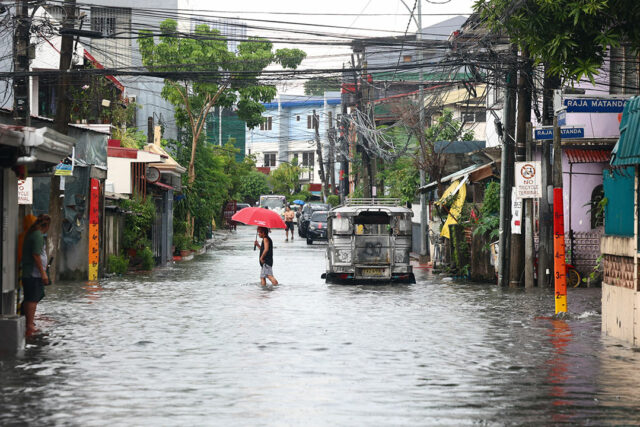
Climate change putting Philippines at double risk of typhoons, scientists say

PHILIPPINE STAR/ MIGUEL DE GUZMAN

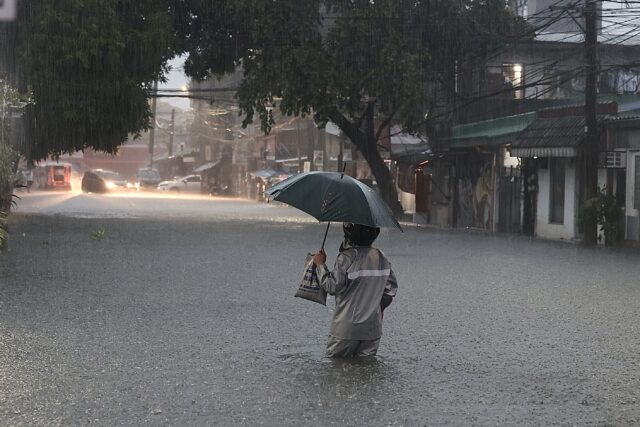
SINGAPORE – Climate change is making the Philippines more vulnerable to tropical storms, with rising temperatures already putting the country at nearly double the risk of deadly typhoons, scientists said in a report published on Thursday.

The unprecedented formation of four typhoons around the Philippines last month was made 70% more likely as a result of global temperature rises of 1.3 degrees Celsius (2.3 degrees Fahrenheit), researchers with the World Weather Attribution group said in a report published on Thursday.

Though scientists are cautious when it comes to attributing individual weather events to climate change, the consensus is that warmer oceans are intensifying rainfall and wind speeds across the globe.

“Climate change made the conditions that formed and fueled the typhoons nearly twice as likely,” the group said.

Hundreds of thousands of people were evacuated and more than 170 people killed during an unprecedented sequence of six tropical cyclones that landed in the country in October and November, raising concerns that storm activity was being turbocharged by higher sea surface temperatures.

“The storms were more likely to develop more strongly and reach the Philippines at a higher intensity than they otherwise would have,” said Ben Clarke, a weather researcher at Imperial College London, one of the report’s authors.

If temperatures rise to 2.6 Celsius above pre-industrial levels, those same storm conditions would be 40% more likely compared to now, he added.

An analysis published last month by U.S. weather researchers Climate Central said that hurricanes had intensified significantly as a result of record-breaking ocean warming, with wind speeds up by 18 miles per hour (29 kph).

Scientists believe warmer ocean temperatures are intensifying tropical storms by increasing the rate of evaporation. The Intergovernmental Panel on Climate Change said in its latest assessment that there was “high confidence” that global warming would make storms more intense.

It is still unclear whether or not rising temperatures would extend the normal typhoon season or make tropical storms more frequent, but climate activists are concerned.
“We used to have what we called a hazard calendar – now it is just basically the whole year around,” said Afrhill Rances, the Philippines’ representative with the International Federation of Red Cross and Red Crescent Societies. – Reuters

Singapore, Vietnam firms in talks for new undersea cables, sources say

 – Singaporean asset manager Keppel and Vietnamese conglomerate Sovico Group are discussing plans for new undersea fiber-optic cables that would boost the region’s data center industry, people familiar with the discussions said.

Southeast Asian countries, a major junction for cables connecting Asia to Europe, are seeking to expand their networks to meet booming demand for AI services and data centers. Vietnam alone plans to have 10 new submarine cables by 2030.

Undersea cables are at the center of the Sino-American tech war, with the two powers vying to win contracts, especially in Asia, to build and maintain the strategic infrastructure that carries most internet data, including sensitive information.

Under one plan under discussion, a cable would be laid to link Vietnam directly with Singapore, five people directly involved or briefed on the matter said.

It would cost $150 million, according to one source with direct knowledge of the talks.

This option is favored by Sovico, but talks with Keppel on the direct cable are in flux and no agreement has been reached yet, two sources with direct knowledge said.

They added that Keppel prefers a more ambitious cable plan involving a consortium of investors.

Under that second plan, the connection to Vietnam developed by Sovico would be an offshoot of a longer cable, three people said, with one noting it would run from Singapore to Japan with links to countries along the route.

The sources declined to be named because the information was not public.

Sovico, a conglomerate whose operations include aviation and banking, has recently announced plans on data center development. It did not respond to requests for comment.

Keppel agreed in November to buy an AI-ready data center facility in Japan. Singapore is a major hub for data centers and undersea cables, but the small island-state has nearly saturated its data usage capacity.

A spokesperson for Keppel declined to answer Reuters questions about the two cable plans, saying: “We do not comment on market speculation.”

A Sovico executive mentioned the company’s cable plans with Keppel late last month in an internal meeting with Vietnam’s Prime Minister Pham Minh Chinh and other companies involved in the digital economy, one of the meeting participants told Reuters.

Vietnam’s government office and the foreign affairs ministry did not reply to requests for comment.


US-CHINA COMPETITION

Under the preliminary plans, no decision had been made about who would build either of the cables, but two people familiar with the talks said Chinese contractors would not be involved in the possible direct link between Vietnam and Singapore.

Sovico was briefed by U.S. officials about alleged risks linked to choosing Chinese contractors for the cables, two people with direct knowledge of the talks told Reuters.

U.S. officials and consultants have organized multiple briefings with Vietnamese and Singaporean officials in recent months to discourage them from using HMN Technologies, part of a global campaign to contain the rise of the Chinese contractor, Reuters exclusively reported in September.

The two projects are separate from possible investments previously announced by Vietnamese companies in four new undersea cables, of which two would be built by Japan’s NEC, and one by China’s HMN Tech to connect Vietnam to existing international cables, according to public information.

The fourth was announced in April by Vietnam’s state-owned telecom firm Viettel and Singapore’s Singtel and would link Vietnam directly to Singapore under a preliminary plan. No building contract has been announced.

Vietnam, with a population of nearly 100 million, is a large market for online platforms, but is currently connected to the global internet infrastructure through only five undersea branches to international cables.

Its plans to triple the number of its cables are seen by industry experts as a possible boost to its chances of becoming an alternative regional data center hub, despite power supply issues and strict data regulations. – Reuters

China says Philippines has ‘provoked trouble’ in South China Sea with US backing

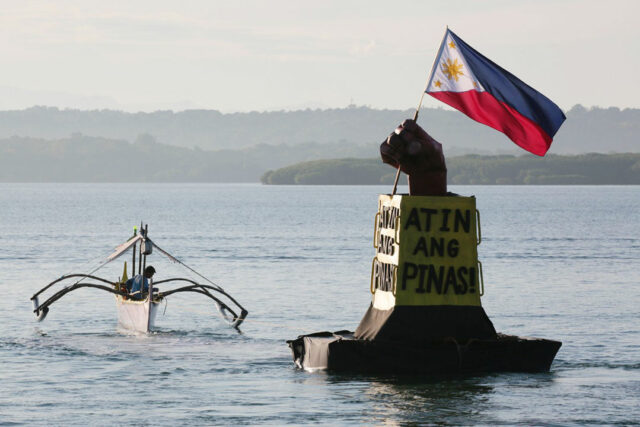
FISHERMEN from Masinloc, Zambales province in northern Philippines released on Monday an 18-foot-tall buoy on which it is written: “Atin ang Pinas” (The Philippines is ours). Fisherfolk in Zambales, whose coast faces the South China Sea, are protesting China’s “continued harassment” of Filipino fishermen at the Scarborough Shoal. — PHILIPPINE STAR/MICHAEL VARCAS

 – China accused the Philippines on Friday of having “provoked trouble” in the South China Sea with U.S. backing, a week after Beijing and Manila traded accusations over a new confrontation in the disputed waters.

“The Philippine side, with U.S. support and solicitation, has been stirring up trouble in many spots in the South China Sea,” Wu Qian, a spokesperson for China’s defense ministry, said on its official WeChat account.

“The Philippines is well aware that the scope of its territory is determined by a series of international treaties and has never included China’s” Spratly Islands and Scarborough Shoal, he added.

Beijing and Manila have been involved this year in a series of confrontations at reefs and outcrops in the South China Sea, which China claims almost in its entirety.

The Philippines, Brunei, Malaysia, Taiwan and Vietnam also claim parts of the sea. They are concerned China’s expansive claim encroaches into their exclusive economic zones (EEZ), non-territorial waters that extend 200 nautical miles (370 km) from the coasts of a nation’s land.

The Philippines’ National Maritime Council and its National Security Council did not immediately respond to a request for comment on the latest remarks from Beijing.

The U.S. Navy’s 7th Fleet also did not immediately respond to a request for comment.

Philippines officials said last week that Chinese coast guard vessels had fired water cannon and side-swiped a Manila fisheries bureau boat on the way to deliver supplies to Filipino fishermen around the Scarborough Shoal, a move that drew condemnation from the U.S.

China’s Coast Guard said that four Philippine ships had attempted to enter waters it described as its own around the Scarborough Shoal, which Beijing calls Huangyan Island.

China submitted nautical charts earlier this month to the United Nations that it said supported its claims to the waters, which a 2016 international tribunal found to be a long established fishing ground for fishermen of many nationalities.

Following the charts’ submission, a spokesperson for the Philippines’ National Maritime Council, said China’s claims were baseless and illegal.

The 2016 tribunal ruled that China’s claim had no basis under the UN Convention on the Law of the Sea (UNCLOS), and that its blockade around the Scarborough Shoal was in breach of international law.

Beijing has never recognized the decision.

Sovereignty over the Scarborough Shoal has never been established.

The Philippines and other members of the Association of Southeast Asian Nations have spent years negotiating a code of conduct with Beijing for the strategic waterway, with some nations in the bloc insisting that it be based on UNCLOS.

EEZs give the coastal nation jurisdiction over living and nonliving resources in the water and on the ocean floor. – Reuters

Amazon donating $1 mln to Trump inaugural fund, to air event on Prime Video

REUTERS

Amazon is donating $1 million to U.S. President-elect Donald Trump’s inaugural fund and the company will air the event on its Prime Video service, an Amazon spokesperson said on Thursday.

The Prime Video represents an in-kind donation worth another $1 million, the spokesperson said. The donations were first reported by the Wall Street Journal.

Amazon joins another tech giant, Meta Platforms, in donating to the Jan. 20 Trump inauguration. Meta will also give $1 million, a company spokesperson said.

Jeff Bezos, Amazon’s founder and executive chairman, will meet with Trump next week, the president-elect said on Thursday in an interview with CNBC.

Trump has criticized the coverage of his first term as president by the Washington Post, which is owned by Bezos.

The Post decided not to endorse a candidate in the November presidential election. The decision blocked an endorsement of Democratic candidate Kamala Harris, according to National Public Radio.

Bezos defended the move not to issue an endorsement, saying in an opinion piece in the paper that “most people believe the media is biased” and the Post and other newspapers needed to boost their credibility.

Trump raised a record $106.7 million for his 2017 inauguration festivities. – Reuters

Breaking silence on possible drills, China says will not be soft on Taiwan independence activities

CHINESE AND TAIWANESE flags are seen in this illustration, Aug. 6, 2022. — REUTERS

 – China’s defense ministry on Friday broke its silence about days of military activities around Taiwan, saying it was up to China to decide whether or not to hold drills and the military would “not be absent” in fighting against separatist forces.

Taiwan’s defense ministry on Monday went on the alert and activated an emergency response center after reporting a large rise in Chinese military activity, both around the island and more broadly in the East and South China Seas.

China’s military had made no announcement about any drills taking place. Beijing views democratically governed Taiwan as its territory – a claim rejected by the government in Taipei which says only Taiwan’s people can decide their future.

In a statement responding to a question on Taiwan President Lai Ching-te’s recent visits to Hawaii and the U.S. territory of Guam and whether or not China has held drills, China’s defense ministry offered neither confirmation nor denial, though quoted from ancient Chinese military tactician Sun Tzu.

“Just as water retains no constant shape, so in warfare there are no constant conditions,” the ministry said, an expression of Sun’s that means war conditions are unpredictable and constantly in flux.

“Whether or not to hold exercises and when to hold them is a matter for us to decide on our own according to our own needs and the situation of the struggle,” it added.

“Regardless of whether or not exercises are held, the People’s Liberation Army will not be absent and will not be soft in its fight against independence and for reunification.”

Any reliance on “foreign forces to seek independence” – the usual wording China uses to warn the United States off supporting Taiwan – will be severely punished and is “doomed to failure”, the ministry added.

China has staged two rounds of war games around Taiwan so far this year, most recently in October responding to Lai’s national day, saying they were a warning to “separatist acts” and vowing to take further action if needed.

On Friday, Taiwan’s defense ministry said that China’s threat towards the island had been evolving since 2022, when it began staging the current round of war games, from “deterring Taiwan” to “impacting the First Island Chain”, an area that stretches from Japan through to Taiwan, along the Chinese coast and into the South China Sea.

“China’s long-term goal of deterring regional parties and disrupting the rule-based international order will not be endorsed by the international community,” it said in a statement.

Security sources had expected China to hold drills to coincide with Lai’s U.S. trip, and also to send a warning to the incoming Trump administration about China’s red lines.

On Thursday, the de facto U.S. embassy in Taiwan said that Chinese military activity in the region was currently elevated but it did not see that wider activity as a response to Lai’s U.S. visit.

Later that day, Taiwan’s defense ministry said it has disbanded its emergency response center, signaling an end to the current round of Chinese military activities.

On Friday morning, the ministry said it had only spotted 12 Chinese military aircraft operating nearby in the past 24 hours, down from 34 reported the previous day.

Taiwan’s coast guard also said on Friday that nine Chinese coast guard ships which were off the island’s southeast and southwest coasts had headed northwards after carrying out “undue” activities in recent days.

Taiwan’s coast guard published pictures and video of its ships shadowing Chinese vessels off the island’s east coast in rough seas and under grey skies. – Reuters

Global EV sales hit third consecutive record high

PHILSTAR FILE PHOTO

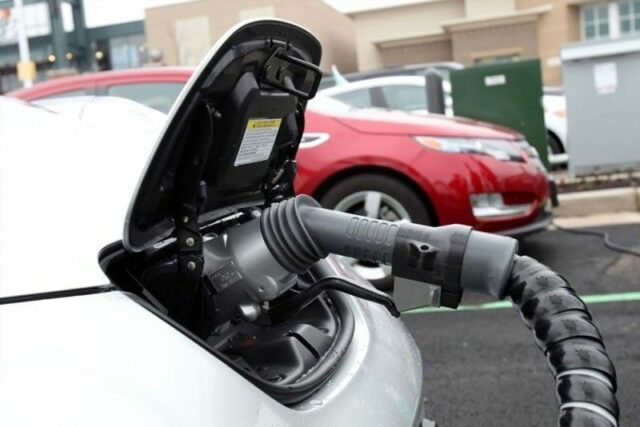
Global sales of fully electric and plug-in hybrid vehicles rose for a seventh consecutive month in November, jumping 32% year on year for a third consecutive record high, data from market research firm Rho Motion showed on Friday.

China continued to lead sales growth, accounting for almost 70% of total EV sales in the month, while registrations in Europe showed a marginal decline.


WHY IT’S IMPORTANT

The electric car market is undergoing critical transformation as incremental demand and production in China threaten EV markets elsewhere. Europe, for instance, is struggling to contend with production costs, new emissions targets and the rising competition.

Automakers in Europe and America say growing trade tensions, CO2 rules and the removal of incentives in some countries affect prices and put thousands of jobs on the line.


BY THE NUMBERS

Global sales of EVs – whether fully electric or plug-in hybrids – were up 32.3% at 1.83 million in November, Rho Motion data showed.

Sales in China were up 50% at 1.27 million vehicles.

In the United States and Canada, EV sales were up 16.8% at 0.17 million, while Europe had sales of 0.28 million, down slightly year on year but up 7.7% from October.

In the rest of the world, sales were flat against November 2023.


KEY QUOTES

“China certainly is in line with expectations,” Rho Motion data manager Charles Lester told Reuters, adding that government incentives pushed EV sales further.

“Penetration has been around about 50% for the last few months now.”


CONTEXT

China’s total November car sales grew 16.6%, the highest growth since January, while domestic champion BYD 1211.HK is set to exceed its global annual sales goal and overtake Ford F.N and Honda 7267.T.

Need a helping hand? Sagot ka ni JuanHand!

Over 6 million families are dealing with the aftermath of the recent typhoon, while rising inflation continues to impact everyday household costs, leaving many Filipino families struggling to make ends meet. In the midst of these challenges, JuanHand reminds Filipinos that if they need a helping hand, Sagot ka ni JuanHand!

With the company’s commitment to helping improve financial inclusion in the country, JuanHand’s “Need a helping hand? Sagot ka ni JuanHand!” campaign places family at the heart of its message. More than just a slogan, it’s a message of reassurance—reminding Filipinos that no one should face tough times alone. By offering accessible and convenient financial assistance, JuanHand empowers Filipinos to access immediate relief from the comfort of their own homes. Whether dealing with a monetary setback or managing daily expenses, JuanHand is always ready to offer a helping hand to anyone in need.

“For us, it’s important to recognize the realities Filipinos face today,” says Francisco “Coco” Mauricio, President and Chief Executive Officer of JuanHand. “We understand the struggle: Life is tough, especially when balancing a growing family, mounting bills, and unexpected costs. That is why at JuanHand, our role is clear: to give Filipinos a helping hand when they need it most,” Mauricio added.

To amplify its message of resilience and hope, JuanHand has partnered with actress and entrepreneur Arci Muñoz as its brand ambassador. With her own experience of overcoming financial struggles and building a successful business, Arci is a relatable voice for JuanHand’s mission of empowerment. “I’ve faced my share of challenges, especially with managing finances. But I’ve learned that with the right support and determination, you can turn things around. That’s why I’m proud to work with JuanHand, they’ve already helped so many take control of their financial journey, and I truly believe in their mission to empower others,” says Muñoz.

With JuanHand, the #1 fintech lending app in the Philippines, Filipinos can access loans of up to PHP50,000 and with affordable rates and minimal requirements, making it the ideal solution for those seeking financial assistance. The application process is simple and hassle-free, they just need to download the app, submit one valid ID and a few information, and approval is within five minutes. “We believe that financial support shouldn’t be complicated or out of reach. It should give Filipinos the ability to take control of their financial well-being,” explains Mauricio.

JuanHand is committed to more than just providing financial solutions; it is dedicated to educating and empowering Filipinos to make smarter financial decisions. This commitment is what makes JuanHand a trusted partner, every step of the way.  To date, JuanHand has helped more than 2 million Filipinos, with over 20,000 loan disbursements per day.

Watch the campaign video here. Visit JuanHand’s official website, https://www.juanhand.com/ or their official social media pages, Facebook  and TikTok, for more information.


Spotlight is BusinessWorld’s sponsored section that allows advertisers to amplify their brand and connect with BusinessWorld’s audience by publishing their stories on the BusinessWorld Web site. For more information, send an email to online@bworldonline.com.

Join us on Viber at https://bit.ly/3hv6bLA to get more updates and subscribe to BusinessWorld’s titles and get exclusive content through www.bworld-x.com.

Globe Business champions AI-driven cybersecurity at IBPAP CEO Forum

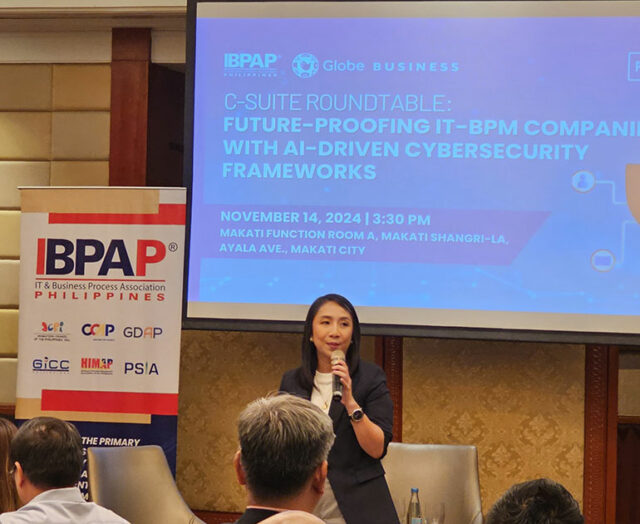
KD Dizon, Vice President and Head of Globe Business during her welcome address at IBPAP CEO Forum

Going beyond being a trusted connectivity provider, Globe Business took the lead at the recent CEO forum hosted by the IT and Business Process Association of the Philippines (IBPAP). Centered around the theme “C-Suite Roundtable: Future-proofing IT-BPM Companies with AI-Driven Cybersecurity Frameworks,” the event convened industry leaders to explore how artificial intelligence (AI) can elevate the utilization of cybersecurity within the IT-BPM sector.

Globe Business shared insights, strategies, and best practices, underscoring its commitment to fostering a secure and resilient digital ecosystem, empowering IT-BPM companies to confidently navigate the complexities of the digital age.

The forum opened with remarks from IBPAP, followed by a welcome address from KD Dizon, Vice President and Head of Globe Business. “In today’s rapidly evolving digital landscape, cybersecurity is not just a necessity but a strategic imperative. By integrating AI-driven solutions, we empower IT-BPM companies to proactively address emerging threats, ensuring they remain resilient and competitive,” said Dizon.

Meanwhile, Marlon Cruz, Senior Director for Business Solutions Consulting of Globe Business, shared insights on developing a practical AI cybersecurity framework.

“AI cybersecurity measures need to be aligned with your existing AI or Cybersecurity framework because it streamlines your governance, facilitating effective enforcement and at the same time promoting collaboration,” Cruz said.

L-R: Glenn Estrella, Globe Business’ Vice President of Business Solutions Consulting; Dominic “Doc” Ligot, IBPAP’s AI Consultant and Founder of Data Ethics PH; and Anton Bonifacio, Chief Information Security Officer and Chief AI Officer of Globe

The fireside chat, moderated by Glenn Estrella, Globe Business’ Vice President of Business Solutions Consulting, featured panelists Dominic “Doc” Ligot, IBPAP’s AI Consultant and Founder of Data Ethics PH; and Anton Bonifacio, Chief Information Security Officer and Chief AI Officer of Globe.

Dr. Ligot highlighted key cybersecurity challenges in the IT-BPM sector, including reliance on onshore counterparts, which increases exposure to insider threats and supplier-related breaches. He noted the struggle to gain decision-maker support for stronger measures despite data being a critical asset and recommended regular cyber drills to keep employees prepared for evolving threats.

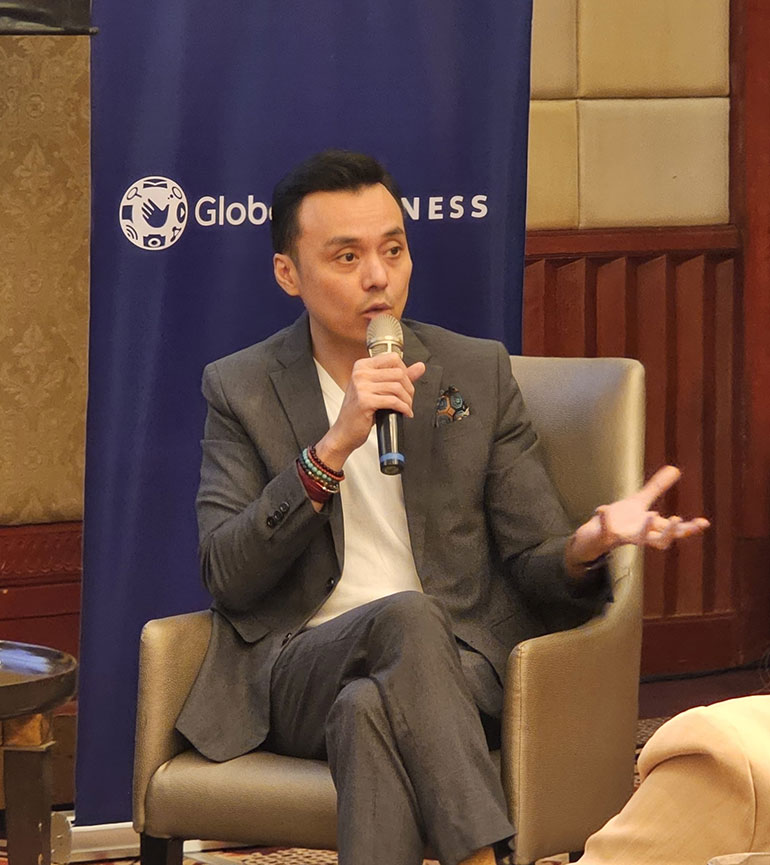
Anton Bonifacio, Chief Information Security Officer and Chief AI Officer of Globe

Bonifacio shared Globe Telecom’s proactive cybersecurity initiatives, such as blocking person-to-person SMS with links, and leveraging AI to boost productivity and promote employee work-life balance. He also emphasized the importance of meaningful collaborations.

Globe Business echoes this position. Deepening collaborations with industry stakeholders like IBPAP is crucial for advancing cybersecurity standards and effectively addressing shared challenges. By actively participating in industry events and working groups, Globe Business believes the industry can collectively develop and promote best practices in AI-driven cybersecurity.

As an ICT provider for the IT-BPM industry, Globe Business recognizes that cybersecurity is not just about technology; it’s about shared responsibility. It requires commitment to continuous innovation, proactive collaboration, and a unified effort to create a secure digital future. By equipping organizations with comprehensive ICT solutions and actively contributing to advancements in AI-driven cybersecurity, Globe Business aims to empower businesses to navigate the evolving threat landscape and confidently embrace the opportunities of the digital age.

For more details, visit https://www.globe.com.ph/business/enterprise/it-bpo.


Spotlight is BusinessWorld’s sponsored section that allows advertisers to amplify their brand and connect with BusinessWorld’s audience by publishing their stories on the BusinessWorld Web site. For more information, send an email to online@bworldonline.com.

Join us on Viber at https://bit.ly/3hv6bLA to get more updates and subscribe to BusinessWorld’s titles and get exclusive content through www.bworld-x.com.
Climate change putting Philippines at double risk of typhoons, scientists say

PHILIPPINE STAR/MIGUEL DE GUZMAN

SINGAPORE – Climate change is making the Philippines more vulnerable to tropical storms, with rising temperatures already putting the country at nearly double the risk of deadly typhoons, scientists said in a report published on Thursday.

The unprecedented formation of four typhoons around the Philippines last month was made 70% more likely as a result of global temperature rises of 1.3 degrees Celsius (2.3 degrees Fahrenheit), researchers with the World Weather Attribution group said in a report published on Thursday.

Though scientists are cautious when it comes to attributing individual weather events to climate change, the consensus is that warmer oceans are intensifying rainfall and wind speeds across the globe.

“Climate change made the conditions that formed and fueled the typhoons nearly twice as likely,” the group said.

Hundreds of thousands of people were evacuated and more than 170 people killed during an unprecedented sequence of six tropical cyclones that landed in the country in October and November, raising concerns that storm activity was being turbocharged by higher sea surface temperatures.

“The storms were more likely to develop more strongly and reach the Philippines at a higher intensity than they otherwise would have,” said Ben Clarke, a weather researcher at Imperial College London, one of the report’s authors.

If temperatures rise to 2.6 Celsius above pre-industrial levels, those same storm conditions would be 40% more likely compared to now, he added.

An analysis published last month by U.S. weather researchers Climate Central said that hurricanes had intensified significantly as a result of record-breaking ocean warming, with wind speeds up by 18 miles per hour (29 kph).

Scientists believe warmer ocean temperatures are intensifying tropical storms by increasing the rate of evaporation. The Intergovernmental Panel on Climate Change said in its latest assessment that there was “high confidence” that global warming would make storms more intense.

It is still unclear whether or not rising temperatures would extend the normal typhoon season or make tropical storms more frequent, but climate activists are concerned.

“We used to have what we called a hazard calendar – now it is just basically the whole year around,” said Afrhill Rances, the Philippines’ representative with the International Federation of Red Cross and Red Crescent Societies. — Reuters

Water rate hike OKd; inflation flagged

PHILIPPINE STAR/EDD GUMBAN

By Sheldeen Joy Talavera, Reporter

WATER PRICES in Metro Manila will go up starting January after the regulator approved the rate increases sought by the region’s two concessionaires, which could add to inflationary pressures.

The Metropolitan Waterworks and Sewerage System (MWSS) Regulatory Office approved a P5.95-per-cubic-meter increase for Manila Water Co., Inc. and P7.32 per cubic meter for Maynilad Water Services, Inc.

The rates will take effect on Jan. 1, 2025, Patrick Lester N. Ty, MWSS Regulatory Office chief regulator, told a news briefing on Thursday.

Customers served by Manila Water in the east zone who consume 10 cubic meters or less will have to pay P24.68 more to P254.83 a month, according to a rate matrix provided by the regulator.

Those who consume 20 and 30 cubic meters will see their monthly bills go up by P54.79 and P111.83, respectively. Low-income customers who consume less than 10 cubic meters will see a P2.87 increase to P91.40 a month.

Meanwhile, Maynilad customers in the west zone who consume 10 cubic meters and below will have to pay P20.08 more, while those who consume 20 cubic meters will see their bills increase by P75.89. Customers who consume 30 cubic meters will pay P155.32 more.

Low-income lifeline customers who consume 10 cubic meters of water will pay P10.56 more to P151.04 a month.

The rate increases would likely add to inflationary pressures, said Jonathan L. Ravelas, senior adviser at professional service firm Reyes Tacandong & Co.

These would increase household expenses and raise the production costs of industries that rely on water. These companies could pass on the costs to consumers by raising prices, he pointed out.

While necessary for infrastructure improvement, these hikes will add to short-term inflationary pressures,” Mr. Ravelas said in a Viber message. “Policy makers will need to monitor and manage these impacts carefully.”

The increase is the third tranche of approved tariffs for the 2023-2027 rate rebasing period. In 2022, the MWSS board greenlit higher rates on a staggered basis for five years starting in January 2023.

Rate rebasing is done every five years, accompanied by a performance review and validation of the two concessionaires’ projected cash flows. It also sets the water rates in a manner that allows the water suppliers to recover their expenditures.

“We monitor their capex (capital expenditure) spending [if] they are actually spending the necessary capex for the rate rebasing,” Mr. Ty told reporters. “Before we allow them to increase their tariff, we will check the actual spending, not just their target.”

“As long as you reach a reasonable target, we will then approve the tariff adjustment,” he added.

Manila Water had spent P32.67 billion of its capex as of November, 81% of the target for 2023 to 2024, he said. Maynilad’s capex spending has hit P47.59 billion, 83% of the target for the two-year period.

In a statement, Maynilad said its commitment to invest over P163 billion to improve the water and wastewater infrastructure in the west zone “necessitates the timely implementation of these staggered adjustments.”

“We remain vigilant in meeting our business plan commitments and are pleased that the corresponding tariff adjustments are being implemented as planned,” it added.

Philippine inflation quickened to 2.5% in November from 2.3% in October, though still within the central bank’s 2.2%-3% forecast for the month.

Manila Water serves the east zone network of Metro Manila, covering parts of Marikina, Pasig, Makati, Taguig, Pateros, Mandaluyong, San Juan, portions of Quezon City and Manila, and several towns in Rizal province.

Maynilad serves the cities of Manila, except San Andres and Sta. Ana. It also operates in Quezon City, Makati, Caloocan, Pasay, Parañaque, Las Piñas, Muntinlupa, Valenzuela, Navotas and Malabon. It also supplies water to the cities of Cavite, Bacoor and Imus, and the towns of Kawit, Noveleta and Rosario, all in Cavite province.

Metro Pacific Investments Corp., which has a majority stake in Maynilad, is one of three Philippine units of Hong Kong-based First Pacific Co. Ltd., the others being Philex Mining Corp. and PLDT Inc.

Hastings Holdings, Inc., a unit of PLDT Beneficial Trust Fund subsidiary MediaQuest Holdings, Inc., has an interest in BusinessWorld through the Philippine Star Group, which it controls.

Slowing Philippine growth may continue next year

FREEPIK

By Luisa Maria Jacinta C. Jocson, Reporter

PHILIPPINE ECONOMIC growth could weaken further next year, falling short of the government’s target amid an incomplete post-coronavirus disease 2019 (COVID-19) fiscal consolidation and still high interest rates, analysts said.

Pantheon Macroeconomics in its Emerging Asia Outlook report said it expects a “continued slowdown” in growth next year. It expects the economy to grow 5.4% this year and slow to 5.2% in 2025.

These are both well below the government’s 6-6.5% and 6-8% targets for 2024 and 2025, respectively.

The Philippine economy grew 5.2% in the third quarter, weaker-than-expected and the slowest in five quarters.

“Surveys show that a slowing rebuild of household savings in the Philippines from COVID and a cost-of-living crisis damage cushioned the slump in consumption growth this year, albeit at the likely expense of delaying a real recovery in GDP (gross domestic product) growth,” Pantheon said.

It added that the country’s economic output would “remain hampered by incomplete post-COVID fiscal consolidation and historically tight monetary policy.”

ANZ Research in its latest quarterly report said it expects economic growth to slow to 5.6% in 2025 from 5.7% this year. It said its outlook for 2025 is “downbeat, complicated by the lack of domestic growth catalysts amid fading exports.”

Consumer confidence has remained static and below pre-pandemic levels in most economies in Asia, it pointed out.

“Consumer surveys in both Indonesia and the Philippines suggest a fall in household savings over the last few years.”

The Institute of International Finance said it expects Philippine growth to average 5.8% this year and in 2025.

“Countries that are more reliant on dollar financing such as Malaysia, Korea and the Philippines are likely to face increased pressure from a strong US dollar and ‘higher-for-longer’ US Fed Funds policy rate,” it said.

The peso sank to the P59-a-dollar level twice last month, hitting a record low on Nov. 21 and Nov. 26.

“The Philippines, in particular, stands out due to its higher external financing needs, given its larger twin current account and fiscal deficits,” the institute said.

Meanwhile, both Pantheon and ANZ expect inflation to settle at 3.2% this year, compared with the Bangko Sentral ng Pilipinas’ (BSP) 3.1% estimate.

The central bank is also expected to continue its rate-cutting cycle next year. ANZ expects the policy rate to end at 5.75% this year and 5% by end-2025.

“Real rates are likely to stay elevated in Indonesia, South Korea and the Philippines where 50-to-100-basis-point (bp) rate cuts are likely in 2025,” it said.

“The efficacy of rate cuts in Indonesia and the Philippines will be limited by the need to rebuild household savings,” it added.

Pantheon also expects the key rate to end at 5.75% this year but sees it falling further to 4.75% by the end of next year.

The Philippine central bank started its easing cycle in August with a 25-bp rate cut. It delivered another 25-bp cut in October, bringing the key rate to 6%.

The Monetary Board will hold its final policy review of the year on Dec. 19.

BSP Governor Eli M. Remolona, Jr. earlier signaled the possibility of another 25-bp cut at the meeting.