Home Blog Page 1871

Future-proofing Philippine businesses


UNIONBANK INNOVATION CAMPUS — FACEBOOK.COM/UNIONBANKCAREERS

The Singapore Management University (SMU) is a partner of De La Salle University (DLSU), and I am deeply privileged, as a member of SMU’s International Advisory Council, to have participated in a two-day learning journey organized by SMU in Manila.

I caught glimpses of future-proofing strategies of Philippine businesses through visits to four of the country’s most forward-looking organizations: Union Bank, ACEN, AC Mobility, and Cebu Pacific. Below are my takeaways.

TAKEAWAY 1: TRANSFORM AND INNOVATE YOUR BUSINESS MODEL
The first stop was UnionBank (UB) Innovation Campus. A first in the industry, it is a hub for research and development geared towards beefing up its digital innovation capabilities. The campus houses the bank’s institutes on data science and artificial intelligence, blockchain, and an Asian Institute of Digital Transformation aside from being home to its digital banking entity, UnionDigital Bank.

The facility is a testament to UB’s commitment to help “Tech Up Pilipinas,” UB’s battle cry to hasten our country’s digital adoption. Its UnionDigital unit, alongside its Bangko Kabayan, seeks the financial inclusion of underserved communities nationwide.

TAKEAWAY 2: PURSUE AND EMBED SUSTAINABILITY LEADERSHIP
The next stop was ACEN, formerly AC Energy. One of the fastest-growing renewable energy companies in the Asia-Pacific region, it is a pioneer in advancing the shift to sustainable energy in the Philippines and in the Asia-Pacific region.

ACEN is at the forefront of sustainability leadership, and integrates sustainability in its business strategy with its use of the energy transition mechanism (ETM), the first such deal in the world. This involves the world’s first coal-to-clean credit pilot project complementing the early retirement of the company’s 246-MW coal plant in Batangas.

Another stop was AC Mobility’s office and showroom at Bonifacio Global City (BGC). AC Mobility sees itself as the country’s first end-to-end mobility provider. It has invested in the development of electric vehicle-charging stations to create a sustainable ecosystem as the Philippines transitions to electrified mobility.

TAKEAWAY 3: DEMOCRATIZE YOUR BUSINESS
The final stop was the country’s leading airline, Cebu Pacific (CEB), which operates flights to 27 domestic destinations and 28 international destinations in 15 countries.

CEB recently announced the largest aircraft order in Philippine aviation history. Its memorandum of agreement with Airbus covers the purchase of 152 A321neo (new engine option) aircraft for an estimated $24 billion.

CEB has also been ranked among the top carriers worldwide in managing environment, social, and governance (ESG) risks and opportunities by MSCI ESG, an agency that evaluates public and private companies based on how effectively they manage their ESG risks.

A low-cost carrier with such impressive credentials? That’s an airline that is truly for “every Juan,” an inclusive business offering affordable travel.

Learning journeys involving company visits are effective ways to share best management and business practices. As businesses in the Philippines and the broader ASEAN region navigate a rapidly evolving landscape, institutions like DLSU and SMU (both deeply embedded in the ASEAN business landscape) play a crucial role in bridging academia and industry. They equip leaders with the insights and networks needed to drive meaningful change.

Future-proofing could be made more inclusive by having companies involve more MSMEs in their ecosystems; share their practices with their MSME suppliers; and become “big brother” in terms of practices to their MSME partners.

The social aspect of running a company is extremely important and should be emphasized. For example, Union Bank has acquired the majority of shares of Bangko Kabayan, a network of banks in the countryside. Cebu Pacific is already promoting domestic tourism in the country, thereby providing prosperity to our tourism zones. AC Mobility could also integrate walkability in its portfolio to improve our roads and public spaces, which are not pedestrian-friendly.

Future-proofing a business boils down to three words: innovation, sustainability, and inclusion.


Dr. Ramon B. Segismundo is a senior professional lecturer at the DLSU Ramon V. Del Rosario College of Business and is a member of the International Advisory Council of SMU. He is also CEO of One HRX, a Singapore-based company focused on organization and management consulting, executive coaching, and sustainability leadership advising.

ramon.segismundo@dlsu.edu.ph

SMIC says $500-M bond recognized at Asset Triple A Awards 2025

Erwin G. Pato, executive vice-president for treasury, finance, and planning at SM Investments

SM INVESTMENTS Corp. (SMIC) said it received recognition at The Asset Triple A Sustainable Finance Awards 2025 for its $500-million bond offering in 2024, which was named the Best Bond for Corporate in the Philippines under the Best Significant Deal category.

“As we continue to diversify and expand across various sectors, this achievement further strengthens our strategy to drive long-term, sustainable growth for the company and its stakeholders,” SMIC Executive Vice-President for Treasury, Finance, and Planning Erwin G. Pato said in an e-mail statement on Thursday.

“This recognition affirms the strength of our financial position and our unwavering commitment to growth. The successful execution of this landmark bond offering and the positive reception from investors reflect SMIC’s resilience and leadership in the market,” he added.

The company’s $500-million bond offering was the largest-ever five-year issuance by a Philippine corporation and achieved the tightest-ever five-year issue spread by an unrated corporation in Southeast Asia. It also generated strong investor demand, with a final order book exceeding $1.6 billion from 103 accounts.

SMIC said it aims to continue strengthening its market leadership in key sectors, including retail, banking, and integrated property development.

The conglomerate posted a 7% increase in net income for 2024, reaching P82.6 billion from P77 billion in 2023.

Of the total net income, banking contributed the largest share at 49%, followed by property at 26%, retail at 18%, and portfolio investments at 7%.

Consolidated revenue grew by 6% to P654.8 billion in 2024 from P616.3 billion the previous year.

Last year, SM expanded its footprint with 619 additional retail stores, two new malls, and 73 new bank branches, with over 85% of its network located in the provinces.

“We ended 2024 with a strong performance, despite the high base of 2023 and inflationary headwinds during the year. Our core businesses all grew, supported by positive macroeconomic fundamentals and healthy consumer sentiment. The fourth quarter registered the highest revenue growth rate of 9.4%, giving us solid momentum into 2025,” SMIC President and Chief Executive Officer Frederic C. DyBuncio said.

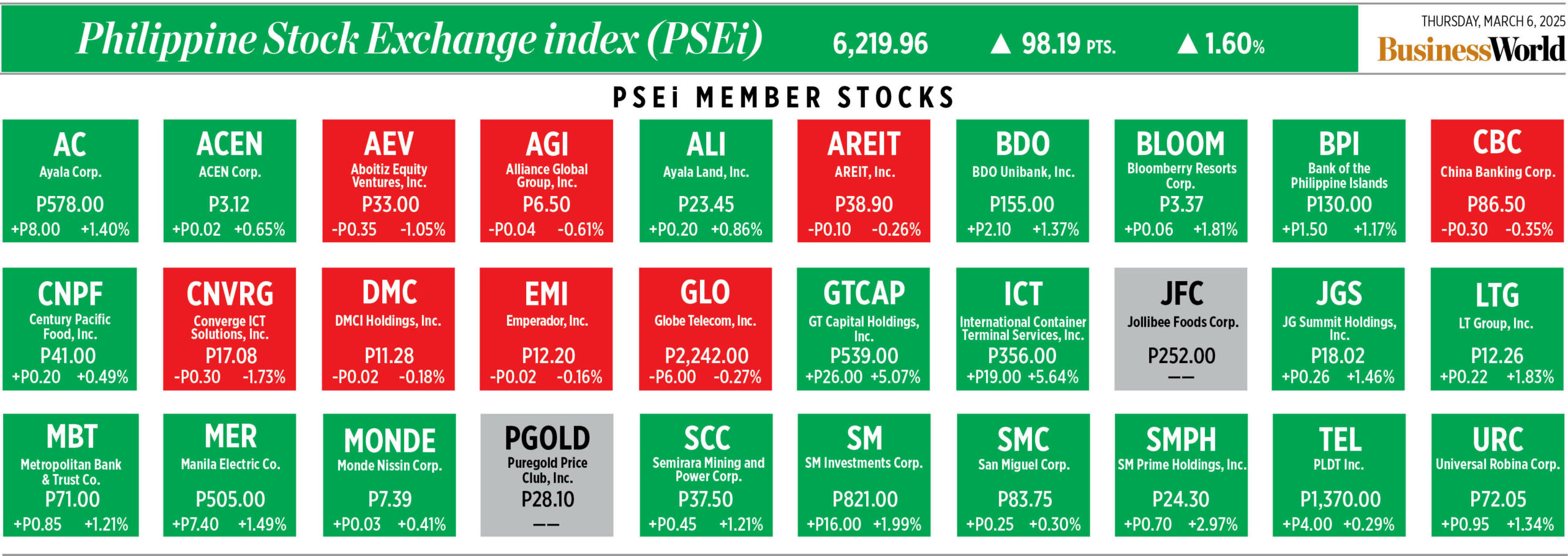
On Thursday, SMIC shares rose by 1.99%, or P16, to close at P821 apiece. — Revin Mikhael D. Ochave

Job Gains by Industry (January 2025 vs January 2024, in thousands)

THE PHILIPPINES’ unemployment rate in January rose to its highest level in six months, as hiring declined after the holiday season, the statistics agency said on Thursday. Read the full story.

Job Gains by Industry

How PSEi member stocks performed — March 6, 2025

Here’s a quick glance at how PSEi stocks fared on Thursday, March 6, 2025.


Pork maximum suggested retail price to be enforced next week

PHILIPPINE STAR/ MICHAEL VARCAS

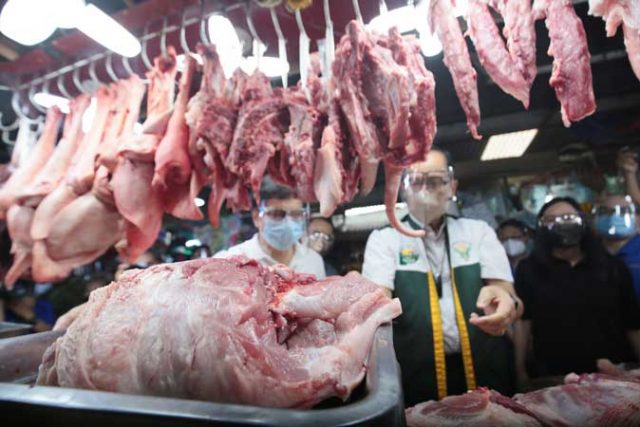
THE Department of Agriculture (DA) said on Thursday that it will enforce a maximum suggested retail price (MSRP) scheme for pork in Metro Manila wet markets starting next week, after a consultation with industry members. 

The MSRP was set at P380 per kilo for liempo (belly) and at P350 per kilo for kasim (shoulder) and pigue (rear leg), Agriculture Secretary Francisco P. Tiu Laurel, Jr. said.

He added that pricing was arrived at following consultations with the pork industry.

He said the agency will also impose a cap of P300 per kilo for sabit ulo — the price at which traders sell pork to retailers.

However, pork sold in so-called “modern markets” such as supermarkets and hypermarkets are exempt from the MSRP scheme due to their higher operating costs.

He said the new pricing scheme considers the lingering effects of African Swine Fever (ASF).

“We believe the MSRP will help ensure the sustainability of the pork industry, which continues to suffer from ASF’s adverse effects.”

As of Feb. 14, 19 provinces in nine regions had active ASF cases, according to the Bureau of Animal Industry.

First detected in 2019, ASF has spread to 76 provinces, it said. 

Mr. Laurel said the MSRP will be reviewed after one month to determine whether adjustments are needed.

Samahang Industriya ng Agrikultura Chairman Rosendo So said the industry is doing its part to “alleviate the burdens of Filipino consumers.”

ProPork President Rolando Tambago and National Federation of Hog Farmers, Inc. Chairman Chester Warren Yeo Tan said the MSRP is essential for the long-term stability of the pork industry.

Representatives from the Department of Trade and Industry and the Philippine National Police were also present during the consultation. — Kyle Aristophere T. Atienza

Palawan council approves 50-year mining permit freeze; awaiting governor’s signature

EN.WIKIPEDIA.ORG

By Kyle Aristophere T. Atienza, Reporter

THE provincial council of Palawan approved a 50-year moratorium on new mining applications, with the measure now going before the governor for signing.

The Sangguniang Panlalawigan-approved moratorium covers all new mining applications, regardless of mine size.

The Department of Environment and Natural Resources (DENR) had not replied to requests for comment at the deadline.

The council also urged President Ferdinand R. Marcos, Jr. to proclaim Palawan a “no-mining province” and an “agri-tourism zone.”

The effort to secure the provincial-level ban was a result of “persistent lobby and protest actions,” according to Alyansa Tigil Mina (ATM), which said the push originated in a 2024 pastoral letter by the Catholic bishops of Palawan, followed by a signature petition by Save Palawan Movement and other non-government organizations.

The letter singled out 67 exploration permit applications in Coron, Taytay, Araceli, Dumaran, and Roxas in northern Palawan.

The Mines and Geosciences Bureau lists 16 mining firms holding approved mining tenements and contracts in the province.

“The ordinance is a clear legal expression of Palawan’s opposition to mining, which the Marcos administration and the DENR must fully respect,” ATM said.

“It reflects the lack of consent by stakeholders for mining contracts and operations in the region,” it added.  “We hope this will pave the way for a total halt to mining operations in the region.”

The Chamber of Mines of the Philippines said the decision is short-sighted, noting that a 1995 mining law and other regulations “provide stringent environmental safeguards that ensure environmental sustainability in communities.”

As of December 2023, mining companies in the Mimaropa region have planted 3.79 million seedlings in more than 502 hectares of mined-out and other areas, with a survival rate of nearly 90%, and have committed P22 billion for environmental programs, according to the Chamber.

“While approved mining tenements — most of them not operating — occupy only 3.8% of Mimaropa’s total land area, the industry accounts for 7.5% of gross regional domestic product,” it said. “The bulk of the contributions come from operating large-scale metallic mines in Palawan.”

It said assessments of sustainability must also take into account investments “in the well-being and development of people, including their health, education, and skills as passports from poverty and a vital component of a long-term sustainable future.”

“Mining companies are mandated to do just that.  Apart from employing thousands of local workers and encouraging the flourishing of other businesses that also create jobs, mining projects in Mimaropa have spent a total of P350.47 million for their Annual Social Development and Management Programs,” it said.

“We maintain that through mining, local governments are greatly supported in their programs that promote a well-educated and skilled workforce — essential to develop sustainable technologies to address environmental challenges.”

The DENR last month issued an order requiring miners to adopt the 17 United Nations Sustainable Development Goals.

Mining companies need to incorporate sustainability efforts into their operations, including biodiversity conservation and climate action. The vehicle for doing so is in the miners’ Social Development and Management Programs (SDMPs).

“Unlike in the past, they must now include programs for enhancing biodiversity conservation and protection, and institutionalizing climate action of host and impact communities, among others,” the DENR said following the release of the order.

An SDMP is a five-year comprehensive plan required of mining companies for the “improvement” of the living standards of host and neighboring communities in their areas of operation.

Furniture makers want gov’t help in ‘opening doors’ to new markets

By Justine Irish D. Tabile, Reporter

THE furniture industry said it needs government support to break into new markets, citing the expense of mounting trade shows overseas.

“We just hope that they support us more, open doors for us, especially internationally,” 2025 Philippine International Furniture Show (PIFS) Chairman Erwin V. Tan told reporters on Thursday.

“It is very expensive to bring shows like this abroad, and it’s not a joke. But with the government there, it’s going to be easier for us. They have all the connections; they have all the resources, so we really need their support,” he added.

He said that the industry is now starting to normalize after the pandemic.

“Things are going back to normal. So our goal is to reposition ourselves back, not only here in the domestic market but also on the international stage,” Mr. Tan said.

Asked about the current standing of the Philippines vis-a-vis its ASEAN counterparts, he said that the Philippine furniture industry has lagged.

“We’re reintroducing a lot of new stuff, new materials, and new talent, because we’d really like to position ourselves for a comeback,” he said.

He said Philippine furniture enjoys a reputation for ingenuity and skilled work, adding: “We just want to bring that back again; thus, we organize shows like this.”

He said that the plan is to do more shows overseas, including Dubai, the US, and Europe adding: “First things first, we have to settle down and fix things first.”

Managed by Global-Link MP Events International, Inc., the 2025 PIFS and Interior & Design Manila (IDM) has around 180 participating brands and 15,000 attendees. It will run until March 8.

Mr. Tan said he is optimistic for the industry this year. “Everything seems to be going back to normal. The construction business is booming again. All the projects that have put on hold are now ongoing. So we feel bullish about it, and that is why we try our best to improve the outlets or the shows like what you see now,” he added.

Asked to comment, Philippine Exporters Confederation, Inc. President Sergio R. Ortiz-Luis, Jr. said the furniture industry is not making full use of the European Union’s (EU) Generalised Scheme of Preferences Plus (GSP+).

“Furniture exports have gone down. It’s almost gone. This afternoon we have a meeting with the EU delegation, and I think the GSP+ will be the topic,” he said.

“We are not taking advantage of it. (Furniture) should be a beneficiary of the GSP+, but it is not being utilized,” he added.

He said challenges faced by Filipino furniture exporters include unfamiliarity with procedures in international markets and high production costs.

IPPs promise swift resolution to outages

BW FILE PHOTO

THE Philippine Independent Power Producers Association, Inc. (PIPPA) said on Thursday that its members are hoping to resolve the problem of power plant outages “in the soonest possible time.”

“We comply with the no-planned-maintenance rule during the summer months. We make sure our plants run as efficiently as possible. It is in our best interest to ensure that we are operating and that there is stable supply,” PIPPA President Anne E. Montelibano said via Viber.

“Our members are working hard to resolve the issues and to bring those plants back to operation in the soonest possible time,” she added.

PIPPA consists of 28 members with a combined installed capacity of about 18,132 megawatts (MW).

On Wednesday, the Luzon grid was placed on yellow alert — the first such notice this year — due to the increase in forecast demand and power plant forced outages.

According to the National Grid Corp. of the Philippines, peak demand hit 11,829 MW, against available capacity of 12,488 MW.

A total of 3,362.3 MW was unavailable to the grid after 12 power plants declared forced outages while 16 plants are running on derated capacities.

Earlier this week, the DoE urged the public to adopt energy efficiency measures to manage consumption and ensure the stability of supply as temperatures rise with the onset of the dry season.

“The summer months are characterized by higher energy demand, primarily driven by the increased use of cooling appliances such as air conditioners, electric fans and refrigerators. Without mindful consumption, this surge could strain the power grid, potentially leading to supply challenges and price fluctuations in the spot market,” Energy Secretary Raphael P.M. Lotilla said.

The DoE demand forecast this year projects highs of 14,769 megawatts (MW) for Luzon, 3,111 MW for the Visayas, and 2,789 MW for Mindanao.

Actual peak demand last year was 14,016 MW for Luzon on April 24; 2,681 MW for the Visayas on May 21; and 2,577 MW for Mindanao on May 22.

The maximum adjusted available generating capacity for Luzon was reported at 15,504 MW, the Visayas 3,040 MW, and Mindanao 3,314 MW in the Grid Operating Maintenance Program 2025-2027, which incorporates output from committed power projects for 2025.

“By making simple adjustments in daily routines, consumers can contribute to a more sustainable and efficient use of electricity, helping to prevent power interruptions and ensuring that energy resources remain sufficient throughout the summer season,” Mr. Lotilla said. — Sheldeen Joy Talavera

Taiheiyo Cement building Luzon distribution center in Batangas

FACEBOOK.COM/TAIHEIYOPH

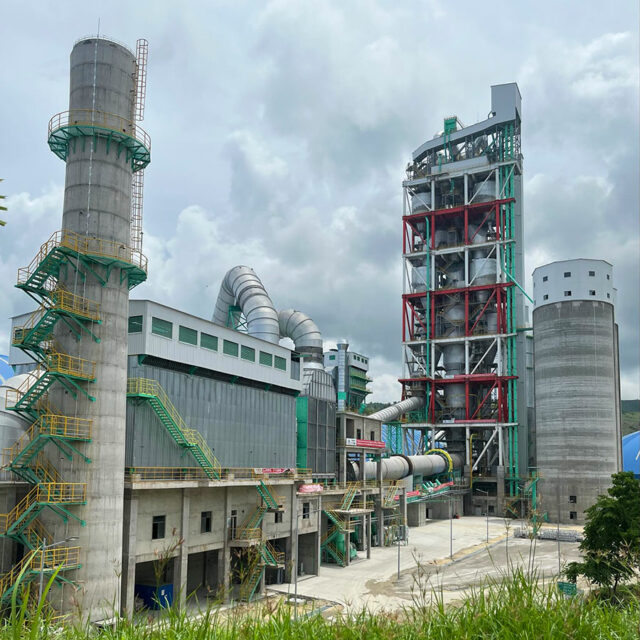
TAIHEIYO Cement Philippines, Inc. has notified the government of plans to enhance its distribution system on Luzon, the Department of Trade and Industry (DTI) said.

In a statement on Thursday, the DTI said the plan was announced at a meeting with company executives on March 3.

“The discussions focused on Taiheiyo’s long-term commitment to the market, with the company pledging to continue developing strategies to boost domestic production and enhancing distribution networks,” DTI said.

According to the DTI, the company has also increased the capacity of its P12.8-billion facility in Cebu from 50,000 bags a day to 100,000.

“Taiheiyo’s investments will strengthen the Philippines’ foundation for sustained industrial excellence, paving the way for resilient infrastructure, residential, and commercial development that will benefit generations to come,” Trade Secretary Cristina A. Roque said.

“By integrating modern technologies and improving operational efficiency, this partnership expands local production, generates quality jobs, and reinforces the country’s position as a key force in regional infrastructure advancement,” she added.

A distribution terminal is being built in Calaca, Batangas. It is being positioned to supply Luzon, which accounts for 64% of Philippine cement demand.

“Once operational, this new facility will streamline logistics, optimize supply chain efficiency, and ensure timely delivery of cement to this critical region,” the DTI said.

Ms. Roque met with 13 companies in Japan between March 3 and 4.

Among the companies was Fujifilm Holdings Corp., which announced plans to diversify its operations at its Fujifilm Optics Philippines, Inc. site in Laguna.

In particular, Fujifilm plans to introduce new business lines at the facility, which will be configured for sustainable manufacturing.

“Fujifilm’s initiative will focus on enhancing operational efficiency to reduce its environmental footprint. This facility will serve as a pilot project for (further) investments in sustainable technologies and practices,” the DTI said.

The company’s factory in Laguna specializes in high-performance optical lenses, critical components for digital cameras, projectors, and surveillance cameras, among others.

She also met with Chodai Co., Ltd. which announced plans to pursue clean energy and waste management projects in the Philippines.

These projects include zero-initial-cost solar power systems for hotels in Palawan, a biomass power generation plant in Central Luzon, and the introduction of advanced Japanese waste treatment equipment for hospitals in Tarlac.

Meanwhile, the company is also planning resource recovery and reforestation projects in Davao and Mindoro. — Justine Irish D. Tabile

PHL rice inventory declines 4.6% month on month in early February

PHILIPPINE STAR/MIGUEL DE GUZMAN

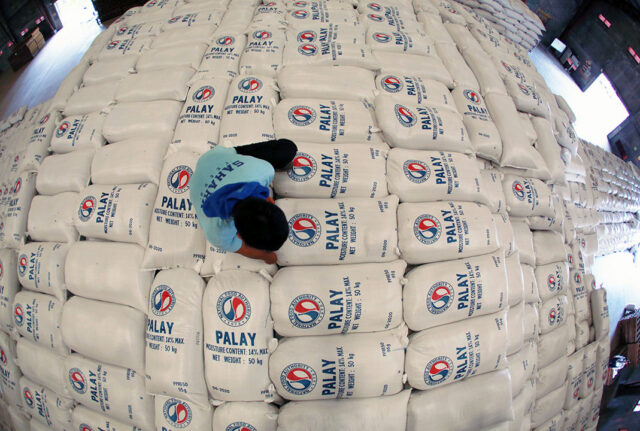
THE national rice inventory at the start of February fell 4.6% month on month, the Philippine Statistics Authority (PSA) said.

Rice stocks hit 2.10 million metric tons (MT) as of Feb. 1.

Year on year, the national rice inventory rose 38.9%, it added.

Rice held by households as of Feb. 1 fell 24.7%. Commercial entities held 18.0% less rice month on month, while National Food Authority (NFA) holdings fell 1.5%.

Year on year, NFA stocks rose 516.7%, while rice held by commercial entities rose 30.4%, and holdings of households rose 15.9%.

“Of this month’s total rice stocks, 48.4% were from the commercial sector, 37.8% were from households, and 13.8% were from the NFA depositories,” the PSA said. 

“Normally, stock levels in the first three months of the year go down until the dry season harvest starts entering the market,” Federation of Free Farmers National Director Raul Q. Montemayor said via Viber.

He said the year-on-year rise in inventory follows record imports of about 4.8 million MT in 2024, “some of which were not consumed in 2024 and carried over to 2025.”

Samahang Industriya ng Agrikultura Executive Director Jayson H. Cainglet said the main concern is the farmgate price of palay at P15-16 per kilo, which could dampen the impact of the harvest on inventories. 

He said traders are only willing to pay between P16 and P18 per kilo due to the competition from imported rice, whose landed cost is now at P35 per kilo.

“We hope that under the food security emergency, additional funding will be provided to the Department of Agriculture so it can procure more dry palay at P23-24 per kilo,” he said.

The NFA has raised the buying price to P18 per kilo for fresh palay (unmilled rice) and P24 for clean and dry palay.

NFA administrator Larry del Rosario Lacson said on Wednesday that millers were paying P20-P22 per kilo for clean and dry palay, adding that fresh or wet palay usually fetches P5 less.

Mr. Cainglet noted that the current budget for palay procurement is the equivalent of 12-13 days, or 3% of rice demand.

“Ideally, government procurement should be at least 15% of consumption.”

Inflation eased to 2.1% in February from 2.9% in January as rice inflation dropped to 4.9%, the sharpest decline since April 2020.

To bring down rice prices, the government has lowered tariffs and has declared an emergency that triggers the release of government rice stocks.

Arze G. Glipo of the Integrated Rural Development Foundation said on Wednesday that production costs are rising while monopolies in key commodities distorting rice markets.

Eduardo Landayan, Vice-President of the AMMA-KATIPUNAN farmers’ group, noted that in Nueva Ecija and Isabela, which account for more than 20% of national rice output, palay prices have dipped to P15-P18 per kilo because traders are reluctant to buy palay because their warehouses are still stocked with rice imports.

He said the Rice Tariffication Law gave traders and importers access to cheap imported rice that they can use during harvest season to delay buying and force palay prices down.

Crop scientist Teodoro M. Mendoza said the threat of climate change and reliance on the international rice market subject the industry to price volatility, especially if major rice exporters suffer from extreme weather events.

He urged the government to give the NFA an additional P100 billion to procure at least 25% of the domestic rice harvest.

He also called for measures to raise household incomes of farmers and workers, expand irrigated land, and diversify sources of food to include more plant-based protein. — Kyle Aristophere T. Atienza

PHL growth to hit lower end of gov’t target — ING 

Motorists are stuck in traffic during morning rush along the southbound lane of EDSA in Cubao, Quezon City, April 1, 2024. — PHILIPPINE STAR/MIGUEL DE GUZMAN

GROSS domestic product (GDP) is expected to remain within the official growth target band this year, ING Philippines said.

“The Philippine economy remains a standout performer in Asia, with GDP growth projected at 6.1% in 2025, following a strong recovery in 2024,” it said in a statement.

“The country ranked the third-fastest-growing economy in Asia and eighth globally in 2024, driven by robust labor market conditions and rising domestic consumption.”

ING’s forecast would be at the lower end of the Development Budget Coordination Committee’s 6-8% target for the year.

The economy expanded by a weaker-than-expected 5.2% in the fourth quarter, bringing 2024 growth to 5.6%, missing the government’s target.

“Additional initiatives, including entry into the JPMorgan Bond Index and amendments to key banking charters, underscore the government’s commitment to fostering a competitive economy,” ING added.

The growth outlook, along with easing inflation, could also attract investment despite the weak peso.

Inflation eased to 2.1% in February from 2.9% in January and 3.4% a year earlier. This was also the weakest inflation reading in five months.

The bank said reforms such as the Corporate Recovery and Tax Incentives for Enterprises to Maximize Opportunities for Reinvigorating the Economy (CREATE MORE) Act will boost investment due to the reduction of corporate tax rates. — Luisa Maria Jacinta C. Jocson

Tourism revenue hits P65 billion in January

PHILIPPINE STAR/MIGUEL DE GUZMAN

REVENUE from tourism activities, products, and services totaled P65.3 billion in January, up 78.8% from a year earlier, the Department of Tourism (DoT) said.

In a statement on Thursday, the DoT said that the January total also exceeded the pre-pandemic level of P43 billion.

“The surge of income for Philippine tourism is a sign that the industry is not only bouncing back from the pandemic but is also evolving and expanding, contributing significantly to the country’s economic stability and growth,” Tourism Secretary Ma. Esperanza Christina G. Frasco said.

She added that the increasing revenue “translate to thousands of jobs created for Filipinos, especially in our rural and underserved areas.”

The tourism revenue estimate was based on visitor surveys, arrival/departure data, shipping manifests, and the eTravel System.

In 2024, tourism revenue hit a record P760.5 billion, up 9.04%.

Separately, the Philippines welcomed 1.17 million foreign travelers in the first two months of the year.

South Korea was still the top source of arrivals for the first two months, accounting for 295,611, or 25.3%, of the total. This represents a 10.3% decline from the 329,651 South Korean visitors a year earlier.

“South Korea has been the Philippines’ top source of tourists since 2023, which is expected to increase further with the appointment of South Korean star Seo In-Guk as ‘celebrity tourism ambassador for the Philippines’ in February,” the DoT said.

Next to South Korea were the US (229,836), Japan (83,208), Canada (65,145), and Australia (61,564).

“The Philippines also welcomed 53,545 tourists from China, 41,388 from Taiwan, 34,451 from the UK, 29,352 from Singapore, and 21,252 from France,” the DoT added. — Justine Irish D. Tabile