Home Blog Page 184

25 more OFWs arrive from Dubai as Middle East war rages

DMW.GOV.PH

TWENTY-FIVE overseas Filipino workers (OFWs) and one dependent arrived in the Philippines from Dubai on Wednesday evening, the Department of Migrant Workers (DMW) said, as rising regional tensions prompt more repatriations.

The group landed on Emirates flight EK 334 at 9:20 p.m. at the Ninoy Aquino International Airport (NAIA) Terminal 3 in Pasay City, the agency said in a statement on Thursday.

They received accommodation, food, transportation, financial support and medical and psychosocial assistance from the DMW, Overseas Workers Welfare Authority, Department of Social Welfare and Development and medical staff from New NAIA Infra Corp., in line with directives from President Ferdinand R. Marcos, Jr.

The Philippine government repatriated the first group of OFWs from Iran and was preparing two chartered flights to bring home more workers from the Middle East, the President said on Wednesday.

The first flight will operate out of Riyadh for Filipinos in Saudi Arabia, Kuwait and Bahrain. The second will depart from Fujairah in the United Arab Emirates (UAE) to transport workers from Dubai, he added.

The Fujairah flight was scheduled for March 13, with an expected arrival in Manila later that evening or early on March 14. Mr. Marcos said the decision to charter these flights follows a slight improvement in regional safety.

Earlier this month, nine Filipinos were repatriated from Iran on March 10 and 11, the first group evacuated amid heightened regional instability following US and Israeli strikes on Iranian targets and Tehran’s retaliatory attacks.

The strikes were meant to curb Iran’s nuclear program and pursue regime change, and reportedly resulted in the death of Iranian leader Ayatollah Ali Khamenei.

In retaliation, Iran launched missile and drone attacks against US and Israeli bases across Gulf states, including Iraq, the UAE, Kuwait, Bahrain, Qatar and Saudi Arabia.

The DMW said it is coordinating closely with relevant agencies to ensure the safe return of citizens and provide immediate support.

The repatriation flights are part of the government’s broader effort to safeguard millions of Filipinos working in the Middle East, offering emergency assistance and logistical support amid the war. — Kaela Patricia B. Gabriel
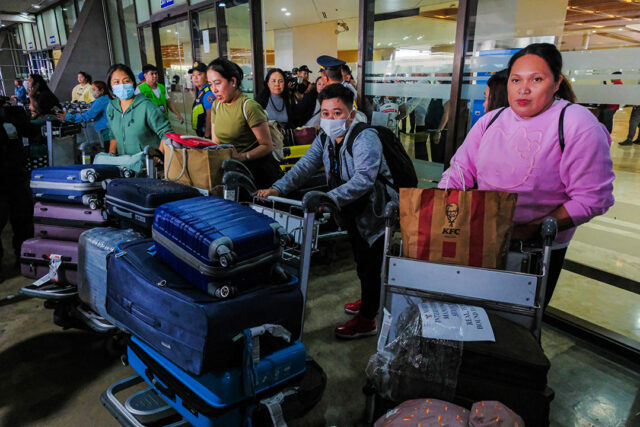
OFWs value fast state action over policies

Overseas Filipino workers (OFWs) arrive at the Ninoy Aquino International Airport (NAIA) Terminal 1, June 16, 2025. — PHILIPPINE STAR/RYAN BALDEMOR

OVERSEAS Filipino workers (OFWs) are more likely to trust the government when it provides fast, visible help rather than introducing fresh policies, a study by research firm Fourth Wall found.

OFWs’ confidence depends on practical services such as quick processing of documents, simplified transactions, responsive hotlines, emergency assistance, and other forms of direct support, it said.

“OFWs are not looking for policy mandates, but a clear, visible, and decisive presence from their government,” John Brylle L. Bae, research director at Fourth Wall, said in a separate statement. “They often look for credible champions — leaders who can mobilize institutions quickly and visibly when workers face risk abroad.”

The research analyzed national labor patterns, migrant worker programs and social media discussions on platforms including Facebook, X and Reddit from 2016 to 2026.

It found that Filipino workers overseas notice government care when assistance is timely, procedures are easy, support measures are clearly communicated, livelihood programs are offered and authorities directly engage with worker concerns.

The study found that migrant workers often credit the National Government for assistance, rather than the specific agencies handling the programs, such as the Department of Migrant Workers or the Overseas Workers Welfare Administration.

This influences how OFWs perceive the administration’s compassion and effectiveness.

The research suggests that during times of geopolitical risk, such as war in the Middle East, OFWs prioritize action over rules.

Quick emergency responses, clear communication, and visible support were far more valued than expanding policy frameworks or creating new mandates.

“Migrants evaluate governance not through policy design but through outcomes,” according to a copy of the study. “Reliable services, visible assistance, clear communication, and responsive intervention are what shape confidence in the system.” — Kaela Patricia B. Gabriel

Marcos certifies fuel excise tax bill

A gas attendant is at work at a gasoline station in Manila in this file photo. — PHILIPPINE STAR/NOEL PABALATE

PRESIDENT Ferdinand R. Marcos, Jr. certified as urgent a measure allowing him to suspend or reduce excise taxes on petroleum products during national emergencies as the Philippines grapples with soaring fuel prices amid the Middle East war.

According to documents from the Office of the Executive Secretary, Mr. Marcos certified the “necessity of the immediate enactment” of House Bill No. 8418, which was approved on second reading on Wednesday.

“[This would] allow the government to respond promptly to extraordinary fuel price volatility and stabilize domestic fuel prices during the period of severe economic disruptions,” the letter, addressed to House Speaker Faustino G. Dy III and signed by Mr. Marcos, read.

The Middle East war, almost in its second week, pushed oil prices higher after Iran disrupted energy shipments from the Middle East passing through the Strait of Hormuz, a crucial chokepoint where about a fifth of global oil and gas supply passes through.

As a net oil importer, the Philippines remains highly vulnerable to sharp swings in global fuel prices.

The measure allows the President to suspend or reduce excise taxes on petroleum products if the average Dubai crude price, based on the Mean of Platts Singapore benchmark, reaches or exceeds $80 per barrel for the month preceding the issuance of such an order.

Under the 2017 Tax Reform for Acceleration and Inclusion law, the Philippines imposes an excise tax of P10 per liter on gasoline, P6 per liter on diesel and P5 per liter on kerosene.

Department of Economy, Planning, and Development Secretary Arsenio M. Balisacan told lawmakers on March 10 that suspending fuel excise taxes could help curb the inflationary impact of rising global oil prices, warning that higher pump prices would feed through to the cost of nearly all goods and services, eroding Filipinos’ purchasing power and weighing on economic activity. — Chloe Mari A. Hufana

Frasco removed from DoT post

CHRISTINA GARCIA FRASCO — PHILIPPINE STAR/RYAN BALDEMOR

PRESIDENT Ferdinand R. Marcos, Jr. on Thursday removed Secretary Ma. Christina G. Frasco from the helm of the Department of Tourism (DoT), reassigning her as the Presidential Adviser for Sustainable and Resilient Communities.

He appointed Tourism Undersecretary Verna Esmeralda C. Buensuceso as the officer-in-charge of the department, according to a statement from Palace Press Officer Clarissa A. Castro.

The Cabinet change comes as tourism rates in the Philippines lagged behind its Southeast Asian peers.

Ms. Castro clarified Ms. Frasco did not step down from her post.

In a news briefing earlier that day, Ms. Castro said Ms. Frasco still enjoys Mr. Marcos’ trust and confidence amid issues hounding the Tourism department.

Ms. Frasco has been under fire for allegedly self-promoting rather than highlighting the country’s tourist destinations amid falling tourism rates. — Chloe Mari A. Hufana

March 20 declared regular holiday

THE Palace on Thursday declared March 20, Friday, a regular holiday in observance of Eid-al Fitr or the end of Ramadan.

President Ferdinand R. Marcos, Jr. made the announcement at the Grand Iftar in Malacañang, reaffirming his government’s respect for traditions.

“The declaration recognizes the significance of Eid’l Fitr, which marks the end of the holy month of Ramadan, a period devoted to prayer, reflection, and fasting,” a statement from Palace Press Officer Clarissa A. Castro read.

Mr. Marcos said rising tensions in the Middle East underscore the importance of sustaining peace and stability at home.

The developments in the Middle East, a region significant to Muslims worldwide, have prompted concern about their broader impact on people, economies, and families, he said.

The President also expressed concern over the growing human toll of the conflict, noting that many Muslim communities should be observing the holy month of Ramadan in peace.

The Philippine government remains focused on strengthening the foundations of peace domestically, particularly in the Bangsamoro region, he said, adding that the administration continues to back a “people-centered governance system” in the autonomous area.

Mr. Marcos pointed to the progress of the Bangsamoro Autonomous Region in Muslim Mindanao as central to the country’s long-running effort to secure lasting peace in Mindanao.

The path toward self-governance requires patience, dialogue, and a commitment to reconciliation, he said.

Officials from the regional government led by Abdulraof A. Macacua attended the gathering alongside members of the diplomatic corps, Cabinet officials and lawmakers.

The annual iftar gathering brought together Muslim and non-Muslim leaders in government, which Mr. Marcos said symbolizes the Philippines’ tradition of religious tolerance and unity.

“As we recognize the sacredness of each other’s traditions, we strengthen the quiet foundation of our nation,” he said. — Chloe Mari A. Hufana

PHL worried by possible CA attacks

US, Israel and Iran flags are seen in this illustration taken June 18, 2025. — REUTERS/DADO RUVIC/ILLUSTRATION

POSSIBLE retaliatory attacks by Iran in California (CA) must not be taken lightly due to the large number of Filipinos in the area, the Palace said on Thursday, after American federal officers warned of unverified claims of potential drone strikes.

Palace Press Officer Clarissa A. Castro said the government needs to remain vigilant and prepare measures to protect Filipinos abroad following an alert issued by the Federal Bureau of Investigation (FBI).

“When there are pieces of information like that, our country also needs to prepare for our compatriots,” she said in Filipino during a briefing. “This cannot simply be ignored or taken lightly. We must stay alert to whatever might happen to our fellow Filipinos in California.”

According to a May 2025 Pew Research article, 1.6 million Filipinos live in California, the largest in all states.

The Palace’s statement comes as the FBI warned US law enforcement agencies last month that Iran could retaliate for potential American strikes by launching surprise drone attacks against targets in California, according to Reuters.

The alert, issued before the outbreak of the current Middle East war that began with US and Israeli bombardments of Iran on Feb. 28, suggested unmanned aerial vehicles could be launched from sea vessels toward the US West Coast.

President Donald J. Trump downplayed concerns about Iranian retaliation on US soil, while California Governor Gavin Newsom said authorities were unaware of any imminent threat but had heightened security as the conflict escalates across the region. — Chloe Mari A. Hufana

Comelec tightens party-list rules

PHILSTAR FILE PHOTO

THE Commission on Elections (Comelec) on Thursday released new rules for registering and accrediting political groups, aiming to professionalize the party-list system and purge inactive organizations ahead of the 2028 elections.

Comelec Resolution No. 11204, promulgated on March 11 by the Comelec en banc, sets a deadline for new groups to register by Dec. 18, 2026, or nearly two years before the general election. The rules streamline oversight of national, regional, and sectoral parties, often criticized as opaque or dominated by political dynasties.

All registered parties must now submit a Sworn Information Update Statement and an audited financial statement every August, according to the poll body. Groups that skip the last two elections or fail to win a seat face delisting, ensuring only active organizations remain on the ballot.

The commission also tightened rules on party names and identity. Acronyms cannot exceed 20 characters and cannot use government project names, public figures, or social media platforms, preventing groups from exploiting brand or celebrity associations.

The party-list system “is a mechanism of proportional representation,” the resolution says, adding that sectoral organizations must identify and “represent only one clearly defined physical attribute or characteristic, employment, interest, or concern.”

“Petitions filed not in accordance with these Rules shall not be docketed and shall be outrightly dismissed,” the Comelec added. — Erika Mae P. Sinaking

Cebu BRT begins partial operations 

THE Department of Transportation (DoTr) announced that the Cebu Bus Rapid Transit (BRT) will begin partial operations on March 13.

Starting on Friday, three stations of the Cebu BRT, such as Fuente, Cebu Normal University, and Cebu South Bus Terminal stations, will be operational.

In June last year, the DoTr said that it targets to begin the partial operations of Cebu BRT by September, which has the potential to serve about 70,000 commuters.

The DoTr said previously that the construction of Cebu Capital station will also begin after partial operations, noting that its detailed engineering design has been finalized.

The remaining phases of the Cebu BRT, designated 2A and 3A, cover 13 stations and 62 stops, due for completion by the end of 2028.

The 35‑kilometer (km) Cebu BRT will feature a 17-km trunk service, 22 stations, 62 bus stops, four terminals, a depot, and 18 km of feeder services, which will connect the northern and southern ends of the trunk lines.

The government broke ground on the first package of the project in 2023. It was initially scheduled for full operations this year but was pushed back to 2028.

Once completed, the Cebu BRT system is expected to serve up to 169,000 passengers per day. — Ashley Erika O. Jose

Probe of onion cartel sought

PHILSTAR FILE PHOTO

A SENATOR has filed a resolution calling on the Senate to investigate the surge of imports and alleged cartel practices by traders, which have pushed onion farmgate prices higher.

Senate Resolution No. 344, filed by Senator Lorna Regina B. Legarda, calls on the chamber to investigate the alleged import overlaps, cold storage guidelines, and cartel-driven distortions affecting onion prices.

The resolution also seeks to probe the proliferation of illegal onion imports, along with directing agencies to ban onion importation amid “predatory pricing.”

Ms. Legarda also called for a full audit on the value chain to trace profit margins of cold storage operators and wholesalers, review storage capacities in Nueva Ecija and Occidental Mindoro, examine anomalous shipments in Bulacan, and review other onion-producing areas for irregularities.

“If we do not dismantle the monopoly over cold storage and import permits, this crisis will repeat every year. Government must buy directly from farmers and build farmer-managed storage facilities so they can compete fairly,” she said.

She added that the government must ban imports every December, to avoid potential surplus during peak harvest season.

“Why allow importation at the height of harvest?” she asked. “The result is farmgate prices collapsing while market prices remain high. Traders profit, but farmers are left behind.” — Adrian H. Halili

Estrada counsel questions admissibility of NBI evidence

SENATE PRIB

SENATOR Jose “Jinggoy” P. Ejercito Estrada, Jr. on Thursday personally lodged his answer before the Department of Justice (DoJ) in response to a complaint filed by the National Bureau of Investigation (NBI) over alleged plunder and graft linked to the flood control scam.

Bianca Isabel D. Soriano, legal counsel and spokesperson for Mr. Estrada, told reporters that the senator submitted a counter-affidavit in connection with the allegations involving supposed kickbacks from government infrastructure projects.

The senator declined to answer questions from the media but had earlier denied the allegations against him.

“We attacked it based on procedural rules specifically on the requirements of a complaint affidavit because what the NBI filed is a letter attaching an affidavit,” Ms. Soriano said in an interview with reporters.

“We also discussed the admissibility and the credibility of the evidence which will not be able to meet the threshold required for criminal cases before the DoJ,” she said.

According to DoJ spokesperson Raphael Niccolo L. Martinez, the NBI complaint cites violations of Section 3(e) of Republic Act No. 3019 (Anti-Graft and Corrupt Practices Act), plunder under Republic Act No. 7080, as amended, direct bribery and receiving gifts by public officers, and corruption of public officials under the Revised Penal Code, as amended.

Separately, Ms. Soriano added that her client has filed an omnibus motion with Manila Regional Trial Court Branch 52 to lift a precautionary hold departure order, arguing that the senator is not a flight risk and that there is no probable cause to maintain the travel restriction.

Mr. Estrada is requesting the court’s approval to travel abroad from March 31 to April 5. The travel clearance is required since he is also facing graft charges related to the multibillion-peso Priority Development Assistance Fund, or pork barrel scam in the anti-graft court.

Ms. Soriano said, “He has been complying with his travel requirements. There’s really no risk for him to escape all of these mess.”

“He is confident that all of these cases will be dismissed,” she added. — Erika Mae P. Sinaking

PDEA agents seize P47.6-M drugs in Tawi-Tawi operation

COTABATO CITY — Anti-narcotics agents seized seven kilos of crystal meth (shabu), costing P47.6 million, from two long-known traffickers entrapped in the island town of Sibutu in Tawi-Tawi on Wednesday.

Municipal officials told reporters via text message on Thursday that the suspects are now both in the joint custody of the Philippine Drug Enforcement Agency-Bangsamoro Autonomous Region in Muslim Mindanao (PDEA-BARMM) and the Tawi-Tawi Provincial Police Office.

One of the suspects was injured after running away when he sensed they were selling seven kilos of shabu to PDEA-BARMM agents. He was immediately transported by barangay officials and policemen to a local medical dispensary for treatment.

Edgar T. Jubay, director of PDEA-BARMM, said the operation that resulted in the duo’s arrest, supervised by their provincial team leader, Abraham S. Kalim, was supported extensively by municipal officials and Tawi-Tawi Governor Yshmael I. Sali and units in the province of the Police Regional Office-Bangsamoro Autonomous Region under Brig. Gen. Jaysen De Guzman.

Mr. Jubay said they will use the confiscated P47.6-million shabu as evidence in prosecuting them in court for their criminal offense.

The operation was planned with the help of local executives and traditional Sama and Tausug community leaders, long aware of the large-scale peddling of shabu by the two suspects, now both locked in a police detention facility.

“Part of the credit for the arrest of these two suspects goes to vigilant local executives in Tawi-Tawi, to the military’s Western Mindanao Command, the Police Regional Office-Bangsamoro Autonomous Region and the confidential tipsters who reported their drug trafficking activities to our agents in the province,” Mr. Jubay said. — John Felix M. Unson

PHL stocks drop as global oil prices surge again

BW FILE PHOTO

PHILIPPINE STOCKS dropped anew on Thursday following a two-day climb as the prolonged war in Iran caused global oil prices to spike again, worsening inflation concerns.

The bellwether Philippine Stock Exchange index (PSEi) retreated by 0.72% or 44.75 points to close at 6,113.58, while the broader all shares index went down by 0.66% or 22.63 points to end at 3,405.40.

“PSEi ended lower as the market entered selling mode after oil prices surged again to $100 per barrel,” Regina Capital Development Corp. Head of Sales Luis A. Limlingan said in a Viber message. “The spike in oil heightened inflation concerns and dampened investors’ risk appetite, raising the possibility of a rate hike by the Bangko Sentral ng Pilipinas (BSP). As a result, broad-based selling emerged across sectors as market sentiment turned cautious.”

“The local market pulled back as worries over the Middle East conflict and its impact on oil prices dominated sentiment again. This comes after Iran warned of oil hitting $200 per barrel amid its war with the US. The peso’s weakness also weighed on the local bourse,” Philstocks Financial, Inc. Research Manager Japhet Louis O. Tantiangco said in a Viber message.

Last week, BSP Governor Eli M. Remolona, Jr. said headline inflation could breach 4% if oil hits $100 a barrel, adding that if fuel prices rise sharply and persistently, they could be forced to tighten their policy stance.

Meanwhile, the peso weakened by 21.5 centavos to close at P59.385 against the greenback on Thursday from P59.17 on Wednesday, data from the Bankers Association of the Philippines showed.

Global shares fell on Thursday as attacks on oil tankers in the Gulf shattered any prospects of an imminent de-escalation in the Middle East conflict, pushing oil prices above $100 a barrel and stoking fresh inflation concerns, Reuters reported.

Brent crude futures jumped as much as 10.4% to $101.59 a barrel, before trimming gains, as doubts persisted over whether reserve releases would be enough to cushion the hit from the Middle East supply shock.

US crude futures were last trading 5.2% higher at $91.82.

Majority of sectoral indices closed lower on Thursday. Mining and oil fell by 2.27% or 425.13 points to 18,294.38; services decreased by 3.28% or 93.34 points to 2,751.89; industrials went down by 0.37% or 33.27 points to 8,870.84; financials dropped by 0.34% or 6.75 points to 1,949.43; and property sank by 0.25% or 5.20 points to 2,039.42.

Meanwhile, holding firms climbed by 1.32% or 62.06 points to 4,732.27.

Decliners outnumbered advancers, 125 to 60, while 65 names closed unchanged.

Value turnover rose to P8.37 billion on Thursday with 1.05 billion shares traded from the P7.95 billion with 1.37 billion issues that changed hands on Wednesday.

Net foreign selling increased to P453.03 million from P219.41 million. — A.G.C. Magno with Reuters