Home Blog Page 1833

Energy dep’t readies large-scale renewable energy auction
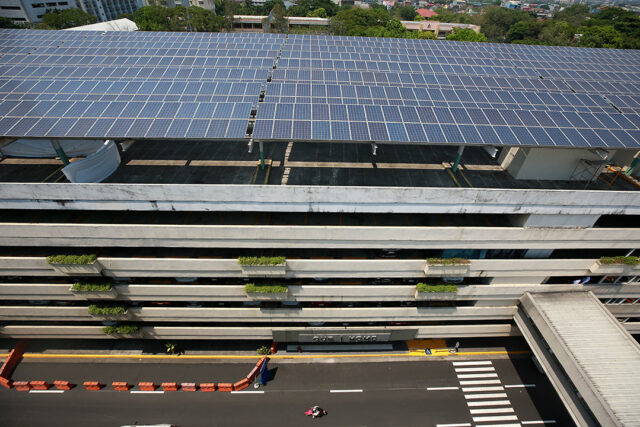
ROWS of solar panels are seen on the roof deck of a mall’s parking building in Quezon City. — PHILIPPINE STAR/ MIGUEL DE GUZMAN

By Sheldeen Joy Talavera, Reporter

THE DEPARTMENT of Energy (DoE) is set to offer a total of 10,478 megawatts (MW) of renewable energy (RE) capacity, which includes some that will be paired with battery energy storage systems (BESS), under the fourth round of the green energy auction (GEA-4) program.

The DoE is planning to auction off 3,940 MW of ground-mounted solar capacity, 48 MW of roof-mounted solar capacity, 3,000 MW of floating solar capacity, and 2,390 MW of onshore wind capacity, based on the notice of auction posted on its website.

The government will also offer integrated RE and energy storage system (IRESS) totaling 1,100 MW in solar generation capacity, along with undisclosed storage capacity.

A BESS is a type of energy storage system that uses batteries to store electrical energy from the grid and releases it when needed to augment supply or improve power quality.

The GEA program (GEAP) aims to promote RE as one of the country’s primary sources of energy through competitive selection. RE developers compete for incentivized fixed power rates by offering their lowest price for a certain capacity.

The DoE is targeting to install 7,523 MW in RE capacity in Luzon, 2,143 MW in Visayas, and 812 MW in Mindanao.

The projects resulting from the auction are scheduled to come online between 2026 and 2029. The supply contract for winning RE projects will be for 20 years, starting from the commercial operation date of the plant.

“The release of the TOR (terms of reference) for GEA-4 underscores the Philippines’ commitment to transitioning to clean energy while ensuring energy security. By ensuring a transparent and competitive selection process for renewable energy projects, we are accelerating the shift toward a more sustainable, secure, and resilient energy system,” Energy Undersecretary Rowena Cristina L. Guevara said in a statement.

The TOR sets out the technical, financial, and commercial requirements that will govern project selection, ensuring a transparent and competitive bidding process.

The DoE said that it will release updated GEAP guidelines to clarify the qualifications of eligible suppliers and ensure fair pricing mechanisms for projects under the program.

Under the new guidelines, qualified suppliers must either hold an RE service contract or possess a certificate of authority issued under the Revised Omnibus RE Guidelines.

“GEA-4 is expected to drive substantial investment in renewable energy, reinforcing its role as a key pillar of the Philippines’ energy transition,” the DoE said.

As a flagship government initiative, the program is seen to contribute to the country’s goal of achieving a 35% share in the power generation mix by 2030.

Asked to comment, Toby Allan C. Arce, head of sales trading at Globalinks Securities and Stocks, Inc., said that offering such a large capacity in a single auction “sends a clear and strong message to investors about the Philippine government’s dedication to renewable energy development.”

“This large-scale opportunity could attract both local and international investments, showcasing the RE sector as a lucrative and stable avenue for growth,” Mr. Arce said in a Viber message.

“It further positions the country as a regional leader in green energy, potentially fostering long-term partnerships and technology transfer,” he added.

Last month, the DoE announced that GEA-3 attracted 7,500 MW worth of bids, exceeding the auction goal of 4,650 MW. The auction round covered pumped-storage hydro, impounding hydro, and geothermal.

An auction round dedicated to offshore wind projects is also set to launch in the third quarter of 2025, stepping up towards the Philippines’ goal to attain offshore wind power generation by 2028.


AirAsia Philippines revives IPO plans

BW FILE PHOTO

By Ashley Erika O. Jose, Reporter

AIRASIA PHILIPPINES has revived its initial public offering (IPO) plans, targeting a public listing within the next 12 months to fund its expansion, according to the company’s top executive. 

“My confidence in the Philippines has grown because finally the airports are being sorted out. I think now with the airport development that is happening in Manila, we can start to see Manila as one of our important hubs,” AirAsia Group Chief Executive Officer (CEO) Anthony Francis Fernandes said during a briefing on Wednesday. 

Capital A Berhad, the owner of the AirAsia Aviation Group, recently secured approval from the Malaysian stock exchange for its regularization plan to exit its PN17 status, a classification issued by the Malaysian bourse for companies in financial distress.

As part of its restructuring, Capital A will focus on non-aviation businesses while retaining an 18% stake in aviation. Its aviation business will be under AirAsia X Berhad (AAX).

“We are exploring having a direct listing on the Philippine Stock Exchange. We might be looking at selling 20-30% once aviation is sorted out,” Mr. Fernandes said, adding that the company is more interested in a public listing than selling to a private investor.

AAX earlier announced a mutual agreement with Capital A to extend the timeline for completing the proposed acquisition of the group’s aviation business. 

Last year, Capital A Berhad disclosed that it had entered into a non-binding agreement with its unit, AirAsia X, for the sale of its aviation businesses — AirAsia Berhad and AirAsia Aviation Group Ltd. 

AirAsia Philippines’ planned listing on the local bourse would help fund its expansion, as the company is banking on the country’s growth trajectory.

“We’re going to be modernizing the fleet with our orderbook. We have taken 14 planes this year. Some of those planes will be coming to Manila,” Mr. Fernandes said, adding that aside from Manila, the company is also expanding its hubs in Cebu.

He said AirAsia aims to strengthen Manila as a hub and attract travelers to use it as a transit point for other destinations.

“Geographically, the Philippines really suits beautifully. So, my vision is that even Japanese, Koreans, and Chinese would fly down to Manila and use us to the west coast of America and east coast of America and other [destinations],” he said.

Asked for comments, Globalinks Securities and Stocks, Inc. Head of Sales Trading Toby Allan C. Arce said AirAsia has a strong brand in Asia, and an IPO would be attractive to potential investors. 

“AirAsia Philippines’ plan to go public is intriguing… It signals its ambition to expand and solidify its position in the regional markets,” Mr. Arce said in a Viber message on Wednesday.

However, Mr. Arce noted that it would be better for AirAsia Philippines to assess market sentiment before proceeding with the IPO.

“IPOs often generate interest during periods of market optimism. If investor sentiment around travel and leisure stocks remains high, it could draw substantial interest,” he said. 

“For an AirAsia IPO to succeed, it would first need to establish a strong record and trajectory of profitability,” China Bank Capital Corp. Managing Director Juan Paolo E. Colet said in a Viber message.

He added that investors would also want to see sustained growth in tourism and the economy to support the airline sector’s fundamentals.

“An IPO would be more viable when equity market conditions are more attractive. Given current circumstances, perhaps the earliest window for them to list is 2026,” Mr. Colet said.

MPIC sets P116-B capex for 2025

CEBU-CORDOVA LINK EXPRESSWAY (CCLEX) — CCLEX.COM.PH

PANGILINAN-LED Metro Pacific Investments Corp. (MPIC) is earmarking around P116 billion in capital expenditures (capex) for 2025, up 15% from the previous year, a company official said on Wednesday.

“For 2025, it’s an increase of about 15% year on year,” MPIC Chief Finance, Risk, and Sustainability Officer Chaye A. Cabal-Revilla said during a media briefing in Pasig City on Wednesday.

“The biggest share will go to our three core businesses — power, toll roads, and water,” she added.

MPIC deployed P101 billion in capex in 2024.

According to Ms. Cabal-Revilla, the 2025 capex will fund the expansion of Manila Electric Co.’s (Meralco) distribution facilities, the further development of solar power plants, and service improvements at Maynilad Water Services, Inc. It will also support projects of Metro Pacific Tollways Corp. (MPTC).

She said MPIC is targeting low-double-digit growth this year.

“Even if there’s turmoil in the country, you still need water, you still need power, you still need to traverse our toll roads. If you’re sick, you still need to go to our hospitals,” she added.

MPIC reported a 41% increase in attributable net income to P28.2 billion for 2024 from P19.9 billion in 2023, driven by non-recurring gains from its real estate business and lower interest expenses.

Consolidated core net income rose 21% to a record-high P23.6 billion, while operating revenue increased 19.2% to P73.12 billion.

Among MPIC’s core businesses, power contributed 69% or P19.7 billion of total net operating income, followed by toll roads at P6.3 billion and water at P6.2 billion.

MPIC’s holdings saw a 16% rise in contribution from operations to P28.4 billion in 2024, driven by Meralco’s energy sales, higher billed volumes at Maynilad, and increased traffic on toll roads, complemented by higher tariffs.

“Our strong full-year earnings reflect exceptional performance across our businesses, with the power, toll roads, and water sectors driving double-digit growth in earnings. This success is a result of strong volumes and the positive impact of long-overdue tariff adjustments,” MPIC Chairman, President, and Chief Executive Officer Manuel V. Pangilinan said.

Meralco posted a 21% increase in reported net income to P45.9 billion in 2024, as revenue rose 6% to P470.4 billion on higher energy sales.

The toll roads segment, led by MPTC, saw a 28% rise in 2024 reported net income to P6.5 billion, driven by a reduction in the acquisition consideration for the Jakarta-Cikampek Elevated (Japex) toll road, which was contingent upon tariff hike approvals.

Toll revenue climbed 16% to P31.6 billion, supported by higher toll rates and traffic growth in the Philippines.

Maynilad recorded a 40% increase in 2024 core net income to P12.8 billion, benefiting from lower operating expenses. Revenue rose 23% to P33.5 billion.

“As we continue to invest heavily in service quality and operational efficiency, we remain focused on improving the lives of our customers while growing our sales and core profitability, ultimately creating long-term value for our investors,” Mr. Pangilinan said.

MPIC is one of the three key Philippine units of Hong Kong-based First Pacific Co. Ltd., alongside Philex Mining Corp. and PLDT Inc.

Hastings Holdings, Inc., a unit of PLDT Beneficial Trust Fund subsidiary MediaQuest Holdings, Inc., holds a majority stake in BusinessWorld through the Philippine Star Group, which it controls. — Revin Mikhael D. Ochave

Best dinner of the year

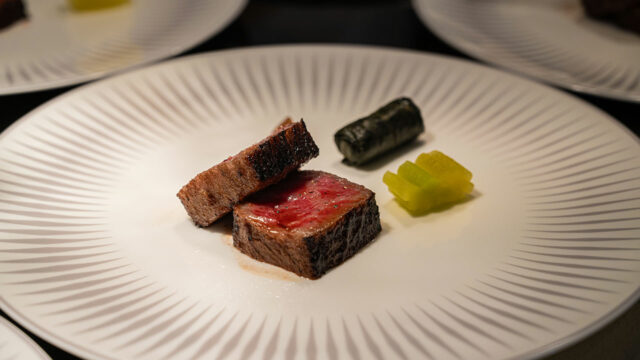
A FRAGRANT DISH: Miyazaki grilled wagyu beef with celtuce, onion puree, and a mushroom ragout.

Solaire celebrates anniversary with top international chefs

By Joseph L. Garcia, Senior Reporter

SOLAIRE Resort Entertainment City marks its 12th anniversary by bringing in some of the world’s best chefs (we’re talking Michelin stars, baby). One such encounter with the guest chef for the March 9 dinner, Sun Kim of Meta in Singapore was hands down, the best meal this writer has had this year (we’ve been invited to meet Solaire’s other guest chef, Heinz Beck, with three Michelin stars, so that might change).

Meta in Singapore usually sits in the upper rungs of Asia’s 50 Best List, and earned its first Michelin star under Mr. Kim in 2017. He’s glad to report that they received their second star last year. In a group interview with Mr. Kim on March 6 at Solaire’s Waterside for a lunch preview of the dinner, Mr. Kim remembers his first star. “I don’t think I was actually ready for the Michelin star. Michelin is a very big achievement. I tried my best to improve and tried my best to evolve.”

Understandably, expectations were very high for the preview lunch, but Mr. Kim exceeded all expectations, and then some. This writer had the sensation that one course was excellent, only to be topped again by the next one.

DINING IN SILENCE, REVERENCE
The first course was a sashimi of tuna with cuttlefish, seaweed, yuzu, and myoga (Japanese ginger). This was paired with a Dry Riesling 200 from Allan Scott in New Zealand. The myoga provides a contrast of texture with the tender tuna, while the wine pairing adds zest. Sliced thinly, the sashimi was dressed in a very subtle sesame oil, sprinkled with seaweed and flowers but arranged just so to look like a flower itself. With the dressing, the light floral notes of the wine are expressed. We noted that the diners were silent and reverent through this course, and after everybody had their last bite, there was a burst of noise from the joy this dish provided. 

The next dish was a rice ball topped with Hokkaido scallops, dressed with parsley and aged soy sauce, and topped with a little luxurious dollop of caviar. This was paired with a Roussanne Blanc Clos de Centenaires 2020 by Jean-Luc Baudet, from the South of France. The wine had a scent like fresh hay, accenting the lighter aspects of the dish’s ingredients. On its own, it’s very elegant, with a touch of earthiness, despite being made of seafood.

Next came a chawanmushi (savory egg custard) with spanner crab, seafood broth, and a dash of chili oil. This was paired with a chardonnay, The First Lady 2022, from the Warwick Estate in South Africa. The chardonnay was especially delicate, like the sugar shell around a candied piece of fruit. The dish, meanwhile, had a similarly delicate texture, but the crab and the seafood broth gave it a deeply intense flavor, while the wine added a little sparkle.

The next course was a Jeju abalone porridge with lily bulb, and chicken heart — apparently, this is a Meta signature. We were justified in our excitement: the porridge is light but intensely flavored with ginger and herbs, with an added bite from the lily bulb, and despite its grilling, the abalone tasted and felt buttery. This was paired with a Paul & Remy 2020 Tempranillo from the Chapillon Estate in Spain — the wine was bold and elegant, strong in flavor but light in scent and texture. It dances with the grilled abalone and the smoky porridge, their weights counterbalancing each other.

If you’ve noticed, most of the offerings were seafood: it turns out that Mr. Kim grew up in the south of South Korea, in Busan. “When I open my door, there’s a seafood market. I grew up eating a lot of good seafood,” he said, also noting that his mother once ran a Korean restaurant.

TRULY INTERNATIONAL
His upbringing forms the base, but his exposure and study of world cuisine forms his technique, with French and Italian cuisines, but also Japanese. “I used to work in a Japanese restaurant for a long time. I worked in a French restaurant as well. I’m Korean,” he said.

That should explain the last savory dish, a Miyazaki grilled wagyu beef with celtuce (a lettuce cultivar), onion puree, and mushroom ragout. The dish is fragrant from afar; we practically smelled it coming from the kitchen. This was paired with a Heritage An 462 2022 by Gerard Bertrand in Languedoc in France. The wagyu, rich as it was, benefited from the wine’s liveliness. The mushroom ragout was wrapped in a leaf, which we combined with the sharp onion puree. This and the pickled celtuce cut through the beef’s richness, providing a nice ritual.

The dessert was sweet corn and caramel popcorn with ice cream (the corn was the one local ingredient he used; the rest were from Singapore). This was paired with Solaire’s other guest’s offering, a rose-scented tea from Chinese Tea Master He Jia.

Daniel Blais, Solaire’s beverage director, said in a speech before the meal, “For our loyal patrons, we bring the best for all of them.” He reported that the dinners (three-Michelin-starred Azabu Yukimura’s owner Jun Yukimura’s, which was held before Mr. Kim’s dinner, and three-Michelin Star La Pergola’s Heinz Beck’s, to be held on March 16) had all been sold out — despite the P11,888++ price tag. “It’s just proof that Manila enjoys what we do.”

“I just do what I can do,” Mr. Kim said after the lunch. “I just cook from my heart.”

For details and more information, e-mail: restaurantevents@solaireresort.com, or check out https://sec.solaireresort.com/ or Solaire’s Facebook and Instagram pages.

Filinvest Land to build retail centers in Clark and Cubao

Filinvest Land, Inc. is planning to develop Filinvest Mall Cubao, a 17,000-sq.m. retail space, within its Activa Towers development in Quezon City. — FILINVEST.COM

GOTIANUN-LED Filinvest Land, Inc. (FLI) plans to use part of the proceeds from its recent P12-billion bond issuance for the construction of two new retail spaces to expand its property portfolio.

FLI President and Chief Executive Officer Tristaneil D. Las Marias said the company will open a 24,000-square-meter (sq.m.) Filinvest Mall in its Filinvest Mimosa Estate in Clark, Pampanga, by 2026.

“It will be a lifestyle destination in the North that will feature many global athleisure brands,” Mr. Las Marias said during a listing ceremony in Makati City on Wednesday.

He added that the company is planning Filinvest Mall Cubao, a 17,000-sq.m. retail space, within FLI’s Activa Towers development in Quezon City. The mall will include a supermarket and areas for food and retail offerings.

FLI listed its P12-billion bond issuance on the Philippine Dealing and Exchange Corp. (PDEx) on Wednesday.

The bonds consist of five-year bonds due in 2030 with an interest rate of 6.2916%, seven-year bonds due in 2032 with an interest rate of 6.6550%, and ten-year bonds due in 2035 with an interest rate of 6.8312%.

The issuance is the second tranche of FLI’s P35-billion shelf-registered bonds approved in 2023. The first tranche, which raised P11.4 billion, was issued in December 2023.

Aside from funding new malls, FLI will use the bond proceeds to repay existing debts and finance capital expenditures for land development and real estate construction projects.

Mr. Las Marias said the proceeds will also be allocated to its industrial business.

“We have also seen a strong demand for our industrial business ready-built factories (RBF). Our RBFs in both our Filinvest New Clark City Industrial Park and Filinvest Technology Park in Ciudad de Calamba, Laguna, are sold out, and we still have a long list of reservations from foreign and local businesses,” he said.

Mr. Las Marias also said FLI aims to sustain its growth trajectory in the residential segment following a profitable 2024.

“With the growth in our residential revenues and the introduction of new residential inventories last year, we aim to sustain our growth trajectory in the residential segment in 2025 and beyond,” he said.

“2024 was challenging, but we achieved income growth as the residential and rental businesses performed well despite the challenges,” he added.

FLI shares were unchanged at 70 centavos apiece on Wednesday. — Revin Mikhael D. Ochave

How Pernod Ricard is promoting responsible drinking in the Philippines

LIQUOR COMPANY Pernod Ricard is doubling down on promoting responsible drinking in the Philippines with the launch of its digital labeling, which also serves to support the company’s growth in the country.

“The Philippines is one of our fastest growing markets,” Hadyu Ikrami, head of legal, public affairs, communications, and sustainability and responsibility at Pernod Ricard Philippines, said in an interview with BusinessWorld.

“We constantly look into ways to strengthen our presence here and improve customer experience… and we want to keep this momentum via investing our brands in the Philippines,” he added.

Pernod Ricard carries over 200 brands, such as Beefeater Gin, Jameson Irish Whiskey, Ballantine’s Scotch Whisky, Chivas Regal, and Absolut Vodka.

“All major supermarkets and convenience stores are carrying our brands; we have nationwide coverage for modern on-trade outlets. We have an office and warehouse in Metro Manila,” he said.

“Locally produced Western-style product categories, like gin, rum, and brandy, are very big in terms of volume in the Philippines with their very low prices. Long-term conversion to aspirational international brands makes the Philippines an attractive market for our category,” he added.

CRÉATEURS DE CONVIVIALITÉ
“Our motto is ‘Createurs de Convivialité,’ which means creators of conviviality, and we believe that true conviviality starts with responsibility,” he said.

“When consumed responsibly, our products can bring people together to celebrate and enjoy the moment. Excessive drinking undermines that spirit and can also lead to serious health and social issues,” he added.

To promote responsible drinking, Pernod Ricard recently launched its new digital label system in the Philippines, which aims to respond to customers’ growing need to know more about the products they consume.

“We want to provide consumers who choose to drink with accurate information about our products to empower them to make informed choices about whether and how much they should drink,” he said.

The spirit maker’s digital labeling program is part of the wider U-label program put in place by the European wine and spirits industry associations.

“The European pilot program was launched in the summer of 2022, focusing on a selection of the group’s international brands,” said Mr. Ikrami.

“After this first phase, digital labels were gradually rolled out across the world with the full brand portfolio between 2023 and 2024. Since the end of 2024, the digital labels have been available across all our markets, including the Philippines,” he added.

He said that the Philippines is actually one of the first markets in the region where Pernod Ricard launched the initiative, along with Singapore.

“We have also noticed a trend that other industry players that are also producing alcoholic beverages are also following our footsteps in launching their own digital labels,” he said.

“So we are happy to be the pioneers of this initiative because we see that there’s a trend going towards more and more digital labels produced by different companies in the industry,” he added.

DIGITAL LABEL
The digital labels, or electronic labels (e-labels), are QR codes printed on the bottles’ back labels that lead to dedicated web pages that offer product information, health guidelines, responsible drinking advice, and more.

“By virtue of this e-label, there is localized guidance to help with moderation with tips on national drinking guidelines,” said Mr. Ikrami.

“If you scan the QR code, you will have all the necessary information about the ingredients of this beverage and also about the national drinking standard from the Philippine Food and Nutrition Research Institute of the Department of Science and Technology,” he added.

He said that the labels are geolocalized, meaning that the information consumers in the Philippines will get from scanning the bottles in the country will be different from that they would find scanning the QR codes elsewhere.

“The information that you get from scanning a bottle here would only be applicable in the Philippines because we are following the guidelines of the local government,” he said.

“If you scan the QR code in other markets, such as in Singapore, it would be slightly different in some aspects,” he added.

He said that the goal is to go a step further than providing nutrition and ingredients and provide easily understandable national drinking guidelines and set industry standards for digital labeling.

“We want to be the market leader for this, and we have been because ever since we launched this digital label in other markets, we saw the trend of other companies also following our footsteps,” he said.

Following the launch, Mr. Ikrami said that Pernod Ricard is looking at ways to improve the digital labels.

“We are committed to working with partners in the industry and with consumers to help evolve this e-label. We don’t want to say that it’s a perfect initiative because obviously there’s always room for improvement, especially by collaborating with other industry players,” he said.

“We look forward to any collaboration with any third party that would like to work with us in developing this initiative. We want to work with industry and consumers to drive uptake and usage of this e-label,” he added. — Justine Irish D. Tabile

ACEN’s profit up 27% to P9.36B in 2024

ACENRENEWABLES.COM

ACEN CORP., the listed energy arm of the Ayala Group, saw its attributable net income rise by 27% to P9.36 billion in 2024, driven by higher generation output. 

Revenues grew by 2.2% to P37.30 billion from P36.50 billion a year ago, ACEN said in a regulatory filing on Wednesday. 

Costs and expenses, meanwhile, declined by 13.8% to P27.36 billion.

“ACEN’s financial results in 2024 demonstrate our ability to convert a robust development pipeline into a renewable energy portfolio that can deliver strong and stable investor returns over the long term. This focus on execution will remain central as we move forward,” said Jonathan Back, chief financial officer and chief strategy officer of ACEN. 

During the period, attributable renewable output rose by 25% to 5,596 gigawatt-hours (GWh), driven by generation from plants that were activated throughout the year, despite a decline in Philippine wind generation in the fourth quarter.

The company’s generation output from its Philippine operations rose by 60% to 1,826 GWh, supported by the completion of several renewable energy projects.

For its international operations, ACEN generated 3,770 GWh from its renewable energy plants, an increase of 13% compared to the previous year. 

ACEN Renewable Energy Solutions, the group’s Philippine retail electricity arm, expanded its portfolio by 26% to 374 megawatts across 554 customers from various sectors, including industrial, educational, and residential.

To date, the company holds 7 gigawatts (GW) of attributable renewable energy capacity across operational, under-construction, and committed projects.

“ACEN continues to progress toward our goals, notwithstanding the global headwinds impacting the energy transition. The company remains committed to scaling up renewables in the Philippines and across the region,” said Eric T. Francia, president and chief executive officer of ACEN.

At the local bourse on Wednesday, shares in the company declined by 3% to close at P2.91 each. — Sheldeen Joy Talavera

Potatoes are filled with nutrients, says trade group

POTATOES USA, the marketing arm of the American potato growers, hosted a talk about the health benefits of potatoes on March 6 in Makati City. Aside from presenting fun facts about the vegetable, the organization invited a speaker to give more details.

Jo Sebastian, a registered nutritionist and dietitian, showcased the versatility of potatoes in a diet, whether baked, roasted, or fried. “They’re an excellent source of vitamin C and potassium, and fuel for your brain and body because of complex carbohydrates. For example, you can try adding some mini potatoes into your first meal — see how that helps you sustain energy for the rest of the day,” she said.

However, with these benefits come a lot of misconceptions regarding the nutrient content.

Ms. Sebastian noted that Filipinos seeking weight loss tend to be “scared off” by the mention of carbs, taking after Western trends in dieting, even though they are an important fuel for people’s bodies.

“Potatoes are actually considered a lower-calorie carb source, meaning it will help you feel energized but can fit in a well-balanced diet,” she explained. “Carbs often get a bad reputation, but they’re important because they’re the preferred energy source of your brain and blood cells.”

Complex carbohydrates in particular, which potatoes contain, take more time to break apart, which is ideal for those who need sustained energy throughout the day.

Meanwhile, potatoes’ vitamin C content strengthens immunity and maintains skin health while potassium (surprisingly contain more than banana) helps with fluid balance, muscle contractions, and healthy blood pressure.

For Ms. Sebastian, that potatoes fit in well with Filipino dishes like afritada, kaldereta, menudo, giniling, adobo, and even torta makes it a great choice for regular consumption.

US VS PHILIPPINE POTATOES
Though the Philippines grows its own potatoes, it is the largest importer of US frozen potatoes in Southeast Asia. The leading markets in all of Asia are Japan, South Korea, and the Philippines.

“Generally, the content of US potatoes and Philippine potatoes should be the same. They’re all healthy,” said Reji Retugal, Potatoes USA country representative to the Philippines.

The main difference would be the varieties available — one of which is hard to grow here. “Unfortunately, we do not grow russet potatoes here, which are the ones primarily used for fries, because they’re big and require a different kind of soil that’s looser and less rocky,” explained Ms. Retugal.

The Philippines also has different farming practices that may create differences in quality.

“In the US, potatoes are stored in climate-controlled facilities to slow aging and preserve freshness,” she said. “The Philippines lacks this technology, so local potatoes often degrade faster due to heat and improper storage.”

The country receives fresh imports usually between November and March. US potatoes are available in fresh, frozen, and dehydrated forms.

Ms. Retugal recommended that potato buyers ensure proper storage, keeping the root vegetable in a cool pantry or refrigerator, to keep them fresh. “Just don’t place them next to other vegetables like onions or garlic. Potatoes are porous and can easily absorb other smells and flavors,” she said.

In terms of diet, Ms. Sebastian shared that having more than one carb source is alright, as long as they are in rotation.

“As an Asian, I still love my rice. Instead of replacing it, consider adding potatoes into your rotation of carbohydrate sources for variety and better nutrition,” she explained.

Frying potatoes may be delicious, but the process adds extra fat and calories. The recommendation is to eat potato this way at most two or three times a week.

Ms. Sebastian concluded: “Whether you bake, roast, or steam your potatoes, you’ll be able to get all the nutrients in there.”

US-grown potatoes can be found fresh, frozen, or instant (dehydrated) in most Philippine supermarkets. — Brontë H. Lacsamana

Globe Business, Shakey’s partner for digital solutions

SHAKEYSGROUP.PH

GLOBE TELECOM, Inc., through its corporate arm Globe Business, has partnered with Shakey’s Pizza Asia Ventures, Inc. (SPAVI) to improve the restaurant chain’s operations using advanced digital solutions.

The partnership between the Ayala-led telecommunications company and SPAVI will focus on improving SPAVI’s order management system to optimize store operations, Globe Business said, adding that it will provide cloud-based solutions to enhance operational efficiency.

“These solutions provide seamless access to point-of-sale systems, centralized data sharing, and real-time monitoring, enabling SPAVI to reduce manual processes and make informed decisions more efficiently,” Globe Business said. 

Globe Business will also help SPAVI refine its inventory management, ensure order accuracy, and strengthen overall business operations.

“We are not looking for mere solutions; we need a true partner like Globe Business, one who understands our values and proactively identifies and creates opportunities. We deeply value the insights Globe Business brings and look forward to their continued innovative contributions to our shared success,” said SPAVI President and Chief Executive Officer Vicente L. Gregorio.

Globe Business said improving digital solutions for companies like SPAVI is essential, especially as SPAVI expands its portfolio. As of 2024, the restaurant chain’s network has surpassed 2,600 stores and outlets, with both domestic and international expansion driving its growth. 

At the stock exchange on Wednesday, shares in Globe fell by P16, or 0.74%, to close at P2,150 apiece, while shares in SPAVI remained unchanged at P7 each. — Ashley Erika O. Jose

Philippine banks to stay resilient amid strong economic backdrop

BW FILE PHOTO

By Luisa Maria Jacinta C. Jocson, Reporter

THE PHILIPPINE banking system is seen to remain resilient amid support from a strong macroeconomic environment, Moody’s Ratings said, with profits expected to be stable amid robust credit growth.

“We maintain a stable outlook for the Philippines’ (Baa2 stable) banking system. Strong economic growth underpinned by further rate cuts and stabilized inflation in 2025 will drive credit demand and support loan quality,” the debt watcher said in a report.

“Banks’ profitability will remain broadly stable as net interest margin compression will be modest because of the weak monetary policy transmission to banks’ lending rates in the Philippines.”

Latest data from the Bangko Sentral ng Pilipinas (BSP) showed the net profit of the country’s banking industry rose by 9.76% year on year to P391.28 billion in 2024.

Moody’s said Philippine banks’ capitalization is expected to remain strong.

“Capital levels will remain high, as strong shareholder support and internal capital generation keep pace with high credit growth,” it said.

It expects bank’ credit growth to accelerate to an estimated 12% this year amid declining interest rates and surge in business activity and consumer sentiment.

Bank lending jumped by 12.8% to P13.02 trillion in January, its fastest pace in over two years, central bank data showed.

“Reserve ratio requirement cuts by the central bank will also drive credit growth, by releasing more liquidity for banks to channel into lending,” Moody’s added.

The RRR of universal and commercial banks and nonbank financial institutions with quasi-banking functions will be reduced by 200 bps to 5% from 7% later this month. BSP Governor Eli M. Remolona, Jr. has said big banks’ RRR can be brought down to zero eventually.

“Strong credit growth and the increasing share of higher-yielding retail and small and medium enterprise (SME) loans will also support yields,” it said.

However, Moody’s noted that retail loans have been growing by 35% over the past two years, “posing loan seasoning risks.”

“Policy rate cuts will support borrowers’ debt repayment capacities, which will mitigate potential loan quality deterioration from the seasoning of newer retail and SME loans.”

The BSP began its easing cycle in August last year, slashing borrowing costs by a total of 75 basis points (bps) to bring the policy rate to 5.75%.

“Meanwhile, the quality of loans to large conglomerates will remain solid, notwithstanding the concentration risks they pose to banks,” Moody’s said.

“Loan loss reserves will decrease, but the larger Philippine banks will continue to have stronger buffers against any loan losses, compared to the smaller banks.”

Banks’ loan loss reserves amounted to P488.48 billion, up by 1.6% from P480.64 billion in December and by 5.7% from P462.12 billion a year ago. This brought the January loan loss reserve ratio to 3.22% from 3.14% in December and 3.45% in the same month in 2024.

“Banks continue to reduce their real estate exposure and we expect stable operating conditions in the sector in 2025,” Moody’s added.

Banks’ real estate exposure ratio dropped to 19.55% at end-September from 19.92% at end-June and from 20.55% at the end of September in 2023. This was the lowest real estate exposure ratio recorded in five years or since the 19.5% as of September 2019.

Meanwhile, Moody’s expects credit costs to rise “modestly” as banks grow their retail and SME loan portfolios, but this can be offset by their loan loss reserves.

“Funding and liquidity in the banking system will remain robust,” it added.

GROWTH OUTLOOK
Moody’s Ratings expects the Philippine economy to grow by 6% this year and next, which will benefit banks.

The credit rater’s forecast is at the low end of the government’s 6-8% growth target for 2025 and 2026.

Philippine gross domestic product grew by 5.6% in 2024, well below the government’s 6-6.5% goal for the year.

“Although global uncertainties pose upside risks to inflation, we expect it to remain between 2% and 4%, which will support further policy rate cuts in 2025,” it said.

“As a result, domestic consumption and investments will improve, giving further stimulus to the economy,” it said. “Given the country’s consumption-led economic model, we expect the impact of higher tariffs on the Philippines under the Trump administration to be muted compared to its regional peers.”

On Tuesday, Mr. Remolona said a rate cut is “on the table” at the Monetary Board’s policy meeting next month, which has been rescheduled to April 10 from April 3 previously.

He added that the BSP is still on easing mode and expects to slash benchmark borrowing costs by “a few more times” this year.

The Monetary Board in February unexpectedly paused its rate-cut cycle, which Mr. Remolona said was a “prudent” move amid uncertainty over the trade policies of US President Donald J. Trump and their potential impact on the Philippines.

A visit to New World’s refurbished Café 1228

AFTER a month and a half after closing the Café 1228 buffet at the New World Makati Hotel, it reopened its doors on the penultimate day of February. Its refurbishment comes with a brighter interior with new countertops, and even a hydroponics system at the salad station (your salad is basically alive) — and a way to welcome its new Executive Chef, Warren Brown.

We counted nine stations during our Feb. 27 visit: Western, Noodles, Chinese, Seafood, Pan-Asian, Japanese, Salads, Cheeses, and Desserts.

The buffet gets a lot of its strength from its Chinese station (noting that Chinese mainstay Jasmine restaurant is just upstairs) but we must commend the lamb curry from the Asian station for its forward, filling flavor, as well as the roast beef from the Western carving station. The sushi was above average for its location (we wag our finger at some hotels, especially those located near the water, that manage to screw up fish).

SALADS AND SALT
As mentioned, Café 1228 introduced the hydroponics system at the salad station, providing fresh, sustainably grown greens. “Sustainability is a core value of Rosewood Hotels & Resorts, and having our own hydroponic garden is a step in that direction. By growing our own herbs and greens, we reduce waste, cut down on transportation emissions, and ensure that we’re using the freshest ingredients available. It’s a great way to bring sustainability into the heart of our kitchen while delivering better quality to our guests,” Mr. Brown said in an e-mail.

The restaurant also proudly supports local salt farmers by incorporating Philippine artisanal salts into its menu. Guests can now enjoy the distinct flavors of Asin Tibuok from Bohol, a rare, smoky salt formed in clay pots; Asin Tultul from Guimaras, a hardened salt block with a unique umami profile derived from a mix of seawater and coconut milk; and Asin Buy-O from Zambales, a fine sea salt produced through a traditional brining and filtration process unique to the region’s northern coast. Mr. Brown said, “It’s a small but meaningful way to showcase high-quality local ingredients while enhancing the overall dining experience.”

He said, “The renovation allows us to elevate everything — from the ambiance to the quality of food and service. We wanted to create a more engaging and interactive atmosphere where guests can truly enjoy great food in a vibrant setting.”

The refurbishment of the café is only the first step.

“Café 1228’s reopening is just the beginning. We’re continuously working on enhancing the overall dining experience, from seasonal specials as well as some special surprises down the road. Guests can also look forward to exciting updates in our other restaurants, like Jasmine, where we’ve introduced new dishes that highlight premium ingredients and bold flavors. We’re always exploring ways to bring fresh, innovative dining experiences to our guests, and there’s plenty more to come,” Mr. Brown said.

Café 1228 is open daily for breakfast from 6 to 10 a.m., with extended hours until 10:30 a.m. on weekends and holidays. Lunch is available from noon to 2:30 p.m., and dinner is served from 6 to 9:30 p.m. Weekday lunch is priced at P2,800 net per person, with weekend lunch and Friday to Saturday dinner at P3,800 net per person. Sunday to Thursday dinner is available at P3,300 net per person. For reservations and inquiries, contact 8811-6888, visit https://bit.ly/NWMDining or e-mail servicecentre.manila@newworldhotels.com. — JLG

MGen unit activates 52.8-MW solar plant in Isabela

MGreen Cordon Solar in Barangay Capirpiriwan, Cordon, Isabela.

MGEN Renewable Energy, Inc. (MGreen), the renewable energy arm of Meralco PowerGen Corp. (MGen), has switched on its 52.8-megawatt (MW) solar power plant in Cordon, Isabela.

The solar project is the second under the second round of the government’s Green Energy Auction Program to be completed ahead of schedule, the company said in a media release on Wednesday.

Completed four months early, the solar farm is expected to supply clean and reliable electricity to over 53,000 households, supporting the Philippines’ goal of increasing the share of renewable energy in the power mix to 35% by 2030.

The project is expected to prevent over 50,400 metric tons of carbon dioxide emissions annually, equivalent to removing more than 11,700 gasoline-powered cars from the road, according to the company.

“We want to show that economic progress and environmental responsibility can go hand in hand,” said MGreen President and Chief Executive Officer Dennis B. Jordan.

This is MGen’s seventh solar power plant in the Philippines, following MGreen BulacanSol, Nueva Solar, MGreen Baras Solar, MGreen Bongabon Solar, MGreen SP Calatagan, and MGreen SP Tarlac.

MGen expects to end this year with at least 82 MW of additional capacity from three solar plants.

The company has a pipeline of projects expected to exceed its 1,500-MW renewable energy target before 2030.

MGen is the power generation arm of Manila Electric Co. (Meralco).

Meralco’s controlling stakeholder, Beacon Electric Asset Holdings, Inc., is partly owned by PLDT, Inc. Hastings Holdings, Inc., a unit of PLDT Beneficial Trust Fund subsidiary MediaQuest Holdings, Inc., has an interest in BusinessWorld through the Philippine Star Group, which it controls. — Sheldeen Joy Talavera