Home Blog Page 1802

Digitalization may boost telco growth in 2025

UNSPLASH

By Ashley Erika O. Jose, Reporter

THE SURGING demand for connectivity, digitalization, and data center expansion would continue to boost growth, though muted, in the telecommunications and information and communications technology (ICT) sector in 2025, analysts said.

“We may see only single-digit revenue and earnings growth for the industry as a whole in 2025,” Juan Paolo E. Colet, managing director at Chinabank Capital Corp., said in a Viber message on Sunday. “Rising demand for data, expansion of product offerings and contributions from segments like fintech and data centers are favorable drivers for positive performance, though at varying extents across the major players.”

Jayniel Carl S. Manuel, a Seedbox Securities, Inc. equity trader, expects surging demand for robust connectivity and cloud-based services to drive the ICT sector’s profitability.

“Consumers and enterprises alike are gravitating toward data-intensive applications ranging from high-speed internet and 5G (fifth generation)-enabled solutions to more sophisticated digital finance and cybersecurity offerings, and this trend should underpin revenue growth for major players,” he said in a Facebook Messenger chat on Dec. 27.

“The profitability outlook for Philippine telecommunications and ICT companies in 2025 appears promising but faces several challenges that could impact growth prospects,” Toby Allan C. Arce, head of sales trading at Globalinks Securities and Stocks, Inc., said in a Viber message on Friday.

PLDT Inc. posted a 2.4% increase in its attributable net income in the third quarter, driven by higher revenue that rose 1.98% to P53.36 billion from a year earlier. This brought its nine-month income to P28.07 billion, a 0.68% increase.

Listed fiber internet provider Converge ICT Solutions’ attributable net income in the third quarter climbed 40.4% to P2.92 billion from a year earlier, while Globe Telecom, Inc.’s net income climbed 21.1% to P6.02 billion.

Meanwhile, DITO CME Holdings Corp., which operates DITO Telecommunity Corp., posted an attributable net income of P998.05 million during the period from a net loss of P4.29 billion a year earlier.

Sam Jacoba, founding president of the National Association of Data Protection Officers, said cyberattacks would continue to threaten ICT companies and their financial technology arms. “Cyberattacks will continue and will focus on where the online assets are managed,” he said in a Viber message on Sunday.

“Cyberattacks will continue to be a major hindrance in the public’s acceptance of digitalization,” Ronald B. Gustilo, national campaigner for Digital Pinoys, said in a Viber message.

Electronic wallet giant GCash earlier reported missing funds and unauthorized transactions for some of its users. GCash said these were due to its system reconciliation process.

Mr. Gustilo said hacking and data breaches hinder digitalization growth because many still view it as a risky path.

Mr. Arce said the continued digital transformation across sectors and the evolving consumer preference for digitalization suggest steady revenue streams for telecommunication and ICT companies.

PLDT through its wireless unit Smart Communications, Inc. and Globe have been expanding their 5G coverage in the country.

“Globe Telecom, for instance, is poised to benefit from ongoing 5G network expansion and its deepening investments in digital platforms,” Mr. Manuel said.

But intense competition and technological evolution could be a problem for many companies. “Keeping pace with global technology trends requires significant capital investment, which could strain profitability,” Mr. Arce said.

Mr. Manuel said PLDT should focus on further modernization of legacy infrastructure and leverage its fiber enterprise segments to sustain steady revenue, while DITO Telecommunity has an optimistic outlook driven by the expansion of its subscriber base.

“Converge ICT Solutions stands to remain a key contender in the fiber broadband space, especially in underserved regions, although high capital expenditures for network rollouts will pose a challenge to profit margins,” he said.

“Stringent data privacy regulations and heightened consumer awareness around cybersecurity will compel telecommunication and ICT firms to invest heavily in compliance measures and digital safeguards,” Mr. Manuel said.

Mr. Colet said data centers would be a key driver for companies’ positive performance in 2025.

PLDT through unit ePLDT, Inc. plans to build its next data center in Southern Luzon to position its 11th and largest data center, VITRO Sta. Rosa, as a data center hub while also maintaining a strong market presence in the data center business.

Meanwhile, ST Telemedia Global Data Centres Philippines has completed the structural framework of its 124-megawatt (MW) data center in Fairview, Quezon City, paving the way for its initial activation by the second quarter of 2025.

Converge ICT is also planning to open two data centers with a combined capacity of 13 MW in 2025.

Your guide to pet safety this New Year’s Eve

FREEPIK

AS New Year’s Eve approaches, Filipinos are preparing for their signature loud and vibrant celebrations, featuring dazzling fireworks, firecrackers (despite many being banned), and lively gatherings. While these festivities bring joy to many, they can cause significant distress for household pets like dogs and cats, whose heightened sensitivity to noise, light, and smells makes the celebration particularly overwhelming.

Studies show that humans can hear sounds up to 20 kilohertz, but dogs can hear sounds almost two to three times higher (up to 35-60 kilohertz depending on the breed). Cats are even more sensitive, detecting sounds up to three times higher (around 65 kilohertz).

This heightened sensitivity can trigger fireworks anxiety in pets, a condition where they experience stress or fear due to the loud, unpredictable noises, flashes, and even the smell of fireworks and firecrackers.

“Add all of those, and our pets tend to be very stressed during festivities, particularly during New Year,” Dr. Ross Antonio Banayo, a veterinarian and a technical manager for parasiticides at Boehringer Ingelheim said in an interview.

Mr. Banayo said that pets showing fireworks anxiety may exhibit a fight-or-flight reaction, either attempting to flee or becoming highly agitated. Other common stress behaviors may include hiding, panting, trembling, and seeking comfort.

Large crowds, typically present during Media Noche or New Year’s Eve dinner, could also exacerbate pets’ stress, especially for pets not accustomed to such gatherings.

Mr. Banayo told BusinessWorld that if fireworks anxiety is left unaddressed or unmanaged, it could lead to other physiological and behavioral problems, such as destructive chewing, where pets excessively chew on their owners’ belongings, the development of other anxieties like separation anxiety, and even an increase in parasites.

To help pets prepare for fireworks anxiety, Mr. Banayo suggests gradually conditioning them to the sounds of fireworks using audio recordings. Start with a low volume and slowly increase it.

Pets should have access to food and water before the festivities, as anxiety may cause them to refuse eating or drinking. A walk before the celebration can also help calm them down. 

Owners can consult their family veterinarian for tailored advice on managing their pet’s anxiety prior to the celebration.

During the festivities, owners could create a safe space for their pets, such as a room, and soundproof it with fabric or sheets. Playing calming music or using a white noise machine can also help distract them from outdoor noise. Mr. Banayo stressed that during this time, owners should stay calm and present to reassure their pets that they are safe.

After the festivities, owners should check their pets. While fireworks anxiety usually subsides once the event is over, some pets may take longer to recover. If sudden behavioral changes persist, it is advisable to consult a veterinarian.

To help pet owners stay informed about responsible care, including how to protect pets from firework anxiety and other health issues like parasites, Mr. Banayo said that Boehringer Ingelheim has been hosting various pet-focused events.  One of their recent initiatives was a webinar held last December, in collaboration with the country’s esteemed veterinarians. They discussed ways to protect pets from parasites and the potential effects if left untreated. Also, Boehringer Ingelheim continues to work closely with veterinarians to elevate their services through the company’s latest pet care innovations. — Edg Adrian A. Eva

BSP extends transitory period for consumer redress standards adoption

BW FILE PHOTO

THE BANGKO SENTRAL ng Pilipinas (BSP) has extended until end-March the transitory period for banks’ adoption of consumer redress mechanism standards for electronic payments.

“The transitory period, previously set to end on Dec. 31, 2024, has been extended by three months. The new deadline for compliance with BSP Circular No. 1195 is now set on March 31, 2025,” it said in a memorandum posted on its website.

“The BSP remains committed to supporting the payments industry throughout this transition,” the central bank added.

The memorandum was signed by BSP Governor Eli M. Remolona, Jr. and was dated Dec. 27.

BSP Circular No. 1195 Series of 2024 dated June 1 or the consumer redress mechanism standards aim to ensure the timely resolution of issues encountered in the use of online transactions, such as failed fund transfers.

These cover account-to-account electronic transfers under the National Retail Payment System framework.

The standards apply to all clearing switch operators and automated clearing house participants that provide domestic account-to-account electronic fund transfers, including person-to-person, person-to-merchant, and person-to-biller payments.

It includes guidelines on the necessary notifications for real-time or batched electronic fund transfers, the return of funds, collection and return of electronic fund transfer fees, the disruption of services and operations, and consumer protection. — Luisa Maria Jacinta C. Jocson

An entertaining Senate

BW FILE PHOTO

When President Ferdinand “Bongbong” Marcos, Jr. announced his senatorial slate for the 2025 midterm elections, former Senate President Franklin Drilon said it is composed of people who can sing or dance. In another interview, he described the slate as a hodgepodge of personalities driven by name recall.

It was a frank putdown of the administration’s candidates for the Senate. He has basis for his low assessment of them. He spent many years in the Senate with some of the nominees: Tito Sotto, Bong Revilla, Lito Lapid, and Manny Pacquiao. Netizens’ reactions are just as disparaging. Here are some comments about the lineup in social media:

• A senatorial ticket just right for the bobotantes (a portmanteau of bobo or stupid and botantes or voters).

• The list of candidates voters should not vote for.

• A slate that discourages one to vote.

• A bunch of showbiz people.

• Multiple dynasties in the making.

• Government service turned into family business.

I understand the disappointment, nay dismay, even disdain of the more discerning citizens over the administration’s candidates for senator. The Senate is that assembly of people mandated to enact laws and enunciate national policies that promote the people’s welfare, empower the poor and weak, stimulate economic growth, institute good governance, promote the rule of law, strengthen democracy, protect the environment and the nation’s rich cultural heritage, and build an equitable, prosperous, and orderly society.

The Senate is usually referred to as the “august body.” When pronounced with the accent on the second syllable, “august” means majestic, dignified, imposing. Not anymore as the Senate is now populated by people with popular names, their popularity gained as a movie actor or television show host. Next year the Senate will likely be overpopulated with such people.

Based on the survey Pulse Asia ran between Nov. 26 and Dec. 3, Erwin Tulfo, Tito Sotto, Bong Go, Ben Tulfo, Pia Cayetano, Manny Pacquiao, Ping Lacson, Willie Revillame, Bong Revilla, Abby Binay, Lito Lapid, and Imee Marcos have a statistical chance of winning any of the 12 seats up for grabs in the May 2025 elections.

The Social Weather Stations (SWS) survey conducted from Dec. 12 to 18 indicated that candidates Erwin and Ben Tulfo, Revilla, Sotto, and Pacquiao will likely be elected senators. Also shown by the survey as likely winners are Cayetano, Go, Lacson, Binay, Lapid, Villar, Dela Rosa or Marcos.

They are not necessarily the best and the brightest — no legal luminary, eminent economist, dedicated community builder, brilliant military commander — but definitely the most popular among the senatorial candidates.

Tito Sotto, a multi-term senator, was first catapulted to the Senate in 1992 by his popularity gained as a mainstay in the TV sitcom Iskul Bukol and as a co-host on the TV noontime variety show Eat Bulaga. Pia Cayetano gained fame as the host of Compañero y Compañera, a public affairs talk show that provided free legal assistance to listeners in need of information and guidance. Brothers Erwin and Ben Tulfo became public figures because of their public service TV programs — Erwin through Ulat Bayan, PTV’s flagship primetime news program, and Ben through BITAG, a documentary-reality and investigative public service program.

Willie Revillame is a television host, actor, comedian, and singer. He has hosted several high-rating TV entertainment programs. He has also appeared in various movies, often playing sidekick to big-named stars. Bong Revilla and Lito Lapid were first popular as movie action stars. Manny Pacquiao was a boxing multiple world champion before entering the political arena. The telecast of his world-title fights drew record-breaking viewership.

If elected, they would join or rejoin incumbent senators Loren Legarda and Raffy Tulfo, both former broadcast personalities; Jinggoy Estrada and Robin Padilla, both-ex movie action stars. Legarda is a true broadcast professional. She graduated cum laude from the University of the Philippines, Diliman with a bachelor’s degree in broadcast communications. She pursued post-graduate courses on special studies towards professional designation in journalism from the University of California, Los Angeles (UCLA). She began her broadcast journalism career as a reporter for RPN. She moved to ABS-CBN when it resumed operations immediately after the EDSA Revolution. She was co-anchor of the television newscast, The World Tonight. She went to the Senate straight from the broadcast world.

Raffy Tulfo began as host of several public service programs on ABC 5, a pre-martial law network and sister company of the daily newspaper The Manila Times. He is the man behind the TV programs Raffy Tulfo in Action and Wanted sa Radyo.

A stint in television, either as star in a sitcom like Tito Sotto, a news anchor like Loren Legarda, or a talk show host like Raffy Tulfo, has proved to be a jumping board to the Senate.

Risa Hontiveros was also in broadcast journalism. After graduating cum laude from Ateneo de Manila with a Bachelor of Arts degree in Social Sciences, she worked for networks IBC and GMA, co-anchoring programs like Firing Line and Headline Trese. She also served as Secretary-General of the Coalition for Peace. It was her advocacy for peace and socio-economic reforms, not her broadcast media personality, that served as her vehicle to the House of Representatives first, then to the Senate.

If brothers Erwin and Ben Tulfo, Pia Cayetano, and Camille Villar are elected, there will be four sets of siblings in the Senate — three Tulfos, two Cayetanos, two Villars, and two Ejercitos or Estradas.

The Senate is a steppingstone to the Presidency. Senate Presidents Manuel Quezon, Manuel Roxas, Ferdinand Marcos, Sr., and Senator Noynoy Aquino went straight from the Senate Hall to Malacañang. Senators Elpidio Quirino, Carlos Garcia, Joseph Estrada, and Gloria Macapagal Arroyo had another stone to step on — the Vice Presidency — before getting to Malacañang.

Incumbent Senators Jose Avelino, Claro Recto, Raul Manglapus, Sergio Osmeña, Jr., Ping Lacson, Jamby Madrigal, Richard Gordon, Manny Villar, Miriam Santiago, and Manny Pacquiao all ran for president but lost. So did former Senators Jose Yulo, Ramon Mitra, and Mar Roxas. Bongbong Marcos is the only former senator who eventually got elected president.

The Tulfo, Cayetano, Villar, and Ejercito-Estrada families seem to be enhancing their chances of occupying Malacañang.

Happy New Year, dear readers.


Oscar P. Lagman, Jr. has been a keen observer of Philippine politics since the late 1950s.

Damosa to launch TRYP condotel in Samal in 2025

SAMAL ISLAND, DAVAO — WIKIMEDIA.ORG

DAMOSA LAND, Inc. (DLI) will launch its condominium-hotel project under the TRYP by Wyndham hotel brand next year, according to its top official.

The condotel, which will be built on the island of Samal in southern Philippines, is slated for completion by 2027 or 2028, to DLI President and Chief Executive Officer Ricardo F. Lagdameo told BusinessWorld.

“We’re only going to introduce it or launch it to the market hopefully by next year, but we’re heavily into the planning stages,” he said in a video interview.

The four-star condotel would feature about 100 rooms and cater to the mid- and luxury markets, Mr. Lagdameo said. “Development will start in the next two years. But we’ll start offering it to the market hopefully by next year.”

Mr. Lagdameo said Samal Island, which is about 17 kilometers from Davao City, is a major upcoming tourist destination in the Mindanao region. “If you want to go to the beach or on vacation, you’ll do it on Samal Island. And it has been developing quite substantially over the last few years.”

The expected completion of the Davao-Samal Bridge in 2027 is expected to increase access to Samal Island by tourists. It will also be Damosa Land’s first condotel project and partnership with a foreign hotel brand.

TRYP, a unit of Wyndham Hotels & Resorts, has more than 100 hotels across 60 cities in Asia, the US, and Europe. TRYP by Wyndham Samal will be the second TRYP hotel in the Philippines after TRYP by Wyndham Mall of Asia Manila in Pasay City.

Under the TRYP brand, the condotel would cater to the younger generation, particularly Millennials, Mr. Lagdameo said.

“If you look at their hotels, they’re very tastefully done, but they’re a little more hip,” he said. “So it’s not just a plain, ordinary business traveler hotel.”

In May, Damosa Land signed a deal with PHINMA Microtel Hotels, Inc. to operate TRYP by Wyndham Samal Island.

Damosa Land is the property development arm of Anflocor Group of Companies that specializes in the residential, township, mixed-use, office, commercial, and industrial segments. — Beatriz Marie D. Cruz

Coworking spaces are the trend after Manila’s POGO ban — IWG

FREEPIK

By Beatriz Marie D. Cruz, Reporter

MULTINATIONAL office space provider International Working Group Plc (IWG) expects to boost its coworking spaces next year amid a total ban on Philippine offshore gaming operators (POGOs).

In an interview with BusinessWorld, IWG Country Manager for the Philippines Lars Wittig said the ban could push developers to refurbish vacated POGO spaces to cater to different office needs, including coworking spaces.

“The developers, landlords are right now affected by the POGOs being discontinued in the Philippines,” he said. “So, there is a higher degree of urgency to reinvent your buildings so that you can attract more or different types of workspace requirements.”

“If you had a lot of POGOs who were willing to pay premium for conventional space, you might postpone the investment into flexible workspace. But with the POGOs also gone, and with a higher vacancy rate, the landlords are now eager to make that development to the next level,” he added.

Vacated office spaces surged 65% this year to 690,000 square meters (sq.m.) from 418,000 sq.m. last year, mainly due to the POGO ban, according to Leechiu Property Consultants.

IWG plans to add 17 to its 33 hybrid working spaces in the Philippines in 2025. It also plans to partner with more local developers to boost its presence nationwide.

Mr. Wittig said the demand for flexible workspaces has been increasing due to the unpredictability of workspace requirements.

“Even the biggest, most traditional employers cannot predict what their workspace requirements are five years from now, even three years, or even one year from now,” he said. “So, they make it permanent to go flexible… because that gives them the agility to be able to expand or the opposite.”

Hybrid working spaces also improve employees’ productivity by avoiding long commutes, allowing companies to retain talent.

“[Employers] like the fact that they don’t have to invest in conventional office space because you take out at least for five or 10 years, and then you have to make a capital investment. With us, there’s zero,” Mr. Wittig added.

The entry of foreign direct investments would boost the growth potential for IWG’s coworking spaces, Mr. Wittig said.

“The fact that we are getting closer to a free trade agreement with the EU is a big driver for foreign investors to come here,” he said, noting that this could increase the occupancy for hybrid working areas.

IWG is one of the biggest coworking space providers in the world, known for brands like Regus, Spaces and HQ. It has almost 10 million customers in 4,000 locations across more than 120 countries. The company’s clients include startups and Fortune 500 corporations, Mr. Wittig said.

IWG charges P6,000 to P8,000 per employee per month, though the cost varies based on workspace requirements.

On the average, Philippine companies sign up for IWG’s coworking spaces for at least 10 months, while the longest time is around three to five years, Mr. Wittig said.

The benchmark cost to build a coworking space is about $1 million (P58 million). It includes amenities such as Wi-Fi, meeting rooms, office supplies and a coffee maker.

IWG is aiming for 85% minimum occupancy rate for its coworking spaces in the Philippines this year, he added.

High food prices dampen festive spirits in Russia

EDUARDO SOARES-UNSPLASH

THIS holiday season, many Russians are tightening their belts.

Stubborn inflation has driven up prices of staples such as butter, potatoes and chicken in recent months, hitting Russia’s poorest and causing some to cut back this festive season.

Reuters spoke to Russians in Moscow, St. Petersburg, Yekaterinburg in the Urals and Omsk in Siberia to understand how people are managing their finances.

“Prices have noticeably increased,” said Natalia Moreva, 58, listing flour, bread, chocolates, fruit, vegetables and meat as all having gone up in price.

“Incomes are sufficient, but when you go to the shop you used to be able to buy more,” said Ms. Moreva, who works for the Omsk regional government.

“The holiday is turning out to be a modest one.”

Russians traditionally increase their spending in the final few weeks of each year, gearing up for New Year celebrations and nationwide holidays in the first weeks of January. This year, they have had to spend a lot more.

“Way more expensive, it is heavy on the pocket. In past New Years, expenses more or less met the budget. Now, the costs are much higher, maybe three or four times more than before,” said Dinara, a student from Yekaterinburg, Russia’s fourth-largest city.

SOARING COSTS
Real wages have risen across Russia, largely due to rising salaries in the defense and technology sectors. But for many, wages have not kept pace with inflation, which is running at more than 9%, despite the central bank maintaining interest rates at 21%, their highest in more than 20 years.

Vyacheslav, 73, a pensioner in Omsk, said he was noticing prices rising from one day to the next.

“It is, of course, not very nice or convenient for people at the moment. We understand that the country is in a difficult situation at the moment, but nevertheless I would like for grocery prices not to grow so quickly.”

The price of his favorite cheese has risen by 15% to 20% since September, he said, to around 850 rubles.

Inflation could end the year at as high as 9.8%, Andrei Gangan, director of the central bank’s monetary policy department, told Interfax on Tuesday, and will peak in April 2025 before starting to come down.

The central bank defied expectations for a rate hike last week and opted to keep the current cost of borrowing, but soaring borrowing costs are cooling demand in Russia’s real estate market, with mortgage rates of up to 30% putting off potential buyers and fueling a rental market boom.

“Communal services are getting more expensive, (so are) taxes, and it is very noticeable,” said Moscow student Veronica Arefieva. “When you go to the shop, a loaf of bread that once cost 20 rubles, now costs 50 rubles.”

Another Moscow student, Sergei Shoreshorin, said the price of chocolates was “scary”.

Even the cost of fir trees was high, buyers in St. Petersburg agreed.

“There are people who need a tree who don’t even ask the price, they just buy one,” said Ramiz, who was selling trees in the city. “And there are people who, even when we offer a discount, say they can’t afford it.

“I wish everyone season’s greetings, all the best and that next year everyone will be able to afford it!” — Reuters

Bank of Makati sees boost from rate cuts

BANK OF MAKATI (A Savings Bank), Inc. expects the Bangko Sentral ng Pilipinas’ (BSP) rate-cut cycle to boost its profitability next year, its top official said.

“Slowly, as they (BSP) bring down the policy rates, [our income is] improving. Hopefully, it will catch up by next year in terms of income growth,” Bank of Makati President Luis M. Chua told BusinessWorld.

He said elevated borrowing costs have caused their net income to grow slower than expected so far this year.

“It’s on track — meaning year on year, it has grown, but by almost the same in terms of income due to high cost of funds because during the first part of the year, we were dealing with high interest rates,” Mr. Chua said.

Still, the bank expects its loans to post double-digit growth this year.

“Usually, our year-on-year growth target is about 10-20%. I think we will be hitting around 15% by yearend,” he said.

Bank of Makati is mainly focused on motorcycle financing, with 70%-80% of its total loan book made up of motorcycle loans.

Its gross loan portfolio stood at P36.57 billion at end-September, down from P39.06 billion as of end-March, its published balance sheet showed.

Meanwhile, it had assets worth P52.88 billion in the same period, ranking fifth among thrift banks, according to BSP data.

The Monetary Board this month reduced benchmark borrowing costs by 25 basis points (bps) for a third straight meeting, bringing its policy rate to 5.75%.

The BSP has so far slashed rates by a total of 75 bps since it began its rate-cutting cycle in August.

BSP Governor Eli M. Remolona, Jr. said that while they remain in an easing cycle, 100 bps worth of cuts next year may be “too much” amid inflation concerns, also reiterating that they will continue to reduce rates in “baby steps.”

Still, Mr. Remolona said the BSP is “neither more dovish nor less dovish” and is open to delivering another cut in their first policy meeting in 2025. — Aaron Michael C. Sy

Top 10 economic developments of 2024

Here is my list of the major economic developments in 2024; the first five are global and the next five are Philippines specific.

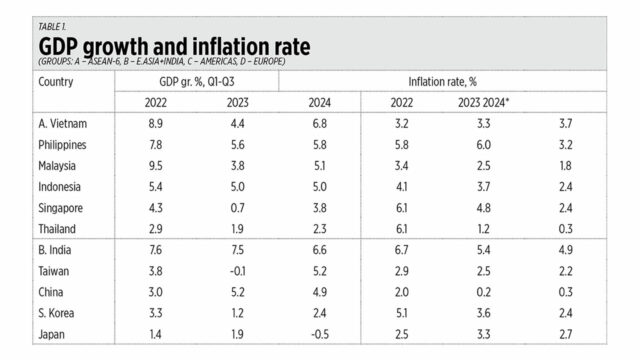
1. The top three fastest growing major economies are Vietnam, India, and Philippines. Major economies are those in the list of the Top 50 countries with the largest GDP size in the world. The average GDP growth of Vietnam, India, and the Philippines in the first three quarters (Q1-Q3) in 2024 were 6.8%, 6.6%, and 5.8%, respectively.

2. The slowest growing, and often contracting, major economies in the world were European. In particular Ireland, Austria, and Germany. Also, Russia’s neighbors Finland, Latvia, and Estonia contracted by -0.7%, -0.9%, and -1.2% respectively over the first three quarters (Q1-Q3) in 2024. Japan was the only major Asian country that experienced an economic contraction in 2024.

3. The inflation rate was decelerating in many countries (exceptions were Vietnam and Russia). Most European nations significantly reduced their inflation rate in 2024 relative to 2023 but suffered low growth or economic contraction in exchange (see Table 1).


4. The election of Donald Trump and more business optimism. The last time the US grew by 3% or higher was in 2018 (under the Trump administration) with 3% and in 2005 (the Bush Jr. administration) with 3.5%. The average US inflation in 2017-2020 (Trump) was 1.9%, and in 2021-2024 (Biden administration) it was 4.9%.

5. Continued wars abroad dampen global economic sentiments. I was expecting that the unwinnable war in Ukraine, the Israel-Hamas/Hezbollah war would end in the middle to late 2024. I was wrong. I can only hope that Trump’s “no new war” policy which he followed in his first term (there were no new US wars from 2017-2020) will kick off early because all the big wars in the world now have huge US involvement.

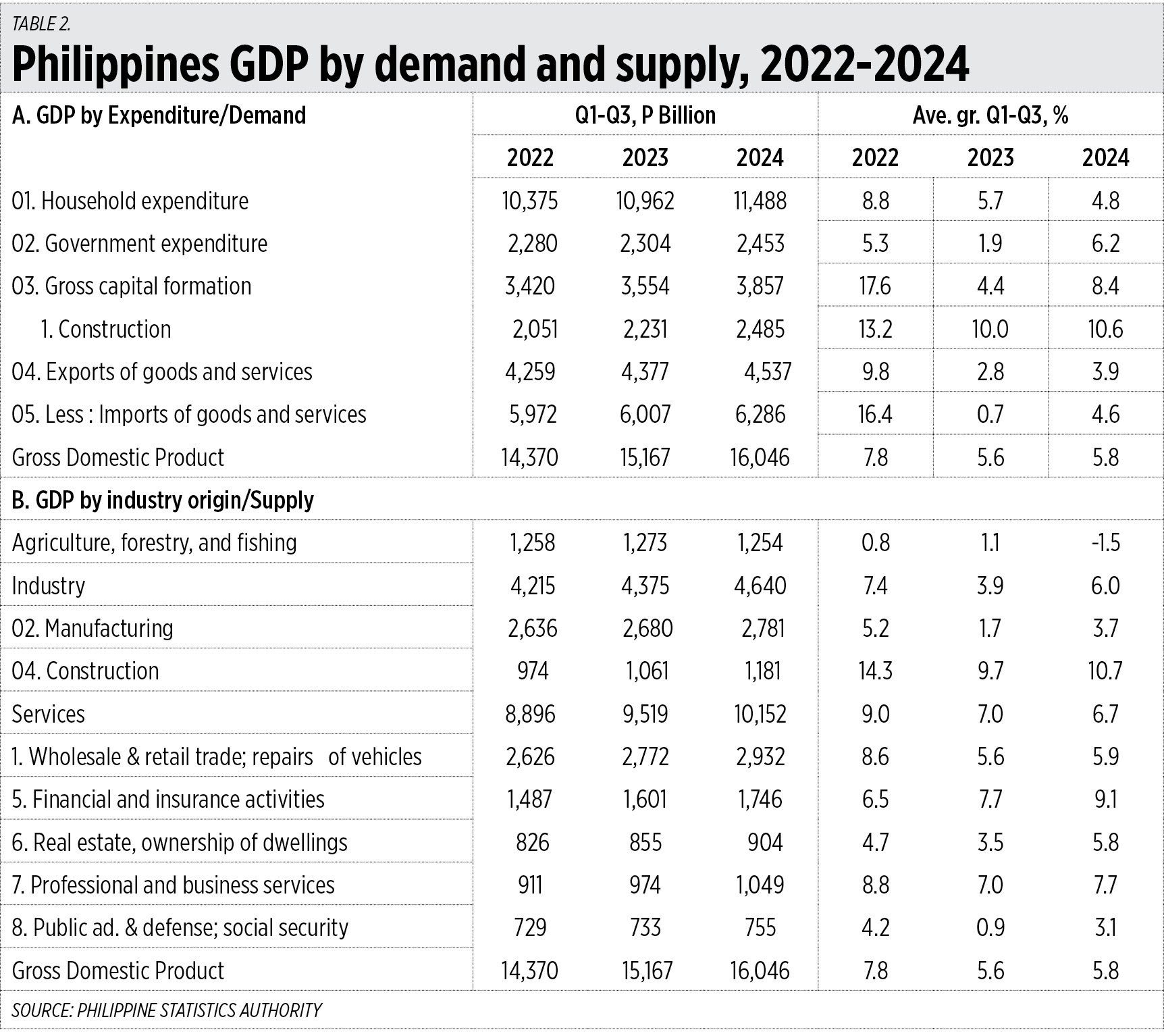
6. The Philippines’ GDP growth failed to reach the 6% target. The high inflation of 2023 dampened household consumption, which constitutes 73% of GDP, until 2024. But as shown in Table 1, the 5.8% growth in Q1-Q3 was still fast and strong by global standards.

7. Investments or capital formation recovered to grow by 8%. Investments constitute 24% of GDP. Construction, both government and private, maintained its double-digit growth.

8. Industry and services sectors pulled up overall growth as agriculture remained weak or understated. The series of strong storms with actual landfalls in September affected the country’s crops and livestock (see Table 2).

9. The Philippines Economic Briefing (PEB) abroad highlighted the country’s economic opportunities. The government’s economic team — composed of Finance Secretary Ralph G. Recto, Budget Secretary Amenah F. Pangandaman, Economics Secretary Arsenio M. Balisacan, Presidential Assistant for Investments Frederick Go, and Bangko Sentral Governor Eli Remolona — conducted a PEB in London and investors meetings in Washington DC last October. As shown in Table 1, the UK and many major European economies are either crawling or contracting, many companies there are shutting down or migrating abroad and Philippines should be one of their destination countries.

10. Large investment projects were encouraged by the Corporate Recovery and Tax Incentives for Enterprises to Maximize Opportunities for Reinvigorating the Economy (CREATE MORE) law, the Public-Private Partnership (PPP) Code, and related legislation. CREATE MORE (RA 12066, November 2024) and PPP Code (RA 11966, December 2023) have expanded fiscal incentives like reduction in corporate income tax from 25% to 20%, and removed uncertainties in PPP infrastructure investments.

I commend the economic team, particularly Secretaries Pangandaman, Balisacan, Recto, Go, plus PPP Center head Cynthia Hernandez. We need more job-creating investments and infrastructure projects without the need for additional taxation, borrowing, and state-dependent welfare.


Bienvenido S. Oplas, Jr. is the president of Bienvenido S. Oplas, Jr. Research Consultancy Services, and Minimal Government Thinkers. He is an international fellow of the Tholos Foundation.

minimalgovernment@gmail.com

SEC vows to sustain reforms

THE SECURITIES and Exchange Commission (SEC) has vowed to sustain corporate and capital market reforms to support the country’s growth.

“We are leaving 2024 with much needed changes implemented to enhance the business sector,” SEC Chairman Emilio B. Aquino said in an e-mailed statement on Monday. “As we embark on our 89th year, we will remain steadfast in transforming the capital market to support the growth of a sound and dynamic economy.”

The SEC said there were 49,432 company registrations from January to November, up 6% from last year and on track to a new record this year, led by its digitalization efforts.

“Looking back, the SEC has been relentless in its efforts to improve its services through digitalization and implementation of reforms that seek to create a conducive environment that will encourage businesses to incorporate and tap the capital market,” Mr. Aquino said.

Market capitalization had increased 23.6% year on year to P20.12 trillion as of Nov. 30, according to the corporate regulator.

It said Association of Southeast Asian Nations (ASEAN)-labeled green, social, sustainable and other labeled bonds (GSS+) issued by Philippine companies from January to November rose seven times to P209.29 billion.

“This brings the value of outstanding ASEAN-labeled GSS+ issued as of end-November to P661.6 billion, representing a 46.27% growth from the same period last year,” it said.

It also said it met its target this year of 888 companies that raised funds public offerings of securities and crowdfunding.

The SEC also intensified efforts to boost investor protection and education. It had released 106 public advisories against unauthorized and illegal investment-taking activities and schemes by end-October. It also issued 18 cease orders against 42 entities and revocation orders against 24 groups.

The SEC filed criminal complaints against 68 people with the Justice department for violating the Securities Regulation Code and the Financial Products and Services Consumer Protection Act.

Meanwhile, the regulator launched digital initiatives to streamline government processes. These include the SEC Zuper Easy Registration Online and Electronic Submission Authentication Portal, which allowed applicants to register their businesses by allowing the digital authentication of documents.

The commission also formed the SEC Foreign Investment Registration Station green lane unit for the applications of companies under the Foreign Investment Act, as well as foreign and multinational companies. It had processed almost 16,000 applications as of November, it said. — Revin Mikhael D. Ochave

AppleOne to complete JW Marriott Residences Panglao in four years

TOURISM SECRETARY Christina Frasco (center), led the groundbreaking of JW Marriott Panglao in Bohol on Dec. 2, 2023. — APPLEONE

CEBU-BASED AppleOne Group seeks to complete its JW Marriott Residences Panglao in Bohol province in central Philippines by 2028, according to a high-ranking official.

“We’re looking at 2028 for the entire hotel and residences,” Samantha Manigsaca, assistant vice-president for hospitality at AppleOne Group, said in a video interview with BusinessWorld earlier this month.

The property, which broke ground in December 2023, is being developed after the company signed a deal with Marriott International. It will be located on a seven-hectare beachfront on Panglao Island in Bohol.

The property will cater to luxury homebuyers and tourists. Taking inspiration from resorts in Bali, Indonesia, the luxury condotel will blend modern lifestyle with nature.

“We leaned towards the luxury segment for Bohol because compared with Cebu, the area is more exclusive,” Ms. Manigsaca said. “We see that the luxury market is into those kinds of travel, the relaxation, the quiet [type.]”

The project will offer several restaurants with diverse food choices and quality amenities.

“When we were pre-planning this project, our main goal was very aligned to what the tourists nowadays do — that they don’t want to go out of the resorts,” Ms. Manigsaca said. “We really want to have multiple restaurants inside so our guests won’t get tired. So, they get to try something different during breakfast, lunch or dinner.”

The property will have 150 rooms — 80 keys for its hotel, JW Marriott Panglao Island Resort & Spa, and 70 for its residences, Ms. Manigsaca said.

The residence portion will feature one and two bedrooms and villas. It will also offer private amenities like a pool and lounge.

“It’s very similar to what Sheraton [Hotels & Resorts] offers but of course, it’s way more elevated because this is a luxury segment,” she said. “So, these offer higher quality products and amenities.” — Beatriz Marie D. Cruz

How OnlyFans turned into a global empire bent on redefining porn

By Andrew R.C. Marshall, Echo Wang, Rosa Furneaux, Jason Szep and Linda So

ONLYFANS is on a mission to redefine porn.

With $1.3 billion in revenue and over 300 million users, the fast-growing company has fused sex work with the online creator economy so successfully that it has branched out into comedy, music and motor-racing.

But for all its ambition and influence, the inner workings of OnlyFans remain opaque.

It has just a few dozen employees even as its user base has almost quadrupled in recent years. Its billionaire owner is rarely seen in public or even mentioned in talks by its chief executive officer (CEO). There’s no company sign outside its registered London address, and a significant but secretive part of its operations — including content moderation — is based in Ukraine, a country at war.

Reuters traced OnlyFans’ journey from an obscure, porn-free site created by a British family to an adults-only social media phenomenon turbocharged by erotic performers and celebrity influencers, worth billions of dollars. As it’s grown, OnlyFans has sought to use explicit content – its seemingly bottomless source of revenue – as a springboard to greater scale, positioning itself as a tech pioneer with a place among social media giants such as Instagram and X. Key to that effort is making porn more socially acceptable and distancing the company from the abuses often associated with the industry.

The public face of OnlyFans is CEO Keily Blair, an Irish lawyer and self-described feminist and “safety nerd” promoted to the top job in 2023. In public appearances, Ms. Blair, 42, presents the platform as lucrative and empowering, particularly for women, and often mentions her two daughters. “I want them to have a good online life,” she told delegates at a UK child-protection conference in 2023. “I want the same for your kids.”

People flock to OnlyFans, she says, because it offers “ethical” porn – although she prefers not to use what she calls the “P-word.”

But the P-word drives the business. Creators typically make money from subscribers by posting porn and chatting with them online. Created in 2016, OnlyFans says it has paid out over $20 billion to its creators, who now number 4.1 million. The company takes a 20% cut of creators’ revenue.

OnlyFans didn’t respond to Reuters’ requests to interview Ms. Blair or the company’s owner, Leonid Radvinsky. The company and its parent, Fenix International, Ltd., didn’t respond to most questions for this story.

This account of the company’s rise is based on interviews with more than a dozen people with direct knowledge of OnlyFans’ operations, along with dozens of creators, former creators, and experts in the porn industry, content moderation and online safety. Reporters also reviewed corporate filings, court records, websites and speeches related to OnlyFans and its key staff.

OnlyFans pledges publicly that it’s building “the safest social media platform in the world.” It operates behind millions of creator paywalls, however, which make this claim almost impossible to independently assess. Those paywalls can hide serious harm. In a series of investigations published this year, Reuters examined police and court records that documented multiple cases of sexual slavery, child sexual abuse material, and nonconsensual or “revenge” porn on OnlyFans between 2019 and 2024.

OnlyFans says it prohibits child sexual abuse material and “modern slavery,” including sex trafficking, and removes illicit content as soon as it is detected. The company also has said it invests heavily in content moderation, vetting “everything” on the site, and works closely with law enforcement globally to support their investigations.

Mr. Radvinsky, the owner Ms. Blair rarely mentions in public, bought OnlyFans in 2018 and is its sole shareholder. Now 42 years old, he has paid himself at least a billion dollars in dividends over the past three years, corporate filings show.

For a head of a famous company, he is little known.

Even with specialized search tools, Reuters could find only six different photos of Mr. Radvinsky online. Of four websites that appear to belong to him, only one mentions OnlyFans by name; none reveals that porn is a major source of his fortune.

Instead, they describe him as an angel investor and philanthropist who dedicates “a huge amount of time, effort and money to non-profit causes.”

FISH & CHIPS & PORN
Mr. Radvinsky cashed in on OnlyFans. But he didn’t create it.

That was British businessman Tim Stokely, a native of Essex, a county northeast of London. As a schoolboy, Mr. Stokely’s “first entrepreneurial endeavor” was charging classmates to collect their orders from a local fish and chips shop, according to an archived version of timstokely.com, a personal website.

But as an adult, it was porn that made Mr. Stokely rich — after a couple of false starts.

In 2011, he launched Glam Worship, a fetish site that allowed users to send gifts and money to dominatrixes. Slogan: “Your new addiction.” A year or two later, he unveiled Customs4U, where women uploaded personalized porn videos for paying customers.

Both ventures failed. Mr. Stokely tried again. After an inspirational chat with friends, according to timstokely.com, he set out to create a website “that made it easy for all creators to monetize their content” – in other words, a social media platform with a pay button.

That platform was OnlyFans.

“The team hit the ground running, pulling late hours to bootstrap the company: From writing code to create a minimal, easy-to-use interface to personally messaging early adopters,” Mr. Stokely’s website said.

Mr. Stokely’s family — described as “very close-knit” by the website — played a central role. OnlyFans launched in 2016 with Tim as CEO and, by year’s end, his parents Guy and Deborah as directors. His brother Tom became chief operating officer in 2018.

Another of the early directors of OnlyFans was Petra, a self-described silent partner in the business who spoke on condition her surname be withheld. An American citizen living in the Netherlands, Petra worked for the porn site FreeOnes and was an expert in raising the visibility of websites on search engines. She said her main job was to drive traffic to OnlyFans. “It was never meant to be a porn site, though,” she said.

Initially, OnlyFans’ terms of service banned explicit content. Petra said the company had hoped to attract musicians and influencers from YouTube and Instagram, but couldn’t get enough of them interested.

“So we just decided to go back with what we know,” she said. “And that’s adult.”

By the end of 2017, OnlyFans had lifted its ban on porn – and the platform took off.

To expand in the US, said Petra, the Stokelys relied on Bill Fox, a prominent figure in California’s porn industry. Mr. Fox recruited dozens of adult performers to join OnlyFans, she said. They were known at the company as “Bill’s Girls,” two former contractors told Reuters.

While Mr. Fox in California provided the A-list performers, the Stokelys made the business decisions in England, said the contractors, and the company expanded rapidly and chaotically.

Former Thai-British porn star Keni Styles, who worked for OnlyFans in the early years, said the company’s direction was a matter of fierce debate. He recalled one Skype meeting, around 2018, descending into a yelling match between Mr. Fox and Tim Stokely.

“Bill wanted it to be just a straight-up adult porn site. Tim had this vision that he was going to challenge Facebook, he was going to challenge Instagram. He was going to bring mainstream YouTube content-creators to OnlyFans.”

Tim, Tom and their parents couldn’t be reached for comment. Bill Fox died in 2019.

The goal wasn’t to hold onto OnlyFans long-term, Petra said. “We wanted a project that we could basically go off and sell,” she said.

In 2018, a buyer appeared: Mr. Radvinsky. How much he paid for OnlyFans has never been disclosed.

ENTER LEO
The new owner was media-shy and socially awkward, said three people who’ve met him — very unlike Mr. Stokely, whose Instagram account brims with images of fast cars, porn stars and villas in Ibiza.

Mr. Radvinsky brought a wealth of experience in the rapidly evolving business of online porn.

As a boy, in the dying years of the Soviet Union, he and his parents left Ukraine for the US He grew up in Illinois, where his first company, Cybertania Inc, was registered by his mother, Anna, in March 1999, according to company filings. Mr. Radvinsky was then only 16.

His mother couldn’t be reached for comment.

Mr. Radvinsky would describe Cybertania’s business in a 2014 court declaration as “online entertainment.” One of its earliest ventures was a website called Ultrapasswords.com, which promised links to porn-related websites, according to a 2021 story by Forbes.

It was a lucrative enterprise. A court filing by Cybertania said Ultrapasswords was generating income of about $5,000 per day in 2002 – the same year Mr. Radvinsky turned 20. The site is no longer active.

Two years later, with an economics degree from Northwestern University outside Chicago, Mr. Radvinsky started his first big porn venture: MyFreeCams, where models performed sexual acts on a live webcam feed. Viewers paid by the minute or bought virtual tokens to tip the performer.

By 2010, XBIZ, a news outlet for the porn industry, was calling MyFreeCams “one of the world’s largest adult webcam communities,” with 100,000 models on its books. It is still around today and owned by Mr. Radvinsky’s US-based MFCXY, Inc.

MyFreeCams was part of a wave of “cam sites” that capitalized on faster internet speeds. They marked a major shift in porn, which until the early 2000s was primarily made by studio-based performers and distributed on videotape, and later CDs and DVDs, or via pay-per-view TV.

Then came so-called “tube sites” in the mid-2000s. These websites didn’t produce their own porn but provided a platform for content uploaded by users — professionals and amateurs alike. Sites such as Xtube, Pornhub and xHamster, which attracted hundreds of millions of users, mainly made money through ads and by selling user data. Consumers got limitless content for free.

“Porn was more accessible than ever before, but performers were making less and less money off of it,” said Maggie MacDonald, a doctoral candidate at the University of Toronto who studies porn platforms. For the next decade, as the tube sites dominated internet porn, many performers struggled.

“And then OnlyFans comes along,” said Ms. MacDonald, an adviser to the private equity firm that owns Aylo, Pornhub’s parent company.

Under Mr. Radvinsky, Tim Stokely stayed on as CEO for the next three years, with his brother Tom as chief operating officer and their father Guy, a former merchant banker, as a co-director with Mr. Radvinsky.

The company’s fortunes soared with the COVID-19 pandemic and its lockdowns.

Millions of isolated, horny people flocked to porn sites. OnlyFans saw a surge in creators, users and revenue in the US and Europe, its main markets. Between 2019 and 2021, its pretax profits rose from $5.6 million to $432.9 million, according to corporate filings.

Although free porn was readily available online, OnlyFans seemed to offer something different that people would pay for: personal connection. Subscribers could directly message creators, and seek companionship and intimacy. Creators made money through subscriptions, tips and sales of custom-made content.

OnlyFans offered its creators an alluring mix of gig work, sexual expression and financial freedom – and, for some influencers, a rare chance to convert big social media followings into small fortunes, so long as they were willing to strip off.

One creator who reaped huge profits is Danielle Bregoli, a rebellious teen who became famous for her 2016 TV appearance with her mother on Dr. Phil. In a segment titled, “I Want to Give Up My Car-Stealing, Knife-Wielding, Twerking 13-Year-Old Daughter Who Tried to Frame Me for a Crime,” she taunted the audience to fight her outside: “Cash me outside, how bout dah?” The catchphrase launched her career as the chart-topping rapper Bhad Bhabie, gaining her millions of followers on social media.

In April 2021, six days after her 18th birthday, she created an OnlyFans account, posting sexually suggestive photos. In the first six hours, she earned more than $1 million, Ms. Bregoli told Reuters. A year later, that sum had reached almost $42 million, she said.

“I had no idea it would make this kind of money,” she said. “Nobody did.”

While top creators cashed in, others scraped by. “It’s incredibly rare that you speak to someone who’s making loads of money,” said Hanne Stegeman, whose doctoral research at the University of Amsterdam focused on the experiences of online sex workers, including OnlyFans creators. “Much more often people are working quite hard to make something similar to a minimum wage.”

Roxie Roots, a former OnlyFans creator from Germany who joined OnlyFans in 2018 and left in 2021, found the work harder — and the earnings much smaller – than she’d expected.

“I kept going for years because I was like, Oh my God, I need to come out with something — at least some savings,” she said.

A ‘MASSIVE EXPLOSION IN CONTENT’
One former employee had a ringside view of what he called the “massive explosion of content” during the pandemic years. Zak Hembry joined OnlyFans in 2019 and worked as a content moderator from his home in Bishop’s Stortford, north of London.

Content was screened by a “programmable bot” that flagged suspect material for human moderators to review, Mr. Hembry said. He scanned this material for illicit content, which was then blocked or removed. “I’ve seen all kinds of things I wish I hadn’t seen on there,” he said, including content featuring children, animals or feces, as well as a creator who was “overeating on purpose.”

In its early years, said Mr. Hembry, OnlyFans took a “zero-tolerance” approach to creators who broke its rules. But as content flooded in under Mr. Radvinsky’s ownership, top earners were treated more leniently, said Mr. Hembry and another former contractor in the US.

Those whose accounts might have been shut down in the past began to receive warnings instead, Mr. Hembry said.

For instance, he said he once suspended an account showing an incestuous sexual encounter between adult twins – violating OnlyFans’ terms of service. Later, he said, he was exasperated to see that someone above him had reactivated the account.

“Why should you give them another chance?” he said. Mr. Hembry concluded that “money was more important” at OnlyFans than rules. The former US contractor agreed; creators who made millions of dollars for the platform could “upload whatever the hell they want,” she said.

By 2021, Mr. Hembry said he knew of more than a dozen people in the UK who worked as OnlyFans moderators.

Faced with exponential growth, OnlyFans turned to workers from Ukraine, Mr. Radvinsky’s homeland, which had a well-developed IT industry, former employees and contractors said. By February 2022, when Russia launched its all-out invasion, OnlyFans had a “huge team” in Ukraine doing content moderation and other functions, CEO Keily Blair said in a recent speech at the Trouble Club in London, which hosts talks by prominent women.

Some of those workers were recruited by a firm called StopFraud, according to four people who previously worked at StopFraud or OnlyFans. One Ukrainian ex-moderator hired by StopFraud shared with Reuters a payment receipt showing she was paid by OnlyFans.

StopFraud is almost untraceable. It describes itself as a “fast-growing, US-based company” in ads posted on a Ukrainian jobs website, but Reuters could find no business registration for it in the US, the UK or Ukraine. The firm could not be reached for comment.

OnlyFans doesn’t publicly acknowledge any relationship with StopFraud, and StopFraud’s website doesn’t mention OnlyFans. Several former StopFraud workers told Reuters they knew little about their employer. They worked from home, moderating content and vetting creators. They knew their colleagues only by nickname. One said the clandestine conditions made her feel like a “spy.” Others declined interviews, saying they had signed nondisclosure agreements.

Mr. Hembry said his UK-based content-moderation team was phased out as Ukrainian contractors took over, and he briefly moved to a job handling relations with top creators. But he could still check the queue where content awaited review, he said. Just before he was laid off in 2022, he said, the queue contained millions of items – at least 50 times the normal load he had seen the year before. He said he couldn’t see how the Ukrainian contractors would get the job done. It’s unclear how the war affected their work. After it broke out, Ms. Blair has said, OnlyFans relocated “a number of people” from Ukraine to neighboring Poland.

By 2022, OnlyFans publicly said it was building “the world’s safest social media platform.” In July that year, it told Ofcom, the British media regulator, that while it relied on automation to flag problems, all content was ultimately reviewed by a human moderator.

At a site with OnlyFans’ volume of content, that task was “virtually impossible” without hiring “thousands of moderators,” said Jason Pomales, former director of trust and safety at Vimeo, a prominent video-sharing platform. “And that’s a huge cost.”

Four other content moderation experts agreed that OnlyFans’ claim of blanket human review was implausible. In November alone, the website said it uploaded almost 55 million pieces of content.

OnlyFans’ moderation process, meanwhile, remains murky. It says 80% of its workforce consists of “trained content moderators,” but the company doesn’t divulge publicly the size of that workforce or how moderators are trained. That makes OnlyFans’ claims about the effectiveness of its moderation difficult for outsiders to verify.

Ofcom has collected information about moderation and other business operations directly from OnlyFans. Some of that information – including the platform’s moderation staffing levels – hasn’t been published, Ofcom said, because the law restricts what it can disclose without the consent of the businesses it regulates. However, a spokesperson added: “It’s our current understanding that every piece of content (on OnlyFans) is ultimately moderated by a human.”

SKITTISH BANKS
As OnlyFans’ popularity grew, illegal content was slipping by its moderators. People were complaining to police of abuses on the platform. The BBC had found children on the site. And OnlyFans’ bankers appeared nervous.

In August 2021, the company dropped a bombshell announcement: it would ban porn as of that October. Offering few details, the company said it was seeking to comply with requests from banking partners and payment providers. In an interview with the Financial Times, Tim Stokely blamed “unfair” treatment by banks that had flagged and rejected OnlyFans payments to its creators due to reputational risk.

The proposed ban outraged porn creators. Many felt betrayed. Lauren Phillips, an American creator who joined OnlyFans early on, said she felt like the company wanted “to use us and then throw us away.”

Six days later, OnlyFans abruptly retracted the ban, saying it had secured the “assurances necessary” to support its creators. It didn’t explain what those assurances were or who gave them. But removing porn would have crippled the platform – and cut off a growing stream of revenue for the banks handling OnlyFans’ business.

Still, it remained an uphill struggle to convince potential banking partners that porn on OnlyFans wasn’t a smokescreen for abuse, some bankers said.

In the spring of 2023, intermediaries for OnlyFans spoke with several Wall Street investment banks to explore the possibility of partnerships, according to three people involved. One said taking OnlyFans public was discussed; the others told Reuters that the intermediaries were seeking major banks to help process payments for OnlyFans.

By then, OnlyFans had eye-popping numbers: over a billion dollars in revenue, over half a billion in operating profit. Bankers would have typically fought for such business. But the talks went nowhere. The hitch, according to two of those involved, was OnlyFans’ main product: porn.

Porn makes OnlyFans untouchable for many big banks and investors, said six bankers, lawyers and other investors, all with expertise in capital markets but no ties to OnlyFans, who spoke with Reuters on condition they and their employers not be named. Four expressed concern that any due diligence done on the platform might find illegal content such as child sexual abuse material, trafficking victims and nonconsensual porn.

OnlyFans has since said it has no plans to go public. Business is booming. In 2023, content creators generated $6.6 billion on the platform. The company had more than enough free cash flow to remain privately held. Its dividend payout of $472 million to Mr. Radvinsky was more than Ralph Lauren earned from the fashion company he founded and Nike co-founder Phil Knight earned from the sportswear giant – combined.

As a reclusive porn mogul, Mr. Radvinsky isn’t usually mentioned in the same breath as the world’s eminent billionaires. But he has suggested he would like it to be.

“My goal is to one day be in a position to sign The Giving Pledge,” he says on one website that appears to belong to him, referring to promises made by Bill Gates, Warren Buffet, Mark Zuckerberg and other tycoons to give away most of their wealth to charitable causes.

Rebuffed by Wall Street, OnlyFans continued its efforts to become a mainstream company, seeking to convince the world that its porn was safe – and that OnlyFans was more than a porn site.

That job fell to its CEO, Keily Blair.

‘ETHICAL’ PORN
At her previous role as a lawyer with the law firm Orrick, Herrington & Sutcliffe, Ms. Blair said she specialized in cybersecurity and online privacy. At least three other Orrick staff have gone to work for OnlyFans, an Orrick client.

At OnlyFans, Ms. Blair presents herself as the folksy, straight-talking leader of a company with mainstream appeal.

“We also host lots of other content,” she said in March at the SXSW conference in Austin, Texas, citing sports, comedy and music. OnlyFans also offers safe-for-work content on OFTV, a streaming platform it launched in 2021.

OnlyFans says it doesn’t even track how much porn it sells, lumping it in financially with all its other offerings. “We don’t categorize our creators by the content they produce so we don’t know what proportion are creating adult content,” a company spokesperson told Reuters last year. Ms. Blair has publicly dismissed the claim that almost all OnlyFans content is porn, without providing a figure of her own.

She also says the porn on OnlyFans is different from other sites. At the SXSW conference, which says it showcases “cutting edge ideas,” she explained how OnlyFans allowed adult performers to escape the “exploitative” studio system and directly profit from the content they produced. This “ethical” adult content, she said, was what drew so many subscribers to OnlyFans.

“I am a feminist,” Ms. Blair told her audience at the Trouble Club in August. “My feminism helps to inform why I do this job.”

Some see Ms. Blair’s appointment as a wily PR move for OnlyFans.

In a recent LinkedIn post, Elly Hanson, a clinical psychologist who focuses on preventing sexual abuse, questioned whether a male CEO would “be regularly invited into societal forums to wax lyrical about ‘empowerment,’ ‘authenticity’ and ‘feminism’ without robust challenge and debate? Of course not.”

Kim Swallows, an American creator who joined OnlyFans in 2017, said OnlyFans is downplaying the contributions of the porn creators whose hard work made it so rich.

“I feel like they’re definitely trying to sanitize their image,” she said.

Other current and former creators also questioned how empowering OnlyFans was for women. Roots, the former creator from Germany, said the platform drew young, potentially vulnerable women into the porn business but offered no advice on coping with its demands and lasting impact.

Producing and promoting content was relentless and punishing, and male customers wanted to “use you for their gratification,” she said. “It’s very difficult to call this feminist.”

Sophia Mayy, 27, a creator from England, said she joined OnlyFans in 2021 to make “a bit of extra pocket money” and now brings home about 35,000 pounds ($44,000) a month. “I honestly wouldn’t look back,” she told Reuters.

Even so, says Ms. Mayy, it’s a mistake for OnlyFans to treat porn just like any other content — because of the risks involved in producing it. In her case, she said, the job has damaged her relations with family and friends, and forced her to cope with loneliness, long hours and abusive male subscribers.

“Probably the biggest thing of all is the mental toll it takes on you,” she said. “You are seen as an object, you are seen as a piece of meat.” — Reuters